tires TOYOTA C_HR HYBRID 2016 Owners Manual
[x] Cancel search | Manufacturer: TOYOTA, Model Year: 2016, Model line: C_HR HYBRID, Model: TOYOTA C_HR HYBRID 2016Pages: 712, PDF Size: 49.31 MB
Page 6 of 712
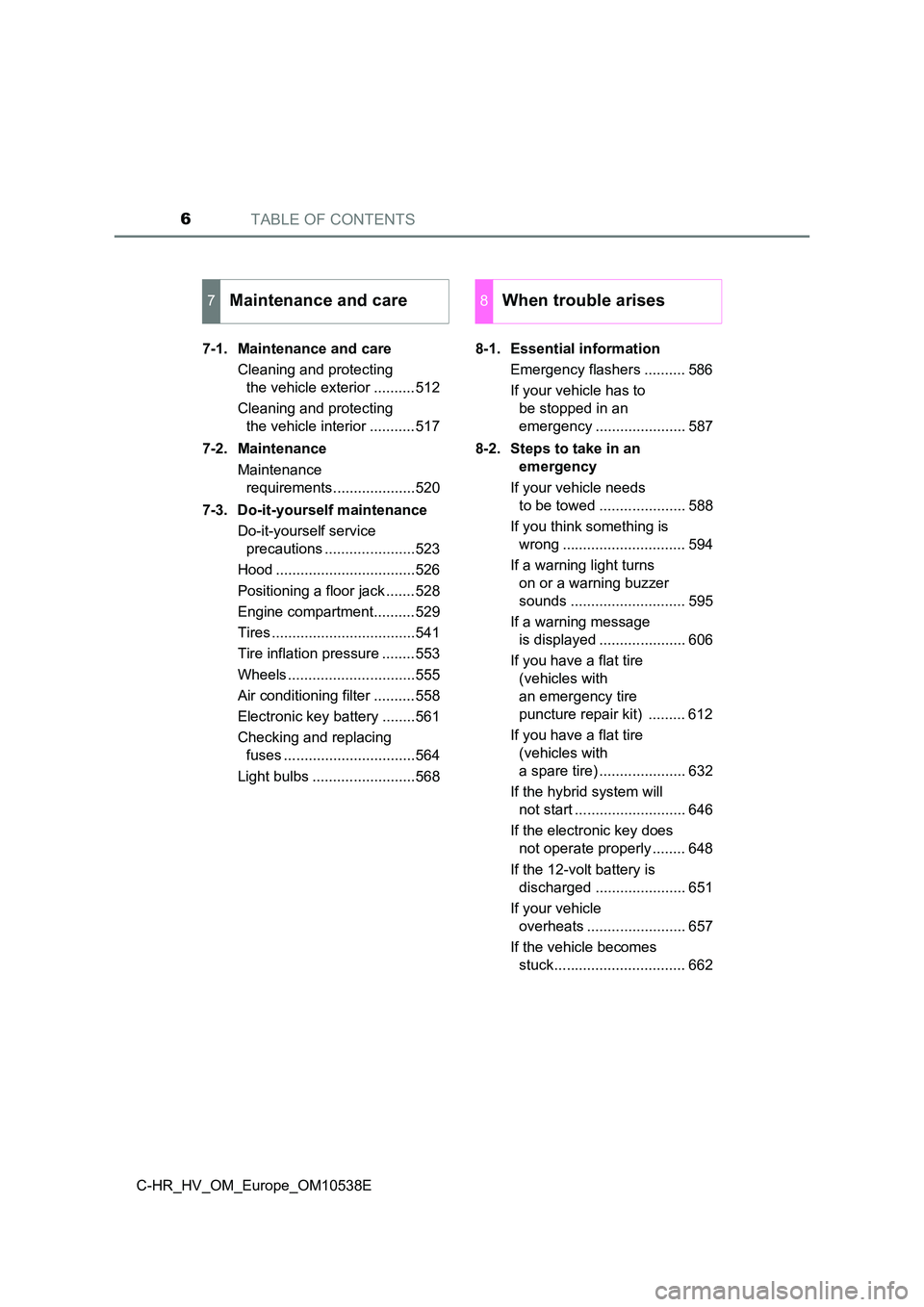
TABLE OF CONTENTS6
C-HR_HV_OM_Europe_OM10538E
7-1. Maintenance and care
Cleaning and protecting
the vehicle exterior ..........512
Cleaning and protecting
the vehicle interior ...........517
7-2. Maintenance
Maintenance
requirements....................520
7-3. Do-it-yourself maintenance
Do-it-yourself service
precautions ......................523
Hood ..................................526
Positioning a floor jack .......528
Engine compartment..........529
Tires ...................................541
Tire inflation pressure ........553
Wheels ...............................555
Air conditioning filter ..........558
Electronic key battery ........561
Checking and replacing
fuses ................................564
Light bulbs .........................568
8-1. Essential information
Emergency flashers .......... 586
If your vehicle has to
be stopped in an
emergency ...................... 587
8-2. Steps to take in an
emergency
If your vehicle needs
to be towed ..................... 588
If you think something is
wrong .............................. 594
If a warning light turns
on or a warning buzzer
sounds ............................ 595
If a warning message
is displayed ..................... 606
If you have a flat tire
(vehicles with
an emergency tire
puncture repair kit) ......... 612
If you have a flat tire
(vehicles with
a spare tire) ..................... 632
If the hybrid system will
not start ........................... 646
If the electronic key does
not operate properly ........ 648
If the 12-volt battery is
discharged ...................... 651
If your vehicle
overheats ........................ 657
If the vehicle becomes
stuck................................ 662
7Maintenance and care8When trouble arises
Page 15 of 712
15Pictorial index
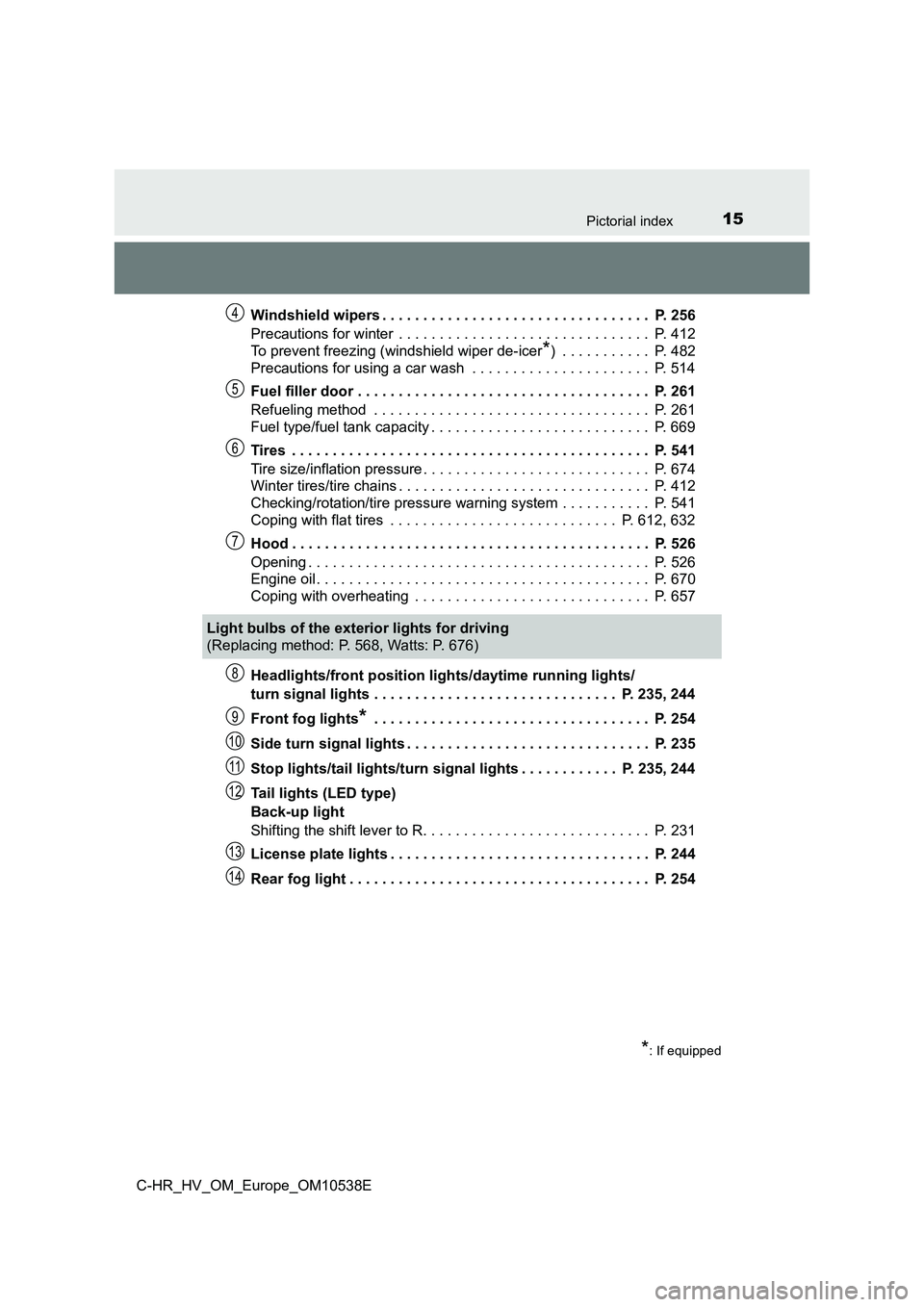
C-HR_HV_OM_Europe_OM10538EWindshield wipers . . . . . . . . . . . . . . . . . . . . . . . . . . . . . . . . . P. 256
Precautions for winter . . . . . . . . . . . . . . . . . . . . . . . . . . . . . . . P. 412
To prevent freezing (windshield wiper de-icer
*) . . . . . . . . . . . P. 482
Precautions for using a car wash . . . . . . . . . . . . . . . . . . . . . . P. 514
Fuel filler door . . . . . . . . . . . . . . . . . . . . . . . . . . . . . . . . . . . . P. 261
Refueling method . . . . . . . . . . . . . . . . . . . . . . . . . . . . . . . . . . P. 261
Fuel type/fuel tank capacity . . . . . . . . . . . . . . . . . . . . . . . . . . . P. 669
Tires . . . . . . . . . . . . . . . . . . . . . . . . . . . . . . . . . . . . . . . . . . . . P. 541
Tire size/inflation pressure . . . . . . . . . . . . . . . . . . . . . . . . . . . . P. 674
Winter tires/tire chains . . . . . . . . . . . . . . . . . . . . . . . . . . . . . . . P. 412
Checking/rotation/tire pressure warning system . . . . . . . . . . . P. 541
Coping with flat tires . . . . . . . . . . . . . . . . . . . . . . . . . . . . P. 612, 632
Hood . . . . . . . . . . . . . . . . . . . . . . . . . . . . . . . . . . . . . . . . . . . . P. 526
Opening . . . . . . . . . . . . . . . . . . . . . . . . . . . . . . . . . . . . . . . . . . P. 526
Engine oil . . . . . . . . . . . . . . . . . . . . . . . . . . . . . . . . . . . . . . . . . P. 670
Coping with overheating . . . . . . . . . . . . . . . . . . . . . . . . . . . . . P. 657
Headlights/front position lights/daytime running lights/
turn signal lights . . . . . . . . . . . . . . . . . . . . . . . . . . . . . . P. 235, 244
Front fog lights
* . . . . . . . . . . . . . . . . . . . . . . . . . . . . . . . . . . P. 254
Side turn signal lights . . . . . . . . . . . . . . . . . . . . . . . . . . . . . . P. 235
Stop lights/tail lights/turn signal lights . . . . . . . . . . . . P. 235, 244
Tail lights (LED type)
Back-up light
Shifting the shift lever to R. . . . . . . . . . . . . . . . . . . . . . . . . . . . P. 231
License plate lights . . . . . . . . . . . . . . . . . . . . . . . . . . . . . . . . P. 244
Rear fog light . . . . . . . . . . . . . . . . . . . . . . . . . . . . . . . . . . . . . P. 254
4
5
6
7
Light bulbs of the exterior lights for driving
(Replacing method: P. 568, Watts: P. 676)
*: If equipped
8
9
10
11
12
13
14
Page 202 of 712
2024-1. Before driving
C-HR_HV_OM_Europe_OM10538E
■When starting off on a uphill
The hill-start assist control will activate. ( P. 403)
■ For fuel-efficient driving
Keep in mind that hybrid vehicles are similar to conventional vehicles, and it
is necessary to refrain from activities such as sudden acceleration. ( P. 409)
■ Driving in the rain
● Drive carefully when it is raining, because visibility will be reduced, the win-
dows may become fogged-up, and the road will be slippery.
● Drive carefully when it starts to rain, because the road surface will be espe-
cially slippery.
● Refrain from high speeds when driving on an expressway in the rain,
because there may be a layer of water between the tires and the road sur-
face, preventing the steering and brakes from operating properly.
■ Restraining hybrid system output (Brake Override System)
● When the accelerator and brake pedals are depressed at the same time, the
hybrid system output may be restrained.
● A warning message is displayed on the multi-information display while the
system is operating.
■ Restraining sudden start (Drive-Start Control)
● When the following unusual operation is performed, the hybrid system out-
put may be restrained.
• When the shift lever is shifted from R to D/B, D/B to R, N to R, P to D/B,
or P to R with the accelerator pedal depressed, a warning message
appears on the multi-information display.
• When the accelerator pedal is depressed too much while the vehicle is in
reverse.
● While Drive-Start Control is being activated, your vehicle may have trouble
escaping from the mud or fresh snow. In such case, deactivate TRC to can-
cel Drive-Start Control so that the vehicle may become able to escape from
the mud or fresh snow.
Page 216 of 712
2164-1. Before driving
C-HR_HV_OM_Europe_OM10538E
■Tire information
● Increase the tire inflation pressure to 20.0 kPa (0.2 kgf/cm2 or bar, 3 psi)
greater than the recommended value when towing. ( P. 674)
● Increase the air pressure of the trailer tires in accordance with the total
trailer weight and according to the values recommended by the manufac-
turer of your trailer.
■ Tr a i l e r l i g h ts
Please consult at any authorized retailer or Toyota authorized repairer, or any
reliable repairer when installing trailer lights, as incorrect installation may
cause damage to the vehicle’s lights. Please take care to comply with your
state’s laws when installing trailer lights.
■ Break-in schedule
Toyota recommends that vehicles fitted with new power train components
should not be used for towing trailers for the first 800 km (500 miles).
■ Safety checks before towing
● Check that the maximum load limit for the towing hitch/bracket and hitch ball
is not exceeded. Bear in mind that the coupling weight of the trailer will add
to the load exerted on the vehicle. Also make sure that the total load exerted
on the vehicle is within the range of the weight limits. ( P. 213)
● Ensure that the trailer load is secure.
● Supplementary outside rear view mirrors should be added to the vehicle if
the traffic behind cannot be clearly seen with standard mirrors. Adjust the
extending arms of these mirrors on both sides of the vehicle so that they
always provide maximum visibility of the road behind.
■ Maintenance
● Maintenance must be performed more frequently when using the vehicle for
towing due to the greater weight burden placed on the vehicle compared to
normal driving.
● Retighten all bolts securing the hitching ball and bracket after towing for
approximately 1000 km (600 miles).
Page 243 of 712
2434-2. Driving procedures
4
Driving
C-HR_HV_OM_Europe_OM10538E
WARNING
■When the vehicle is on a steep incline
When using the brake hold system on a steep incline exercise caution. The
brake hold function may not hold t he vehicle in such a situation.
■ When stopped on a slippery road
The system cannot stop the vehicle when the gripping ability of the tires has
been exceeded. Do not use the system when stopped on a slippery road.
NOTICE
■ When parking the vehicle
The brake hold system is not designed for use when parking the vehicle for
a long period of time. Turning the power switch off while the system is hold-
ing the brake may release the brake, which would cause the vehicle to
move. When operating the power switch, depress the brake pedal, shift the
shift lever to P and set the parking brake.
Page 277 of 712
2774-5. Using the driving support systems
4
Driving
C-HR_HV_OM_Europe_OM10538E
WARNING
■When to disable the pre-collision system
In the following situations, disable the system, as it may not operate prop-
erly, possibly leading to an accident resulting in death or serious injury:
● When the vehicle is being towed
● When your vehicle is towing another vehicle
● When transporting the vehicle via truck, boat, train or similar means of
transportation
● When the vehicle is raised on a lift with the hybrid system operating and
the tires are allowed to rotate freely
● When inspecting the vehicle using a drum tester such as a chassis dyna-
mometer or speedometer tester, or when using an on vehicle wheel bal-
ancer
● When a strong impact is applied to the front bumper or front grille, due to
an accident or other reasons
● If the vehicle cannot be driven in a stable manner, such as when the vehi-
cle has been in an accident or is malfunctioning
● When the vehicle is driven in a sporty manner or off-road
● When the tires are not properly inflated
● When the tires are very worn
● When tires of a size other than specified are installed
● When tire chains are installed
● When a compact spare tire or an emergency tire puncture repair kit is used
● If equipment (snow plow, etc.) that may obstruct the radar sensor or cam-
era sensor is temporarily installed to the vehicle
Page 287 of 712
2874-5. Using the driving support systems
4
Driving
C-HR_HV_OM_Europe_OM10538E
● In some situations such as the following, sufficient braking force may not be
obtained, preventing the system from performing properly:
• If the braking functions cannot operate to their full extent, such as when
the brake parts are extremely cold, extremely hot, or wet
• If the vehicle is not properly maintained (brakes or tires are excessively
worn, improper tire inflation pressure, etc.)
• When the vehicle is being driven on a gravel road or other slippery sur-
face
● Some pedestrians such as the following may not be detected by the radar
sensor and camera sensor, preventi ng the system from operating properly*:
• Pedestrians shorter than approximately 1 m (3.2 ft.) or taller than approx-
imately 2 m (6.5 ft.)
• Pedestrians wearing oversized clothing (a rain coat, long skirt, etc.), mak-
ing their silhouette obscure
• Pedestrians who are carrying large baggage, holding an umbrella, etc.,
hiding part of their body
• Pedestrians who are bending forward or squatting
• Pedestrians who are pushing a stroller, wheelchair, bicycle or other vehi-
cle
• Groups of pedestrians which are close together
• Pedestrians who are wearing wh ite and look extremely bright
• Pedestrians in the dark, such as at night or while in a tunnel
• Pedestrians whose clothing appears to be nearly the same color or
brightness as their surroundings
• Pedestrians near walls, fences, guardrails, or large objects
• Pedestrians who are on a metal object (manhole cover, steel plate, etc.)
on the road
• Pedestrians who are walking fast
• Pedestrians who are changing speed abruptly
• Pedestrians running out from behind a vehicle or a large object
• Pedestrians who are extremely close to the side of the vehicle (outside
rear view mirror, etc.)
*: Depending on the region in which the vehicle was sold, the pedestrian
detection function may not be available.
Page 293 of 712
2934-5. Using the driving support systems
4
Driving
C-HR_HV_OM_Europe_OM10538E
WARNING
■Situations unsuitable for LDA system
Do not use the LDA system in the following situations.
The system may not operate properly and lead to an accident, resulting in
death or serious injury.
● A compact spare tire (if equipped), tire chains, etc., are equipped.
● When the tires have been excessively worn, or when the tire inflation pres-
sure is low.
● Tires which differ by structure, manufacturer, brand or tread pattern are
used.
● Objects or patterns that could be mistaken for white (yellow) lines are
present on the side of the road (guardrails, curbs, reflective poles, etc.).
● Vehicle is driven on a snow-covered road.
● White (yellow) lines are difficult to see due to rain, snow, fog, dust, etc.
● Asphalt repair marks, white (yellow) line marks, etc., are present due to
road repair.
● Vehicle is driven in a temporary lane or restricted lane due to construction
work.
● Vehicle is driven on a road surface which is slippery due to rainy weather,
fallen snow, freezing, etc.
● Vehicle is driven in traffic lanes other than on highways and freeways.
● Vehicle is driven in a construction zone.
● Vehicle is towing a trailer or another vehicle.
■ Preventing LDA system malfunctions and operations performed by
mistake
● Do not modify the headlights or place stickers, etc., on the surface of the
lights.
● Do not modify the suspension, etc. If the suspension, etc., needs to be
replaced, contact any authorized Toyota retailer or Toyota authorized
repairer, or any reliable repairer.
● Do not install or place anything on the hood or grille. Also, do not install a
grille guard (bull bars, kangaroo bar, etc.).
● If your windshield needs repairs, contact any authorized Toyota retailer or
Toyota authorized repairer, or any reliable repairer.
Page 298 of 712
2984-5. Using the driving support systems
C-HR_HV_OM_Europe_OM10538E
■ Conditions in which functions may not operate properly
In the following situations, the camera sensor may not detect white (yellow)
lines and various functions may not operate normally.
● There are shadows on the road that run parallel with, or cover, the white
(yellow) lines.
● The vehicle is driven in an area without white (yellow) lines, such as in front
of a tollgate or checkpoint, or at an intersection, etc.
● The white (yellow) lines are cracked, “Raised pavement marker” or stones
are present.
● The white (yellow) lines cannot be seen or are difficult to see due to sand,
etc.
● The vehicle is driven on a road surface that is wet due to rain, puddles, etc.
● The traffic lines are yellow (which may be more difficult to recognize than
lines that are white).
● The white (yellow) lines cross over a curb, etc.
● The vehicle is driven on a bright surface, such as concrete.
● The vehicle is driven on a surface that is bright due to reflected light, etc.
● The vehicle is driven in an area where the brightness changes suddenly,
such as at the entrances and exits of tunnels, etc.
● Light from the headlights of an oncoming vehicle, the sun, etc., enters the
camera.
● The vehicle is driven where the road diverges, merges, etc.
● The vehicle is driven on a slope.
● The vehicle is driven on a road which tilts left or right, or a winding road.
● The vehicle is driven on an unpaved or rough road.
● The vehicle is driven around a sharp curve.
● The traffic lane is excessively narrow or wide.
● The vehicle is extremely tilted due to carrying heavy luggage or having
improper tire pressure.
● The distance to the preceding vehicle is extremely short.
● The vehicle is moving up and down a large amount due to road conditions
during driving (poor r oads or road seams).
● The headlight lenses are dirty and emit a faint amount of light at night, or the
beam axis has deviated.
● The vehicle is struck by a crosswind.
● The vehicle has just changed lanes or crossed an intersection.
● Snow tires, etc., are equipped.
Page 345 of 712
3454-5. Using the driving support systems
4
Driving
C-HR_HV_OM_Europe_OM10538E
● Instances of the BSM function unnecessarily detecting a vehicle and/or
object may increase in the following situations:
• When the sensor is misaligned due to a strong impact to the sensor or its
surrounding area
• When the distance between your vehicle and a guardrail, wall, etc., that
enters the detection area is short
• When driving up and down consecutive steep inclines, such as hills, dips
in the road, etc.
• When vehicle lanes are narrow, or when driving on the edge of a lane,
and a vehicle traveling in a lane other than the adjacent lanes enters the
detection area
• When driving on roads with sharp bends, consecutive curves, or uneven
surfaces
• When the tires are slipping or spinning
• When the distance between your vehicle and a following vehicle is short
• When a bicycle carrier or other accessor y is installed to the rear of the
vehicle