trans TOYOTA CAMRY 2018 (in English) Owner's Manual
[x] Cancel search | Manufacturer: TOYOTA, Model Year: 2018, Model line: CAMRY, Model: TOYOTA CAMRY 2018Pages: 612, PDF Size: 13.73 MB
Page 424 of 612
4246-2. Maintenance
CAMRY_U (01999-06122)
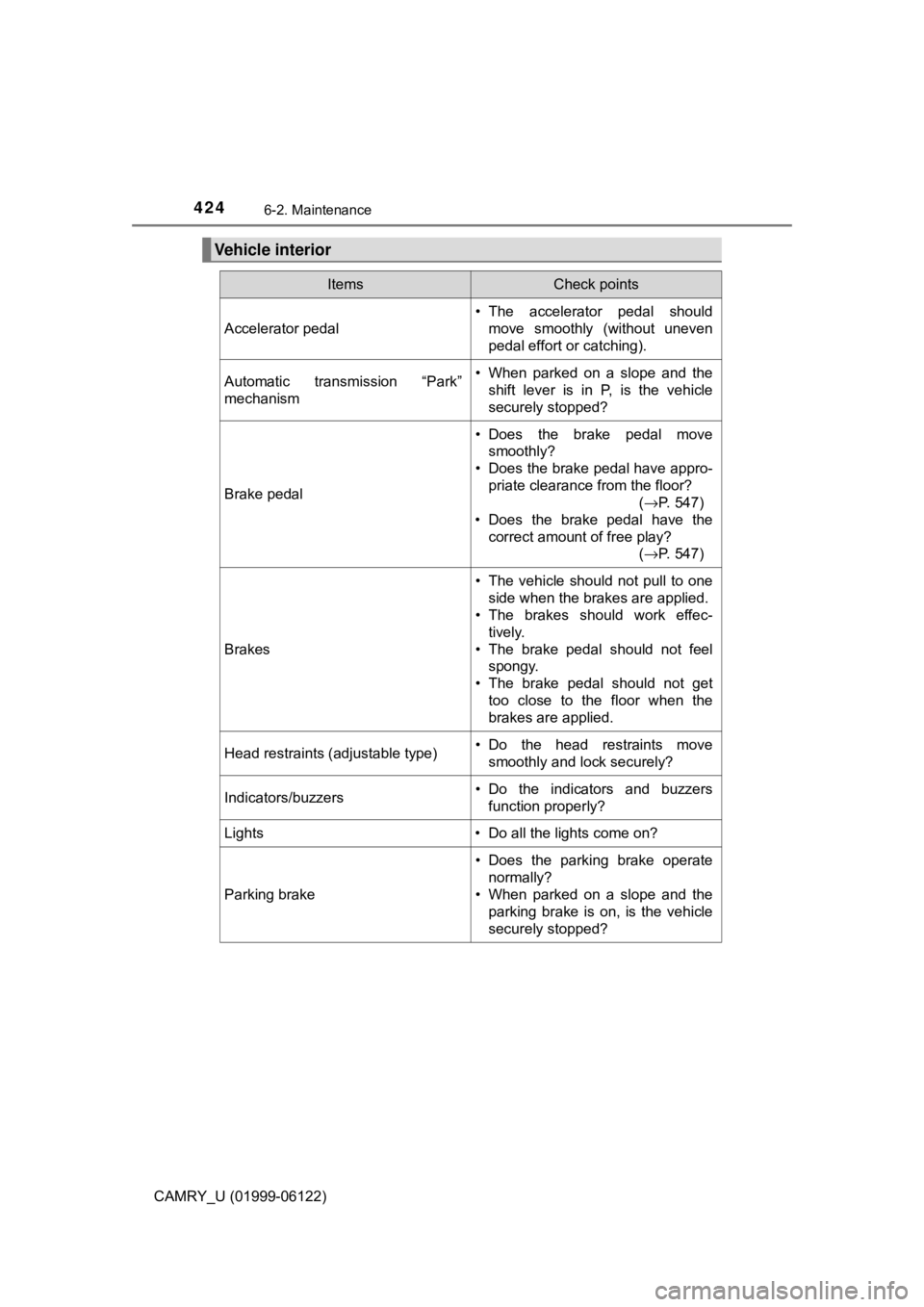
Vehicle interior
ItemsCheck points
Accelerator pedal
• The accelerator pedal should
move smoothly (without uneven
pedal effort or catching).
Automatic transmission “Park”
mechanism• When parked on a slope and the
shift lever is in P, is the vehicle
securely stopped?
Brake pedal
• Does the brake pedal move
smoothly?
• Does the brake pedal have appro-
priate clearance from the floor?
(→P. 547)
• Does the brake pedal have the
correct amount of free play?
(→P. 547)
Brakes
• The vehicle should not pull to one
side when the brakes are applied.
• The brakes should work effec-
tively.
• The brake pedal should not feel
spongy.
• The brake pedal should not get
too close to the floor when the
brakes are applied.
Head restraints (adjustable type)• Do the head restraints move
smoothly and lock securely?
Indicators/buzzers• Do the indicators and buzzers
function properly?
Lights • Do all the lights come on?
Parking brake
• Does the parking brake operate
normally?
• When parked on a slope and the
parking brake is on, is the vehicle
securely stopped?
Page 445 of 612
4456-3. Do-it-yourself maintenance
CAMRY_U (01999-06122)
6
Maintenance and care
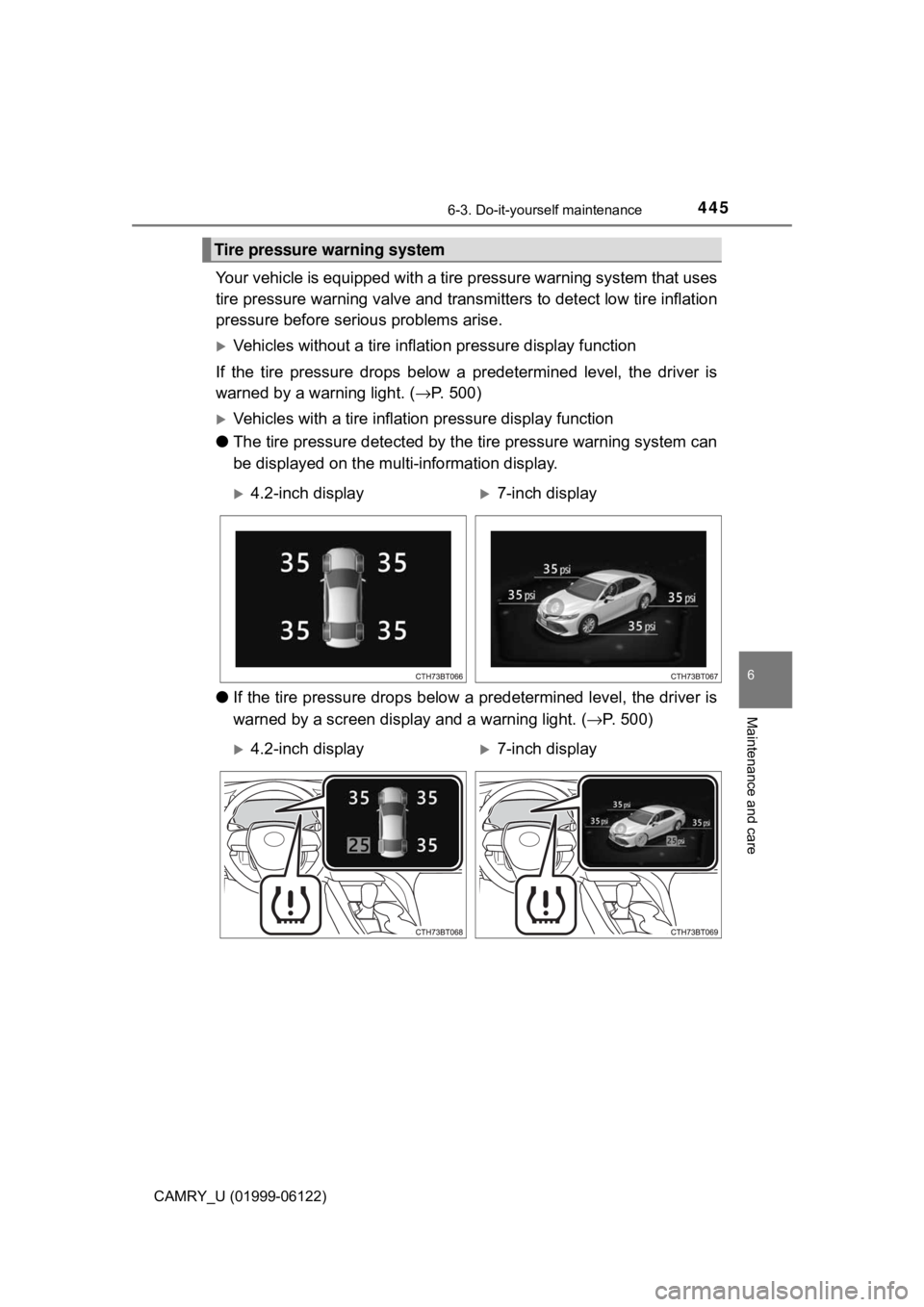
Your vehicle is equipped with a tire pressure warning system that uses
tire pressure warning valve and transmitters to detect low tire inflation
pressure before serious problems arise.
Vehicles without a tire inflation pressure display function
If the tire pressure drops below a predetermined level, the driver is
warned by a warning light. (→P. 500)
Vehicles with a tire inflation pressure display function
●The tire pressure detected by the tire pressure warning system can
be displayed on the multi-information display.
●If the tire pressure drops below a predetermined level, the driver is
warned by a screen display and a warning light. (→P. 500)
Tire pressure warning system
4.2-inch display7-inch display
4.2-inch display7-inch display
Page 446 of 612

4466-3. Do-it-yourself maintenance
CAMRY_U (01999-06122)
◆Installing tire pressure warning valve and transmitters
When replacing the tires or wheels, the tire pressure warning valve
and transmitters must be installed to the wheels which will be
installed to the vehicle.
When new tire pressure warning valve and transmitters are
installed, new ID codes must be registered in the tire pressure
warning computer and the tire pressure warning system must be
initialized. (→P. 448)
◆Initializing the tire pressure warning system
■The tire pressure warning system must be initialized in the fol-
lowing circumstances:
●When the tire inflation pressure is changed such as when chang-
ing traveling speed or load weight.
●When the tire inflation pressure is changed such as when the tire
size is changed.
●When rotating the tires.
●Vehicles with a tire inflation pressure display function: After per-
forming the transmitter ID code registration procedure. (→P. 448)
When the tire pressure warning system is initialized, the current tire
inflation pressure is set as the benchmark pressure.
■How to initialize the tire pressure warning system
Park the vehicle in a safe place and turn the engine switch off.
The initialization procedure cannot be started while the vehicle is
moving.
Adjust the tire inflation pressure to the specified cold tire inflation
pressure level. (→P. 547)
Make sure to adjust the tire pressure to the specified cold tire infla-
tion pressure level. The tire pressure warning system will operate
based on this pressure level.
Vehicles without a smart key system:
Turn the engine switch to the “ON” position.
Vehicles with a smart key system:
Turn the engine switch to IGNITION ON mode.
Select (4.2-inch display) or (7-inch display) on the multi-
information display using the meter control switches on the steer-
ing wheel. (→P. 92, 104).
1
2
3
4
Page 448 of 612

4486-3. Do-it-yourself maintenance
CAMRY_U (01999-06122)
◆Registering ID codes
Vehicles without a tire inflation pressure display function
Every tire pressure warning valve and transmitter has a unique ID
code. In addition to the set of tire pressure warning system sensor
ID codes initially registered to the vehicle, a second set of ID codes
can be registered.
A second set of tire pressure warning system sensor ID codes can
be registered at your Toyota dealer. When 2 sets of ID codes have
been registered, either ID code set can be selected.
Vehicles with a tire inflation pressure display function
Every tire pressure warning valve and transmitter has a unique ID
code. When replacing a tire pressure warning valve and transmitter,
it is necessary to register the ID codes.
The ID codes can be registered on (4.2-inch display) or (7-
inch display) of the multi-information display.
■Changing the available set of ID codes (vehicles without a tire
inflation pressure display function)
When 2 sets of ID codes are registered, the corresponding ID code
set for the installed wheels can be selected on (4.2-inch display)
or (7-inch display) of the multi-information display. It is not nec-
essary to reregister the ID codes each time the wheels are
changed.
For information regarding changing the registered ID codes for an
ID code set, contact your Toyota dealer.
Page 450 of 612

4506-3. Do-it-yourself maintenance
CAMRY_U (01999-06122)
■When to replace your vehicle’s tires
Tires should be replaced if:
●The treadwear indicators are showing on a tire.
●You have tire damage such as cuts, splits, cracks deep enough to
expose the fabric, and bulges indicating internal damage
●A tire goes flat repeatedly or cannot be properly repaired due to the size
or location of a cut or other damage
If you are not sure, consult with your Toyota dealer.
■Replacing tires and wheels
If the ID codes of the tire pressure warning valve and transmitters are not
registered, the tire pressure warning system will not work properly. In this
case, after driving for about 20 minutes, the tire pressure warning light will
blink for approximately 1 minute and then illuminate to indicate a system
malfunction.
■Tire life
Any tire over 6 years old must be checked by a qualified technician even
if it has seldom or never been used or damage is not obvious.
■Routine tire inflation pressure checks
The tire pressure warning system does not replace routine tire inflation
pressure checks. Make sure to check tire inflation pressure as part of
your routine of daily vehicle checks.
■Low profile tires (vehicles with 18 or 19-inch wheels)
Generally, low profile tires will wear more rapidly and tire grip perfor-
mance will be reduced on snowy and/or icy roads when compared to
standard tires. Be sure to use snow tires on snowy and/or icy roads and
drive carefully at a speed appropriate for road and weather conditions.
■Maximum load of tire
Check that the maximum load of the replacement tire is greater than 1/2
of the Gross Axle Weight Ratings (GAWR) of either the front axle or the
rear axle, whichever is greater.
For the GAWR, see the Certification
Label. For the maximum load of the tire,
see the load limit at maximum cold tire
inflation pressure mentioned on the
sidewall of the tire. (→P. 554)
Page 451 of 612

4516-3. Do-it-yourself maintenance
CAMRY_U (01999-06122)
6
Maintenance and care
■Tire types
●Summer tires
Summer tires are high-speed performance tires best suited to highway
driving under dry conditions. Since summer tires do not have the same
traction performance as snow tires, summer tires are inadequate for
driving on snow-covered or icy roads. For driving on snow-covered
roads or icy roads, the use of snow tires is recommended. When install-
ing snow tires, be sure to replace all four tires.
●All season tires
All season tires are designed to provide better traction in snow and to
be adequate for driving in most winter conditions as well as for use
year-round. All season tires, however, do not have adequate traction
performance compared with snow tires in heavy or loose snow. Also, all
season tires fall short in acceleration and handling performance com-
pared with summer tires in highway driving.
●Snow tires
For driving on snow-covered roads or icy roads, we recommend using
snow tires. If you need snow tires, select tires of the same size, con-
struction and load capacity as the originally installed tires. Since your
vehicle has radial tires as original equipment, make sure your snow
tires also have radial construction. Do not install studded tires without
first checking local regulations for possible restrictions. Snow tires
should be installed on all wheels. (→P. 345)
■If the tread on snow tires wears down below 0.16 in. (4 mm)
The effectiveness of the tires as snow tires is lost.
■Situations in which the tire pressure warning system may not oper-
ate properly
●In the following situations, the tire pressure warning system may not
operate properly.
• If non-genuine Toyota wheels are used.
• If a tire has been replaced with a tire that is not an OE (Original
Equipment) tire.
• If a tire has been replaced with a tire that is not of the specified size.
• If tire chains, etc. are installed.
• If a window tint that affects radio wave signals is installed.
• If there is a lot of snow or ice on the vehicle, particularly around the
wheels or wheel housings.
• If the tire inflation pressure is much higher than the specified level.
• If wheels not equipped with tire pressure warning valve and transmit-
ter are used.
• If the ID codes of the tire pressure warning valve and transmitters are
not registered in the tire pressure warning computer.
Page 453 of 612

4536-3. Do-it-yourself maintenance
CAMRY_U (01999-06122)
6
Maintenance and care
■If the tire pressure warning system is not initialized properly
Vehicles without a tire inflation pressure display function
Initialization can be completed in a few minutes. However, in the following
cases, the settings have not been recorded and the system will not oper-
ate properly. If repeated attempts to record tire inflation pressure settings
are unsuccessful, have the vehicle inspected by your Toyota dealer.
●If initialization is attempted and the tire pressure warning light does not
blink 3 times.
●If, when the vehicle has been driven for about 20 minutes after perform-
ing initialization, the tire pressure warning light blinks for approximately
1 minute and then illuminates.
Vehicles with a tire inflation pressure display function
●In the following situations, initialization may take longer than usual to be
completed or may not be possible. (Usually, the vehicle will need to be
driven for approximately 10 to 30 minutes to complete initialization.)
If initialization is not complete after driving approximately 30 minutes,
continue driving for a while.
• If the vehicle is driven on an unpaved road, it may take longer to com-
plete initialization.
• If the vehicle is backed up while performing initialization, data col-
lected during initialization will be cleared and it will take longer than
normal to complete.
• If the vehicle is driven in heavy traffic or another situation where other
vehicles are driven close by, it may take time for the system to recog-
nize the tire pressure warning valve and transmitters of your vehicle
over those of other vehicles.
If initialization is not complete after driving for approximately 1 hour,
park the vehicle in a safe place for approximately 20 minutes and then
drive the vehicle again.
●In the following situations, initialization will not be started or was not
completed properly and the system will not operate properly. Perform
the initialization procedure again.
• If, when attempting to start initialization, the tire pressure warning light
does not blink 3 times.
• If, when the vehicle has been driven for about 20 minutes after per-
forming initialization, the tire pressure warning light blinks for approxi-
mately 1 minute and then illuminates.
●If initialization cannot be completed after performing the above proce-
dure, contact your Toyota dealer.
Page 454 of 612

4546-3. Do-it-yourself maintenance
CAMRY_U (01999-06122)■
When registering ID codes (vehicles with a tire inflation pressure dis-
play function)
●Before performing ID code registration, make sure that no wheels with
tire pressure warning valve and transmitters installed are near the vehi-
cle.
●Make sure to initialize the tire pressure warning system after registering
the ID codes. If the system is initialized before registering the ID codes,
the initialized values will be invalid.
●As the tires will be warm when registration is completed, make sure to
allow the tires to cool before performing initialization.
■Canceling ID code registration (vehicles with a tire inflation pressure
display function)
●To cancel ID code registration after it has been started, turn the engine
switch off before driving the vehicle.
If the vehicle is driven after ID code registration is started, to cancel reg-
istration, perform the ID code registration start procedure again and turn
the engine switch off before driving.
●If ID code registration has been canceled, the tire pressure warning light
will blink for approximately 1 minute when the engine switch is turned to
the “ON” position (vehicles without a smart key system) or IGNITION
ON mode (vehicles with a smart key system) and then illuminate. The
tire pressure warning system will be operational when the tire pressure
warning light turns off.
●If the warning light does not turn off even after several minutes have
elapsed, ID code registration may not have been cancelled correctly. To
cancel registration, perform the ID code registration start procedure
again and then turn the engine switch off before driving.
Page 455 of 612

4556-3. Do-it-yourself maintenance
CAMRY_U (01999-06122)
6
Maintenance and care
■If ID codes are not registered properly (vehicles with a tire inflation
pressure display function)
●In the following situations, ID code registration may take longer than
usual to be completed or may not be possible. (Usually, the vehicle will
need to be driven for approximately 10 to 30 minutes to complete ID
code registration.)
If ID code registration is not complete after driving for approximately 30
minutes, continue driving for a while.
• If the vehicle is driven on an unpaved road, it may take longer than
normal to complete registration.
• If the vehicle is backed up while performing registration, data col-
lected during registration will be cleared, and it will take longer than
normal to complete.
• If the vehicle is driven in heavy traffic or another situation where other
vehicles are driven close by, it may take time for the system to recog-
nize the tire pressure warning valve and transmitters of your vehicle
over those of other vehicles.
• If a wheel with a tire pressure warning valve and transmitter installed
is inside or near the vehicle, registration of the ID codes for the
installed wheels may not be possible.
If ID registration is not complete after driving for approximately 1 hour,
park the vehicle in a safe place for approximately 20 minutes and then
perform the ID code registration procedure again.
●In the following situations, ID code registration will not be started or was
not completed properly and the system will not operate properly. Per-
form the ID code registration procedure again.
• If, when attempting to start ID code registration, the tire pressure
warning light does not blink slowly 3 times.
• If, when the vehicle has been driven for about 20 minutes after per-
forming ID code registration, the tire pressure warning light blinks for
approximately 1 minute and then illuminates.
●If ID code registration cannot be completed after performing the above
procedure, contact your Toyota dealer.
Page 458 of 612

4586-3. Do-it-yourself maintenance
CAMRY_U (01999-06122)
NOTICE
■Repairing or replacing tires, wheels, tire pressure warning valve
and transmitters and tire valve caps
●When removing or fitting the wheels, tires or the tire pressure warning
valve and transmitters, contact your Toyota dealer as the tire pressure
warning valve and transmitters may be damaged if not handled cor-
rectly.
●Make sure to install the tire valve caps. If the tire valve caps are not
installed, water may enter the valves of the tire pressure warning valve
and transmitters and the valves may become stuck.
●When replacing tire valve caps, do not use tire valve caps other than
those specified. The cap may become stuck.
■To avoid damage to the tire pressure warning valve and transmit-
ters
When a tire is repaired with liquid sealants, the tire pressure warning
valve and transmitter may not operate properly. If a liquid sealant is
used, contact your Toyota dealer or other qualified service shop as soon
as possible. Make sure to replace the tire pressure warning valve and
transmitter when replacing the tire. (→P. 446)
■Driving on rough roads
Take particular care when driving on roads with loose surfaces or pot-
holes.
These conditions may cause losses in tire inflation pressure, reducing
the cushioning ability of the tires. In addition, driving on rough roads
may cause damage to the tires themselves, as well as the vehicle’s
wheels and body.
■Low profile tires (vehicles with 18 or 19-inch wheels)
Low profile tires may cause greater damage than usual to the tire wheel
when sustaining impact from the road surface. Therefore, pay attention
to the following:
●Be sure to use proper tire inflation pressure. If tires are under-inflated,
they may be damaged more severely.
●Avoid potholes, uneven pavement, curbs and other road hazards. Fail-
ure to do so may lead to severe tire and wheel damage.
■If tire inflation pressure of each tire becomes low while driving
Do not continue driving, or your tires and/or wheels may be ruined.