light TOYOTA CAMRY 2022 Owners Manual
[x] Cancel search | Manufacturer: TOYOTA, Model Year: 2022, Model line: CAMRY, Model: TOYOTA CAMRY 2022Pages: 664, PDF Size: 11.3 MB
Page 551 of 664
5517-2. Steps to take in an emergency
CAMRY_U
7
When trouble arises
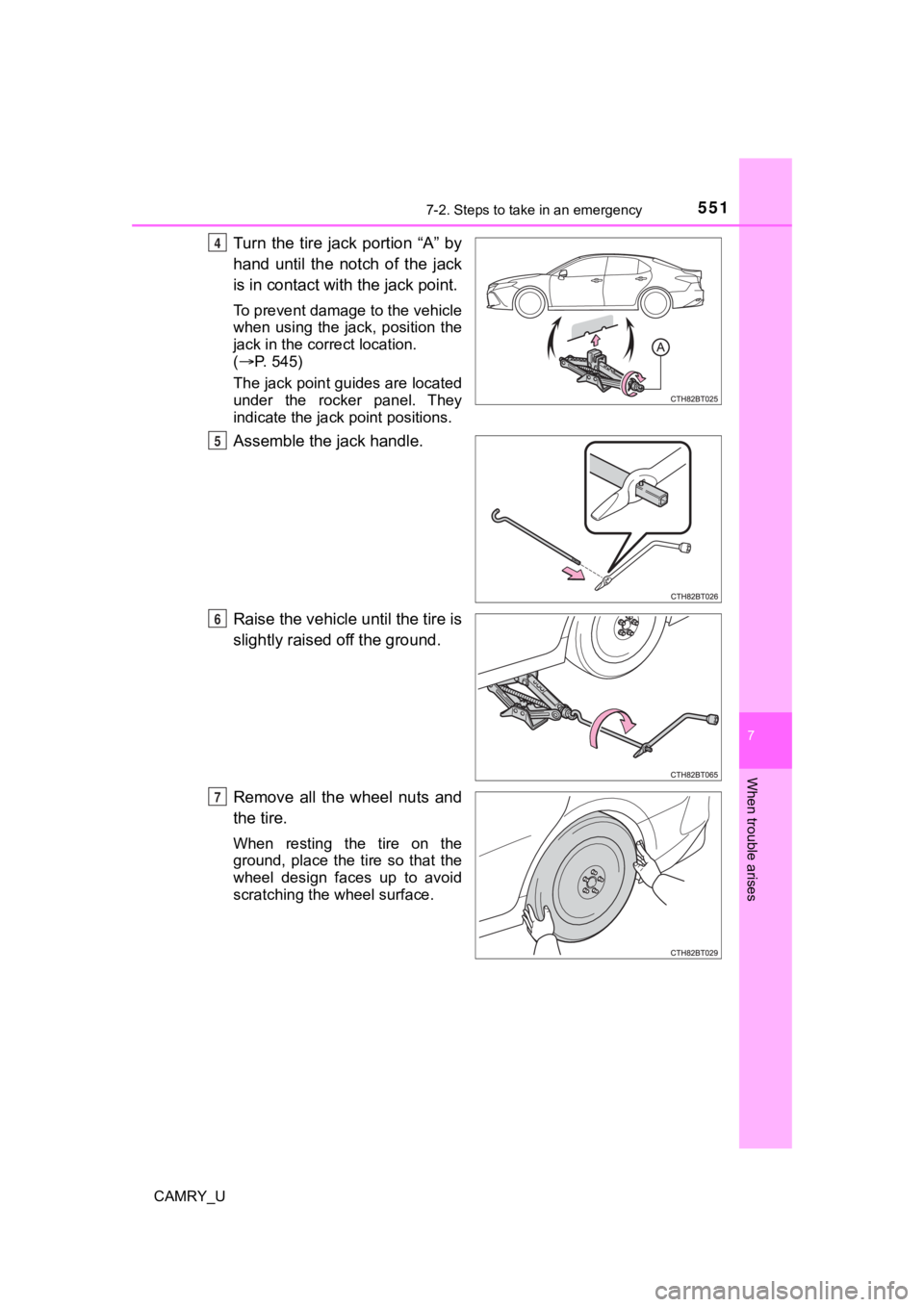
Turn the tire jack portion “A” by
hand until the notch of the jack
is in contact with the jack point.
To prevent damage to the vehicle
when using the jack, position the
jack in the correct location.
(
P. 5 4 5 )
The jack point guides are located
under the rocker panel. They
indicate the jack point positions.
Assemble the jack handle.
Raise the vehicle until the tire is
slightly raised off the ground.
Remove all the wheel nuts and
the tire.
When resting the tire on the
ground, place the tire so that the
wheel design faces up to avoid
scratching the wheel surface.
4
5
6
7
Page 554 of 664
5547-2. Steps to take in an emergency
CAMRY_U
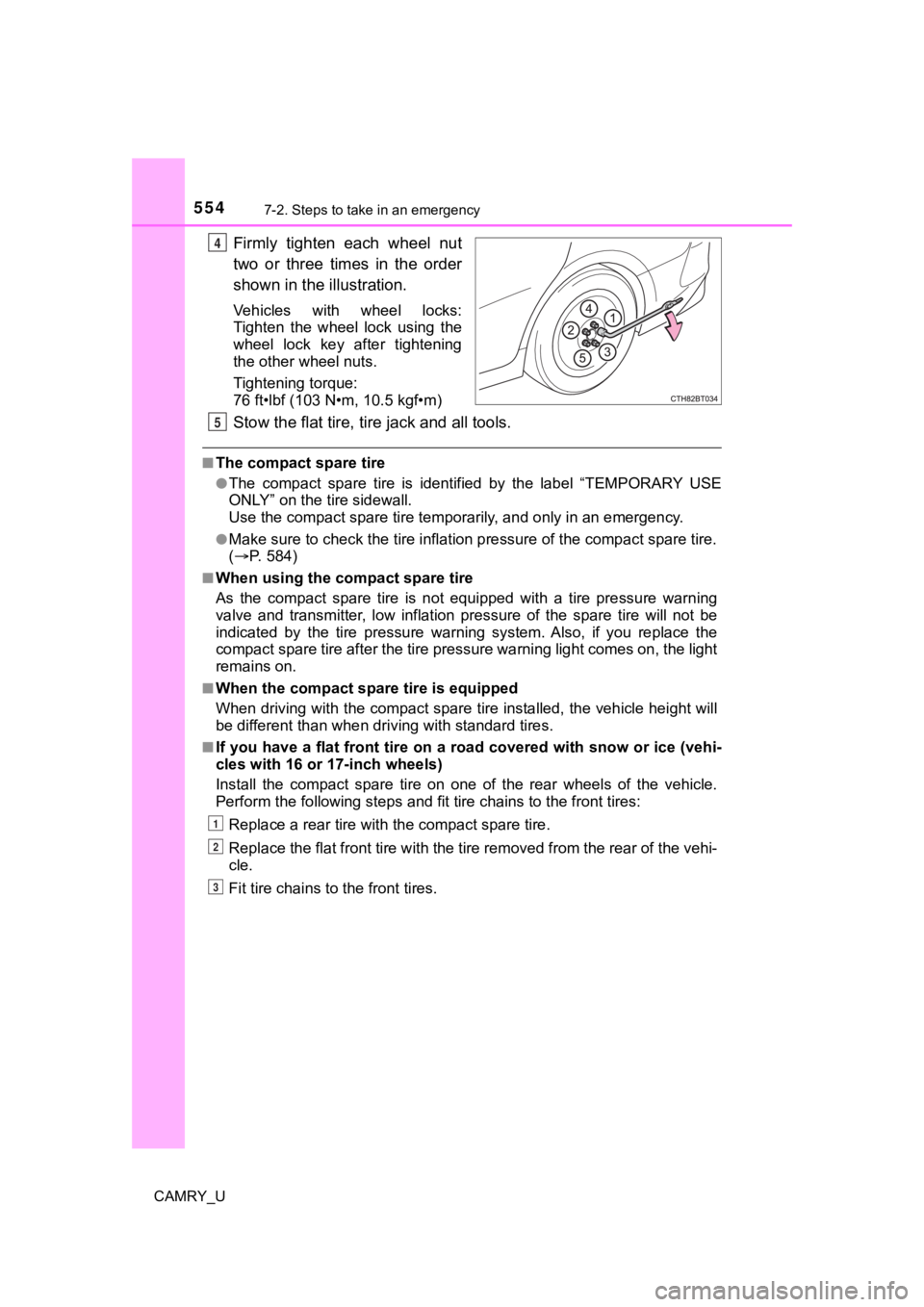
Firmly tighten each wheel nut
two or three times in the order
shown in the illustration.
Vehicles with wheel locks:
Tighten the wheel lock using the
wheel lock key after tightening
the other wheel nuts.
Tightening torque:
76 ft•lbf (103 N•m, 10.5 kgf•m)
Stow the flat tire, tire jack and all tools.
■The compact spare tire
●The compact spare tire is identified by the label “TEMPORARY US E
ONLY” on the tire sidewall.
Use the compact spar e tire temporarily, and only in an emergenc y.
●Make sure to check the tire inflation pressure of the compact spare tire.
( P. 5 8 4 )
■When using the compact spare tire
As the compact spare tire is not equipped with a tire pressure warning
valve and transmitter, low inflation pressure of the spare tire will not be
indicated by the tire pressure warning system. Also, if you rep lace the
compact spare tire after the tire pressure warning light comes on, the light
remains on.
■When the compact spa re tire is equipped
When driving with the compact spare tire installed, the vehicle height will
be different than when driving with standard tires.
■If you have a flat front tire on a road covered with snow or ic e (vehi-
cles with 16 or 17-inch wheels)
Install the compact spare tire on one of the rear wheels of the vehicle.
Perform the following steps and f it tire chains to the front tires:
Replace a rear tire with the compact spare tire.
Replace the flat front tire with the tire removed from the rear of the vehi-
cle.
Fit tire chains to the front tires.
4
5
1
2
3
Page 557 of 664
5577-2. Steps to take in an emergency
CAMRY_U
7
When trouble arises
One of the following may be the cause of the problem:
● There may not be sufficient fuel in the vehicle’s tank.
Refuel the vehicle.
● The engine may be flooded.
Try to restart the engine again following correct starting proc edures.
( P. 209, 211)
● There may be a malf unction in the engine immobilizer system.
( P. 80)
One of the following may be the cause of the problem:
● The battery may be discharged. ( P. 562)
● The battery terminal connecti ons may be loose or corroded.
The engine starting system may be malfunctioning due to an elec trical
problem such as electronic key battery depletion or a blown fus e.
However, an interim measure is a vailable to start the engine.
( P. 558)
If the engine will not star t
If the engine will not start eve n though correct starting proce -
dures are being followed ( P. 209, 211), consider each of the fol-
lowing points:
The engine will not start even t hough the starter motor operates
normally.
The starter motor turns over slowly, the interior lights and he ad-
lights are dim, or the horn does not sound or sounds at a low
volume.
The starter motor does not turn over (vehicles with a smart key
system)
Page 558 of 664
5587-2. Steps to take in an emergency
CAMRY_U
One of the following may be the cause of the problem:
● One or both of the battery t erminals may be disconnected.
● The battery may be discharged. ( P. 562)
● There may be a malfunction in the steering lock system (vehicles
with a smart key system).
Contact your Toyota dealer if the problem cannot be repaired, o r if repair
procedures are unknown.
When the engine does not start, the following steps can be used as an
interim measure to start the engine if the engine switch is fun ctioning
normally:
Set the parking brake.
Shift the shift lever to P.
Turn the engine switch to ACCESSORY mode.
Press and hold the engine switch for about 15 seconds while
depressing the brake pedal firmly.
Even if the engine can be start ed using the above steps, the sy stem
may be malfunctioning. Have the vehicle inspected by your Toyot a
dealer.
The starter motor does not turn over, the interior lights and h ead-
lights do not turn on, o r the horn does not sound.
Emergency start function (vehicles with a smart key system)
1
2
3
4
Page 564 of 664

5647-2. Steps to take in an emergency
CAMRY_U
Start the engine of the second vehicle. Increase the engine speed
slightly and maintain at that lev el for approximately 5 minutes to
recharge the batter y of your vehicle.
Vehicles with a smart key syst em: Open and close any of the doo rs
of your vehicle with the engine switch off.
Vehicles without a smart key system:
Maintain the engine speed of the second vehicle and turn the
engine switch to the “ON” posit ion, then start the vehicle's engine.
Vehicles with a smart key system:
Maintain the engine speed of the second vehicle and turn the
engine switch to IGNITION ON mode, then start the vehicle's
engine.
Once the vehicle’s engine has st arted, remove the jumper cables in
the exact reverse order from which they were connected.
Once the engine starts, have the vehicle inspected at your Toyota
dealer as soon as possible.
■ Starting the engine when t he battery is discharged
The engine cannot be started by push-starting.
■ To prevent battery discharge
●Turn off the headlights and the audio system while the engine is off.
● Turn off any unnecessary electrical components when the vehicle is running
at a low speed for an extended period, such as in heavy traffic .
■ When the battery is removed or discharged
●Information stored in the ECU is cleared. When the battery is d epleted, have
the vehicle inspected at your Toyota dealer.
● Some systems may require initialization. (→P. 614)
■ When removing the battery terminals
When the battery terminals are removed, the information stored in the ECU is
cleared. Before removing the battery terminals, contact your Toyota dealer.
■ Charging the battery
The electricity stored in the battery will discharge gradually even when the
vehicle is not in use, due to natural discharge and the draining effects of cer-
tain electrical appliances. If the vehicle is left for a long t ime, the battery may
discharge, and the engine may be unable to start. (The battery recharges
automatically during driving.)
5
6
7
8
Page 566 of 664
5667-2. Steps to take in an emergency
CAMRY_U
WARNING
■When removing the battery terminals
Always remove the negative (-) terminal first. If the positive (+) terminal con-
tacts any metal in the surrounding area when the positive (+) terminal is
removed, a spark may occur, leading to a fire in addition to el ectrical shocks
and death or serious injury.
■ Avoiding battery fires or explosions
Observe the following precautions to prevent accidentally ignit ing the flam-
mable gas that may be emitted from the battery:
● Make sure each jumper cable is connected to the correct terminal and that
it is not unintentionally in contact with any other than the in tended terminal.
● Do not allow the other end of the jumper cable connected to the “+” termi-
nal to come into contact with any other parts or metal surfaces in the area,
such as brackets or unpainted metal.
● Do not allow the + and - clamps of the jumper cables to come in to contact
with each other.
● Do not smoke, use matches, cigarette lighters or allow open fla me near
the battery.
■ Battery precautions
The battery contains poisonous and corrosive acidic electrolyte , while
related parts contain lead and lead compounds. Observe the following pre-
cautions when handling the battery:
● When working with the battery, always wear safety glasses and take care
not to allow any battery fluids (acid) to come into contact with skin, clothing
or the vehicle body.
● Do not lean over the battery.
● In the event that battery fluid comes into contact with the skin or eyes,
immediately wash the affected area with water and seek medical attention.
Place a wet sponge or cloth over the affected area until medical attention
can be received.
● Always wash your hands after handling the battery support, terminals, and
other battery-related parts.
● Do not allow children near the battery.
NOTICE
■When handling jumper cables
When connecting the jumper cables, ensure that they do not beco me entan-
gled in the cooling fan or engine drive belt.
Page 581 of 664
5818-1. Specifications
8
Vehicle specifications
CAMRY_U
*: The fluid capacity is a reference quantity. If replacement is necessary, contact your Toyota dealer.
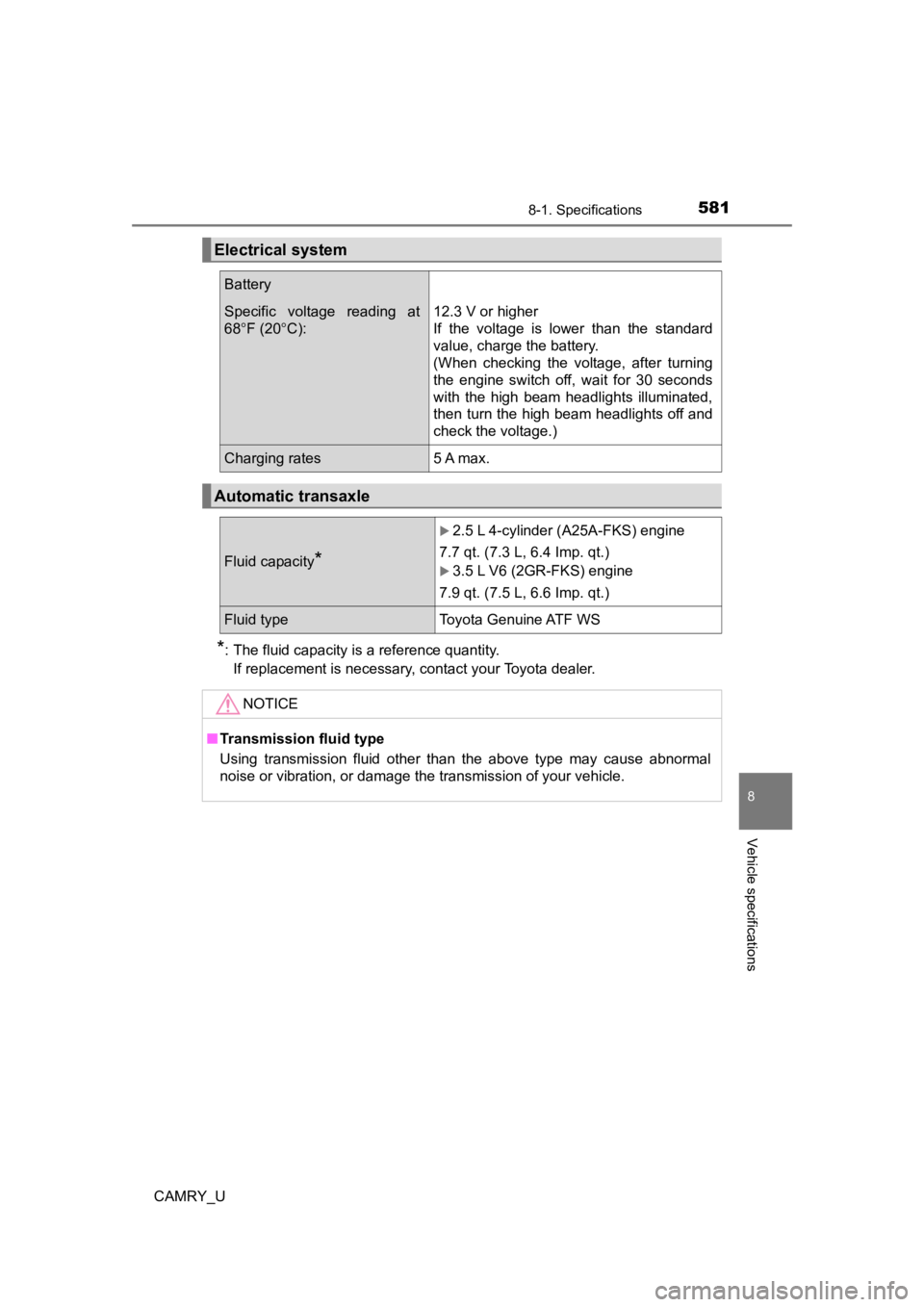
Electrical system
Battery
Specific voltage reading at
68 F (20 C):12.3 V or higher
If the voltage is lower than the standard
value, charge the battery.
(When checking the voltage, after turning
the engine switch off, wait for 30 seconds
with the high beam headlights illuminated,
then turn the high beam headlights off and
check the voltage.)
Charging rates5 A max.
Automatic transaxle
Fluid capacity*
2.5 L 4-cylinder ( A25A-FKS) engine
7.7 qt. (7.3 L, 6.4 Imp. qt.)
3.5 L V6 (2GR-FKS) engine
7.9 qt. (7.5 L, 6.6 Imp. qt.)
Fluid type Toyota Genuine ATF WS
NOTICE
■Transmission fluid type
Using transmission fluid other than the above type may cause abnormal
noise or vibration, or damage the transmission of your vehicle.
Page 589 of 664
5898-1. Specifications
8
Vehicle specifications
CAMRY_U
*1: Light bulbs not listed in this table are LED bulbs.
*2: If equipped
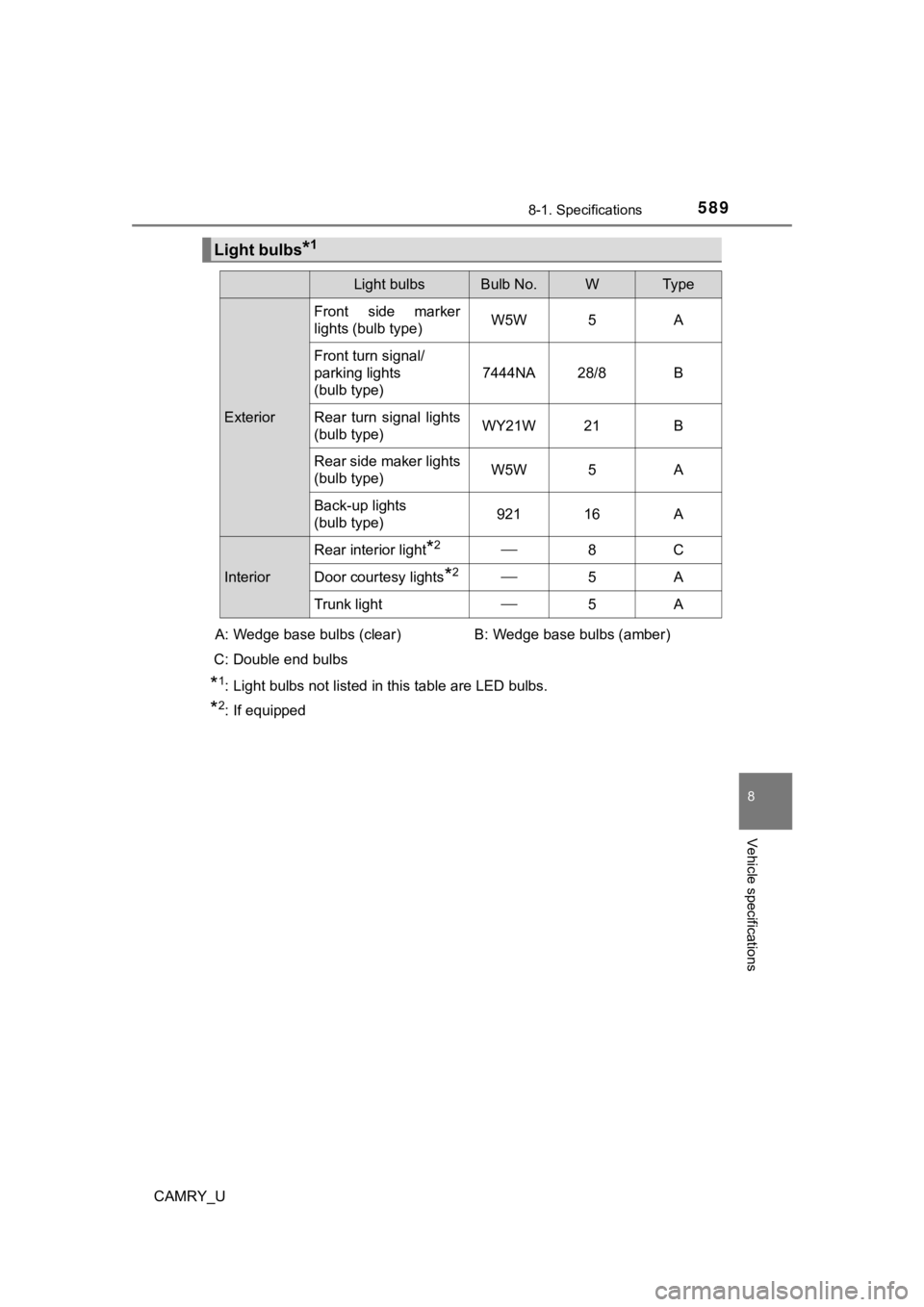
Light bulbs*1
Light bulbsBulb No.WTy p e
ExteriorFront side marker
lights (bulb type)
W5W 5 A
Front turn signal/
parking lights
(bulb type) 7444NA 28/8 B
Rear turn signal lights
(bulb type) WY21W 21 B
Rear side maker lights
(bulb type) W5W 5 A
Back-up lights
(bulb type) 921 16 A
InteriorRear interior light
*2
8C
Door courtesy lights
*2 5A
Trunk light 5A
A: Wedge base bulbs (clear)
C: Double end bulbs B: Wedge base bulbs (amber)
Page 591 of 664
5918-1. Specifications
8
Vehicle specifications
CAMRY_U■
Recommendation of the use of low emissions gasoline
Gasolines containing oxygenates such as ethers and ethanol, as well as
reformulated gasolines, are available in some cities. These fue ls are typically
acceptable for use, providing they meet other fuel requirements .
Toyota recommends these fuels, since the formulations allow for reduced
vehicle emissions.
■ Non-recommendation of the use of blended gasoline
●If you use gasohol in your vehicle, be sure that it has an octa ne rating no
lower than 87.
● Toyota does not recommend the use of gasoline containing methan ol.
■ Non-recommendation of the use of gasoline containing MMT
Some gasoline contains an octane enhancing additive called MMT (Methylcy-
clopentadienyl Manganese Tricarbonyl).
Toyota does not recommend the use of gasoline that contains MMT. If fuel
containing MMT is used, your emission control system may be adversely
affected.
The malfunction indicator lamp on the instrument cluster may come on. If this
happens, contact your Toyota dealer for service.
■ If your engine knocks
●Consult your Toyota dealer.
● You may occasionally notice light knocking for a short time whi le accelerat-
ing or driving uphill. This is normal and there is no need for concern.
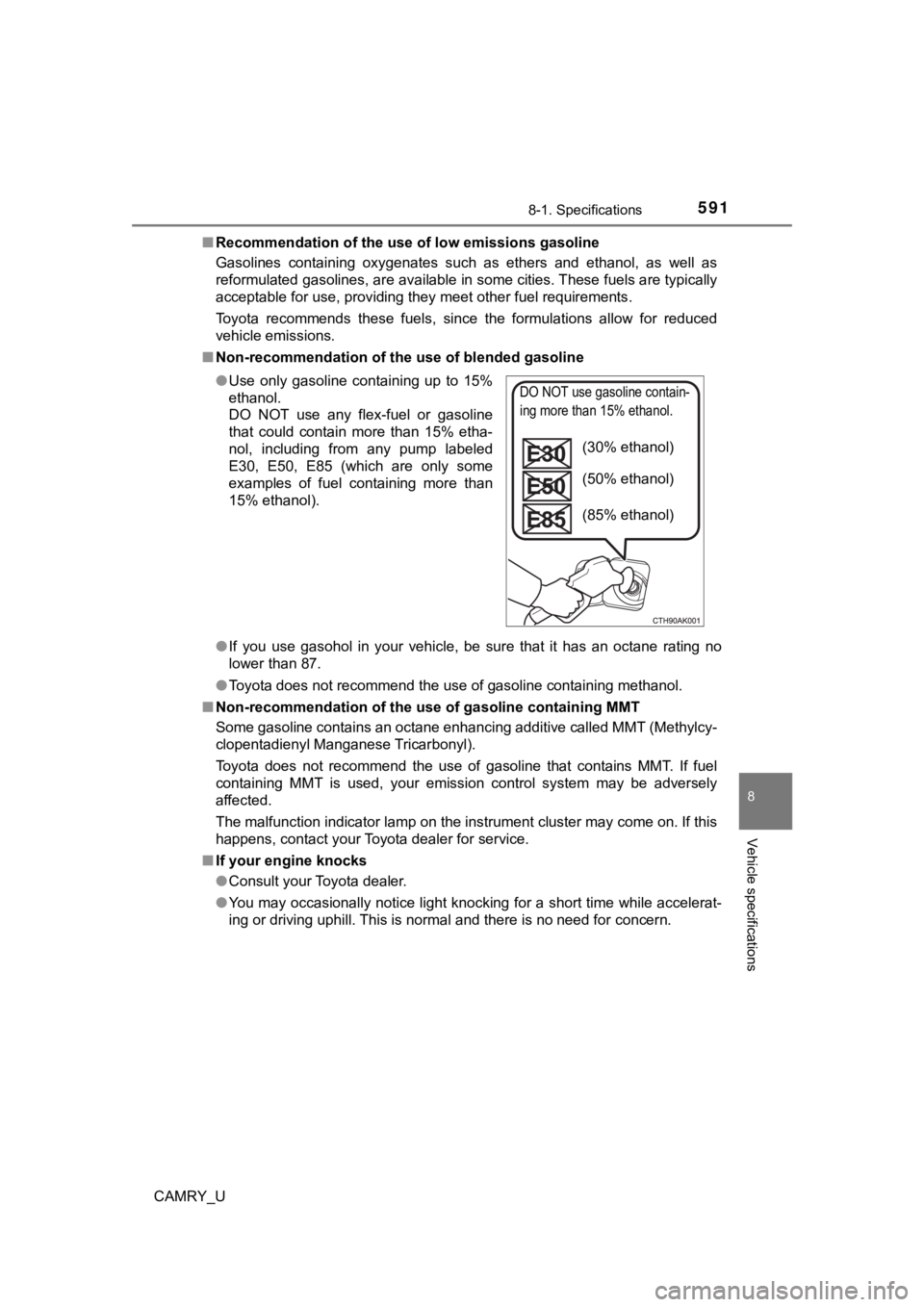
●
Use only gasoline containing up to 15%
ethanol.
DO NOT use any flex-fuel or gasoline
that could contain more than 15% etha-
nol, including from any pump labeled
E30, E50, E85 (which are only some
examples of fuel containing more than
15% ethanol).
DO NOT use gasoline contain-
ing more than 15% ethanol.
(30% ethanol)
(50% ethanol)
(85% ethanol)
Page 603 of 664
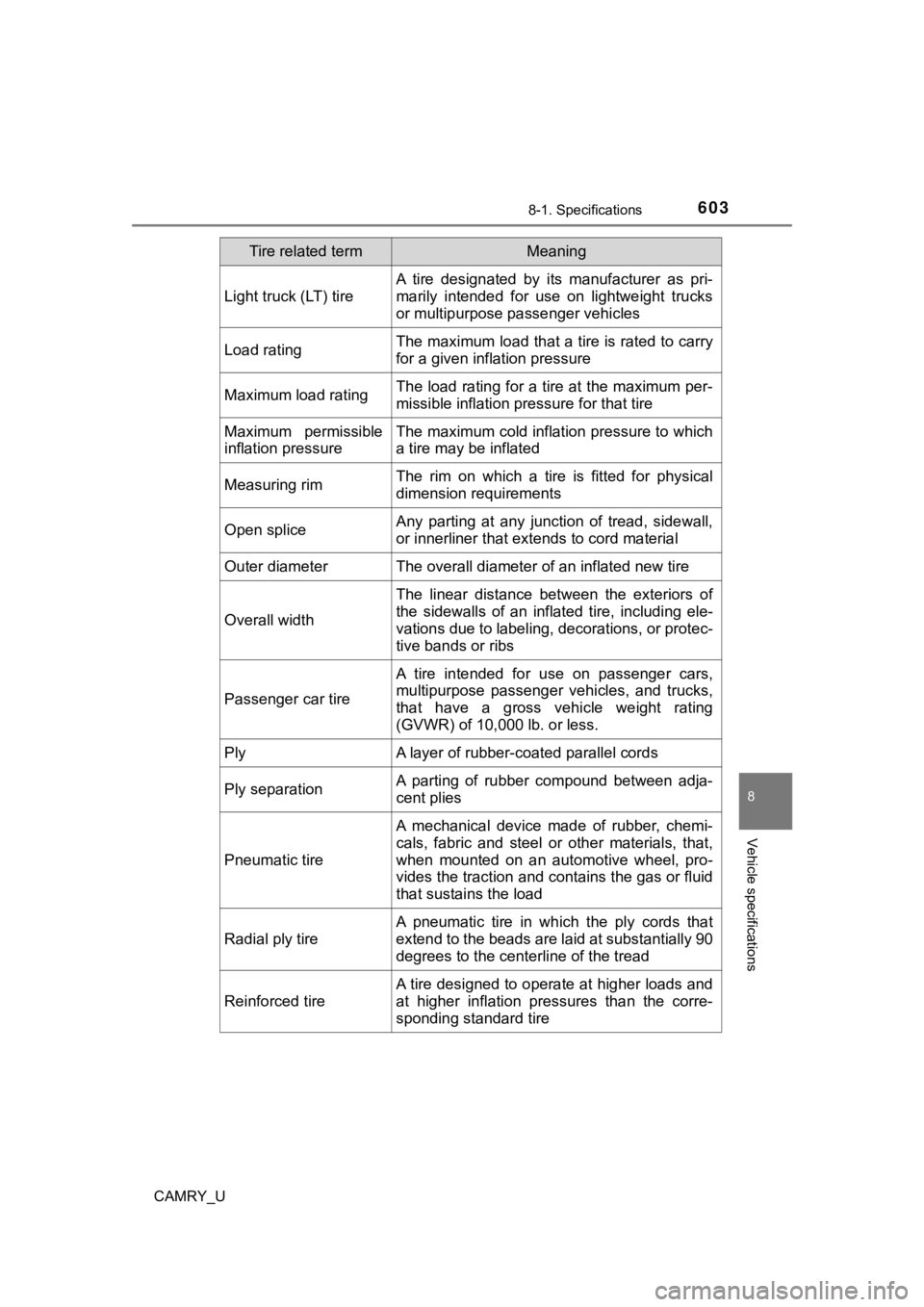
6038-1. Specifications
8
Vehicle specifications
CAMRY_U
Light truck (LT) tire
A tire designated by its manufacturer as pri-
marily intended for use on lightweight trucks
or multipurpose passenger vehicles
Load ratingThe maximum load that a tire is rated to carry
for a given inflation pressure
Maximum load ratingThe load rating for a tire at the maximum per-
missible inflation pressure for that tire
Maximum permissible
inflation pressureThe maximum cold inflation pressure to which
a tire may be inflated
Measuring rimThe rim on which a tire is fitted for physical
dimension requirements
Open spliceAny parting at any junction of tread, sidewall,
or innerliner that extends to cord material
Outer diameterThe overall diameter of an inflated new tire
Overall width
The linear distance between the exteriors of
the sidewalls of an inflated tire, including ele-
vations due to labeling, decorations, or protec-
tive bands or ribs
Passenger car tire
A tire intended for use on passenger cars,
multipurpose passenger vehicles, and trucks,
that have a gross vehicle weight rating
(GVWR) of 10,000 lb. or less.
PlyA layer of rubber-coated parallel cords
Ply separationA parting of rubber compound between adja-
cent plies
Pneumatic tire
A mechanical device made of rubber, chemi-
cals, fabric and steel or other materials, that,
when mounted on an automotive wheel, pro-
vides the traction and co ntains the gas or fluid
that sustains the load
Radial ply tire
A pneumatic tire in which the ply cords that
extend to the beads are laid at substantially 90
degrees to the centerline of the tread
Reinforced tire
A tire designed to operate at higher loads and
at higher inflation pressures than the corre-
sponding standard tire
Tire related termMeaning