light TOYOTA CAMRY HV 2009 Owners Manual
[x] Cancel search | Manufacturer: TOYOTA, Model Year: 2009, Model line: CAMRY HV, Model: TOYOTA CAMRY HV 2009Pages: 444, PDF Size: 6.46 MB
Page 378 of 444
378
5-2. Steps to take in an emergency
If the hybrid system will not start
Reasons for the hybrid system not starting vary depending on the
situation. Check the following a nd perform the appropriate proce-
dure:
■ The hybrid system will not start, even though the correct
starting procedure is being followed. ( →P. 131)
One of the following may be the cause of the problem.
● The electronic key may not be functioning properly. ( →P. 382)
● There may be a malfunction in the immobilizer system.
(→ P. 8 3 )
● There may be a malfunction in the steering lock system.
● The hybrid system may be malfun ctioning due to an electrical
problem such as an open circuit or a blown fuse. However,
depending on the type of malf unction, an interim measure is
available to start the hybrid system. ( →P. 379)
■ The interior lights and headlight s are dim, or the horn does
not sound or sounds at a low volume.
One of the following may be the cause of the problem.
● The 12-volt battery may be discharged. ( →P. 385)
● The 12-volt battery terminal c onnections may be loose or cor-
roded.
Page 379 of 444
5
When trouble arises
379
5-2. Steps to take in an emergency
Emergency start function
When the hybrid system does not
start, the following steps can be
used as an interim measure to start the hybrid system if the
“POWER” switch is functioning normally.
Set the parking brake.
Shift the shift lever to P.
Turn the “POWER” switch to ACCESSORY mode.
Press and hold the “POWER” switch for about 15 seconds
while depressing the brake pedal firmly.
Even if the hybrid sy stem can be started usi ng the above steps, the
system may be malfunctioning. Ha ve the vehicle checked by your
Toyota dealer.
■ The interior lights and headlights do not turn on, or the horn
does not sound.
One of the following may be the cause of the problem.
●One or both of the 12-volt ba ttery terminals may be discon-
nected.
● The 12-volt battery may be discharged. ( →P. 385)
● There may be a malfunction in the steering lock system.
Contact your Toyota dealer if the problem cannot be repaired, or if
repair procedures are unknown.
STEP1
STEP2
STEP3
STEP4
Page 386 of 444
386 5-2. Steps to take in an emergency
■Avoiding a discharged 12-volt battery
●Turn off the headlights and the audio system while the hybrid system is
turned off.
● Turn off any unnecessary electrical components when the vehicle is run-
ning at a low speed for an extended period, such as in heavy traffic, etc.
■ When the 12-volt battery is removed or discharged
●The hybrid system may not start. ( →P. 301)
● The tire pressure warning system must be initialized. ( →P. 305)
■ Starting the hybrid system when the 12-volt battery is discharged
The hybrid system cannot be started by push-starting.
Start the engine of the second vehicle. Increase the gaso-
line engine speed slightly and maintain at that level for
approximately 5 minutes to recharge the 12-volt battery of
your vehicle.
Open and close any of the doors with the “POWER” switch
OFF.
Maintain the engine speed of the second vehicle and turn
the “POWER” switch to ON mode, then start the hybrid sys-
tem.
Make sure the “READY” indicator comes on. If the indicator
does not comes on, contact your Toyota dealer.
Once the hybrid system has started, remove the jumper
cables in the exact reverse order in which they were con-
nected.
Once the hybrid system starts, ha ve the vehicle checked at your
Toyota dealer as soon as possible.STEP3
STEP4
STEP5
STEP6
Page 387 of 444
5
When trouble arises
387
5-2. Steps to take in an emergency
CAUTION
■
Avoiding 12-volt battery fires or explosions
Observe the following precautions to prevent accidentally igniting the flam-
mable gas that may be emitted from the 12-volt battery.
●Make sure each jumper cable is connected to the correct terminal.
● Do not allow the ends of the jumper cable used for the “+” terminals to
come into contact with any other parts or metal surface in the area, such
as brackets or unpainted metal.
● Do not allow the “+” and “-” terminals of the jumper cables to come into
contact with each other.
● Do not smoke, use matches, cigarette lighters or allow open flame near
the 12-volt battery.
■ 12-volt battery precautions
The 12-volt battery contains poisonous and corrosive acidic electrolyte,
while related parts contain lead and lead compounds. Observe the following
precautions when handling the 12-volt battery.
●When working with the 12-volt battery, always wear safety glasses and
take care not to allow any battery fluids (acid) to come into contact with
skin, clothing or the vehicle body.
● Do not lean over the 12-volt battery.
● In the event that battery fluid comes into contact with the skin or eyes,
immediately wash the affected area with water and seek medical attention.
Place a wet sponge or cloth over the affected area until medical attention
can be received.
● Always wash your hands after handling the 12-volt battery support, termi-
nals, and other battery-related parts.
● Do not allow children near the 12-volt battery.
Page 402 of 444
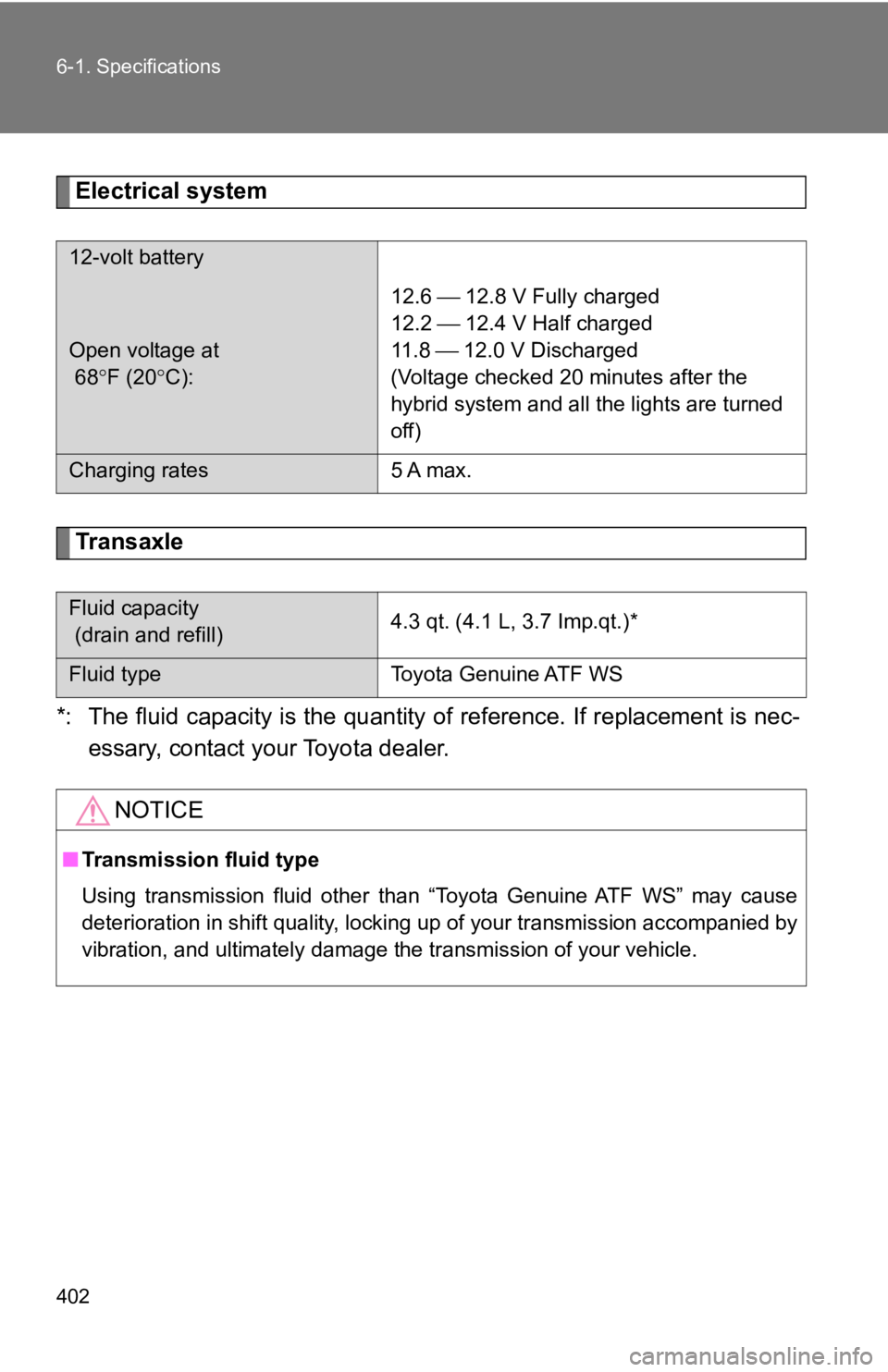
402 6-1. Specifications
Electrical system
Transaxle
*: The fluid capacity is the quantity of reference. If replacement is nec- essary, contact your Toyota dealer.
12-volt battery
Open voltage at
68° F (20 °C): 12.6
⎯ 12.8 V Fully charged
12.2 ⎯ 12.4 V Half charged
11.8 ⎯ 12.0 V Discharged
(Voltage checked 20 minutes after the
hybrid system and all the lights are turned
off)
Charging rates 5 A max.
Fluid capacity
(drain and refill)4.3 qt. (4.1 L, 3.7 Imp.qt.)*
Fluid type
Toyota Genuine ATF WS
NOTICE
■Transmission fluid type
Using transmission fluid other than “Toyota Genuine ATF WS” may cause
deterioration in shift quality, locking up of your transmission accompanied by
vibration, and ultimately damage the transmission of your vehicle.
Page 405 of 444
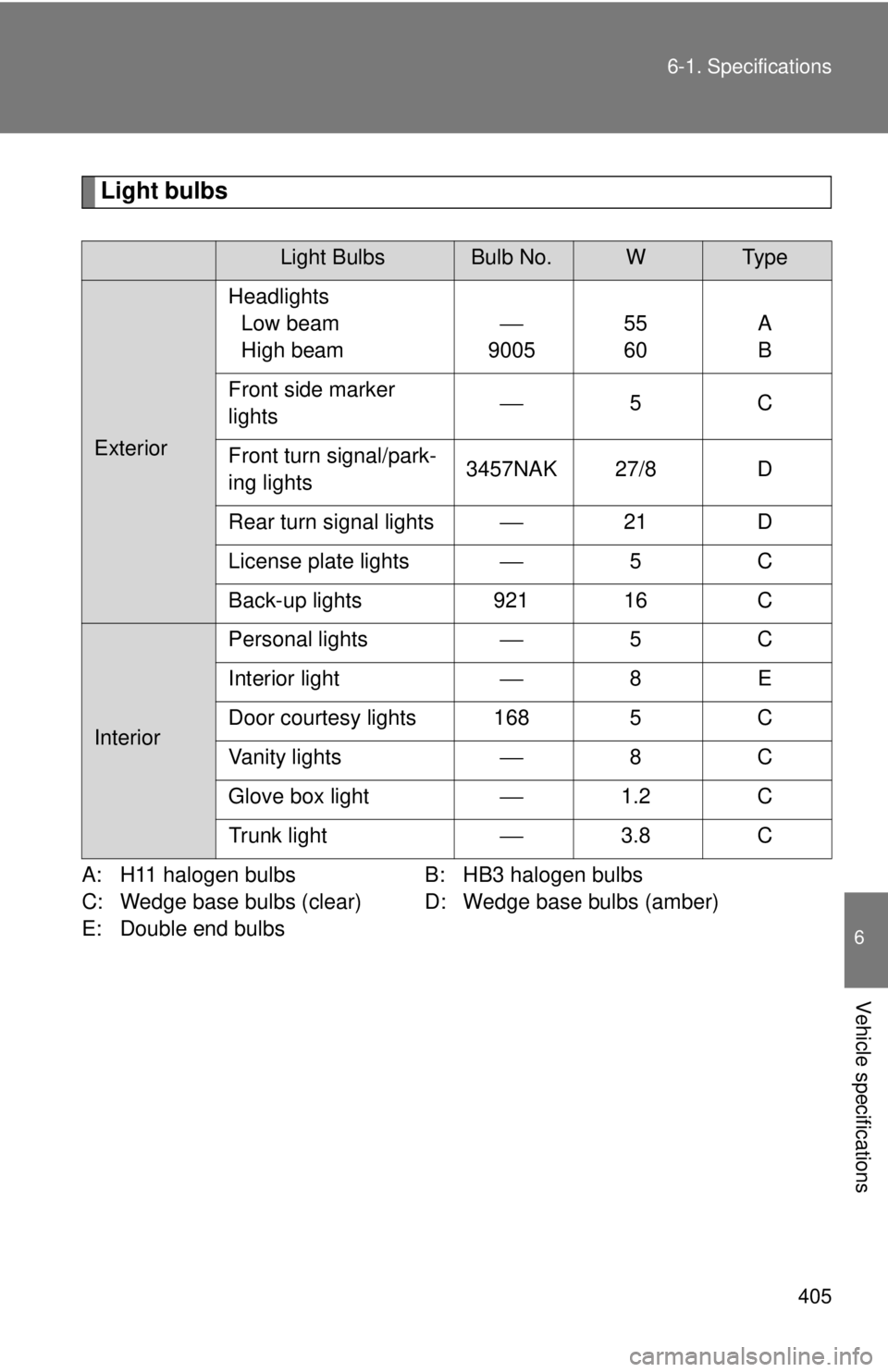
405
6-1. Specifications
6
Vehicle specifications
Light bulbs
A: H11 halogen bulbs
B: HB3 halogen bulbs
C: Wedge base bulbs (clear) D: Wedge base bulbs (amber)
E: Double end bulbs
Light BulbsBulb No.WTy p e
Exterior Headlights
Low beam
High beam ⎯
9005 55
60A
B
Front side marker
lights ⎯
5C
Front turn signal/park-
ing lights 3457NAK 27/8 D
Rear turn signal lights ⎯21 D
License plate lights ⎯5C
Back-up lights 921 16 C
Interior Personal lights
⎯5C
Interior light ⎯8E
Door courtesy lights 168 5 C
Vanity lights ⎯8C
Glove box light ⎯1.2 C
Trunk light ⎯3.8 C
Page 406 of 444
406
6-1. Specifications
Fuel information
■Fuel tank opening for unleaded gasoline
To help prevent incorrect fueling, your Toyota has a fuel tank opening that
only accommodates the special nozzle on unleaded fuel pumps.
■ If your engine knocks
●Consult your Toyota dealer.
● You may occasionally notice light knocking for a short time while acceler-
ating or driving uphill. This is normal and there is no need for concern.
■ Gasoline quality
In very few cases, driveability problems may be caused by the brand of gas-
oline you are using. If driveability problems persist, try changing the brand of
gasoline. If this does not correct the problem, consult your Toyota dealer.
■ Gasoline quality standards
●Automotive manufacturers in the U.S., Europe and Japan have devel-
oped a specification for fuel quality called the World-Wide Fuel Charter
(WWFC) that is expected to be applied worldwide.
● The WWFC consists of four categories that are based on required emis-
sion levels. In the U.S., category 4 has been adopted.
● The WWFC improves air quality by lo wering emissions in vehicle fleets,
and improves customer satisfaction through better performance.
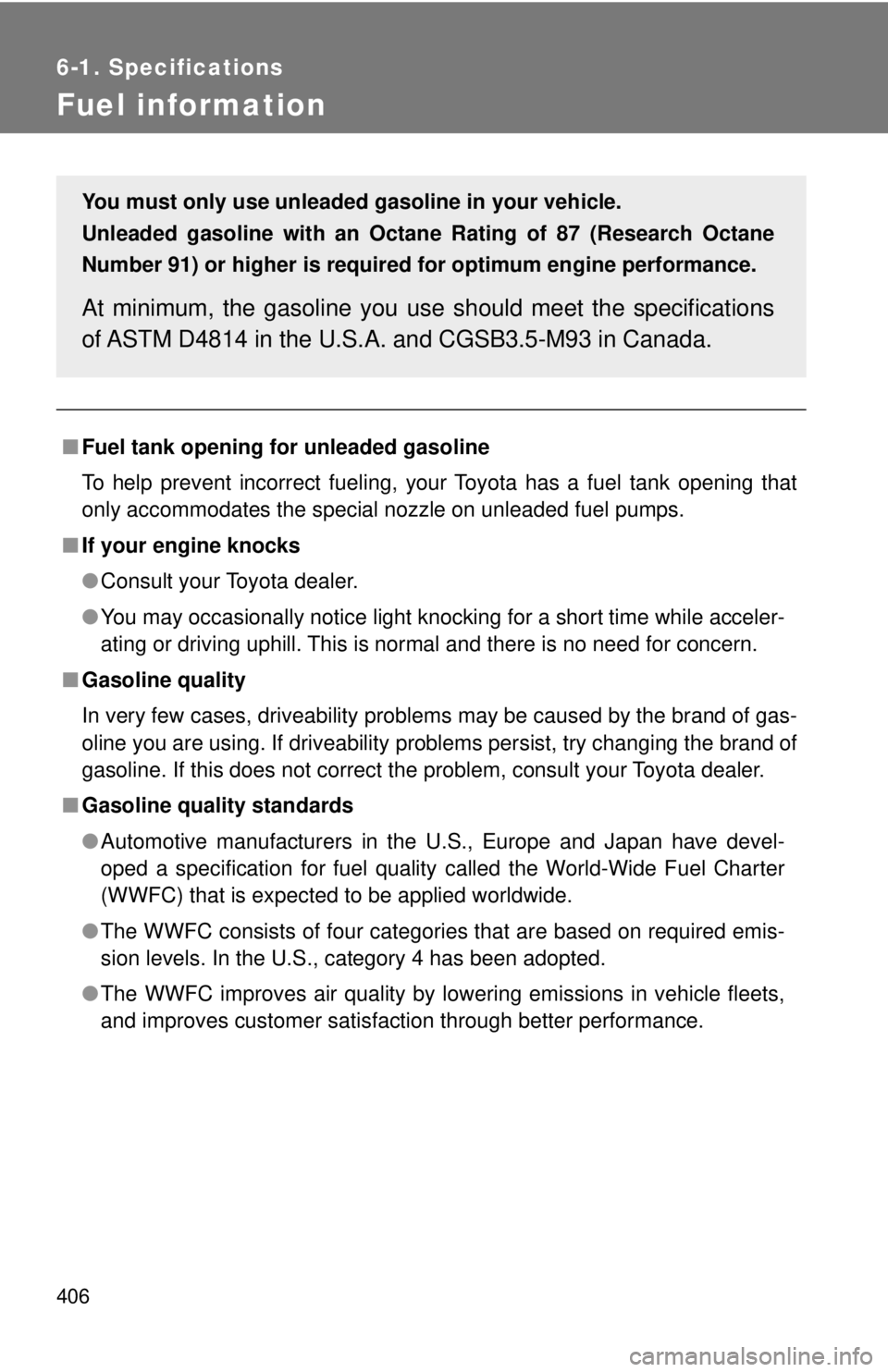
You must only use unleaded gasoline in your vehicle.
Unleaded gasoline with an Octane Rating of 87 (Research Octane
Number 91) or higher is required for optimum engine performance.
At minimum, the gasoline you use should meet the specifications
of ASTM D4814 in the U.S.A. and CGSB3.5-M93 in Canada.
Page 418 of 444

418 6-1. Specifications
Tire related termMeaning
Innerliner separation The parting of the innerliner from cord material
in the carcass
Intended outboard
sidewall (a) The sidewall that contains a whitewall,
bears white lettering, or bears manufac-
turer, brand, and/or model name molding
that is higher or deeper than the same
molding on the other sidewall of the tire, or
(b) The outward facing sidewall of an asym- metrical tire that has a particular side that
must always face ou tward when mounted
on a vehicle
Light truck (LT) tire A tire designated by its manufacturer as pri-
marily intended for use on lightweight trucks or
multipurpose passenger vehicles
Load rating The maximum load that a tire is rated to carry
for a given inflation pressure
Maximum load rating The load rating for a tire at the maximum per-
missible inflation pressure for that tire
Maximum permissible
inflation pressure The maximum cold inflation pressure to which
a tire may be inflated
Measuring rim The rim on which a tire is fitted for physical
dimension requirements
Open splice Any parting at any junction of tread, sidewall, or
innerliner that extends to cord material
Outer diameter The overall diameter of an inflated new tire
Overall width The linear distance between the exteriors of
the sidewalls of an inflated tire, including eleva-
tions due to labeling, decorations, or protective
bands or ribs
Passenger car tire A tire intended for use on passenger cars, mul-
tipurpose passenger vehicles, and trucks, that
have a gross vehicle weight rating (GVWR) of
10,000 lb. or less.
Page 423 of 444

423
6-2. Customization
6
Vehicle specifications
Door lock
(
→P. 50)
Unlocking using a key
Driver's door
unlocked in one step, all doors
unlocked in two steps All doors
unlocked in one step.
Speed-detecting auto-
matic door lock function Off On
Opening driver's door
unlocks all doors Off On
Shifting gears to P
unlocks all doors. On Off
Shifting gears to posi-
tion other than P locks
all doors. On Off
Automatic
light control
system
(
→P. 149) Light sensor sensitivity Level 3 Level 1 to 5
Time elapsed before
headlights automati-
cally turn off after doors
are closed
30 seconds0 seconds
60 seconds
90 seconds
Lights
(
→P. 149) Daytime running light
system (U.S.A. only)
On Off
Illumination
(
→P. 244) Time elapsed before
lights turn off
15 seconds7.5 seconds
30 seconds
Operation when the
doors are unlocked On Off
Operation after the
hybrid system is off On Off
Seat belt
reminder
(
→P. 351) Vehicle speed linked
seat belt reminder
buzzer
On Off
ItemFunctionDefault settingCustomized
setting
Page 432 of 444
432
Abbreviation list
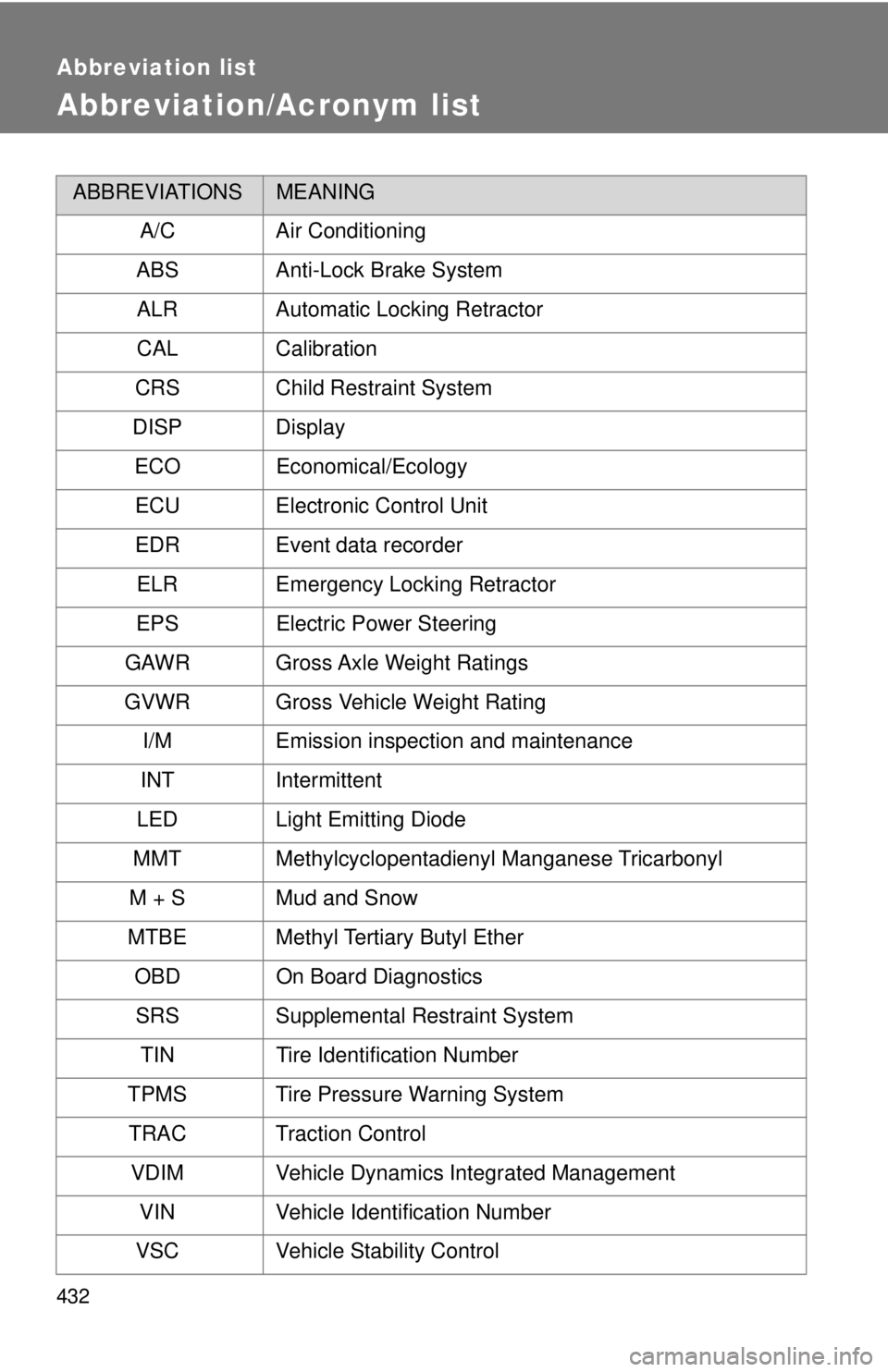
Abbreviation/Acronym list
ABBREVIATIONSMEANING
A/C Air Conditioning
ABS Anti-Lock Brake System ALR Automatic Locking Retractor
CAL Calibration
CRS Child Restraint System
DISP Display
ECO Economical/EcologyECU Electronic Control Unit
EDR Event data recorder ELR Emergency Locking Retractor
EPS Electric Power Steering
GAWR Gross Axle Weight Ratings
GVWR Gross Vehicle Weight Rating
I/M Emission inspection and maintenance
INT Intermittent
LED Light Emitting Diode
MMT Methylcyclopentadienyl Manganese Tricarbonyl
M + S Mud and Snow
MTBE Methyl Tertiary Butyl Ether
OBD On Board DiagnosticsSRS Supplemental Restraint System TIN Tire Identification Number
TPMS Tire Pressure Warning System TRAC Traction Control VDIM Vehicle Dynamics Integrated Management
VIN Vehicle Identification Number
VSC Vehicle Stability Control