brake light TOYOTA CAMRY HV 2009 User Guide
[x] Cancel search | Manufacturer: TOYOTA, Model Year: 2009, Model line: CAMRY HV, Model: TOYOTA CAMRY HV 2009Pages: 444, PDF Size: 6.46 MB
Page 282 of 444
282 4-2. Maintenance
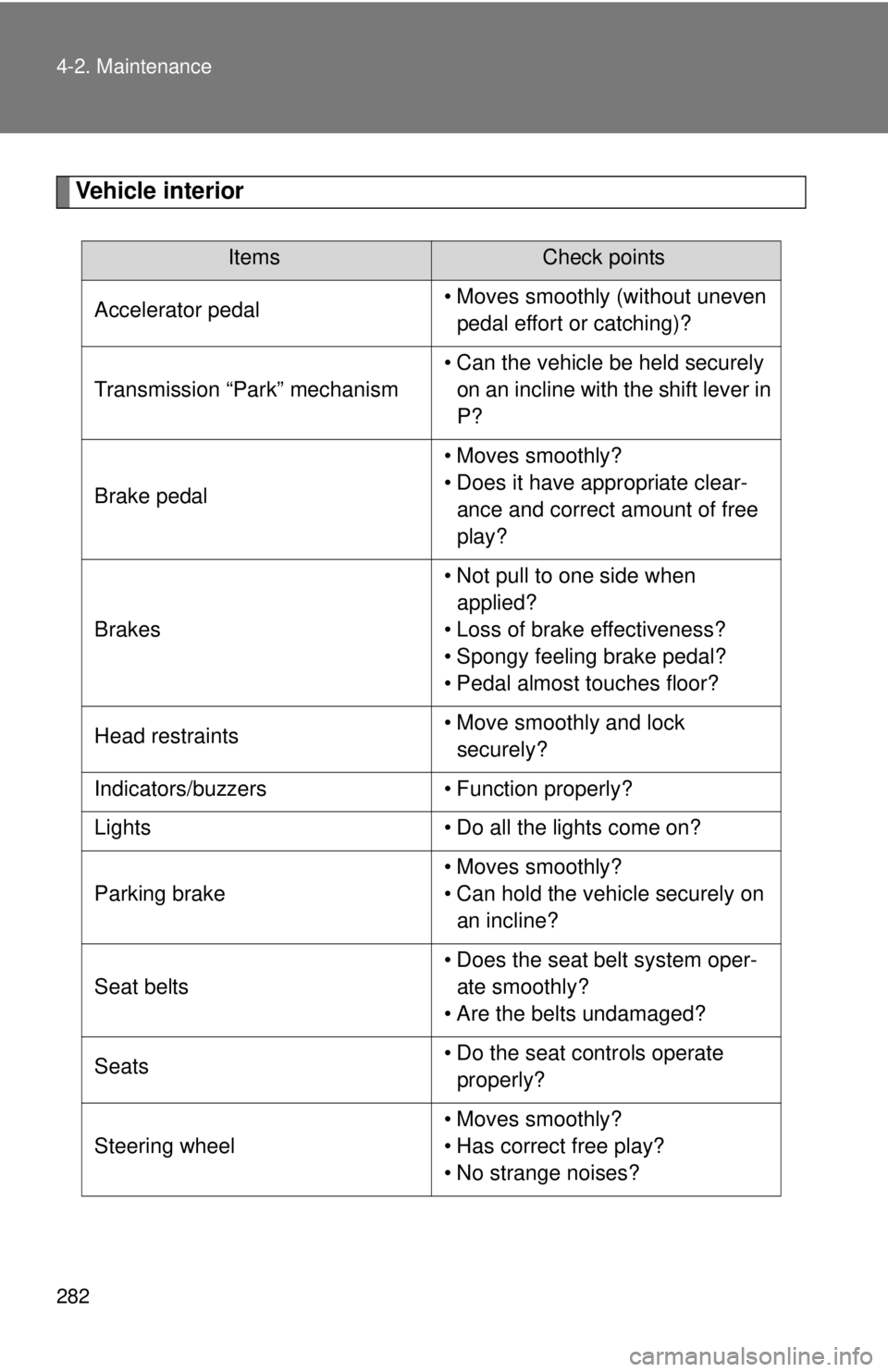
Vehicle interior
ItemsCheck points
Accelerator pedal • Moves smoothly (without uneven
pedal effort or catching)?
Transmission “Park” mechanism • Can the vehicle be held securely
on an incline with the shift lever in
P?
Brake pedal • Moves smoothly?
• Does it have appropriate clear-
ance and correct amount of free
play?
Brakes • Not pull to one side when
applied?
• Loss of brake effectiveness?
• Spongy feeling brake pedal?
• Pedal almost touches floor?
Head restraints • Move smoothly and lock
securely?
Indicators/buzzers • Function properly?
Lights • Do all the lights come on?
Parking brake • Moves smoothly?
• Can hold the vehicle securely on
an incline?
Seat belts • Does the seat belt system oper-
ate smoothly?
• Are the belts undamaged?
Seats • Do the seat controls operate
properly?
Steering wheel • Moves smoothly?
• Has correct free play?
• No strange noises?
Page 298 of 444
298 4-3. Do-it-yourself maintenance
Radiators and condenserCheck the radiators and condenser and remove any foreign objects.
If any of the above parts are extremely dirty or you are not sure of
their condition, have your vehicle checked by your Toyota dealer.
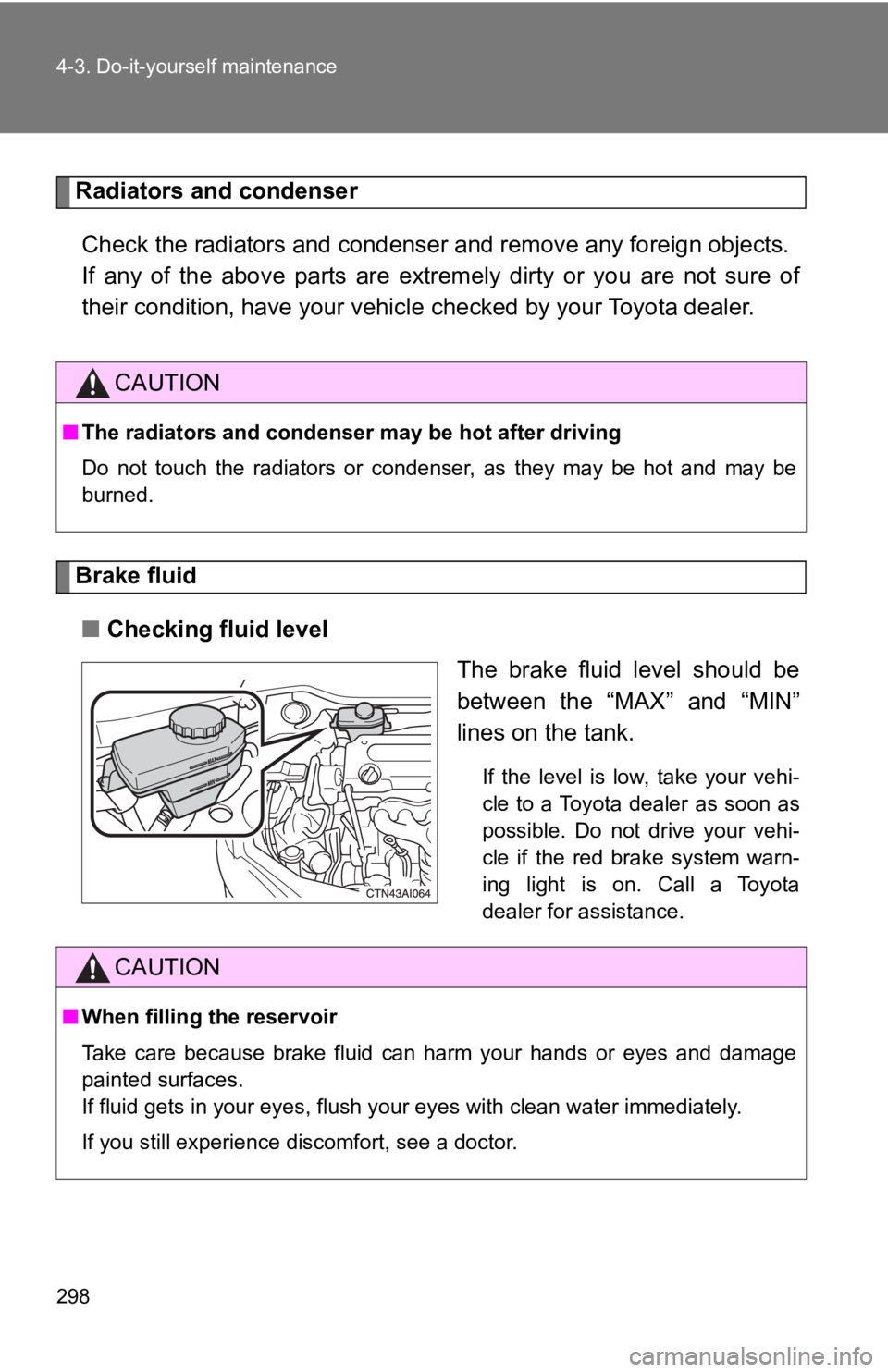
Brake fluid
■ Checking fluid level
The brake fluid level should be
between the “MAX” and “MIN”
lines on the tank.
If the level is low, take your vehi-
cle to a Toyota dealer as soon as
possible. Do not drive your vehi-
cle if the red brake system warn-
ing light is on. Call a Toyota
dealer for assistance.
CAUTION
■The radiators and condenser may be hot after driving
Do not touch the radiators or condenser, as they may be hot and may be
burned.
CAUTION
■ When filling the reservoir
Take care because brake fluid can harm your hands or eyes and damage
painted surfaces.
If fluid gets in your eyes, flush your eyes with clean water immediately.
If you still experience discomfort, see a doctor.
Page 299 of 444
299
4-3. Do-it-yourself maintenance
4
Maintenance and care
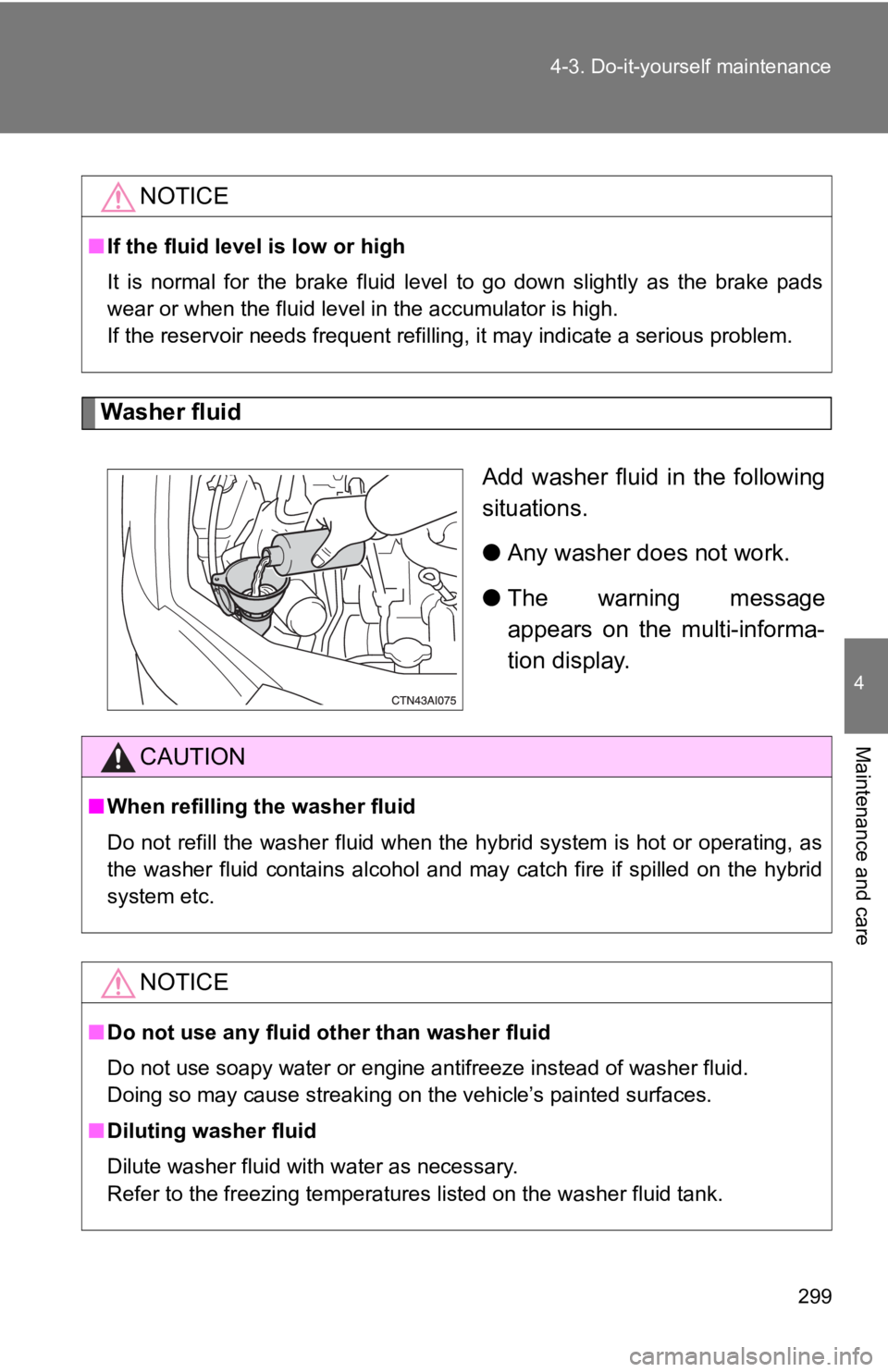
Washer fluid
Add washer fluid in the following
situations.
●Any washer does not work.
● The warning message
appears on the multi-informa-
tion display.
NOTICE
■If the fluid level is low or high
It is normal for the brake fluid level to go down slightly as the brake pads
wear or when the fluid level in the accumulator is high.
If the reservoir needs frequent refilling, it may indicate a serious problem.
CAUTION
■When refilling the washer fluid
Do not refill the washer fluid when the hybrid system is hot or operating, as
the washer fluid contains alcohol and may catch fire if spilled on the hybrid
system etc.
NOTICE
■Do not use any fluid other than washer fluid
Do not use soapy water or engine antifreeze instead of washer fluid.
Doing so may cause streaking on the vehicle’s painted surfaces.
■ Diluting washer fluid
Dilute washer fluid with water as necessary.
Refer to the freezing temperatures listed on the washer fluid tank.
Page 329 of 444

329
4-3. Do-it-yourself maintenance
4
Maintenance and care
4 AM2
7.5 A “POWER” switch
5 ABS MAIN
NO.2 10 AElectronically controlled brake sys-
tem
6 ABS MAIN
NO.1 10 AElectronically controlled brake sys-
tem
7 ABS MAIN
NO.3 10 AElectronically controlled brake sys-
tem
8 BATT FAN 10 A Hybrid battery fan
9 ETCS 10 A Electronic throttle control system
10 HAZ 15 A Turn signal lights
11 IG2 20 AMultiport fuel injection system/
sequential multiport fuel injection
system, starting system, “GAUGE
NO.2”, “INJ” and “IGN” fuses
12 STR LOCK 20 A Steering lock system
13 DOME 10 AGauges and meters, vanity lights,
trunk light, “POWER” switch light,
door courtesy lights, interior light,
personal lights, clock, smart key
system
14 ECU-B NO.1 10 A Front passenger occupant classifi-
cation system, main body ECU
15 RADIO NO.1 15 A Audio system, navigation system
16 DOOR NO.1 25 A Main body ECU, power door lock
17 IGCT 30 AHybrid system ECU, “PWR”, “IGCT
No.2” and “INV W/P” fuses
18 AMP 25 A Audio system
19 EFI MAIN 30 AMultiport fuel injection system/
sequential multiport fuel injection
system, electronic throttle control
system and “EFI NO.3” fuses
FuseAmpereCircuit
Page 332 of 444
332 4-3. Do-it-yourself maintenance
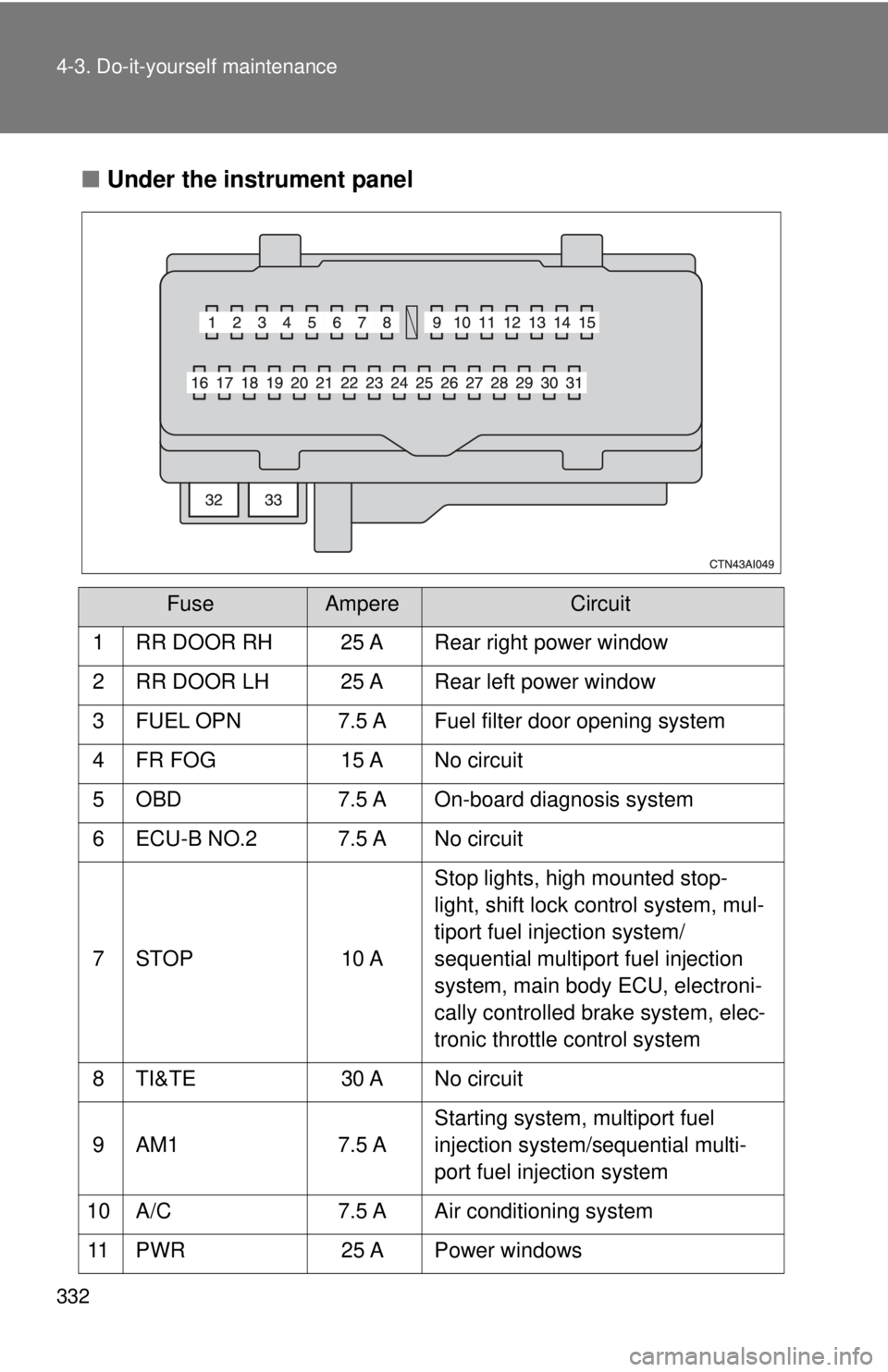
■Under the instrument panel
FuseAmpereCircuit
1 RR DOOR RH 25 A Rear right power window
2 RR DOOR LH 25 A Rear left power window
3 FUEL OPN 7.5 A Fuel filter door opening system
4 FR FOG 15 A No circuit
5 OBD 7.5 A On-board diagnosis system
6 ECU-B NO.2 7.5 A No circuit
7 STOP 10 A Stop lights, high mounted stop-
light, shift lock control system, mul-
tiport fuel injection system/
sequential multiport fuel injection
system, main body ECU, electroni-
cally controlled brake system, elec-
tronic throttle control system
8 TI&TE 30 A No circuit
9 AM1 7.5 A Starting system, multiport fuel
injection system/sequential multi-
port fuel injection system
10 A/C 7.5 A Air conditioning system
11 PWR 25 A Power windows
Page 333 of 444
333
4-3. Do-it-yourself maintenance
4
Maintenance and care
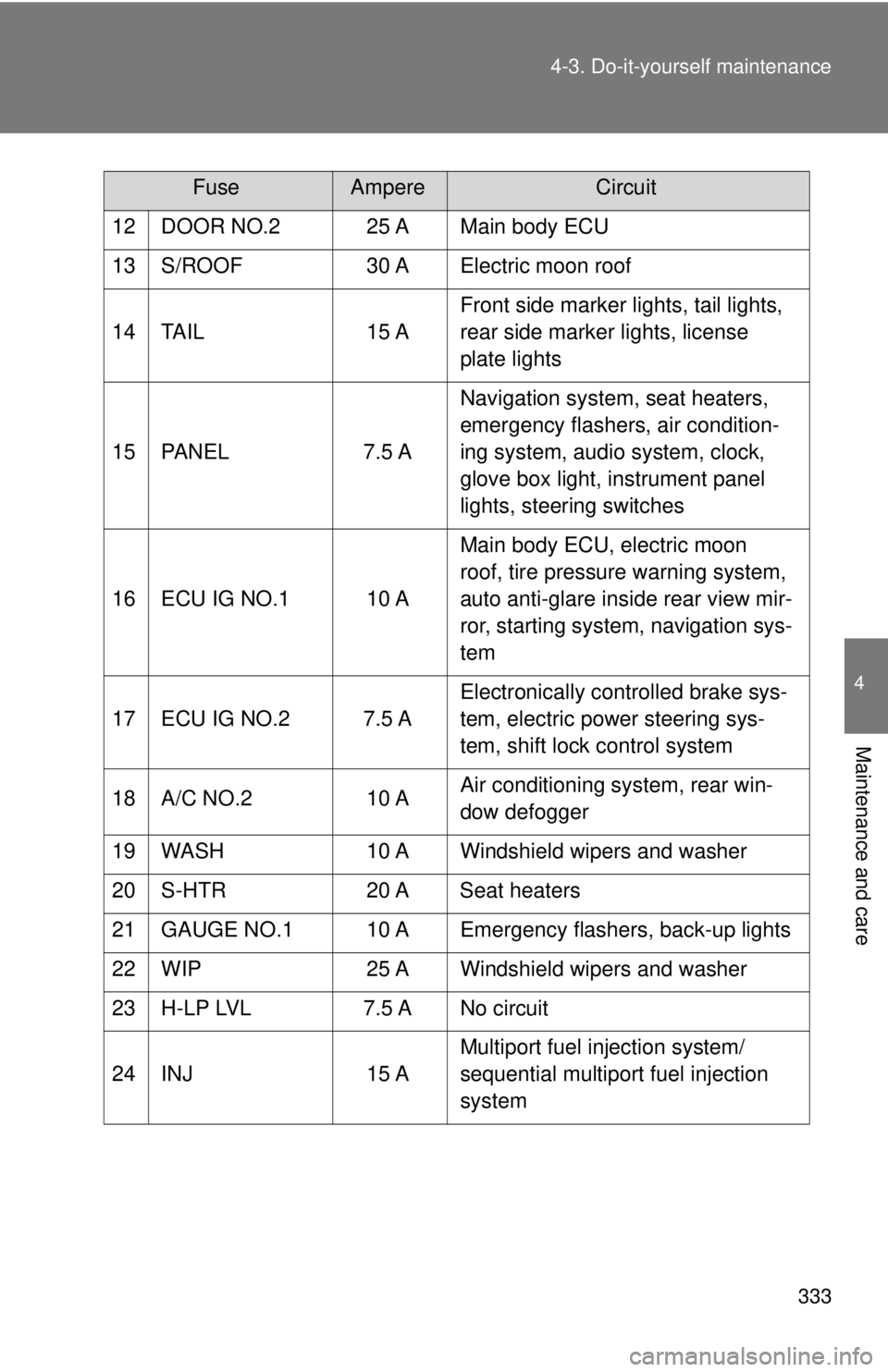
12 DOOR NO.2 25 A Main body ECU
13 S/ROOF
30 A Electric moon roof
14 TAIL 15 AFront side marker lights, tail lights,
rear side marker lights, license
plate lights
15 PANEL 7.5 ANavigation system, seat heaters,
emergency flashers, air condition-
ing system, audio system, clock,
glove box light, instrument panel
lights, steering switches
16 ECU IG NO.1 10 A Main body ECU, electric moon
roof, tire pressure warning system,
auto anti-glare inside rear view mir-
ror, starting system, navigation sys-
tem
17 ECU IG NO.2 7.5 A Electronically controlled brake sys-
tem, electric power steering sys-
tem, shift lock control system
18 A/C NO.2 10 AAir conditioning system, rear win-
dow defogger
19 WASH 10 A Windshield wipers and washer
20 S-HTR 20 A Seat heaters
21 GAUGE NO.1 10 A Emergency flashers, back-up lights
22 WIP 25 A Windshield wipers and washer
23 H-LP LVL 7.5 A No circuit
24 INJ 15 AMultiport fuel injection system/
sequential multiport fuel injection
system
FuseAmpereCircuit
Page 348 of 444
348
5-2. Steps to take in an emergency
If a warning light turns on or a warning buzzer sounds...
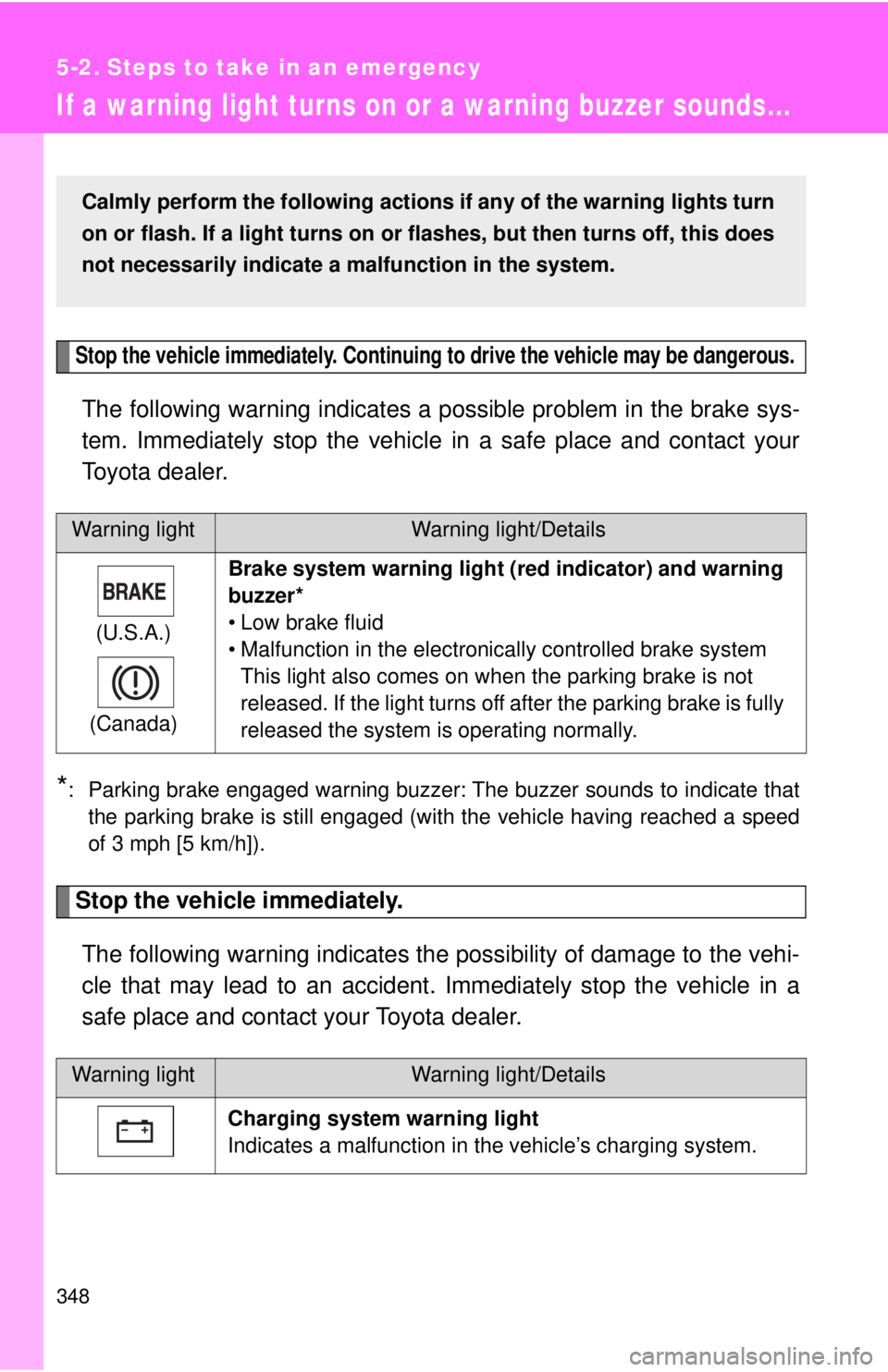
Stop the vehicle immediately. Continuing to drive the vehicle may be dangerous.
The following warning indicates a possible problem in the brake sys-
tem. Immediately stop the vehicle in a safe place and contact your
Toyota dealer.
*: Parking brake engaged warning buzzer: The buzzer sounds to indicate that the parking brake is still engaged (with the vehicle having reached a speed
of 3 mph [5 km/h]).
Stop the vehicle immediately.
The following warning indicates the possibility of damage to the vehi-
cle that may lead to an accident. Immediately stop the vehicle in a
safe place and contact your Toyota dealer.
Warning lightWarning light/Details
(U.S.A.)
(Canada) Brake system warning light (r
ed indicator) and warning
buzzer*
• Low brake fluid
• Malfunction in the electronically controlled brake system This light also comes on when the parking brake is not
released. If the light turns off after the parking brake is fully
released the system is operating normally.
Warning lightWarning light/Details
Charging system warning light
Indicates a malfunction in the vehicle’s charging system.
Calmly perform the following action s if any of the warning lights turn
on or flash. If a light turns on or flashes, but then turns off, this does
not necessarily indicate a malfunction in the system.
Page 349 of 444

5
When trouble arises
349
5-2. Steps to take in an emergency
Have the vehicle inspected immediately.
Failing to investigate the cause of the following warnings may lead to
the system operating abnormally and possibly cause an accident.
Have the vehicle inspected by your Toyota dealer immediately.
Warning lightWarning light/Details
(U.S.A.)
(Canada) Malfunction indicator lamp
Indicates a malfunction in:
• The electronic engine control system;
• The electronic throttle control system; or
• The transmission control system.
SRS warning light
Indicates a malfunction in:
• The SRS airbag system;
• The front passenger occupant classification system; or
• The seat belt pretensioner system.
(U.S.A.)
(Canada) ABS warning light
Indicates a malfunction in:
•ABS; or
• The brake assist system.
Brake system warning light (yellow indicator)
Indicates a malfunction in:
• The regenerative braking system; or
• The electronically controlled brake system.
Electric power steering warning light
Indicates a malfunction in the EPS (Electric Power Steering)
system.
Page 350 of 444

350 5-2. Steps to take in an emergency
■If the malfunction indicator lamp comes on while driving
First check the following:
● Is the fuel tank empty?
If it is, fill the fuel tank immediately.
● Is the fuel tank cap loose?
If it is, tighten it securely.
The light will go off after taking several driving trips.
If the light does not go off even after several trips, contact your Toyota dealer
as soon as possible.
■ Brake system warning light operation
The following does not indicate a malfunction:
●After the hybrid system is turned on, the red and yellow brake system
warning lights may stay on for about 60 seconds.
● Depressing the brake pedal repeatedly may turn on the red brake system
warning light and buzzer.
Page 354 of 444
354 5-2. Steps to take in an emergency
■Customization that can be configured at Toyota dealer
The vehicle speed linked seat belt reminder buzzer can be disabled.
(Customizable features →P. 421)
However, Toyota recommends that the seat belt reminder buzzer be opera-
tional to alert the driver and front passenger that the seat belts are not fas-
tened.
CAUTION
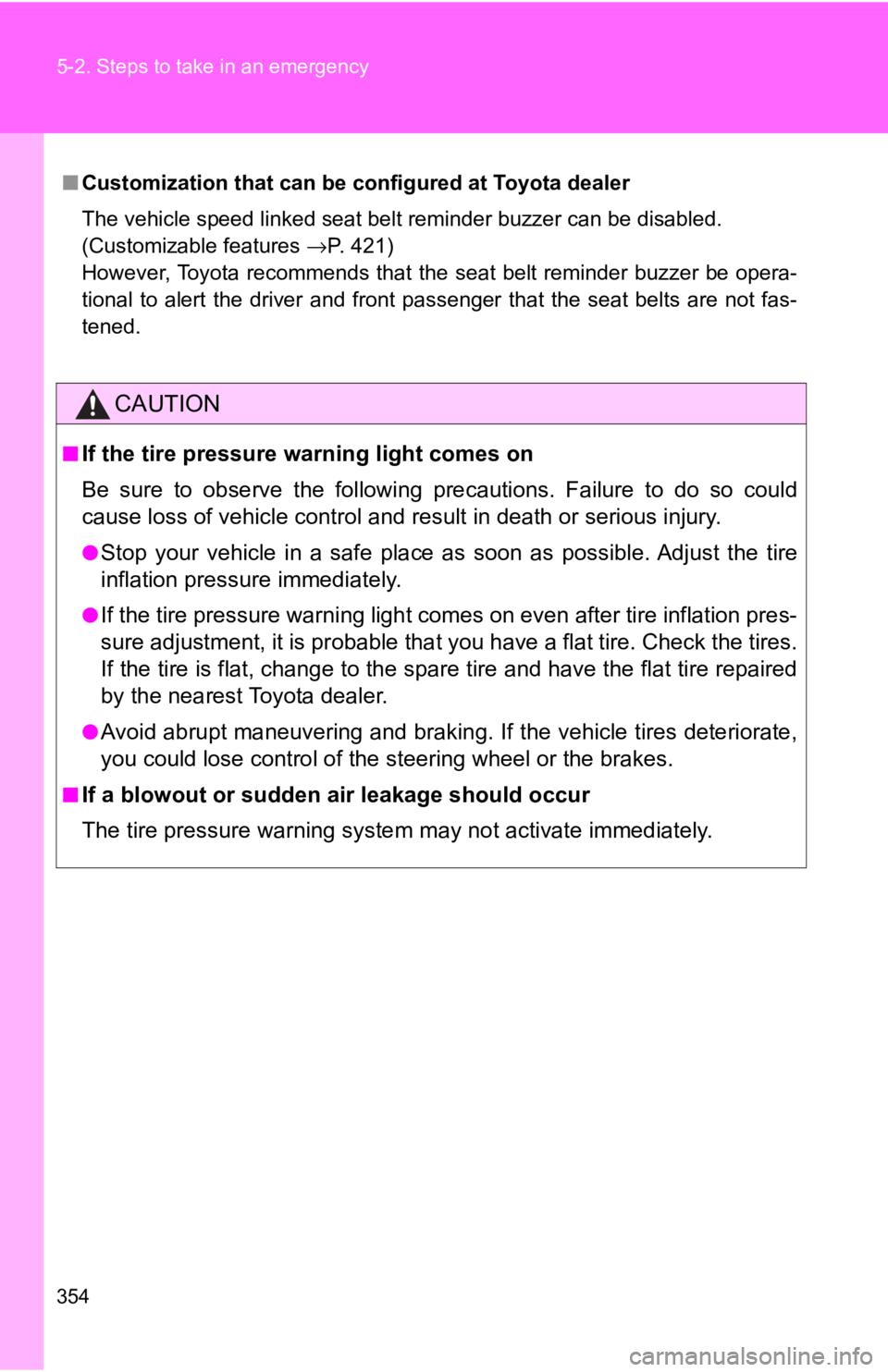
■If the tire pressure warning light comes on
Be sure to observe the following precautions. Failure to do so could
cause loss of vehicle control and result in death or serious injury.
●Stop your vehicle in a safe place as soon as possible. Adjust the tire
inflation pressure immediately.
●If the tire pressure warning light comes on even after tire inflation pres-
sure adjustment, it is pr obable that you have a flat tire. Check the tires.
If the tire is flat, change to the spar e tire and have the flat tire repaired
by the nearest Toyota dealer.
●Avoid abrupt maneuvering and braking. If the vehicle tires deteriorate,
you could lose control of the steering wheel or the brakes.
■If a blowout or sudden air leakage should occur
The tire pressure warning syste m may not activate immediately.