brakes TOYOTA CAMRY HV 2009 User Guide
[x] Cancel search | Manufacturer: TOYOTA, Model Year: 2009, Model line: CAMRY HV, Model: TOYOTA CAMRY HV 2009Pages: 444, PDF Size: 6.46 MB
Page 383 of 444
5
When trouble arises
383
5-2. Steps to take in an emergency
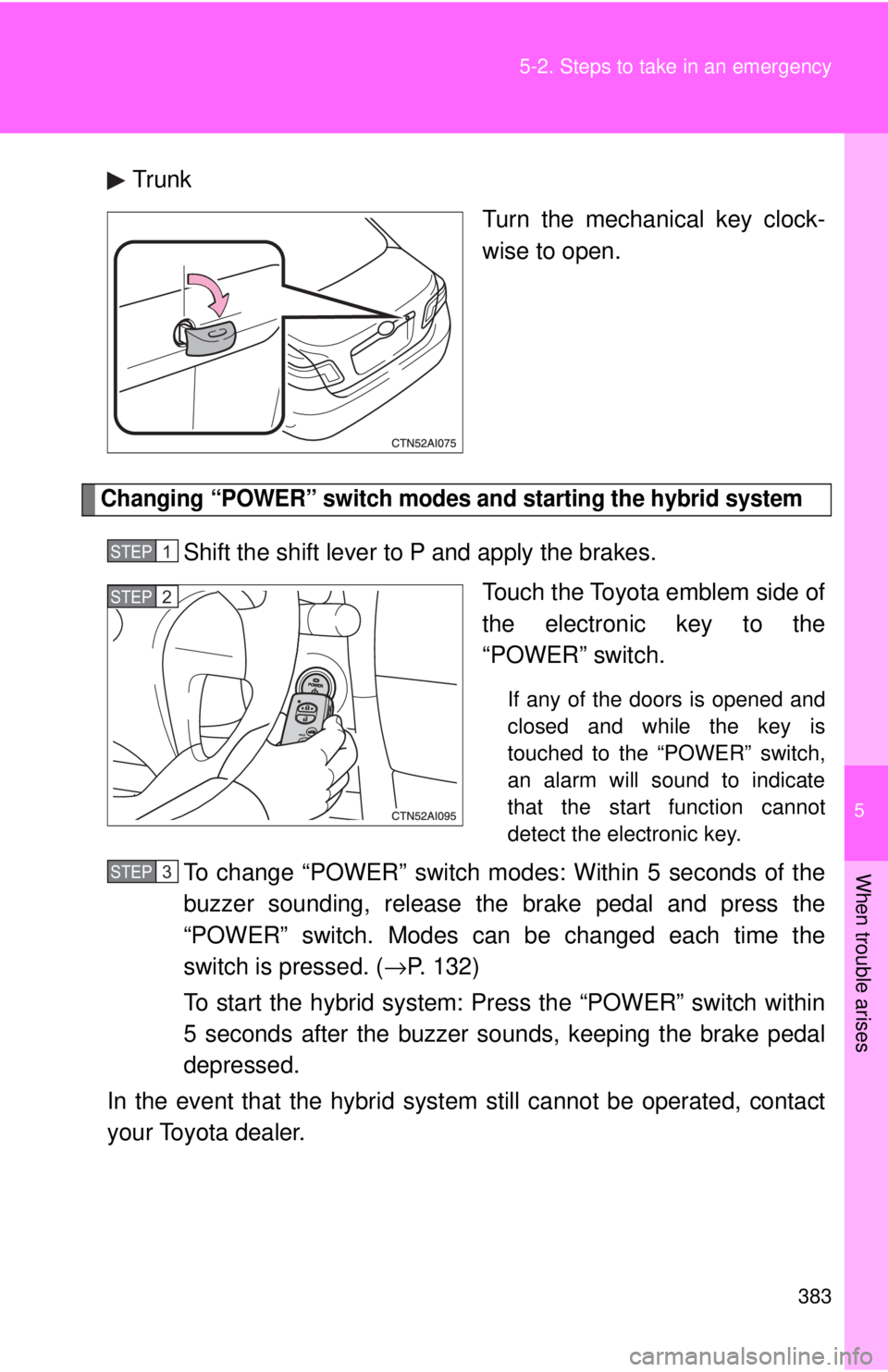
Trunk
Turn the mechanical key clock-
wise to open.
Changing “POWER” switch modes and starting the hybrid system
Shift the shift lever to P and apply the brakes.Touch the Toyota emblem side of
the electronic key to the
“POWER” switch.
If any of the doors is opened and
closed and while the key is
touched to the “POWER” switch,
an alarm will sound to indicate
that the start function cannot
detect the electronic key.
To change “POWER” switch modes: Within 5 seconds of the
buzzer sounding, release the brake pedal and press the
“POWER” switch. Modes can be changed each time the
switch is pressed. ( →P. 132)
To start the hybrid system: Press the “POWER” switch within
5 seconds after the buzzer so unds, keeping the brake pedal
depressed.
In the event that the hybrid syst em still cannot be operated, contact
your Toyota dealer.
STEP1
STEP2
STEP3
Page 403 of 444
403
6-1. Specifications
6
Vehicle specifications
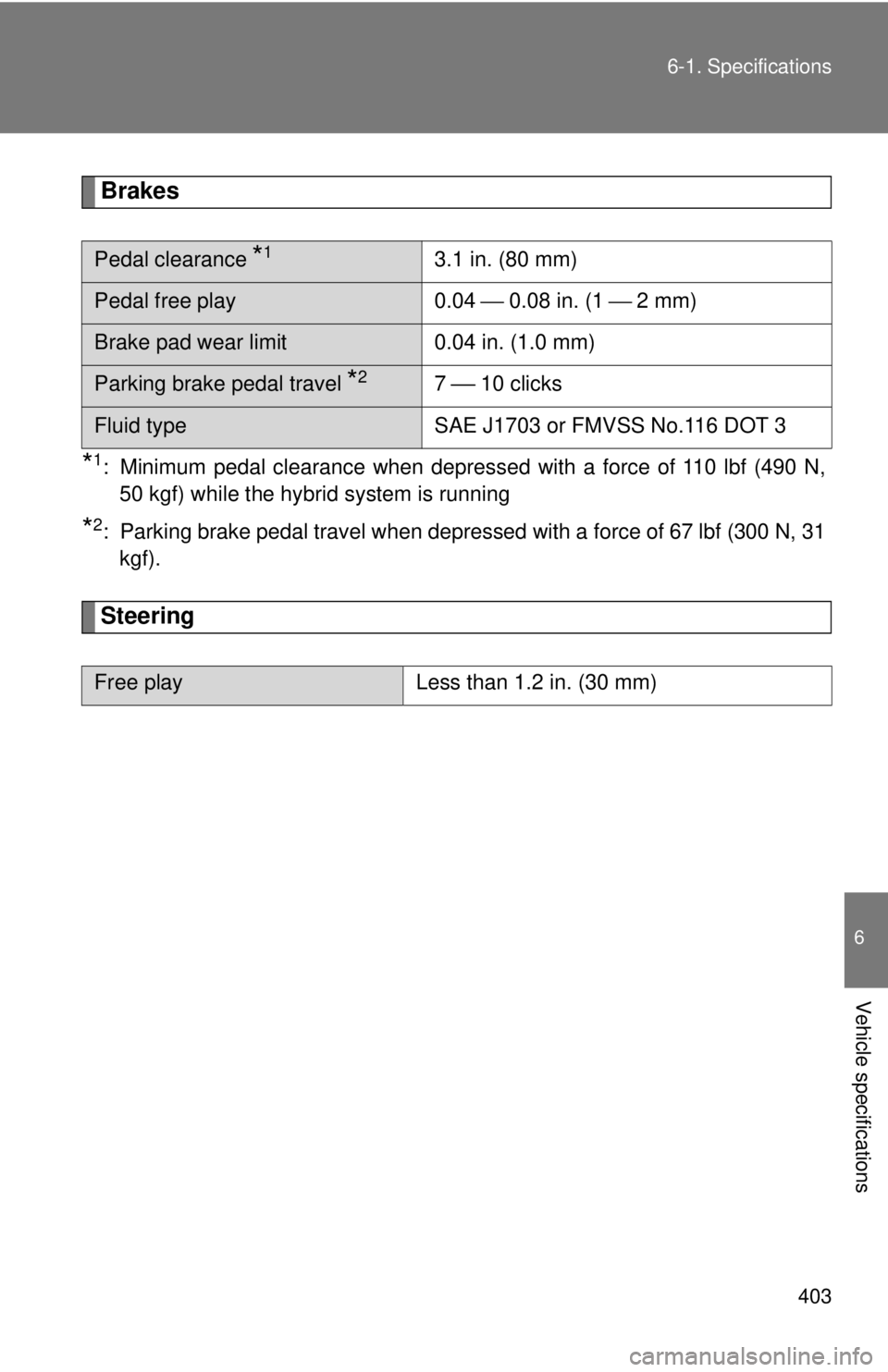
Brakes
*1: Minimum pedal clearance when depressed with a force of 110 lbf (490 N,
50 kgf) while the hybrid system is running
*2: Parking brake pedal travel when depressed with a force of 67 lbf (300 N, 31kgf).
Steering
Pedal clearance *13.1 in. (80 mm)
Pedal free play 0.04 ⎯ 0.08 in. (1 ⎯ 2 mm)
Brake pad wear limit 0.04 in. (1.0 mm)
Parking brake pedal travel *27 ⎯ 10 clicks
Fluid type SAE J1703 or FMVSS No.116 DOT 3
Free playLess than 1.2 in. (30 mm)
Page 415 of 444

415
6-1. Specifications
6
Vehicle specifications
Warning: The temperature grades for this tire are established for a
tire that is properly inflated and not overloaded.
Excessive speed, underinflation, or
excessive loading, either sepa-
rately or in combination, can caus e heat buildup and possible tire fail-
ure.
Glossary of tire terminology
Tire related termMeaning
Cold tire inflation pres-
sure Tire pressure when the vehicle has been
parked for three hours or more, or has not
been driven more than 1 mile or 1.5 km under
that condition
Maximum inflation
pressure The maximum cold inflated
pressure to which a
tire may be inflated, s hown on the sidewall of
the tire
Recommended infla-
tion pressure Cold tire inflation pressure recommended by a
manufacturer
Accessory weight The combined weight (in excess of those stan-
dard items which may be replaced) of auto-
matic transmission, power steering, power
brakes, power windows, power seats, radio
and heater, to the extent that these items are
available as factory-installed equipment
(whether installed or not)
Curb weight The weight of a motor vehicle with standard
equipment, including the maximum capacity of
fuel, oil and coolant, and if so equipped, air
conditioning and additional weight optional
engine
Maximum loaded vehi-
cle weight The sum of:
(a) Curb weight
(b) Accessory weight
(c) Vehicle capacity weight
(d) Production options weight
Page 416 of 444

416 6-1. Specifications
Tire related termMeaning
Normal occupant
weight 150 lb. (68 kg) times the number of occupants
specified in the second column of Table 1
* that
follows
Occupant distribution Distribution of occupants in a vehicle as speci-
fied in the third column of Table 1
* below
Production options
weight The combined weight of
installed regular pro-
duction options weighing over 5 lb. (2.3 kg) in
excess of the standard items which they
replace, not previously considered in curb
weight or accessory weight, including heavy
duty brakes, ride levelers, roof rack, heavy duty
battery, and special trim
Rim A metal support for a tire or a tire and tube
assembly upon which the tire beads are seated
Rim diameter
(Wheel diameter) Nominal diameter of the bead seat
Rim size designation Rim diameter and width
Rim type designation The industry manufacturer's designation for a
rim by style or code
Rim width Nominal distance between rim flanges
Vehicle capacity
weight (Total load
capacity) The rated cargo and luggage load plus 150 lb.
(68 kg) times the vehicl
e's designated seating
capacity
Vehicle maximum load
on the tire The load on an individual tire that is determined
by distributing to each axle its share of the
maximum loaded vehicle weight, and dividing
by two
Vehicle normal load
on the tire The load on an individual tire that is determined
by distributing to each axle its share of curb
weight, accessory weight, and normal occu-
pant weight (distributed
in accordance with
Ta b l e 1
* below), and dividing by two