ECU TOYOTA CAMRY HV 2011 Service Manual
[x] Cancel search | Manufacturer: TOYOTA, Model Year: 2011, Model line: CAMRY HV, Model: TOYOTA CAMRY HV 2011Pages: 508, PDF Size: 8.76 MB
Page 381 of 508
381
4-3. Do-it-yourself maintenance
4
Maintenance and care
■
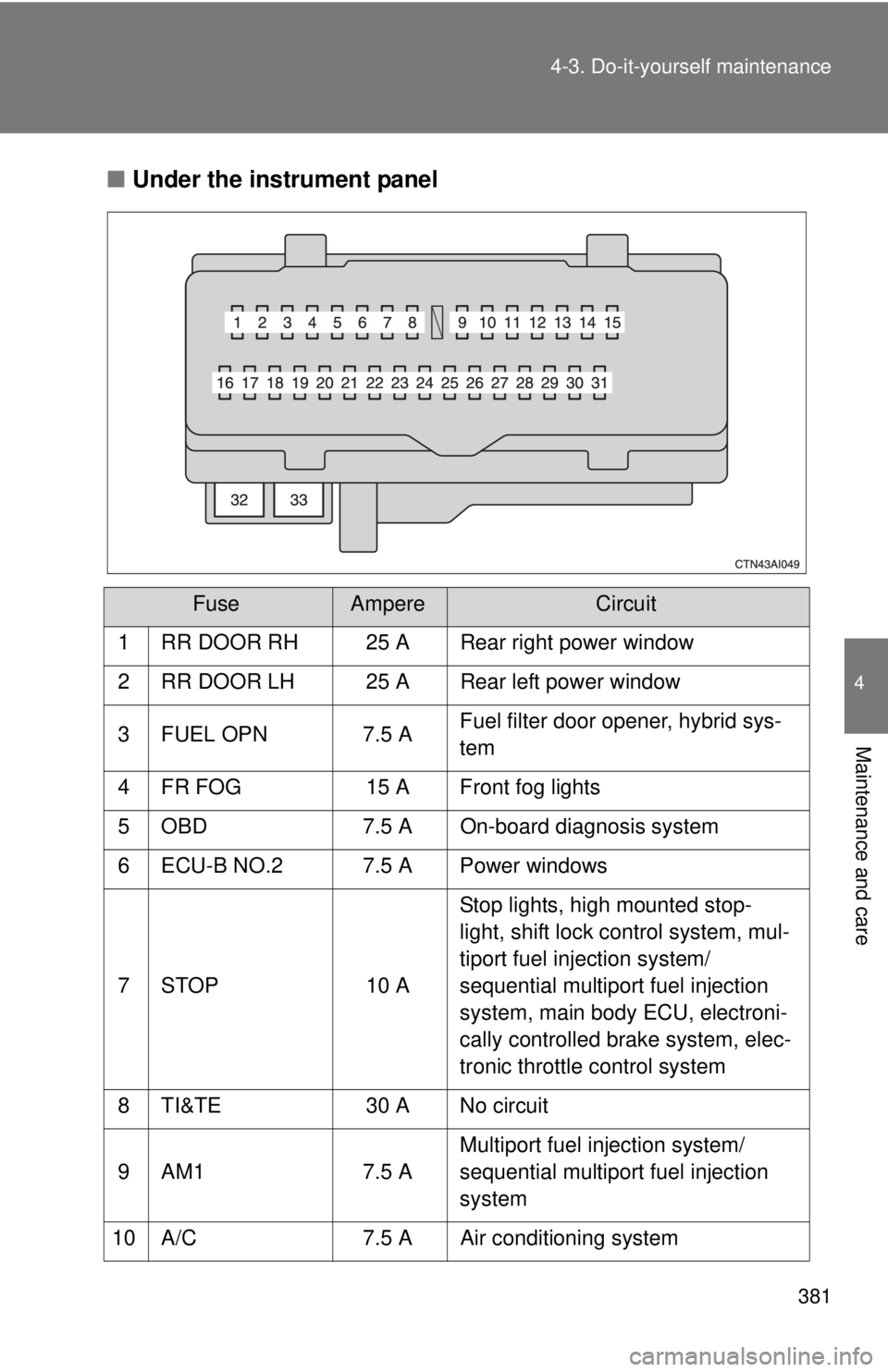
Under the instrument panel
FuseAmpereCircuit
1 RR DOOR RH 25 A Rear right power window
2 RR DOOR LH 25 A Rear left power window
3 FUEL OPN 7.5 A Fuel filter door opener, hybrid sys-
tem
4 FR FOG 15 A Front fog lights
5 OBD 7.5 A On-board diagnosis system
6 ECU-B NO.2 7.5 A Power windows
7 STOP 10 A Stop lights, high mounted stop-
light, shift lock control system, mul-
tiport fuel injection system/
sequential multiport fuel injection
system, main body ECU, electroni-
cally controlled brake system, elec-
tronic throttle control system
8 TI&TE 30 A No circuit
9 AM1 7.5 A Multiport fuel injection system/
sequential multiport fuel injection
system
10 A/C 7.5 A Air conditioning system
Page 382 of 508

382 4-3. Do-it-yourself maintenance
11 PWR25 A Power windows
12 DOOR NO.2 25 A Main body ECU
13 S/ROOF 30 A Moon roof
14 TAIL 15 AFront side marker/parking lights,
stop/tail lights, rear side marker
lights, license plate lights, front turn
signal lights, main body ECU
15 PANEL 7.5 ANavigation system, seat heaters,
emergency flashers, air condition-
ing system, audio system, clock,
glove box light, instrument panel
lights, steering switches, rear win-
dow defogger
16 ECU IG NO.1 10 A Main body ECU, electric moon
roof, tire pressure warning system,
auto anti-glare inside rear view mir-
ror, starting system, navigation sys-
tem
17 ECU IG NO.2 7.5 A Electronically controlled brake sys-
tem, electric power steering sys-
tem, shift lock control system
18 A/C NO.2 10 AAir conditioning system, rear win-
dow defogger
19 WASH 10 A Windshield wipers and washer
20 S-HTR 20 A Seat heaters
21 GAUGE NO.1 10 A Emergency flashers, back-up lights
22 WIP 25 A Windshield wipers and washer
23 H-LP LVL 7.5 A No circuit
24 INJ 15 A No circuit
FuseAmpereCircuit
Page 383 of 508

383
4-3. Do-it-yourself maintenance
4
Maintenance and care
25 IGN
10 AMultiport fuel injection system/
sequential multiport fuel injection
system, SRS airbag system, steer-
ing lock system, front passenger
occupant classification system,
smart key system, electronic throt-
tle control system
26 GAUGE NO.2 7.5 A Gauges and meters, clock
27 ECU-ACC 7.5 A Clock, main body ECU, shift lock
control system, outside rear view
mirrors, smart key system
28 CIG 20 A No circuit
29 PWR OUTLET 20 A Power outlet
30 RADIO NO.2 7.5 A Audio system, navigation system
31 MIR HTR 10 A Outside rear view mirror defoggers
32 POWER 30 A Power windows
33 P/SEAT 30 A Power seat
■ After a fuse is replaced
●If the lights do not turn on even after the fuse has been replaced, a bulb
may need replacing. ( P. 385)
● If the replaced fuse blows again, have the vehicle inspected by your
Toyota dealer.
■ If there is an overload in the circuits
The fuses are designed to blow, protecting the wiring harness from damage.
FuseAmpereCircuit
Page 389 of 508
389
4-3. Do-it-yourself maintenance
4
Maintenance and care
CAUTION
■
Replacing light bulbs
●Turn off the headlights. Do not attempt to replace the bulb immediately
after turning off the headlights.
The bulbs become very hot and may cause burns.
● Do not touch the glass portion of the light bulb with bare hands. Hold the
bulb by the plastic or metal portion.
If the bulb is scratched or dropped it may blow out or crack.
● Fully install light bulbs and any parts used to secure them. Failing to do so
may result in heat damage, fire, or water entering the headlight unit. This
may damage the headlights or cause condensation to build up on the lens.
■ To prevent damage or fire
Make sure bulbs are fully seated and locked.
Page 401 of 508

5
When trouble arises
401
5-2. Steps to take in an emergency
■
If the malfunction indicator lamp comes on while driving
First check the following:
● Is the fuel tank empty?
If it is, fill the fuel tank immediately.
● Is the fuel tank cap loose?
If it is, tighten it securely.
The light will go off after taking several driving trips.
If the light does not go off even after several trips, contact your Toyota dealer
as soon as possible.
■ Brake system warning light operation
The following does not indicate a malfunction:
●After the hybrid system is turned on, the red and yellow brake system
warning lights may stay on for about 60 seconds.
● Depressing the brake pedal repeatedly may turn on the red brake system
warning light and buzzer.
Page 425 of 508
5
When trouble arises
425
5-2. Steps to take in an emergency
■If you have a flat front tire on a road covered with snow or ice
Install the compact spare tire on the rear of the vehicle. Perform the fol-
lowing steps and fit tire chains to the front tires.
Replace a rear tire with the compact spare tire.
Replace the flat front tire with the tire removed from the rear of
the vehicle.
Fit tire chains to the front tires.
■After completing the tire change (U.S.A. only)
The tire pressure warning system must be reset. (P. 355)
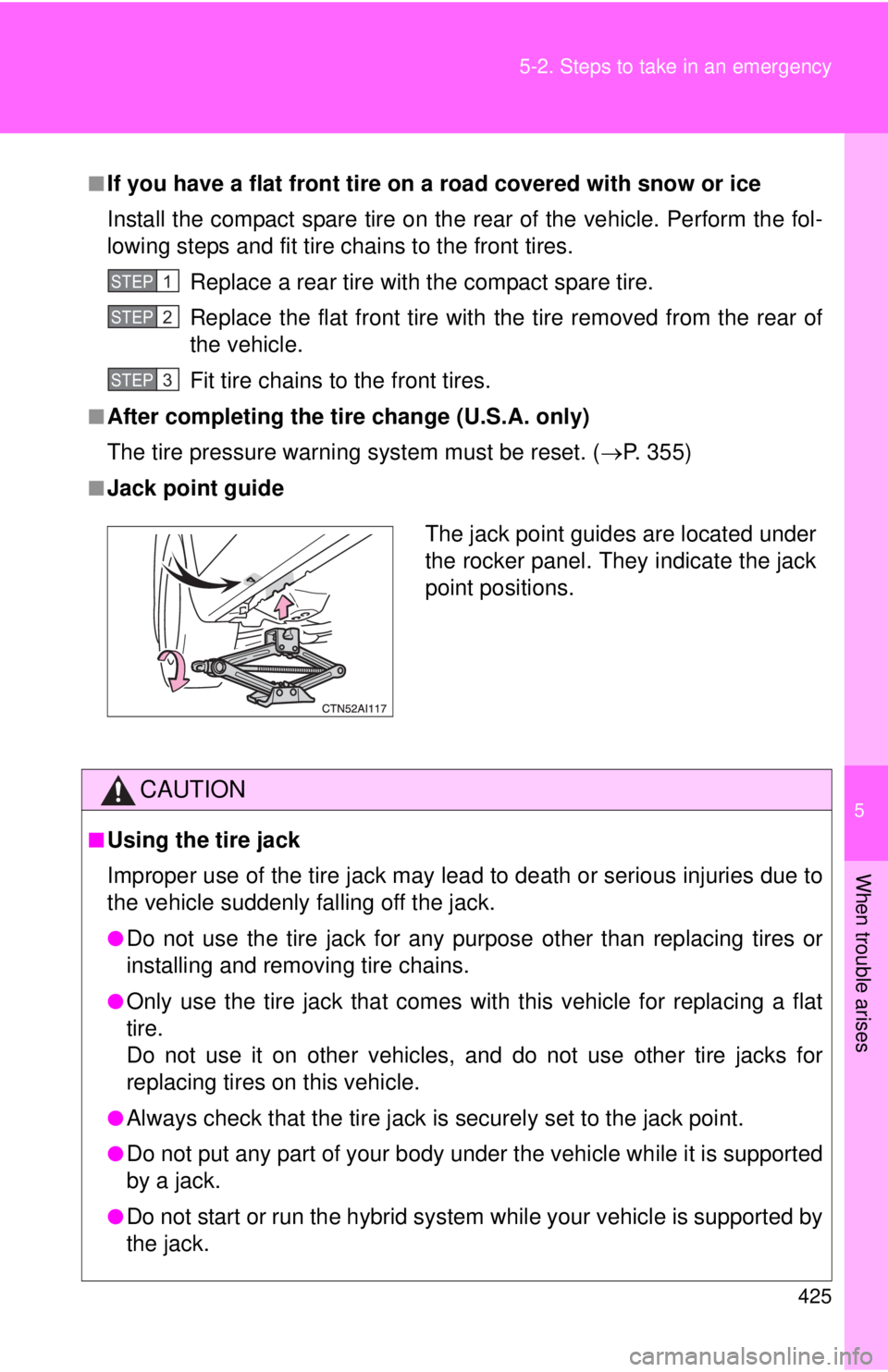
■Jack point guide
CAUTION
■Using the tire jack
Improper use of the tire jack may lead to death or serious injuries due to
the vehicle suddenly falling off the jack.
●Do not use the tire jack for any pu rpose other than replacing tires or
installing and removing tire chains.
●Only use the tire jack that comes wi th this vehicle for replacing a flat
tire.
Do not use it on other vehicles, and do not use other tire jacks for
replacing tires on this vehicle.
●Always check that the tire jack is securely set to the jack point.
●Do not put any part of your body under the vehicle while it is supported
by a jack.
●Do not start or run the hybrid system while your vehicle is supported by
the jack.
STEP1
STEP2
STEP3
The jack point guides are located under
the rocker panel. They indicate the jack
point positions.
Page 473 of 508
473
6-1. Specifications
6
Vehicle specifications
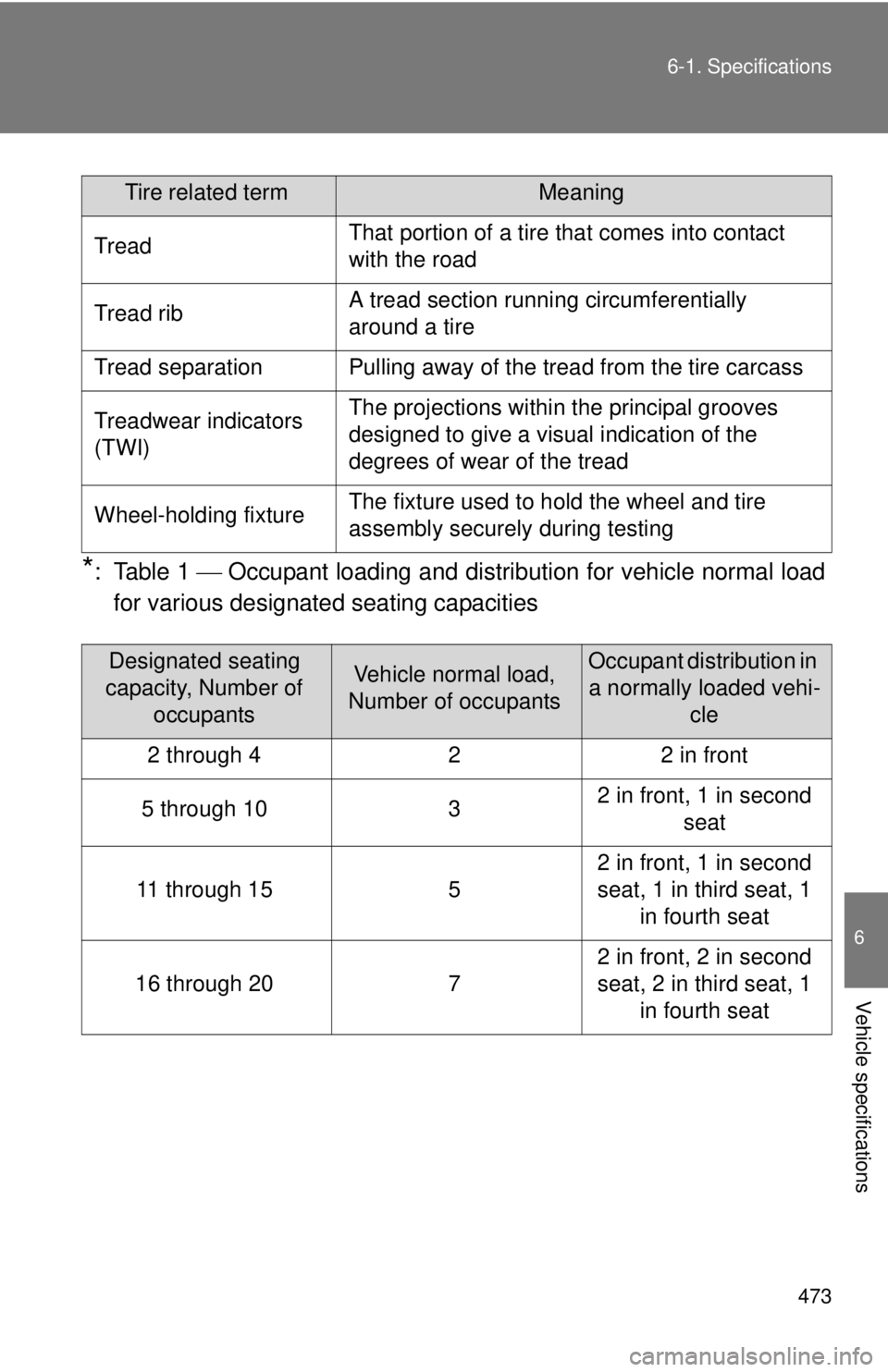
*: Table 1
Occupant loading and distri bution for vehicle normal load
for various designated seating capacities
Tire related termMeaning
Tread That portion of a tire that comes into contact
with the road
Tread rib A tread section running circumferentially
around a tire
Tread separation Pulling away of the tread from the tire carcass
Treadwear indicators
(TWI) The projections within the principal grooves
designed to give a visual indication of the
degrees of wear of the tread
Wheel-holding fixture The fixture used to hold the wheel and tire
assembly securely
during testing
Designated seating
capacity, Number of occupantsVehicle normal load,
Number of occupantsOccupant distribution in a normally loaded vehi- cle
2 through 4 2 2 in front
5 through 10 3 2 in front, 1 in second
seat
11 through 15 5 2 in front, 1 in second
seat, 1 in third seat, 1
in fourth seat
16 through 20 7 2 in front, 2 in second
seat, 2 in third seat, 1
in fourth seat
Page 481 of 508

481
7
For owners
Seat belt instructions for Canadian owners (in French)
Utilisation correcte des ceintures de sécurité●Tendez la sangle diagonale de
sorte qu'elle couvre
complètement l'épaule, sans
entrer en contact avec le cou
ou glisser de l'épaule.
● Placez la sangle abdominale
le plus bas possible sur les
hanches.
● Réglez la position du dossier
de siège. Asseyez-vous le dos
le plus droit possible et calez-
vous bien dans le siège.
● Ne vrillez pas la ceinture de
sécurité.
The following is a French explanation of seat belt instructions
extracted from the seat belt section in this manual.
See the seat belt section for more detailed seat belt instructions in
English.
Page 482 of 508
482
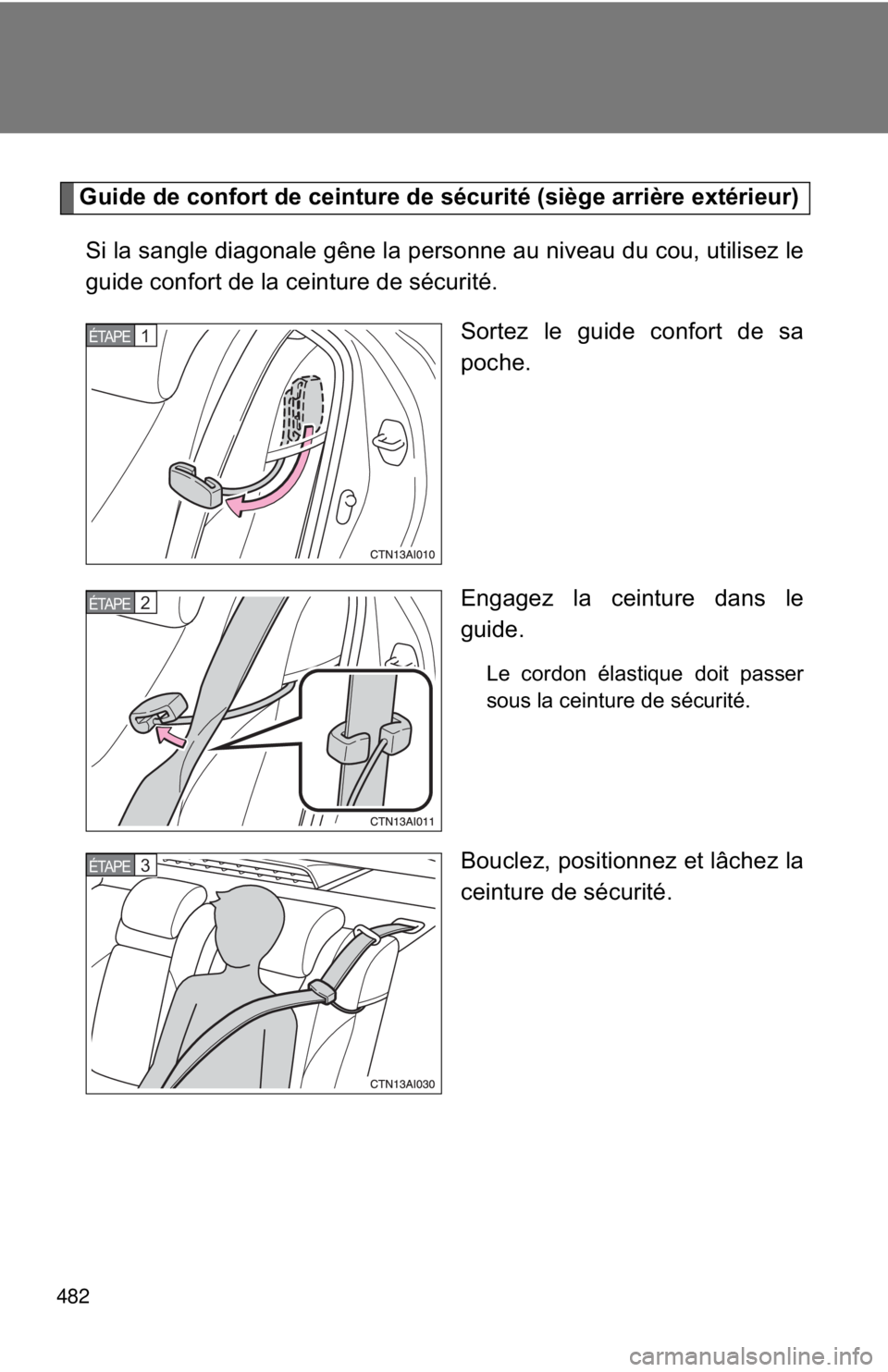
Guide de confort de ceinture de sécurité (siège arrière extérieur)Si la sangle diagonale gêne la personne au niveau du cou, utilisez le
guide confort de la ceinture de sécurité. Sortez le guide confort de sa
poche.
Engagez la ceinture dans le
guide.
Le cordon élastique doit passer
sous la ceinture de sécurité.
Bouclez, positionnez et lâchez la
ceinture de sécurité.
1ÉTAPE
2ÉTAPE
3ÉTAPE
Page 483 of 508
483
7
For owners
Entretien et soin
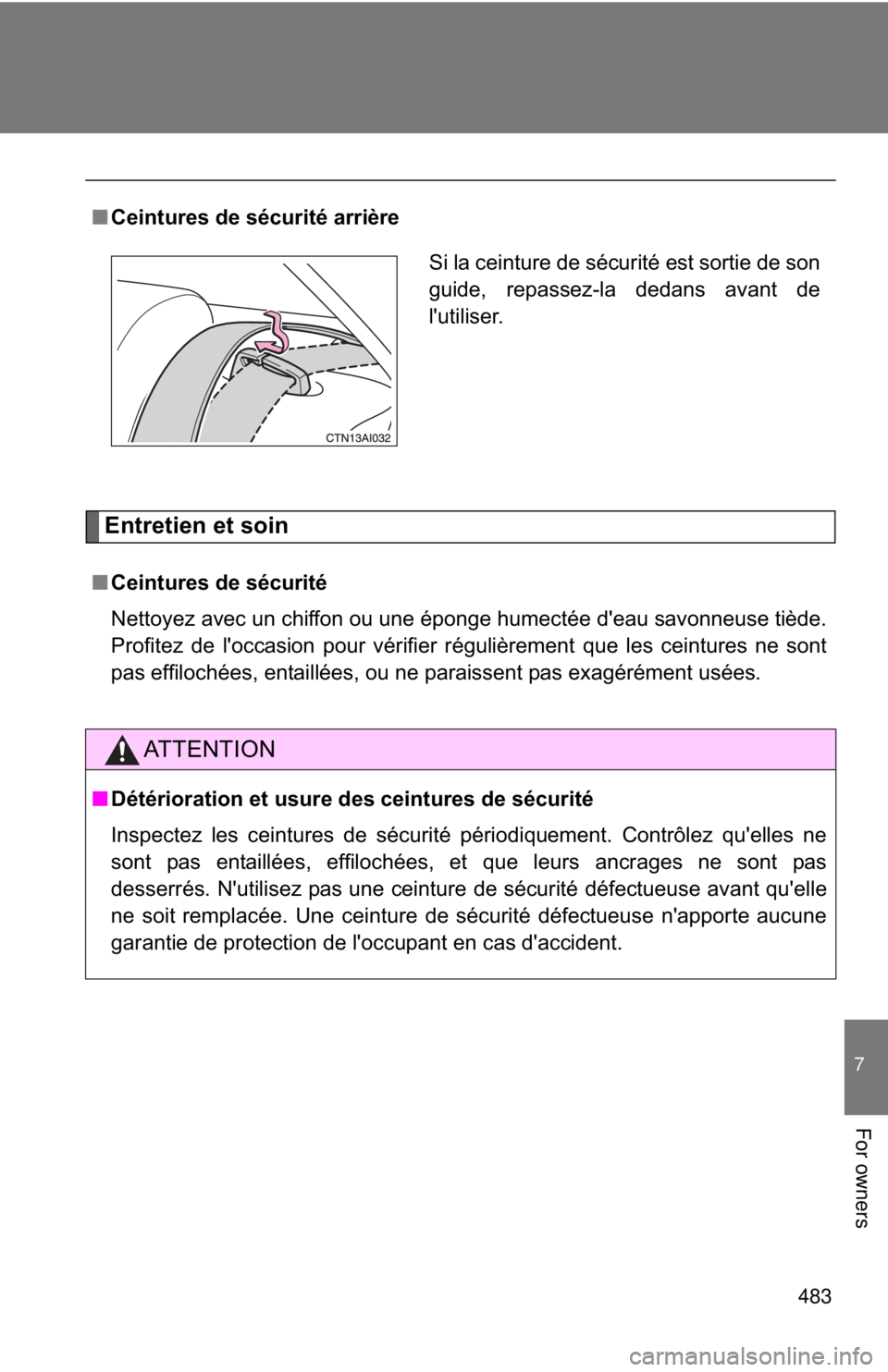
■Ceintures de sécurité arrière
■ Ceintures de sécurité
Nettoyez avec un chiffon ou une éponge humectée d'eau savonneuse tiède.
Profitez de l'occasion pour vérifier régulièrement que les ceintures ne sont
pas effilochées, entaillées, ou ne paraissent pas exagérément usées.
AT T E N T I O N
■Détérioration et usure des ceintures de sécurité
Inspectez les ceintures de sécurité périodiquement. Contrôlez qu'elles ne
sont pas entaillées, effilochées, et que leurs ancrages ne sont pas
desserrés. N'utilisez pas une ceinture de sécurité défectueuse avant qu'elle
ne soit remplacée. Une ceinture de sécurité défectueuse n'apporte aucune
garantie de protection de l'occupant en cas d'accident.
Si la ceinture de sécurité est sortie de son
guide, repassez-la dedans avant de
l'utiliser.