wipers TOYOTA CAMRY HYBRID 2023 Owners Manual
[x] Cancel search | Manufacturer: TOYOTA, Model Year: 2023, Model line: CAMRY HYBRID, Model: TOYOTA CAMRY HYBRID 2023Pages: 624, PDF Size: 10.51 MB
Page 3 of 624
3
1
9 7 6
5
4
3
2
8
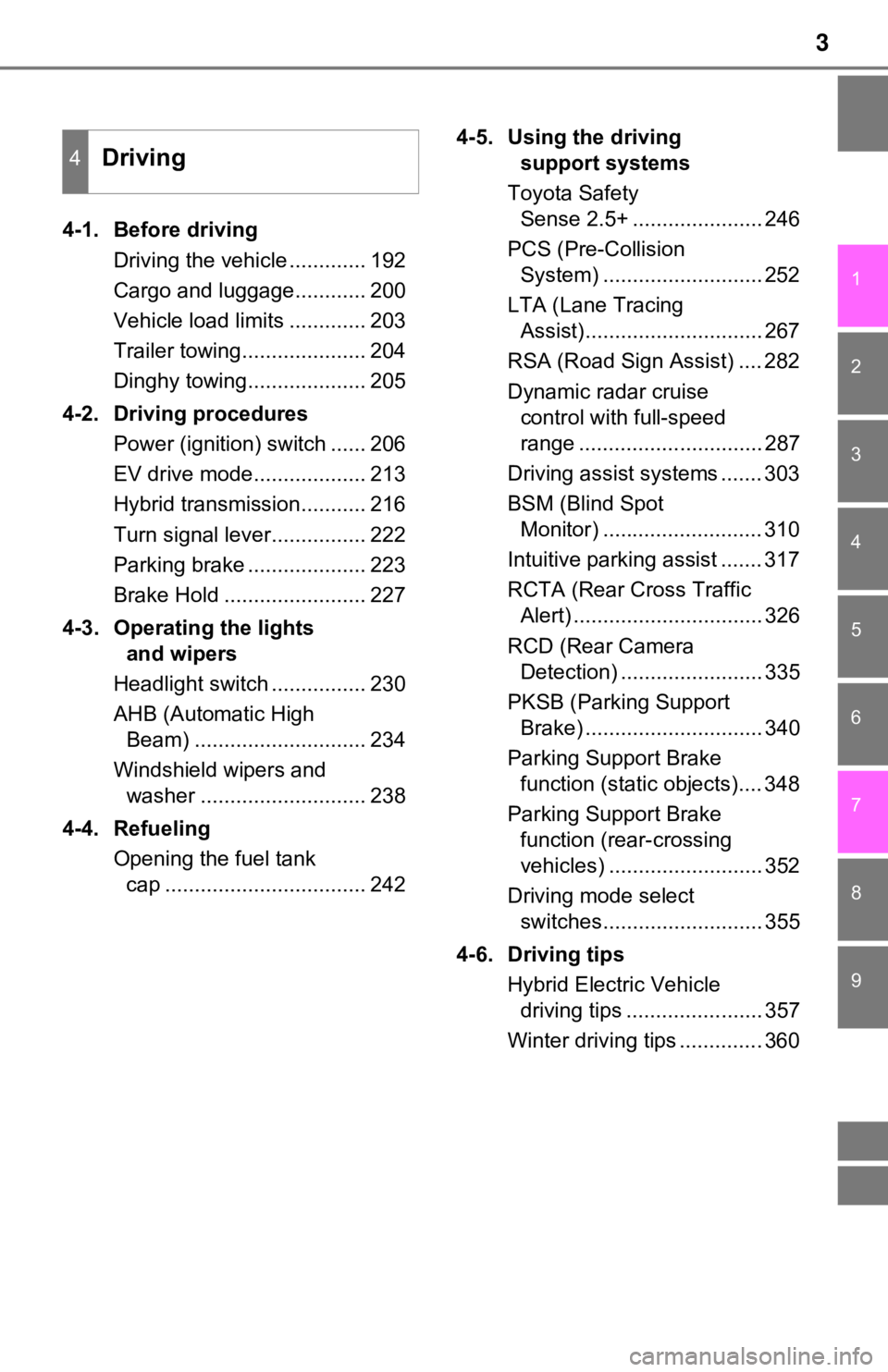
4-1. Before drivingDriving the vehicle ............. 192
Cargo and luggage............ 200
Vehicle load limits ............. 203
Trailer towing..................... 204
Dinghy towing.................... 205
4-2. Driving procedures Power (ignition) switch ...... 206
EV drive mode................... 213
Hybrid transmission........... 216
Turn signal lever................ 222
Parking brake .................... 223
Brake Hold ........................ 227
4-3. Operating the lights and wipers
Headlight switch ................ 230
AHB (Automatic High Beam) ............................. 234
Windshield wipers and washer ............................ 238
4-4. Refueling Opening the fuel tank cap .................................. 242 4-5. Using the driving
support systems
Toyota Safety Sense 2.5+ ...................... 246
PCS (Pre-Collision System) ........................... 252
LTA (Lane Tracing Assist).............................. 267
RSA (Road Sign Assist) .... 282
Dynamic radar cruise control with full-speed
range ............................... 287
Driving assist systems ....... 303
BSM (Blind Spot Monitor) ........................... 310
Intuitive parking assist ....... 317
RCTA (Rear Cross Traffic Alert) ................................ 326
RCD (Rear Camera Detection) ........................ 335
PKSB (Parking Support Brake) .............................. 340
Parking Support Brake function (static objects).... 348
Parking Support Brake function (rear-crossing
vehicles) .......................... 352
Driving mode select switches........................... 355
4-6. Driving tips Hybrid Electric Vehicle driving tips ....................... 357
Winter driving tips .............. 360
4Driving
Page 15 of 624
15Pictorial index
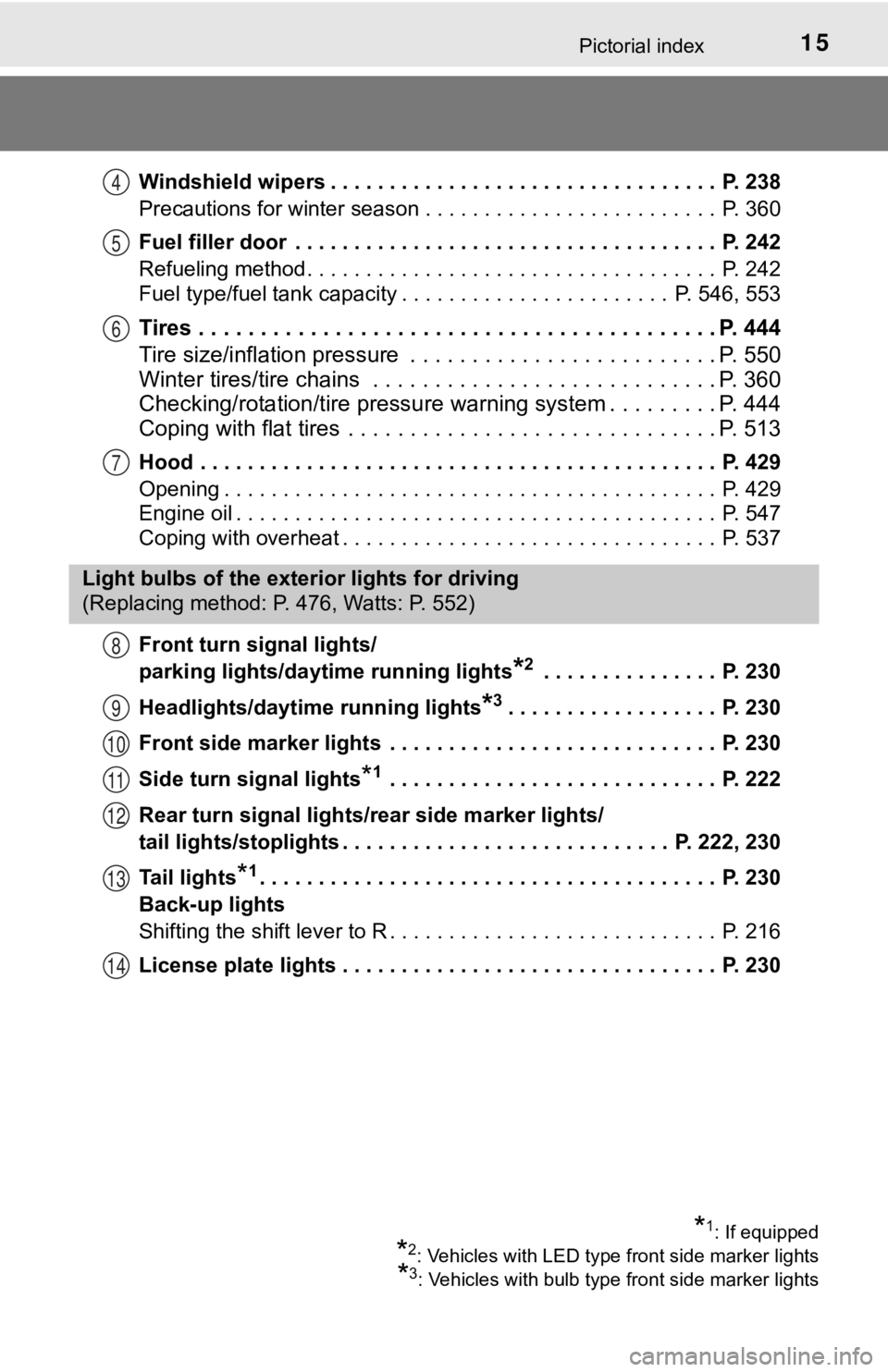
Windshield wipers . . . . . . . . . . . . . . . . . . . . . . . . . . . . . . . . . P. 238
Precautions for winter season . . . . . . . . . . . . . . . . . . . . . . . . . P. 360
Fuel filler door . . . . . . . . . . . . . . . . . . . . . . . . . . . . . . . . . . . . P. 242
Refueling method . . . . . . . . . . . . . . . . . . . . . . . . . . . . . . . . . . . P. 242
Fuel type/fuel tank capacity . . . . . . . . . . . . . . . . . . . . . . . P. 546, 553
Tires . . . . . . . . . . . . . . . . . . . . . . . . . . . . . . . . . . . . . . . . . . P. 444
Tire size/inflation pressure . . . . . . . . . . . . . . . . . . . . . . . . . P. 550
Winter tires/tire chains . . . . . . . . . . . . . . . . . . . . . . . . . . . . P. 360
Checking/rotation/tire pressur e warning system . . . . . . . . .P. 444
Coping with flat tires . . . . . . . . . . . . . . . . . . . . . . . . . . . . . . P. 513
Hood . . . . . . . . . . . . . . . . . . . . . . . . . . . . . . . . . . . . . . . . . . . . P. 429
Opening . . . . . . . . . . . . . . . . . . . . . . . . . . . . . . . . . . . . . . . . . . P. 429
Engine oil . . . . . . . . . . . . . . . . . . . . . . . . . . . . . . . . . . . . . . . . . P. 547
Coping with overheat . . . . . . . . . . . . . . . . . . . . . . . . . . . . . . . . P. 537
Front turn signal lights/
parking lights/daytime running lights
*2 . . . . . . . . . . . . . . . P. 230
Headlights/daytime running lights
*3. . . . . . . . . . . . . . . . . . P. 230
Front side marker lights . . . . . . . . . . . . . . . . . . . . . . . . . . . . P. 230
Side turn signal lights
*1 . . . . . . . . . . . . . . . . . . . . . . . . . . . . P. 222
Rear turn signal lights/r ear side marker lights/
tail lights/stoplights . . . . . . . . . . . . . . . . . . . . . . . . . . . . P. 222, 230
Tail lights
*1. . . . . . . . . . . . . . . . . . . . . . . . . . . . . . . . . . . . . . . P. 230
Back-up lights
Shifting the shift lever to R . . . . . . . . . . . . . . . . . . . . . . . . . . . . P. 216
License plate lights . . . . . . . . . . . . . . . . . . . . . . . . . . . . . . . . P. 230
4
5
6
7
Light bulbs of the exter ior lights for driving
(Replacing method: P. 476, Watts: P. 552)
8
9
10
11
12
13
14
*1: If equipped
*2: Vehicles with LED type front side marker lights
*3: Vehicles with bulb type front side marker lights
Page 191 of 624
191
4Driving
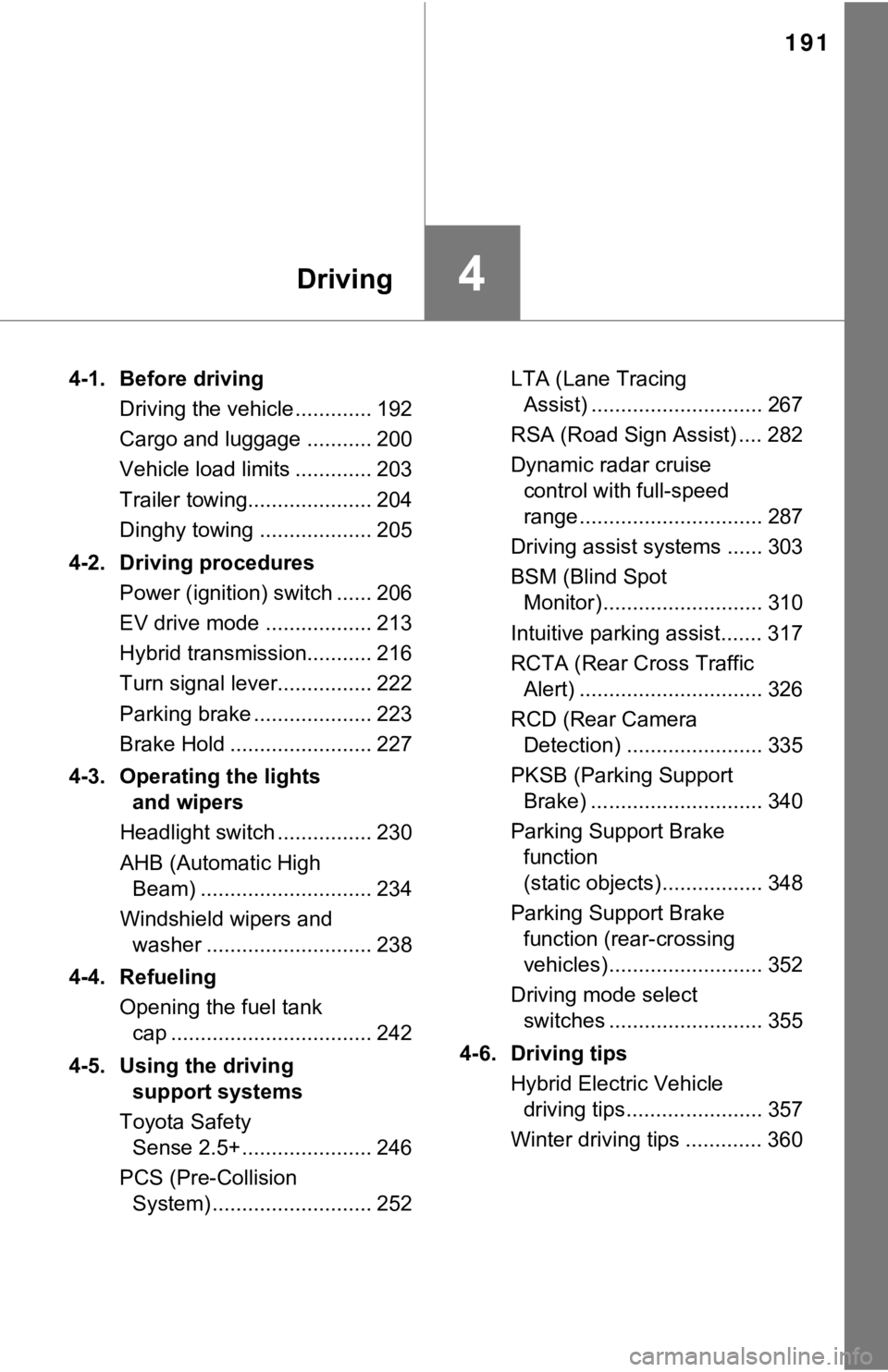
4-1. Before drivingDriving the vehicle ............. 192
Cargo and luggage ........... 200
Vehicle load limits ............. 203
Trailer towing..................... 204
Dinghy towing ................... 205
4-2. Driving procedures Power (ignition) switch ...... 206
EV drive mode .................. 213
Hybrid transmission........... 216
Turn signal lever................ 222
Parking brake .................... 223
Brake Hold ........................ 227
4-3. Operating the lights and wipers
Headlight switch ................ 230
AHB (Automatic High Beam) ............................. 234
Windshield wipers and washer ............................ 238
4-4. Refueling Opening the fuel tank cap .................................. 242
4-5. Using the driving support systems
Toyota Safety Sense 2.5+...................... 246
PCS (Pre-Collision System) ........................... 252 LTA (Lane Tracing
Assist) ............................. 267
RSA (Road Sign Assist) .... 282
Dynamic radar cruise control with full-speed
range............................... 287
Driving assist systems ...... 303
BSM (Blind Spot Monitor)........................... 310
Intuitive parking assist....... 317
RCTA (Rear Cross Traffic Alert) ............................... 326
RCD (Rear Camera Detection) ....................... 335
PKSB (Parking Support Brake) ............................. 340
Parking Support Brake function
(static objects)................. 348
Parking Support Brake function (rear-crossing
vehicles).......................... 352
Driving mode select switches .......................... 355
4-6. Driving tips Hybrid Electric Vehicle driving tips....................... 357
Winter driving tips ............. 360
Page 230 of 624

2304-3. Operating the lights and wipers
Operating the switch turns on the lights as follows:
For U.S.A.
The headlights, day-
time running lights
( P.
232) and all the lights
listed below turn on and
off automatically.
(When the power
switch is in ON mode)
The side marker, park-
ing, tail, license plate,
instrument panel lights,
and daytime running
lights
( P. 232) turn
on.
The headlights and all the li ghts listed above (except day-
time running lights) turn on.
The daytime running lights turn off.
Headlight switch
The headlights can be operated manually or automatically.
Operating instructions
1
2
3
4
Page 231 of 624

2314-3. Operating the lights and wipers
4
Driving
For Canada
The headlights, day-
time running lights
( P.
232) and all the lights
listed below turn on and
off automatically.
(When the power
switch is in ON mode)
The side marker, park-
ing, tail, license plate,
instrument panel lights,
and daytime running
lights
( P. 232) turn
on.
The headlights and all the li ghts listed above (except day-
time running lights) turn on.
With the headlights on, push
the lever away from you to turn
on the high beams.
Pull the lever toward you to the
center position to turn the high
beams off.
Pull the lever toward you and
release it to flash the high
beams once.
You can flash the high beams with the headlights on or off.
AFS (Adaptive Front-lighting System) secures excellent visibili ty at
intersections and on curves by automatically adjusting the dire ction of
the light axis of the headlights according to vehicle speed and the
degree of the tire’s angle as controlled by steering input.
AFS operates at speeds of 6 mph (10 km/h) or higher.
1
2
Turning on the high beam headlights
3
1
2
AFS (Adaptive Front-light ing System) (if equipped)
Page 232 of 624

2324-3. Operating the lights and wipers
■Daytime running light system
●Type A:
The daytime running lights illuminate using the same lights as the headlights
and illuminate darker than the headlights.
Type B:
The daytime running lights illuminate using the same lights as the parking
lights and illuminate brighter than the parking lights.
● To make your vehicle more visible to other drivers during dayti me driving,
the daytime running lights turn on automatically when all of the following
conditions are met. (The daytime running lights are not designe d for use at
night.)
• The hybrid system is operating
• The parking brake is released
• The headlight switch is in the or
* position
*: When the surroundings are bright
The daytime running lights remain on after they illuminate, even if the parking
brake is set again.
● For U.S.A.: Daytime running lights can be turned off by operati ng the switch.
● Compared to turning on the headlights, the daytime running ligh t system
offers greater durability and consumes less electricity, so it can help improve
fuel economy.
■ Headlight control sensor
The sensor may not function properly if an
object is placed on the sensor, or anything
that blocks the sensor is affixed to the
windshield.
Doing so interferes with the sensor
detecting the level of ambient light and
may cause the automatic headlight sys-
tem to malfunction.
Page 233 of 624

2334-3. Operating the lights and wipers
4
Driving
■Automatic light off system
●When the headlights are on: The headlights and tail lights turn off 30 sec-
onds after the power switch is turned to ACCESSORY mode or turned off
and a door is opened and closed. (The lights turn off immediate ly if on
the key is pressed twice after all the doors are closed.)
● When only the tail lights are on: The tail lights turn off automatically if the
power switch is turned to ACCESSORY mode or turned off and the driver’s
door is opened.
To turn the lights on again, turn the power switch to ON mode, or turn the light
switch off once and then back to or .
If any of the doors or trunk lid is kept open, the lights automatically turn off
after 20 minutes.
■ Light reminder buzzer (except when the light switch is in )
A buzzer sounds when the power switch is turned off or turned to ACCES-
SORY mode and the driver's door is opened while the lights are turned on.
■ Windshield wiper linked headlight illumination
When driving during daytime with the headlight switch turned to , if the
windshield wipers are used, the headlights will turn on automatically after
several seconds to help enhance the visibility of your vehicle.
■ Automatic headlight leveling system (if equipped)
The level of the headlights is automatically adjusted according to the number
of passengers and the loading condition of the vehicle to ensure that the
headlights do not interfere with other road users.
■ 12-volt battery-saving function
In the following conditions, the remaining lights will go off automatically after
20 minutes in order to prevent the 12-volt battery from being discharged:
●The headlights and/or tail lights are on.
● The power switch is in ACCESSORY mode or turned off.
This function will be canceled in any of the following situations:
● When the power switch is turned to ON mode.
● When the light switch is operated.
● When a door or the trunk is opened or closed.
■ Customization
Some functions can be customized. ( P. 569)
NOTICE
■To prevent 12-volt battery discharge
Do not leave the lights on longer than necessary when the hybrid system is
off.
Page 234 of 624

2344-3. Operating the lights and wipers
Turn the headlight switch to the or position.
( P. 230)
Press the Automatic High
Beam switch.
When the headlight switch lever is
in the low beam position, the AHB
system will be enabled and the
AHB indicator will illuminate.
AHB (Automatic High Beam)
The Automatic High Beam uses a front camera located behind
the upper portion of the windshi eld to assess the brightness of
the lights of vehicles ahead, streetlights, etc., and automatically
turns the high beams on or off as necessary.
WARNING
■Limitations of the Automatic High Beam
Do not overly rely on the Automatic High Beam. Always drive safely, taking
care to observe your surroundings and turning the high beams on or off
manually if necessary.
■ To prevent incorrect operation of the Automatic High Beam syste m
Do not overload the vehicle.
Activating the Automatic High Beam
1
2
Page 235 of 624

2354-3. Operating the lights and wipers
4
Driving
■Switching to the high beams
Push the lever away from you.
The Automatic High Beam indi-
cator will turn off and the high
beam indicator will turn on.
Pull the lever to its original posi-
tion to activate the Automatic
High Beam system again.
■
Switching to the low beams
Press the Automatic High
Beam switch.
The Automatic High Beam indi-
cator will turn off.
Press the switch to activate the
Automatic High Beam system
again.
■
Temporarily switching to the low beams
Pull the lever toward you and
then return it to its original posi-
tion.
The high beams are on while
the lever is pulled toward you.
However, after the lever is
returned to its original position,
the low beams remain on for a
certain amount of time. After-
wards, the Automatic High
Beam will be activated again.
■ Temporarily switchi ng to the low beams
It is recommended to switch to the low beams when the high beam may
cause problems or distress to other drivers or pedestrians near by.
Turning the high beams on/off manually
Page 236 of 624
2364-3. Operating the lights and wipers
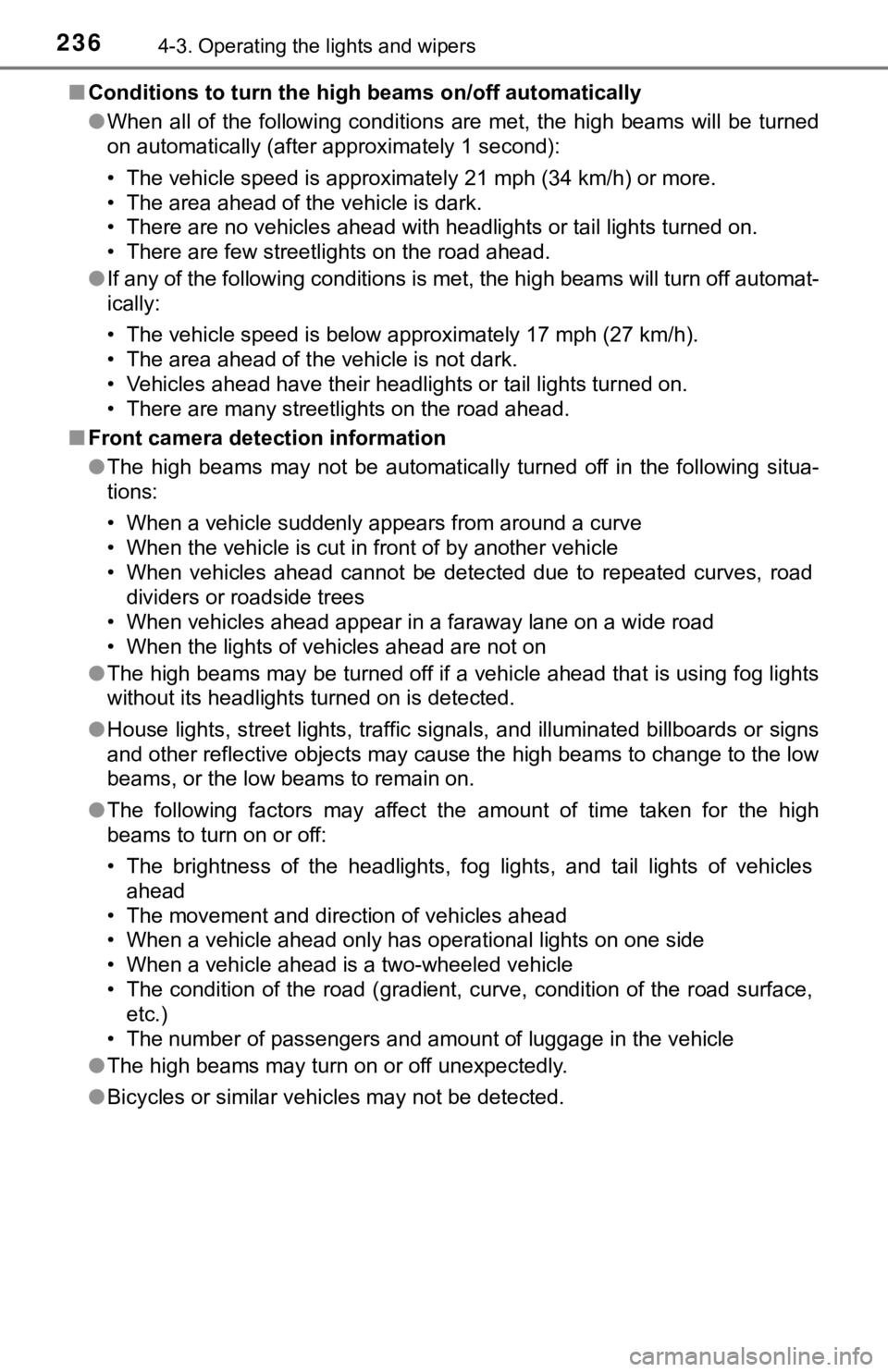
■Conditions to turn the high beams on/off automatically
●When all of the following conditions are met, the high beams will be turned
on automatically (after approximately 1 second):
• The vehicle speed is approximately 21 mph (34 km/h) or more.
• The area ahead of the vehicle is dark.
• There are no vehicles ahead with headlights or tail lights turned on.
• There are few streetlights on the road ahead.
● If any of the following conditions is met, the high beams will turn off automat-
ically:
• The vehicle speed is below approximately 17 mph (27 km/h).
• The area ahead of the vehicle is not dark.
• Vehicles ahead have their headlights or tail lights turned on.
• There are many streetlights on the road ahead.
■ Front camera detection information
●The high beams may not be automatically turned off in the following situa-
tions:
• When a vehicle suddenly appears from around a curve
• When the vehicle is cut in front of by another vehicle
• When vehicles ahead cannot be detected due to repeated curves, road
dividers or roadside trees
• When vehicles ahead appear in a faraway lane on a wide road
• When the lights of vehicles ahead are not on
● The high beams may be turned off if a vehicle ahead that is usi ng fog lights
without its headlights turned on is detected.
● House lights, street lights, traffic signals, and illuminated billboards or signs
and other reflective objects may cause the high beams to change to the low
beams, or the low beams to remain on.
● The following factors may affect the amount of time taken for t he high
beams to turn on or off:
• The brightness of the headlights, fog lights, and tail lights of vehicles
ahead
• The movement and direction of vehicles ahead
• When a vehicle ahead only has operational lights on one side
• When a vehicle ahead is a two-wheeled vehicle
• The condition of the road (gradient, curve, condition of the r oad surface,
etc.)
• The number of passengers and amount of luggage in the vehicle
● The high beams may turn on or off unexpectedly.
● Bicycles or similar vehicles may not be detected.