oil temperature TOYOTA CAMRY V20 1986 Service Information
[x] Cancel search | Manufacturer: TOYOTA, Model Year: 1986, Model line: CAMRY V20, Model: TOYOTA CAMRY V20 1986Pages: 2389, PDF Size: 84.44 MB
Page 898 of 2389
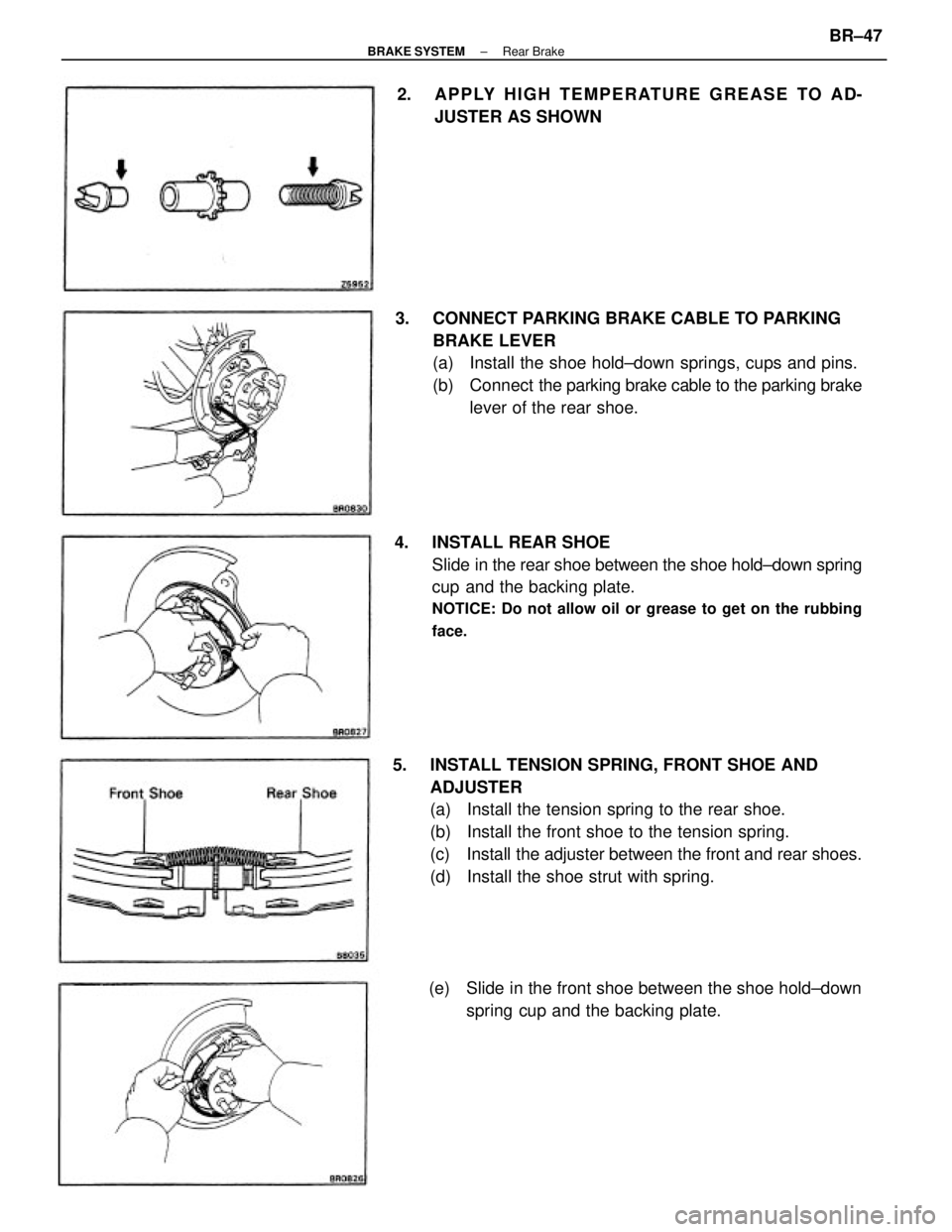
5. INSTALL TENSION SPRING, FRONT SHOE AND
ADJUSTER
(a) Install the tension spring to the rear shoe.
(b) Install the front shoe to the tension spring.
(c) Install the adjuster between the front and rear shoes.
(d) Install the shoe strut with spring. 4. INSTALL REAR SHOE
Slide in the rear shoe between the shoe hold±down spring
cup and the backing plate.
NOTICE: Do not allow oil or grease to get on the rubbing
face.
3. CONNECT PARKING BRAKE CABLE TO PARKING
BRAKE LEVER
(a) Install the shoe hold±down springs, cups and pins.
(b) Connect the parking brake cable to the parking brake
lever of the rear shoe.
(e) Slide in the front shoe between the shoe hold±down
spring cup and the backing plate. 2. APPLY HIGH TEMPERATURE GREASE TO AD-
JUSTER AS SHOWN
± BRAKE SYSTEMRear BrakeBR±47
Page 989 of 2389
The cooling system is composed of the water jacket (inside the cylinder block and cylinder head), radiator,
water pump, thermostat, electric fan, hoses and other components.
Coolant which is heated in the water jacket is pumped to the radiator, through which an electric fan blows air
to cool the coolant as it passes through. Coolant which has been cooled is then sent back to the engine by
the water pump, where it cools the engine.
The water jacket is a network of channels in the shell of the cylinder block and cylinder head through which
coolant passes. It is designed to provide adequate cooling of the cylinders and combustion chambers which
become heated during engine operation.
RADIATOR
The radiator performs the function of cooling the coolant which has passed through the water jacket and be-
come hot, and it is mounted in the front of the vehicle. The radiator consists of an upper tank and lower tank,
and a core which connects the two tanks. The upper tank contains the inlet for coolant from the water jacket
and the filler inlet. It also has a hose attached through which excess coolant or steam can flow. The lower
tank has an outlet and drain cock for the coolant. The core contains many tubes through which coolant flows
from the upper tank to the lower tank as well as cooling fins which radiate heat away from the coolant in the
tubes.
The air sucked through the radiator by the electric fan, as well as the wind generated by the vehicle's travel,
passes through the radiator, cooling the coolant. Models with automatic transmission include an automatic
transmission fluid cooler built into the lower tank of the radiator. A fan with an electric motor is mounted be-
hind the radiator to assist the flow of air through the radiator. The fan operates when the coolant tempera-
ture becomes high in order to prevent it from becoming too high.
RADIATOR CAP
The radiator cap is a pressure type cap which seals the radiator, resulting in pressurization of the radiator as
the coolant expands. The pressurization prevents the coolant from boiling even when the coolant tempera-
ture exceeds 100°C (212°F). A relief valve (pressurization valve) and a vacuum valve (negative pressure
valve) are built into the radiator cap. The relief valve opens and lets steam escape through the overflow pipe
when the pressure generated inside the cooling system exceeds the limit (coolant temperature: 110 ±
120°C, 230 ± 248°F, pressure; 0.3 ±1.0 kg/cm
2, 4.3 ±14.2 psi, 29.4 ± 98.1 kPa). The vacuum valve opens to
alleviate the vacuum which develops in the coolant system after the engine is stopped and the coolant tem-
perature drops.
The valves's opening allows the coolant in the reservoir tank to return to the cooling system.
RESERVOIR TANK
The reservoir tank is used to catch coolant which overflows the cooling system as a result of volumetric ex-
pansion when the coolant is heated. The coolant in the reservoir rank returns to the radiator when the cool-
ant temperature drops, thus keeping the radiator full at all times and avoiding needless coolant loss. Check
the reservoir tank level to find out if the coolant needs to be replenished.
WATER PUMP
The water pump is used for forced circulation of coolant through the cooling system. It is mounted on the
front of the cylinder block and driven by a timing belt.
THERMOSTAT
The thermostat has a wax type by±pass valve and is mounted in the water inlet housing. The thermostat in-
cludes a type of automatic valve operated by fluctuations in the coolant temperature. This valve closes when
the coolant temperature drops, preventing the circulation of coolant through the engine and thus permitting
the engine to warm up rapidly. The valve opens when the coolant temperature has risen, allowing the cir-
culation of coolant. Wax inside the thermostat expands when heated and contracts when cooled. Heating
the wax thus generates pressure which overpowers the force of the spring which keeps±the valve closed,
thus opening the valve. When the wax cools, its contraction causes the force of the spring to take effect
once more, closing the valve. The thermostat in this engine operates at a temperature of 82°C (180°F).
± COOLING SYSTEMDescriptionCO±3
Page 995 of 2389
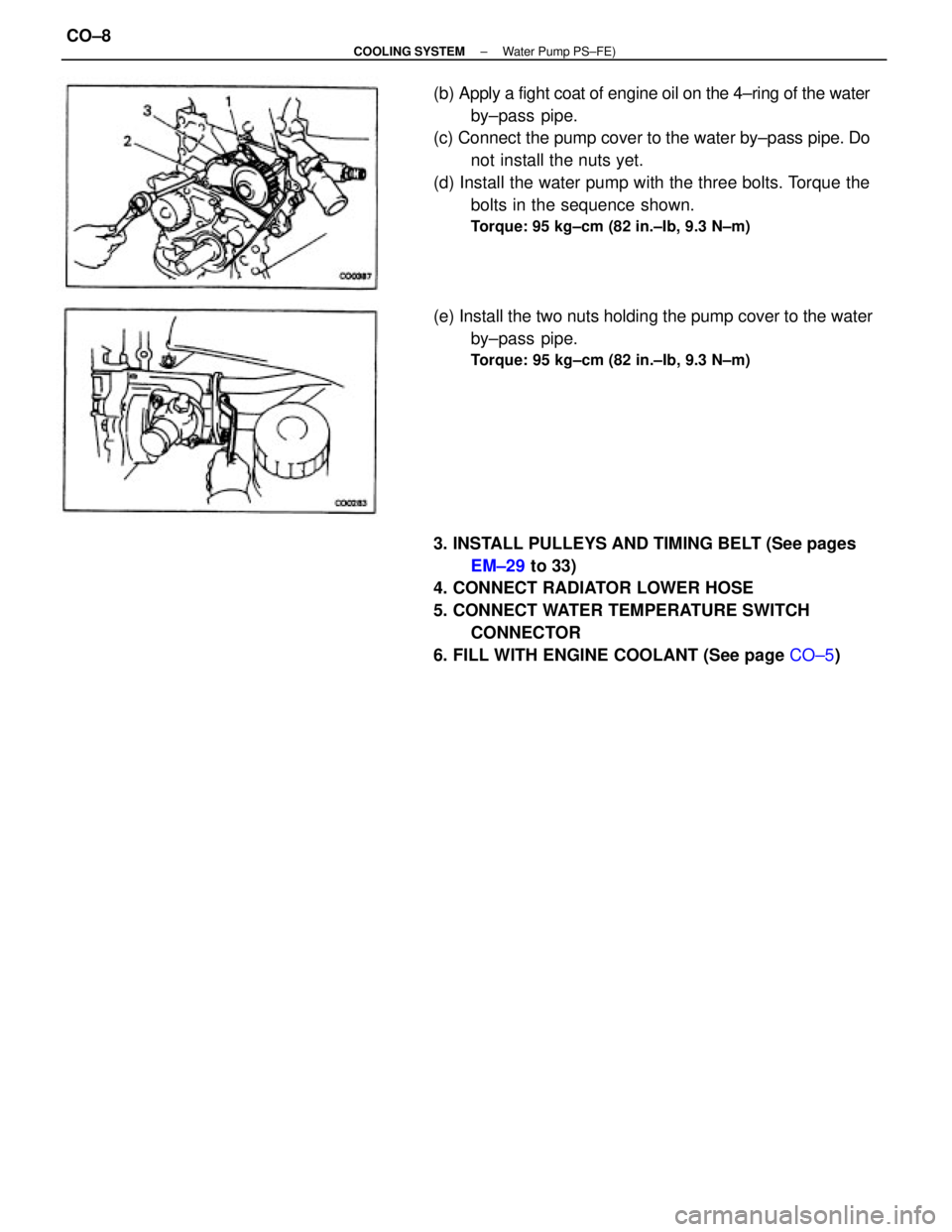
(b) Apply a fight coat of engine oil on the 4±ring of the water
by±pass pipe.
(c) Connect the pump cover to the water by±pass pipe. Do
not install the nuts yet.
(d) Install the water pump with the three bolts. Torque the
bolts in the sequence shown.
Torque: 95 kg±cm (82 in.±Ib, 9.3 N±m)
3. INSTALL PULLEYS AND TIMING BELT (See pages
EM±29 to 33)
4. CONNECT RADIATOR LOWER HOSE
5. CONNECT WATER TEMPERATURE SWITCH
CONNECTOR
6. FILL WITH ENGINE COOLANT (See page CO±5) (e) Install the two nuts holding the pump cover to the water
by±pass pipe.
Torque: 95 kg±cm (82 in.±Ib, 9.3 N±m)
± COOLING SYSTEMWater Pump PS±FE)CO±8
Page 1180 of 2389
The 3S±FE engine is an in±line 4±cylinder engine with the cylinders numbered 1 ± 2 ± 3 ± 4 from the
front.
The crankshaft is supported by 5 bearing inside the crankcase. These bearing are made of aluminum
alloy.
The crankshaft is integrated with 8 weights for balance. Oil holes are placed in the center of the crank-
shaft to supply oil to the connecting rods, bearing, pistons and other components.
This engine's ignition order is 1 ± 3 ± 4 ± 2. The cylinder head is made of aluminum alloy, with a cross
flow type intake and exhaust layout and with pent±roof type combustion chambers. The spark plugs are
located in the center of the combustion chamber.
The intake manifold has 8 independent long ports and utilizes the inertial supercharging effect to im-
prove engine torque at low and medium speeds.
Exhaust and intake valves are equipped with irregular pitch springs made of special valve spring carbon
steel which are capable of functioning no matter what the engine speed.
The intake side camshaft is driven by a timing belt, and a gear on the intake side camshaft engages with
a gear on the exhaust side camshaft to drive it. The cam journal is supported at 5 places between the
valve lifters of each cylinder and on the front end of the cylinder head. Lubrication of the cam journal and
gear is accomplished by oil being supplied through the oiler port in the center of the camshaft.
Adjustment of the valve clearance is done by means of outer shim type system, in which valve adjusting
shims are located above the valve lifters. This permits replacement of the shims without removal of the
camshafts.
The resin timing belt cover is made of 2 pieces. A service hole is provided in the No. 1 belt cover for ad-
justing the timing belt tension.
Piston are made of high temperature±resistant aluminum alloy, and a depression is built into the piston
head to prevent interference with the valves.
Piston pins are the semi±floating type, with the pins fastened to the connecting rods by pressure fitting,
allowing the pistons and pins to float.
The No. 1 compression ring is made of steel and the No. 2 compression ring is made of cast iron. The oil
ring is made of a combination of steel and stainless steel. The outer diameter of each piston ring is
slightly larger than the diameter of the piston and the flexibility of the rings allows them to hug the cylin-
der walls when they are mounted on the piston rings No. 1 and No. 2 work to prevent gas leakage from
the cylinder and oil ring works to clear oil off the cylinder walls to prevent it from entering the combustion
chambers.
The cylinder block is made of cast iron. It has 4 cylinders which are approximately 2 times the length of
the piston stroke. The top of the cylinders is closed off by the cylinder head and the lower end of the cyl-
inders becomes the crankcase, in which the crankshaft is installed. In .addition, the cylinder block con-
tains a water jacket, through which coolant is pumped to cool the cylinders.
The oil pan is bolted onto the bottom of the cylinder block. The oil pan is an oil reservoir made of
pressed steel shoot. A dividing plate is included inside the oil pan to keep sufficient oil in the bottom of
the pan even when the vehicle is tilted. This dividing plate also prevents the oil from making waves when
the vehicle is topped suddenly and thus shifting the oil away from the oil pump suction pipe.
± ENGINE MECHANICALDescription (3S±FE)EM±3
Page 1182 of 2389
The 2VZ±FE engine has 6 cylinder in a V arrangement at bank of 60°. From the front of the RH bank cylin-
ders are numbered 1 ± 3 ± 5, and from the front of the LH bank cylinders are numbered 2 ± 4 ±r 6. The crankshaft is
supported by 4 bearings inside the crankcase. These bearing are made of copper and lead alloy.
The crankshaft is integrated with 5 weights for balance. Oil holes are placed in the center of the crankshaft for sup-
plying oil to the connecting rods, pistons and other components.
This engine's ignition order is 1 ± 2 ± 3 ± 4 ± 5 ± 6. The cylinder head is made of aluminum alloy, with a cross flow
type intake and exhaust layout and with pent±roof type combustion chambers. The spark plugs are located in the
center of the combustion chambers.
At,the front and rear of the intake port of the intake manifold, a water passage has been provided which connects
the RH and LH cylinder heads.
Exhaust and intake valves are equipped with irregular pitch springs made of special valve spring carbon steel which
are capable of functioning no matter what the engine speed.
The RH and LH intake camshaft are driven by a single timing belt, and a gear on the intake side camshaft engages
with a gear on the exhaust side camshaft to drive it. The cam journal is supported at 5 (intake) or 4
(exhaust) places between the valve liters of each cylinder and on the front end of the cylinder head. Lubrication of
the cam journals and gears is accomplished by oil being supplied through the oiler port in the center of the camshaft.
Adjustment of the valve clearance is done by means of outer shim type system, in which valve adjusting shims are
located above the valve lifters. The permits replacement of the shims without removal of the camshafts.
The timing belt cover is composed of resin type No. 2 and No. 1 above and below the RH mounting bracket.
Piston are made high temperature±resistant aluminum alloy, and a depression is built into the piston head to prevent
interference with the valves.
Piston pins are the semi±floating type, with the pins fastened to the connecting rods by pressure fitting, allowing the
pistons and pins to float.
The No. 1 compression ring is made of steel and the No. 2 compression ring is made±of cast iron. The oil ring is
made of a combination of steel and stainless steel. The outer diameter of each piston ring is slightly larger than the
diameter of the piston and the flexibility of the rings allows them to hug the cylinder walls when they are mounted on
the piston. Compression rings No. 1 and No. 2 work to prevent gas leakage from the cylinder and oil ring works to
clear oil off the cylinder walls to prevent it from entering the combustion chambers.
The cylinder block is made of cast iron with a bank angle of 60°. It has 6 cylinders which are approximately 2
times the length of the piston stroke. The top of the cylinders is closed off by the cylinder heads and the lower end of
the cylinders becomes the crankcase, in which the crankshaft is installed. In addition, the cylinder block contains a
water jacket, through which coolant is pumped to cool the cylinders.
The oil pan is bolted onto the bottom of the cylinder block. The oil pan is an oil reservoir made of pressed steel
sheet. A dividing plate is included inside the oil pan to keep sufficient oil in the bottom of the pan even when the ve-
hicle is tilted. This dividing plate also prevents the oil from making waves when the vehicle is stopped suddenly and
thus shifting the oil away from the oil pump suction pipe.
± ENGINE MECHANICALDescription (2VZ±FE)EM±5
Page 1249 of 2389
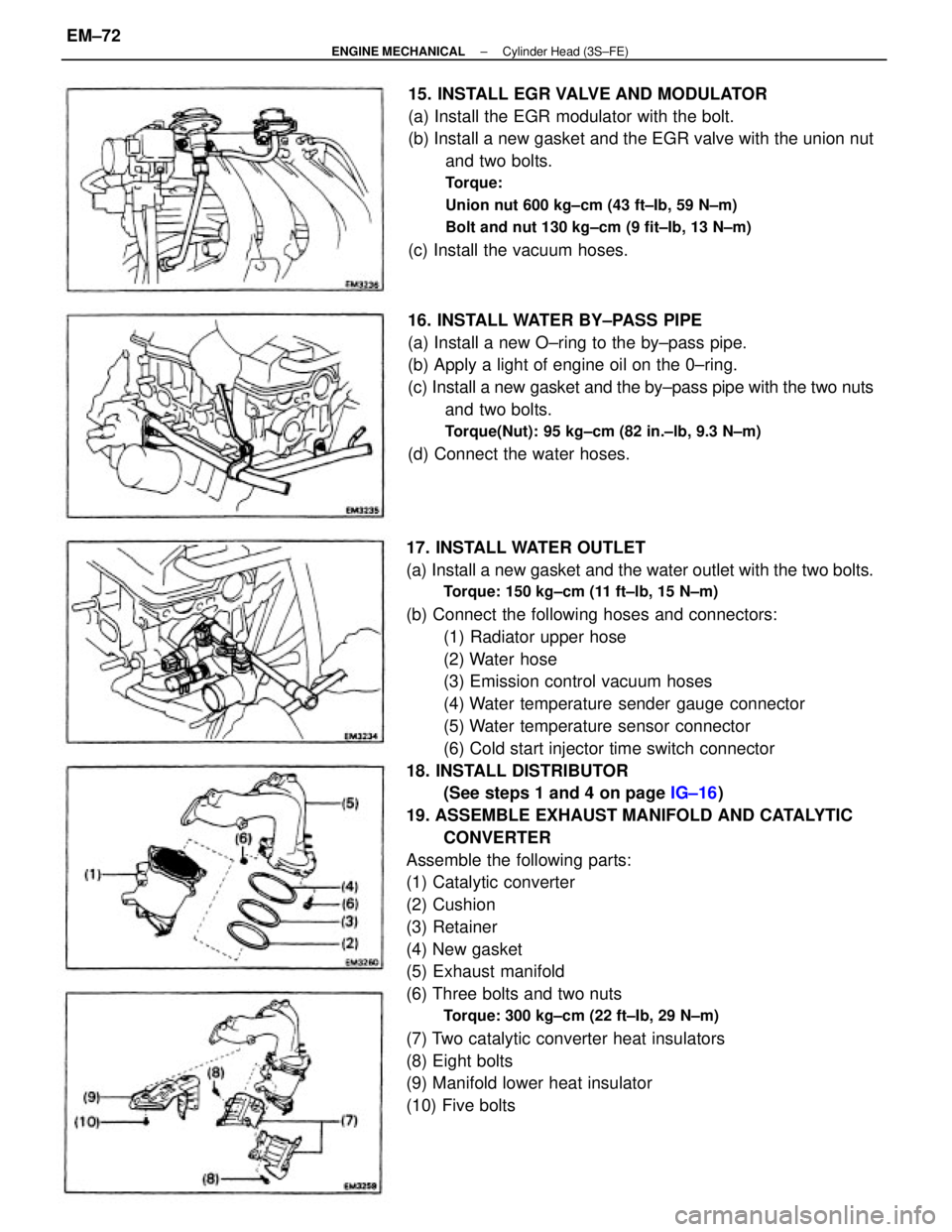
17. INSTALL WATER OUTLET
(a) Install a new gasket and the water outlet with the two bolts.
Torque: 150 kg±cm (11 ft±lb, 15 N±m)
(b) Connect the following hoses and connectors:
(1) Radiator upper hose
(2) Water hose
(3) Emission control vacuum hoses
(4) Water temperature sender gauge connector
(5) Water temperature sensor connector
(6) Cold start injector time switch connector
18. INSTALL DISTRIBUTOR
(See steps 1 and 4 on page IG±16)
19. ASSEMBLE EXHAUST MANIFOLD AND CATALYTIC
CONVERTER
Assemble the following parts:
(1) Catalytic converter
(2) Cushion
(3) Retainer
(4) New gasket
(5) Exhaust manifold
(6) Three bolts and two nuts
Torque: 300 kg±cm (22 ft±Ib, 29 N±m)
(7) Two catalytic converter heat insulators
(8) Eight bolts
(9) Manifold lower heat insulator
(10) Five bolts15. INSTALL EGR VALVE AND MODULATOR
(a) Install the EGR modulator with the bolt.
(b) Install a new gasket and the EGR valve with the union nut
and two bolts.
Torque:
Union nut 600 kg±cm (43 ft±Ib, 59 N±m)
Bolt and nut 130 kg±cm (9 fit±Ib, 13 N±m)
(c) Install the vacuum hoses.
16. INSTALL WATER BY±PASS PIPE
(a) Install a new O±ring to the by±pass pipe.
(b) Apply a light of engine oil on the 0±ring.
(c) Install a new gasket and the by±pass pipe with the two nuts
and two bolts.
Torque(Nut): 95 kg±cm (82 in.±lb, 9.3 N±m)
(d) Connect the water hoses.
± ENGINE MECHANICALCylinder Head (3S±FE)EM±72
Page 1849 of 2389
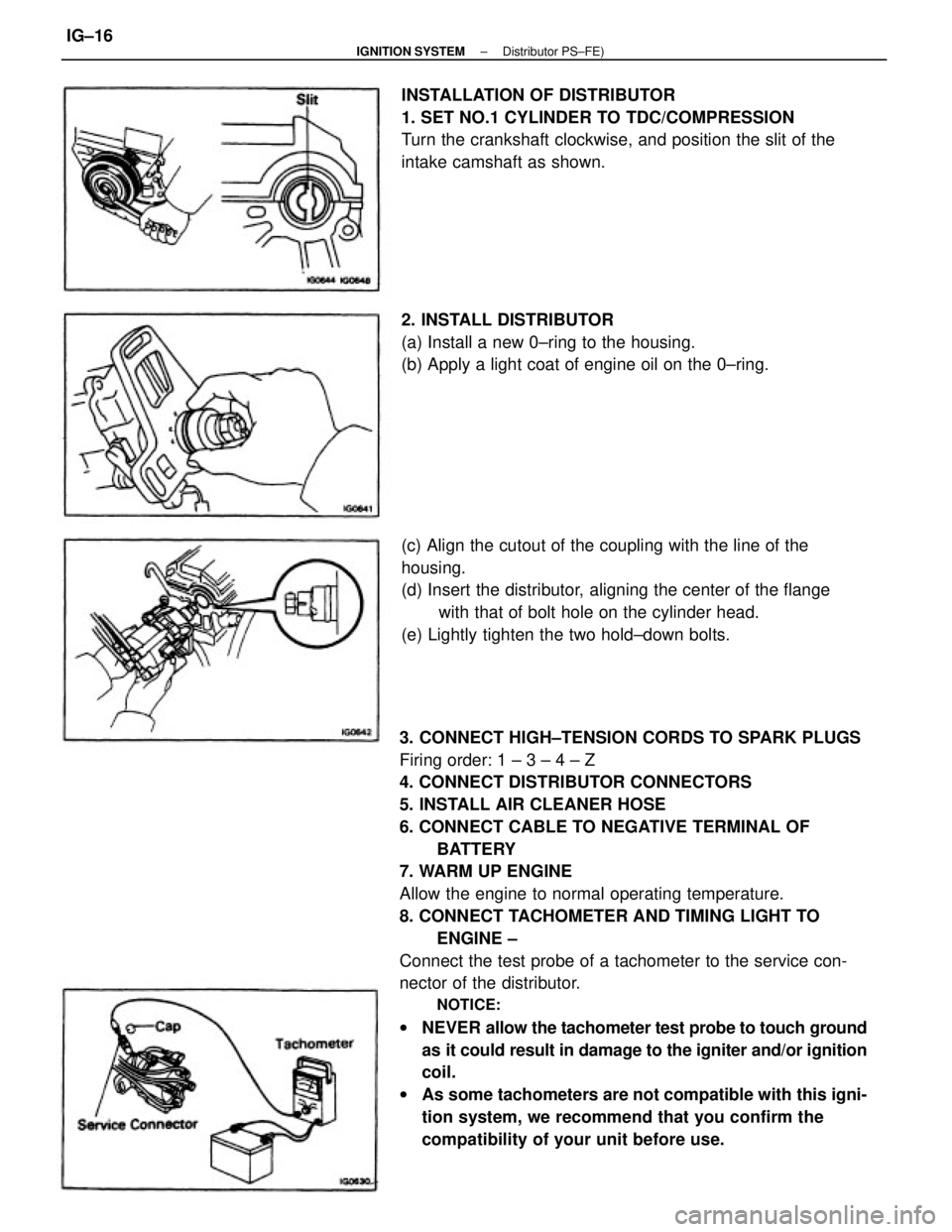
3. CONNECT HIGH±TENSION CORDS TO SPARK PLUGS
Firing order: 1 ± 3 ± 4 ± Z
4. CONNECT DISTRIBUTOR CONNECTORS
5. INSTALL AIR CLEANER HOSE
6. CONNECT CABLE TO NEGATIVE TERMINAL OF
BATTERY
7. WARM UP ENGINE
Allow the engine to normal operating temperature.
8. CONNECT TACHOMETER AND TIMING LIGHT TO
ENGINE ±
Connect the test probe of a tachometer to the service con-
nector of the distributor.
NOTICE:
wNEVER allow the tachometer test probe to touch ground
as it could result in damage to the igniter and/or ignition
coil.
wAs some tachometers are not compatible with this igni-
tion system, we recommend that you confirm the
compatibility of your unit before use. (c) Align the cutout of the coupling with the line of the
housing.
(d) Insert the distributor, aligning the center of the flange
with that of bolt hole on the cylinder head.
(e) Lightly tighten the two hold±down bolts. INSTALLATION OF DISTRIBUTOR
1. SET NO.1 CYLINDER TO TDC/COMPRESSION
Turn the crankshaft clockwise, and position the slit of the
intake camshaft as shown.
2. INSTALL DISTRIBUTOR
(a) Install a new 0±ring to the housing.
(b) Apply a light coat of engine oil on the 0±ring.
± IGNITION SYSTEMDistributor PS±FE)IG±16
Page 1854 of 2389
![TOYOTA CAMRY V20 1986 Service Information 6. WARM UP ENGINE
Allow the engine to normal operating temperature.
7. CONNECT TACHOMETER AND TIMING LIGHT TO
ENGINE
Connect the tachometer test probe to terminal IG [±] of the
check connector.
NOTIC](/img/14/57449/w960_57449-1853.png "TOYOTA CAMRY V20 1986 Service Information 6. WARM UP ENGINE
Allow the engine to normal operating temperature.
7. CONNECT TACHOMETER AND TIMING LIGHT TO
ENGINE
Connect the tachometer test probe to terminal IG [±] of the
check connector.
NOTIC")
6. WARM UP ENGINE
Allow the engine to normal operating temperature.
7. CONNECT TACHOMETER AND TIMING LIGHT TO
ENGINE
Connect the tachometer test probe to terminal IG [±] of the
check connector.
NOTICE:
wNEVER allow the tachometer test probe to touch ground
as it could result in damage to the igniter
and/or ignition coil.
wAs some tachometers are not compatible with this igni-
tion system, we recommended that you confirm the
compatibility of your unit before use.
8. ADJUST IGNITION TIMING
(a) Check the idle speed.
Idle speed: 700
+ 50 rpm
(b) Using SST connect terminals TE1 and E1 of the check con-
nector.
SST 09843±18020
(c) Using a timing light, check the ignition timing.
Ignition timing: 10°6TDC @ idle
(Transmission in N range)
(d) Loosen the two hold±down bolts, and adjust by turning the
distributor.
(e) Tighten the hold±down bolts, and recheck the ignition timing.
Torque: 185 kg±cm (13 ft±Ib, 18 N±m)
9. FURTHER CHECK IGNITION TIMING
Ignition timing: 10°BTDC @ idle
(Transmission in N range)
HINT: The timing mark moves in a range between 13°
and 27°.
10. DISCONNECT TACHOMETER AND TIMING LIGHT
FROM ENGINE (f) Remove SST.
SST 09843±18020
± IGNITION SYSTEMDistributor (2VZ±FE)IG±21
Page 1861 of 2389
PRECAUTIONS FOR VEHICLES EQUIPPED WITH A
CATALYTIC CONVERTER
CAUTION: If large amounts of unburned gasoline flow into the converter, it may overheat
and create a fire hazard. To prevent this, observe the following precautions and
explain them to your customer.
1. Use only unleaded gasoline.
2. Avoid prolonged idling.
Avoid running the engine at idle speed for more than 20
minutes.
3. Avoid spark jump test.
(a) Spark jump test only when absolutely necessary. Perform this test as rapidly as pos-
sible.
(b) While testing, never race the engine.
4. Avoid prolonged engine compression measurement.
Engine compression tests must be made as rapidly as possible.
5. Do not run engine when fuel tank is nearly empty.
This may cause the engine to misfire and create an extra
load on the converter.
6. Avoid coasting with ignition turned off and prolonged braking.
7. Do not dispose of used catalyst along with parts contaminated with gasoline or oil.(f) When steam cleaning an engine, protect the distribu-
tor, air filter and VCV from water.
(g) Never use an impact wrench to remove or install tem-
perature switches or temperature sensors.
(h) When checking continuity at the wire connector, insert
the tester probe carefully to prevent terminals from
bending.
(i) When using a vacuum gauge, never force the hose
onto a connector that is too large. Use a step±down
adapter instead. Once the hose has been stretched,
it may leak.
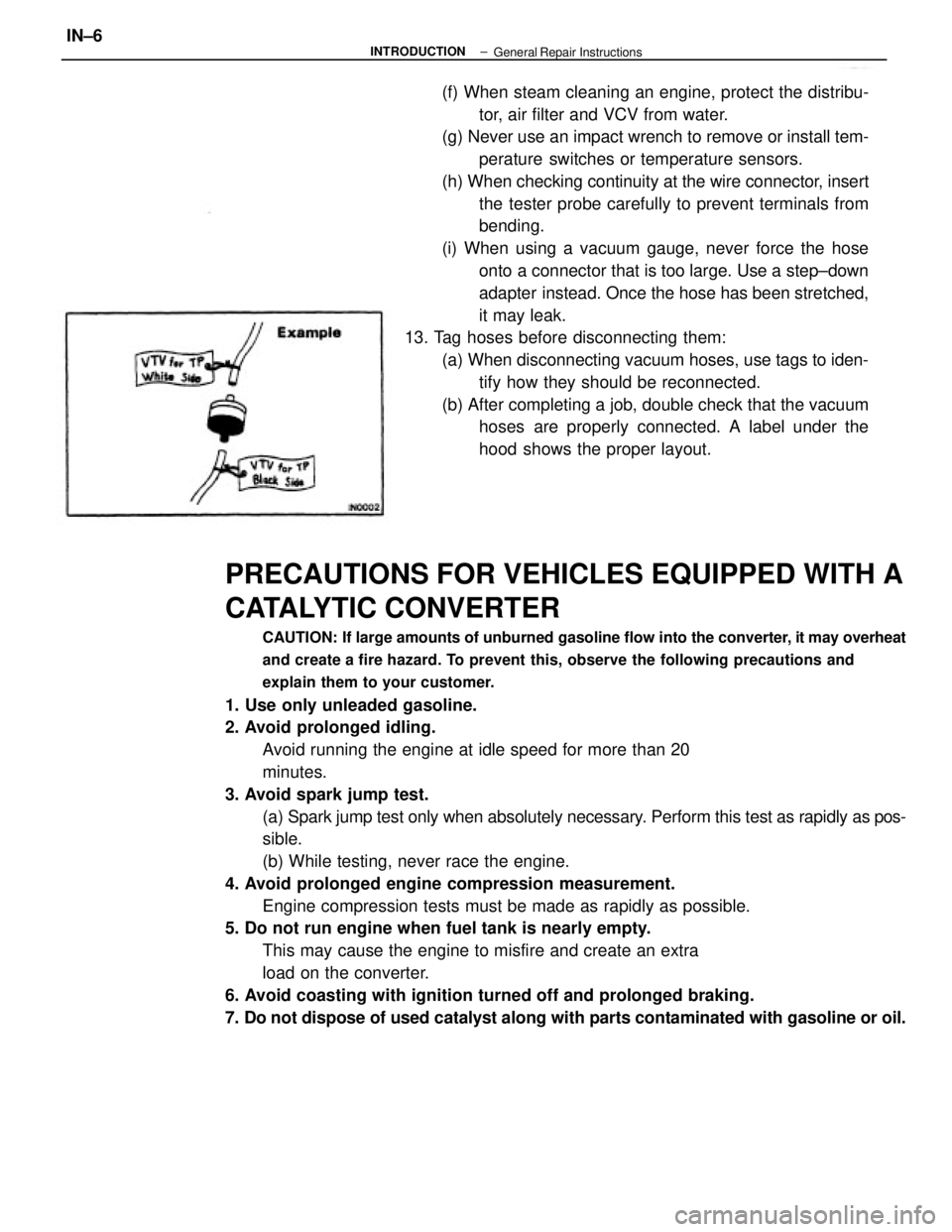
13. Tag hoses before disconnecting them:
(a) When disconnecting vacuum hoses, use tags to iden-
tify how they should be reconnected.
(b) After completing a job, double check that the vacuum
hoses are properly connected. A label under the
hood shows the proper layout.
± INTRODUCTIONIN±6General Repair Instructions
Page 1862 of 2389
PRECAUTIONS FOR VEHICLES EQUIPPED WITH A
CATALYTIC CONVERTER
CAUTION: If large amounts of unburned gasoline flow into the converter, it may overheat
and create a fire hazard. To prevent this, observe the following precautions and
explain them to your customer.
1. Use only unleaded gasoline.
2. Avoid prolonged idling.
Avoid running the engine at idle speed for more than 20
minutes.
3. Avoid spark jump test.
(a) Spark jump test only when absolutely necessary. Perform this test as rapidly as pos-
sible.
(b) While testing, never race the engine.
4. Avoid prolonged engine compression measurement.
Engine compression tests must be made as rapidly as possible.
5. Do not run engine when fuel tank is nearly empty.
This may cause the engine to misfire and create an extra
load on the converter.
6. Avoid coasting with ignition turned off and prolonged braking.
7. Do not dispose of used catalyst along with parts contaminated with gasoline or oil.(f) When steam cleaning an engine, protect the distribu-
tor, air filter and VCV from water.
(g) Never use an impact wrench to remove or install tem-
perature switches or temperature sensors.
(h) When checking continuity at the wire connector, insert
the tester probe carefully to prevent terminals from
bending.
(i) When using a vacuum gauge, never force the hose
onto a connector that is too large. Use a step±down
adapter instead. Once the hose has been stretched,
it may leak.
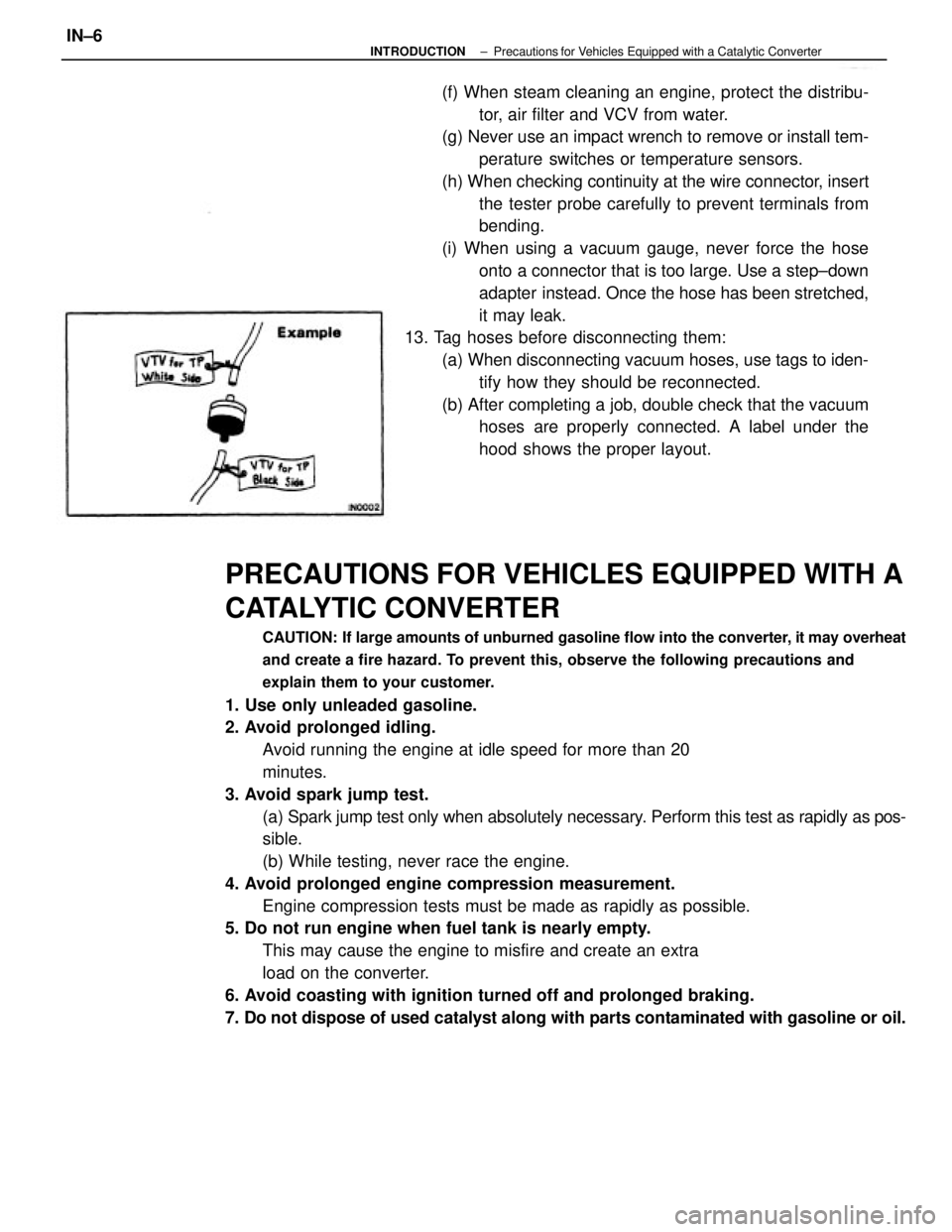
13. Tag hoses before disconnecting them:
(a) When disconnecting vacuum hoses, use tags to iden-
tify how they should be reconnected.
(b) After completing a job, double check that the vacuum
hoses are properly connected. A label under the
hood shows the proper layout.
± INTRODUCTIONPrecautions for Vehicles Equipped with a Catalytic ConverterIN±6