ESP TOYOTA CAMRY V20 1986 Service Information
[x] Cancel search | Manufacturer: TOYOTA, Model Year: 1986, Model line: CAMRY V20, Model: TOYOTA CAMRY V20 1986Pages: 2389, PDF Size: 84.44 MB
Page 1927 of 2389
23. FINAL INSPECTION
(a) Check the operation of the body parts:
wHood
Auxiliary catch operation properly
Hood locks securely when closed
wFront and rear doors
Door locks operate properly
Doors close properly
wLuggage compartment door and back door
Door sock operates properly
wSeats
Seat adjusts easily and locks securely in any position
Front seat back locks securely in any position
Folding±down rear seat backs lock securely
(b) Road test
wCheck the engine and chassis for abnormal noises.
wCheck that the vehicle does not wander or pull to one side.
wCheck that the brakes work properly and do not drag.
wPerform bedding down of the parking brake shoes and drum.
(See page MA±8)
(c) Be sure to deliver a clean car especially check:
wSteering wheel
wShift lever knob
wAll switch knobs
wDoor handles
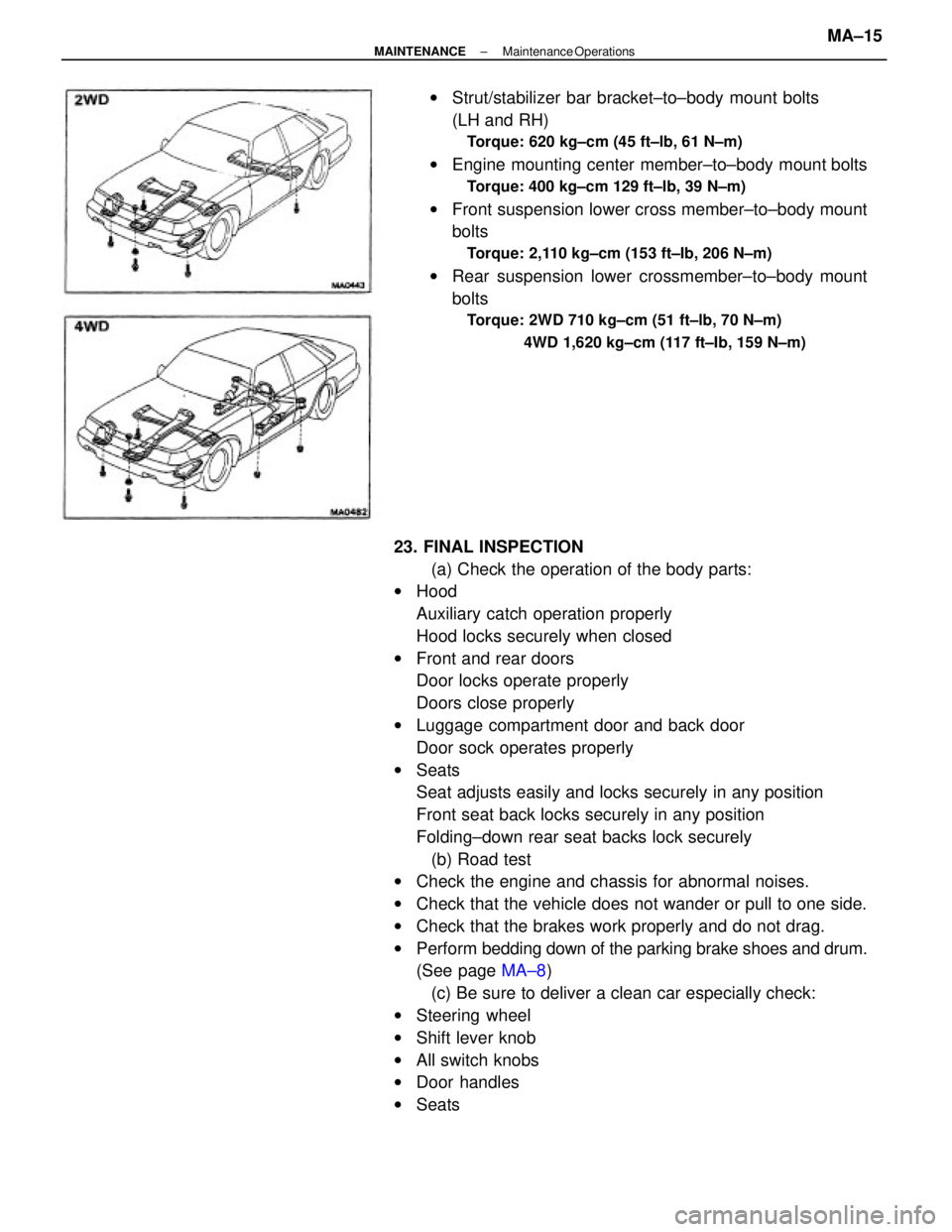
wSeatswStrut/stabilizer bar bracket±to±body mount bolts
(LH and RH)
Torque: 620 kg±cm (45 ft±lb, 61 N±m)
wEngine mounting center member±to±body mount bolts
Torque: 400 kg±cm 129 ft±lb, 39 N±m)
wFront suspension lower cross member±to±body mount
bolts
Torque: 2,110 kg±cm (153 ft±Ib, 206 N±m)
wRear suspension lower crossmember±to±body mount
bolts
Torque: 2WD 710 kg±cm (51 ft±lb, 70 N±m)
4WD 1,620 kg±cm (117 ft±Ib, 159 N±m)
± MAINTENANCEMaintenance OperationsMA±15
Page 2188 of 2389
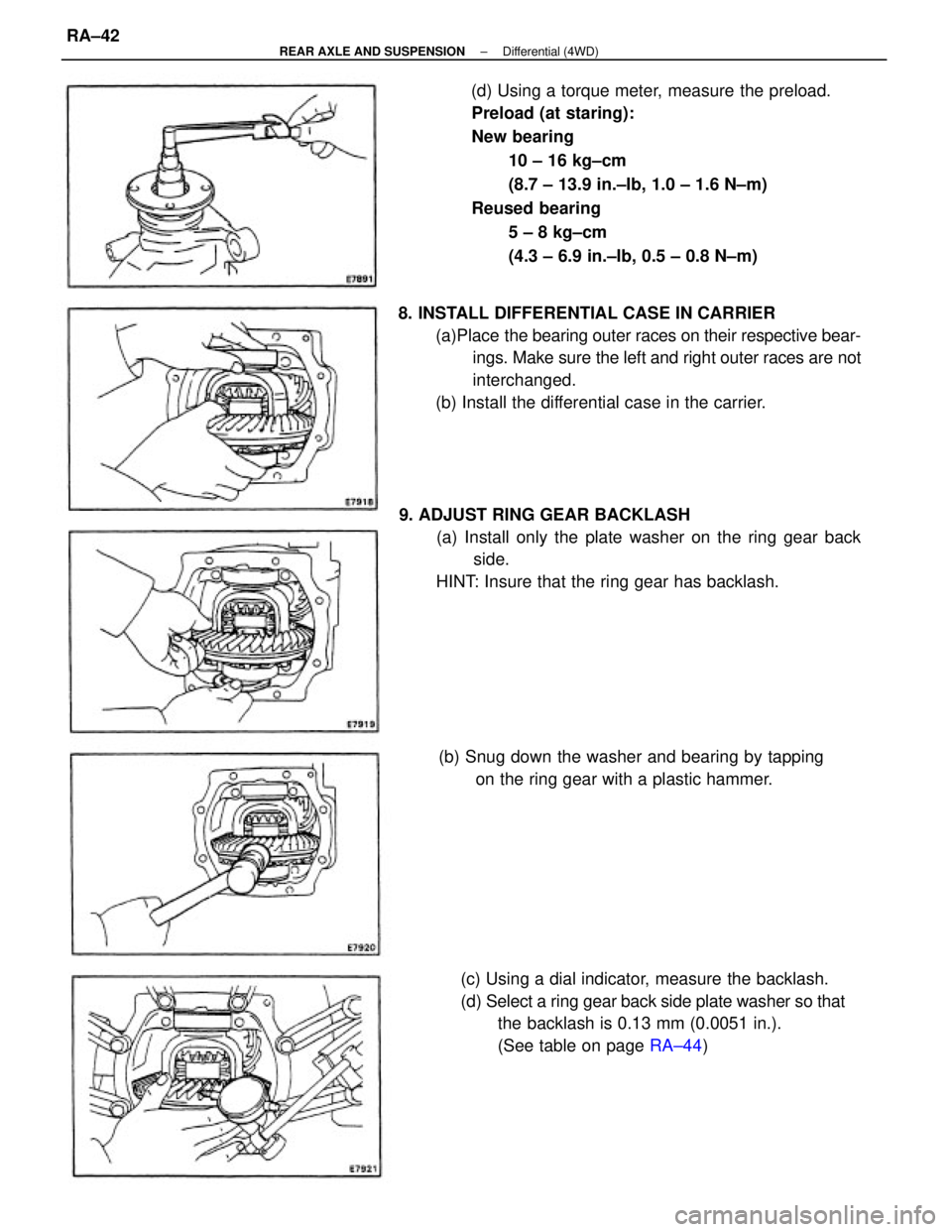
(d) Using a torque meter, measure the preload.
Preload (at staring):
New bearing
10 ± 16 kg±cm
(8.7 ± 13.9 in.±Ib, 1.0 ± 1.6 N±m)
Reused bearing
5 ± 8 kg±cm
(4.3 ± 6.9 in.±Ib, 0.5 ± 0.8 N±m)
9. ADJUST RING GEAR BACKLASH
(a) Install only the plate washer on the ring gear back
side.
HINT: Insure that the ring gear has backlash. 8. INSTALL DIFFERENTIAL CASE IN CARRIER
(a)Place the bearing outer races on their respective bear-
ings. Make sure the left and right outer races are not
interchanged.
(b) Install the differential case in the carrier.
(c) Using a dial indicator, measure the backlash.
(d) Select a ring gear back side plate washer so that
the backlash is 0.13 mm (0.0051 in.).
(See table on page RA±44) (b) Snug down the washer and bearing by tapping
on the ring gear with a plastic hammer.
± REAR AXLE AND SUSPENSIONDifferential (4WD)RA±42
Page 2202 of 2389
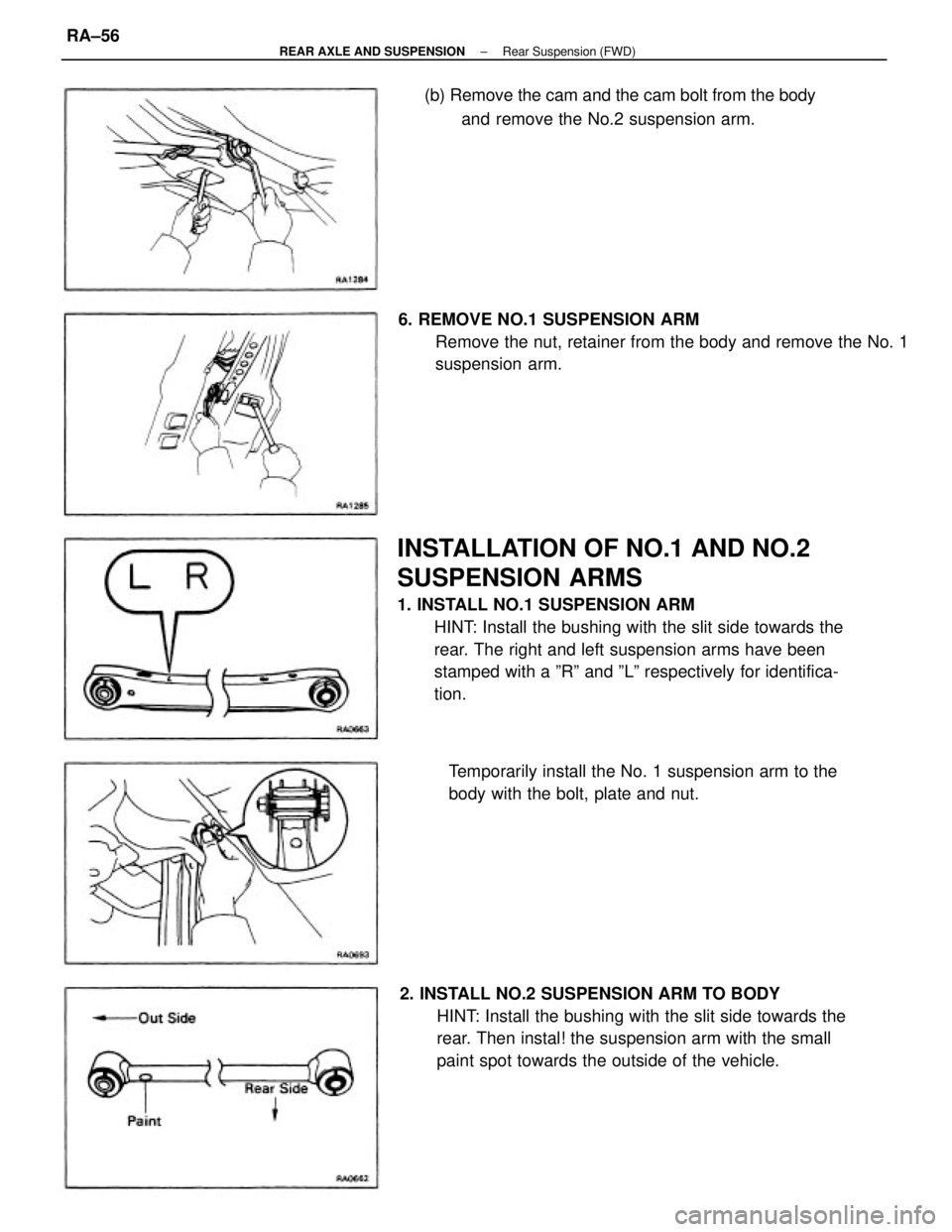
INSTALLATION OF NO.1 AND NO.2
SUSPENSION ARMS
1. INSTALL NO.1 SUSPENSION ARM
HINT: Install the bushing with the slit side towards the
rear. The right and left suspension arms have been
stamped with a ºRº and ºLº respectively for identifica-
tion.
2. INSTALL NO.2 SUSPENSION ARM TO BODY
HINT: Install the bushing with the slit side towards the
rear. Then instal! the suspension arm with the small
paint spot towards the outside of the vehicle. 6. REMOVE NO.1 SUSPENSION ARM
Remove the nut, retainer from the body and remove the No. 1
suspension arm.
Temporarily install the No. 1 suspension arm to the
body with the bolt, plate and nut. (b) Remove the cam and the cam bolt from the body
and remove the No.2 suspension arm.
± REAR AXLE AND SUSPENSIONRear Suspension (FWD)RA±56
Page 2337 of 2389
The oil seals on both sides of the power cylinder
are for the prevention of leakage of the high
pressure fluid which acts on the piston. Always
use new oil seals when reassembling and be
very careful not to scratch or damage them.
Because of the high pressure, even the slightest
scratch will cause fluid leakage, resulting in an
inoperative power steering system.
Also, be very careful not to scratch the sliding
portion of the rack which makes contact with the
oil seals. When removing the rack ends from the
rack, it is very easy to cause a burr when hold-
ing the tip of the rack with a wrench. Therefore,
before assembling the rack, first check the tip for
burrs and remove any with an oil stone.
Teflon rings are used for the piston and control
valve. These teflon rings are highly durable
against wear, but if it is necessary to replace
them, be careful not to stretch the new ones.
After installing a teflon ring into its groove, snug
it down into the groove before assembly of the
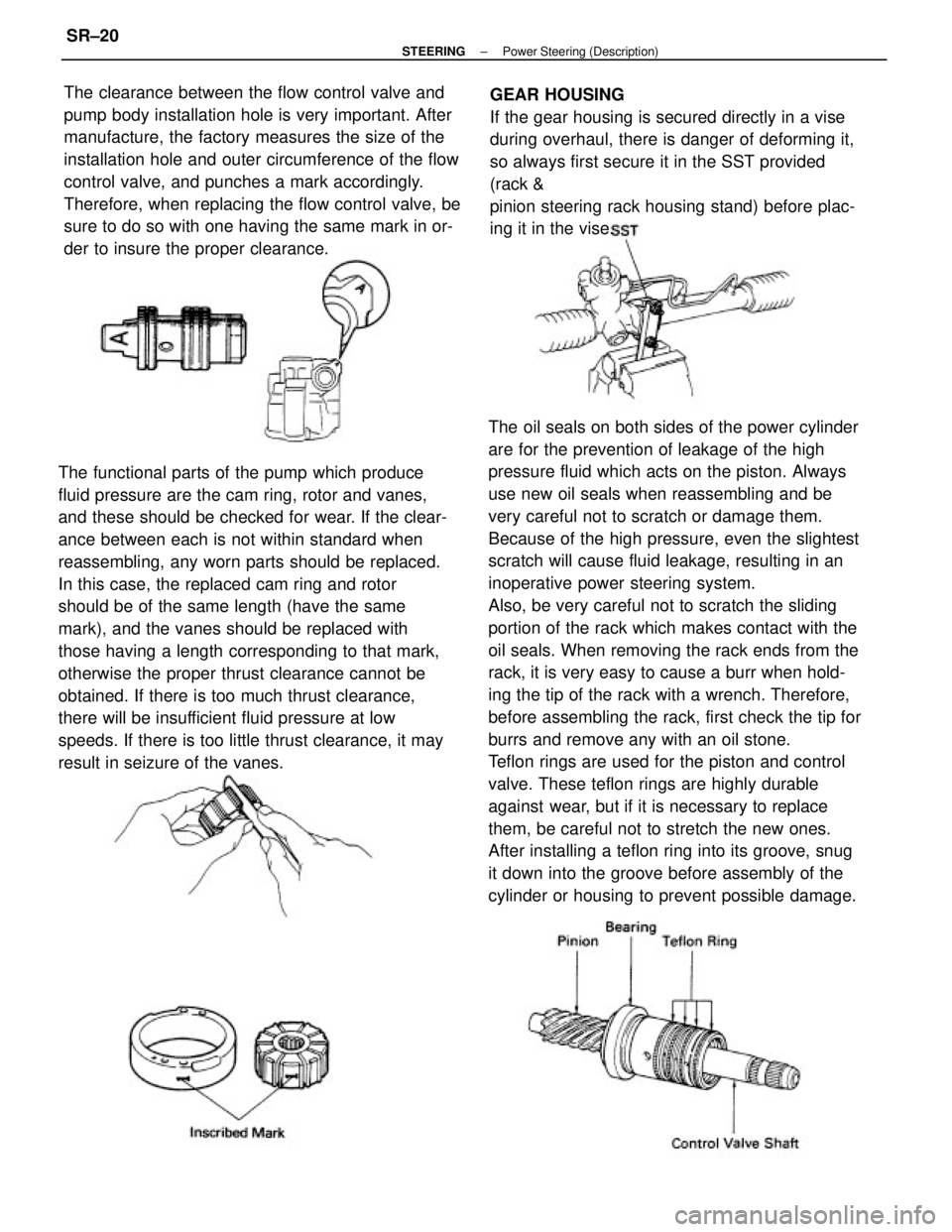
cylinder or housing to prevent possible damage. The functional parts of the pump which produce
fluid pressure are the cam ring, rotor and vanes,
and these should be checked for wear. If the clear-
ance between each is not within standard when
reassembling, any worn parts should be replaced.
In this case, the replaced cam ring and rotor
should be of the same length (have the same
mark), and the vanes should be replaced with
those having a length corresponding to that mark,
otherwise the proper thrust clearance cannot be
obtained. If there is too much thrust clearance,
there will be insufficient fluid pressure at low
speeds. If there is too little thrust clearance, it may
result in seizure of the vanes.The clearance between the flow control valve and
pump body installation hole is very important. After
manufacture, the factory measures the size of the
installation hole and outer circumference of the flow
control valve, and punches a mark accordingly.
Therefore, when replacing the flow control valve, be
sure to do so with one having the same mark in or-
der to insure the proper clearance.GEAR HOUSING
If the gear housing is secured directly in a vise
during overhaul, there is danger of deforming it,
so always first secure it in the SST provided
(rack &
pinion steering rack housing stand) before plac-
ing it in the vise.
± STEERINGPower Steering (Description)SR±20