weight TOYOTA CELICA 1987 Service Repair Manual
[x] Cancel search | Manufacturer: TOYOTA, Model Year: 1987, Model line: CELICA, Model: TOYOTA CELICA 1987Pages: 346, PDF Size: 35.13 MB
Page 165 of 346
ENGINE MECHANICAL -, Description
EM-3
The 7M-GE, 7M-GTE engines are an in-line 6-
cylinder engine with the cylinders numbered l-2-
3-4-5-6 from the front. The crankshaft is sup-
ported by 7 bearings specified by the inside of the
crankcase. These bearings are made of kelmet.
.The crankshaft is integrated with 8 weights
which are cast along with it for balancing. Oil holes
‘are built into the crankshaft for supplying oil to the
connecting rods, pistons and other components.
These engine’s ignition order is l-5-3-6-2-4 .
The cylinder head is made of aluminum alloy, with
a cross flow type intake and exhaust layout and
with pent roof type combustion chambers. The
spark plugs are located in the center of the com-
bustion chambers.
Exhaust and intake valves are equipped with
irregular pitch springs with symmetrical ends
made of oil tempered silicon chrome steel wire
which are capable of following the valves even at
,high engine speeds.
Both the exhaust side cam shaft and the. intake
side cam shaft are driven by a single timing belt.
The cam journal is supported at 7 places between
the valve lifters of each cylinder and on the
cylinder head of front end. Lubrication of the cam
journal and cam is accomplished by oil being sup-
plied through the oiler port in the center of the
camshaft.
Adjustment of the valve clearance is done by
means of an outer shim type system, in which
valve adjusting shims are located above the valve
lifters. This permits replacement of the shims
without removal of the camshafts.
The resin timing belt cover is made in 2 pieces.
Pistons are made of highly temperature-resis-
tant aluminum alloy, and depressions are built into
the piston head to prevent interference with
valves.
Piston pins are the full-floating type, with the
pins fastened to neither the piston boss nor the
connecting rods. Instead, snap rings are fitted on
both ends of the pins, preventing the pins from
falling out.
The No. 1 compression ring is made of stainless
steel and the No. 2 compression ring is made of
cast iron. The oil ring is made of a combination of
stainless steel. The outer diameter of each piston
ring is slightly larger than the diameter of the
piston
and the flexibility of the rings allows them
to hug the cylinder walls when they are mounted
on the piston. Compression rings No. 1 and No. 2
work to prevent the leakage of gas from the
cylinder and the oil ring works to scrape oil off the
cylinder walls to prevent it from entering the com-
bustion chamber.
The cylinder block is made of cast iron. It has 6
cylinders which are approximately 1.6 times the
length of the piston stroke. The top of the cylin- ders is closed off by the cylinder head and the
lower end of the cylinders becomes the crankcase,
in which the crankshaft is installed. In addition,- the
cylinder block contains a water jacket, through
which coolant is pumped to cool the cylinders.
The .oil pan is bolted onto the botiom of the
cylinder block. The oil pan is an oil reservoir made .
of pressed steel sheet. A dividing plate’is included
-inside the oil pan to keep sufficient oil in the bot-
tom of the pan even when the vehicle is tilted. This
dividing plate also prevent5 the oil from making
waves when the vehicle is stopped suddenly and
thus shifting the oil away from the oil pump suc-
tion pipe.
Page 293 of 346
LG&RICATION SYSTEM - Oil Pump
L.!J:ll
.... ..- .._.~.“.“._ _ ,.. _,-
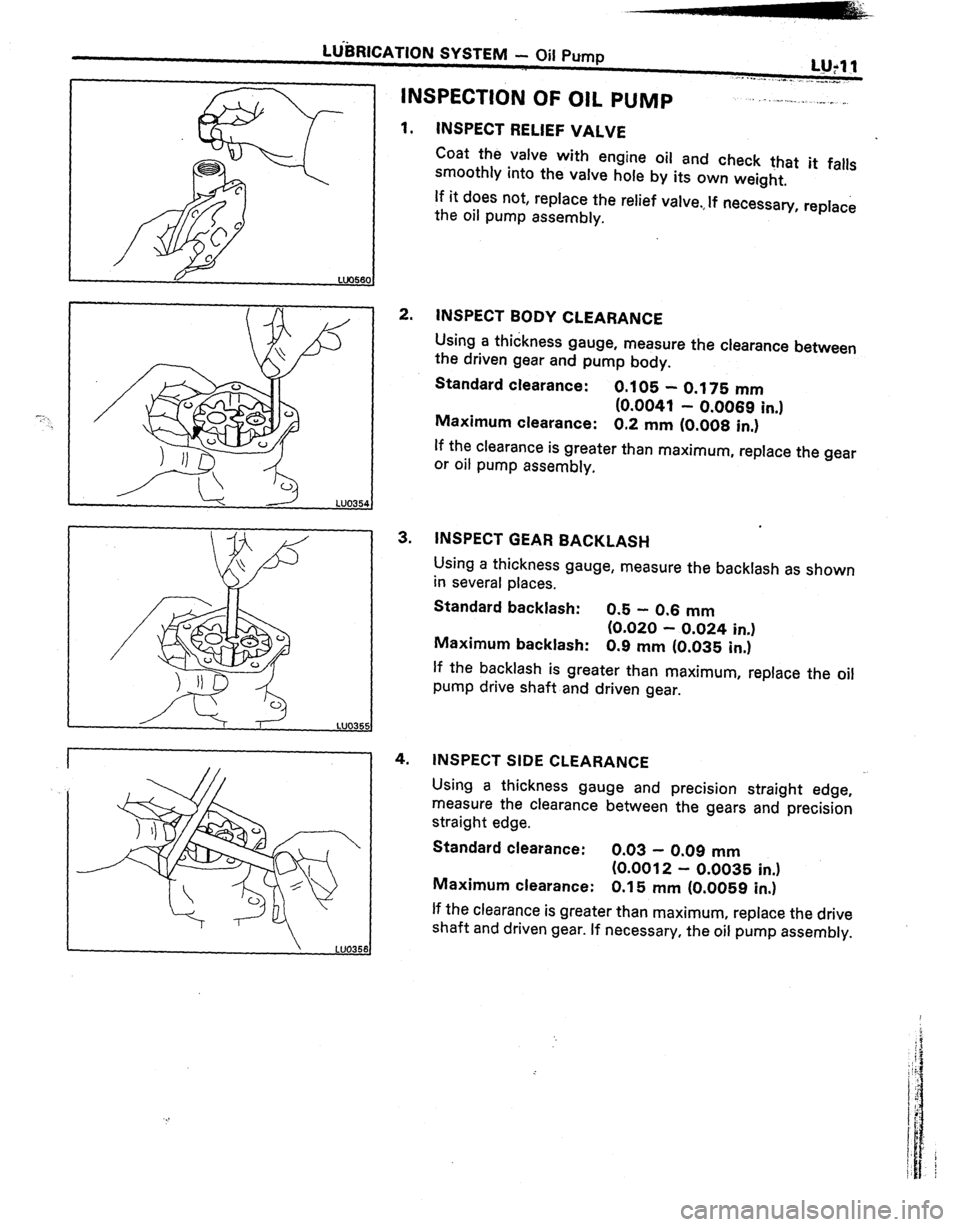
INSPECTION OF OIL PUMP
1.
2.
3.
4.
~. -.--. . ._. I ”
INSPECT RELIEF VALVE
Coat the valve with engine oil and check that it falls
smoothly into the valve hole by its own weight,
If it does not, replace the relief valve.,If necessary, replace
the oil pump assembly.
INSPECT BODY CLEARANCE
Using a thickness gauge, measure the clearance between
the driven gear and pump body.
Standard clearance:
0.105 - 0.175 mm
(0.0041 - 0.0069 in.1
Maximum clearance: 0.2 mm (0.008 in.)
If the clearance is greater than maximum, replace the gear
or oil pump assembly.
INSPECT GEAR BACKLASH
Using a thickness gauge, measure the backlash as shown
in several places.
Standard backlash: 0.5 - 0.6 mm
(0.020 - 0.024 in.)
Maximum backlash: 0.9 mm (0.035 in.)
If the backlash is greater than maximum, replace the oil
pump drive shaft and driven gear.
INSPECT SIDE CLEARANCE
Using a thickness gauge and precision straight edge,
measure the clearance between the gears and precision
straight edge.
Standard clearance:
0.03 - 0.09 mm
(0.0012 - 0.0035 in.)
Maximum clearance: 0.15 mm (0.0059 in.)
If the clearance is greater than maximum, replace the drive
shaft and driven gear. If necessary, the oil pump assembly.
Page 299 of 346
LUBRICATION SYSTENl
- Qii Cooler and oil Pressure. Regulator (-/M-GE)
LU-17.
._ .
w
e
0
LUO48f
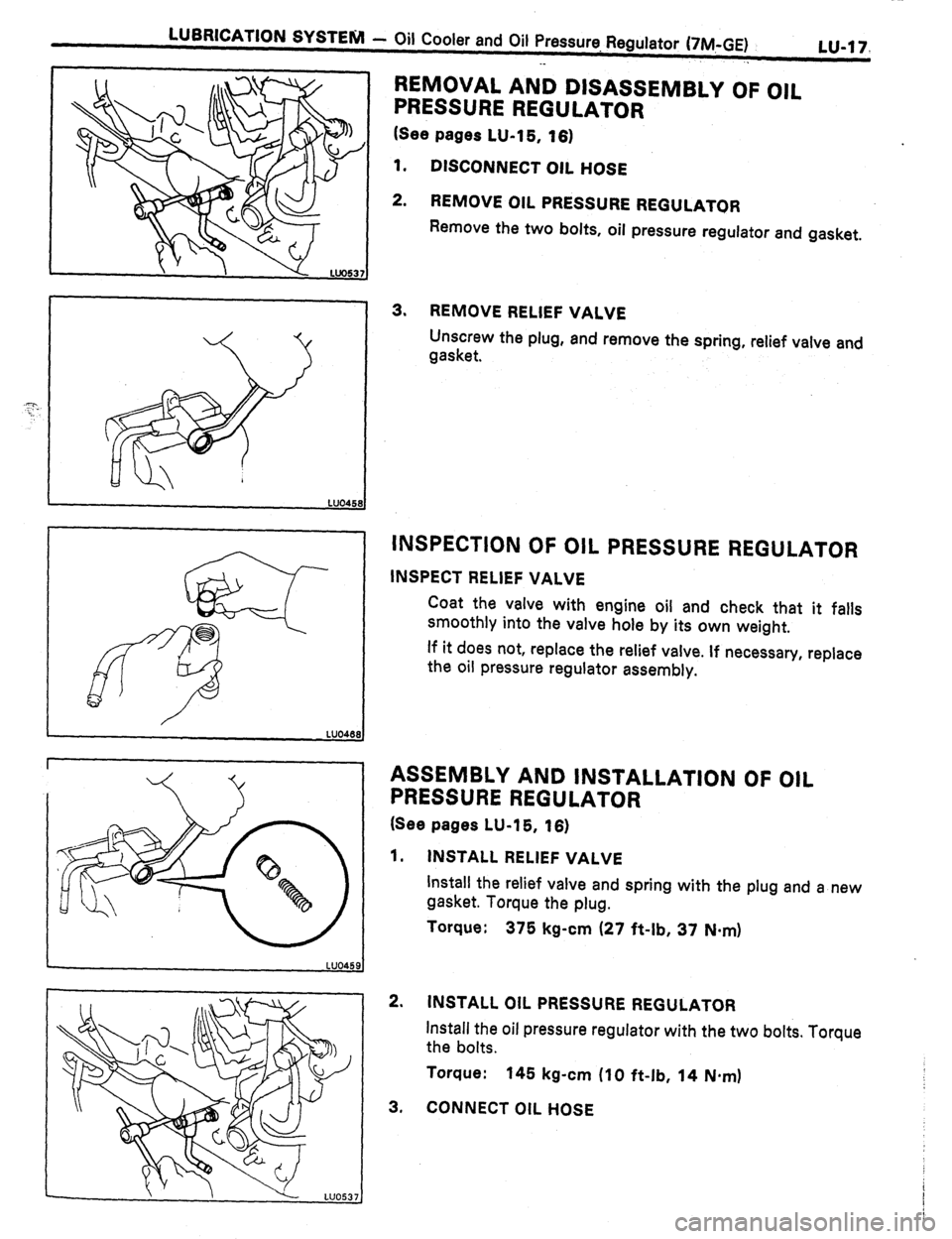
REMOVAL AND DISASSEMBLY OF OIL
PRESSURE REGULATOR
(See pages LU-15, 16)
1. DISCONNECT OIL HOSE
2. REMOVE OIL PRESSURE REGULATOR
Remove the two bolts, oil pressure regulator and gasket.
3. REMOVE RELIEF VALVE
Unscrew the plug, and remove the spring, relief valve and
gasket.
INSPECTION OF OIL PRESSURE REGULATOR
INSPECT RELIEF VALVE
Coat the valve with engine oil and check that it falls
smoothly into the valve hole by its own weight.
If it does not, replace the relief valve. If necessary, replace
the oil pressure regulator assembly.
ASSEMBLY AND INSTALLATION OF OIL
PRESSURE REGULATOR
(See pages LU-15, 16)
1. INSTALL RELIEF VALVE
Install the relief valve and spring with the plug and a new
gasket. Torque the plug.
Torque:
375 kg-cm (27 ft-lb, 37 N-m)
2. INSTALL OIL PRESSURE REGULATOR
Install the oil pressure regulator with the two bolts. Torque
the bolts.
Torque:
145 kg-cm (10 ft-lb, 14 N.m)
3, CONNECT OIL HOSE
Page 301 of 346
LUBRICATION SYSTENI - Oil Cooler and Oil Pressurr+ Regulator (7M-GTE)
’ 1” - 06Lu-19
---. “, -“-~~yII.
. .
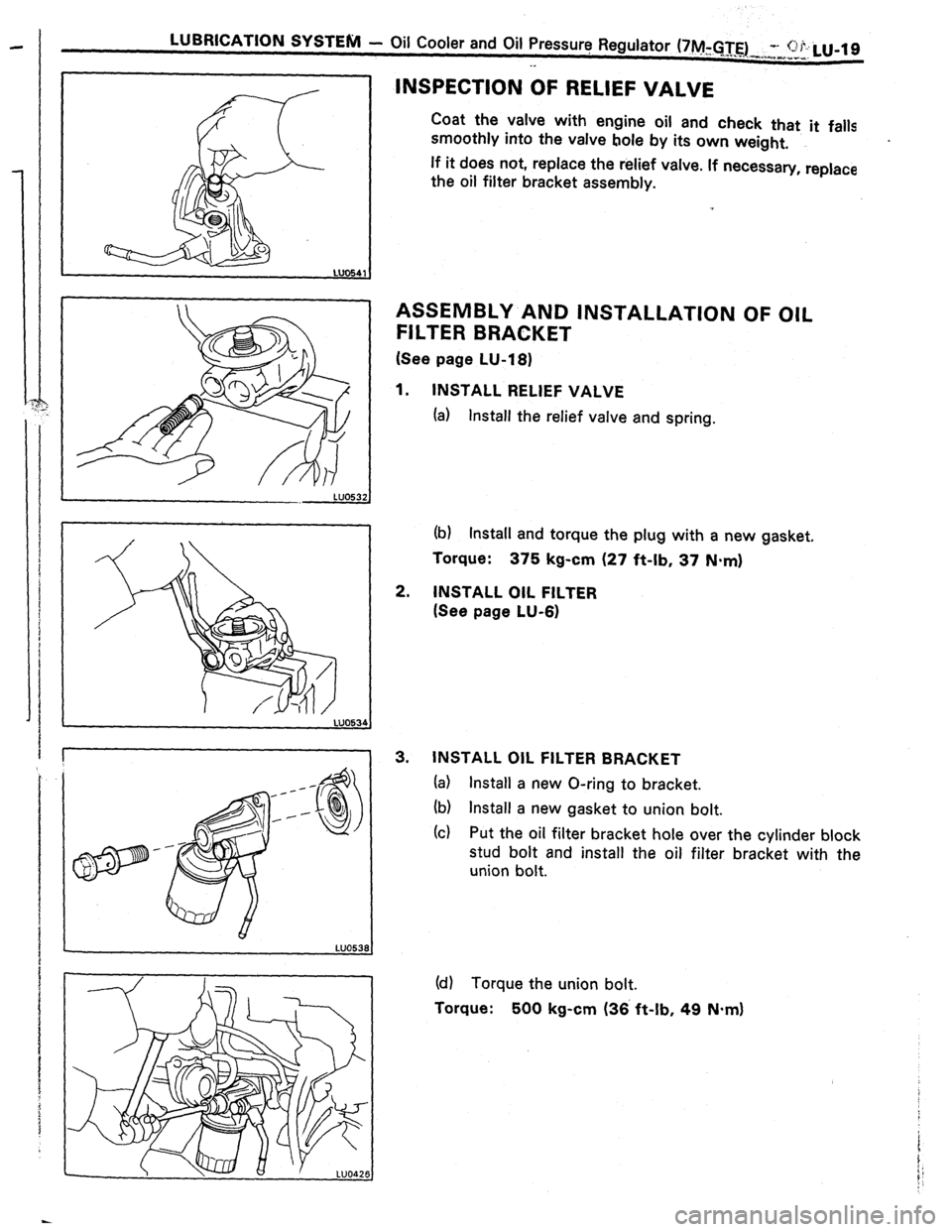
INSPECTION OF RELIEF VALVE
Coat the valve with engine oil and check that it falls
smoothly into the valve hole by its own weight.
If it does not, replace the relief valve. If necessary,
replace
the oil filter bracket assembly.
INSTALLATION OF OIL ASSEMBLY AND
FILTER BRACKET
(See page LU-18)
1. INSTALL RELIEF VALVE
(a) Install the relief valve and spring.
(b) Install and torque the plug with a new gasket.
Torque: 375 kg-cm (27 ft-lb, 37 Nsm)
2.
INSTALL OIL FILTER
(See page LU-8)
3. INSTALL OIL FILTER BRACKET
(a) Install a new O-ring to bracket.
(b) Install a new gasket to union bolt.
(c) Put the oil filter bracket hole over the cylinder block
stud bolt and install the oil filter bracket with the
union bolt.
(d) Torque the union bolt.
Torque: 500 kg-cm (36’ ft-lb, 49 N*mI