hood release TOYOTA COROLLA 1996 Owners Manual
[x] Cancel search | Manufacturer: TOYOTA, Model Year: 1996, Model line: COROLLA, Model: TOYOTA COROLLA 1996Pages: 195, PDF Size: 4.13 MB
Page 17 of 195
14
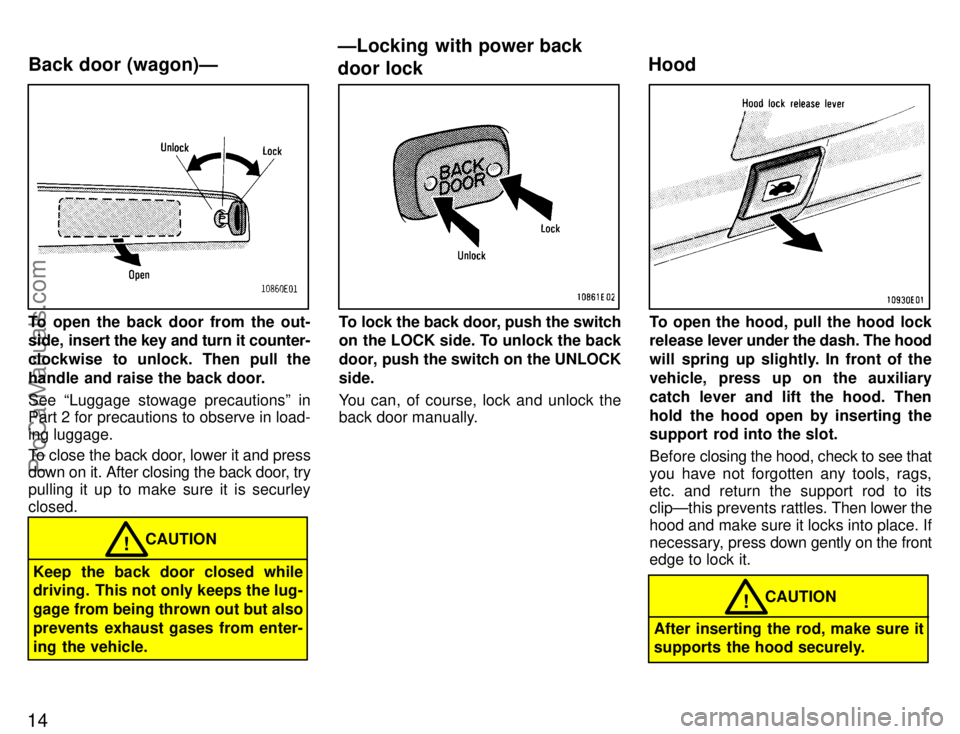
To open the back door from the out-
side, insert the key and turn it counter-
clockwise to unlock. Then pull the
handle and raise the back door.
See Luggage stowage precautionsº in
Part 2 for precautions to observe in load-
ing luggage.
To close the back door, lower it and press
down on it. After closing the back door, try
pulling it up to make sure it is securley
closed.
Keep the back door closed while
driving. This not only keeps the lug-
gage from being thrown out but also
prevents exhaust gases from enter-
ing the vehicle.
CAUTION!
To lock the back door, push the switch
on the LOCK side. To unlock the back
door, push the switch on the UNLOCK
side.
You can, of course, lock and unlock the
back door manually.To open the hood, pull the hood lock
release lever under the dash. The hood
will spring up slightly. In front of the
vehicle, press up on the auxiliary
catch lever and lift the hood. Then
hold the hood open by inserting the
support rod into the slot.
Before closing the hood, check to see that
you have not forgotten any tools, rags,
etc. and return the support rod to its
clipÐthis prevents rattles. Then lower the
hood and make sure it locks into place. If
necessary, press down gently on the front
edge to lock it.
After inserting the rod, make sure it
supports the hood securely.
CAUTION! ÐLocking with power back
door lockHood Back door (wagon)Ð
ProCarManuals.com
Page 149 of 195
144You can be confident that your Toyota
dealer's service department performs the
best job to meet the maintenance require-
ments on your vehicleÐreliably and eco-
nomically.
Your copy of the repair order is proof that
all required maintenance has been per-
formed for warranty coverage. And if any
problems should arise with your vehicle
while under warranty, your Toyota dealer
will promptly take care of it. Again, be sure
to keep a copy of the repair order for any
service performed on your Toyota.
What about do- it- yourself mainte-
nance?
Many of the maintenance items are easy
to do yourself if you have a little mechani-
cal ability and a few basic automotive
tools. Simple instructions for how to per-
form them are presented in Part 7.
If you are a skilled do-it-yourself me-
chanic, the Toyota service manuals are
recommended. Please be aware that do-
it-yourself maintenance can affect your
warranty coverage. See Owner's Guide,
Owner 's Manual Supplement or Warranty
Booklet for the details.Listed below are the general maintenance
items that should be performed as fre-
quently as specified. In addition to check-
ing the items listed, if you notice any un-
usual noise, smell or vibration, you should
investigate the cause or take your vehicle
to your Toyota dealer or a qualified service
shop immediately. It is recommended
that any problem you notice be brought to
the attention of your dealer or the qualified
service shop for their advice.
Make these checks only where
adequate ventilation can be obtained
if you run the engine.CAUTION
!
OUTSIDE THE VEHICLE
Items listed below should be per-
formed from time to time, unless
otherwise specified.
Tire pressure
Check the pressure with a gauge every
two weeks, or at least once a month. See
Chapter 7-2 for additional information.
Tire surface and wheel nuts
Check the tires carefully for cuts, damage
or excessive wear. See Chapter 7-2 for
additional information. When checking
the tires, make sure no nuts are missing,
and check the nuts for looseness. Tighten
them if necessary.Tire rotation
Rotate the tires every 12000 km (7500
miles). See Chapter 7-2 for additional in-
formation.
Fluid leaks
Check underneath for leaking fuel, oil, wa-
ter or other fluid after the vehicle has been
parked for a while. If you smell fuel fumes
or notice any leak, have the cause found
and corrected immediately.
Doors and engine hood
Check that all doors including trunk lid or
back door operate smoothly and all
latches lock securely. Make sure the en-
gine hood secondary latch secures the
hood from opening when the primary latch
is released.
INSIDE THE VEHICLE
Items listed below should be checked
regularly, e.g. while performing peri-
odic services, cleaning the vehicle,
etc.
Lights
Make sure the headlights, stop lights, tail
lights, turn signal lights, and other lights
are all working. Check headlight aim.
Service reminder indicators and warn-
ing buzzers
Check that all service reminder indicators
and warning buzzers function properly.
General maintenance
ProCarManuals.com