roof TOYOTA COROLLA 2009 10.G User Guide
[x] Cancel search | Manufacturer: TOYOTA, Model Year: 2009, Model line: COROLLA, Model: TOYOTA COROLLA 2009 10.GPages: 468, PDF Size: 9.31 MB
Page 90 of 468
90 1-7. Safety information
CAUTION
■SRS airbag precautions
●Side airbags: Do not use seat accessories which cover the parts where the
SRS side airbags inflate as they may interfere with inflation of the airbags.
● Do not strike or apply significant levels of force to the area of the SRS air-
bag components ( P. 81).
Doing so can cause the SRS airbags to malfunction.
● Do not touch any of the component parts immediately after the SRS air-
bags have deployed (inflated) as they may be hot.
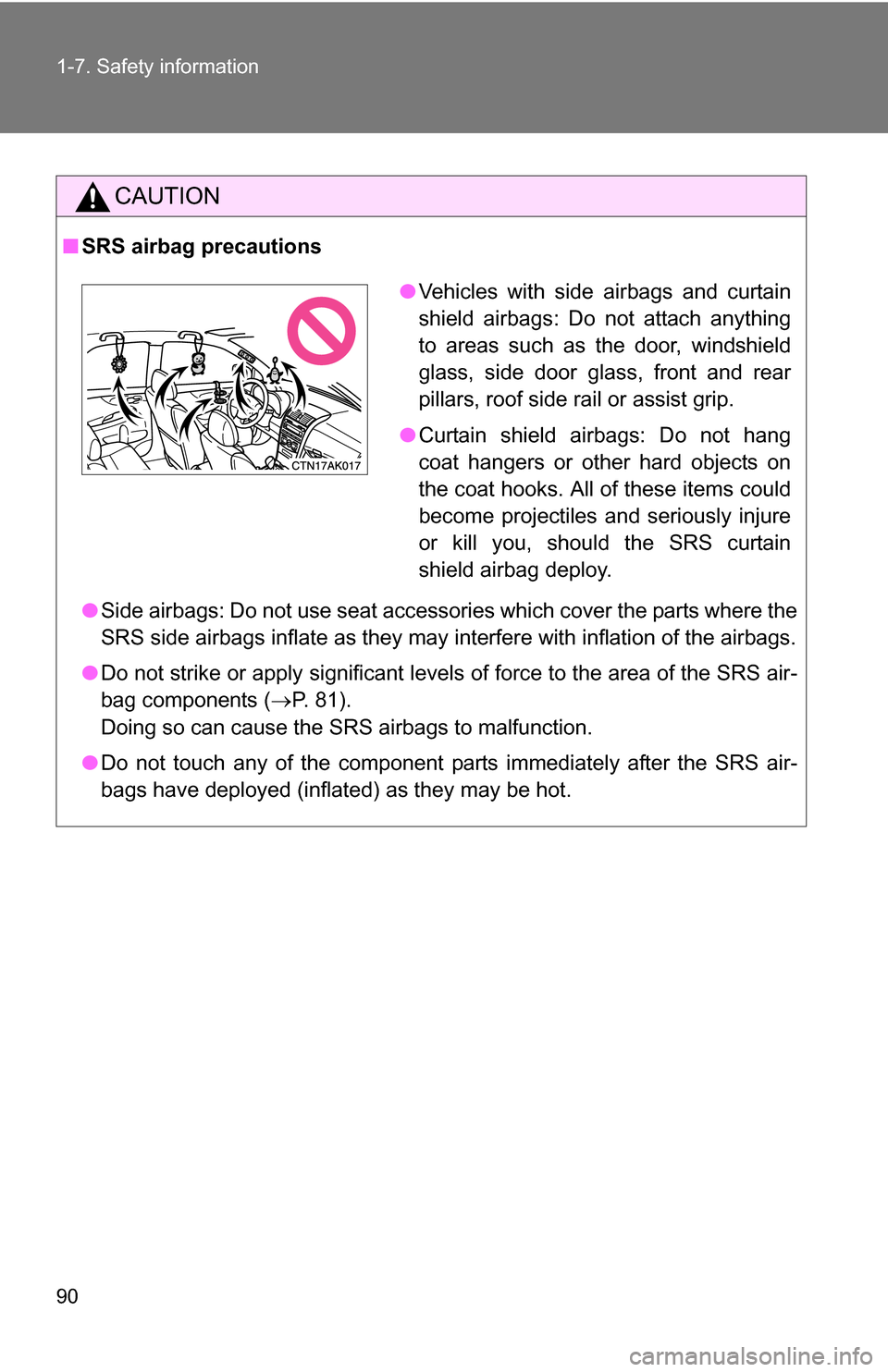
●Vehicles with side airbags and curtain
shield airbags: Do not attach anything
to areas such as the door, windshield
glass, side door glass, front and rear
pillars, roof side rail or assist grip.
● Curtain shield airbags: Do not hang
coat hangers or other hard objects on
the coat hooks. All of these items could
become projectiles and seriously injure
or kill you, should the SRS curtain
shield airbag deploy.
Page 91 of 468
91
1-7. Safety information
1
Before driving
CAUTION
■
SRS airbag precautions
●If breathing becomes difficult after the SRS airbag has deployed, open a
door or window to allow fresh air in, or leave the vehicle if it is safe to do
so. Wash off any residue as soon as possible to prevent skin irritation.
● Vehicles with side airbags and curtain shield airbags: If the areas where
the SRS airbags are stored, such as the steering wheel pad and front and
rear pillar garnishes, are damaged or cracked, have them replaced by
your Toyota dealer.
● Vehicles without side airbags and curtain shield airbags: If the areas
where the SRS airbags are stored, such as the steering wheel pad are
damaged or cracked, have them replaced by your Toyota dealer.
■ Modification and disposal of SRS airbag system components
Do not dispose of your vehicle or per form any of the following modifications
without consulting your Toyota dealer.
The SRS airbags may malfunction or deploy (inflate) accidentally, causing
death or serious injury.
● Installation, removal, disassembly and repair of the SRS airbags.
● Vehicles with side airbags and curtain shield airbags: Repairs, modifica-
tions, removal or replacement of the steering wheel, instrument panel,
dashboard, seats or seat upholstery, front, side and rear pillars or roof side
rail.
● Vehicles without side airbags and curtain shield airbags: Repairs, modifi-
cations, removal or replacement of the steering wheel, instrument panel,
dashboard, seats or seat upholstery.
● Repairs or modifications of the front fender, front bumper, or side of the
occupant compartment.
● Installation of snow plows, winches, etc. to the front grille (bull bars, kan-
garoo bar etc.).
● Modifications to the vehicle's suspension system.
● Installation of electronic devices such as mobile two-way radios or CD
players.
● Modifications to your vehicle for a person with a physical disability.
Page 100 of 468
100 1-7. Safety information
CAUTION
■Child restraint precautions
●Never install a rear-facing child restraint system on the front passenger
seat even if the “AIR BAG OFF” indicator light is illuminated. In the event
of an accident, the force of the rapid inflation of the front passenger airbag
can cause death or serious injury to the child if the rear-facing child
restraint system is installed on the front passenger seat.
● A forward-facing child restraint system should be installed on the front
passenger seat only when it is unavoidable. Always move the seat as far
back as possible even if the “AIR BAG OFF” indicator light is illuminated,
because the front passenger airbag could inflate with considerable speed
and force. Otherwise, the child may be killed or seriously injured.
● Do not use the seat belt extender when installing a child restraint system
on the front or rear passenger seat. If installing a child restraint system
with the seat belt extender connected to the seat belt, the seat belt will not
securely hold the child restraint system, which could cause death or seri-
ous injury to the child or other passengers in the event of collision.
● Vehicles with side airbags and curtain shield airbags: Do not allow the
child to lean his/her head or any part of his/her body against the door or
the area of the seat, front and rear pill ars or roof side rail from which the
side airbags or curtain shield airbags deploy even if the child is seated in
the child restraint system. It is dangerous if the side airbags and curtain
shield airbags inflate, and the impact could cause death or serious injury to
the child.
● Make sure you have complied with all installation instructions provided by
the child restraint manufacturer and that the system is properly secured. If
it is not secured properly, it may cause death or serious injury to the child
in the event of a sudden stop or accident.
■ When the child restrain t system is not in use
● Keep the child restraint system properly secured on the seat even if it is
not in use.
Do not store the restraint unsecured in the passenger compartment.
● If it is necessary to detach the child restraint system, remove it from the
vehicle or store it securely in the trunk. This will prevent it from injuring
passengers in the event of a sudden stop or accident.
Page 233 of 468
233
3-3. Using the hand
s-free phone system (for cellular phone)
3
Interior features
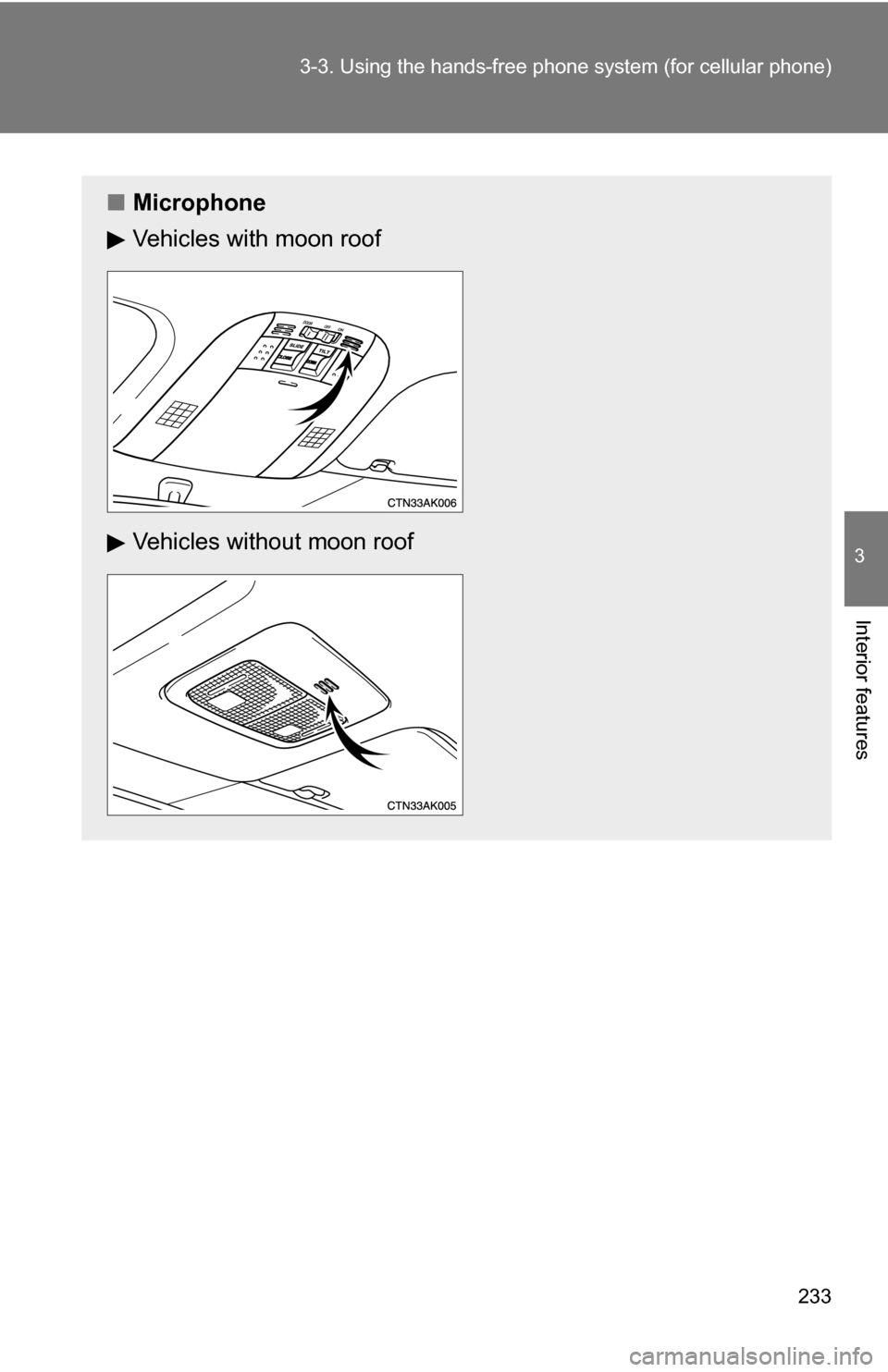
■Microphone
Vehicles with moon roof
Vehicles without moon roof
Page 261 of 468
261
3-4. Using the interior lights
3
Interior features
■
Illuminated entry system
Vehicles without moon roof
The interior light (with the switch in the “DOOR” position) and “ENGINE
START STOP” switch light (vehicles with smart key system) automatically
turn on/off according to “ENGINE START STOP” switch mode (vehicles with
smart key system) or engine switch pos ition (vehicles without smart key sys-
tem), the presence of the electronic key (vehicles with smart key system),
whether the doors are locked/unlocked (vehicles with power door lock sys-
tem) and whether the doors are open/closed.
Vehicles with moon roof
The interior light, personal/interior lights (with the switch in the “DOOR” posi-
tion) and “ENGINE START STOP” switch light (vehicles with smart key sys-
tem) automatically turn on/off according to “ENGINE START STOP” switch
mode (vehicles with smart key system) or engine switch position (vehicles
without smart key system), the presence of the electronic key (vehicle\
s with
smart key system), whether the doors are locked/unlocked (vehicles with
power door lock system) and whether the doors are open/closed.
■ To prevent the battery from being discharged
If the interior light, personal/interior lights (vehicles with moon roof) and
“ENGINE START STOP” switch light (vehicles with smart key system)
remain on when the door is not fully closed and the switch is in the “DOOR”
position, the lights will go off automatically after 20 minutes.
■ Customization that can be co nfigured at Toyota dealer
Settings (e.g. The time elapsed before lights turn off) can be changed.
(Customizable features P. 443)
Page 262 of 468
262 3-4. Using the interior lights
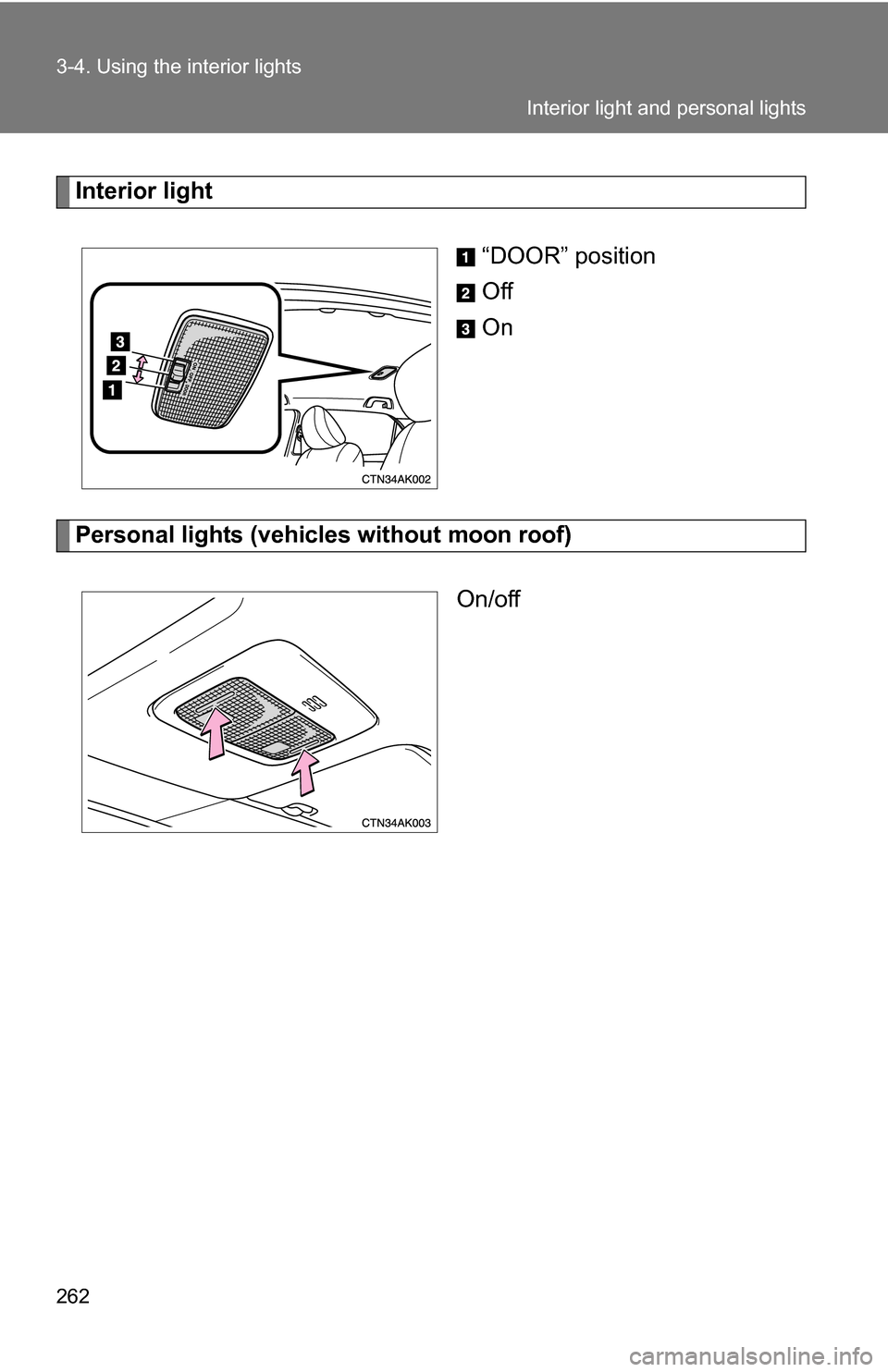
Interior light“DOOR” position
Off
On
Personal lights (vehicles without moon roof)On/off
Interior light and personal lights
Page 263 of 468
263
3-4. Using the interior lights
3
Interior features
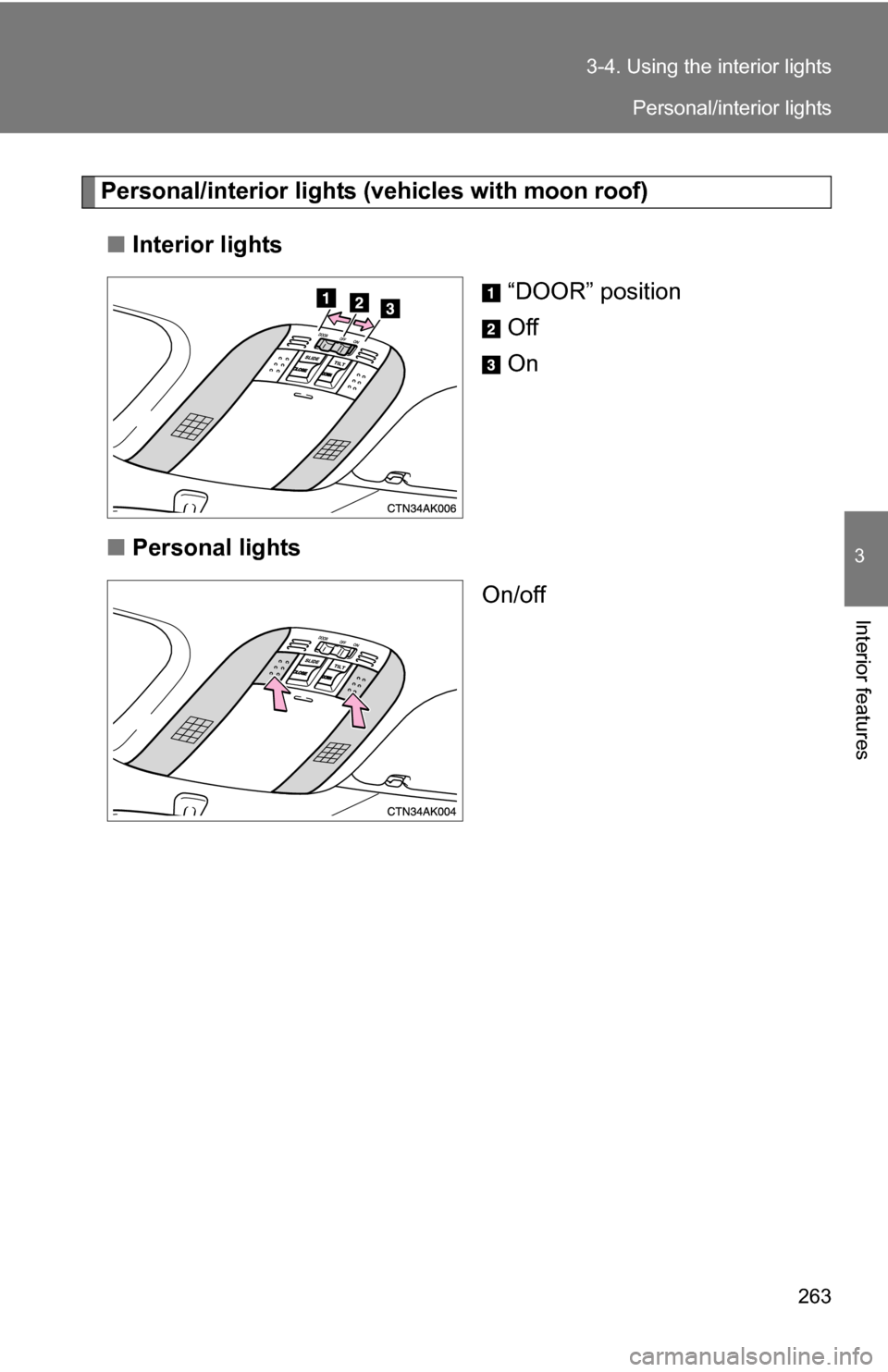
Personal/interior lights (
vehicles with moon roof)
■ Interior lights
“DOOR” position
Off
On
■ Personal lights
On/off
Personal/interior lights
Page 269 of 468
269
3-5. Using the
storage features
3
Interior features
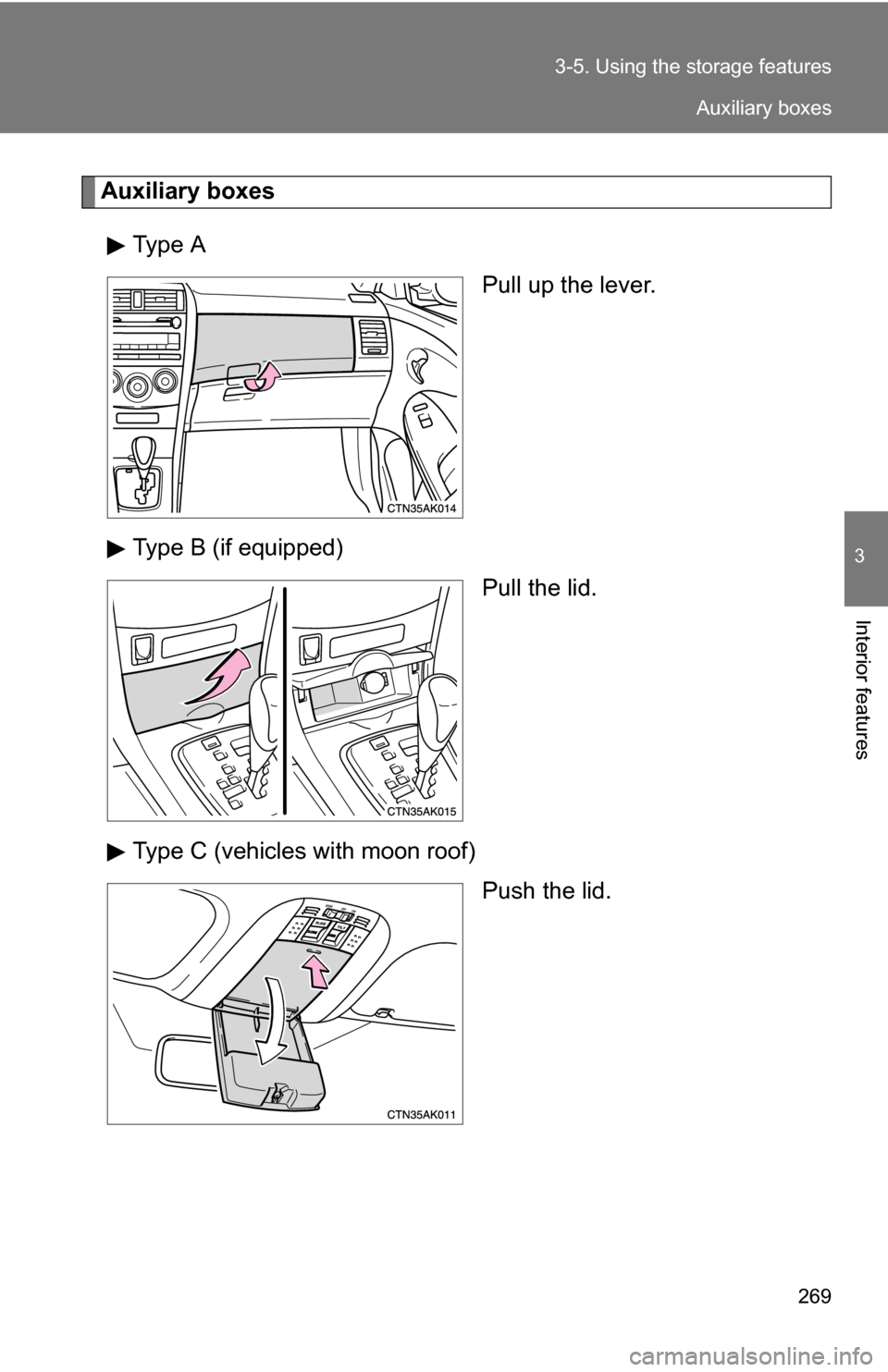
Auxiliary boxes
Type A Pull up the lever.
Type B (if equipped) Pull the lid.
Type C (vehicles with moon roof) Push the lid.
Auxiliary boxes
Page 286 of 468
286 3-6. Other interior features
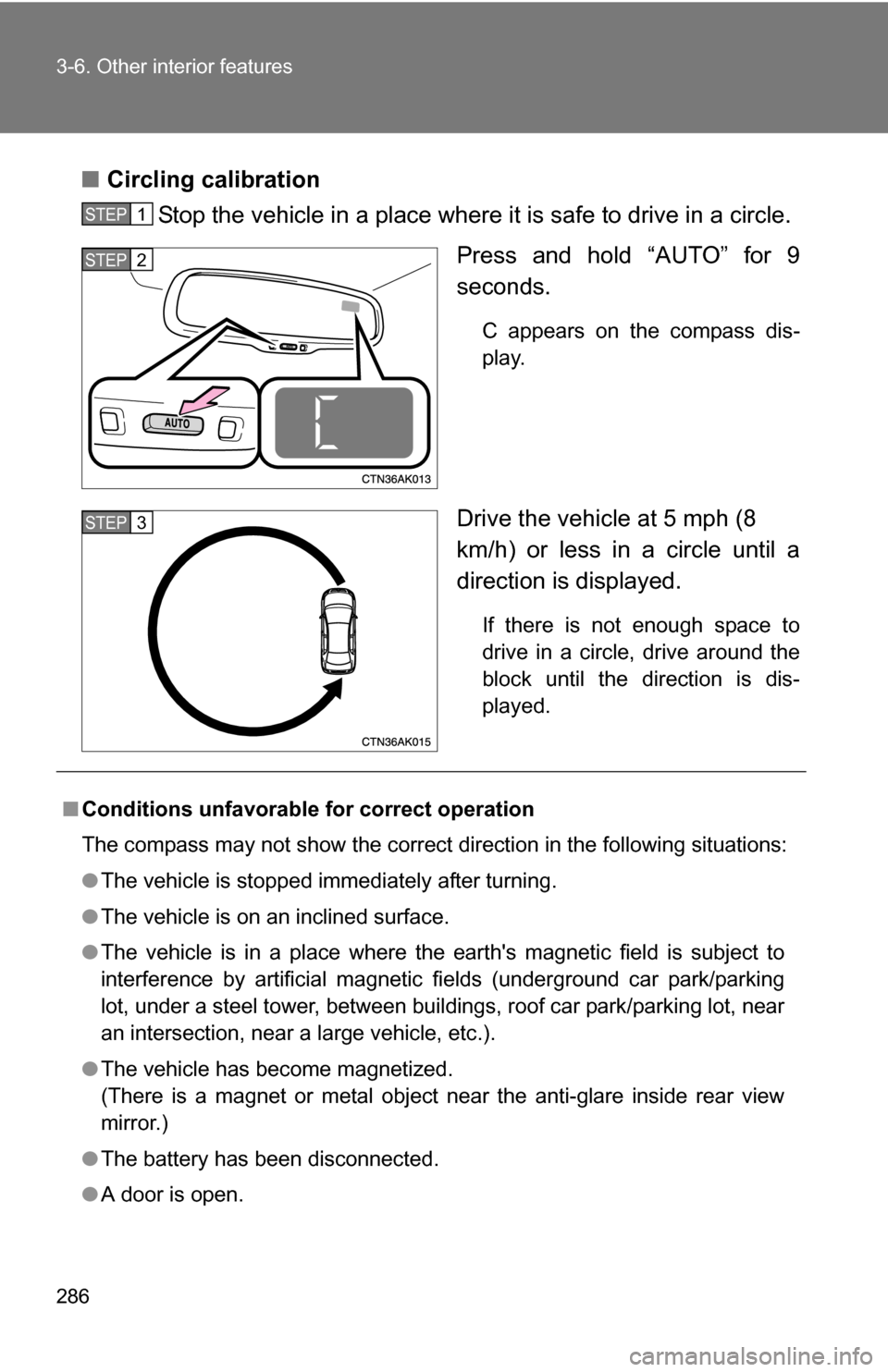
■Circling calibration
Stop the vehicle in a place where it is safe to drive in a circle.
Press and hold “AUTO” for 9
seconds.
C appears on the compass dis-
play.
Drive the vehicle at 5 mph (8
km/h) or less in a circle until a
direction is displayed.
If there is not enough space to
drive in a circle, drive around the
block until the direction is dis-
played.
STEP1
STEP2
STEP3
■Conditions unfavorable for correct operation
The compass may not show the correct direction in the following situations:
●The vehicle is stopped immediately after turning.
● The vehicle is on an inclined surface.
● The vehicle is in a place where the earth's magnetic field is subject to
interference by artificial magnetic fields (underground car park/parking
lot, under a steel tower, between buildings, roof car park/parking lot, near
an intersection, near a large vehicle, etc.).
● The vehicle has become magnetized.
(There is a magnet or metal object near the anti-glare inside rear view
mirror.)
● The battery has been disconnected.
● A door is open.
Page 287 of 468
287
3-6. Other interior features
3
Interior features
CAUTION
■
While driving the vehicle
Do not adjust the display. Be sure to adjust the display only when the vehicle
is stopped.
■ When doing the circling calibration
Be sure to secure a wide space, and watch out for people and vehicles in the
neighborhood. Do not violate any local traffic rules while performing circling
calibration.
NOTICE
■To avoid compass malfunctions
Do not place magnets or any metal objects near the anti-glare inside rear
view mirror.
Doing this may cause a malfunction of the compass sensor.
■ To ensure normal operation of the compass
●Do not perform circling calibration of the compass in a place where the
earth's magnetic field is subject to interference by artificial magnetic fields.
● During calibration, do not operate electric systems (moon roof, power win-
dows, etc.) as they may interfere with the calibration.