warning TOYOTA COROLLA 2009 10.G User Guide
[x] Cancel search | Manufacturer: TOYOTA, Model Year: 2009, Model line: COROLLA, Model: TOYOTA COROLLA 2009 10.GPages: 468, PDF Size: 9.31 MB
Page 93 of 468
93
1-7. Safety information
1
Before driving
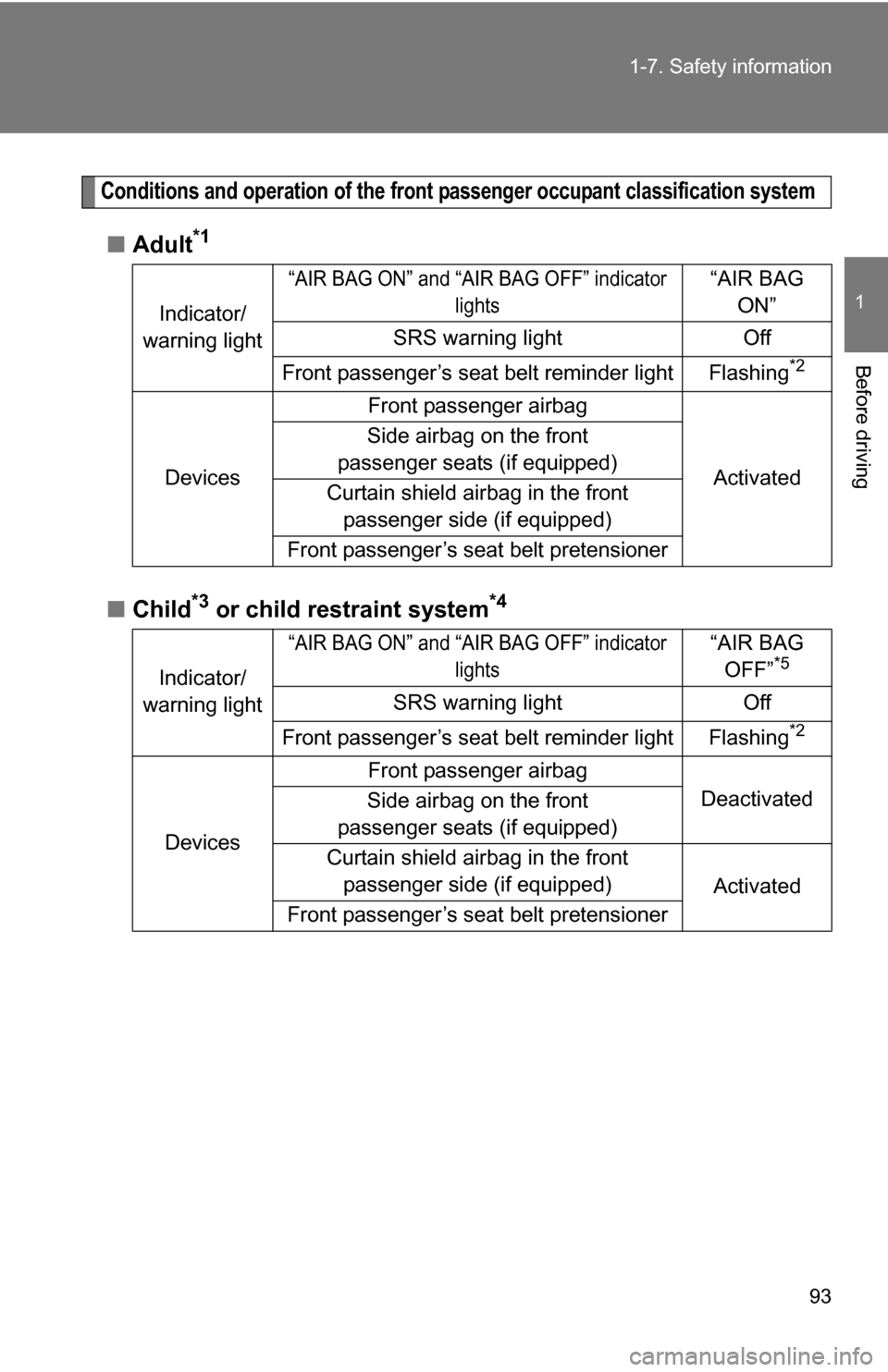
Conditions and operation of the front passenger occupant classification system
■
Adult*1
■Child*3 or child restraint system*4
Indicator/
warning light
“AIR BAG ON” and “AIR BAG OFF” indicator
lights“AIR BAG ON”
SRS warning light Off
Front passenger’s seat belt reminder light Flashing
*2
Devices Front passenger airbag
Activated
Side airbag on the front
passenger seats (if equipped)
Curtain shield airbag in the front passenger side (if equipped)
Front passenger’s seat belt pretensioner
Indicator/
warning light
“AIR BAG ON” and “AIR BAG OFF” indicator
lights“AIR BAG OFF”*5
SRS warning light Off
Front passenger’s seat belt reminder light Flashing
*2
Devices Front passenger airbag
Deactivated
Side airbag on the front
passenger seats (if equipped)
Curtain shield airbag in the front passenger side (if equipped) Activated
Front passenger’s seat belt pretensioner
Page 94 of 468
94 1-7. Safety information
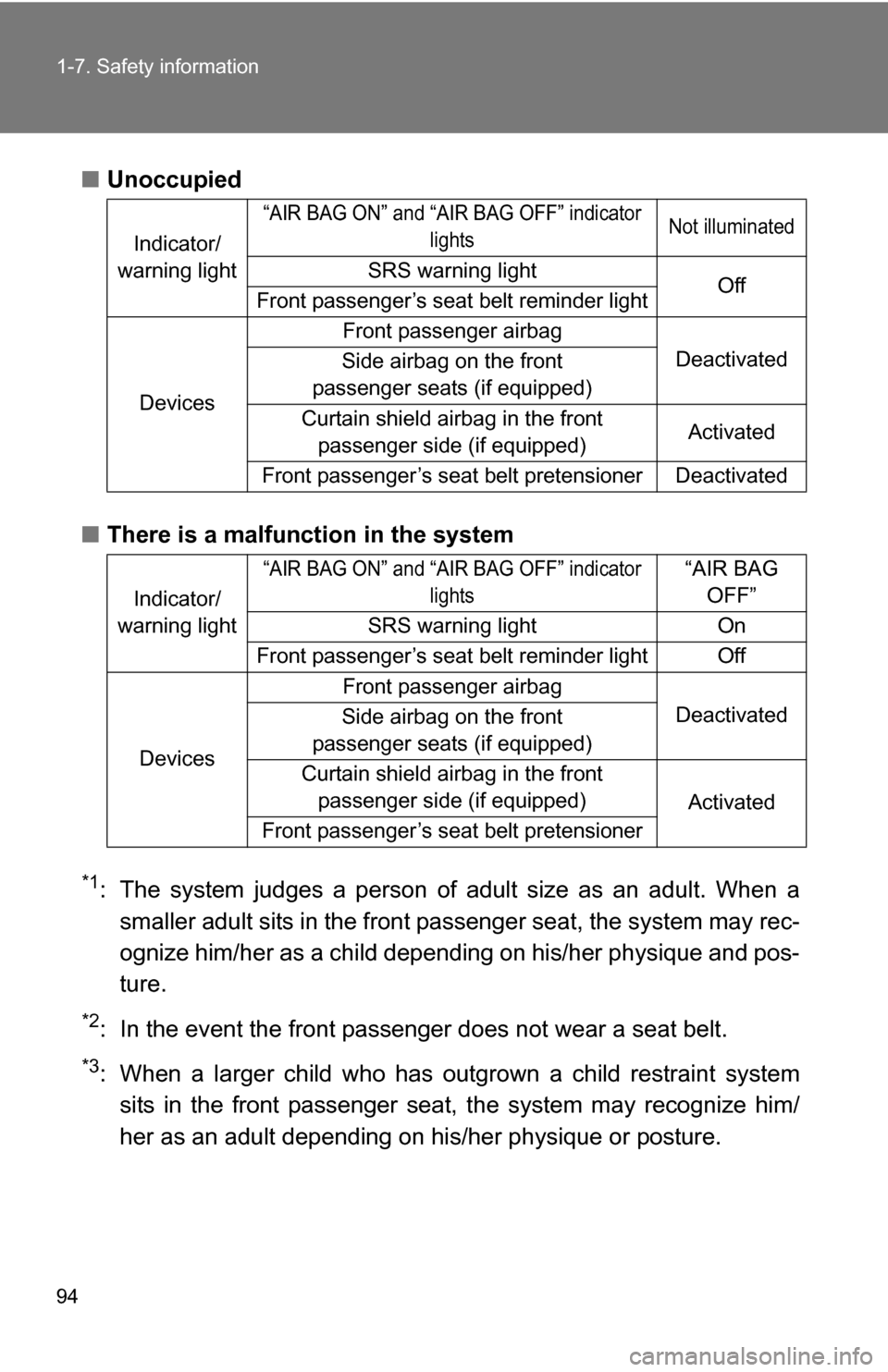
■Unoccupied
■ There is a malfunction in the system
*1: The system judges a person of adult size as an adult. When a
smaller adult sits in the front passenger seat, the system may rec-
ognize him/her as a child depending on his/her physique and pos-
ture.
*2: In the event the front passenger does not wear a seat belt.
*3: When a larger child who has outgrown a child restraint systemsits in the front passenger seat, the system may recognize him/
her as an adult depending on hi s/her physique or posture.
Indicator/
warning light
“AIR BAG ON” and “AIR BAG OFF” indicator
lights Not illuminated
SRS warning light
Off
Front passenger’s seat belt reminder light
Devices Front passenger airbag
Deactivated
Side airbag on the front
passenger seats (if equipped)
Curtain shield airbag in the front passenger side (if equipped) Activated
Front passenger’s seat belt pretensioner Deactivated
Indicator/
warning light
“AIR BAG ON” and “AIR BAG OFF” indicator
lights“AIR BAG OFF”
SRS warning light On
Front passenger’s seat belt reminder light Off
Devices Front passenger airbag
Deactivated
Side airbag on the front
passenger seats (if equipped)
Curtain shield airbag in the front passenger side (if equipped) Activated
Front passenger’s seat belt pretensioner
Page 96 of 468
96 1-7. Safety information
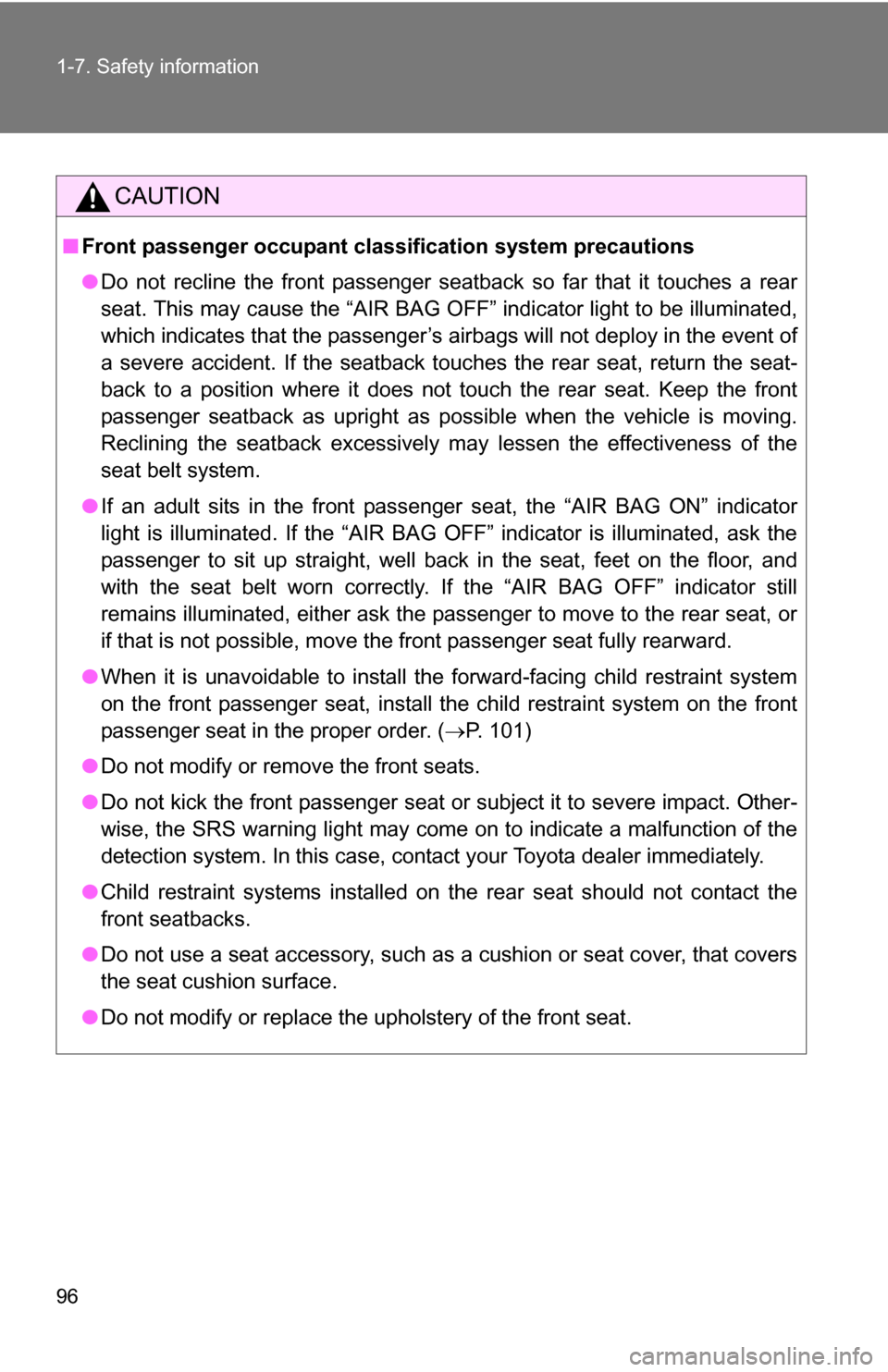
CAUTION
■Front passenger occupant cl assification system precautions
● Do not recline the front passenger seatback so far that it touches a rear
seat. This may cause the “AIR BAG OFF” indicator light to be illuminated,
which indicates that the passenger’s airbags will not deploy in the event of
a severe accident. If the seatback touches the rear seat, return the seat-
back to a position where it does not touch the rear seat. Keep the front\
passenger seatback as upright as possible when the vehicle is moving.
Reclining the seatback excessively may lessen the effectiveness of the
seat belt system.
● If an adult sits in the front passenger seat, the “AIR BAG ON” indicator
light is illuminated. If the “AIR BAG OFF” indicator is illuminated, ask the
passenger to sit up straight, well back in the seat, feet on the floor, and
with the seat belt worn correctly. If the “AIR BAG OFF” indicator still
remains illuminated, either ask the passenger to move to the rear seat, or
if that is not possible, move the front passenger seat fully rearward.
● When it is unavoidable to install the forward-facing child restraint system
on the front passenger seat, install the child restraint system on the front
passenger seat in the proper order. (P. 101)
● Do not modify or remove the front seats.
● Do not kick the front passenger seat or subject it to severe impact. Other-
wise, the SRS warning light may come on to indicate a malfunction of the
detection system. In this case, contact your Toyota dealer immediately.
● Child restraint systems installed on the rear seat should not contact the
front seatbacks.
● Do not use a seat accessory, such as a cushion or seat cover, that covers
the seat cushion surface.
● Do not modify or replace the upholstery of the front seat.
Page 111 of 468
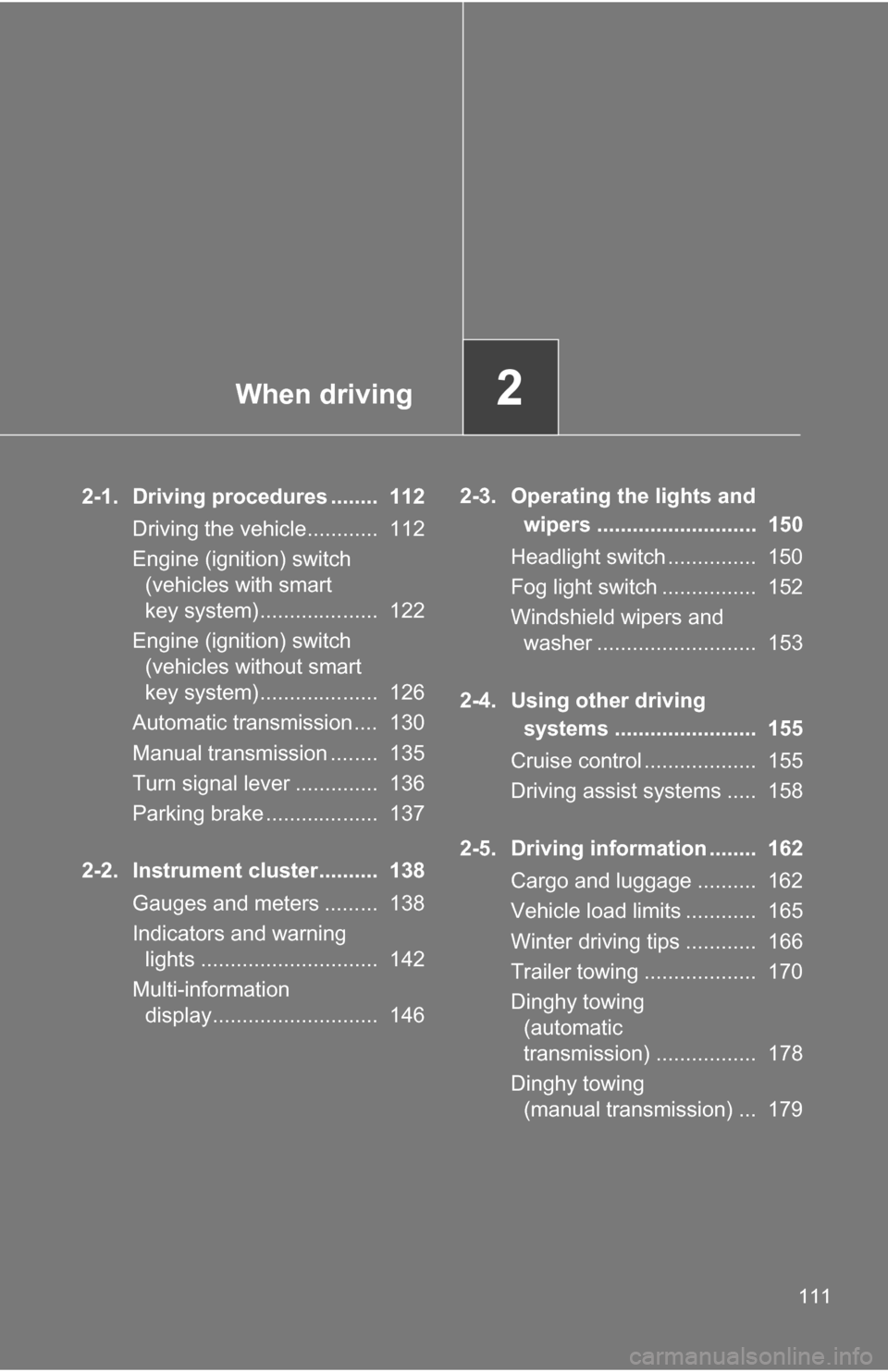
When driving2
111
2-1. Driving procedures ........ 112Driving the vehicle............ 112
Engine (ignition) switch (vehicles with smart
key system).................... 122
Engine (ignition) switch (vehicles without smart
key system).................... 126
Automatic transmission .... 130
Manual transmission ........ 135
Turn signal lever .............. 136
Parking brake ................... 137
2-2. Instrument cluster.......... 138 Gauges and meters ......... 138
Indicators and warning lights .............................. 142
Multi-information display............................ 146 2-3. Operating the lights and
wipers ........................... 150
Headlight switch ............... 150
Fog light switch ................ 152
Windshield wipers and washer ........................... 153
2-4. Using other driving systems ........................ 155
Cruise control ................... 155
Driving assist systems ..... 158
2-5. Driving information ........ 162 Cargo and luggage .......... 162
Vehicle load limits ............ 165
Winter driving tips ............ 166
Trailer towing ................... 170
Dinghy towing (automatic
transmission) ................. 178
Dinghy towing (manual transmission) ... 179
Page 134 of 468
134 2-1. Driving procedures
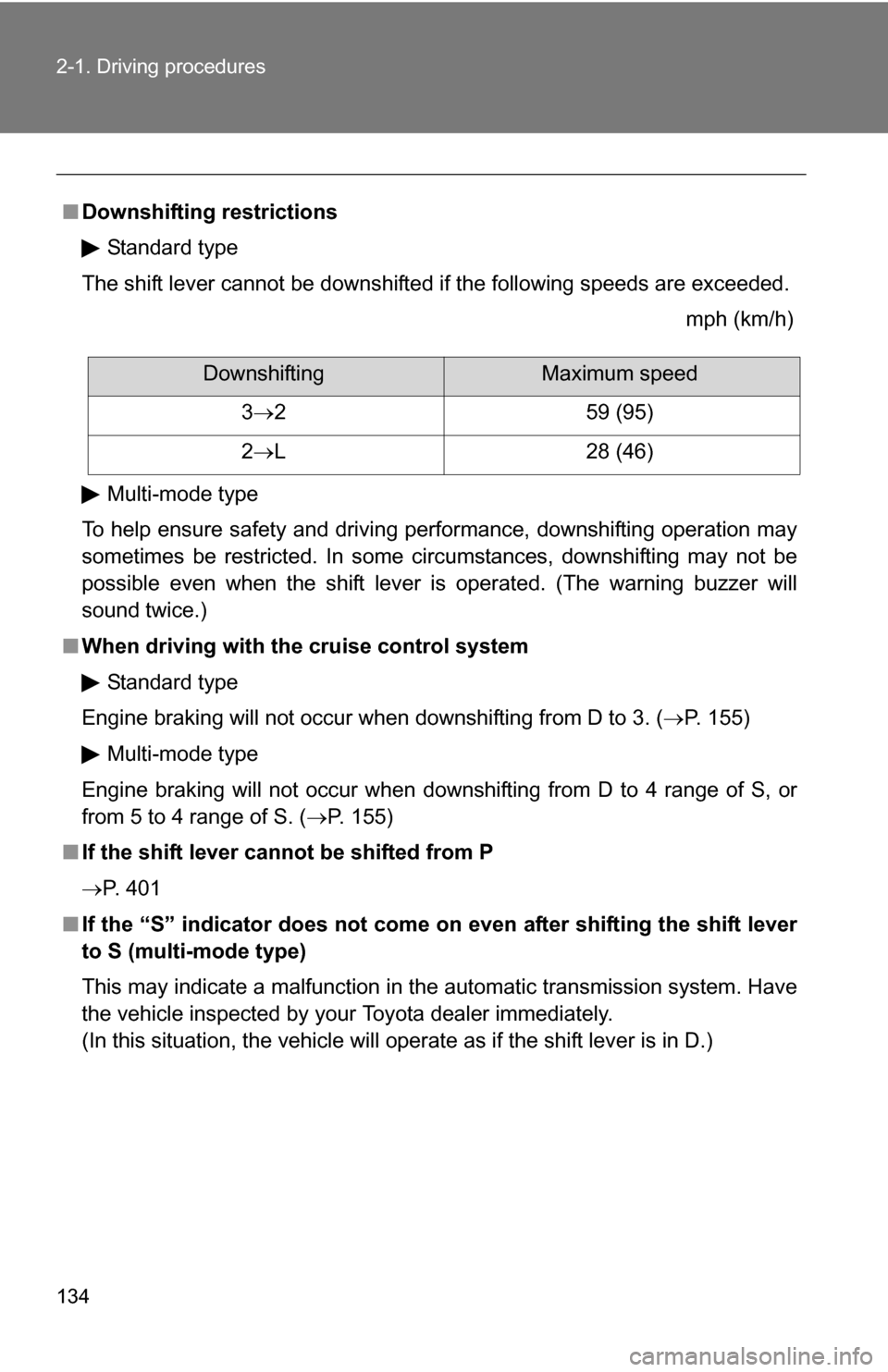
■Downshifting restrictions
Standard type
The shift lever cannot be downshifted if the following speeds are exceeded.
mph (km/h)
Multi-mode type
To help ensure safety and driving performance, downshifting operation may
sometimes be restricted. In some circumstances, downshifting may not be
possible even when the shift lever is operated. (The warning buzzer will
sound twice.)
■ When driving with the cruise control system
Standard type
Engine braking will not occur when downshifting from D to 3. (P. 155)
Multi-mode type
Engine braking will not occur when downshifting from D to 4 range of S, or
from 5 to 4 range of S. ( P. 155)
■ If the shift lever cannot be shifted from P
P. 401
■ If the “S” indicator does not come on even after shifting the shift lever
to S (multi-mode type)
This may indicate a malfunction in the automatic transmission system. Have
the vehicle inspected by your Toyota dealer immediately.
(In this situation, the vehicle will operate as if the shift lever is in D.)
DownshiftingMaximum speed
3 2 59 (95)
2 L 28 (46)
Page 138 of 468
138
2-2. Instrument cluster
Gauges and meters
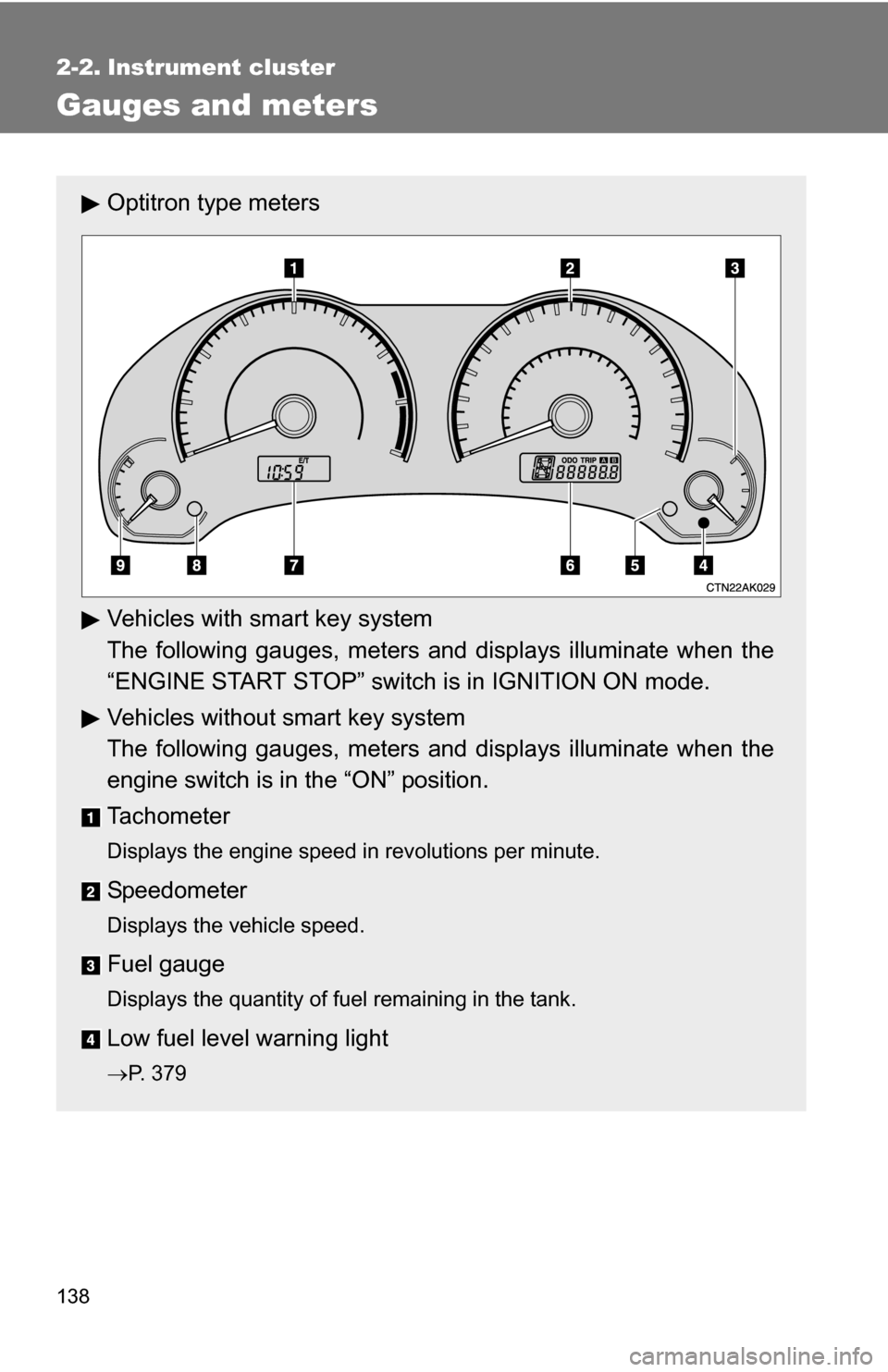
Optitron type meters
Vehicles with smart key system
The following gauges, meters and displays illuminate when the
“ENGINE START STOP” switch is in IGNITION ON mode.
Vehicles without smart key system
The following gauges, meters and displays illuminate when the
engine switch is in the “ON” position.
Tachometer
Displays the engine speed in revolutions per minute.
Speedometer
Displays the vehicle speed.
Fuel gauge
Displays the quantity of fuel remaining in the tank.
Low fuel level warning light
P. 379
Page 140 of 468
140 2-2. Instrument cluster
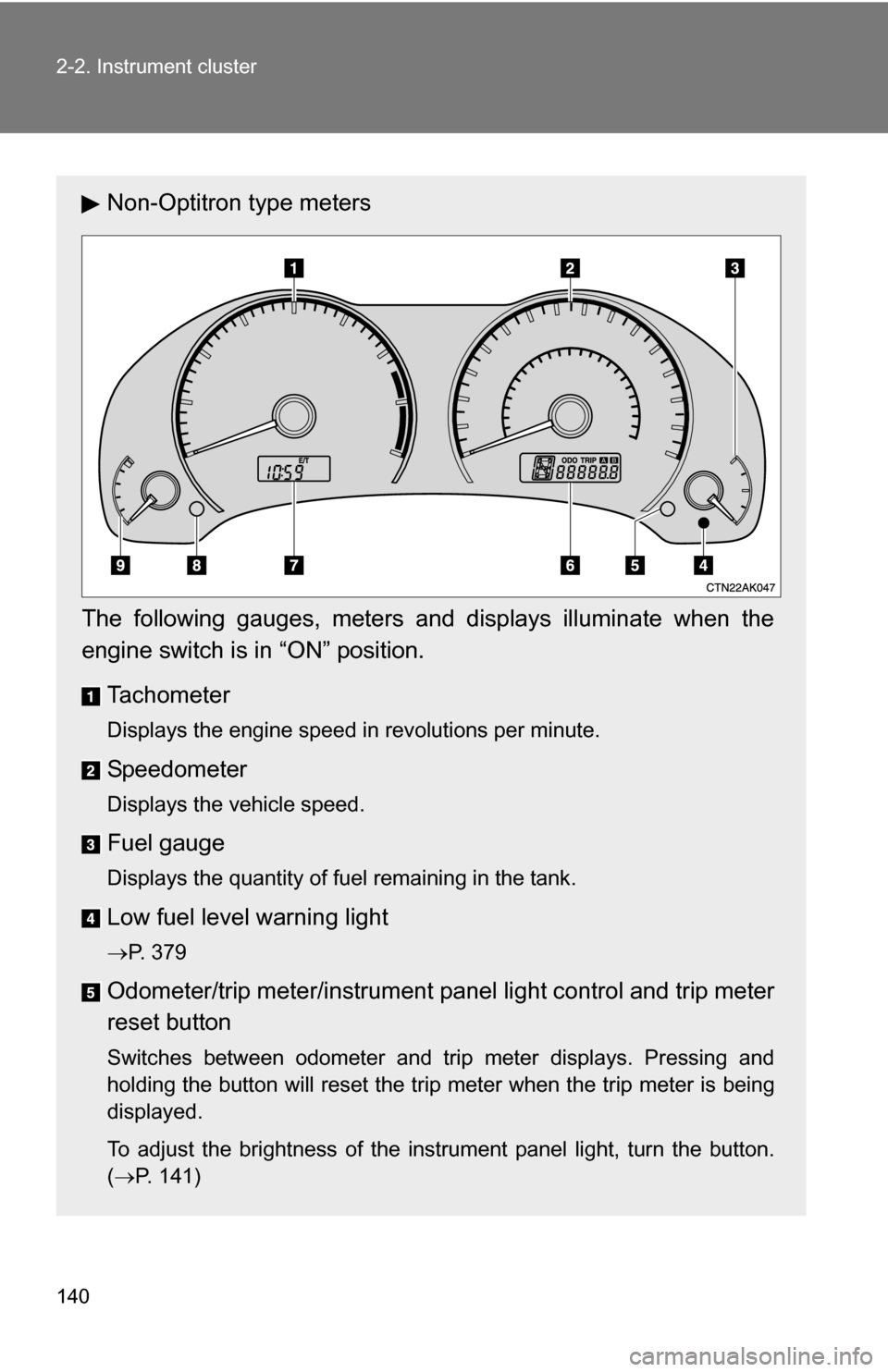
Non-Optitron type meters
The following gauges, meters and displays illuminate when the
engine switch is in “ON” position.
Tachometer
Displays the engine speed in revolutions per minute.
Speedometer
Displays the vehicle speed.
Fuel gauge
Displays the quantity of fuel remaining in the tank.
Low fuel level warning light
P. 379
Odometer/trip meter/instrument p anel light control and trip meter
reset button
Switches between odometer and trip meter displays. Pressing and
holding the button will reset the trip meter when the trip meter is being
displayed.
To adjust the brightness of the instrument panel light, turn the button.
( P. 141)
Page 142 of 468
142
2-2. Instrument cluster
Indicators and warning lights
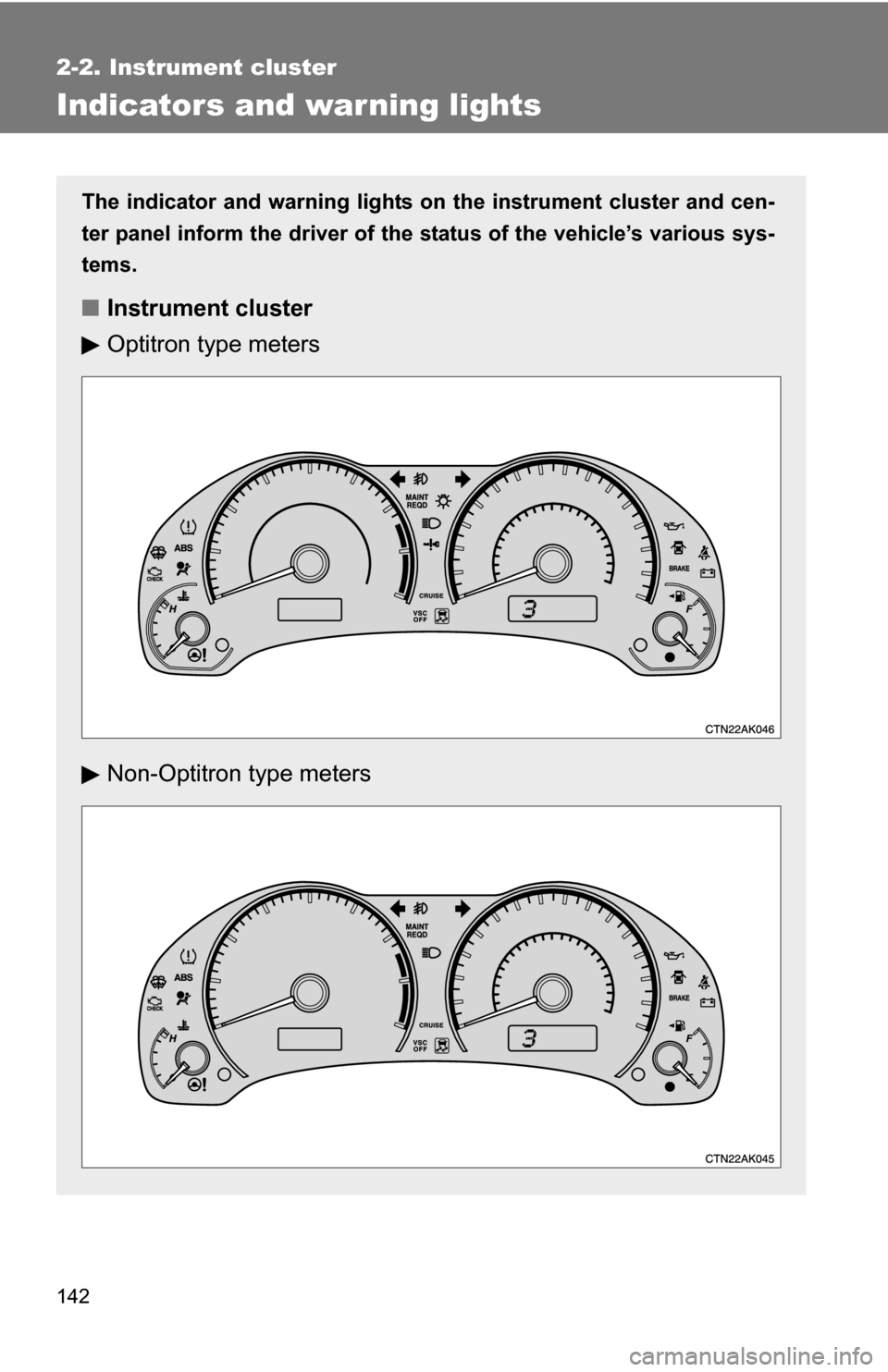
The indicator and warning lights on the instrument cluster and cen-
ter panel inform the driver of the status of the vehicle’s various sys-
tems.
■ Instrument cluster
Optitron type meters
Non-Optitron type meters
Page 145 of 468
145
2-2. Instrument cluster
2
When driving
CAUTION
■
If a safety system warning light does not come on
Should a safety system light such as the ABS or the SRS airbag warning
light not come on when you start the engine, this could mean that these sys-
tems are not available to help protect you in an accident, which could result
in death or serious injury. Have the vehicle inspected by your Toyota dealer
immediately if this occurs.
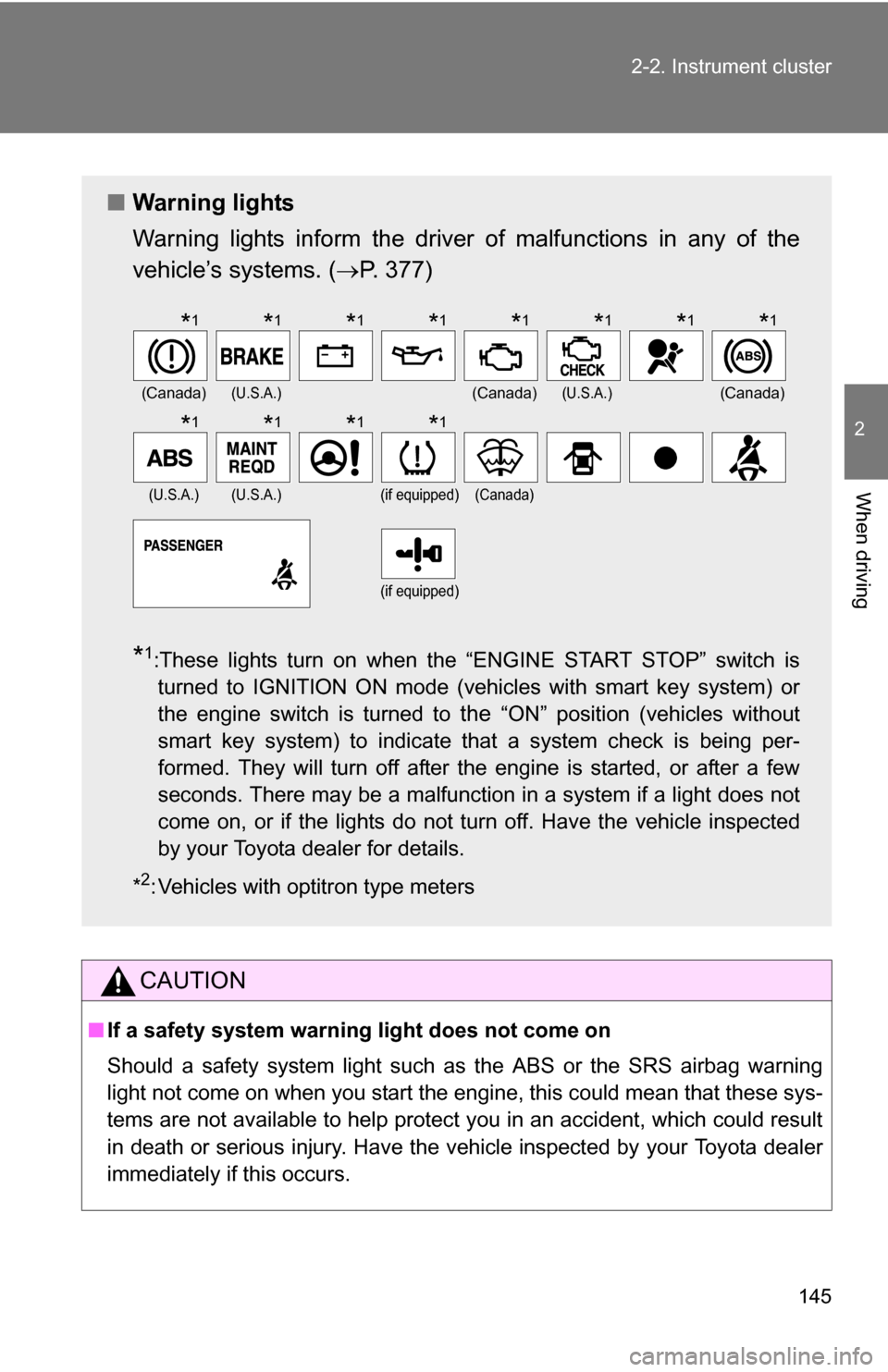
■ Warning lights
Warning lights inform the driver of malfunctions in any of the
vehicle’s systems. ( P. 377)
*1:These lights turn on when the “ENGINE START STOP” switch is
turned to IGNITION ON mode (vehicles with smart key system) or
the engine switch is turned to
the “ON” position (vehicles without
smart key system) to indicate that a system check is being per-
formed. They will turn off after the engine is started, or after a few
seconds. There may be a malfunction in a system if a light does not
come on, or if the lights do not turn off. Have the vehicle inspected
by your Toyota dealer for details.
*
2: Vehicles with optitron type meters
(Canada)(U.S.A.)(Canada)(U.S.A.)(Canada)
(U.S.A.)(U.S.A.)(if equipped)(Canada)
(if equipped)
*1*1*1*1*1*1*1*1
*1*1*1*1
Page 161 of 468
161
2-4. Using other
driving systems
2
When driving
CAUTION
■Stopping distance when ABS is operating on the wet or slick roads
ABS is not designed to shorten the vehicle's stopping distance. Always
maintain a safe distance from the vehicle in front of you in the following situ-
ations.
●When driving on dirt, gravel or snow-covered roads
● When driving with tire chains
● When driving over bumps in the road
● When driving over roads with potholes or uneven roads
■ TRAC may not operate effectively when
Directional control and power may not be achievable while driving on slip-
pery road surfaces, even if the TRAC system is operating.
Do not drive the vehicle in conditions where stability and power may be lost.
■ When VSC is activated
The slip indicator light flashes and a warning buzzer sounds. Always drive
carefully. Reckless driving may cause an accident. Exercise particular care
when the indicator light flashes and a buzzer sounds.
■ When TRAC and VSC are off
Be especially careful and drive at a speed appropriate to the road condi-
tions. As these are systems to ensure vehicle stability and driving force, do
not turn off TRAC and VSC unless necessary.
■ Replacing tires
Make sure that all tires are of the same size, brand, tread pattern and total
load capacity. In addition, make sure that the tires are inflated to the recom-
mended tire pressure level.
The ABS and VSC system will not function correctly if different tires are fitted
on the vehicle.
Contact your Toyota dealer for further information when replacing tires or
wheels.
■ Handling of tires and suspension
Using tires with any kind of problem or modifying the suspension will affect
the driving assist systems, and may cause the system to malfunction.