check engine TOYOTA COROLLA 2009 10.G Owner's Guide
[x] Cancel search | Manufacturer: TOYOTA, Model Year: 2009, Model line: COROLLA, Model: TOYOTA COROLLA 2009 10.GPages: 468, PDF Size: 9.31 MB
Page 381 of 468
5
When trouble arises
381
5-2. Steps to take in an emergency
■
Front passenger detection sensor and passenger seat belt reminder
● If luggage is placed on the front passenger seat, the front passenger
detection sensor may cause the warning light to flash, even if a passen-
ger is not sitting in the seat.
● If a cushion is placed on the seat, the sensor may not detect a passen-
ger, and the warning light may not operate properly.
■ Changing the engine oil (U.S.A. only)
Make sure to reset the oil change system. ( P. 315)
■
When the tire pressure warning light comes on
Check the tire inflation pressure and adjust to the appropriate level.
Pushing the tire pressure warning reset switch does not turn off the tire
pressure warning light.
■The tire pressure warning light may turn on due to natural causes
The tire pressure warning light may turn on due to natural causes such
as natural air leaks or tire inflation pressure changes caused by temper-
ature. In this case, adjusting the ti re inflation pressure will turn off the
warning light (after a few minutes).
Page 383 of 468
5
When trouble arises
383
5-2. Steps to take in an emergency
■If the tire pressure warning light comes on after blinking frequently
for 1 minute
If the tire pressure warning light comes on after blinking frequently for 1
minute when the “ENGINE START STOP” switch or engine switch is
turned ON, have it checked by your Toyota dealer.
■
Customization that can be co nfigured at Toyota dealer
The vehicle speed linked seat belt reminder buzzer can be disabled.
(Customizable features P. 443) However, Toyota recommends that the
seat belt reminder buzzer be operational to alert the driver and front passen-
ger that the seat belts are not fastened.
CAUTION
■If the tire pressure warning light comes on
Be sure to observe the following precautions. Failure to do so could
cause loss of vehicle control and result in death or serious injury.
●Stop your vehicle in a safe place as soon as possible. Adjust the tire
inflation pressure immediately.
●If the tire pressure warning light comes on even after tire inflation pres-
sure adjustment, it is pr obable that you have a flat tire. Check the tires.
If the tire is flat, change to the spare tire and have the flat tire repaired
by the nearest Toyota dealer.
●Avoid abrupt maneuvering and braking. If the vehicle tires deteriorate,
you could lose control of the steering wheel or the brakes.
■If a blowout or sudden air leakage should occur
The tire pressure warning syste m may not activate immediately.
Page 386 of 468
386 5-2. Steps to take in an emergency
Follow the correction procedures. (vehicles with smart key system)
After taking the specified steps to correct the suspected problem,
check that the warning light turns off.
*: If the engine does not start when the electronic key is inside the vehi- cle, the electronic key battery may be depleted or there may be diffi-
culties receiving the si gnal from the key. (P. 2 9 )
Interior
buzzerExterior
buzzerWarning
lightWarning light/DetailsCorrection procedure
Once (Comes
on for 8
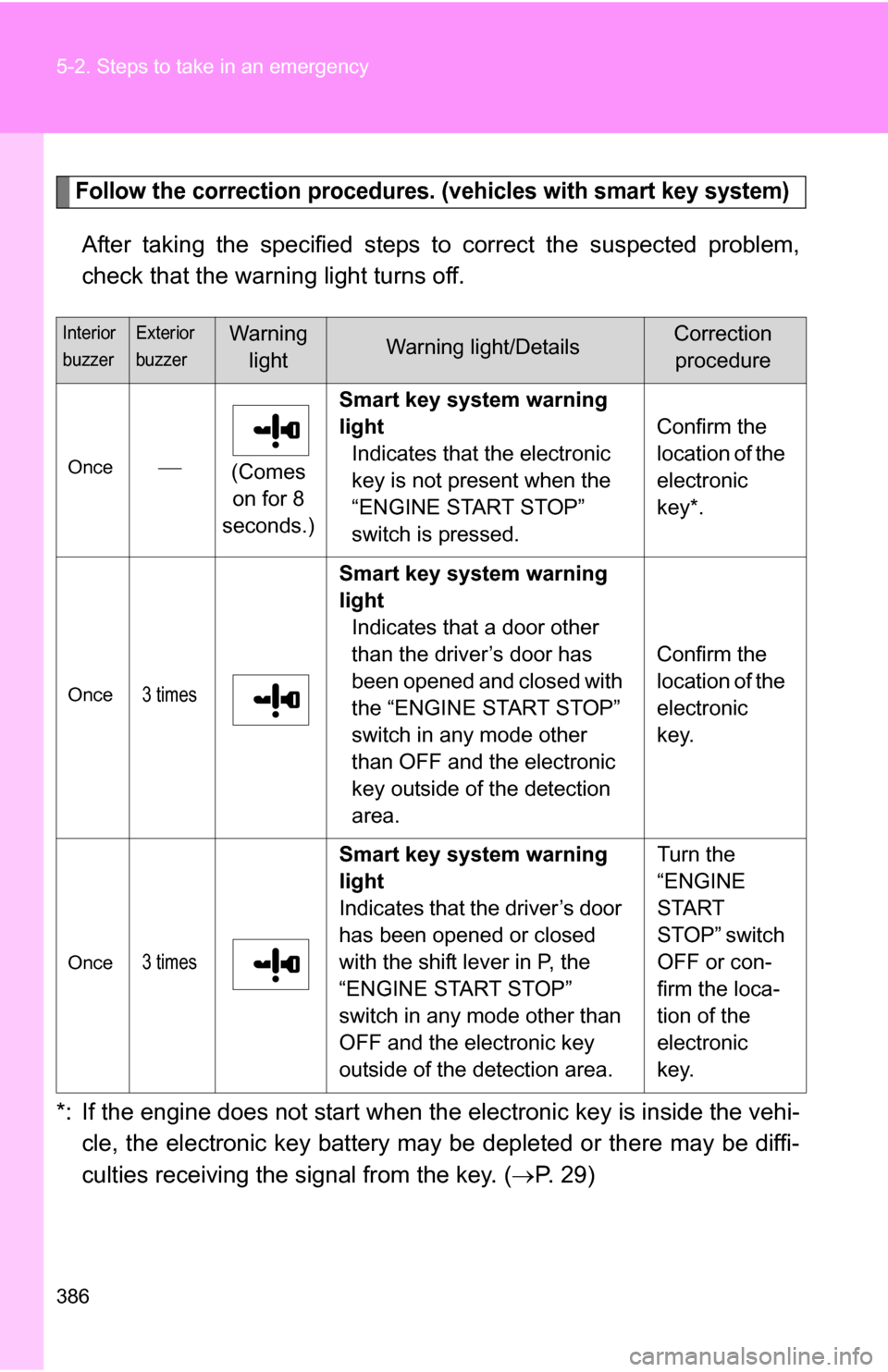
seconds.) Smart key system warning
light
Indicates that the electronic
key is not present when the
“ENGINE START STOP”
switch is pressed. Confirm the
location of the
electronic
key*.
Once3 times
Smart key system warning
light
Indicates that a door other
than the driver’s door has
been opened and closed with
the “ENGINE START STOP”
switch in any mode other
than OFF and the electronic
key outside of the detection
area. Confirm the
location of the
electronic
key.
Once3 times
Smart key system warning
light
Indicates that the driver’s door
has been opened or closed
with the shift lever in P, the
“ENGINE START STOP”
switch in any mode other than
OFF and the electronic key
outside of the detection area. Turn the
“ENGINE
START
STOP” switch
OFF or con-
firm the loca-
tion of the
electronic
key.
Page 396 of 468
396 5-2. Steps to take in an emergency
CAUTION
■Using the tire jack
Improper use of the tire jack may lead to death or injuries due to the
vehicle suddenly falling off the jack.
●Do not use the tire jack for any pu rpose other than replacing tires or
installing and removing tire chains.
●Only use the tire jack that comes with this vehicle for replacing a flat
tire.
Do not use it on other vehicles, and do not use other tire jacks for
replacing tires on this vehicle.
●Always check that the tire jack is securely set to the jack point.
●Do not put any part of your body under the vehicle while it is supported
by a jack.
●Do not start or run the engine while your vehicle is supported by the
jack.
●Do not raise the vehicle while someone is in it.
●When raising the vehicle, do not put an object on or under the jack.
●Do not raise the vehicle to a hei ght greater than that required to
replace the tire.
●Use a jack stand if it is necessary to get under the vehicle.
Take particular care when lowering the vehicle to ensure that no one
working on or near the vehicle will be injured.
Page 400 of 468
400 5-2. Steps to take in an emergency
Emergency start function (vehicles with smart key system)
When the engine does not start, the following steps can be used as
an interim measure to start the engine if the “ENGINE START STOP”
switch is functioning normally.Set the parking brake.
Shift the shift lever to P.
Set the “ENGINE START ST OP” switch to ACCESSORY
mode.
Press and hold the “ENGINE START STOP” switch for about
15 seconds while depressing the brake pedal firmly.
Even if the engine can be start ed using the above steps, the system
may be malfunctioning. Have the vehicle checked by your Toyota
dealer.
■ The starter motor does not turn over, the interior lights and
headlights do not turn on, or the horn does not sound.
One of the following may be the cause of the problem.
● One or both of the battery terminals may be disconnected.
● The battery may be discharged. ( P. 405)
● There may be a malfunction in the steering lock system (vehi-
cles with smart key system).
Contact your Toyota dealer if the problem cannot be repaired, or if
repair procedures are unknown.
STEP1
STEP2
STEP3
STEP4
Page 407 of 468
5
When trouble arises
407
5-2. Steps to take in an emergency
Once the vehicle’s engine has started, remove the jumper
cables in the exact reverse order in which they were con-
nected.
Once the engine starts, have the vehicle checked at your Toyota
dealer as soon as possible.
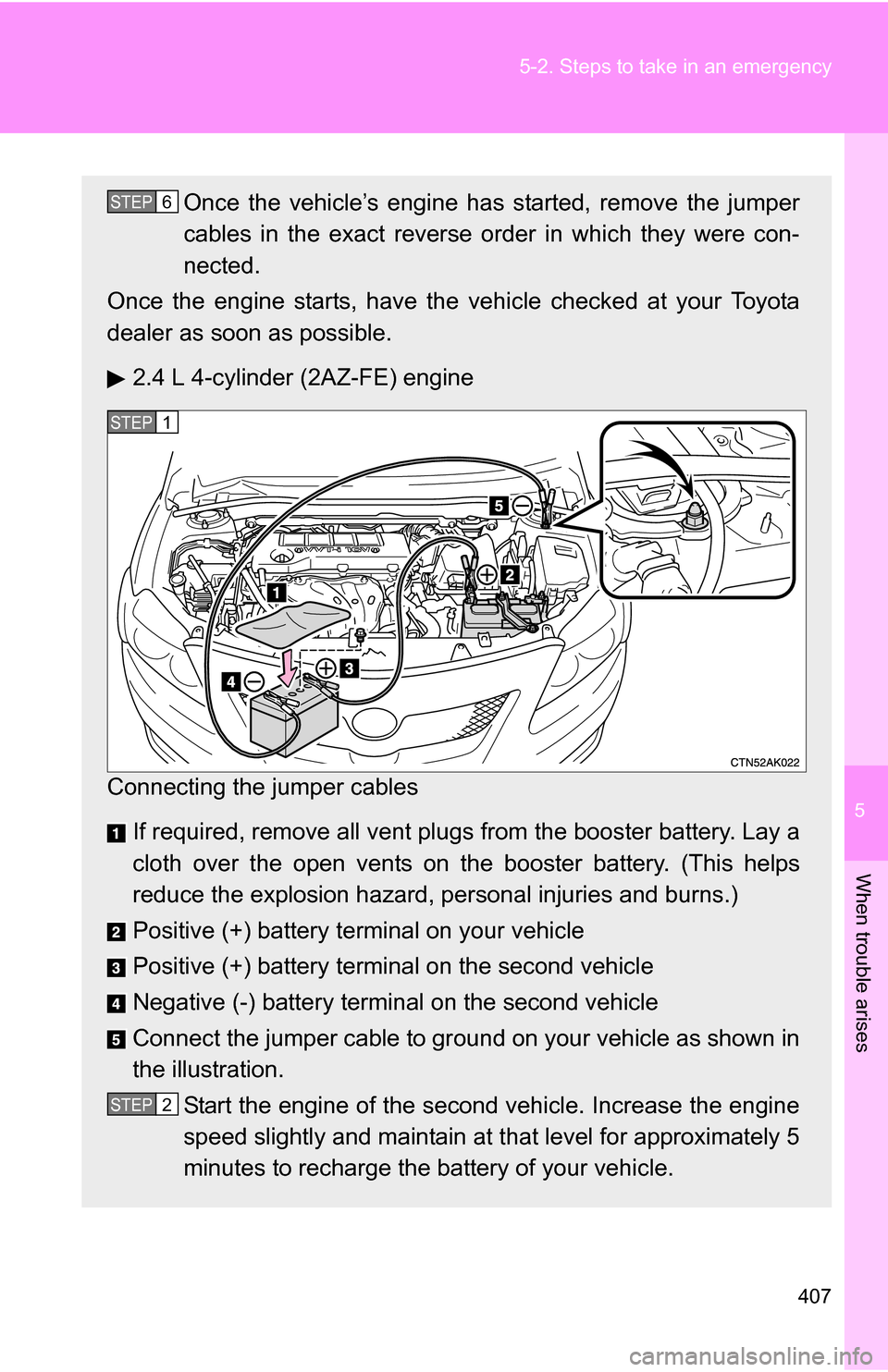
2.4 L 4-cylinder (2AZ-FE) engine
Connecting the jumper cables If required, remove all vent plugs from the booster battery. Lay a
cloth over the open vents on t he booster battery. (This helps
reduce the explosion hazard, personal injuries and burns.)
Positive (+) battery terminal on your vehicle
Positive (+) battery terminal on the second vehicle
Negative (-) battery terminal on the second vehicle
Connect the jumper cable to ground on your vehicle as shown in
the illustration.
Start the engine of the second vehicle. Increase the engine
speed slightly and maintain at that level for approximately 5
minutes to recharge the battery of your vehicle.STEP6
STEP1
STEP2
Page 408 of 468
408 5-2. Steps to take in an emergency
■Avoiding a discharged battery
●Turn off the headlights and the audio system while the engine is turned
off.
● Turn off any unnecessary electrical components when the vehicle is run-
ning at a low speed for an extended period, such as in heavy traffic, etc.
■ When the battery is removed or discharged
The tire pressure warning system must be initialized.
(P. 327)
Maintain the engine speed of the second vehicle, and turn
the engine switch to the “ON” position, then start the vehi-
cle's engine.
Once the vehicle’s engine has started, remove the jumper
cables in the exact reverse order in which they were con-
nected.
Once the engine starts, have the vehicle checked at your Toyota
dealer as soon as possible.STEP3
STEP4
Page 411 of 468
5
When trouble arises
411
5-2. Steps to take in an emergency
If your vehicle overheats
If your engine overheats:
Stop the vehicle in a safe place and turn off the air condi-
tioning system.
Check to see if steam is coming out from under the hood.
If you see steam: Stop the engine. Wait until the steam subsides, and then
carefully lift the hood.
If you do not see steam: Leave the engine running and carefully lift the hood.
Check to see if the cooling fans are operating.
If the fans are operating: Wait until the temperature of the engine (shown on the
instrument cluster) begins to fall and then stop the
engine.
If the fans are not operating: Stop the engine and call your Toyota dealer.
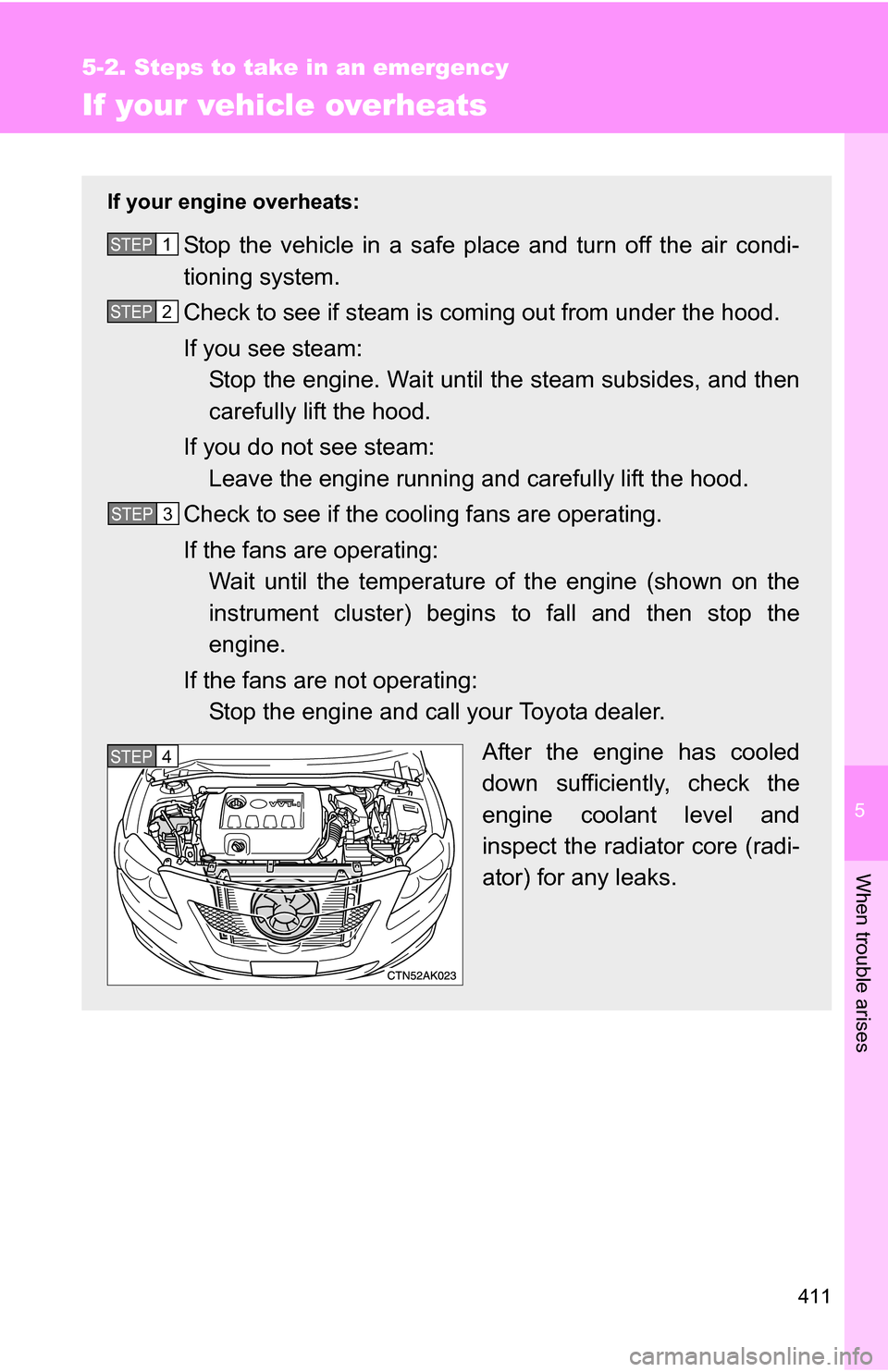
After the engine has cooled
down sufficiently, check the
engine coolant level and
inspect the radiator core (radi-
ator) for any leaks.STEP1
STEP2
STEP3
STEP5STEP4
Page 423 of 468
423
6-1. Specifications
6
Vehicle specifications
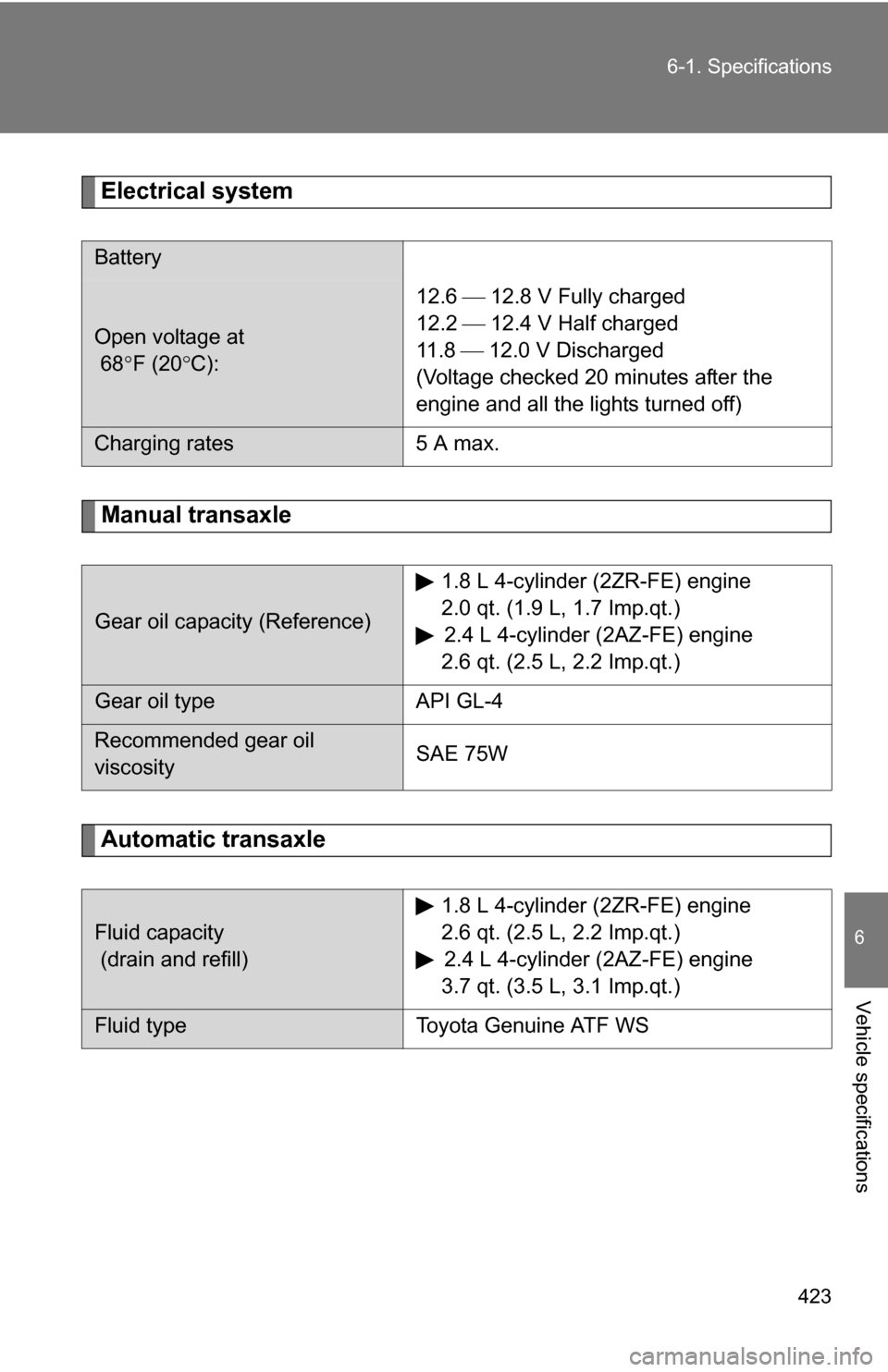
Electrical system
Manual transaxle
Automatic transaxle
Battery
Open voltage at
68
F (20 C): 12.6 12.8 V Fully charged
12.2 12.4 V Half charged
11 . 8
12.0 V Discharged
(Voltage checked 20 minutes after the
engine and all the lights turned off)
Charging rates 5 A max.
Gear oil capacity (Reference) 1.8 L 4-cylinder (2ZR-FE) engine
2.0 qt. (1.9 L, 1.7 Imp.qt.)
2.4 L 4-cylinder (2AZ-FE) engine
2.6 qt. (2.5 L, 2.2 Imp.qt.)
Gear oil type API GL-4
Recommended gear oil
viscosity SAE 75W
Fluid capacity
(drain and refill) 1.8 L 4-cylinder (2ZR-FE) engine
2.6 qt. (2.5 L, 2.2 Imp.qt.)
2.4 L 4-cylinder (2AZ-FE) engine
3.7 qt. (3.5 L, 3.1 Imp.qt.)
Fluid type Toyota Genuine ATF WS
Page 459 of 468
459
Alphabetical index
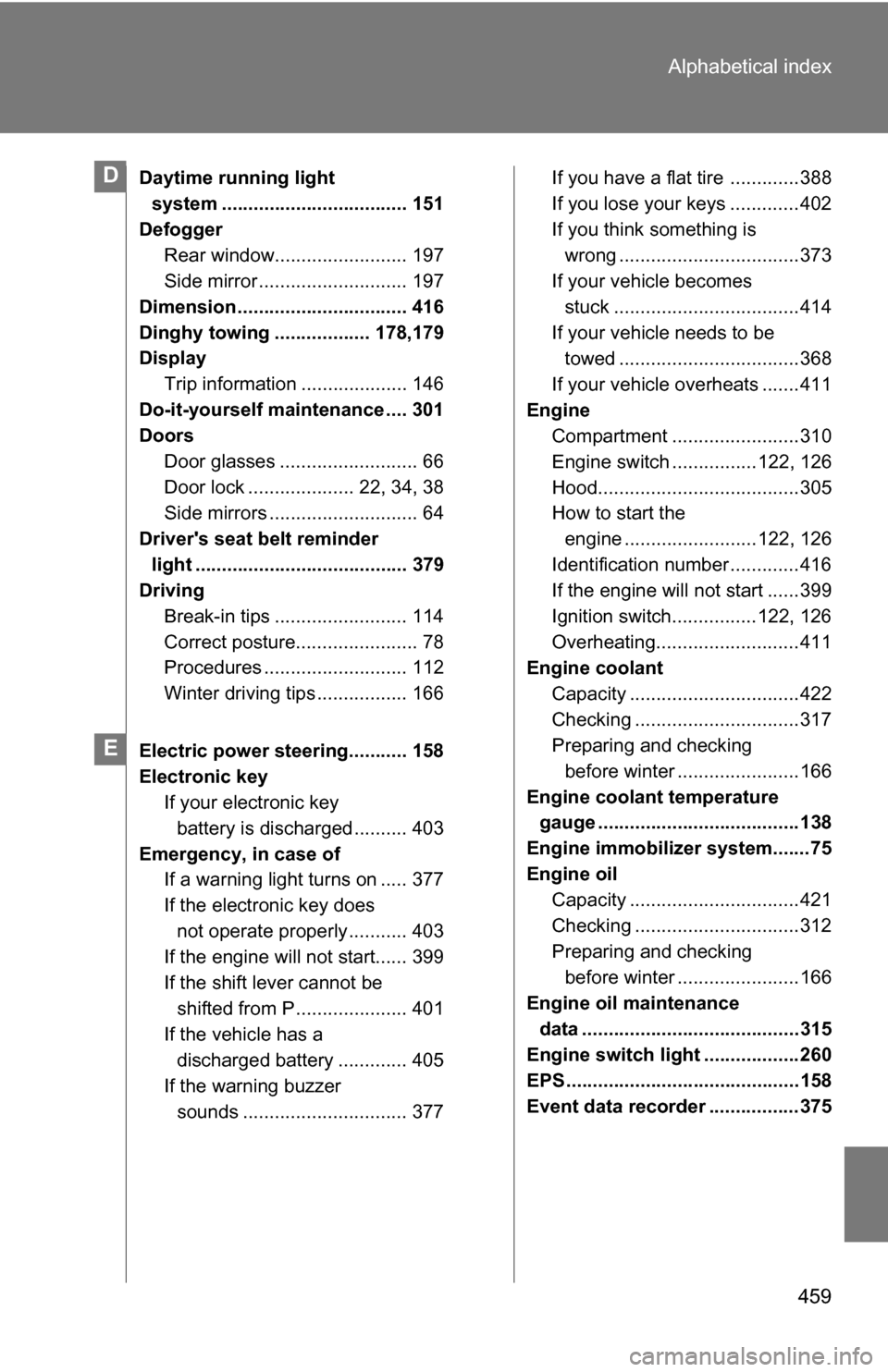
Daytime running light
system ................................... 151
Defogger Rear window......................... 197
Side mirror ............................ 197
Dimension ................................ 416
Dinghy towing .................. 178,179
Display Trip information .................... 146
Do-it-yourself maintenance .... 301
Doors Door glasses .......................... 66
Door lock .................... 22, 34, 38
Side mirrors ............................ 64
Driver's seat belt reminder light ........................................ 379
Driving
Break-in tips ......................... 114
Correct posture....................... 78
Procedures ........................... 112
Winter driving tips ................. 166
Electric power steering........... 158
Electronic key If your electronic key
battery is discharged .......... 403
Emergency, in case of If a warning light turns on ..... 377
If the electronic key does
not operate properly ........... 403
If the engine will not start...... 399
If the shift lever cannot be
shifted from P ..................... 401
If the vehicle has a
discharged battery ............. 405
If the warning buzzer sounds ............................... 377 If you have a flat tire .............388
If you lose your keys .............402
If you think something is
wrong ..................................373
If your vehicle becomes
stuck ...................................414
If your vehicle needs to be towed ..................................368
If your vehicle overheats .......411
Engine Compartment ........................310
Engine switch ................122, 126
Hood......................................305
How to start the
engine .........................122, 126
Identification number .............416
If the engine will not start ......399
Ignition switch................122, 126
Overheating...........................411
Engine coolant
Capacity ................................422
Checking ...............................317
Preparing and checking before winter .......................166
Engine coolan t temperature
gauge ......................................138
Engine immobilizer system.......75
Engine oil Capacity ................................421
Checking ...............................312
Preparing and checking before winter .......................166
Engine oil maintenance data .........................................315
Engine switch light ..................260
EPS ............................................158
Event data recorder .................375D
E