automatic transmission TOYOTA COROLLA 2009 10.G Owners Manual
[x] Cancel search | Manufacturer: TOYOTA, Model Year: 2009, Model line: COROLLA, Model: TOYOTA COROLLA 2009 10.GPages: 468, PDF Size: 9.31 MB
Page 2 of 468
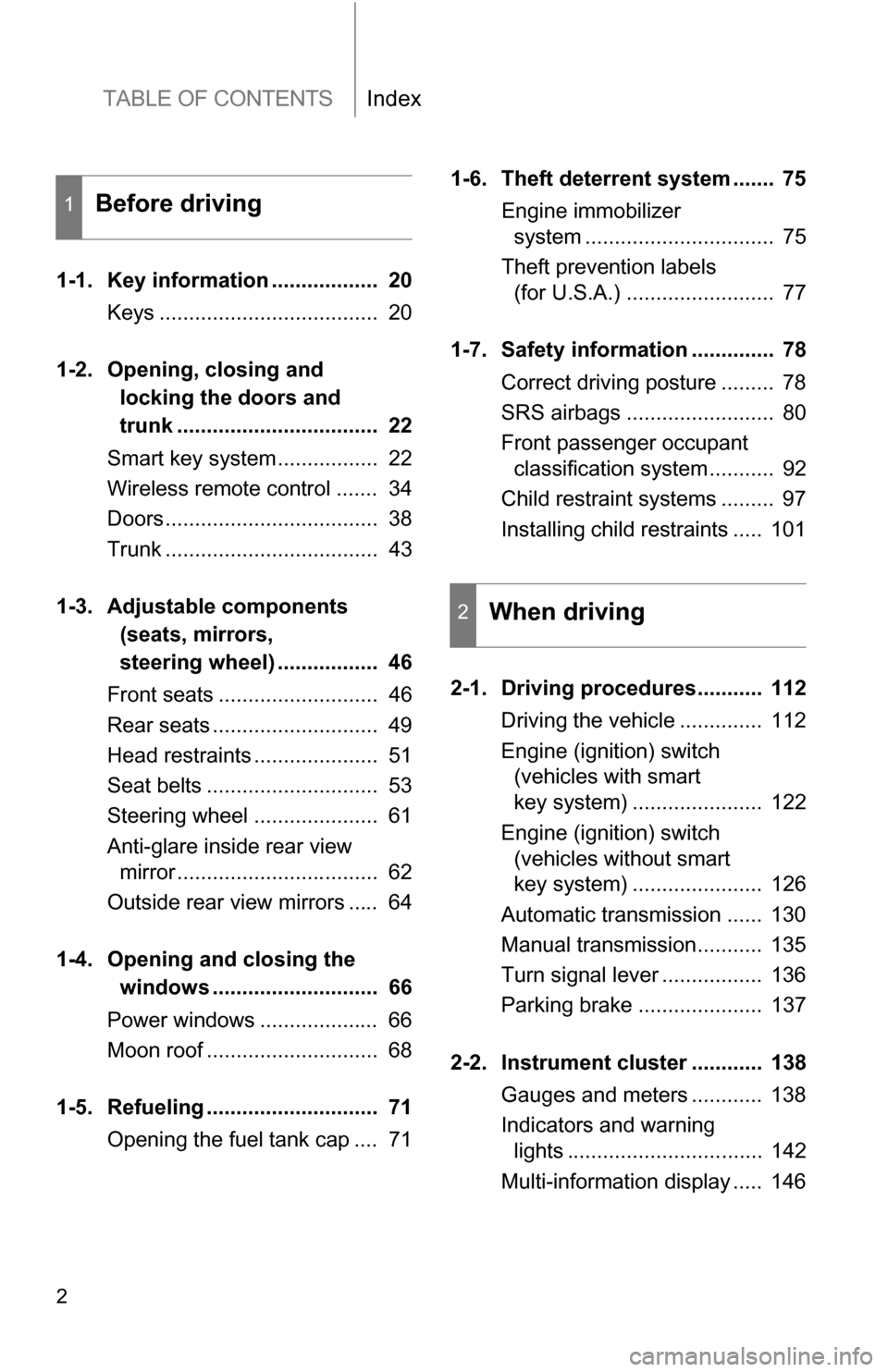
TABLE OF CONTENTSIndex
2
1-1. Key information .................. 20Keys ..................................... 20
1-2. Opening, closing and
locking the doors and
trunk .................................. 22
Smart key system................. 22
Wireless remote control ....... 34
Doors.................................... 38
Trunk .................................... 43
1-3. Adjustable components
(seats, mirrors,
steering wheel) ................. 46
Front seats ........................... 46
Rear seats ............................ 49
Head restraints ..................... 51
Seat belts ............................. 53
Steering wheel ..................... 61
Anti-glare inside rear view mirror .................................. 62
Outside rear view mirrors ..... 64
1-4. Opening a nd closing the
window s ............................ 66
Power windows .................... 66
Moon roof ............................. 68
1-5. Refueling ............................. 71 Opening the fuel tank cap .... 71 1-6. Theft deterrent system ....... 75
Engine immobilizer system ................................ 75
Theft prevention labels (for U.S.A.) ......................... 77
1-7. Safety information .............. 78 Correct driving posture ......... 78
SRS airbags ......................... 80
Front passenger occupant classification system ........... 92
Child restraint systems ......... 97
Installing child restraints ..... 101
2-1. Driving procedures........... 112 Driving the vehicle .............. 112
Engine (ignition) switch (vehicles with smart
key system) ...................... 122
Engine (ignition) switch (vehicles without smart
key system) ...................... 126
Automatic transmission ...... 130
Manual transmission........... 135
Turn signal lever ................. 136
Parking brake ..................... 137
2-2. Instrument cluster ............ 138 Gauges and meters ............ 138
Indicators and warning lights ................................. 142
Multi-information display ..... 146
1Before driving
2When driving
Page 3 of 468
1
2
3
4
5
6
7
3
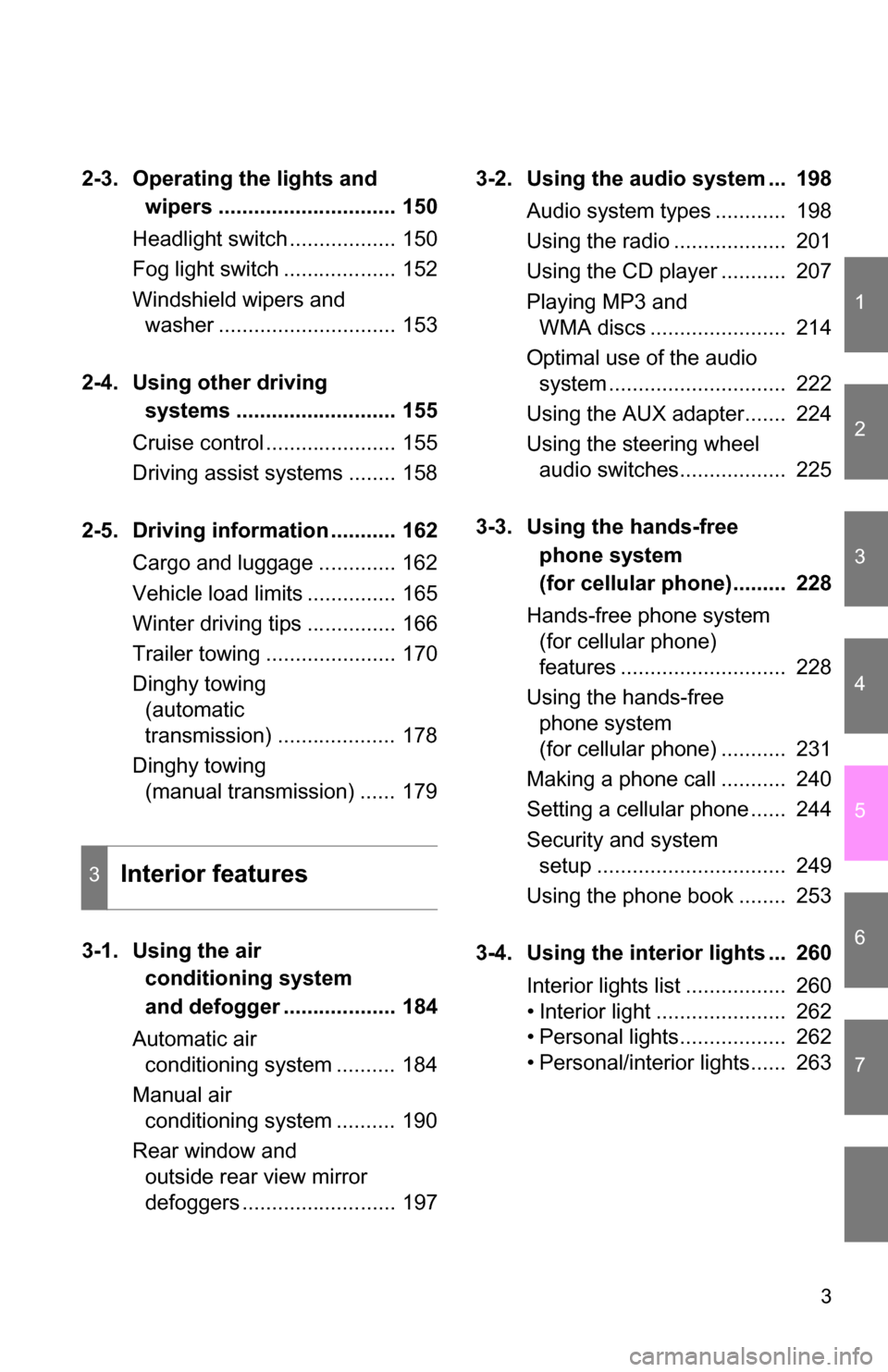
2-3. Operating the lights and wipers .............................. 150
Headlight switch .................. 150
Fog light switch ................... 152
Windshield wipers and washer .............................. 153
2-4. Using other driving systems ........................... 155
Cruise control ...................... 155
Driving assist systems ........ 158
2-5. Driving information ........... 162 Cargo and luggage ............. 162
Vehicle load limits ............... 165
Winter driving tips ............... 166
Trailer towing ...................... 170
Dinghy towing (automatic
transmission) .................... 178
Dinghy towing (manual transmission) ...... 179
3-1. Using the air conditioning system
and defogger ................... 184
Automatic air conditioning system .......... 184
Manual air conditioning system .......... 190
Rear window and outside rear view mirror
defoggers .......................... 197 3-2. Using the audio system ... 198
Audio system types ............ 198
Using the radio ................... 201
Using the CD player ........... 207
Playing MP3 and WMA discs ....................... 214
Optimal use of the audio system .............................. 222
Using the AUX adapter....... 224
Using the steering wheel audio switches.................. 225
3-3. Using the hands-free phone system
(for cellular phone)......... 228
Hands-free phone system (for cellular phone)
features ............................ 228
Using the hands-free phone system
(for cellular phone) ........... 231
Making a phone call ........... 240
Setting a cellular phone ...... 244
Security and system setup ................................ 249
Using the phone book ........ 253
3-4. Using the interior lights ... 260 Interior lights list ................. 260
• Interior light ...................... 262
• Personal lights.................. 262
• Personal/interior lights...... 263
3Interior features
Page 5 of 468
1
2
3
4
5
6
7
5
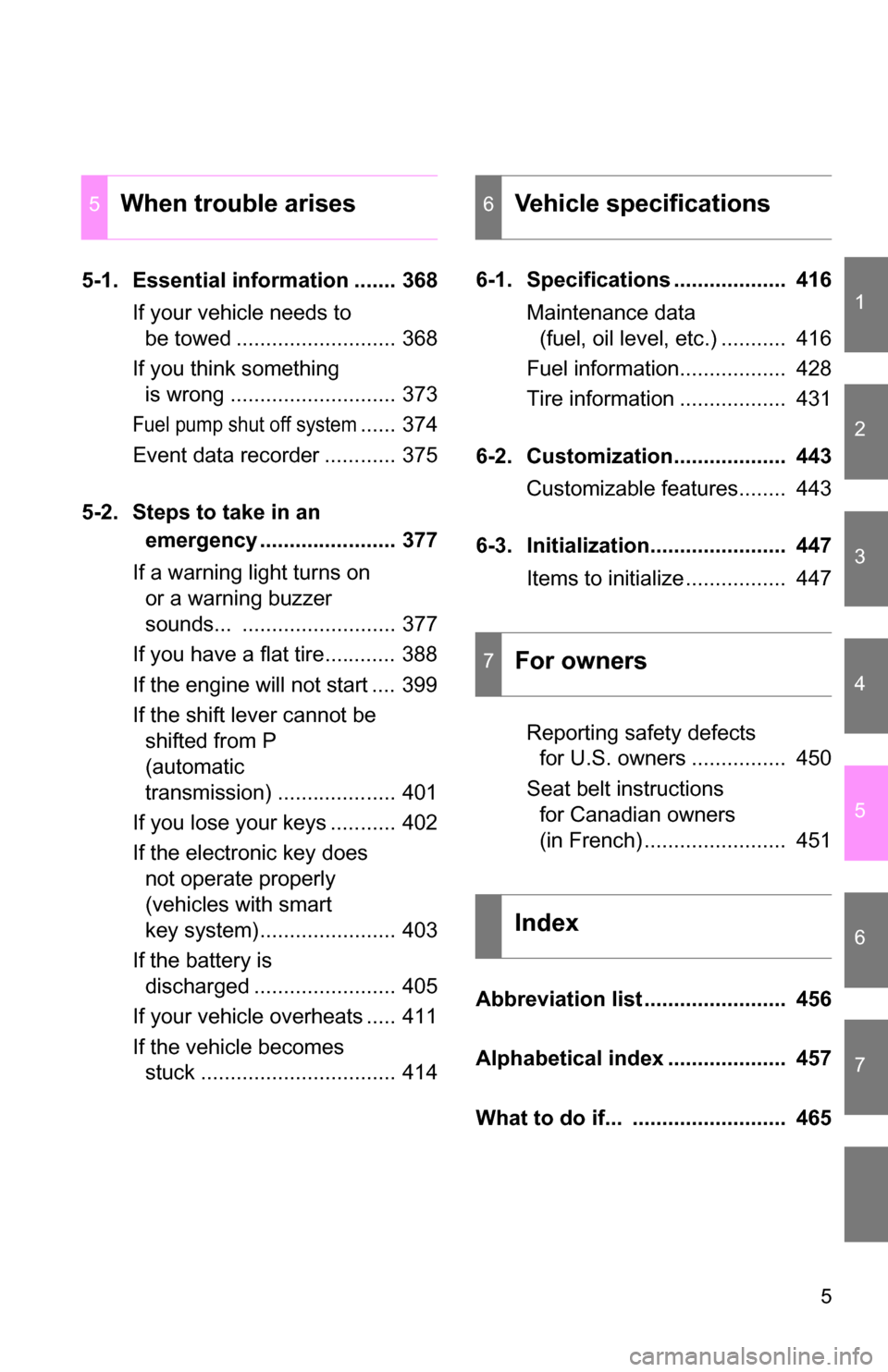
5-1. Essential information ....... 368If your vehicle needs to be towed ........................... 368
If you think something is wrong ............................ 373
Fuel pump shut off system...... 374
Event data recorder ............ 375
5-2. Steps to take in an emergency ....................... 377
If a warning light turns on or a warning buzzer
sounds... .......................... 377
If you have a flat tire............ 388
If the engine will not start .... 399
If the shift lever cannot be shifted from P
(automatic
transmission) .................... 401
If you lose your keys ........... 402
If the electronic key does not operate properly
(vehicles with smart
key system)....................... 403
If the battery is discharged ........................ 405
If your vehicle overheats ..... 411
If the vehicle becomes stuck ................................. 414 6-1. Specifications ................... 416
Maintenance data (fuel, oil level, etc.) ........... 416
Fuel information.................. 428
Tire information .................. 431
6-2. Customization................... 443 Customizable features........ 443
6-3. Initialization....................... 447 Items to initialize ................. 447
Reporting safety defects for U.S. owners ................ 450
Seat belt instructions for Canadian owners
(in French) ........................ 451
Abbreviation list ........................ 456
Alphabetical index .................... 457
What to do if... .......................... 465
5When trouble arises6Vehicle specifications
7For owners
Index
Page 40 of 468
40 1-2. Opening, closing and locking the doors and trunk
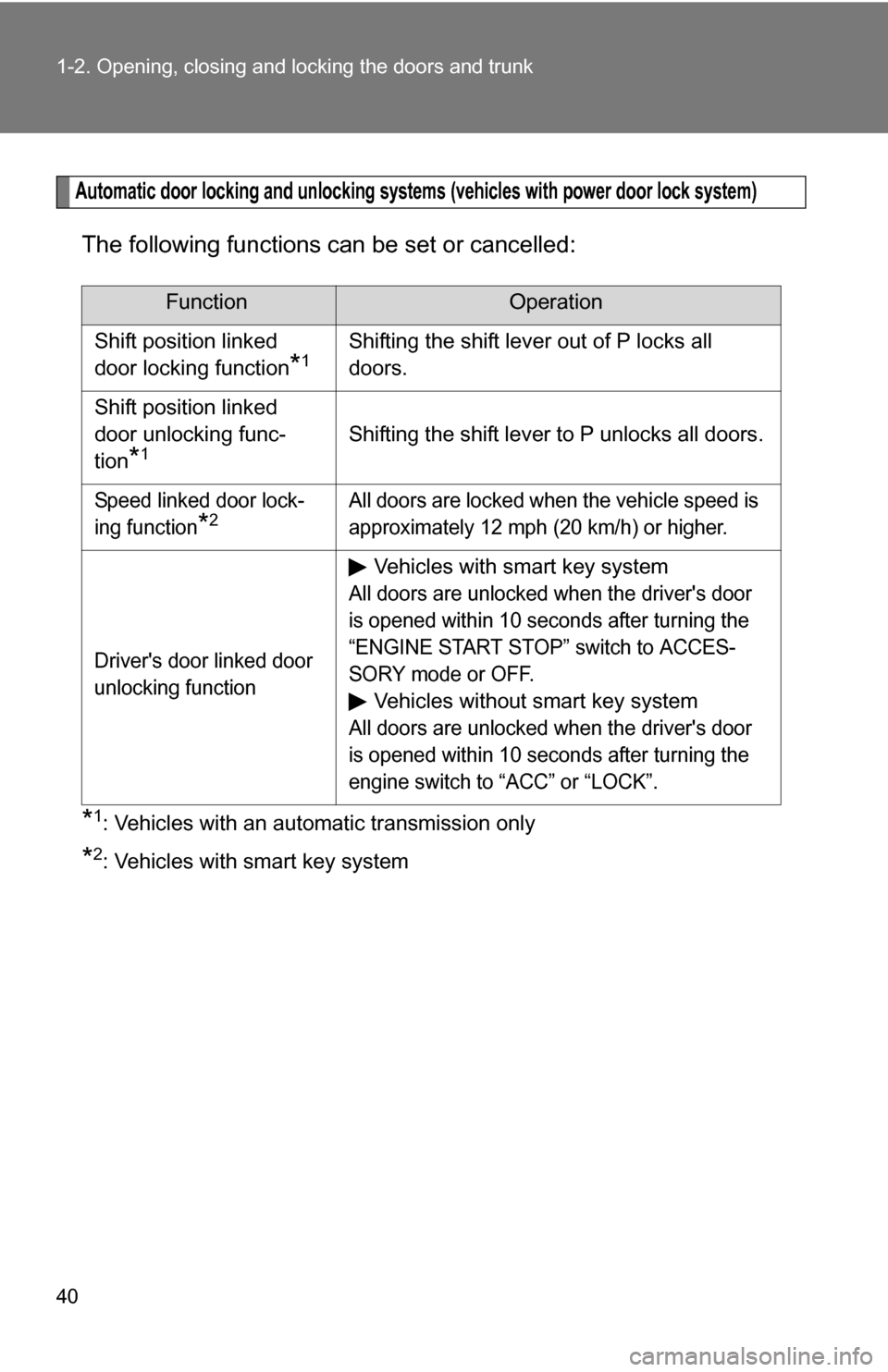
Automatic door locking and unlocking systems (vehicles with power door lock system)
The following functions can be set or cancelled:
*1: Vehicles with an automatic transmission only
*2: Vehicles with smart key system
FunctionOperation
Shift position linked
door locking function
*1Shifting the shift lever out of P locks all
doors.
Shift position linked
door unlocking func-
tion
*1Shifting the shift lever to P unlocks all doors.
Speed linked door lock-
ing function
*2All doors are locked when the vehicle speed is
approximately 12 mph (20 km/h) or higher.
Driver's door linked door
unlocking function
Vehicles with smart key system
All doors are unlocked when the driver's door
is opened within 10 seconds after turning the
“ENGINE START STOP” switch to ACCES-
SORY mode or OFF.
Vehicles without smart key system
All doors are unlocked when the driver's door
is opened within 10 seconds after turning the
engine switch to “ACC” or “LOCK”.
Page 41 of 468
41
1-2. Opening, closing and locking the doors and trunk
1
Before driving
■
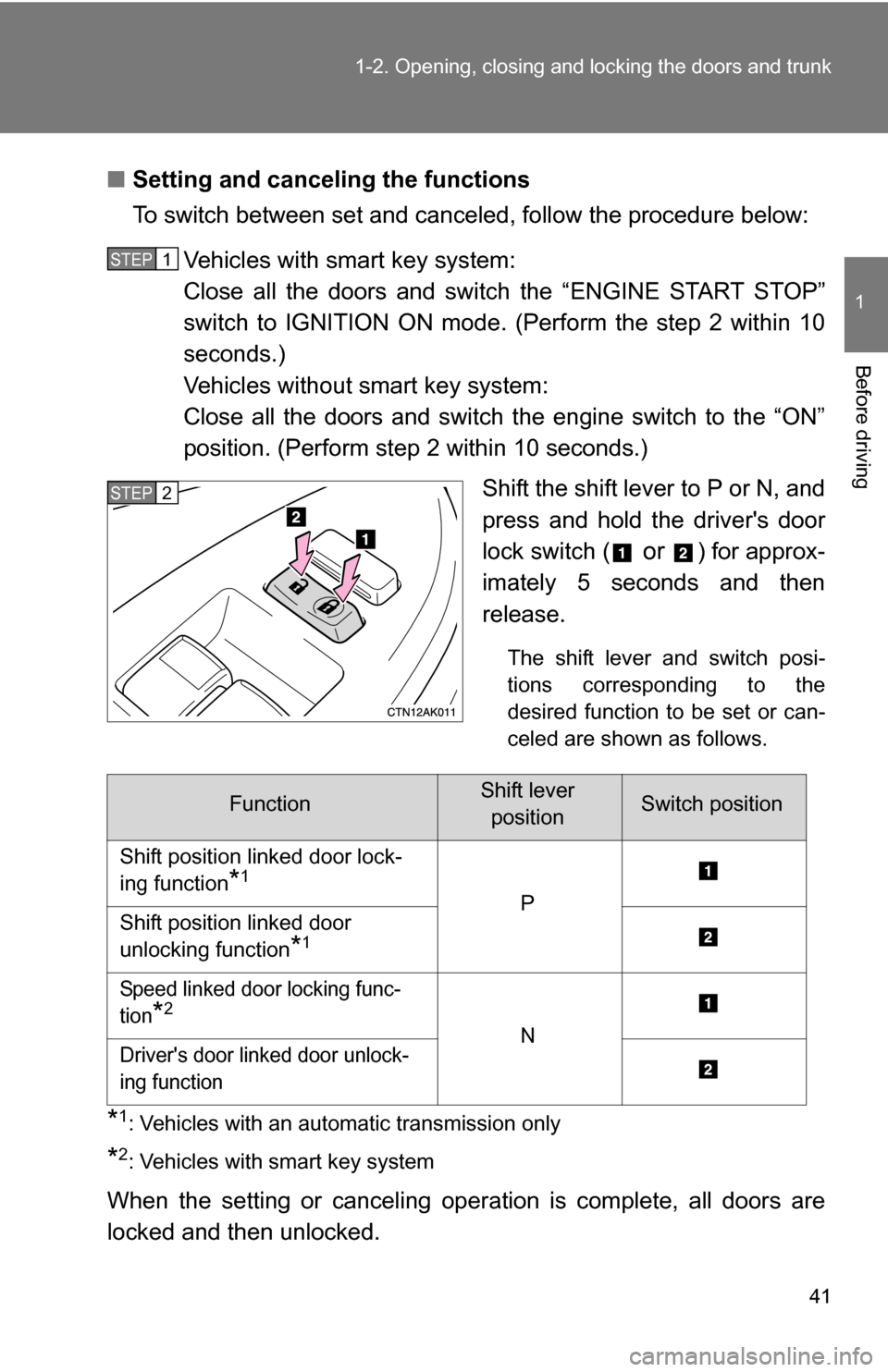
Setting and canceling the functions
To switch between set and canceled, follow the procedure below:
Vehicles with smart key system:
Close all the doors and switch the “ENGINE START STOP”
switch to IGNITION ON mode. (Perform the step 2 within 10
seconds.)
Vehicles without smart key system:
Close all the doors and switch the engine switch to the “ON”
position. (Perform step 2 within 10 seconds.) Shift the shift lever to P or N, and
press and hold the driver's door
lock switch (
or ) for approx-
imately 5 seconds and then
release.
The shift lever and switch posi-
tions corresponding to the
desired function to be set or can-
celed are shown as follows.
*1: Vehicles with an automatic transmission only
*2: Vehicles with smart key system
When the setting or canceling operation is complete, all doors are
locked and then unlocked.
STEP1
STEP2
FunctionShift lever positionSwitch position
Shift position linked door lock-
ing function
*1
P
Shift position linked door
unlocking function
*1
Speed linked door locking func-
tion
*2
N
Driver's door linked door unlock-
ing function
Page 111 of 468
When driving2
111
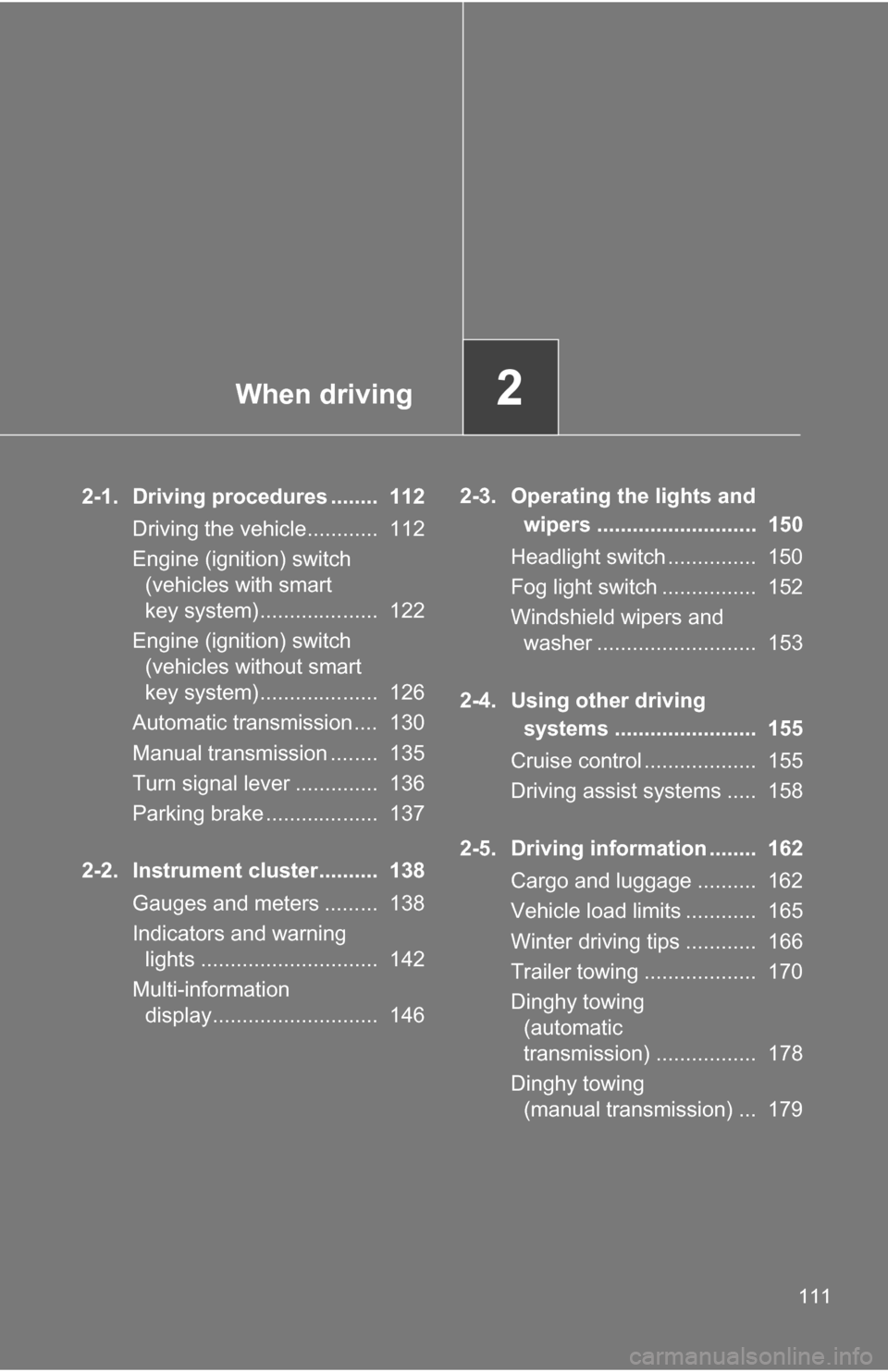
2-1. Driving procedures ........ 112Driving the vehicle............ 112
Engine (ignition) switch (vehicles with smart
key system).................... 122
Engine (ignition) switch (vehicles without smart
key system).................... 126
Automatic transmission .... 130
Manual transmission ........ 135
Turn signal lever .............. 136
Parking brake ................... 137
2-2. Instrument cluster.......... 138 Gauges and meters ......... 138
Indicators and warning lights .............................. 142
Multi-information display............................ 146 2-3. Operating the lights and
wipers ........................... 150
Headlight switch ............... 150
Fog light switch ................ 152
Windshield wipers and washer ........................... 153
2-4. Using other driving systems ........................ 155
Cruise control ................... 155
Driving assist systems ..... 158
2-5. Driving information ........ 162 Cargo and luggage .......... 162
Vehicle load limits ............ 165
Winter driving tips ............ 166
Trailer towing ................... 170
Dinghy towing (automatic
transmission) ................. 178
Dinghy towing (manual transmission) ... 179
Page 112 of 468
112
2-1. Driving procedures
Driving the vehicle
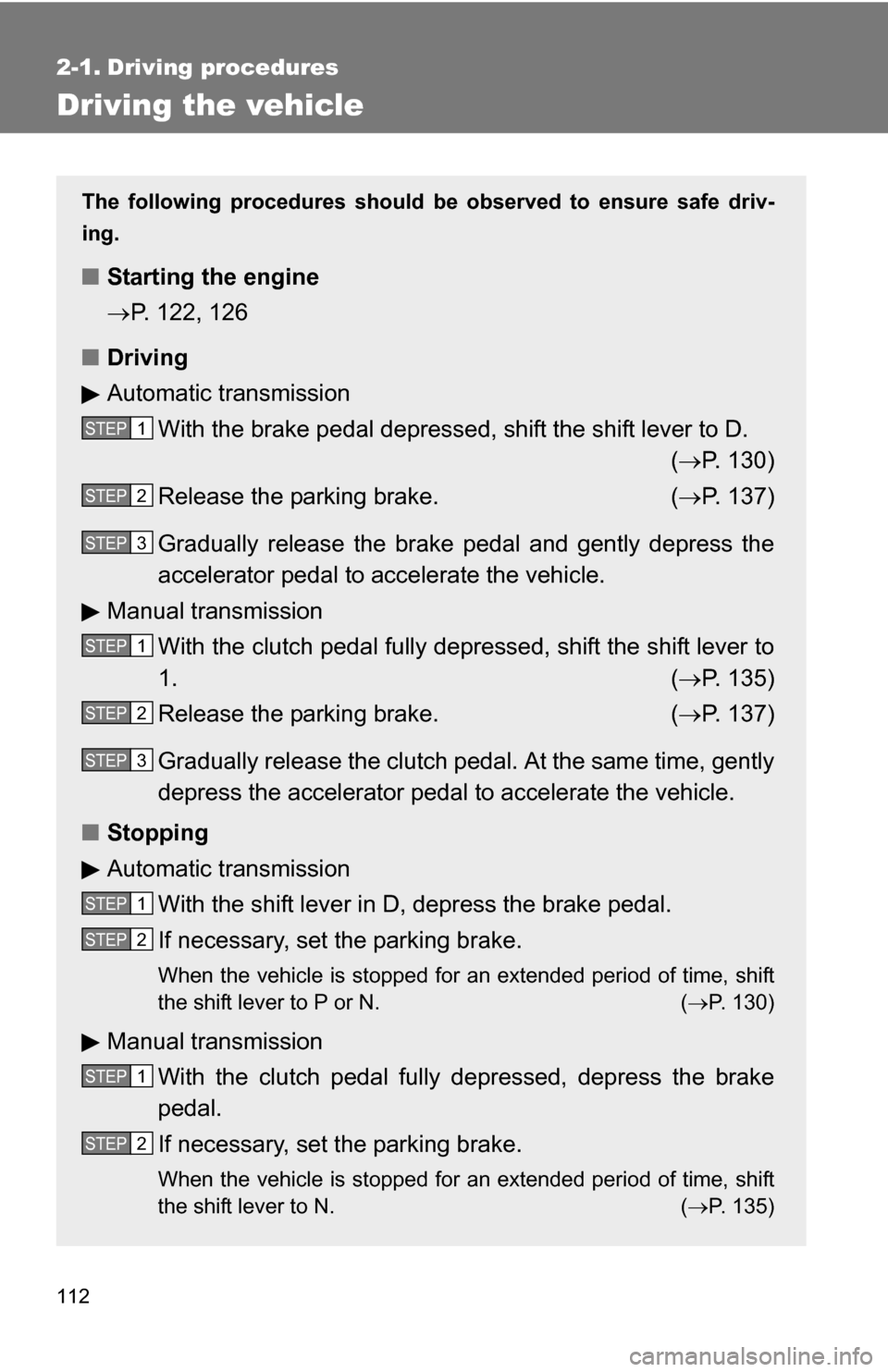
The following procedures should be observed to ensure safe driv-
ing.
■ Starting the engine
P. 122, 126
■ Driving
Automatic transmission
With the brake pedal depressed, shift the shift lever to D. ( P. 130)
Release the parking brake. ( P. 137)
Gradually release the brake pedal and gently depress the
accelerator pedal to accelerate the vehicle.
Manual transmission With the clutch pedal fully depressed, shift the shift lever to
1. ( P. 135)
Release the parking brake. ( P. 137)
Gradually release the clutch pedal. At the same time, gently
depress the accelerator pedal to accelerate the vehicle.
■ Stopping
Automatic transmission
With the shift lever in D, depress the brake pedal.
If necessary, set the parking brake.
When the vehicle is stopped for an extended period of time, shift
the shift lever to P or N. ( P. 130)
Manual transmission
With the clutch pedal fully depressed, depress the brake
pedal.
If necessary, set the parking brake.
When the vehicle is stopped for an extended period of time, shift
the shift lever to N. ( P. 135)
STEP1
STEP2
STEP3
STEP1
STEP2
STEP3
STEP1
STEP2
STEP1
STEP2
Page 113 of 468
113
2-1. Driving procedures
2
When driving
■
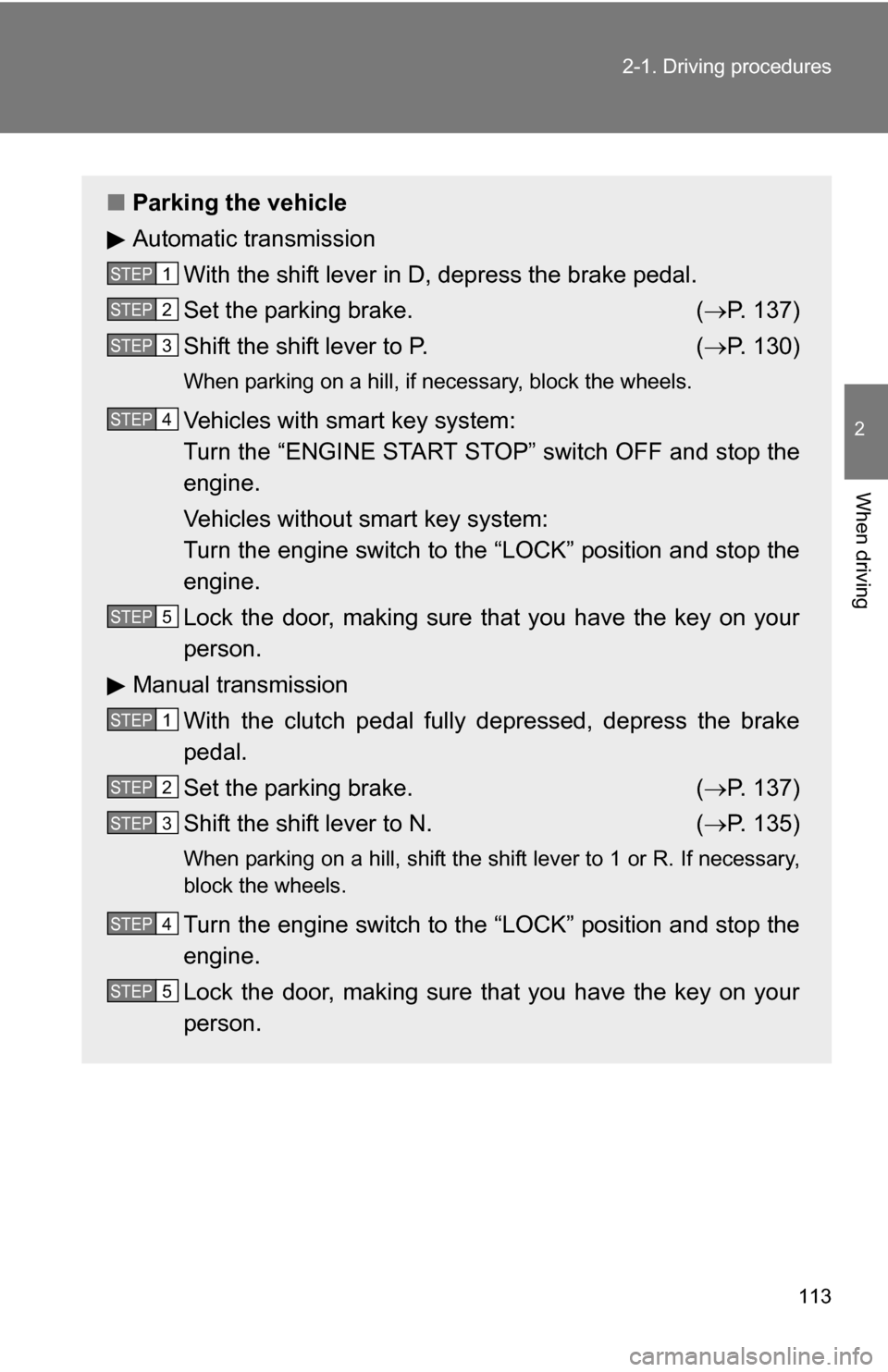
Parking the vehicle
Automatic transmission
With the shift lever in D, depress the brake pedal.
Set the parking brake. ( P. 137)
Shift the shift lever to P. ( P. 130)
When parking on a hill, if necessary, block the wheels.
Vehicles with smart key system:
Turn the “ENGINE START STOP” switch OFF and stop the
engine.
Vehicles without smart key system:
Turn the engine switch to the “LOCK” position and stop the
engine.
Lock the door, making sure that you have the key on your
person.
Manual transmission
With the clutch pedal fully depressed, depress the brake
pedal.
Set the parking brake. ( P. 137)
Shift the shift lever to N. ( P. 135)
When parking on a hill, shift the shift lever to 1 or R. If necessary,
block the wheels.
Turn the engine switch to the “LOCK” position and stop the
engine.
Lock the door, making sure that you have the key on your
person.
STEP1
STEP2
STEP3
STEP4
STEP5
STEP1
STEP2
STEP3
STEP4
STEP5
Page 114 of 468
114 2-1. Driving procedures
Starting on a steep uphillAutomatic transmission Firmly set the parking brake and shift the shift lever to D.
Gently depress the accelerator pedal.
Release the parking brake.
Manual transmission
With the parking brake firmly set and the clutch pedal fully
depressed, shift the shift lever to 1.
Lightly depress the accelerator pedal at the same time as
gradually releasing the clutch pedal.
Release the parking brake.
■Driving in the rain
●Drive carefully when it is raining, because visibility will be reduced, the
windows may become fogged-up, and the road will be slippery.
● Drive carefully when it starts to rain, because the road surface will be
especially slippery.
● Refrain from high speeds when driving on an expressway in the rain,
because there may be a layer of water between the tires and the road
surface, preventing the steering and brakes from operating properly.
■ Breaking in your new Toyota
To extend the life of the vehicle, the following precautions are recommended
to observe:
●For the first 200 miles (300 km):
Avoid sudden stops.
● For the first 500 miles (800 km):
Do not tow a trailer.
● For the first 1000 miles (1600 km):
• Do not drive at extremely high speeds.
• Avoid sudden acceleration.
• Do not drive slowly with the manual transmission in a high gear.
• Do not drive at a constant speed for extended periods.
STEP1
STEP2
STEP3
STEP1
STEP2
STEP3
Page 115 of 468
115
2-1. Driving procedures
2
When driving
■
Operating your vehicle in a foreign country
Comply with the relevant vehicle registration laws and confirm the availability
of the correct fuel. ( P. 420)
■ Normal characteristics afte r turning off the engine
Approximately five hours after the engine is turned off, you may hear sound
coming from under the vehicle for several minutes. This is because the fuel
evaporation leakage check is performed. It does not indicate a malfunction.
CAUTION
■ When starting the vehicle (vehicl es with an automatic transmission)
Always keep your foot on the brake pedal while stopped with the engine run-
ning. This prevents the vehicle from creeping.
■ When driving the vehicle
●Do not drive if you are unfamiliar with the location of the brake and accel-
erator pedals to avoid depressing the wrong pedal.
• Accidentally depressing the accelerator pedal instead of the brake
pedal will result in sudden acceleration that may lead to an accident
that could result in death or serious injury.
• When backing up, you may twist your body around, leading to a diffi- culty in operating the pedals. Make sure to operate the pedals properly.
• Make sure to keep a correct driving posture even when moving the vehicle only slightly, allowing you to depress the brake and accelerator
pedals properly.
• Depress the brake pedal using your right foot. Depressing the brake pedal using your left foot may delay response in an emergency, result-
ing in an accident.
● Do not drive the vehicle over or st op the vehicle near flammable materials.
The exhaust system and exhaust gases can be extremely hot. This may
cause a fire if there is any flammable material nearby.
● Vehicles with an automatic transmission: Do not let the vehicle roll back-
wards while the shift lever is in a driving position, or roll forward while the
shift lever is in R. Doing so may cause the engine to stall or lead to poor
brake and steering performance, resulting in an accident or damage to th\
e
vehicle.