light TOYOTA COROLLA 2011 10.G Owner's Manual
[x] Cancel search | Manufacturer: TOYOTA, Model Year: 2011, Model line: COROLLA, Model: TOYOTA COROLLA 2011 10.GPages: 529, PDF Size: 9.69 MB
Page 76 of 529
76 1-5. Refueling
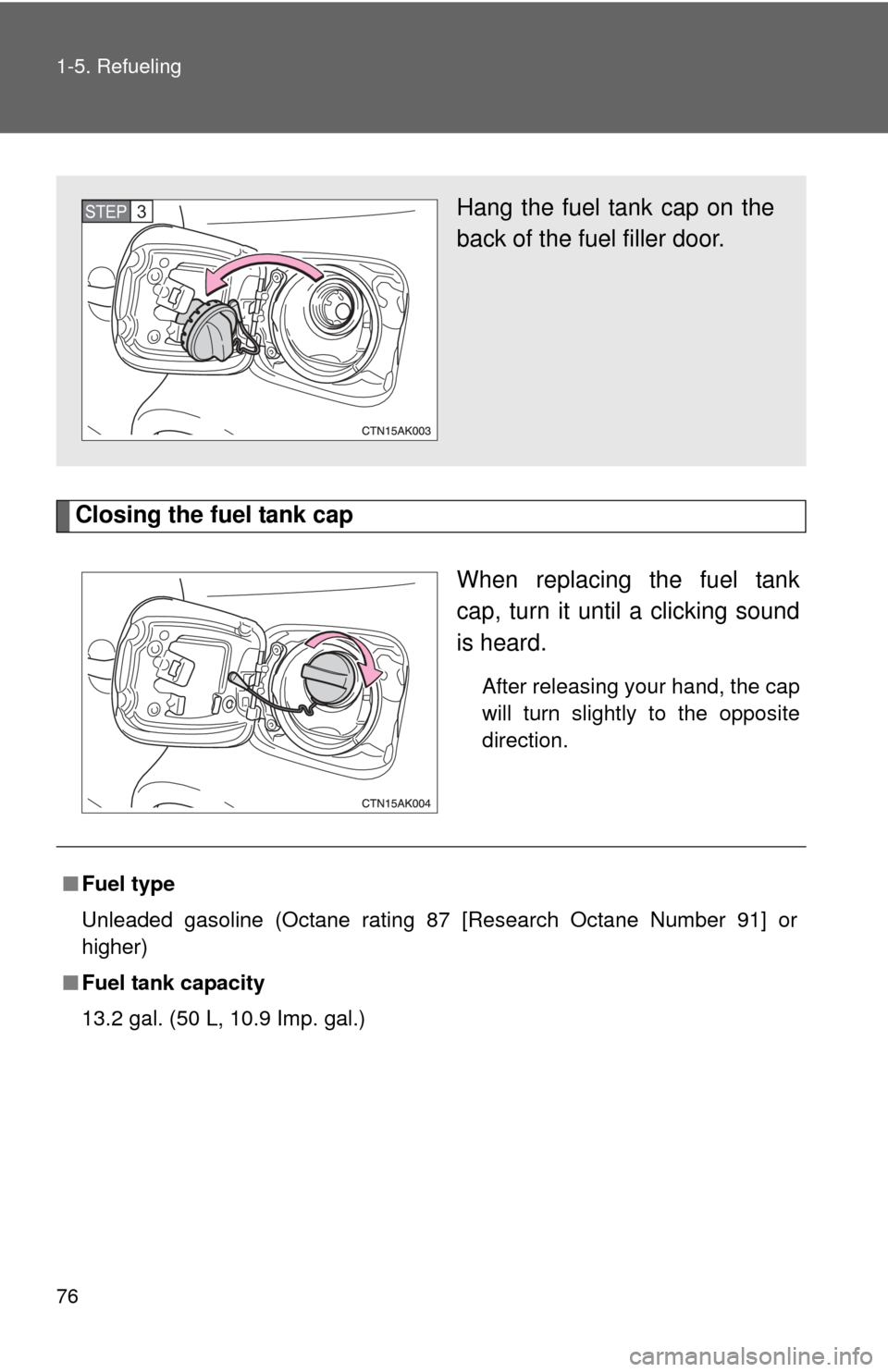
Closing the fuel tank capWhen replacing the fuel tank
cap, turn it until a clicking sound
is heard.
After releasing your hand, the cap
will turn slightly to the opposite
direction.
Hang the fuel tank cap on the
back of the fuel filler door.STEP 3
■Fuel type
Unleaded gasoline (Octane rating 87 [Research Octane Number 91] or
higher)
■ Fuel tank capacity
13.2 gal. (50 L, 10.9 Imp. gal.)
Page 79 of 529
79
1
Before driving
1-6. Theft deterrent system
Engine immobilizer system
The vehicle's keys have built-in transponder chips that prevent the
engine from starting if the key has not been previously registered in
the vehicle's on-board computer.
Never leave the keys inside the vehicle when you leave the vehicle.
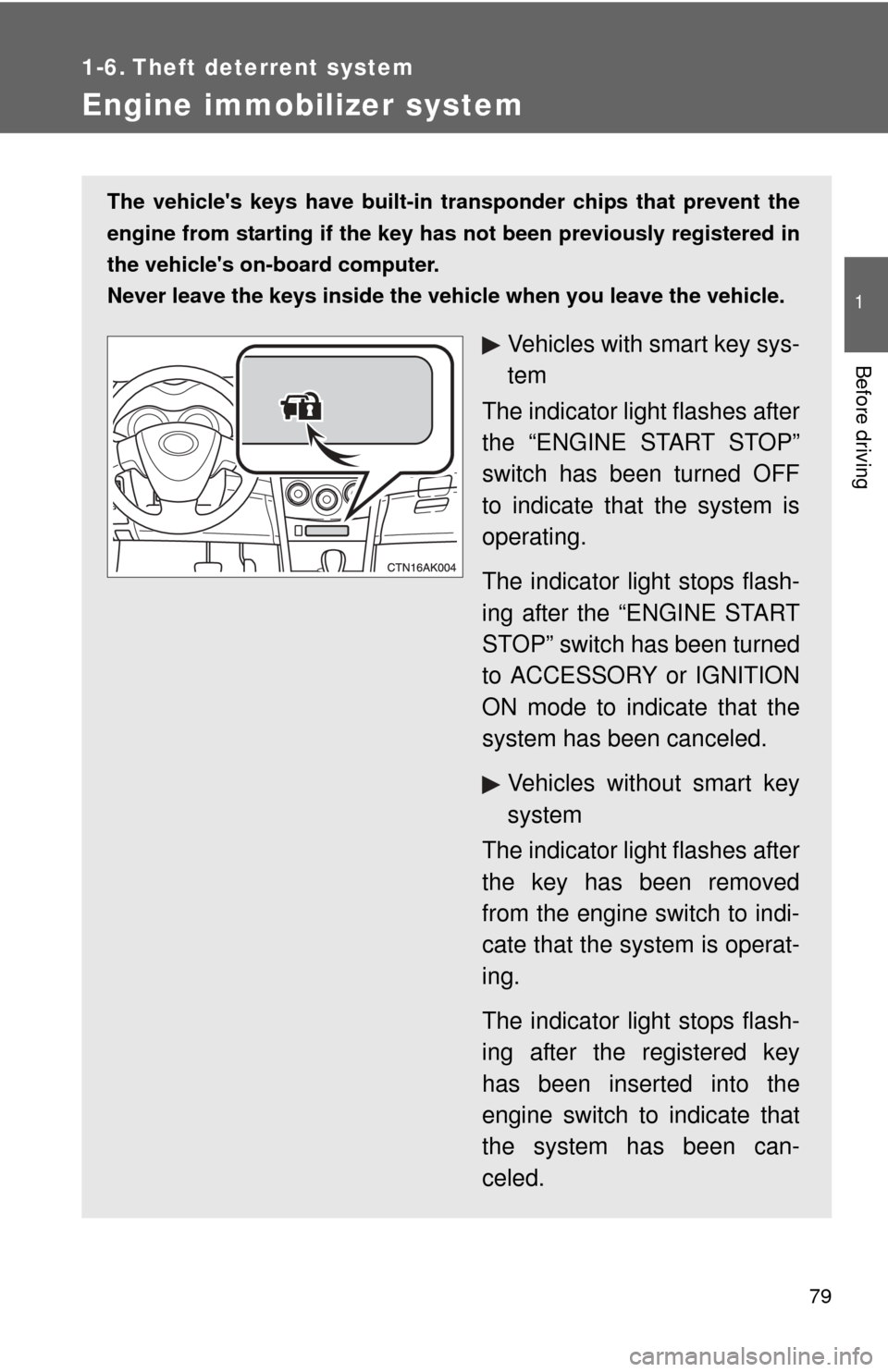
Vehicles with smart key sys-
tem
The indicator light flashes after
the “ENGINE START STOP”
switch has been turned OFF
to indicate that the system is
operating.
The indicator light stops flash-
ing after the “ENGINE START
STOP” switch has been turned
to ACCESSORY or IGNITION
ON mode to indicate that the
system has been canceled.
Vehicles without smart key
system
The indicator light flashes after
the key has been removed
from the engine switch to indi-
cate that the system is operat-
ing.
The indicator light stops flash-
ing after the registered key
has been inserted into the
engine switch to indicate that
the system has been can-
celed.
Page 86 of 529
86 1-7. Safety information
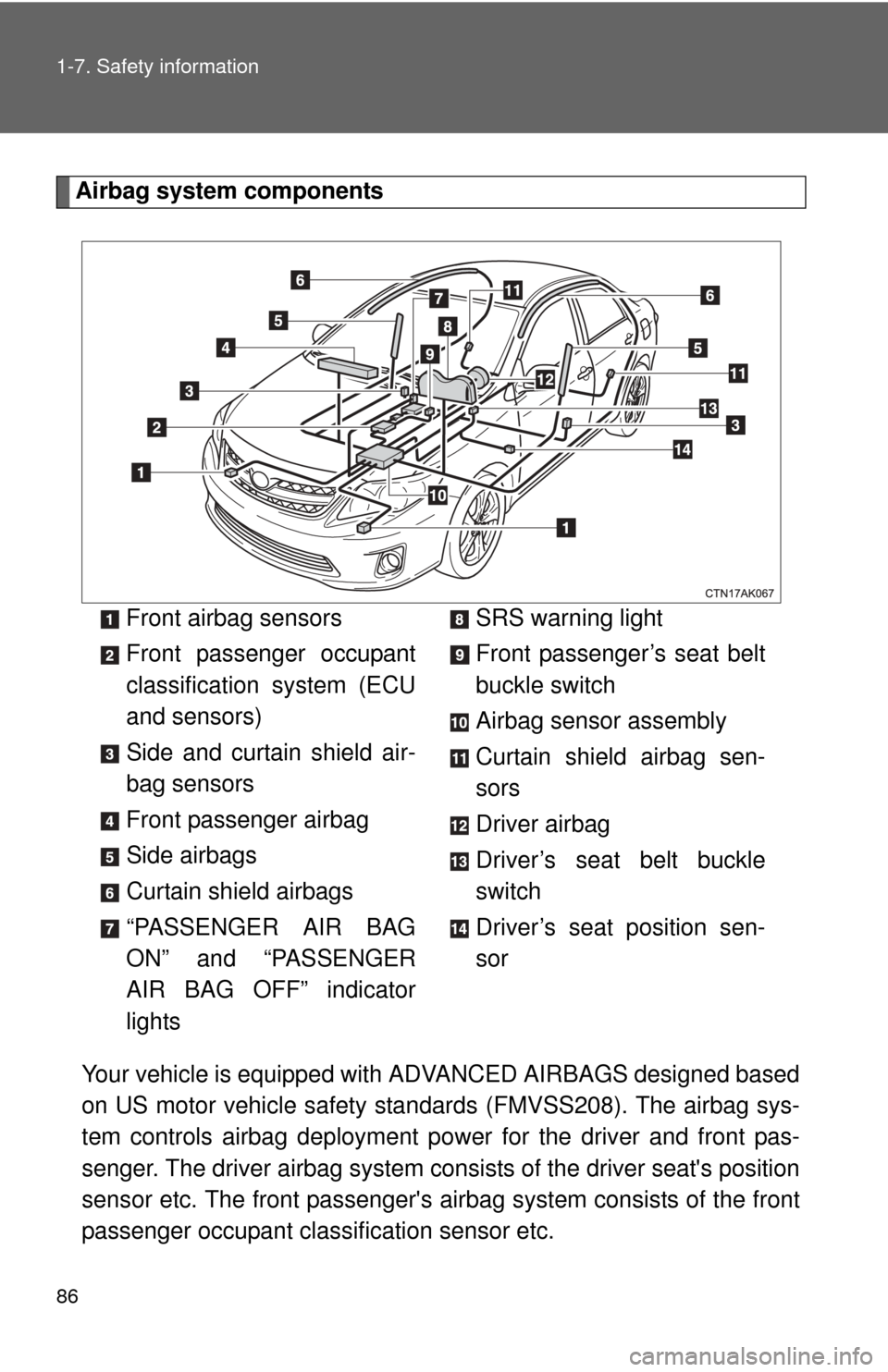
Airbag system componentsYour vehicle is equipped with ADVANCED AIRBAGS designed based
on US motor vehicle safety standards (FMVSS208). The airbag sys-
tem controls airbag deployment po wer for the driver and front pas-
senger. The driver airbag system cons ists of the driver seat's position
sensor etc. The front passenger's airbag system consists of the front
passenger occupant classification sensor etc. Front airbag sensors
Front passenger occupant
classification system (ECU
and sensors)
Side and curtain shield air-
bag sensors
Front passenger airbag
Side airbags
Curtain shield airbags
“PASSENGER AIR BAG
ON” and “PASSENGER
AIR BAG OFF” indicator
lights
SRS warning light
Front passenger’s seat belt
buckle switch
Airbag sensor assembly
Curtain shield airbag sen-
sors
Driver airbag
Driver’s seat belt buckle
switch
Driver’s seat position sen-
sor
Page 88 of 529

88 1-7. Safety information
■If the SRS airbags deploy (inflate)
●Bruising and slight abrasions may result from contact with a deploying
(inflating) SRS airbag.
● A loud noise and white powder will be emitted.
● Parts of the airbag module (steering wheel hub, airbag cover and inflator)
as well as the front seats, and parts of the front and rear pillars and roof
side rail, may be hot for several minutes. The airbag itself may also be
hot.
● The windshield may crack.
■ SRS airbag deployment conditions (front airbags)
●The SRS front airbags will deploy in the event of an impact that exceeds
the set threshold level (the level of force corresponding to an approxi-
mately 12 - 18 mph [20 - 30 km/h] frontal collision with a fixed wall that
does not move or deform).
However, this threshold velocity will be considerably higher if the vehicle
strikes an object, such as a parked vehicle or sign pole, which can move or
deform on impact, or if the vehicle is involved in an underride collision (e.g.
a collision in which the front of the vehicle “underrides”, or goes under, the
bed of a truck, etc.).
● It is possible that in some collisions where the forward deceleration of the
vehicle is very close to the designed threshold level, the SRS front air-
bags and the seat belt pretensioners may not activate together.
● The SRS front passenger airbag will not activate if there is no passenger
sitting in the front passenger seat. However, the front passenger airbag
may deploy if luggage is put in the seat, or the seat belt is fastened, even
if the seat is unoccupied. ( P. 9 7 )
Page 92 of 529

92 1-7. Safety information
CAUTION
■SRS airbag precautions
Observe the following precautions regarding the airbags.
Failure to do so may cause death or serious injury.
●The driver and all passengers in the vehicle must wear their seat belts
properly.
The SRS airbags are supplemental devices to be used with the seat belts.
● The SRS driver airbag deploys with considerable force, and can cause
death or serious injury especially if the driver is very close to the airbag.
The National Highway Traffic Safety Administration (“NHTSA”) advises:
Since the risk zone for the driver’s airbag is the first 2 - 3 in. (50 - 75 mm)
of inflation, placing yourself 10 in. (250 mm) from your driver airbag pro-
vides you with a clear margin of safety. This distance is measured from the
center of the steering wheel to your breastbone. If you sit less than 10 in.
(250 mm) away now, you can change your driving position in several
ways:
• Move your seat to the rear as far as you can while still reaching the pedals comfortably.
• Slightly recline the back of the seat. Although vehicle designs vary, many drivers can achieve the 10 in.
(250 mm) distance, even with the driver seat all the way forward, sim-
ply by reclining the back of the seat somewhat. If reclining the back of
your seat makes it hard to see the road, raise yourself by using a firm,
non-slippery cushion, or raise the seat if your vehicle has that feature\
.
• If your steering wheel is adjustable, tilt it downward. This points the air- bag toward your chest instead of your head and neck.
The seat should be adjusted as recommended by NHTSA above, while
still maintaining control of the foot pedals, steering wheel, and your view of
the instrument panel controls.
Page 97 of 529
97
1
1-7. Safety information
Before driving
Front passenger occupant classification system
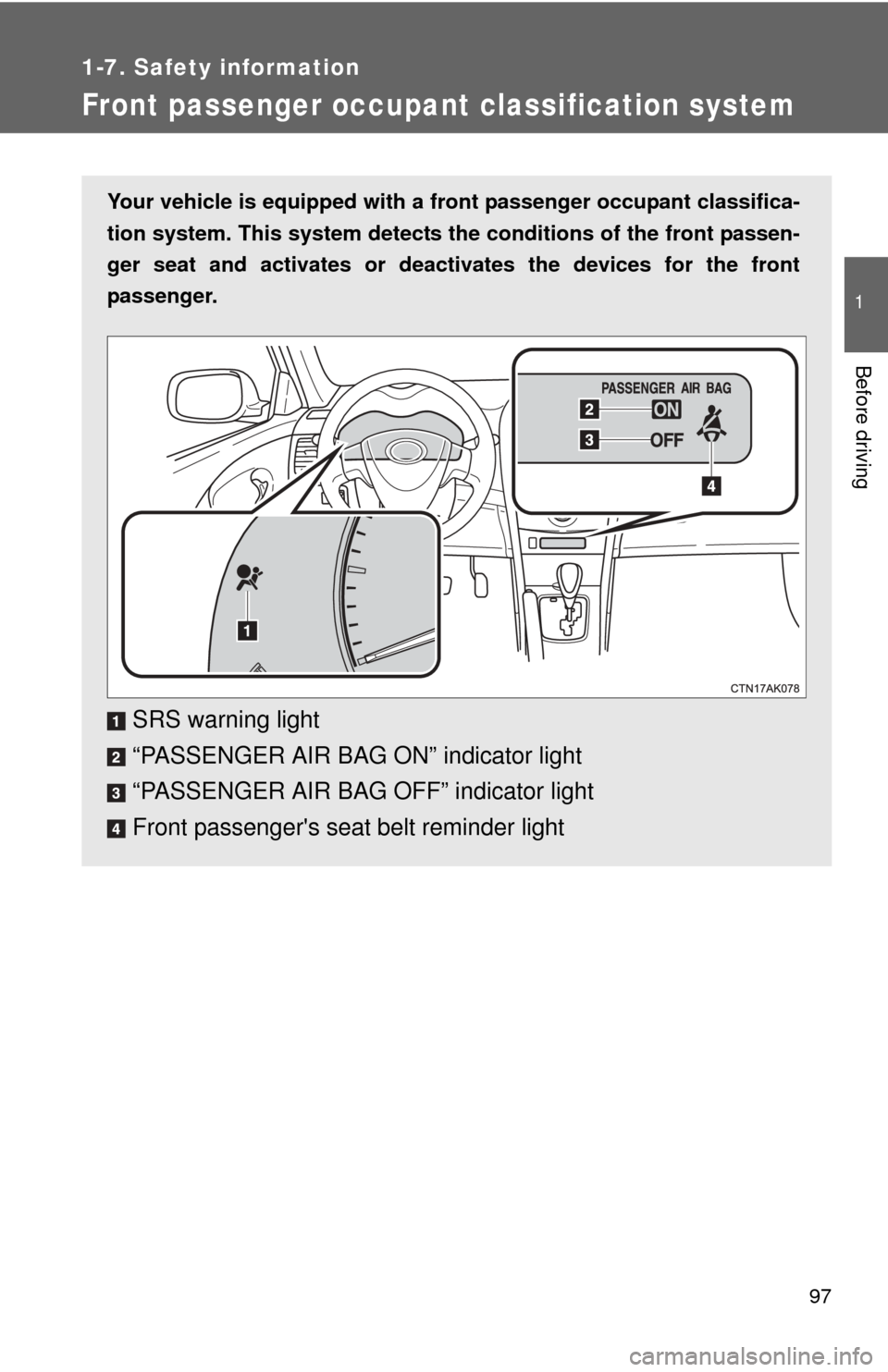
Your vehicle is equipped with a front passenger occupant classifica-
tion system. This system detects the conditions of the front passen-
ger seat and activates or deactiv ates the devices for the front
passenger.
SRS warning light
“PASSENGER AIR BAG ON” indicator light
“PASSENGER AIR BAG OFF” indicator light
Front passenger's seat belt reminder light
Page 98 of 529

98 1-7. Safety information
Conditions and operation of the front passenger occupant classification system
■Adult*1
■Child*3 or child restraint system*4
Indicator/
warning light
“PASSENGER AIR BAG ON” and
“PASSENGER AIR BAG OFF” indicator lights“PASSENGER AIR BAG ON”
SRS warning light Off
Front passenger’s seat belt reminder light Flashing
*2
Devices Front passenger airbag
Activated
Side airbag on the front
passenger seats
Curtain shield airbag in the front passenger side
Front passenger’s seat belt pretensioner
Indicator/
warning light
“PASSENGER AIR BAG ON” and
“PASSENGER AIR BAG OFF” indicator lights“PASSENGER AIR BAG OFF”
*5
SRS warning light Off
Front passenger’s seat belt reminder light Flashing
*2
Devices Front passenger airbag Deactivated
Side airbag on the front passenger seats
Activated
Curtain shield airbag in the front
passenger side
Front passenger’s seat belt pretensioner
Page 99 of 529

99
1-7. Safety information
1
Before driving
■
Unoccupied
■ There is a malfunction in the system
*1: The system judges a person of adult size as an adult. When a
smaller adult sits in the front passenger seat, the system may rec-
ognize him/her as a child depending on his/her physique and pos-
ture.
*2: In the event the front passenger does not wear a seat belt.
*3: When a larger child who has outgrown a child restraint systemsits in the front passenger seat, the system may recognize him/
her as an adult depending on his/her physique or posture.
Indicator/
warning light
“PASSENGER AIR BAG ON” and
“PASSENGER AIR BAG OFF” indicator lights Not illuminated
SRS warning light
Off
Front passenger’s seat belt reminder light
Devices Front passenger airbag Deactivated
Side airbag on the front passenger seats Activated
Curtain shield airbag in the front
passenger side
Front passenger’s seat belt pretensioner Deactivated
Indicator/
warning light
“PASSENGER AIR BAG ON” and
“PASSENGER AIR BAG OFF” indicator lights“PASSENGER
AIR BAG OFF”
SRS warning light On
Front passenger’s seat belt reminder light Off
Devices Front passenger airbag
Deactivated
Side airbag on the front passenger seats
Activated
Curtain shield airbag in the front
passenger side
Front passenger’s seat belt pretensioner
Page 100 of 529

100 1-7. Safety information
*4: Never install a rear-facing child restraint system on the front pas-senger seat. A forward-facing ch ild restraint system should only
be installed on the front passenger seat when it is unavoidable.
( P. 102)
*5: In case the indicator is not illumi nated, consult this manual as for
installing the child restraint system properly. ( P. 106)
CAUTION
■Front passenger occupant cl assification system precautions
Observe the following precautions regarding the front passenger occupant
classification system.
Failure to do so may cause death or serious injury.
● Wear the seat belt properly.
● Make sure the front passenger’s seat belt tab has not been left inserted
into the buckle before someone sits in the front passenger seat.
● Make sure the “PASSENGER AIR BAG OFF” indicator light is not illumi-
nated when using the seat belt extender for the front passenger seat. If the
“PASSENGER AIR BAG OFF” indicator light is illuminated, disconnect the
extender tongue from the seat belt buckle, then reconnect the seat belt.
Reconnect the seat belt extender after making sure the “PASSENGER
AIR BAG ON” indicator light is illuminated. If you use the seat belt
extender while the “PASSENGER AIR BAG OFF” indicator light is illumi-
nated, the front passenger airbag and side airbag on the front passenger
side may not activate correctly, which could cause death or serious injury
in the event of collision.
● Do not apply a heavy load to the front passenger seat or equipment (e.g.
seatback pocket).
● Do not put weight on the front passenger seat by putting your hands or
feet on the front passenger seat seatback from the rear passenger seat.
● Do not let a rear passenger lift the front passenger seat with their feet or
press on the seatback with their legs.
● Do not put objects under the front passenger seat.
Page 101 of 529

101
1-7. Safety information
1
Before driving
CAUTION
■
Front passenger occupant cl assification system precautions
● Do not recline the front passenger seatback so far that it touches a rear
seat. This may cause the “PASSENGER AIR BAG OFF” indicator light to
be illuminated, which indicates that the passenger’s airbags will not deploy
in the event of a severe accident. If the seatback touches the rear seat\
,
return the seatback to a position where it does not touch the rear seat.
Keep the front passenger seatback as upright as possible when the vehi-
cle is moving. Reclining the seatback excessively may lessen the effec-
tiveness of the seat belt system.
● If an adult sits in the front passenger seat, the “PASSENGER AIR BAG
ON” indicator light is illuminated. If the “PASSENGER AIR BAG OFF” indi-
cator is illuminated, ask the passenger to sit up straight, well back in the
seat, feet on the floor, and with the seat belt worn correctly. If the
“PASSENGER AIR BAG OFF” indicator still remains illuminated, either
ask the passenger to move to the rear seat, or if that is not possible, move
the front passenger seat fully rearward.
● When it is unavoidable to install the forward-facing child restraint system
on the front passenger seat, install the child restraint system on the front
passenger seat in the proper order. ( P. 106)
● Do not modify or remove the front seats.
● Do not kick the front passenger seat or subject it to severe impact. Other-
wise, the SRS warning light may come on to indicate a malfunction of the
detection system. In this case, contact your Toyota dealer immediately.
● Child restraint systems installed on the rear seat should not contact the
front seatbacks.
● Do not use a seat accessory, such as a cushion or seat cover, that covers
the seat cushion surface.
● Do not modify or replace the upholstery of the front seat.