spec TOYOTA COROLLA 2012 10.G Workshop Manual
[x] Cancel search | Manufacturer: TOYOTA, Model Year: 2012, Model line: COROLLA, Model: TOYOTA COROLLA 2012 10.GPages: 529, PDF Size: 8.07 MB
Page 375 of 529

375
4-3. Do-it-yourself maintenance
4
Maintenance and care
NOTICE
■Repairing or replacing tires, wheels, tire pressure warning valves,
transmitters and tire valve caps
●When removing or fitting the wheels, tires or the tire pressure warning
valves and transmitters, contact your
Toyota dealer as the tire pres-
sure warning valves and transmitters may be damaged if not handled
correctly.
●When replacing tire valve caps, do not use tire valve caps other than
those specified. The cap may become stuck.
■To avoid damage to the tire pressure warning valves and transmit-
ters
When a tire is repaired with liquid sealants, the tire pressure warning
valve and transmitter may not operate properly. If a liquid sealant is
used, contact your Toyota dealer or other qualified service shop as soon
as possible. Make sure to replace the tire pressure warning valve and
transmitter when replacing the tire. ( P. 369)
■Driving on rough roads
Take particular care when driving on roads with loose surfaces or pot-
holes.
These conditions may cause losses in tire air pressure, reducing the
cushioning ability of the tires. In addition, driving on rough roads may
cause damage to the tires themselves, as well as the vehicle’s wheels
and body.
■Low profile tires and wheels
Wheels with profile tires like 17-inch tires may cause greater damage
than usual to the tire wheel when receiving impact from the road surface.
Therefore pay attention to the following:
●Be sure to use proper tire inflation pressure. If tires are under-inflated,
they may be damaged more severely.
●Avoid pot holes, uneven pavement, curbs and other road hazards.
Failure to do so can lead to severe tire and wheel damage.
■If tire inflation pressures become low while driving
Do not continue driving, or your tires and/or wheels may be ruined.
Page 377 of 529
377
4-3. Do-it-yourself maintenance
4
Maintenance and care
■Tire inflation pressure check interval
You should check tire inflation pressure every two weeks, or at least
once a month.
Do not forget to check the spare.
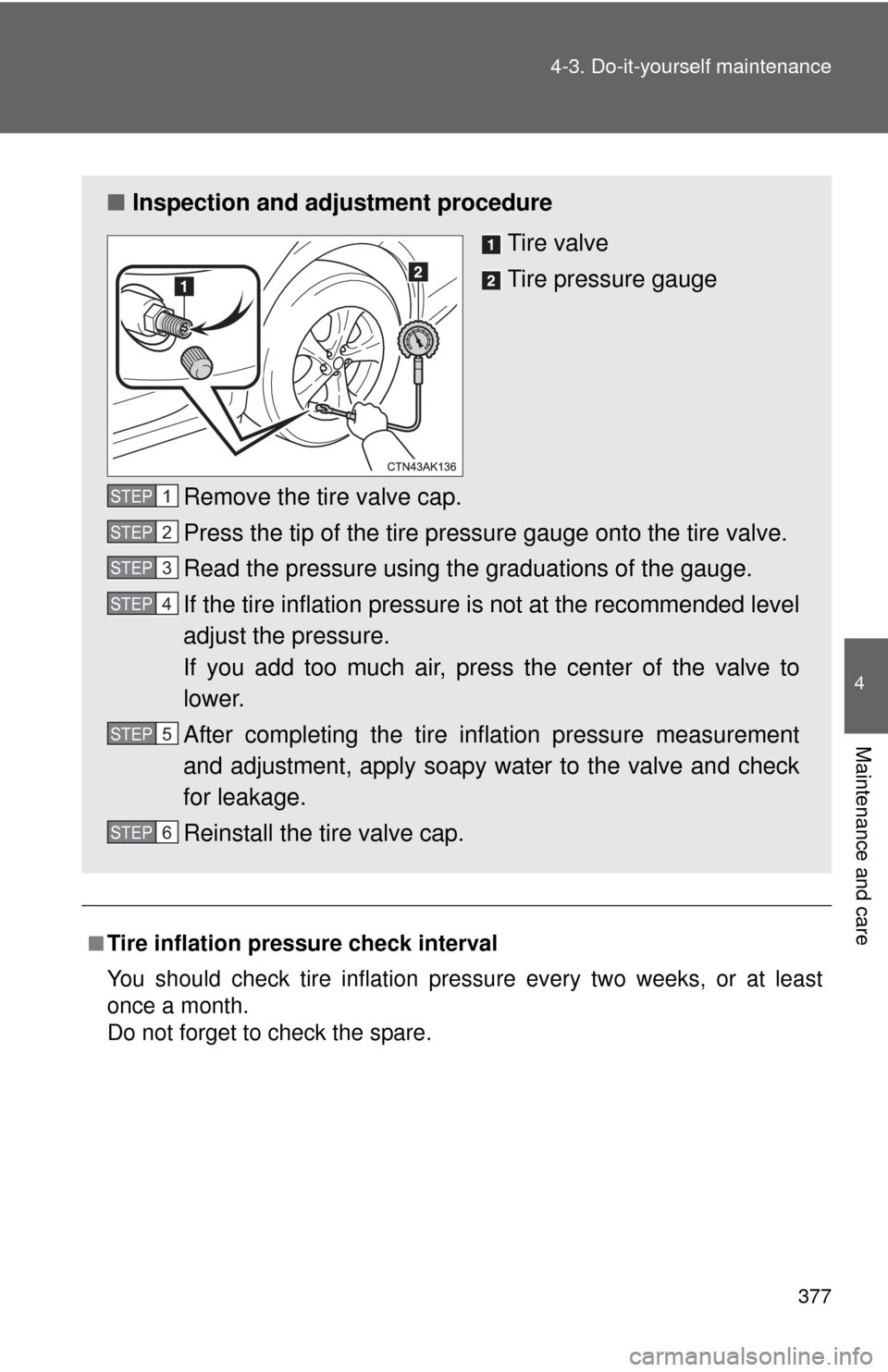
■
Inspection and adjustment procedure
Tire valve
Tire pressure gauge
Remove the tire valve cap.
Press the tip of the tire pressure gauge onto the tire valve.
Read the pressure using the graduations of the gauge.
If the tire inflation pressure is not at the recommended level
adjust the pressure.
If you add too much air, pres s the center of the valve to
lower.
After completing the tire inflation pressure measurement
and adjustment, apply soapy water to the valve and check
for leakage.
Reinstall the tire valve cap.
STEP 1
STEP 2
STEP 3
STEP 4
STEP 5
STEP 6
Page 379 of 529
379
4-3. Do-it-yourself maintenance
4
Maintenance and care
CAUTION
■Proper inflation is critical
to save tire performance
Keep your tires properly inflated. Otherwise, the following conditions
may occur and result in an accident causing death or serious injury.
●Excessive wear
●Uneven wear
●Poor handling
●Possibility of blowouts resu lting from overheated tires
●Poor sealing of the tire bead
●Wheel deformation and/or tire separation
●A greater possibility of tire damage from road hazards
NOTICE
■When inspecting and adjusting tire inflation pressure
Be sure to reinstall the tire valve caps.
Without the valve caps, dirt or mo isture could get into the valve and
cause air leakage, which could result in an accident. If the caps have
been lost, replace them as soon as possible.
Page 398 of 529
398 4-3. Do-it-yourself maintenance
■After a fuse is replaced
●If the lights do not turn on even after the fuse has been replaced, a bulb
may need replacing. ( P. 399)
● If the replaced fuse blows again, have the vehicle inspected by your
Toyota dealer.
■ If there is an overload in the circuits
The fuses are designed to blow, protecting the wiring harness from damage.
CAUTION
■To prevent system breakdowns and vehicle fire
Observe the following precautions.
Failing to do so may cause damage, and possibly a fire or injury.
●Never use a fuse of a higher amperage rating than indicated, or use any
other object in place of a fuse.
● Always use a genuine Toyota fuse or equivalent.
Never replace a fuse with a wire, even as a temporary fix.
This can cause extensive damage or even fire.
● Do not modify the fuse or the fuse box.
NOTICE
■Before replacing fuses
Have the cause of electrical overload determined and repaired by your
Toyota dealer, as soon as possible.
Page 419 of 529
5
When trouble arises
419
5-1. Essential information
Fuel pump shut off system
Follow the procedure below to restart the engine after the system is
activated.
Vehicles with smart key system Turn the “ENGINE START STOP” switch OFF.
Restart the engine.
Vehicles without smart key system Turn the engine switch to the “ACC” or “LOCK” position.
Restart the engine.
NOTICE
■Before starting the engine
Inspect the ground under the vehicle.
If you find that fuel has leaked on to the ground, the fuel system has been
damaged and is in need of repair. Do not restart the engine. Have the vehi-
cle checked and repaired by your Toyota dealer.
To minimize the risk of fuel leakage when the engine stalls or an air-
bag inflates upon collision, the fu el pump shut off system stops sup-
plying fuel to the engine.
STEP 1
STEP 2
STEP 1
STEP 2
Page 421 of 529
5
When trouble arises
421
5-2. Steps to take in an emergency
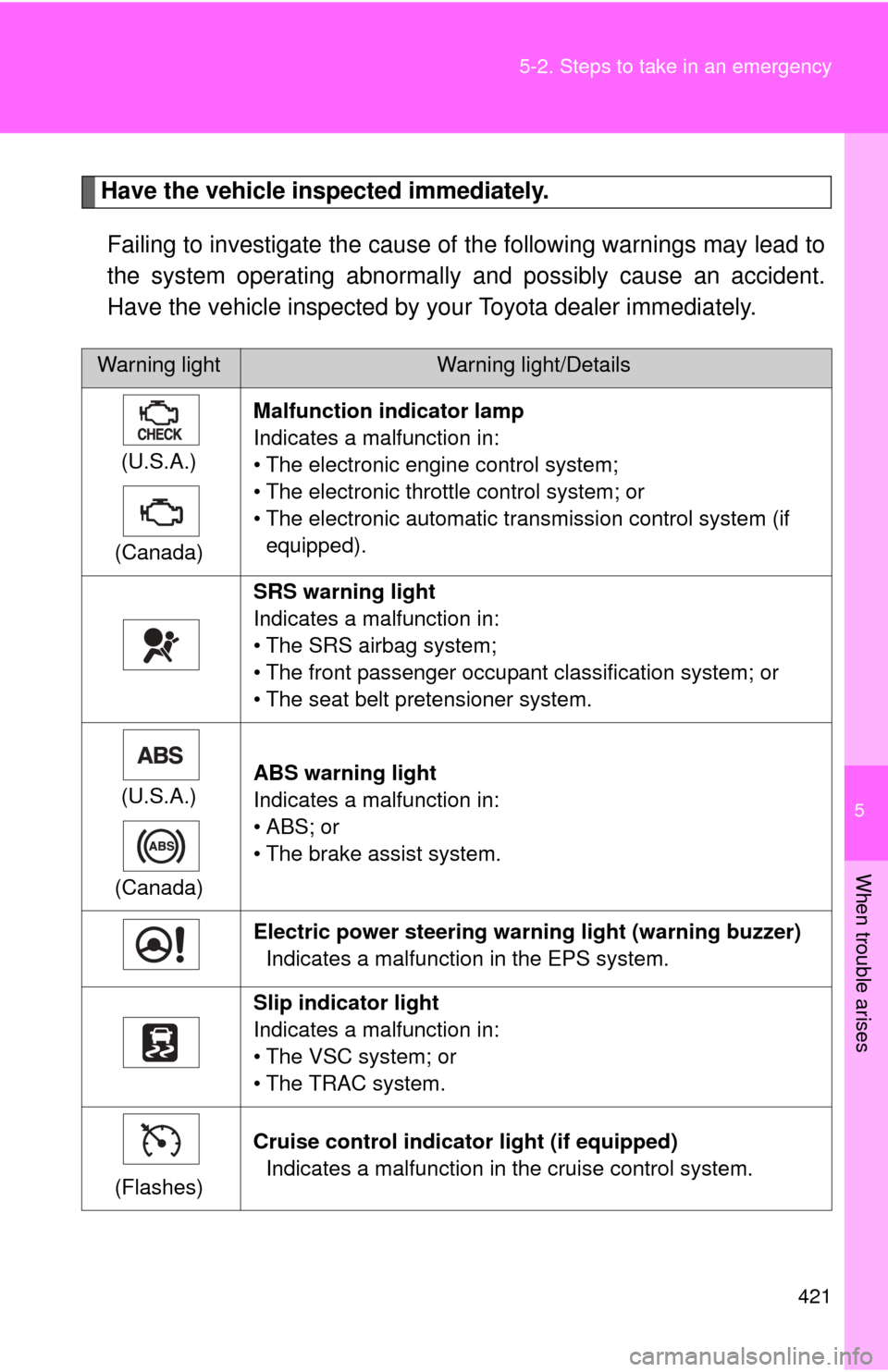
Have the vehicle inspected immediately.
Failing to investigate the cause of the following warnings may lead to
the system operating abnormally and possibly cause an accident.
Have the vehicle inspected by your Toyota dealer immediately.
Warning lightWarning light/Details
(U.S.A.)
(Canada) Malfunction indicator lamp
Indicates a malfunction in:
• The electronic engine control system;
• The electronic throttle control system; or
• The electronic automatic transmission control system (if
equipped).
SRS warning light
Indicates a malfunction in:
• The SRS airbag system;
• The front passenger occupant classification system; or
• The seat belt pretensioner system.
(U.S.A.)
(Canada) ABS warning light
Indicates a malfunction in:
•ABS; or
• The brake assist system.
Electric power steering warning light (warning buzzer)
Indicates a malfunction in the EPS system.
Slip indicator light
Indicates a malfunction in:
• The VSC system; or
• The TRAC system.
(Flashes) Cruise control indicator light (if equipped)
Indicates a malfunction in the cruise control system.
Page 422 of 529
422 5-2. Steps to take in an emergency
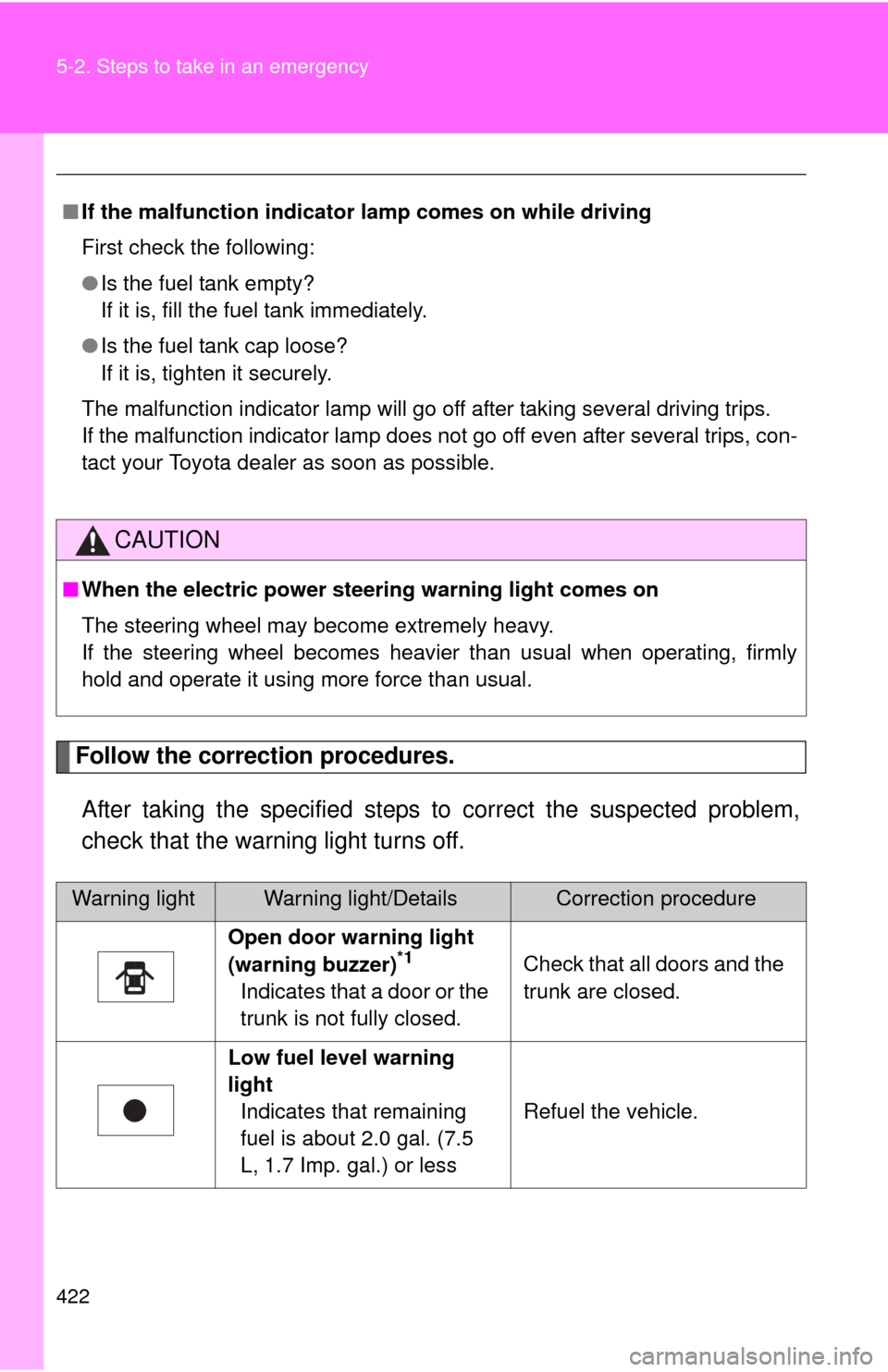
Follow the correction procedures.After taking the specified steps to correct the suspected problem,
check that the warning light turns off.
■ If the malfunction indicator lamp comes on while driving
First check the following:
● Is the fuel tank empty?
If it is, fill the fuel tank immediately.
● Is the fuel tank cap loose?
If it is, tighten it securely.
The malfunction indicator lamp will go off after taking several driving trips.
If the malfunction indicator lamp does not go off even after several trips, con-
tact your Toyota dealer as soon as possible.
CAUTION
■ When the electric power steering warning light comes on
The steering wheel may become extremely heavy.
If the steering wheel becomes heavier than usual when operating, firmly
hold and operate it using more force than usual.
Warning lightWarning light/DetailsCorrection procedure
Open door warning light
(warning buzzer)
*1
Indicates that a door or the
trunk is not fully closed. Check that all doors and the
trunk are closed.
Low fuel level warning
light Indicates that remaining
fuel is about 2.0 gal. (7.5
L, 1.7 Imp. gal.) or less Refuel the vehicle.
Page 424 of 529
424 5-2. Steps to take in an emergency
*1: Open door warning buzzer:The open door warning buzzer sounds to alert the driver that one or more of
the doors or trunk is not fully closed (with the vehicle having reached a speed
of 3 mph [5 km/h]).
*2: Driver's and front passenger’s seat belt warning buzzers:The driver’s and front passenger’s seat belts warning buzzers sound to alert
the driver and front passenger that his or her seat belt is not fastened. The
buzzer sounds intermittently for 10 seconds after the vehicle has reached a
speed of 12 mph (20 km/h). Then, if the seat belt is still unfastened, the
buzzer will sound at a different tone for 20 more seconds.
*3: Refer to the separate “Scheduled Maintenance Guide” or “Owner’s ManualSupplement” for the maintenance interval applicable to your vehicle. (U.S.A.)
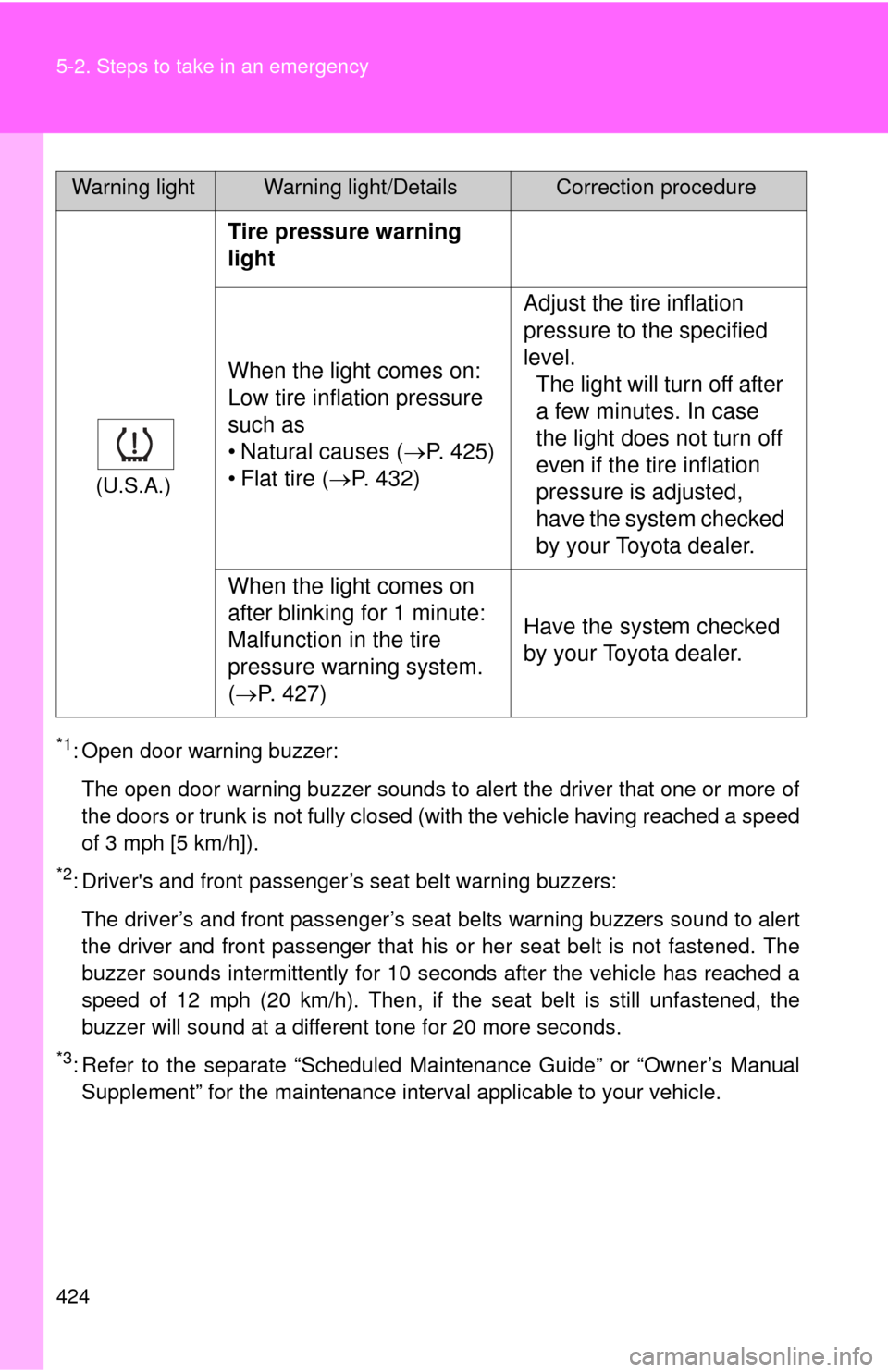
Tire pressure warning
light
When the light comes on:
Low tire inflation pressure
such as
• Natural causes (
P. 425)
• Flat tire ( P. 432) Adjust the tire inflation
pressure to the specified
level.
The light will turn off after
a few minutes. In case
the light does not turn off
even if the tire inflation
pressure is adjusted,
have the system checked
by your Toyota dealer.
When the light comes on
after blinking for 1 minute:
Malfunction in the tire
pressure warning system.
( P. 427) Have the system checked
by your Toyota dealer.
Warning lightWarning light/DetailsCorrection procedure
Page 429 of 529
5
When trouble arises
429
5-2. Steps to take in an emergency
CAUTION
Your vehicle has also been equipped with a TPMS (tire pressure warning
system) malfunction indicator to indi
cate when the system is not operat-
ing properly. The TPMS (tire pressure warning system) malfunction indi-
cator is combined with the low tire pressure telltale (tire pressure
warning light). When the system det ects a malfunction, the telltale will
flash for approximately one minute an d then remain continuously illumi-
nated. This sequence will continue upon subsequent vehicle start-ups as
long as the malfunction exists. When the malfunction indi cator is illumi-
nated, the system may not be able to detect or signal low tire pressure
as intended.
TPMS (tire pressure warning system) malfunctions may occur for a vari-
ety of reasons, including the installati on of replacement or alternate tires
or wheels on the vehicle that prevent the TPMS (tire pressure warning
system) from functioning properly. Always check the TPMS (tire pres-
sure warning system) malfunction te lltale after replacing one or more
tires or wheels on your vehicle to ensure that the replacement or alter-
nate tires and wheels allow the TPMS (tire pressure warning system) to
continue to function properly.
NOTICE
■Precaution when installing a different tire
When a tire of a different specification or maker is installed, the tire pres-
sure warning system may not operate properly.
Page 430 of 529
430 5-2. Steps to take in an emergency
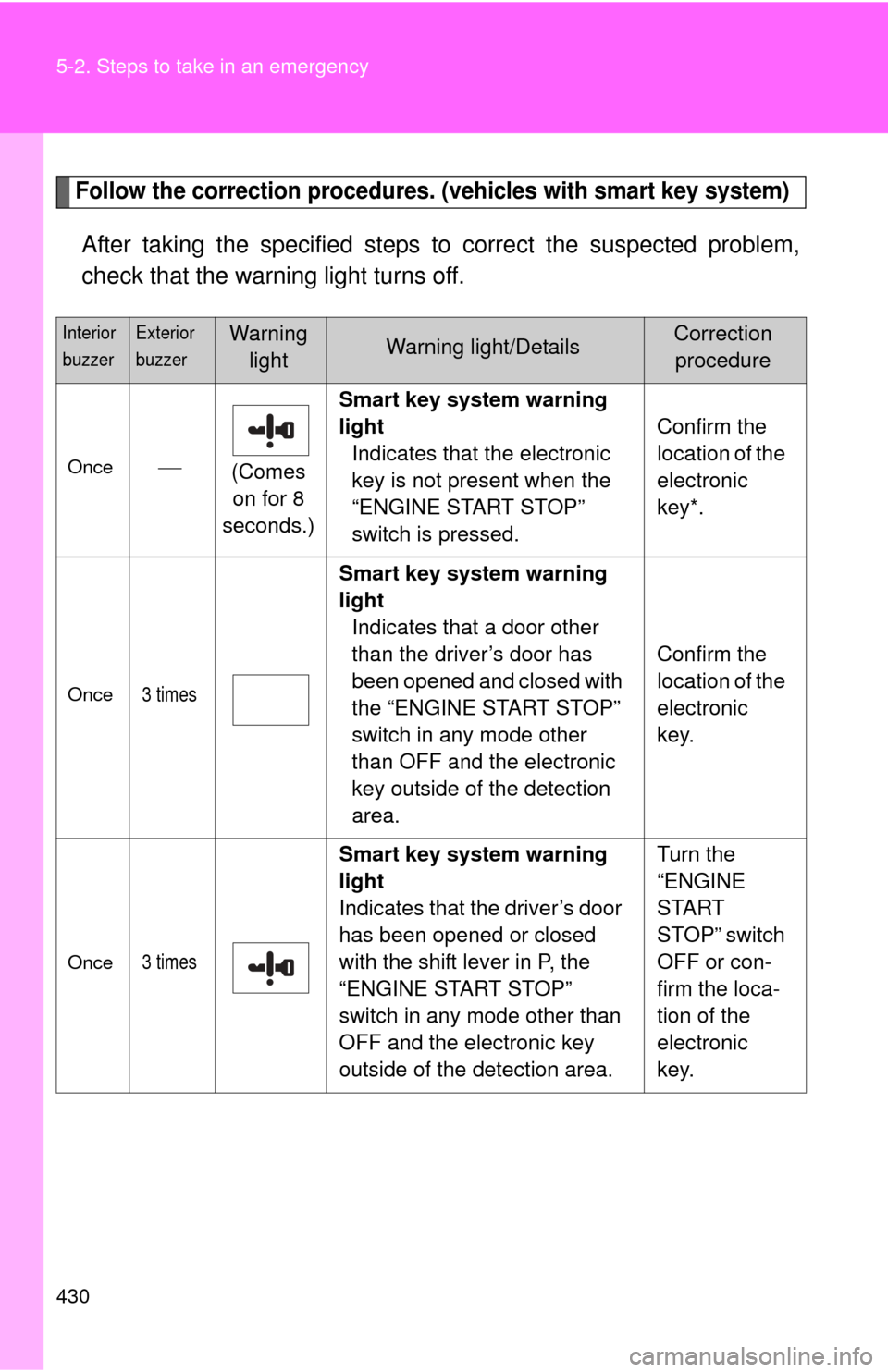
Follow the correction procedures. (vehicles with smart key system)
After taking the specified steps to correct the suspected problem,
check that the warning light turns off.
Interior
buzzerExterior
buzzerWarning lightWarning light/DetailsCorrection procedure
Once (Comes
on for 8
seconds.) Smart key system warning
light
Indicates that the electronic
key is not present when the
“ENGINE START STOP”
switch is pressed. Confirm the
location of the
electronic
key*.
Once3 times
Smart key system warning
light
Indicates that a door other
than the driver’s door has
been opened and closed with
the “ENGINE START STOP”
switch in any mode other
than OFF and the electronic
key outside of the detection
area. Confirm the
location of the
electronic
key.
Once3 times
Smart key system warning
light
Indicates that the driver’s door
has been opened or closed
with the shift lever in P, the
“ENGINE START STOP”
switch in any mode other than
OFF and the electronic key
outside of the detection area. Turn the
“ENGINE
START
STOP” switch
OFF or con-
firm the loca-
tion of the
electronic
key.