Front TOYOTA COROLLA 2012 10.G Manual Online
[x] Cancel search | Manufacturer: TOYOTA, Model Year: 2012, Model line: COROLLA, Model: TOYOTA COROLLA 2012 10.GPages: 529, PDF Size: 8.07 MB
Page 439 of 529
5
When trouble arises
439
5-2. Steps to take in an emergency
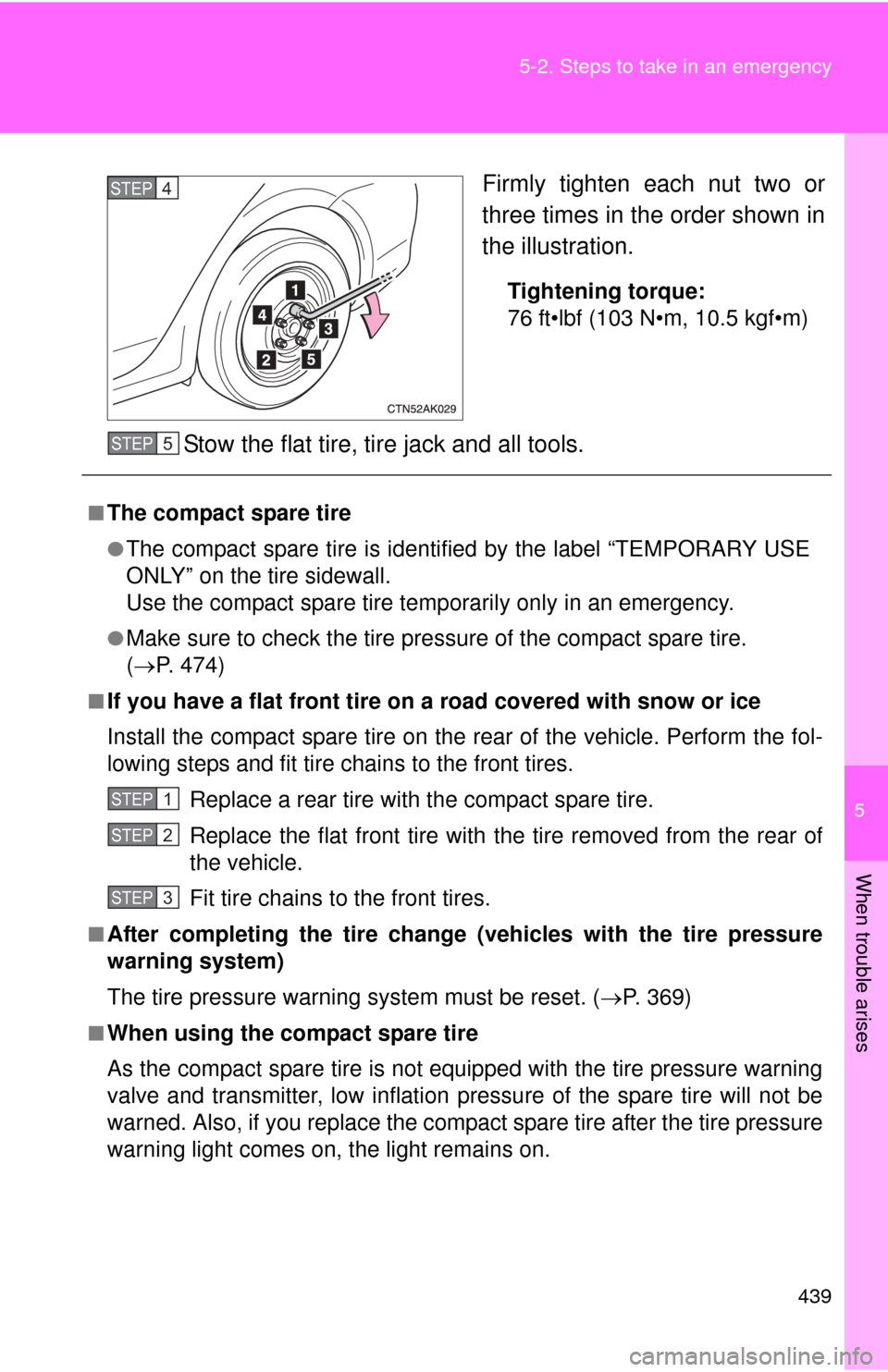
Firmly tighten each nut two or
three times in the order shown in
the illustration.
Tightening torque:
76 ft•lbf (103 N•m, 10.5 kgf•m)
Stow the flat tire, tire jack and all tools.
STEP 4
■The compact spare tire
●The compact spare tire is identifi
ed by the label “TEMPORARY USE
ONLY” on the tire sidewall.
Use the compact spare tire temporarily only in an emergency.
●Make sure to check the tire pre ssure of the compact spare tire.
( P. 474)
■If you have a flat front tire on a road covered with snow or ice
Install the compact spare tire on the rear of the vehicle. Perform the fol-
lowing steps and fit tire chains to the front tires.
Replace a rear tire with the compact spare tire.
Replace the flat front tire with the tire removed from the rear of
the vehicle.
Fit tire chains to the front tires.
■After completing the tire change (vehicles with the tire pressure
warning system)
The tire pressure warning system must be reset. (P. 369)
■When using the compact spare tire
As the compact spare tire is not equipped with the tire pressure warning
valve and transmitter, low inflation pressure of the spare tire will not be
warned. Also, if you replace the compac t spare tire after the tire pressure
warning light comes on, the light remains on.
STEP 5
STEP 1
STEP 2
STEP 3
Page 450 of 529
450
5-2. Steps to take in an emergency
If the batter y is discharged
The following procedures may be used to start the engine if the vehi-
cle's battery is discharged.
You can call your Toyota dealer or qualified repair shop.
If you have a set of jumper (or boo ster) cables and a second vehi-
cle with a 12-volt battery, you can jump start your Toyota following
the steps below.
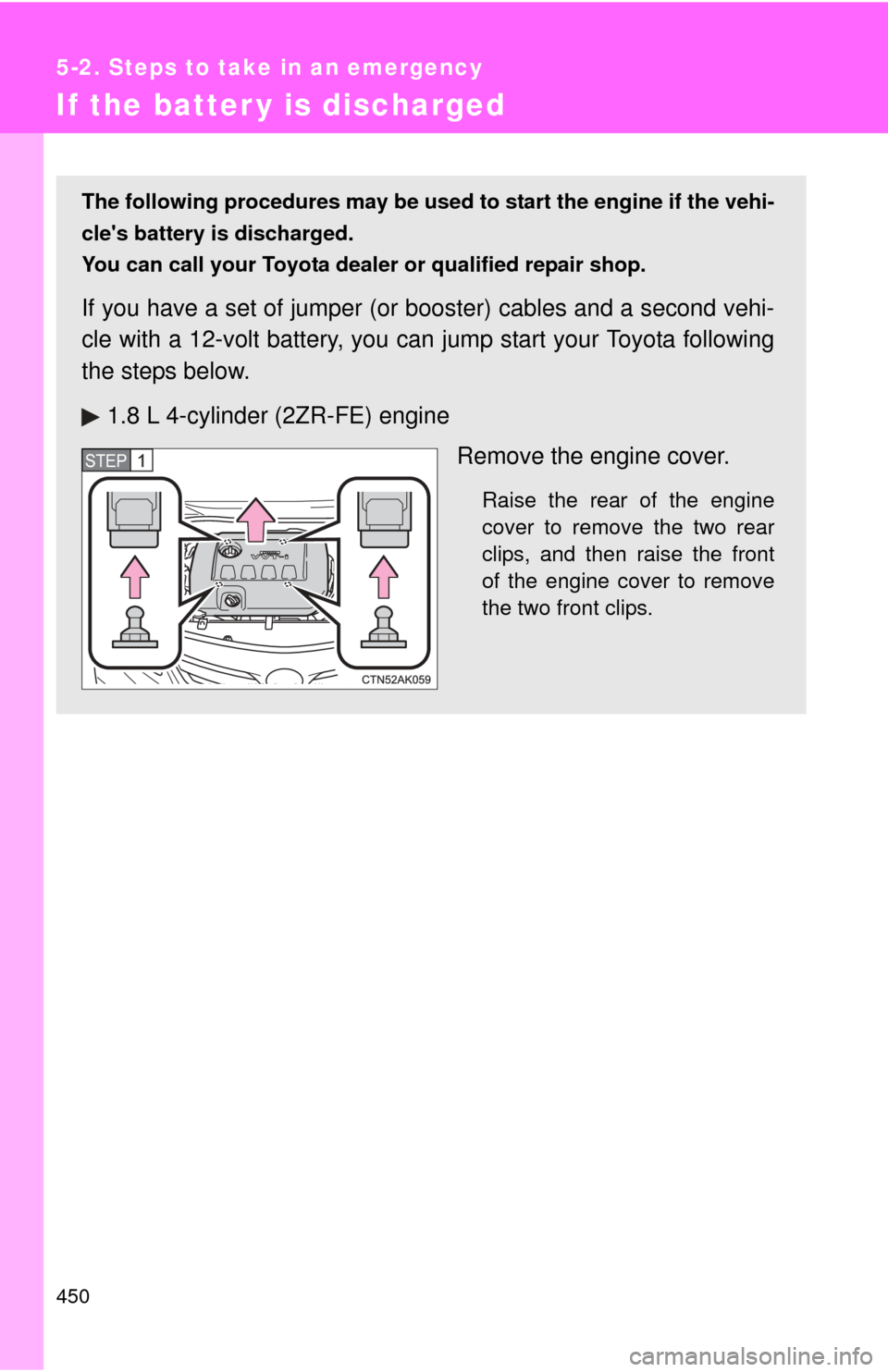
1.8 L 4-cylinder (2ZR-FE) engine Remove the engine cover.
Raise the rear of the engine
cover to remove the two rear
clips, and then raise the front
of the engine cover to remove
the two front clips.
STEP 5 STEP 1
Page 464 of 529
464
6-1. Specifications
Maintenance data (fuel, oil level, etc.)
Dimensions and weights
*1: Unladen vehicles
*2: P195/65R15 tires
*3: P205/55R16 and P215/45R17 tires
*4: 2.4 L 4-cylinder (2AZ-FE) engine only
Vehicle identification■ Vehicle identification number
The vehicle identification number (VIN) is the legal identifier for
your vehicle. This is the primar y identification number for your
Toyota. It is used in registering the ownership of your vehicle.
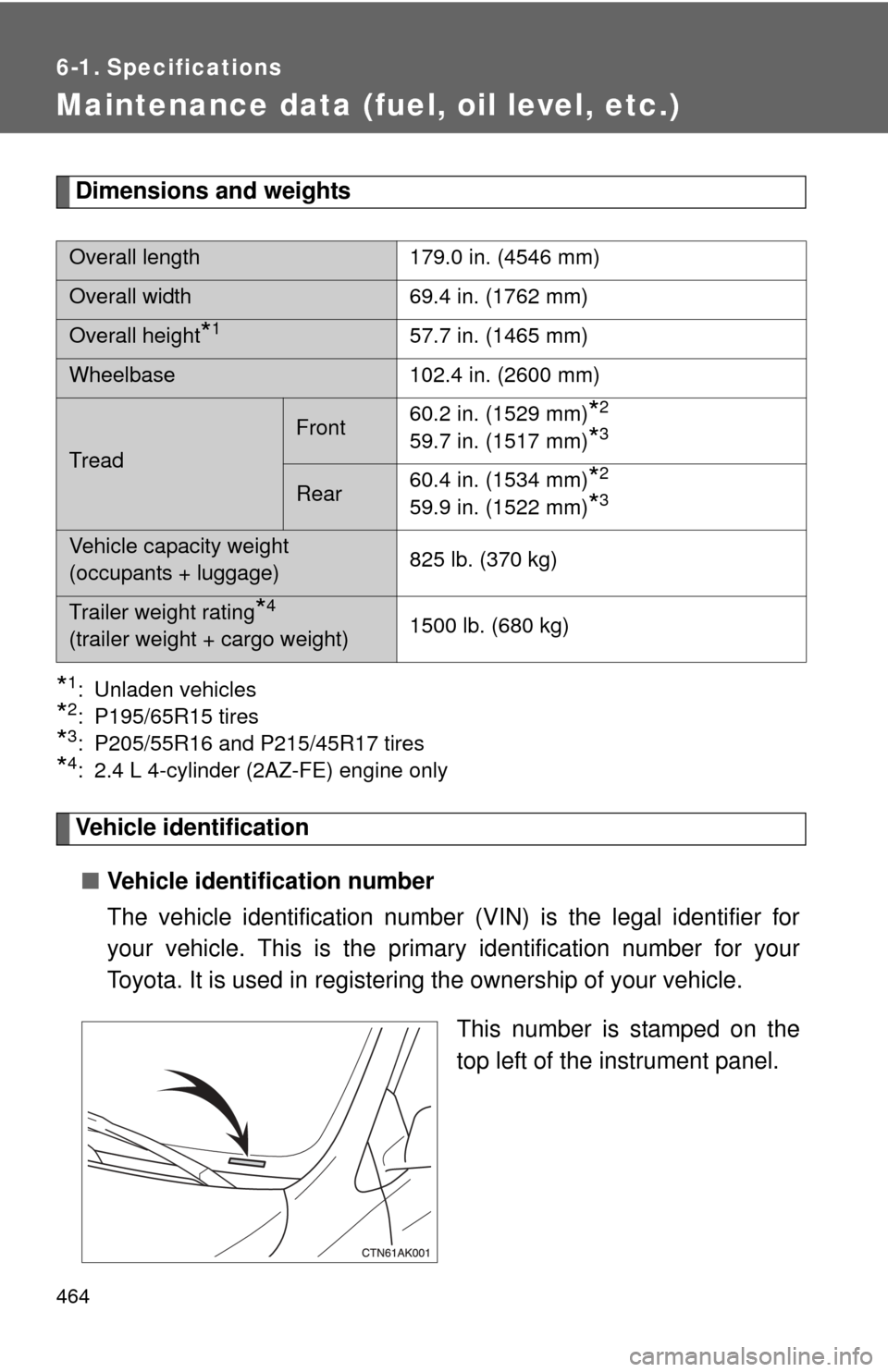
This number is stamped on the
top left of the instrument panel.
Overall length 179.0 in. (4546 mm)
Overall width69.4 in. (1762 mm)
Overall height*157.7 in. (1465 mm)
Wheelbase102.4 in. (2600 mm)
Tread
Front60.2 in. (1529 mm)*2
59.7 in. (1517 mm)*3
Rear60.4 in. (1534 mm)*2
59.9 in. (1522 mm)*3
Vehicle capacity weight
(occupants + luggage) 825 lb. (370 kg)
Trailer weight rating*4
(trailer weight + cargo weight)1500 lb. (680 kg)
Page 465 of 529
465
6-1. Specifications
6
Vehicle specifications
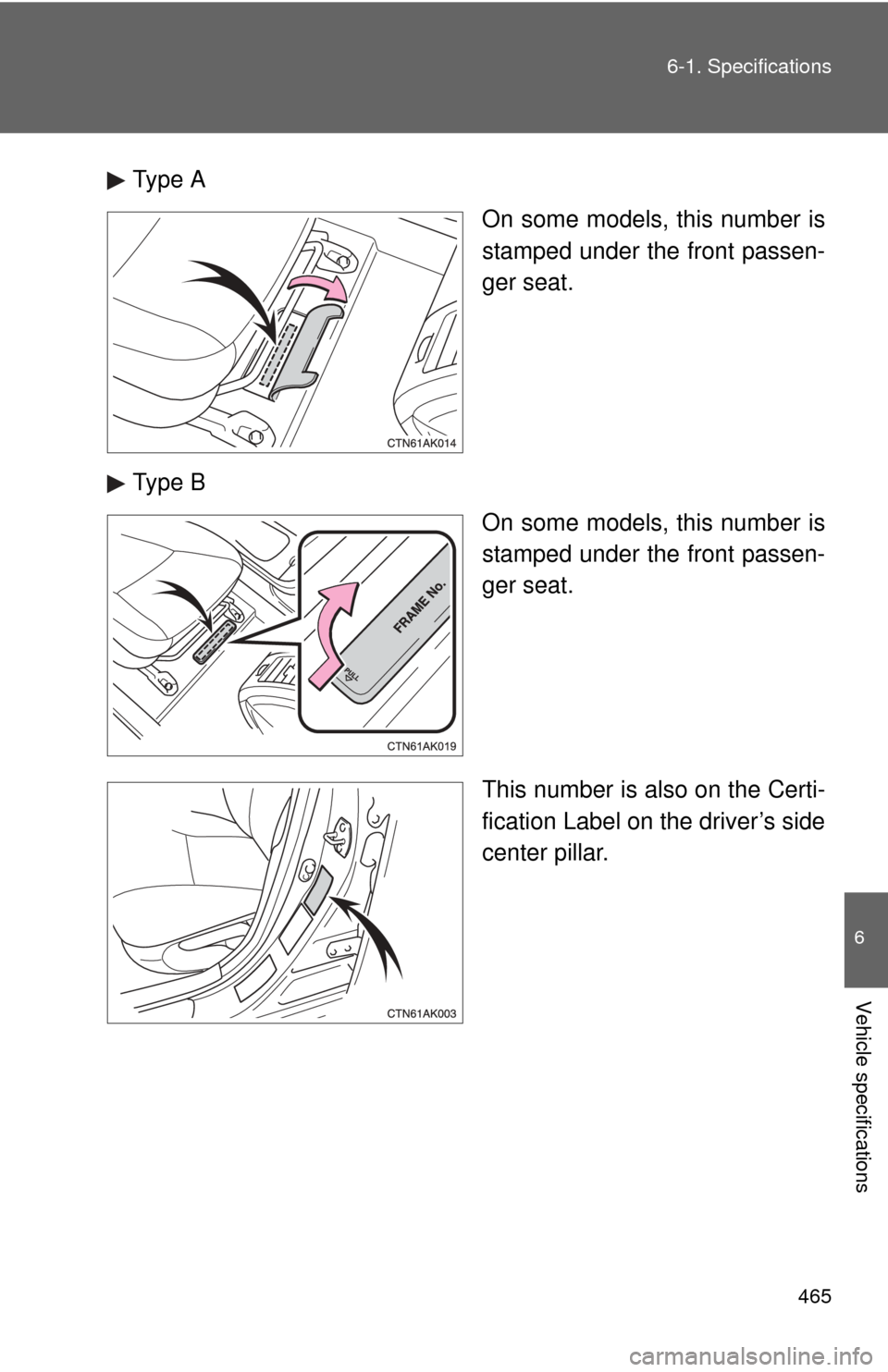
Type A
On some models, this number is
stamped under the front passen-
ger seat.
Type B On some models, this number is
stamped under the front passen-
ger seat.
This number is also on the Certi-
fication Label on the driver’s side
center pillar.
Page 474 of 529
474 6-1. Specifications
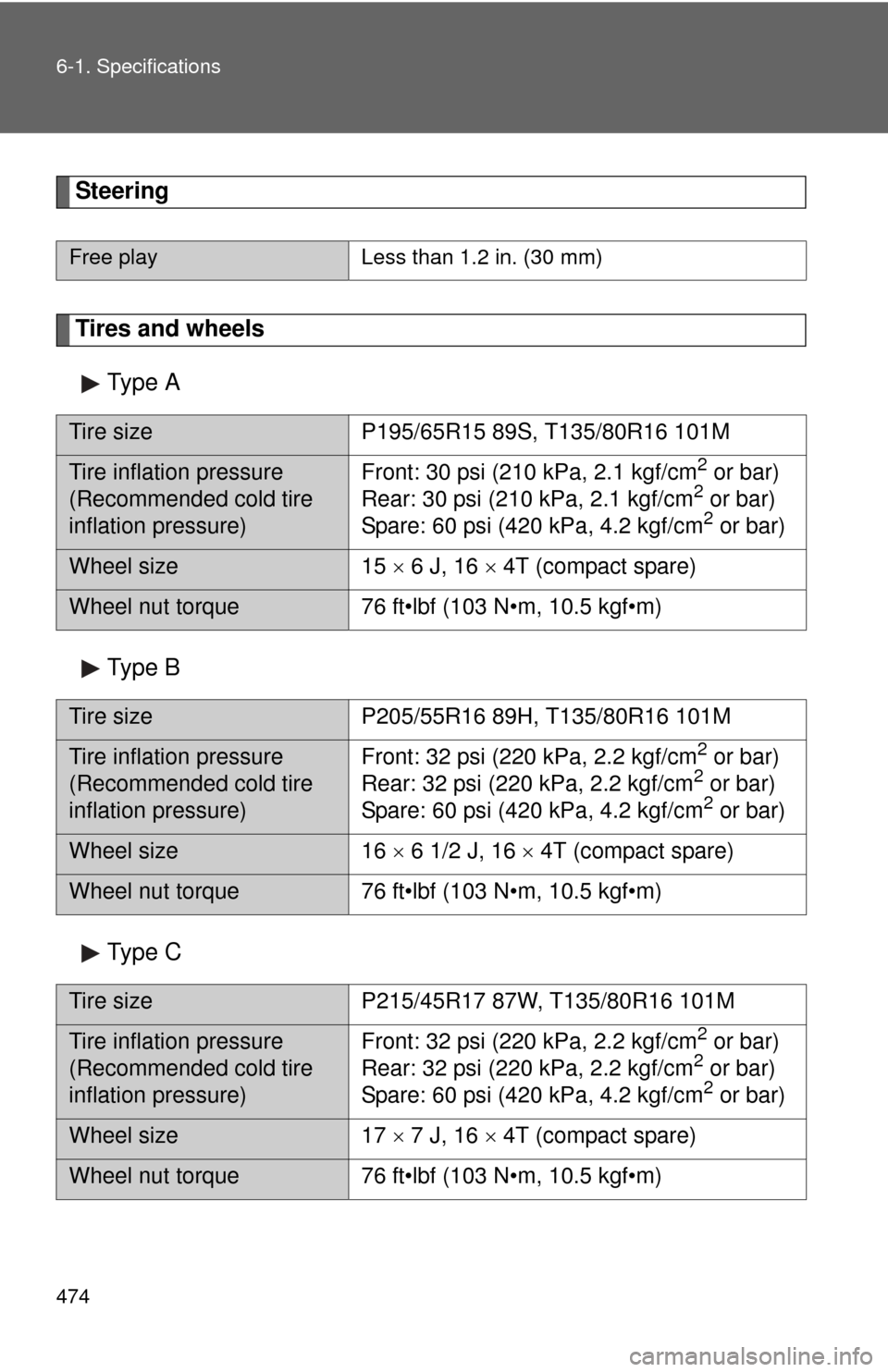
Steering
Tires and wheelsType A
Type B
Type C
Free play Less than 1.2 in. (30 mm)
Tire sizeP195/65R15 89S, T135/80R16 101M
Tire inflation pressure
(Recommended cold tire
inflation pressure)Front: 30 psi (210 kPa, 2.1 kgf/cm2 or bar)
Rear: 30 psi (210 kPa, 2.1 kgf/cm2 or bar)
Spare: 60 psi (420 kPa, 4.2 kgf/cm2 or bar)
Wheel size 15 6 J, 16 4T (compact spare)
Wheel nut torque 76 ft•lbf (103 N•m, 10.5 kgf•m)
Tire size P205/55R16 89H, T135/80R16 101M
Tire inflation pressure
(Recommended cold tire
inflation pressure)Front: 32 psi (220 kPa, 2.2 kgf/cm2 or bar)
Rear: 32 psi (220 kPa, 2.2 kgf/cm2 or bar)
Spare: 60 psi (420 kPa, 4.2 kgf/cm2 or bar)
Wheel size 16 6 1/2 J, 16 4T (compact spare)
Wheel nut torque 76 ft•lbf (103 N•m, 10.5 kgf•m)
Tire size P215/45R17 87W, T135/80R16 101M
Tire inflation pressure
(Recommended cold tire
inflation pressure)Front: 32 psi (220 kPa, 2.2 kgf/cm2 or bar)
Rear: 32 psi (220 kPa, 2.2 kgf/cm2 or bar)
Spare: 60 psi (420 kPa, 4.2 kgf/cm2 or bar)
Wheel size 17 7 J, 16 4T (compact spare)
Wheel nut torque 76 ft•lbf (103 N•m, 10.5 kgf•m)
Page 475 of 529
475
6-1. Specifications
6
Vehicle specifications
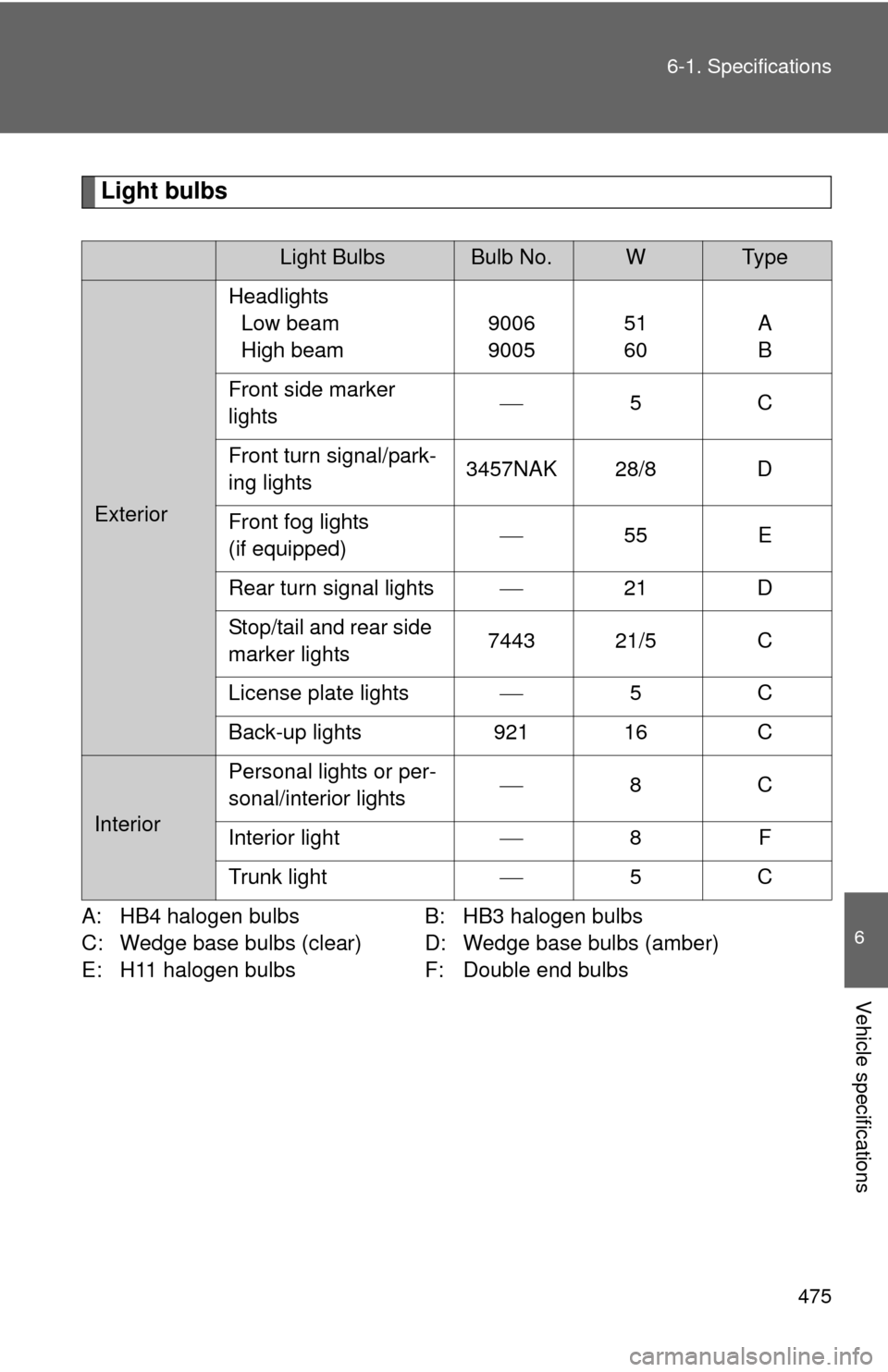
Light bulbs
A: HB4 halogen bulbs
B: HB3 halogen bulbs
C: Wedge base bulbs (clear) D: Wedge base bulbs (amber)
E: H11 halogen bulbs F: Double end bulbs
Light BulbsBulb No.WTy p e
ExteriorHeadlights
Low beam
High beam 9006
900551
60A
B
Front side marker
lights
5C
Front turn signal/park-
ing lights 3457NAK 28/8 D
Front fog lights
(if equipped)
55 E
Rear turn signal lights 21 D
Stop/tail and rear side
marker lights 7443 21/5 C
License plate lights 5C
Back-up lights 921 16 C
Interior Personal lights or per-
sonal/interior lights
8C
Interior light 8F
Trunk light 5C
Page 490 of 529
490 6-1. Specifications
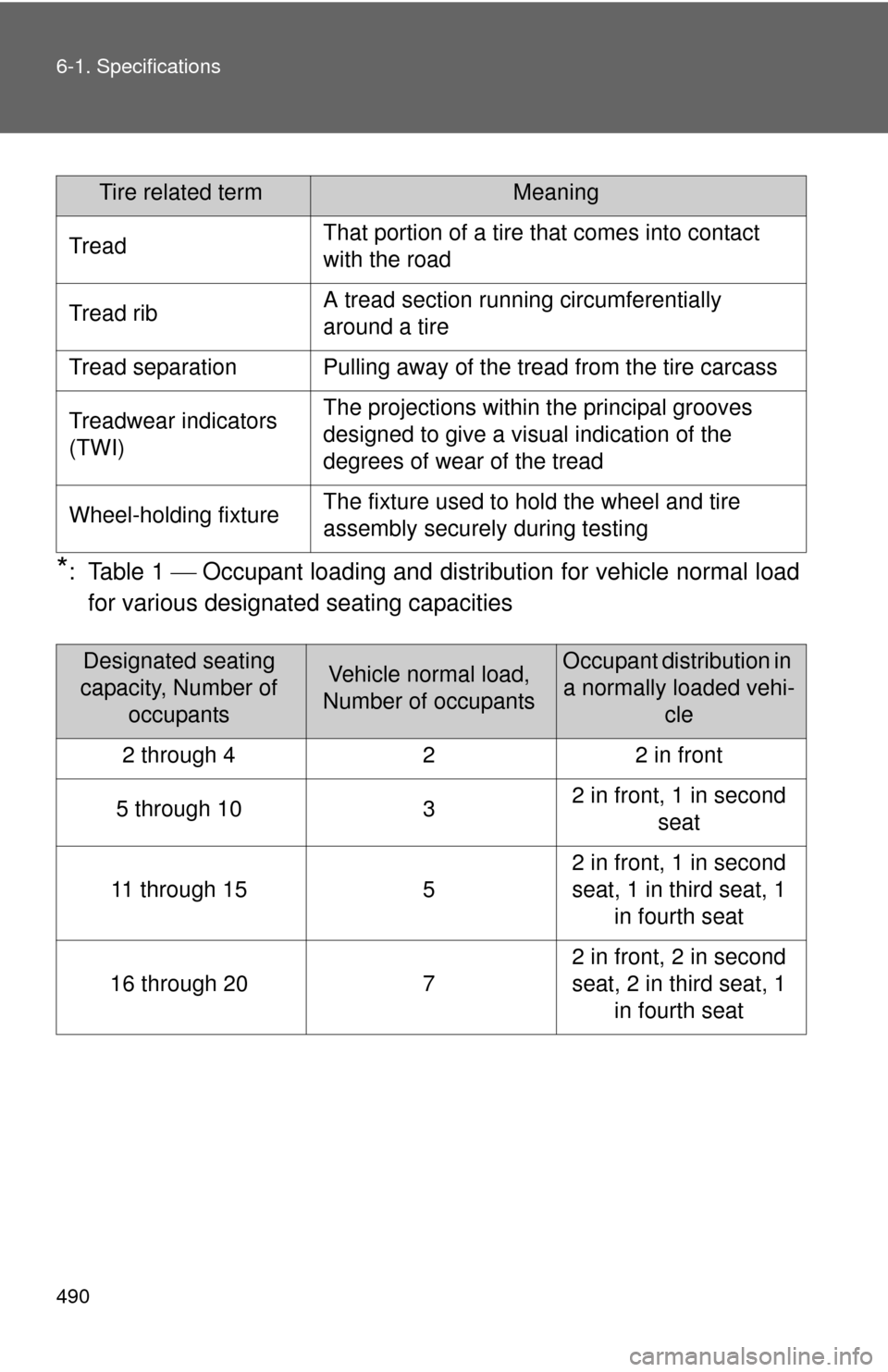
*: Table 1 Occupant loading and distri bution for vehicle normal load
for various designated seating capacities
Tire related termMeaning
Tread That portion of a tire that comes into contact
with the road
Tread rib A tread section running circumferentially
around a tire
Tread separation Pulling away of the tread from the tire carcass
Treadwear indicators
(TWI) The projections within the principal grooves
designed to give a visual indication of the
degrees of wear of the tread
Wheel-holding fixture The fixture used to hold the wheel and tire
assembly securely
during testing
Designated seating
capacity, Number of occupantsVehicle normal load,
Number of occupantsOccupant distribution in a normally loaded vehi- cle
2 through 4 2 2 in front
5 through 10 3 2 in front, 1 in second
seat
11 through 15 5 2 in front, 1 in second
seat, 1 in third seat, 1
in fourth seat
16 through 20 7 2 in front, 2 in second
seat, 2 in third seat, 1
in fourth seat
Page 502 of 529
502
SRS airbag instructions for Canadian owners (in French)
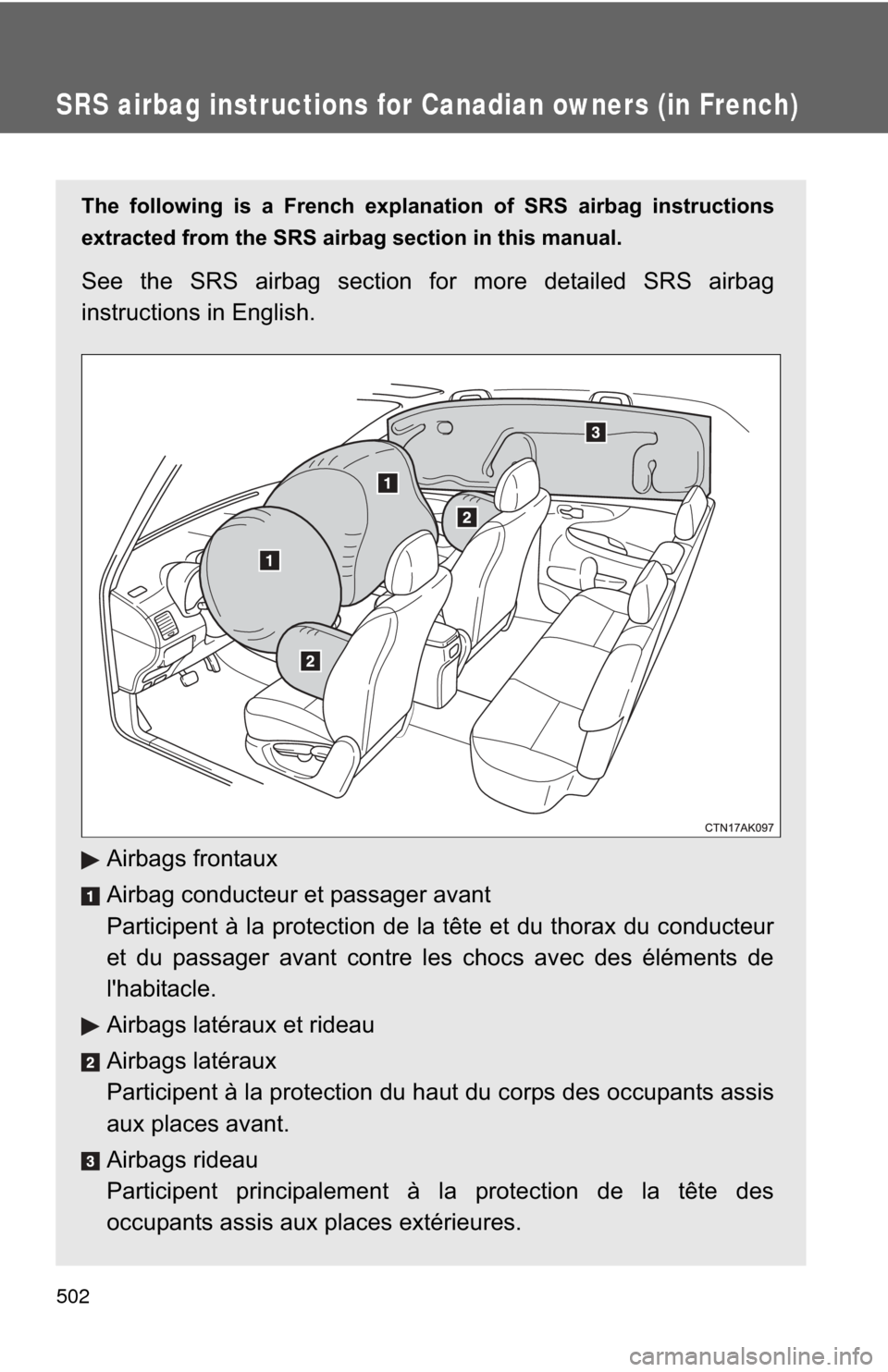
The following is a French explanation of SRS airbag instructions
extracted from the SRS airbag section in this manual.
See the SRS airbag section for more detailed SRS airbag
instructions in English.Airbags frontaux
Airbag conducteur et passager avant
Participent à la protection de la tête et du thorax du conducteur
et du passager avant contre les chocs avec des éléments de
l'habitacle.
Airbags latéraux et rideau
Airbags latéraux
Participent à la protection du haut du corps des occupants assis
aux places avant.
Airbags rideau
Participent principalement à la protection de la tête des
occupants assis aux places extérieures.
Page 504 of 529
504
Votre véhicule est équipé de ADVANCED AIRBAGS conçus selon les
normes de sécurité américaines applicables aux véhicules à moteur
(FMVSS208). Le système d’airbag contrôle la puissance de
déploiement des airbags pour le conducteur et le passager avant. Le
système d'airbag conducteur comprend le capteur de position du
siège conducteur, etc. Le système d'airbag passager avant
comprend le capteur de classification des occupants du siège
passager avant, etc.
Les principaux éléments du système d’airbags SRS sont illustrés ci-
dessus. Le système des airbags SRS est commandé par un boîtier
électronique. Ce boîtier intègre un capteur de sécurité et un capteur
d’airbag.
Lorsque la violence du choc frontal ou latéral l'exige, le système
d’airbags SRS déclenche les dispositifs de gonflage. Le déploiement
rapide des airbags est obtenu au moyen d'une réaction chimique
dans les dispositifs de gonflage, qui produit un gaz inoffensif
permettant d'amortir le mouvement des occupants.
Page 514 of 529

514
Alphabetical index
Alphabetical index
A/C ..................................... 206, 212
ABS ........................................... 173
Air conditioning filter............... 383
Air conditioning systemAir conditioning filter .............. 383
Automatic air conditioning system ................................ 206
Manual air conditioning system ................................ 212
Airbags
Airbag operating conditions.....89
Airbag precautions for your child ......................................93
Airbag warning light............... 421
Curtain shield airbag operating conditions..............90
Curtain shield airbag precautions ...........................93
Front passenger occupant
classification system .............98
General airbag precautions .....93
Locations of airbags ................86
Modification and disposal of airbags ..................................97
Proper driving posture .......84, 93
Side airbag operating
conditions..............................90
Side airbag precautions ..........93
SRS airbags ............................86
Antenna..................................... 234
Anti-lock brake system............ 173
Ashtray...................................... 323
Audio input ............................... 273 Audio system
Antenna................................. 234
Audio input ............................ 273
AUX port ............................... 273
CD player/changer ................ 236
iPod ....................................... 252
MP3/WMA disc ..................... 243
Optimal use ........................... 269
Portable music player ........... 273
Radio..................................... 232
Steering wheel audio switch.................................. 275
Type ...................................... 220
USB memory......................... 261
Automatic air conditioning system .................................... 206
Automatic transmission Automatic transmission ......... 139
If the shift lever cannot be shifted from P ..................... 446
S mode.................................. 142
AUX port ................................... 273
Auxiliary boxes ........................ 317A