jack TOYOTA COROLLA 2013 11.G Owners Manual
[x] Cancel search | Manufacturer: TOYOTA, Model Year: 2013, Model line: COROLLA, Model: TOYOTA COROLLA 2013 11.GPages: 532, PDF Size: 8.55 MB
Page 4 of 532

TABLE OF CONTENTSIndex
4
3-4. Using the hands-free phone system
(for cellular phone)
Making a phone call ........... 291
Using the “SET UP” menu (“Bluetooth” menu) ........... 296
Using the “SET UP” menu (“Phone” menu) ................ 302
3-5. Using the interior lights Interior lights list ................. 308
• Interior light ...................... 310
• Personal lights ................. 310
• Personal/interior lights...... 311
3-6. Using the storage features List of storage features....... 312
• Glove box ......................... 313
• Console box ..................... 313
• Cup holders ...................... 315
• Auxiliary boxes ................. 318
• Bottle holders ................... 320
3-7. Other interior features Sun visors .......................... 321
Vanity mirrors ..................... 322
Clock .................................. 323
Ashtray ............................... 324
Cigarette lighter .................. 325
Power outlet ....................... 326
Seat heaters ....................... 327
Assist grips ......................... 329
Floor mat ............................ 330
Compass ............................ 331 4-1. Maintenance and care
Cleaning and protecting the vehicle exterior ........... 336
Cleaning and protecting the vehicle interior ............ 338
4-2. Maintenance Maintenance requirements .................... 341
General maintenance ......... 343
Emission inspection and maintenance (I/M)
programs .......................... 346
4-3. Do-it-yourself maintenance Do-it-yourself service precautions ....................... 347
Hood ................................... 351
Positioning a floor jack........ 353
Engine compartment .......... 356
Tires.................................... 371
Tire inflation pressure ......... 379
Wheels................................ 383
Air conditioning filter ........... 386
Key battery ......................... 388
Checking and replacing fuses ................................. 392
Light bulbs .......................... 402
4Maintenance and care
Page 192 of 532

192 2-5. Driving information
Trailer towing tipsYour vehicle will handle differently when towing a trailer. Help to avoid
an accident, death or serious injury, keep the following in mind when
towing:
● Speed limits for towing a trailer vary by state or province. Do not
exceed the posted towing speed limit.
● Toyota recommends that the vehicle-trailer speed limit is 65 mph
(104 km/h) on a flat, straight, dry road. Do not exceed this limit, the
posted towing speed limit or the speed limit for your trailer as set
forth in your trailer owner’s man ual, whichever is lowest. Instability
of the towing vehicle-trailer combin ation (trailer sway) increases as
speed increases. Exceeding speed limits may cause loss of con-
trol.
● Before starting out, check the trailer lights, tires and the vehicle-
trailer connections. Recheck after driving a short distance.
● Practice turning, stopping and reve rsing with the trailer attached in
an area away from traffic until you become accustomed to the feel
of the vehicle-trailer combination.
● Reversing with a trailer attached is difficult and requires practice.
Grip the bottom of the steering wheel and move your hand to the
left to move the trailer to the left. Move your hand to the right to
move the trailer to the right. (This is generally opposite to reversing
without a trailer attached.) Avoid sharp or prolonged turning. Have
someone guide you when reversing to reduce the risk of an acci-
dent.
● As stopping distance is increased when towing a trailer, vehicle-to-
vehicle distance should be increased. For each 10 mph (16 km/h)
of speed, allow at least o ne vehicle and trailer length.
● Avoid sudden braking as you may skid, resulting in the trailer jack-
knifing and a loss of vehicle control. This is especially true on wet
or slippery surfaces.
Page 198 of 532

198 2-5. Driving information
CAUTION
■To avoid accident or injury
●Do not exceed the TWR, unbraked TWR, GCWR, GVWR or GAWR.
● Adjust the tongue weight within the appropriate range. Place heavier loads
as close to the trailer axle as possible.
● Do not exceed 65 mph (104 km/h), the posted towing speed limit or the
speed limit for your trailer as set forth in your trailer owner’s manual,
whichever is lowest. Slow down sufficiently before making a turn, in cross
winds, on wet or slippery surface, etc. to help avoid an accident. If you
experience a vehicle-trailer instability from reducing a certain speed, slow
down and make sure you keep your vehicle speed under the speed of
which you experience the instability.
● Do not make jerky, abrupt or sharp turns.
● Do not apply the brakes suddenly as you may skid, resulting in jackknifing
and loss of vehicle control. This is especially true on wet or slippery sur-
faces.
● Do not exceed the trailer hitch assembly weight, gross vehicle weight,
gross axle weight and trailer tongue weight capacities.
● Do not use cruise control when towing.
● Slow down and downshift before descending steep or long downhill
grades. Do not make sudden downshifts while descending steep or long
downhill grades.
● Vehicle-trailer instability is more likely on steep long downhills. Before
descending steep or long downhill grades, slow down and downshift. Do
not make sudden downshifts when descending steep or long downhill
grades. Avoid holding the brake pedal down too long or applying the
brakes too frequently. This could cause the brakes to overheat and result
in reduced braking efficiency.
● Do not tow a trailer when the compact spare tire is installed on your vehi-
cle.
Page 335 of 532
Maintenance and care4
335
4-1. Maintenance and careCleaning and protecting the vehicle exterior......... 336
Cleaning and protecting the vehicle interior.......... 338
4-2. Maintenance Maintenance requirements .................. 341
General maintenance....... 343
Emission inspection and maintenance (I/M)
programs........................ 346 4-3. Do-it-yourself
maintenance
Do-it-yourself service precautions .................... 347
Hood ................................ 351
Positioning a floor jack ..... 353
Engine compartment ........ 356
Tires ................................. 371
Tire inflation pressure ...... 379
Wheels ............................. 383
Air conditioning filter......... 386
Key battery ....................... 388
Checking and replacing fuses .............................. 392
Light bulbs........................ 402
Page 353 of 532
353
4-3. Do-it-yourself maintenance
4
Maintenance and care
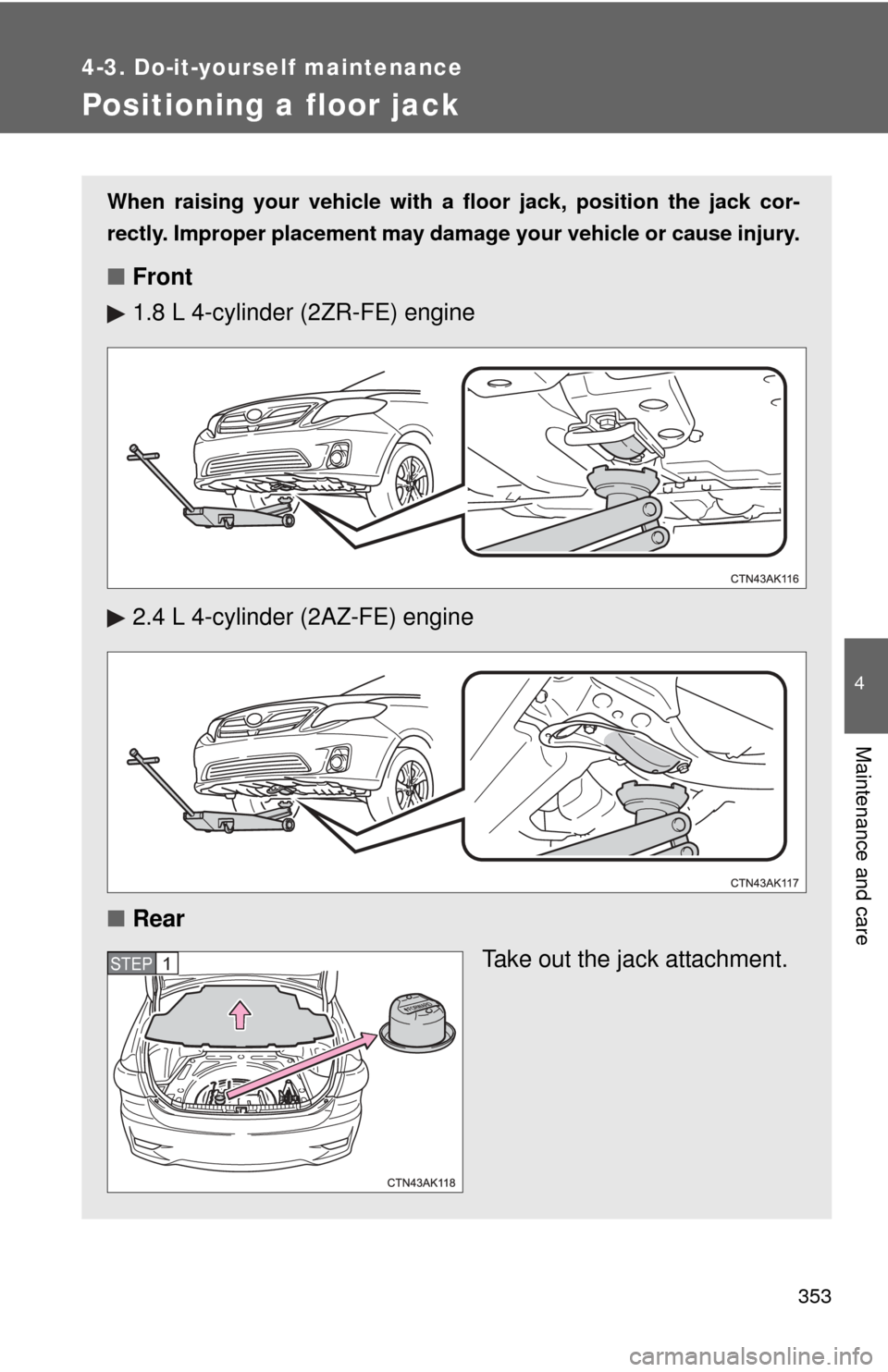
Positioning a floor jack
When raising your vehicle with a floor jack, position the jack cor-
rectly. Improper placement may damage your vehicle or cause injury.
■Front
1.8 L 4-cylinder (2ZR-FE) engine
2.4 L 4-cylinder (2AZ-FE) engine
■ Rear
Take out the jack attachment.
STEP 1
Page 354 of 532
354 4-3. Do-it-yourself maintenance
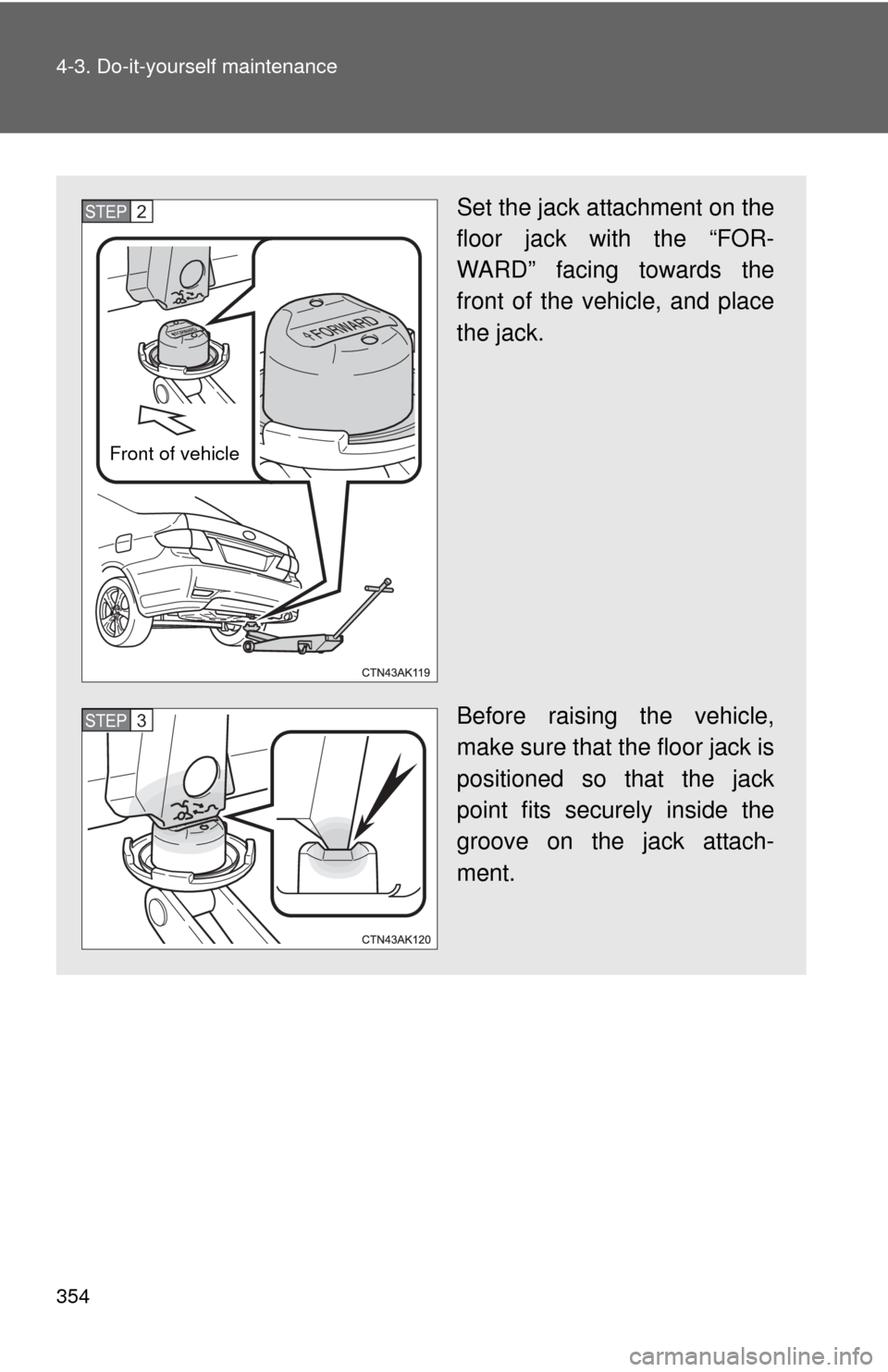
Set the jack attachment on the
floor jack with the “FOR-
WARD” facing towards the
front of the vehicle, and place
the jack.
Before raising the vehicle,
make sure that the floor jack is
positioned so that the jack
point fits securely inside the
groove on the jack attach-
ment. STEP 2
Front of vehicle
STEP 3
Page 355 of 532

355
4-3. Do-it-yourself maintenance
4
Maintenance and care
CAUTION
■
When raising your vehicle
Make sure to observe the following to reduce the possibility of death or\
seri-
ous injury.
●When using a floor jack, follow the instructions of the manual provided with
the jack.
● Do not use the jack that was supplied with your vehicle.
● Do not put any part of your body or get underneath the vehicle supported
only by the floor jack.
● Always use floor jack and/or automotive jack stands on a solid, flat, level
surface.
● Do not start the engine while the vehicle is supported by the floor jack.
● Stop the vehicle on level firm ground, firmly set the parking brake and put
the shift lever in P (automatic transmission) or R (manual transmission).
● Do not raise the vehicle while someone is in the vehicle.
● When raising the vehicle, do not place any objects on top of or underneath
the floor jack other than the jack attachment.
●Lift up the vehicle using a floor jack
such as the one shown in the illustra-
tion.
●Make sure to set the jack attachment
properly at the jack point.
Raising the vehicle with an improperly
positioned floor jack will damage the
vehicle and may cause the vehicle to
fall off the floor jack.
Page 436 of 532
436
5-2. Steps to take in an emergency
If you have a flat tire
Remove the flat tire and replace it with the spare provided.
■Before jacking up the vehicle
●Stop the vehicle on a hard, flat surface.
● Set the parking brake.
● Shift the shift lever to P (automatic transmission) or R (manual
transmission).
● Stop the engine.
● Turn on the emergency flashers.
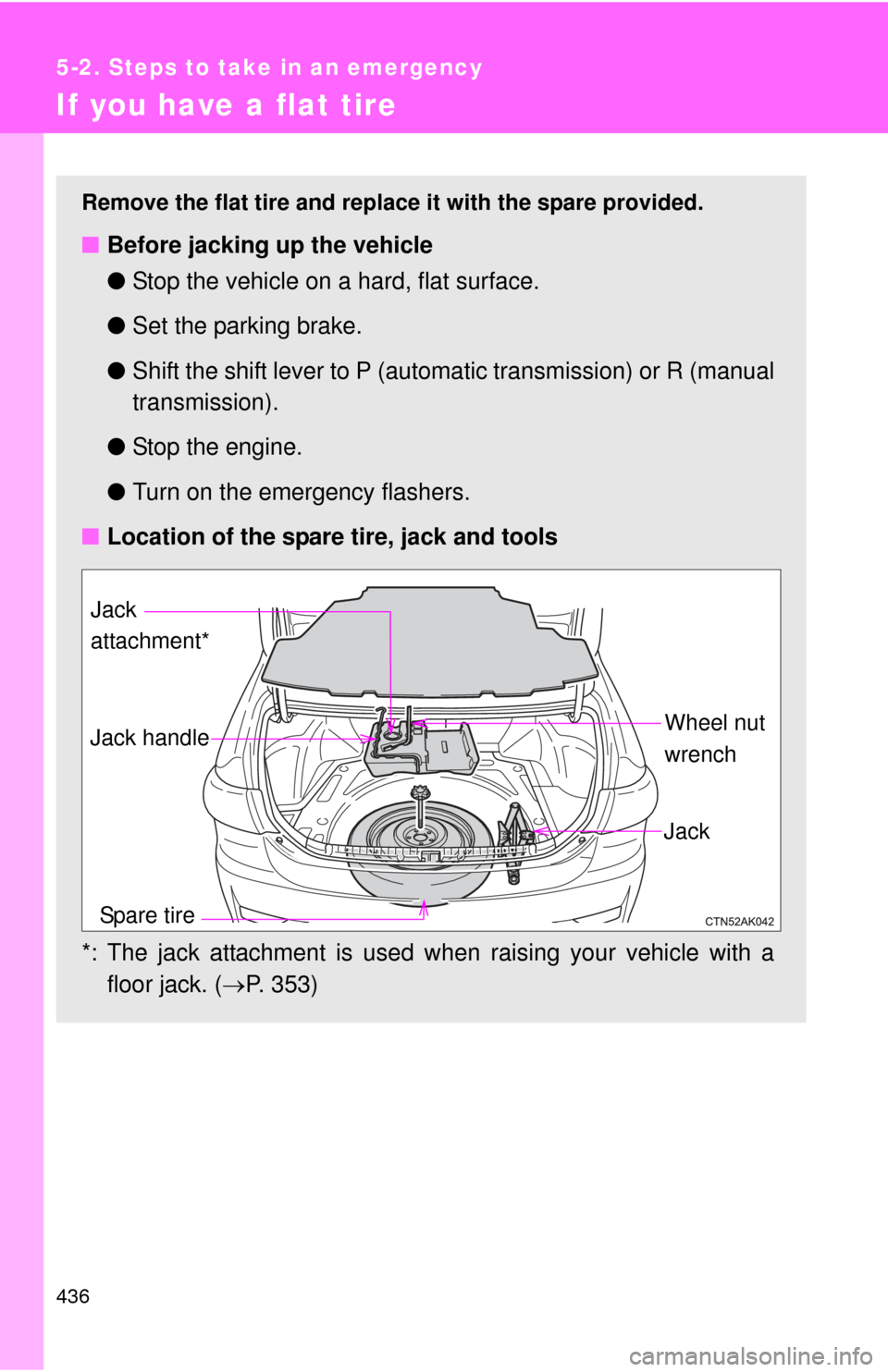
■ Location of the spare tire, jack and tools
*: The jack attachment is used w hen raising your vehicle with a
floor jack. ( P. 353)
Spare tire Jack
Wheel nut
wrenchJack handleJack
attachment*
Page 437 of 532
5
When trouble arises
437
5-2. Steps to take in an emergency
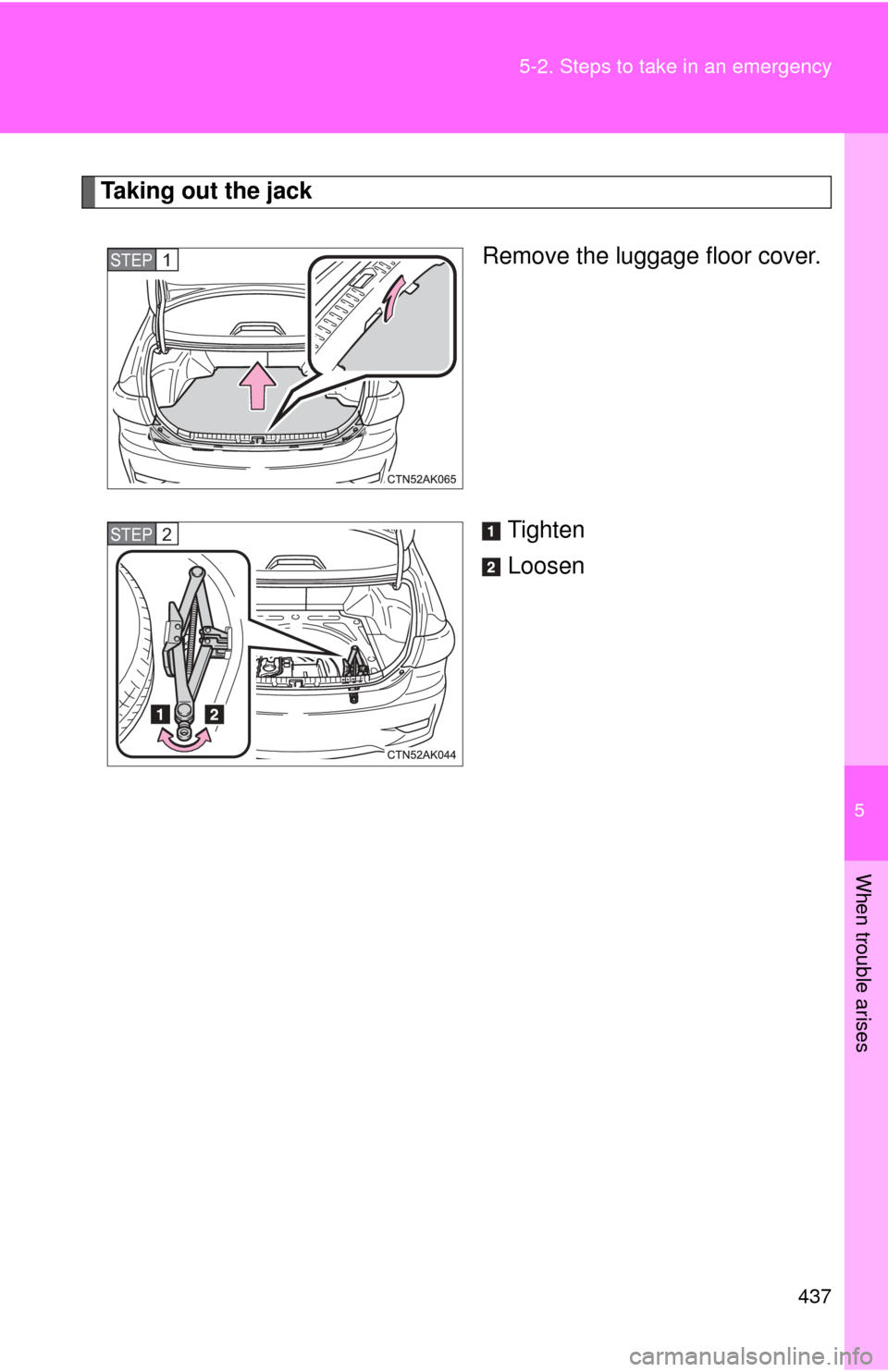
Taking out the jack
Remove the luggage floor cover.
Tighten
Loosen
STEP 1
STEP 2
Page 440 of 532
440 5-2. Steps to take in an emergency
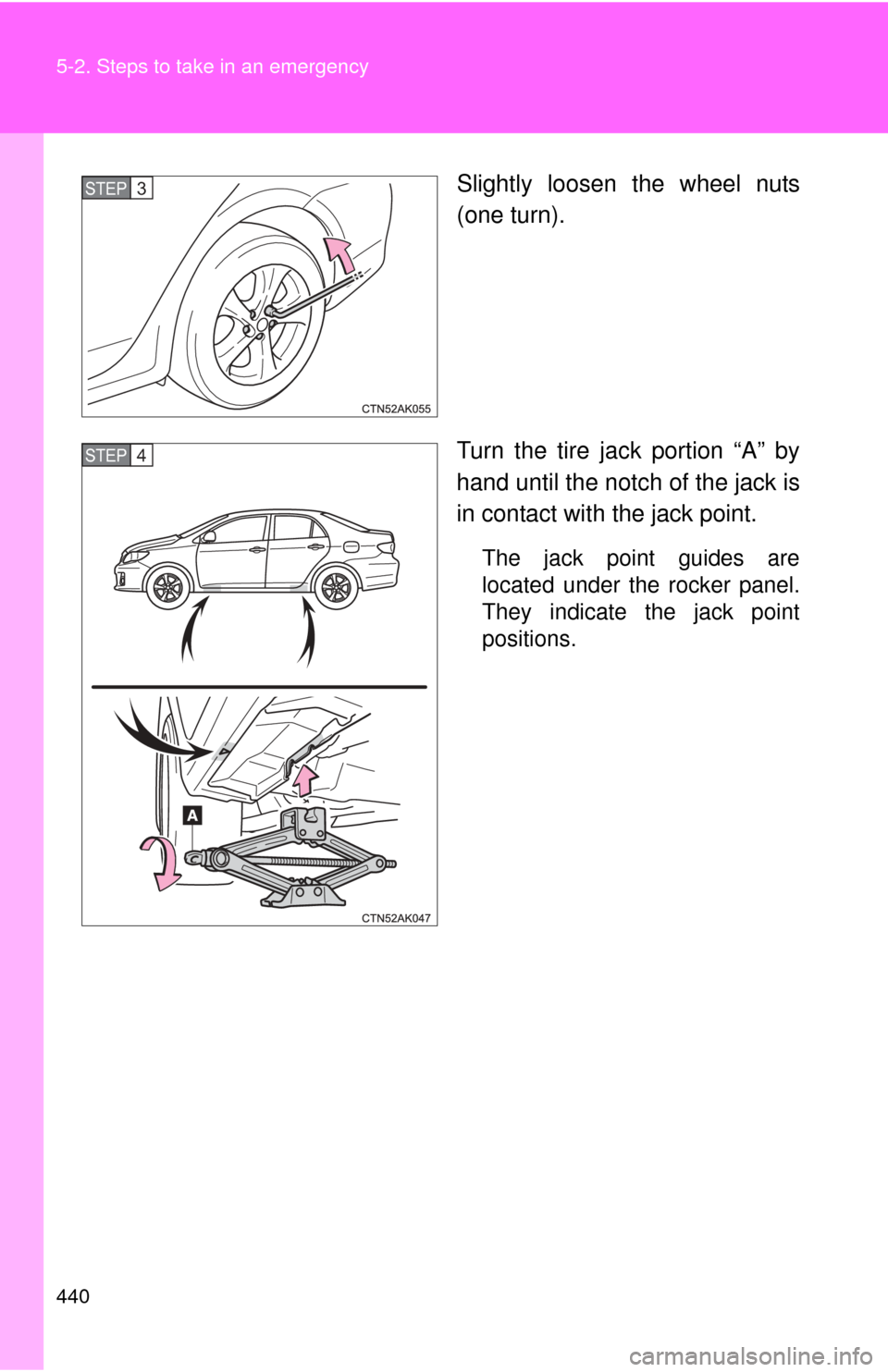
Slightly loosen the wheel nuts
(one turn).
Turn the tire jack portion “A” by
hand until the notch of the jack is
in contact with the jack point.
The jack point guides are
located under the rocker panel.
They indicate the jack point
positions.
STEP 3
STEP 4