transmission TOYOTA COROLLA 2017 11.G Owner's Guide
[x] Cancel search | Manufacturer: TOYOTA, Model Year: 2017, Model line: COROLLA, Model: TOYOTA COROLLA 2017 11.GPages: 612, PDF Size: 14.18 MB
Page 186 of 612
1864-2. Driving procedures
COROLLA_TMMMS_TMMC_U (OM02494U)
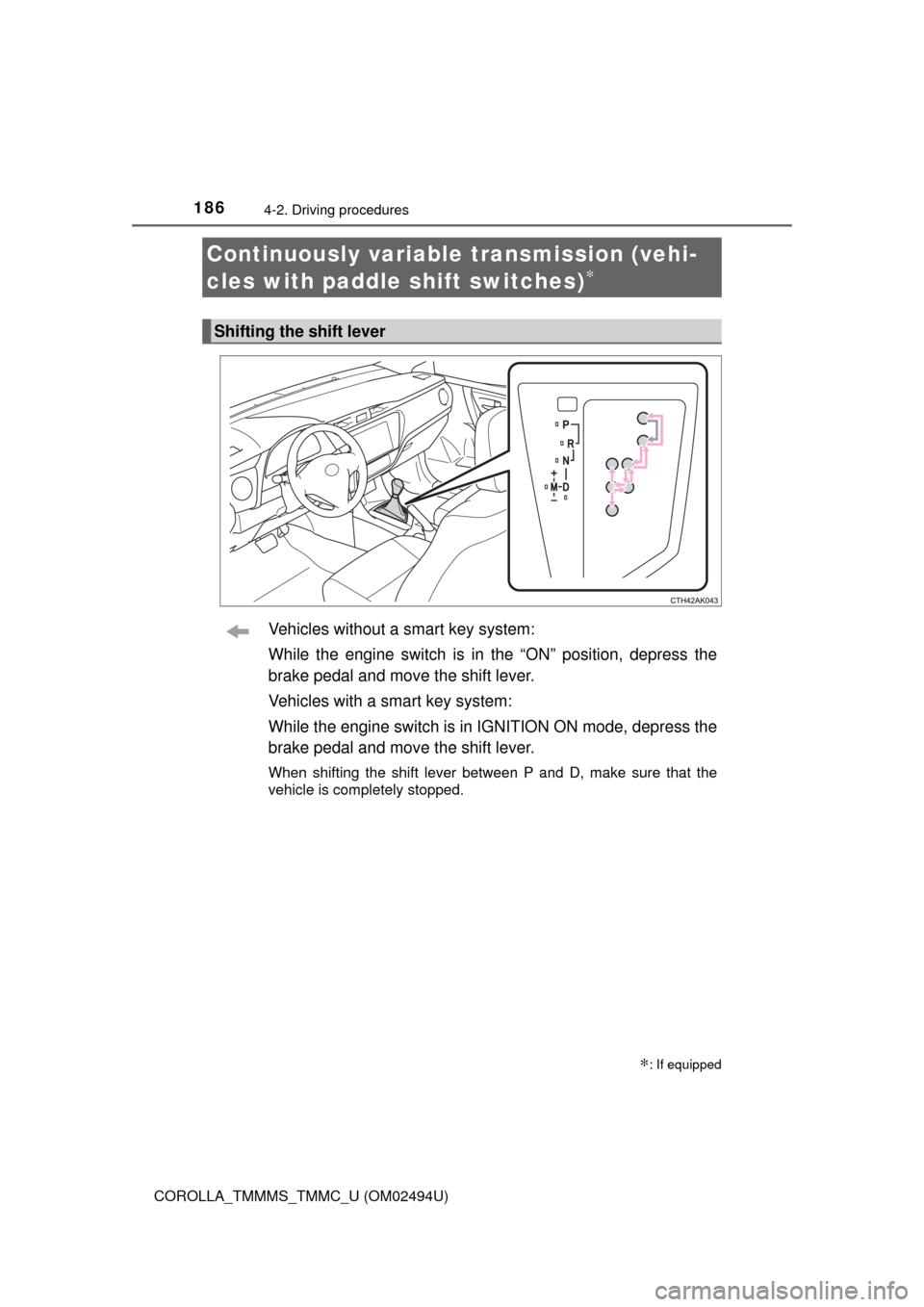
Vehicles without a smart key system:
While the engine switch is in the “ON” position, depress the
brake pedal and move the shift lever.
Vehicles with a smart key system:
While the engine switch is in IGNITION ON mode, depress the
brake pedal and move the shift lever.
When shifting the shift lever between P and D, make sure that the
vehicle is completely stopped.
Continuously variable transmission (vehi-
cles with paddle shift switches)
∗
∗: If equipped
Shifting the shift lever
Page 188 of 612
1884-2. Driving procedures
COROLLA_TMMMS_TMMC_U (OM02494U)
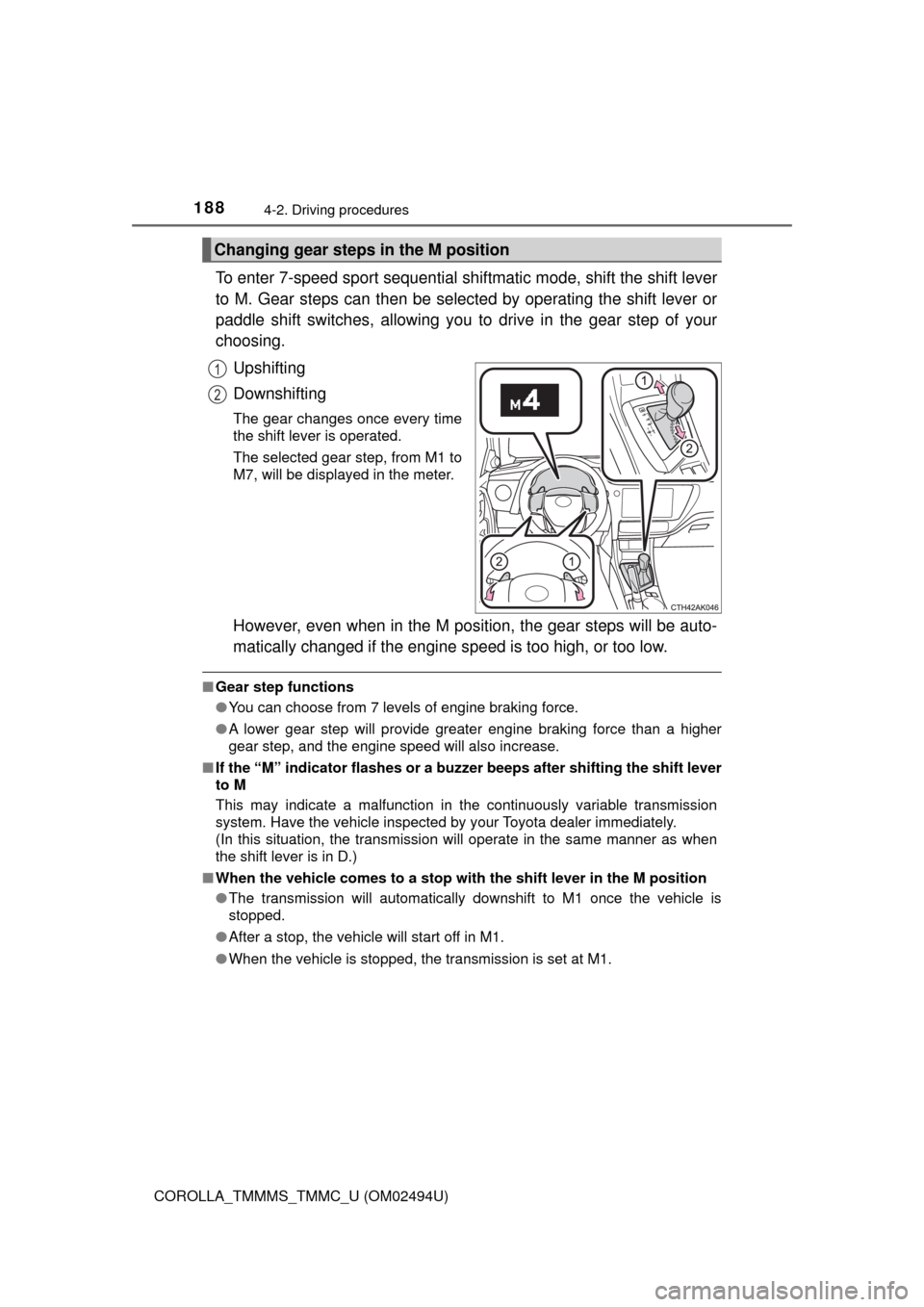
To enter 7-speed sport sequential shiftmatic mode, shift the shift lever
to M. Gear steps can then be selected by operating the shift lever or
paddle shift switches, allowing you to drive in the gear step of your
choosing.
Upshifting
Downshifting
The gear changes once every time
the shift lever is operated.
The selected gear step, from M1 to
M7, will be displayed in the meter.
However, even when in the M position, the gear steps will be auto-
matically changed if the engine speed is too high, or too low.
■Gear step functions
●You can choose from 7 levels of engine braking force.
●A lower gear step will provide greater engine braking force than a higher
gear step, and the engine speed will also increase.
■If the “M” indicator flashes or a buzzer beeps after shifting the shift lever
to M
This may indicate a malfunction in the continuously variable transmission
system. Have the vehicle inspected by your Toyota dealer immediately.
(In this situation, the transmission will operate in the same manner as when
the shift lever is in D.)
■When the vehicle comes to a stop with the shift lever in the M position
●The transmission will automatically downshift to M1 once the vehicle is
stopped.
●After a stop, the vehicle will start off in M1.
●When the vehicle is stopped, the transmission is set at M1.
Changing gear steps in the M position
1
2
Page 191 of 612
1914-2. Driving procedures
4
Driving
COROLLA_TMMMS_TMMC_U (OM02494U)
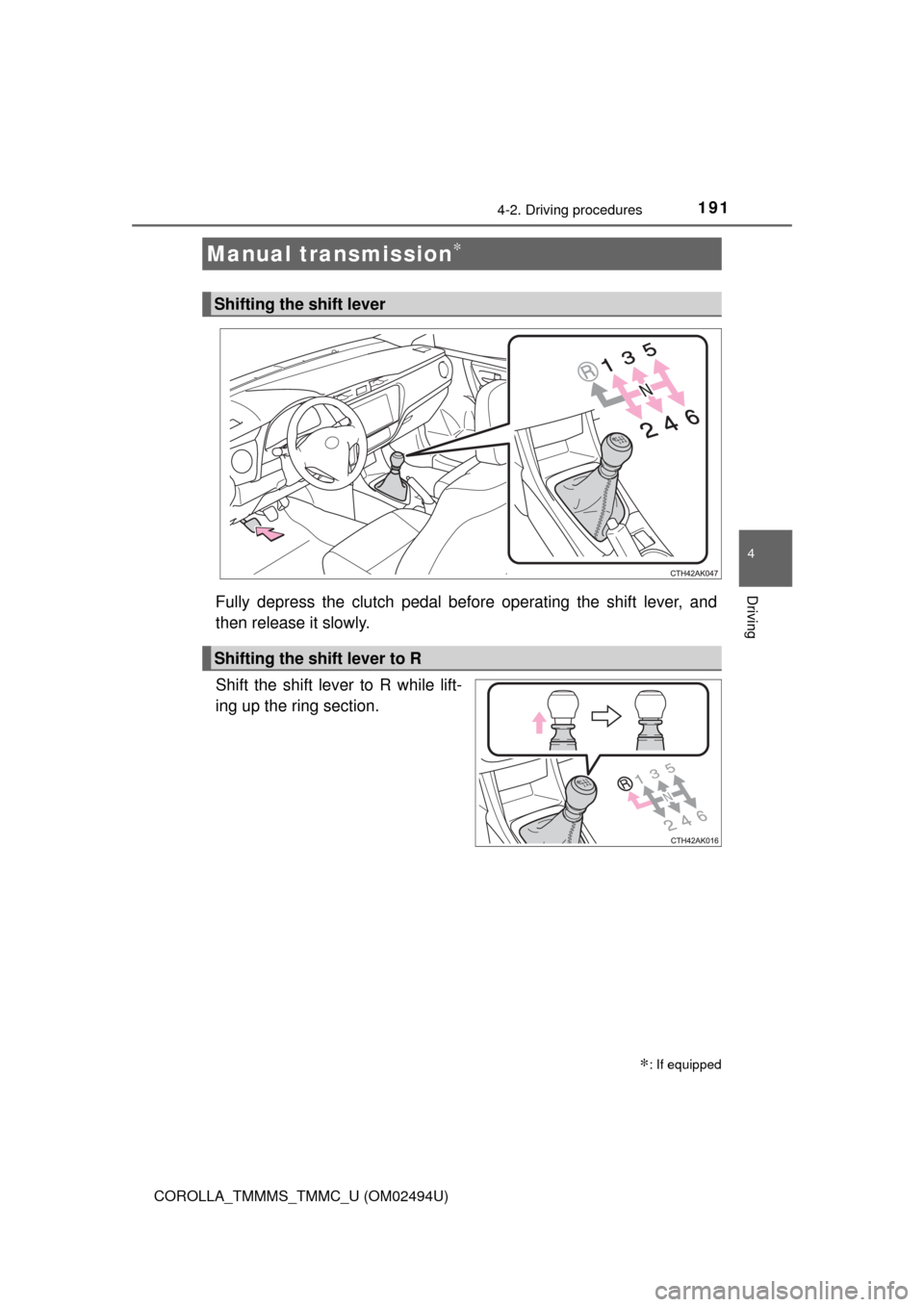
Fully depress the clutch pedal before operating the shift lever, and
then release it slowly.
Shift the shift lever to R while lift-
ing up the ring section.
Manual transmission∗
∗: If equipped
Shifting the shift lever
Shifting the shift lever to R
Page 192 of 612
1924-2. Driving procedures
COROLLA_TMMMS_TMMC_U (OM02494U)
■Maximum allowable speeds
Observe the following maximum allowable speeds in each gear when maxi-
mum acceleration is necessary.
mph (km/h)
Shift position
Maximum speed
Vehicles with 15-inch and
16-inch tiresVehicles with 17-inch tires
130 (49)30 (49)
256 (91)56 (90)
382 (133)82 (132)
4111 (179)111 ( 1 7 9 )
5⎯⎯
NOTICE
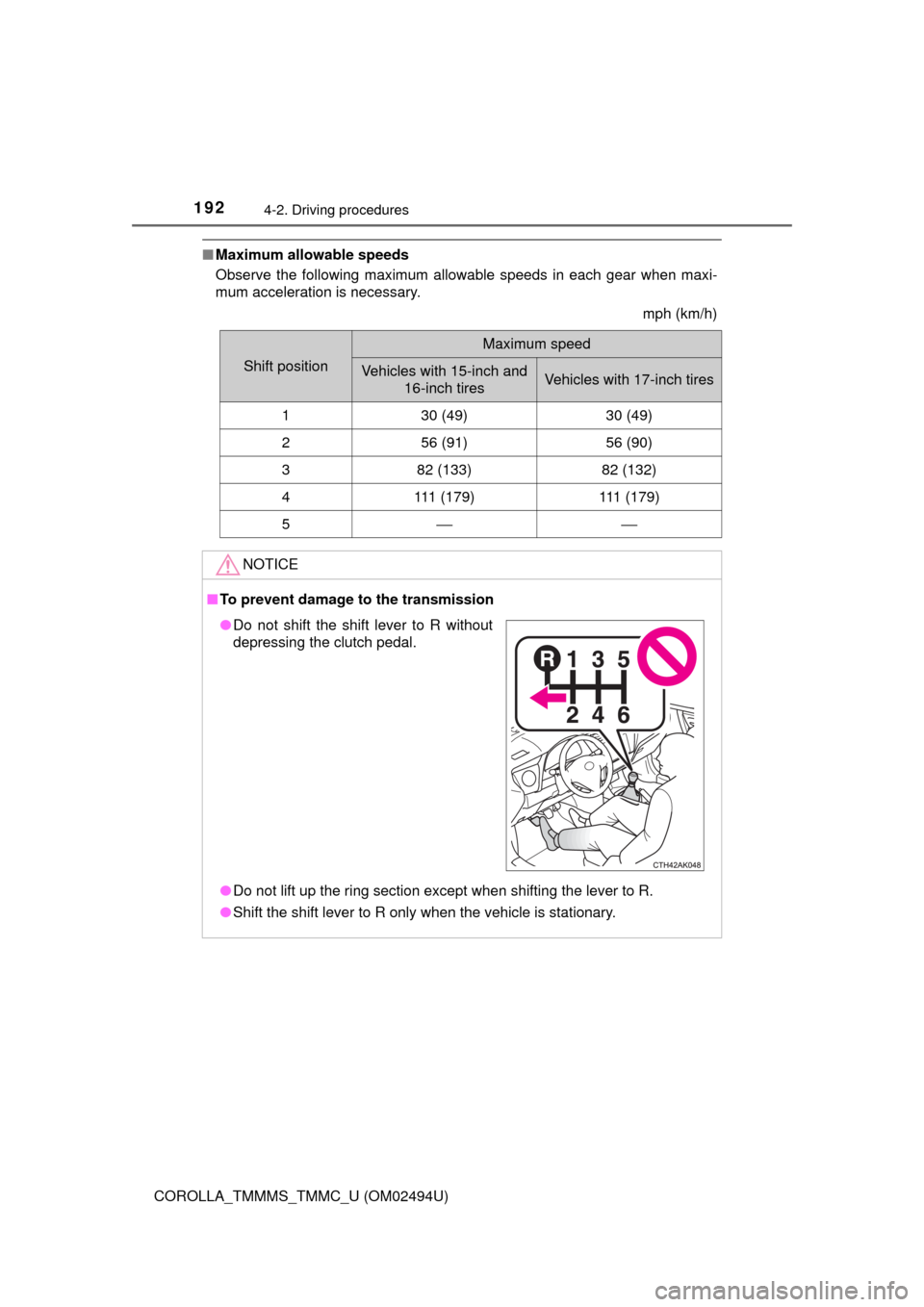
■To prevent damage to the transmission
●Do not lift up the ring section except when shifting the lever to R.
●Shift the shift lever to R only when the vehicle is stationary.
●Do not shift the shift lever to R without
depressing the clutch pedal.
Page 249 of 612

2494-5. Using the driving support systems
4
Driving
COROLLA_TMMMS_TMMC_U (OM02494U)
■Dynamic radar cruise control can be set when
Vehicles with a continuously variable transmission
●The shift lever is in the D or range 4 or higher of S has been selected.
(vehicles without paddle shift switches)
●The shift lever is in D.
(vehicles with paddle shift switches)
●Range 4 or higher of D has been selected by using the paddle shift.
(vehicles with paddle shift switches)
●Vehicle speed is above approximately 30 mph (50 km/h).
Vehicles with a manual transmission
●The shift lever is in the position 2 or higher.
●Vehicle speed is above approximately 30 mph (50 km/h).
■Accelerating after setting the vehicle speed
The vehicle can accelerate by operating the accelerator pedal. After acceler-
ating, the set speed resumes. However, during vehicle-to-vehicle distance
control mode, the vehicle speed may decrease below the set speed in order
to maintain the distance to the preceding vehicle.
■Automatic cancelation of vehicle-to-vehicle distance control mode
Vehicle-to-vehicle distance control mode is automatically canceled in the fol-
lowing situations.
●Actual vehicle speed falls below approximately 25 mph (40 km/h).
●VSC is activated.
●TRAC is activated for a period of time.
●When the VSC or TRAC system is turned off.
●The sensor cannot detect correctly because it is covered in some way.
●Pre-collision braking is activated.
●The engine speed is too high, or too low. (vehicles with a manual transmis-
sion)
If vehicle-to-vehicle distance control mode is automatically canceled for any
other reason, there may be a malfunction in the system. Contact your Toyota
dealer.
Page 265 of 612

2654-5. Using the driving support systems
4
Driving
COROLLA_TMMMS_TMMC_U (OM02494U)■Reduced effectiveness of the EPS system
The effectiveness of the EPS system is reduced to prevent the system from
overheating when there is frequent steering input over an extended period of
time. The steering wheel may feel heavy as a result. Should this occur, refrain
from excessive steering input or stop the vehicle and turn the engine off. The
EPS system should return to normal within 10 minutes.
■Operating conditions of hill-start assist control
When the following four conditions are met, the hill-start assist control will
operate:
●When starting off forward/backward
Vehicles with a manual transmission
• The shift lever is in a position other than R (when starting off forward on
an upward incline).
• The shift lever is in R (when starting off backward on an upward incline).
Vehicles with a continuously variable transmission
The shift lever is in a position other than P or N (when starting off forward/
backward on an upward incline).
●The vehicle is stopped.
●The accelerator pedal is not depressed.
●The parking brake is not engaged.
■Automatic system cancelation of hill-start assist control
The hill-start assist control will turn off in any of the following situations:
●When starting off forward/backward
Vehicles with a manual transmission
• The shift lever is in R (when starting off forward on an upward incline).
• The shift lever is in a position other than R (when starting off backward
on an upward incline).
Vehicles with a continuously variable transmission
The shift lever is moved to P or N.
●The accelerator pedal is depressed.
●The parking brake is engaged.
●Approximately 2 seconds elapse after the brake pedal is released.
Page 269 of 612

2694-6. Driving tips
4
Driving
COROLLA_TMMMS_TMMC_U (OM02494U)
Accelerate the vehicle slowly, keep a safe distance between you and
the vehicle ahead, and drive at a reduced speed suitable to road con-
ditions.
●Park the vehicle and move the shift lever to P (continuously variable
transmission), 1 or R (manual transmission) without setting the
parking brake. The parking brake may freeze up, preventing it from
being released. If the vehicle is parked without setting the parking
brake, make sure to block the wheels.
Failure to do so may be dangerous because it may cause the vehi-
cle to move unexpectedly, possibly leading to an accident.
●Vehicles with a continuously variable transmission: If the vehicle is
parked without setting the parking brake, confirm that the shift lever
cannot be moved out of P*.
*: The shift lever will be locked if it is attempted to be shifted from P to any
other position without depressing the brake pedal. If the shift lever can
be shifted from P, there may be a problem with the shift lock system.
Have the vehicle inspected by your Toyota dealer immediately
When driving the vehicle
When parking the vehicle
Page 422 of 612
4227-2. Maintenance
COROLLA_TMMMS_TMMC_U (OM02494U)
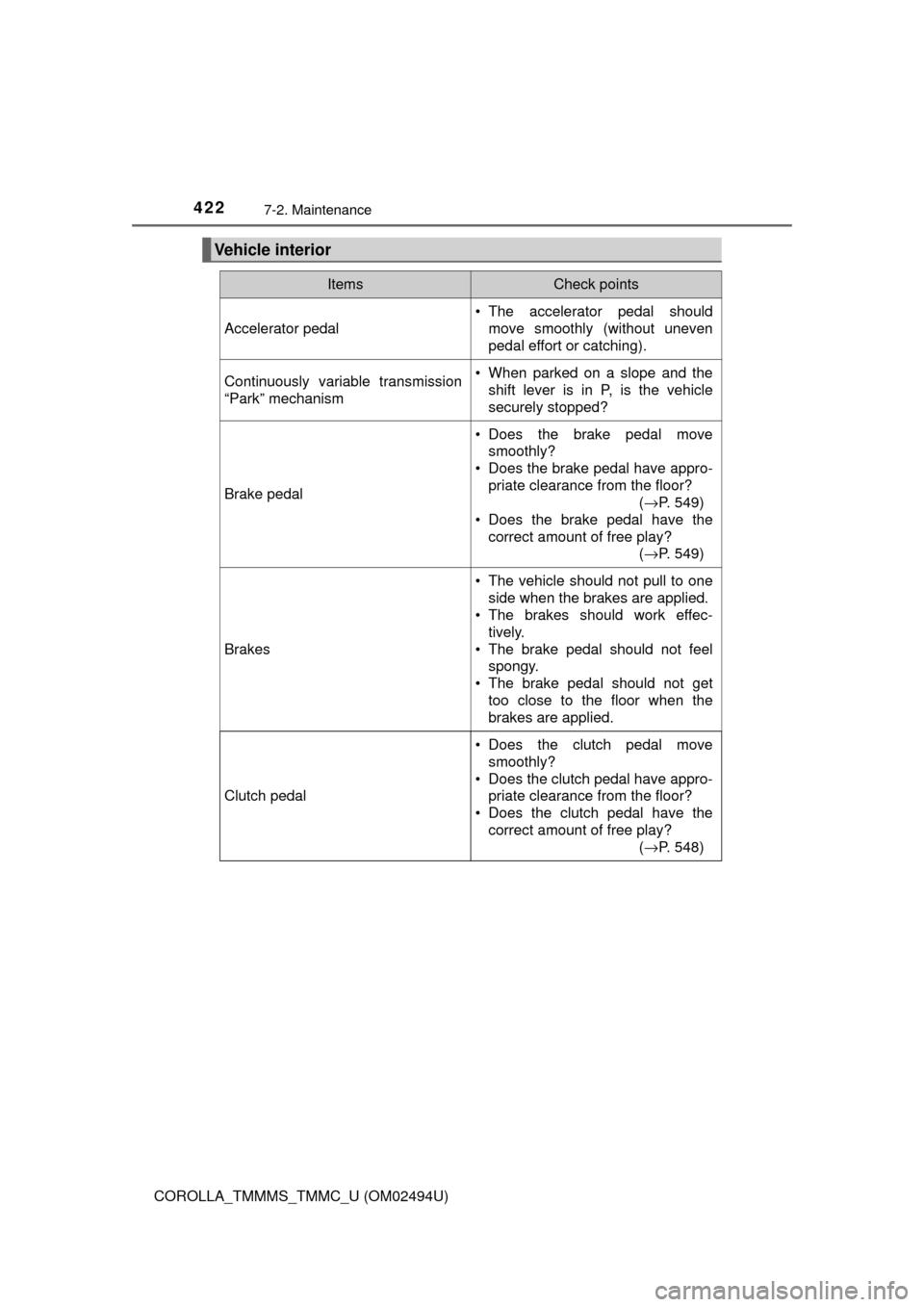
Vehicle interior
ItemsCheck points
Accelerator pedal
• The accelerator pedal should
move smoothly (without uneven
pedal effort or catching).
Continuously variable transmission
“Park” mechanism• When parked on a slope and the
shift lever is in P, is the vehicle
securely stopped?
Brake pedal
• Does the brake pedal move
smoothly?
• Does the brake pedal have appro-
priate clearance from the floor?
(→P. 549)
• Does the brake pedal have the
correct amount of free play?
(→P. 549)
Brakes
• The vehicle should not pull to one
side when the brakes are applied.
• The brakes should work effec-
tively.
• The brake pedal should not feel
spongy.
• The brake pedal should not get
too close to the floor when the
brakes are applied.
Clutch pedal
• Does the clutch pedal move
smoothly?
• Does the clutch pedal have appro-
priate clearance from the floor?
• Does the clutch pedal have the
correct amount of free play?
(→P. 548)
Page 477 of 612
477
8
When trouble arises
COROLLA_TMMMS_TMMC_U (OM02494U)
8-2. Steps to take in an emergency
The following may indicate a problem with your transmission. Contact
your Toyota dealer or commercial towing service before towing.
●The engine is running but the vehicle does not move.
●The vehicle makes an abnormal sound.
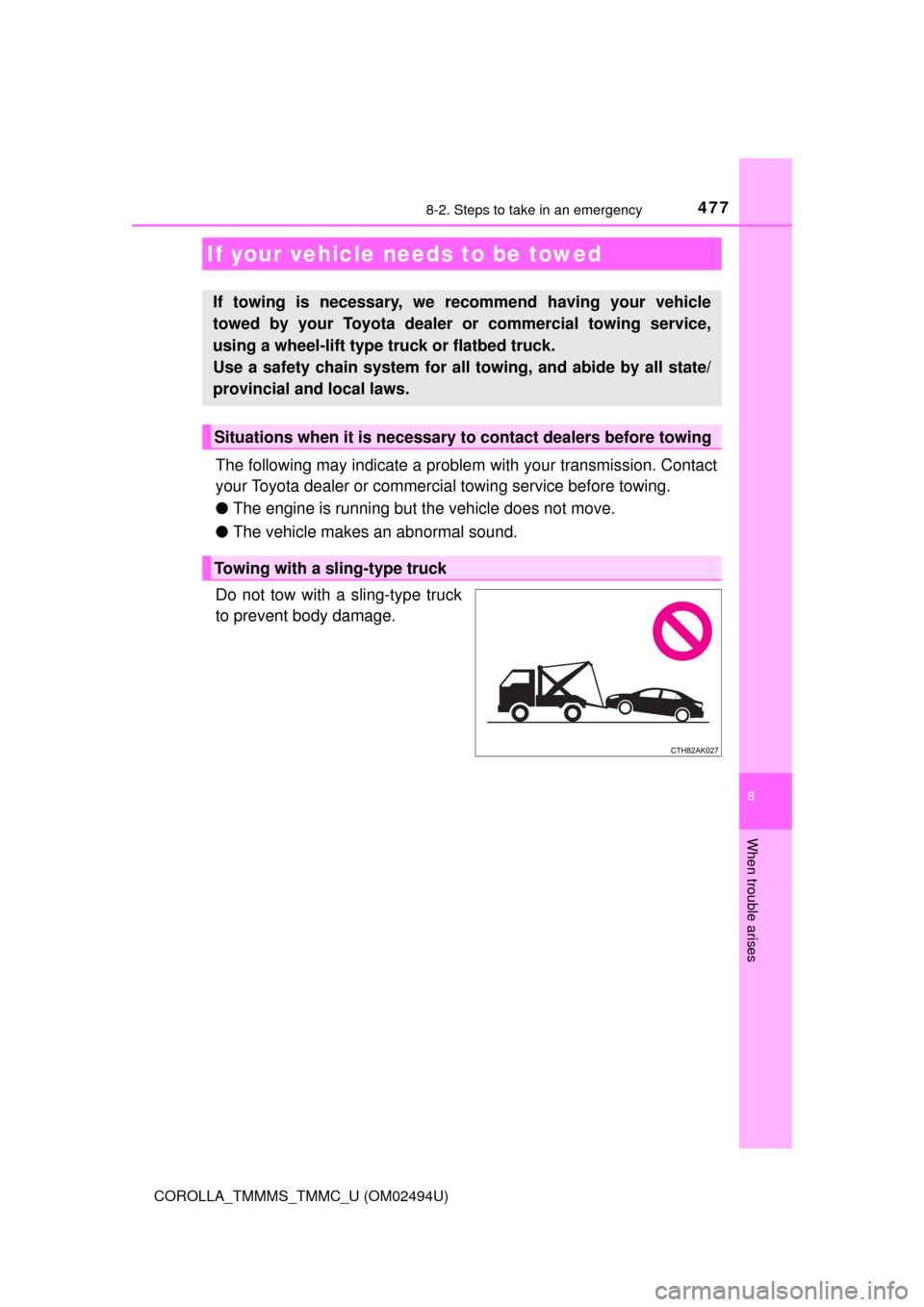
Do not tow with a sling-type truck
to prevent body damage.
If your vehicle needs to be towed
If towing is necessary, we recommend having your vehicle
towed by your Toyota dealer or commercial towing service,
using a wheel-lift type truck or flatbed truck.
Use a safety chain system for all towing, and abide by all state/
provincial and local laws.
Situations when it is necessary to contact dealers before towing
Towing with a sling-type truck
Page 479 of 612
4798-2. Steps to take in an emergency
8
When trouble arises
COROLLA_TMMMS_TMMC_U (OM02494U)
If a tow truck is not available in an emergency, your vehicle may be
temporarily towed using cables or chains secured to the emergency
towing eyelet. This should only be attempted on hard surfaced roads
for at most 50 miles (80 km) at under 18 mph (30 km/h).
A driver must be in the vehicle to steer and operate the brakes. The
vehicle’s wheels, drive train, axles, steering and brakes must be in
good condition.
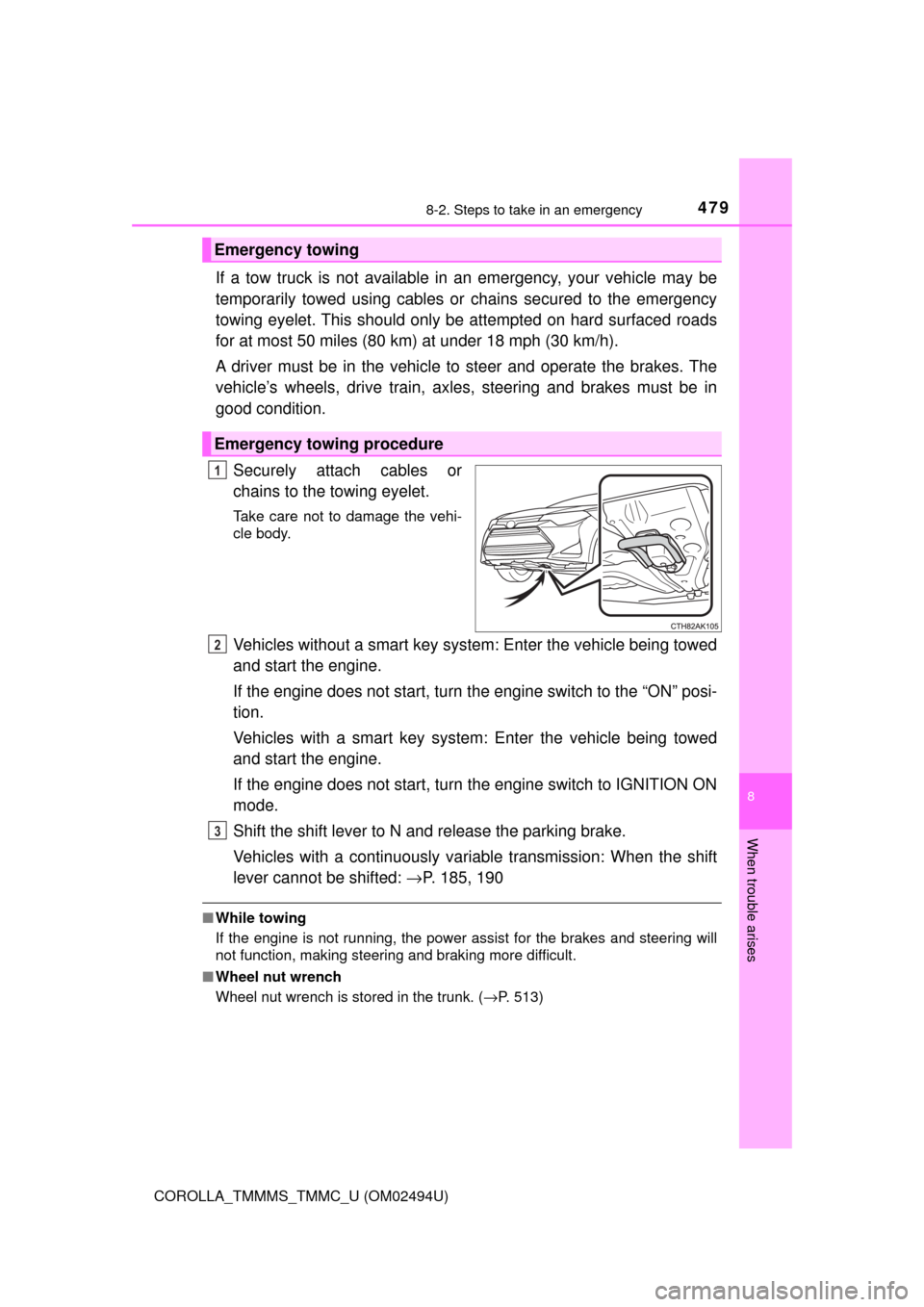
Securely attach cables or
chains to the towing eyelet.
Take care not to damage the vehi-
cle body.
Vehicles without a smart key system: Enter the vehicle being towed
and start the engine.
If the engine does not start, turn the engine switch to the “ON” posi-
tion.
Vehicles with a smart key system: Enter the vehicle being towed
and start the engine.
If the engine does not start, turn the engine switch to IGNITION ON
mode.
Shift the shift lever to N and release the parking brake.
Vehicles with a continuously variable transmission: When the shift
lever cannot be shifted: →P. 185, 190
■While towing
If the engine is not running, the power assist for the brakes and steering will
not function, making steering and braking more difficult.
■Wheel nut wrench
Wheel nut wrench is stored in the trunk. (→P. 513)
Emergency towing
Emergency towing procedure
1
2
3