spare tire TOYOTA COROLLA 2020 Warranties & Maintenance Guides (in English)
[x] Cancel search | Manufacturer: TOYOTA, Model Year: 2020, Model line: COROLLA, Model: TOYOTA COROLLA 2020Pages: 260, PDF Size: 8.54 MB
Page 160 of 260
NITTO TIRE
158
• Over-inflation can cause the tire to be more susceptible to
impact damage.
•
Over-inflation or underinflation may adversely affect vehicle
handling.
•
Remember to check your spare tire. Consult your vehicle Owner’s
Manual for the correct inflation pressure and use of a “temporary
use” spare tire. The inflation pressure specified for a spare tire is
typically different from that specified for your regular tires.
•
Use valve caps to keep valve cores clean and clear of debris and
to help guard against air leakage.
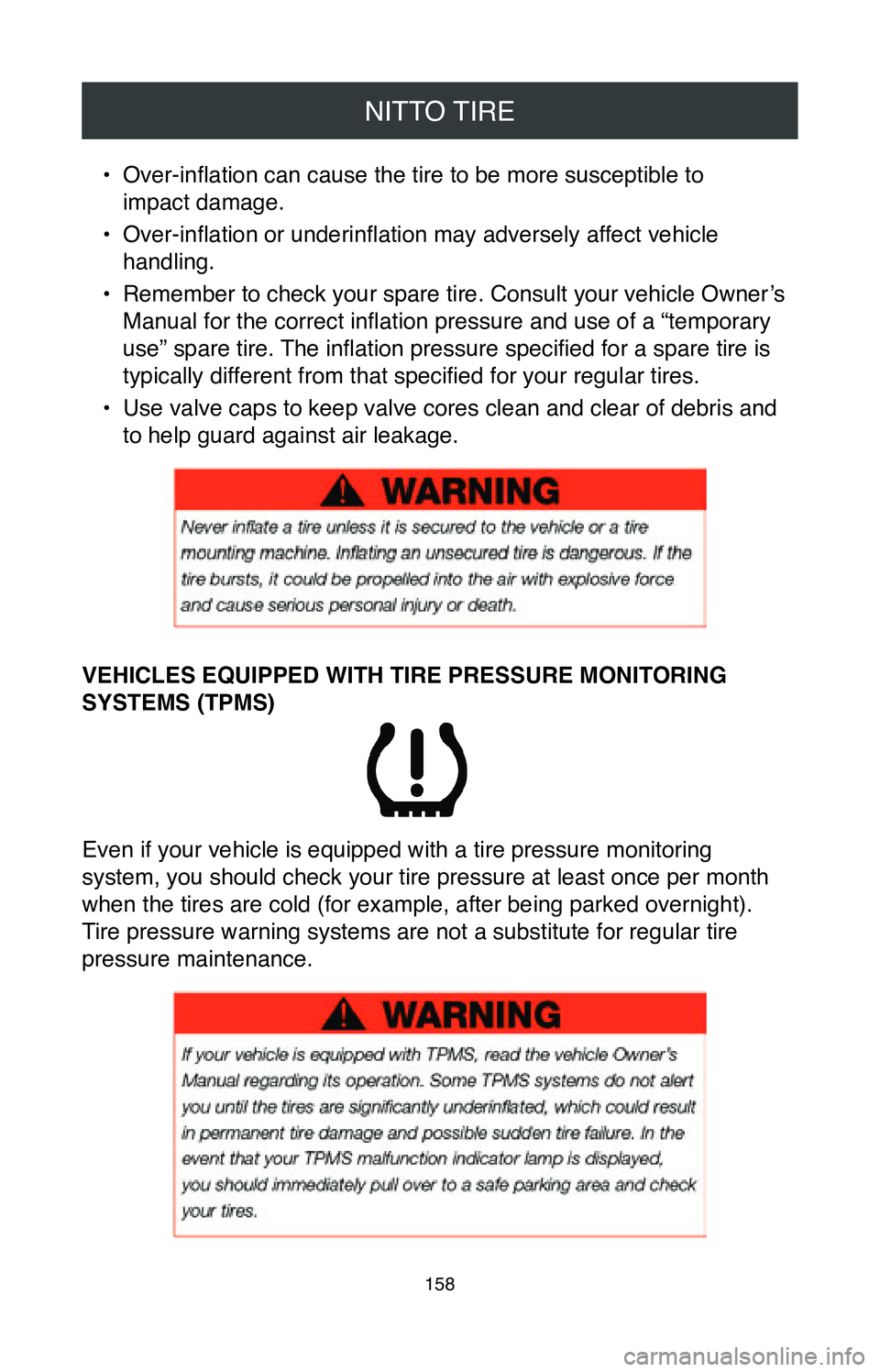
VEHICLES EQUIPPED WITH TIRE PRESSURE MONITORING
SYSTEMS (TPMS)
Even if your vehicle is equipped with a tire pressure monitoring
system, you should check your tire pressure at least once per month
when the tires are cold (for example, after being parked overnight).
Tire pressure warning systems are not a substitute for regular tire
pressure maintenance.
Page 167 of 260
NITTO TIRE
165
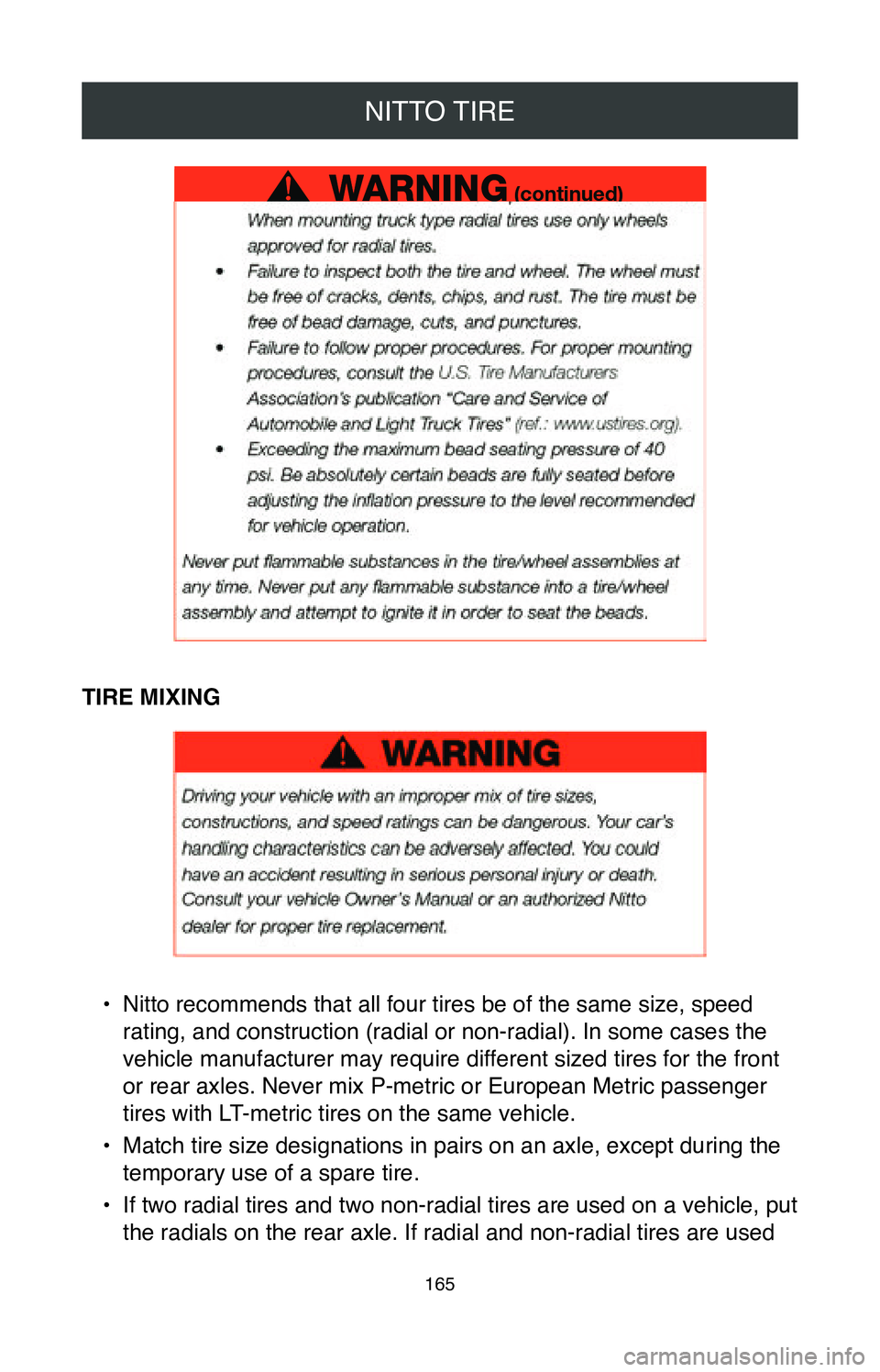
TIRE MIXING
• Nitto recommends that all four tires be of the same size, speed
rating, and construction (radial or non-radial). In some cases the
vehicle manufacturer may require different sized tires for the front
or rear axles. Never mix P-metric or European Metric passenger
tires with LT-metric tires on the same vehicle.
•
Match tire size designations in pairs on an axle, except during the
temporary use of a spare tire.
•
If two radial tires and two non-radial tires are used on a vehicle, put
the radials on the rear axle. If radial and non-radial tires are used
Page 172 of 260
NITTO TIRE
170
• Find a safe place to pull off the road and allow the vehicle to
gradually decelerate. Apply light braking as required to stop safely.
•
Gradually pull over to the shoulder and come to a stop. Look for a
damaged tire on your vehicle.
•
Seek roadside assistance or change the damaged tire with your
spare tire.
•
Have all of your tires and the vehicle thoroughly inspected by a
tire professional.
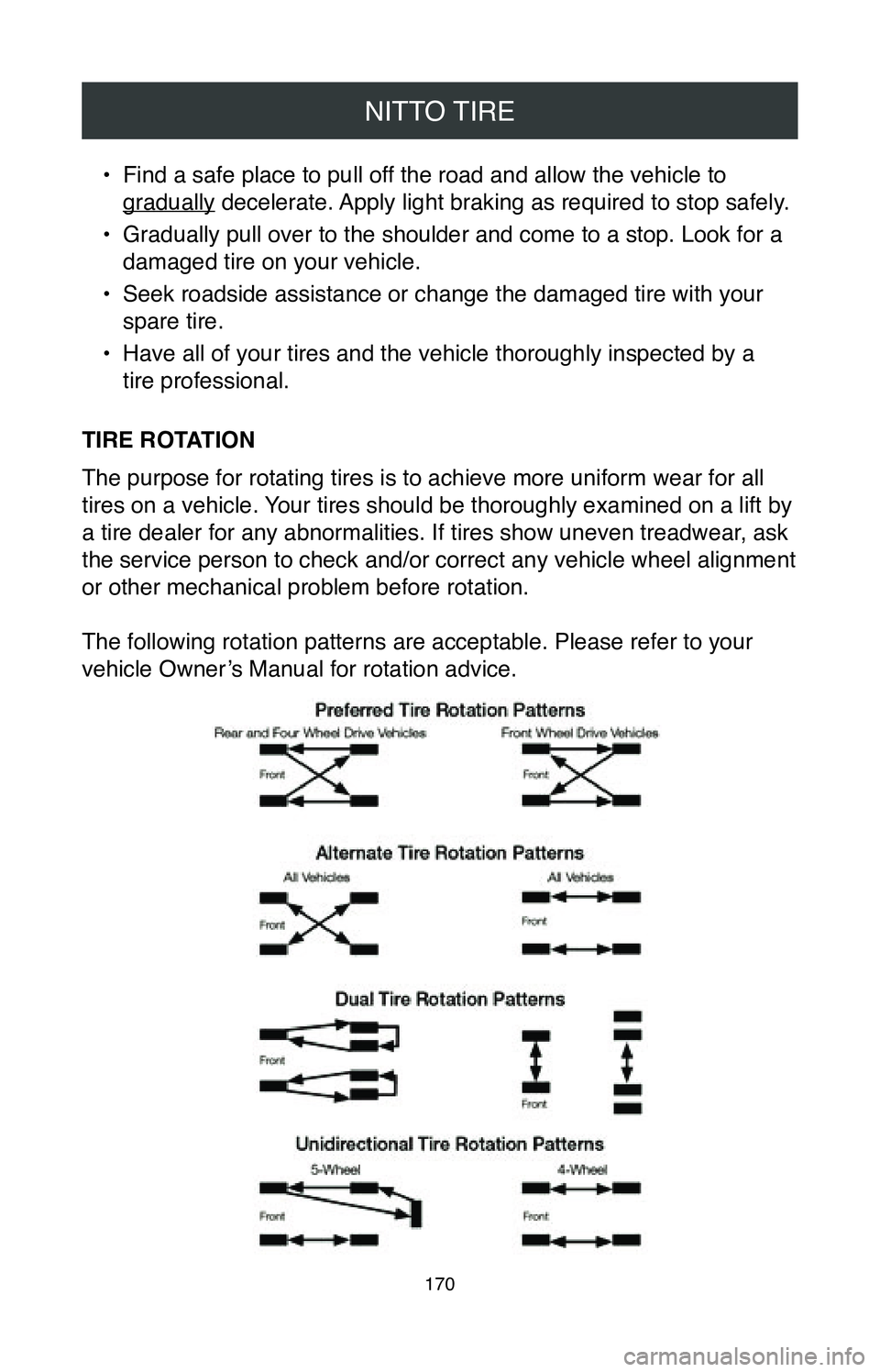
TIRE ROTATION
The purpose for rotating tires is to achieve more uniform wear for all
tires on a vehicle. Your tires should be thoroughly examined on a lift by
a tire dealer for any abnormalities. If tires show uneven treadwear, ask
the service person to check and/or correct any vehicle wheel alignment
or other mechanical problem before rotation.
The following rotation patterns are acceptable. Please refer to your
vehicle Owner’s Manual for rotation advice.
Page 173 of 260
NITTO TIRE
171
Full-size spare tires (not temporary spares) of the same size,
construction, and speed rating may be used in a five-tire
rotation pattern.
After rotation, check the inflation pressure of all the tires. The front
and rear tire pressures may vary according to the vehicle
manufacturer’s specifications.
Remember to follow your vehicle Owner’s Manual for tire rotation
intervals. Your Limited Warranty recommends Nitto brand tires to be
rotated as follows:
•
Every 3,500 miles or less for high performance (low profile) tires.
•
Every 7,500 miles or less for standard passenger and light
truck tires.
More frequent rotation or a thorough vehicle inspection may be
necessary if, upon inspection, irregular or erratic treadwear is
beginning to appear.
It is important to remember the following: •
These tire rotation recommendations do not take into account
different tire and construction types mixed on the vehicle.
•
Some tires cannot be rotated in the manner described. Such tires
include unidirectional tires. Unidirectional tread patterns must be
rotated front-to-rear only so that the direction of revolution does
not change.
•
Some vehicles are designed with different tire sizes on the front
and rear axles. Normally, such combinations will not allow rotation.
Prior to rotating, consult the vehicle Owner’s Manual.
•
For vehicles with dual rear wheels, see the vehicle Owner’s
Manual for the vehicle manufacturer’s procedures. If your vehicle
Owner’s Manual is not available, please contact the vehicle
manufacturer.
•
Some vehicles are equipped with wheels that limit the choice of
rotation pattern. Consult the vehicle Owner’s Manual.
•
Do not include temporary spare tires in the rotation pattern.
However, if your spare tire is the same size and type as a road tire
(for LT tires of the same size, type, and load rating), it should be
Page 174 of 260
NITTO TIRE
172
included in the tire rotation process. The proper procedure is to use
the vehicle manufacturer’s recommended tire rotation procedures,
or if not available, to use the appropriate rotation pattern shown,
inserting the spare in the right rear position. Place the tire that
would have gone to the right rear in the spare tire storage position
as the new spare.
•
Important! After rotation, adjust the pressure of the individual tires
to the vehicle manufacturer’s recommendation or the inflation
pressure recommended by Nitto for an optional fitment according
to the tire’s new location on the vehicle.
•
Do not mix speed-rated tires on the same axle. Higher speed-
rated tires must remain on the rear axle. Consult your authorized
Nitto dealer.
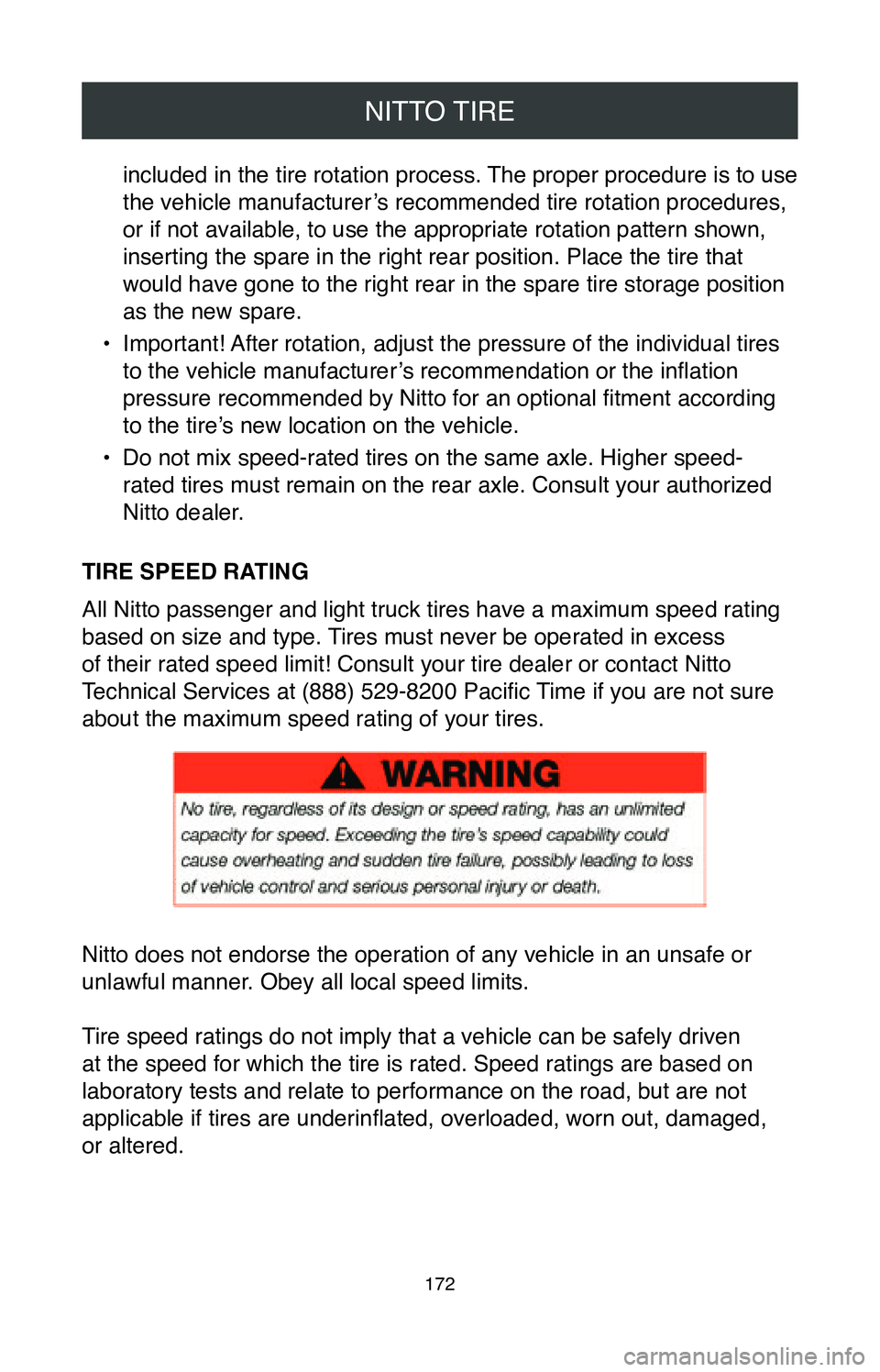
TIRE SPEED RATING
All Nitto passenger and light truck tires have a maximum speed rating
based on size and type. Tires must never be operated in excess
of their rated speed limit! Consult your tire dealer or contact Nitto
Technical Services at (888) 529-8200 Pacific Time if you are not sure
about the maximum speed rating of your tires.
Nitto does not endorse the operation of any vehicle in an unsafe or
unlawful manner. Obey all local speed limits.
Tire speed ratings do not imply that a vehicle can be safely driven
at the speed for which the tire is rated. Speed ratings are based on
laboratory tests and relate to performance on the road, but are not
applicable if tires are underinflated, overloaded, worn out, damaged,
or altered.
Page 179 of 260
NITTO TIRE
177
molded into the sidewall near the bead. These letters mean “Mud
and Snow.” Tires designed for use in severe snow conditions
generally have tread patterns, structure, and materials for giving
superior performance. These tires are marked with the “M&S”
designation plus a mountain/snowflake symbol
. Even the best
all-season tires will not provide acceptable levels of traction if you
drive too fast in snow or ice conditions and if you do not allow more
stopping distance on icy roads compared to dry road surfaces.
Your ability to safely maneuver your vehicle in snow or ice
conditions is considerably reduced if your tires are too worn to
provide adequate road grip.
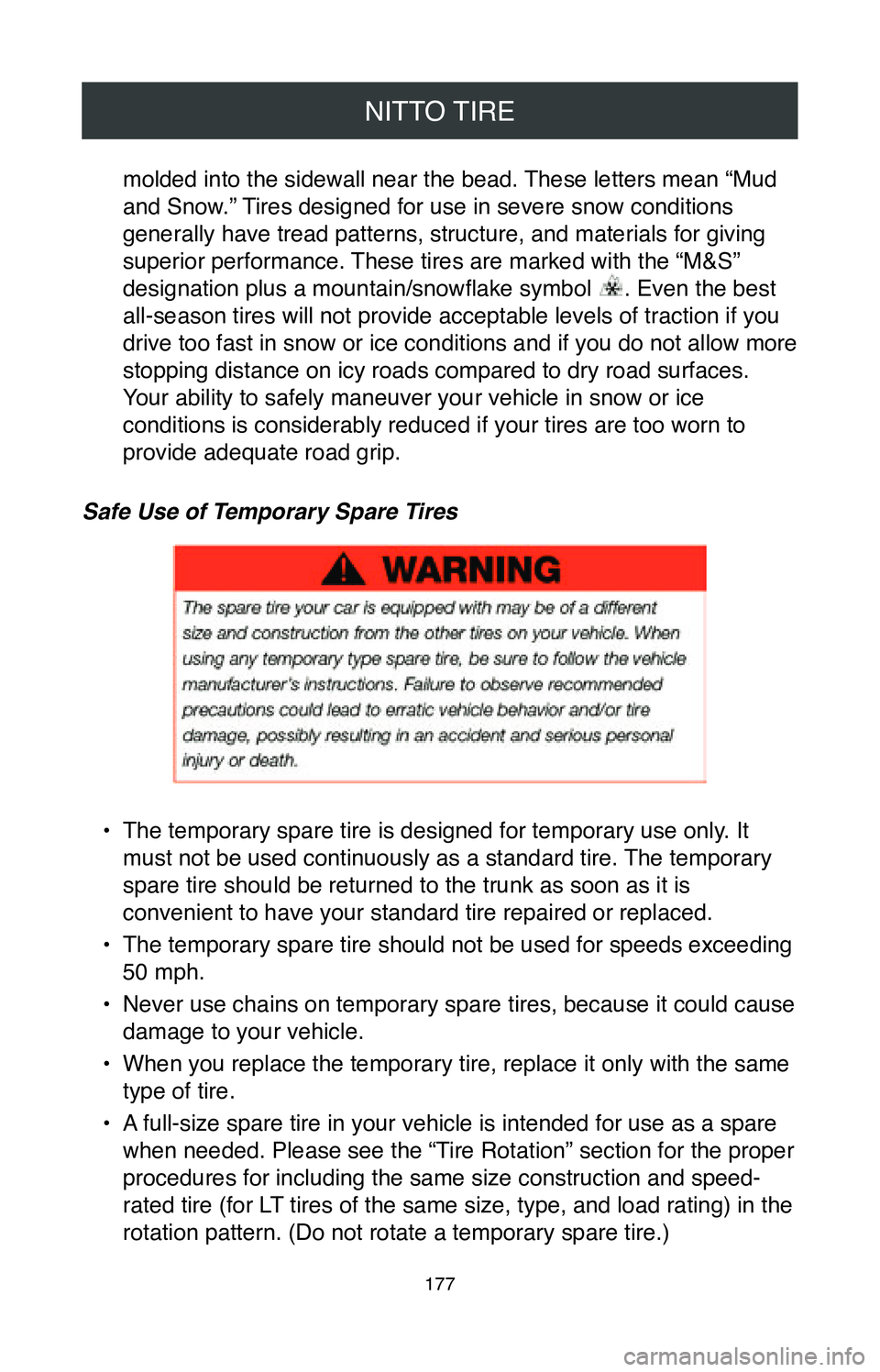
Safe Use of Temporary Spare Tires
• The temporary spare tire is designed for temporary use only. It
must not be used continuously as a standard tire. The temporary
spare tire should be returned to the trunk as soon as it is
convenient to have your standard tire repaired or replaced.
•
The temporary spare tire should not be used for speeds exceeding
50 mph.
•
Never use chains on temporary spare tires, because it could cause
damage to your vehicle.
•
When you replace the temporary tire, replace it only with the same
type of tire.
•
A full-size spare tire in your vehicle is intended for use as a spare
when needed. Please see the “Tire Rotation” section for the proper
procedures for including the same size construction and speed-
rated tire (for LT tires of the same size, type, and load rating) in the
rotation pattern. (Do not rotate a temporary spare tire.)
Page 205 of 260
PIRELLI
203
minimum tread depth and they may be dangerous if left in service.
Tires should be removed from service for numerous reasons,
including tread worn down to minimum depth, damage or abuse
(including, without limitation, punctures, cuts, impacts, cracks, bulges,
under inflation, overloading, etc.). For these reasons, tires, including
spares, should be inspected at least once a month and before long
trips. Inspection should occur regardless of whether the vehicle is
equipped with a tire pressure monitoring system. In addition to these
visual conditions, consumers should take note of and address any
change in performance such as increased air loss, noise or vibration or \
other factors.
The mere passage of time (age) does not cause tires to deteriorate,
but rather exposure to outside forces. The service life of a tire is a
function of service and storage conditions. For each individual tire,
this service life is determined by many factors such as temperature/
weather, storage conditions, and service conditions (e.g., load, speed,
inflation pressure, maintenance, and road hazard damage, etc.) to
which a tire is subjected throughout its life. Since service and storage
conditions vary widely, accurately predicting the service life of any
specific tire based on chronological age is not possible. There is no
scientific or technical data that establishes or identifies a minimum
or maximum service life, but the longer a tire has been in service,
the greater the chance that it will need to be replaced due to service-
related conditions.
Only use a mild soap solution to clean tires and rinse the soap off with
low pressure tap water, use of high-pressure sprayers may cause
damage. Never apply cleaners or other products to enhance sidewall
or tire appearance to avoid removal of substances which are intended
to protect the tire and reduce rubber degradation associated with the
impact of ozone and other environmental conditions.
The removal of these substances may degrade the rubber and can
lead to sidewall cracking. To remove the protective film from a Pirelli
tire with white letters, first flood the area with a stream of water from a
hose. After a minute or two the film will soften and it can be removed
with soft nylon brush if needed.
Page 209 of 260
TOYO TIRE
207
Limited Warranty for Original Equipment
Passenger & Light Truck Tires
Limited Warranty for Original Equipment Toyo Tires
(Effective November 2011)
WHAT IS COVERED AND FOR HOW LONG?
This Limited Warranty covers all Toyo brand passenger car, light truck
and temporary spare tires installed as original equipment on vehicles
that are sold and used within the United States.
Eligible Tires
Your tires are covered under this Limited Warranty if all of the following
criteria are met:•
The tire was installed on your vehicle at the factory as an original
equipment part.
•
You are the original purchaser of the vehicle.
•
You purchased the vehicle after November 2011*.
•
You have always used the tires with this vehicle.
•
The tires have been used for normal street driving.
•
The vehicle has not been used for commercial service.
•
You properly maintained and used the tire (See “Tire Safety and
Maintenance Information” section below).
•
The tires are not subject to an exclusion (See “What is Not
Covered?” section below).
•
You fulfill the warranty claim procedure (See “How to Make a
Claim” section below).
Eligible Tires are covered under this Limited Warranty for a period of up
to 5 years from the date you purchased your new vehicle. Toyo Tires
will replace it with a comparable new Toyo brand tire in the manner
explained in the “What Toyo Tires Will Do” section below.
* Vehicles purchased before November 2011 may be covered by an
earlier warranty. See your Toyo Tires retailer or contact Toyo Tires for
more information.
Page 211 of 260
TOYO TIRE
209
Failure to meet conditions of this Limited Warranty, not limited to:•
Any tire that is not an Eligible Tire.
•
Any tire for which mileage and tire rotation records are not
available or verifiable.
•
Any tire not presented and available for Toyo Tires’ inspection.
•
Any tire worn beyond the treadwear indicators (less than 2/32” of
remaining tread).
•
Uniformity issues after the first 25% of treadwear.
Temporary spare tires that are used at speeds over 50 miles per hour.
Nothing in this Limited Warranty is intended to be a representation that
tire failures cannot occur.
WHAT TOYO TIRES WILL DO
For every Eligible Tire, Toyo Tires will do the following:
Regular OE Tires 1.
If less than 25% Worn: Toyo Tires will replace, free of charge,
any Eligible Tire when the original usable tread is worn by 25% or
less, and within 5 years from the date you purchased the vehicle
new. If you cannot provide a copy of the new vehicle registration
or vehicle purchase receipt, the manufacture date of the tire, as
indicated by the tire DOT code, will be used instead to determine
if a tire is within the warranty period. Tire mounting and balancing
costs are covered by Toyo Tires. You are responsible for taxes
and all other costs, fees and expenses.
2.
If more than 25% Worn: Toyo Tires will replace any Eligible Tire
when the original usable tread is worn by more than 25%, and
within 5 years from the date you purchased the vehicle new. If you
cannot provide a copy of the new vehicle registration or vehicle
purchase receipt, the manufacture date of the tire, as indicated
by the tire DOT code, will be used instead to determine if a tire is
within the warranty period. You are responsible for the pro-
rated cost of a replacement tire, mounting and balancing
costs, taxes and all other costs, fees and expenses.
Page 212 of 260
TOYO TIRE
210
Temporary Spare Tire1.
If less than 50% Worn: Toyo Tires will replace, free of charge,
any Eligible Tire when the original usable tread is worn by 50% or
less, and within 5 years from the date you purchased the vehicle
new. If you cannot provide a copy of the new vehicle registration
or vehicle purchase receipt, the manufacture date of the tire, as
indicated by the tire DOT code, will be used instead to determine
if the tire is within the warranty period. Tire mounting and
balancing costs are covered by Toyo Tires. You are responsible
for taxes and all other costs, fees and expenses.
2.
If more than 50% Worn: Toyo Tires will replace any Eligible Tire
when the original usable tread is worn by more than 50%, and
within 5 years from the date you purchased the vehicle new. If you
cannot provide a copy of the new vehicle registration or vehicle
purchase receipt, the manufacture date of the tire, as indicated
by the tire DOT code, will be used instead to determine if the
tire is within the warranty period. You are responsible for the
pro-rated cost of a replacement tire, mounting and balancing
costs, taxes and all other costs, fees and expenses.
The original usable tread is determined by measuring the depth on
the tread of an identical model of a new Toyo brand tire to the top of
the treadwear indicator bars (note: the original usable tread depth will
vary by tire model).
The prorated cost of a replacement tire is determined as follows:
[(Original usable tread worn) ÷ (Original usable tread)]x (Actual current dealer selling price).
A comparable Toyo brand tire is the same tire, or a tire of the same
basic construction and quality, as the original tire, as determined by
Toyo Tires.
HOW TO MAKE A CLAIM
To make a claim under this Limited Warranty, you must: 1.
Present your vehicle with the subject tire(s), to an authorized Toyo
Tires dealer.