check engine light TOYOTA COROLLA 2021 Owners Manual (in English)
[x] Cancel search | Manufacturer: TOYOTA, Model Year: 2021, Model line: COROLLA, Model: TOYOTA COROLLA 2021Pages: 624, PDF Size: 20.3 MB
Page 5 of 624
5TABLE OF CONTENTS
1
2
3
4
5
6
7
8
9
10
COROLLA_U
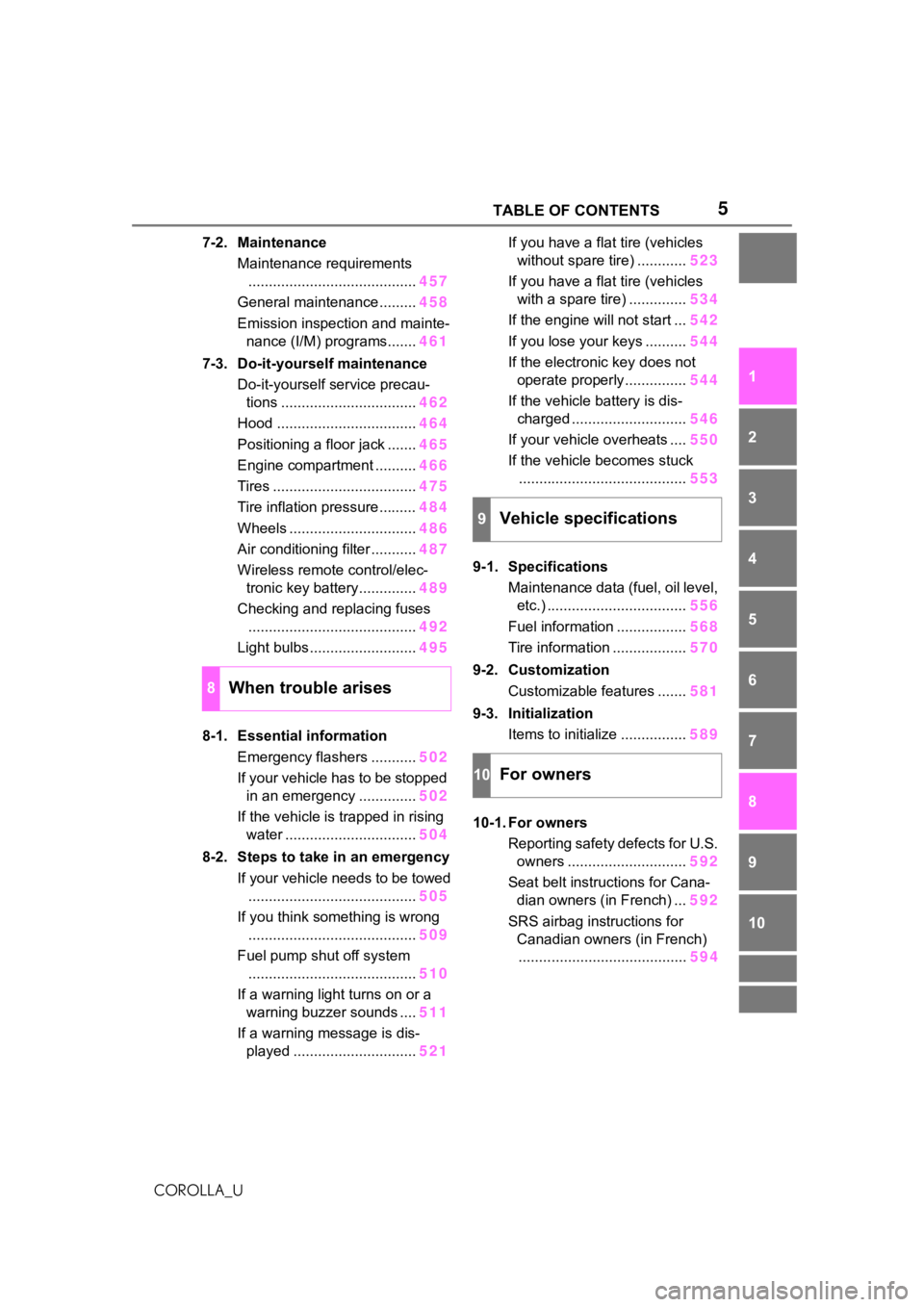
7-2. Maintenance Maintenance requirements......................................... 457
General maintenance ......... 458
Emission inspection and mainte- nance (I/M) programs....... 461
7-3. Do-it-yourself maintenance Do-it-yourself service precau-tions ................................. 462
Hood .................................. 464
Positioning a floor jack ....... 465
Engine compartment .......... 466
Tires ................................... 475
Tire inflation pressure......... 484
Wheels ............................... 486
Air conditioning filter ........... 487
Wireless remote control/elec- tronic key battery.............. 489
Checking and replacing fuses ......................................... 492
Light bulbs .......................... 495
8-1. Essential information Emergency flashers ........... 502
If your vehicle has to be stopped in an emergency .............. 502
If the vehicle is trapped in rising water ................................ 504
8-2. Steps to take in an emergency If your vehicle needs to be towed......................................... 505
If you think something is wrong ......................................... 509
Fuel pump shut off system ......................................... 510
If a warning light turns on or a warning buzzer sounds .... 511
If a warning message is dis- played .............................. 521If you have a flat tire (vehicles
without spare tire) ............ 523
If you have a flat tire (vehicles with a spare tire) .............. 534
If the engine will not start ... 542
If you lose your keys .......... 544
If the electronic key does not operate properly............... 544
If the vehicle battery is dis- charged ............................ 546
If your vehicle overheats .... 550
If the vehicle becomes stuck ......................................... 553
9-1. Specifications Maintenance data (fuel, oil level, etc.) .................................. 556
Fuel information ................. 568
Tire information .................. 570
9-2. Customization Customizable features ....... 581
9-3. Initialization Items to initialize ................ 589
10-1. For owners Reporting safety defects for U.S. owners ............................. 592
Seat belt instructions for Cana- dian owners (in French) ... 592
SRS airbag instructions for Canadian owners (in French)........ ................................. 59
4
8When trouble arises
9Vehicle specifications
10For owners
Page 14 of 624
14Pictorial index
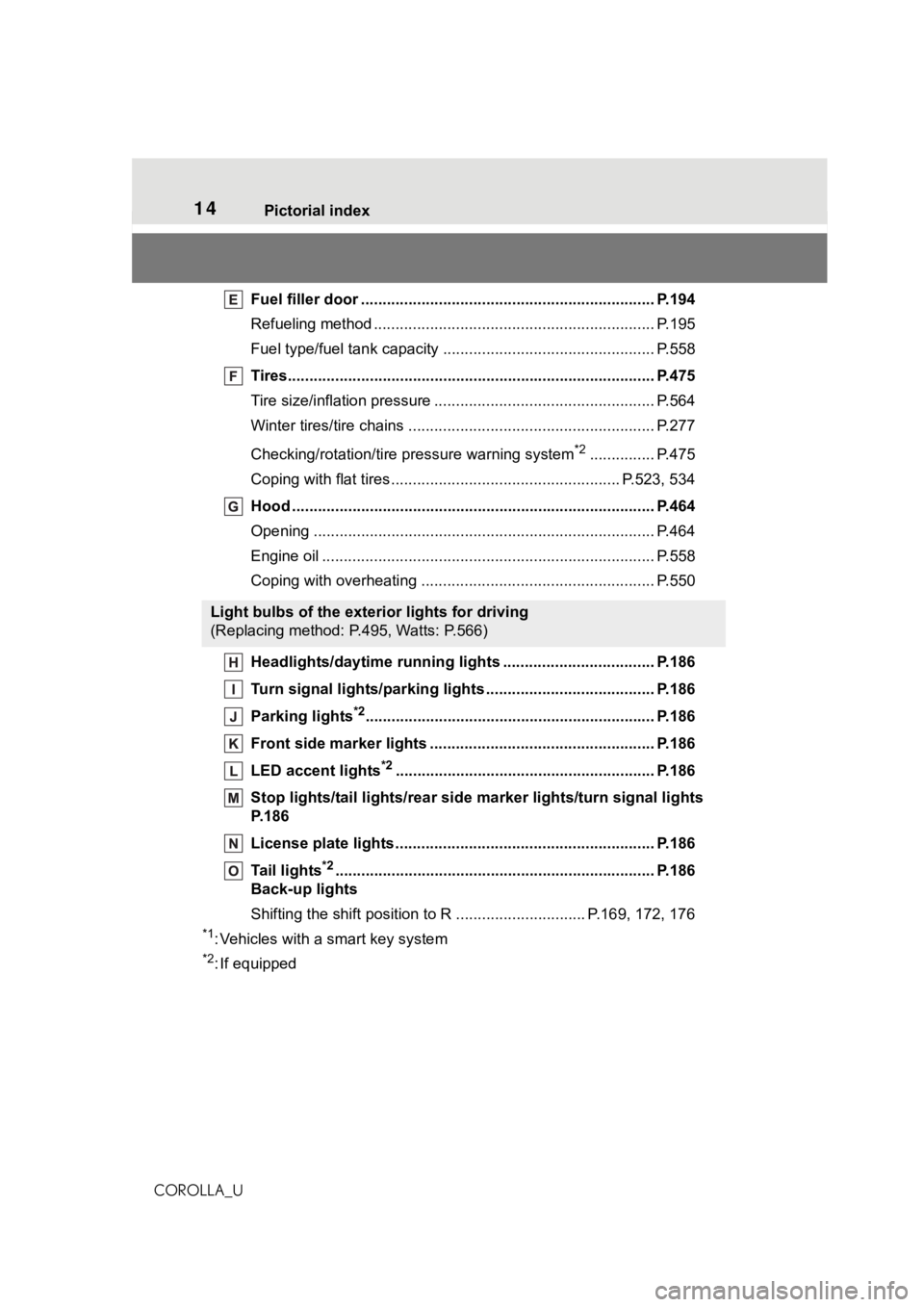
COROLLA_UFuel filler door ...............................................
..................... P.194
Refueling method ............................................... .................. P.195
Fuel type/fuel tan k capacity ................................... .............. P.558
Tires.......................................................... ........................... P.475
Tire size/inflation pressure ................................... ................ P.564
Winter tires/tire chains ....................................... .................. P.277
Checking/rotation/tire pressure warning system
*2............... P.475
Coping with flat tires......................................... ............ P.523, 534
Hood ........................................................... ......................... P.464
Opening ............................................................................... P.464
Engine oil ..................................................... ........................ P.558
Coping with overheating ...................................................... P.550
Headlights/daytime running lights .............................. ..... P.186
Turn signal lights/parking lights .............................. ......... P.186
Parking lights
*2............................................................... .... P.186
Front side marker lights ....................................... ............. P.186
LED accent lights
*2............................................................ P.1 86
Stop lights/tail lights/rear side marker lights/turn signal lig hts
P. 1 8 6
License plate lights........................................... ................. P.186
Tail lights
*2............................................................... ........... P.186
Back-up lights
Shifting the shift position to R .............................. P .169, 172, 176
*1: Vehicles with a smart key system
*2: If equipped
Light bulbs of the exterior lights for driving
(Replacing method: P.495, Watts: P.566)
Page 25 of 624
251-1. For safe use
1
For safety and security
COROLLA_U
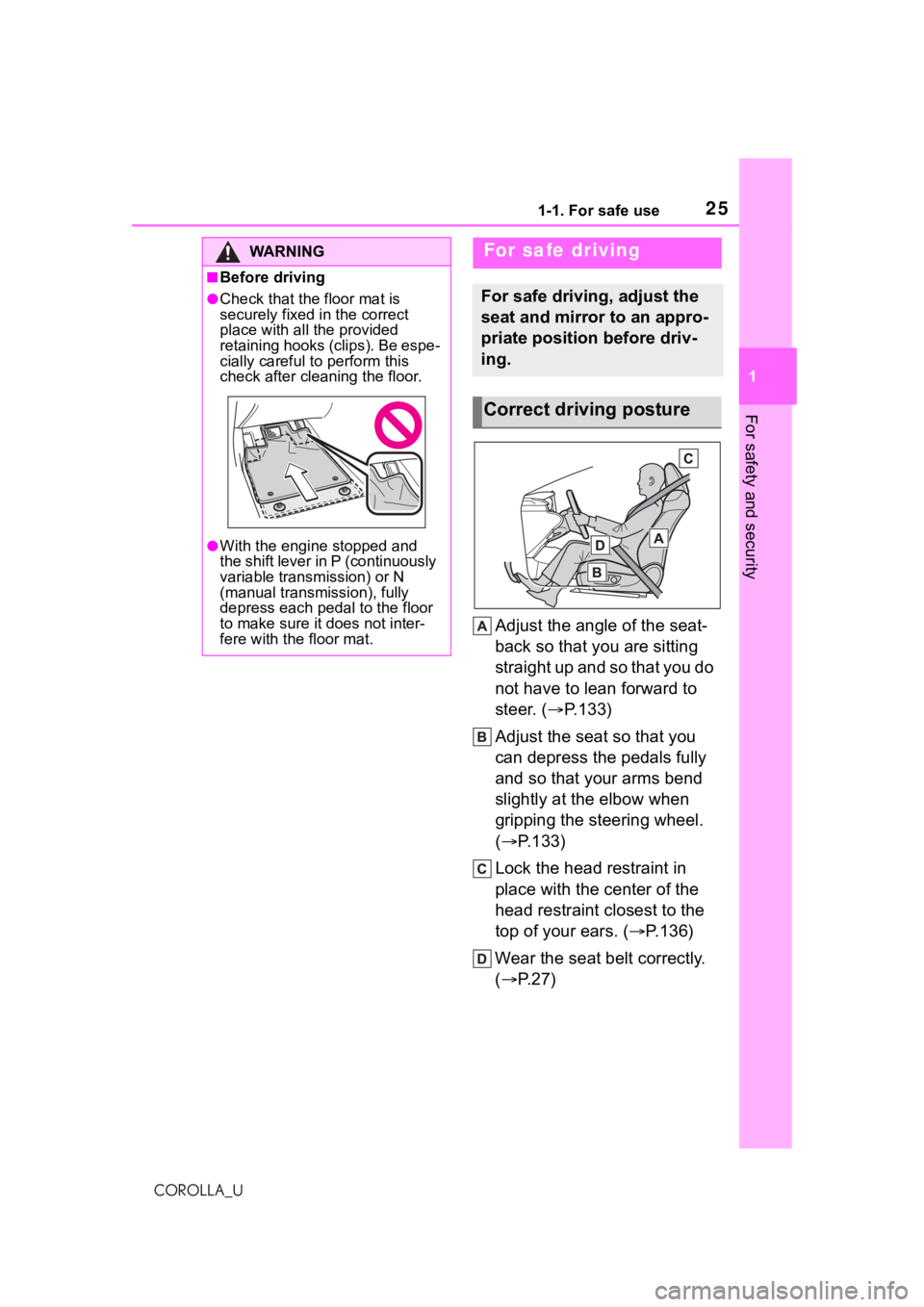
Adjust the angle of the seat-
back so that you are sitting
straight up and so that you do
not have to lean forward to
steer. (P.133)
Adjust the seat so that you
can depress the pedals fully
and so that your arms bend
slightly at the elbow when
gripping the steering wheel.
( P.133)
Lock the head restraint in
place with the center of the
head restraint closest to the
top of your ears. ( P.136)
Wear the seat belt correctly.
( P.27)
WA R N I N G
■Before driving
●Check that the floor mat is
securely fixed in the correct
place with all the provided
retaining hooks (clips). Be espe-
cially careful to perform this
check after cleaning the floor.
●With the engine stopped and
the shift lever in P (continuously
variable transmission) or N
(manual transmission), fully
depress each pedal to the floor
to make sure it does not inter-
fere with the floor mat.
For safe driving
For safe driving, adjust the
seat and mirror to an appro-
priate position before driv-
ing.
Correct driving posture
Page 46 of 624
461-1. For safe use
COROLLA_U
Exhaust gas precau-
tions
Harmful substance to the
human body is included in
exhaust gases if inhaled.
WA R N I N G
Exhaust gases include harmful
carbon monoxide (CO), which is
colorless and odorless. Observe
the following precautions.
Failure to do so may cause
exhaust gases enter the vehicle
and may lead to an accident
caused by light-headedness, or
may lead to death or a serious
health hazard.
■Important points while driving
●Keep the trunk lid closed.
●If you smell exhaust gases in
the vehicle even when the trunk
lid is closed, open the windows
and have the vehicle inspected
at your Toyota dealer as soon
as possible.
■When parking
●If the vehicle is in a poorly venti-
lated area or a closed area,
such as a garage, stop the
engine.
●Do not leave the vehicle with
the engine on for a long time.
If such a situation cannot be
avoided, park the vehicle in an
open space and ensure that
exhaust fumes do not enter the
vehicle interior.
●Do not leave the engine running
in an area with snow build-up,
or where it is snowing. If snow-
banks build up around the vehi-
cle while the engine is running,
exhaust gases may collect and
enter the vehicle.
■Exhaust pipe
The exhaust system needs to be
checked periodically. If there is a
hole or crack caused by corro-
sion, damage to a joint or abnor-
mal exhaust noise, be sure to
have the vehicle inspected and
repaired by your Toyota dealer.
Page 88 of 624
882-1. Instrument cluster
COROLLA_U
*1: These lights come on when the engine switch is turned to ON to
indicate that a system check is
being performed. They will turn
off after the engine is started, or
after a few seconds. There may
be a malfunction in a system if
the lights do not come on, or turn
off. Have the vehicle inspected
by your Toyota dealer.
*2: This light illuminates on the multi-information display.
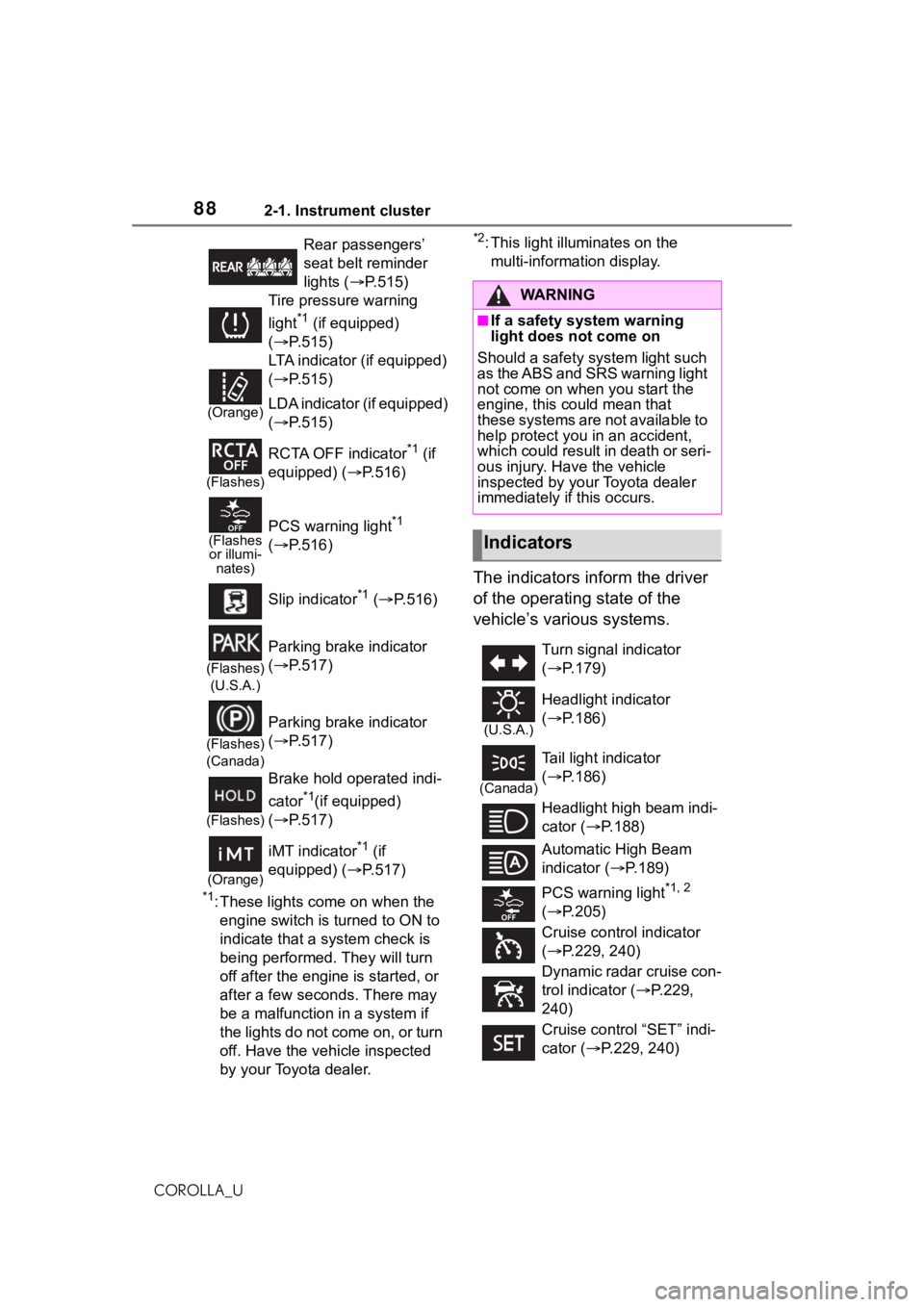
The indicators inform the driver
of the operating state of the
vehicle’s various systems.
Rear passengers’
seat belt reminder
lights ( P.515)
Tire pressure warning
light
*1 (if equipped)
( P.515)
(Orange)
LTA indicator (if equipped)
( P.515)
LDA indicator (if equipped)
( P.515)
(Flashes)
RCTA OFF indicator*1 (if
equipped) (P.516)
(Flashes or illumi- nates)PCS warning light*1
( P.516)
Slip indicator
*1 ( P.516)
(Flashes)
(U.S.A.)
Parking brake indicator
( P.517)
(Flashes)
(Canada)
Parking brake indicator
( P.517)
(Flashes)
Brake hold operated indi-
cator
*1(if equipped)
( P.517)
(Orange)
iMT indicator*1 (if
equipped) (P.517)
WA R N I N G
■If a safety system warning
light does not come on
Should a safety system light such
as the ABS and SRS warning light
not come on when you start the
engine, this cou ld mean that
these systems are not available to
help protect you in an accident,
which could result in death or seri-
ous injury. Have the vehicle
inspected by your Toyota dealer
immediately if this occurs.
Indicators
Turn signal indicator
( P.179)
(U.S.A.)
Headlight indicator
( P.186)
(Canada)
Tail light indicator
( P.186)
Headlight high beam indi-
cator ( P.188)
Automatic High Beam
indicator ( P.189)
PCS warning light
*1, 2
( P.205)
Cruise control indicator
( P.229, 240)
Dynamic radar cruise con-
trol indicator ( P.229,
240)
Cruise control “SET” indi-
cator ( P.229, 240)
Page 89 of 624
892-1. Instrument cluster
2
Vehicle status information and indicators
COROLLA_U
*1: These lights come on when the engine switch is turned to ON to
indicate that a system check is
being performed. They will turn
off after the engine is started, or
after a few seconds. There may
be a malfunction in a system if
the lights do not come on, or turn
off. Have the vehicle inspected
by your Toyota dealer.
*2: This light comes on when the system is turned off.
*3: Depending on the operating con-dition, the color and illuminat-
ing/flashing stat e of the light
change.
*4: In order to confirm operation, the BSM outside rear view mirror
indicators illumina te in the follow-
ing situations:
• When the engine switch is
turned to ON, the BSM func-
tion is enabled on of the
multi-information display.
• When the BSM function is
enabled on of the
multi-information display, the
engine switch is turned to ON.
If the system is functioning cor-
rectly, the BSM outside rear view
mirror indicators will turn off after a
few seconds.
*3
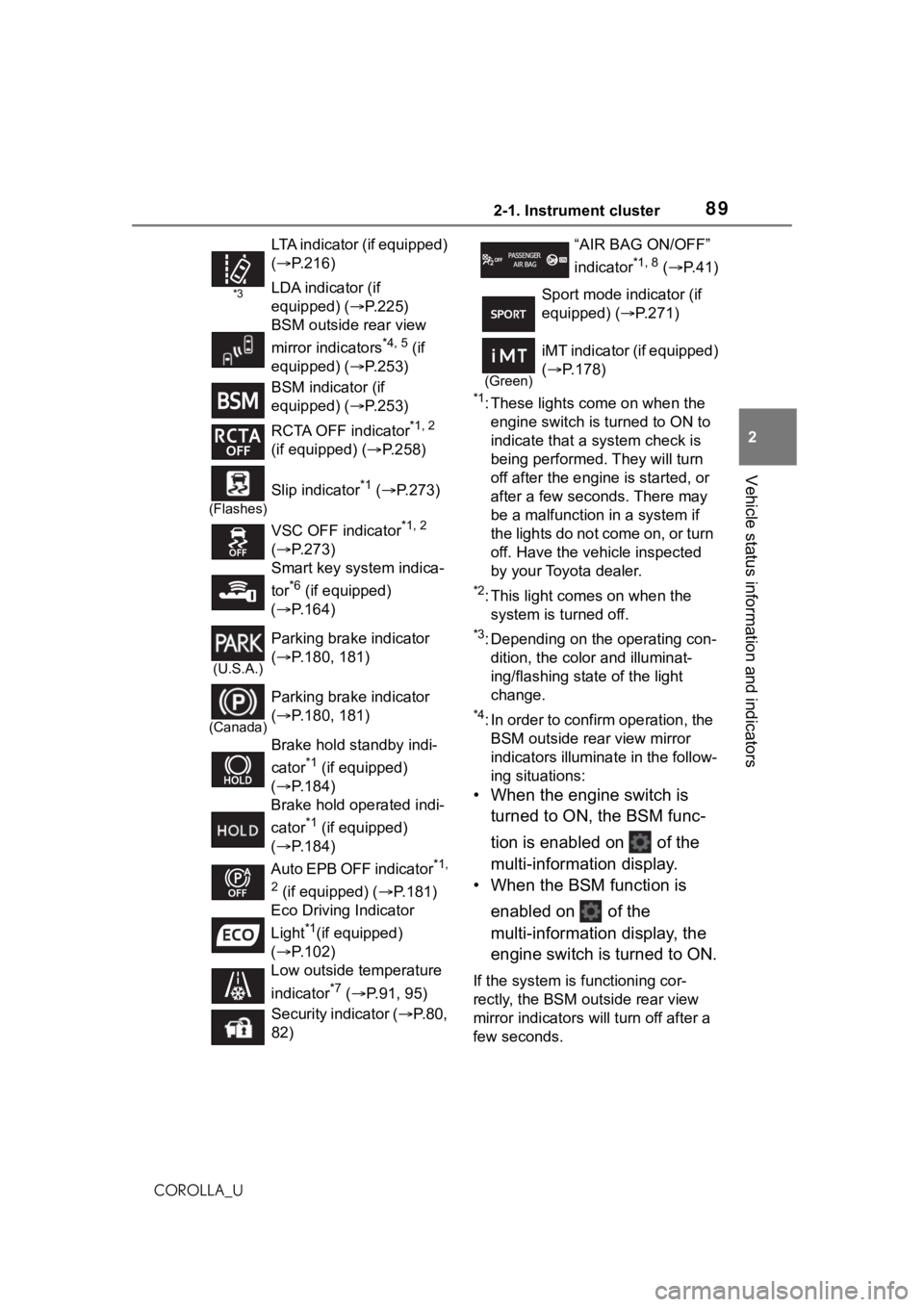
LTA indicator (if equipped)
( P.216)
LDA indicator (if
equipped) ( P.225)
BSM outside rear view
mirror indicators
*4, 5 (if
equipped) ( P.253)
BSM indicator (if
equipped) ( P.253)
RCTA OFF indicator
*1, 2
(if equipped) ( P.258)
(Flashes)
Slip indicator*1 ( P.273)
VSC OFF indicator
*1, 2
( P.273)
Smart key system indica-
tor
*6 (if equipped)
( P.164)
(U.S.A.)
Parking brake indicator
( P.180, 181)
(Canada)
Parking brake indicator
( P.180, 181)
Brake hold standby indi-
cator
*1 (if equipped)
( P.184)
Brake hold operated indi-
cator
*1 (if equipped)
( P.184)
Auto EPB OFF indicator
*1,
2
(if equipped) ( P.181)
Eco Driving Indicator
Light
*1(if equipped)
( P.102)
Low outside temperature
indicator
*7 ( P.91, 95)
Security indicator ( P.80,
82)
“AIR BAG ON/OFF”
indicator
*1, 8 ( P. 4 1 )
Sport mode indicator (if
equipped) (P.271)
(Green)
iMT indicator (if equipped)
( P.178)
Page 129 of 624
1293-2. Opening, closing and locking the doors
3
Before driving
COROLLA_Uthe doors.
●The lock sensor may not work
properly if it com
es into contact
with ice, snow, mud, etc. Clean
the lock sensor and attempt to
operate it again.
●A sudden handle operation or a
handle operation immediately
after entering the effective range
may prevent the doors from being
unlocked. Touch the door unlock
sensor and check that the doors
are unlocked bef ore pulling the
door handle again.
●If there is another electronic key in
the detection area, it may take
slightly longer to unlock the doors
after the door handle is gripped.
■When the vehicle is not driven
for extended periods
●To prevent theft of the vehicle, do
not leave the electronic key within
6 ft. (2 m) of the vehicle.
●The smart key system can be
deactivated in advance. ( P.581)
●Setting the electronic key to bat-
tery-saving mode helps to reduce
key battery depletion. ( P.127)
■To operate the system properly
●Make sure to carry the electronic
key when operati ng the system.
Do not get the electronic key too
close to the vehicle when operat-
ing the system from the outside of
the vehicle.
Depending on the position and hold-
ing condition of the electronic key,
the key may not be detected cor-
rectly and the system may not oper-
ate properly. (The alarm may go off
accidentally, or the door lock pre-
vention function may not operate.)
●Do not leave the electronic key
inside the trunk.
The key confinement prevention
function may not operate, depend-
ing on the location of the key (the
inside edge of the trunk), condi-
tions (inside a met al bag, close to metallic objects)
and the radio
waves in the surrounding area.
( P.124)
■If the smart key system does
not operate properly
●Locking and unlocking the doors:
P. 5 4 4
●Starting the engine: P. 5 4 5
■Customization
Some functions can be customized.
( P.581)
■If the smart key system has
been deactivated in a custom-
ized setting
●Locking and unlocking the doors:
Use the wireless remote control or
mechanical key. ( P.117, 544)
●Starting the engi ne and changing
engine switch modes: P. 5 4 5
●Stopping the engine: P. 1 6 6
Page 151 of 624
1514-1. Before driving
4
Driving
COROLLA_U
4Slowly release the brake
pedal.
5 Lock the door, making sure
that you have the key on your
person.
If parking on a hill, block the wheels
as needed.
Manual transmission
1 While depressing the clutch
pedal, depress the brake
pedal.
2 Set the parking brake.
( P.180, 181)
Check that the park ing brake indi-
cator is illuminated.
3 Shift the shift lever to N.
( P.176)
If parking on a hill, shift the shift
lever to 1 or R and block the wheels
as needed.
4Vehicles without a smart key
system: Turn the engine
switch to OFF to stop the
engine.
Vehicles with a smart key
system: Press the engine
switch to stop the engine.
5 Slowly release the brake
pedal.
6 Lock the door, making sure
that you have the key on your
person.
■Starting off on a steep
uphill
Continuously variable trans-
mission
1 Make sure that the parking
brake is set and shift the shift
lever to D.
2 Gently depress the accelera-
tor pedal.
3 Release the parking brake.
Manual transmission
1 Make sure that the parking
brake is set and shift the shift
lever to 1.
2 Lightly depress the accelera-
tor pedal at the same time as
gradually releasing the clutch
pedal.
3 Release the parking brake.
■Driving in the rain
●Drive carefully whe n it is raining,
because visibility will be reduced,
the windows may become
fogged-up, and the road will be
slippery.
●Drive carefully whe n it starts to
rain, because the road surface will
be especially slippery.
●Refrain from hig h speeds when
driving on an expressway in the
rain, because there may be a
layer of water between the tires
and the road surface, preventing
the steering and brakes from
operating properly.
■Engine speed while driving
(vehicles with a continuously
variable transmission)
In the following conditions, the
engine speed may become high
while driving. This is due to auto-
Page 153 of 624
1534-1. Before driving
4
Driving
COROLLA_U
WA R N I N G
■When driving the vehicle
●Do not drive if y ou are unfamil-
iar with the location of the brake
and accelerator pedals to avoid
depressing the wrong pedal.
• Accidentally depressing the accelerator pedal instead of the
brake pedal will result in sudden
acceleration that may lead to an
accident.
• When backing up, you may twist your body around, leading to a
difficulty in operating the pedals.
Make sure to operate the pedals
properly.
• Make sure to keep a correct driving posture even when mov-
ing the vehicle only slightly. This
allows you to depress the brake
and accelerator pedals properly.
• Depress the brake pedal using your right foot. Depressing the
brake pedal using your left foot
may delay respon se in an emer-
gency, resulting in an accident.
●Do not drive the vehicle over or
stop the vehicle near flammable
materials.
The exhaust system and
exhaust gases can be
extremely hot. These hot parts
may cause a fire if there is any
flammable material nearby.
●During normal driving, do not
turn off the engine. Turning the
engine off while driving will not
cause loss of steering or brak-
ing control, but the power assist
to these systems will be lost.
This will make it more difficult to
steer and brake, so you should
pull over and stop the vehicle as
soon as it is safe to do so.
However, in the event of an
emergency, such as if it
becomes impossible to stop the
vehicle in the normal way:
P.502
●Use engine braking (shift posi-
tion B*1 or downshift*2, 3) to
maintain a safe speed when
driving down a steep hill.
Using the brakes continuously
may cause the brakes to over-
heat and lose effectiveness.
(
P.169, 172, 176)
*1: Vehicles with a continuously
variable transmission (without
paddle shift switches)
*2: Vehicles with a continuously variable transmission (with
paddle shift switches)
*3: Vehicles with a manual trans-mission
●Do not adjust the positions of
the steering wheel, the seat, or
the inside or outside rear view
mirrors while driving.
Doing so may result in a loss of
vehicle control.
●Always check that all passen-
gers’ arms, heads or other parts
of their body are not outside the
vehicle.
Page 154 of 624
1544-1. Before driving
COROLLA_U
WA R N I N G
●Do not drive in excess of the
speed limit. Even if the legal
speed limit permits it, do not
drive over 85 mph (140 km/h)
unless your vehicle has
high-speed capability tires. Driv-
ing over 85 mp h (140 km/h)
may result in tire failure, loss of
control and possible injury. Be
sure to consult a tire dealer to
determine whether the tires on
your vehicle are high-speed
capability tires or not before
driving at such speeds.
■When driving on slippery
road surfaces
●Sudden braking, acceleration
and steering may cause tire
slippage and reduce your ability
to control the vehicle.
●Sudden acceleration, engine
braking due to shifting, or
changes in engine speed could
cause the vehicle to skid.
●After driving through a puddle,
lightly depress the brake pedal
to make sure that the brakes
are functioning properly. Wet
brake pads may prevent the
brakes from functioning prop-
erly. If the brakes on only one
side are wet and not functioning
properly, steering control may
be affected.
■When shifting the shift lever
●Vehicles with a continuously
variable transmission: Do not let
the vehicle roll backward while a
forward driving position is
selected, or roll forward while
the shift lever is in R.
Doing so may cause the engine
t o st all or lea d to po o r br ak e a nd
steering performance, resulting
in an accident or damage to the
vehicle.
●Vehicles with a continuously
variable transmission: Do not
shift the shift lever to P while the
vehicle is moving.
Doing so can damage the trans-
mission and may result in a loss
of vehicle control.
●Do not shift the sh ift lever to R
while the vehicle is moving for-
ward.
Doing so can damage the trans-
mission and may result in a loss
of vehicle control.
●Do not shift the shift lever to a
driving position while the vehicle
is moving backward.
Doing so can damage the trans-
mission and may result in a loss
of vehicle control.
●Moving the shift lever to N while
the vehicle is moving will disen-
gage the engine from the trans-
mission. Engine braking is not
available when N is selected.
●Vehicles with a continuously
variable transmission: Be care-
ful not to shift the shift lever with
the accelerator pedal
depressed. Shifting the shift
lever to any positions other than
P or N may lead to unexpected
rapid acceleration of the vehicle
that may cause an accident and
result in death or serious injury.
■If you hear a squealing or
scraping noise (brake pad
wear indicators)
Have the brake pads checked and
replaced by your Toyota dealer as
soon as possible.
Rotor damage may result if the
pads are not replaced when
needed.
It is dangerous to drive the vehicle
when the wear limits of the brake
pads and/or those of the brake
discs are exceeded.