lock TOYOTA COROLLA 2022 (in English) Workshop Manual
[x] Cancel search | Manufacturer: TOYOTA, Model Year: 2022, Model line: COROLLA, Model: TOYOTA COROLLA 2022Pages: 678, PDF Size: 147.24 MB
Page 133 of 678
131
3
3-4. Adjusting the steering wheel and mirrors
Before driving
3-4.Adjusting the steering wheel and mirrors
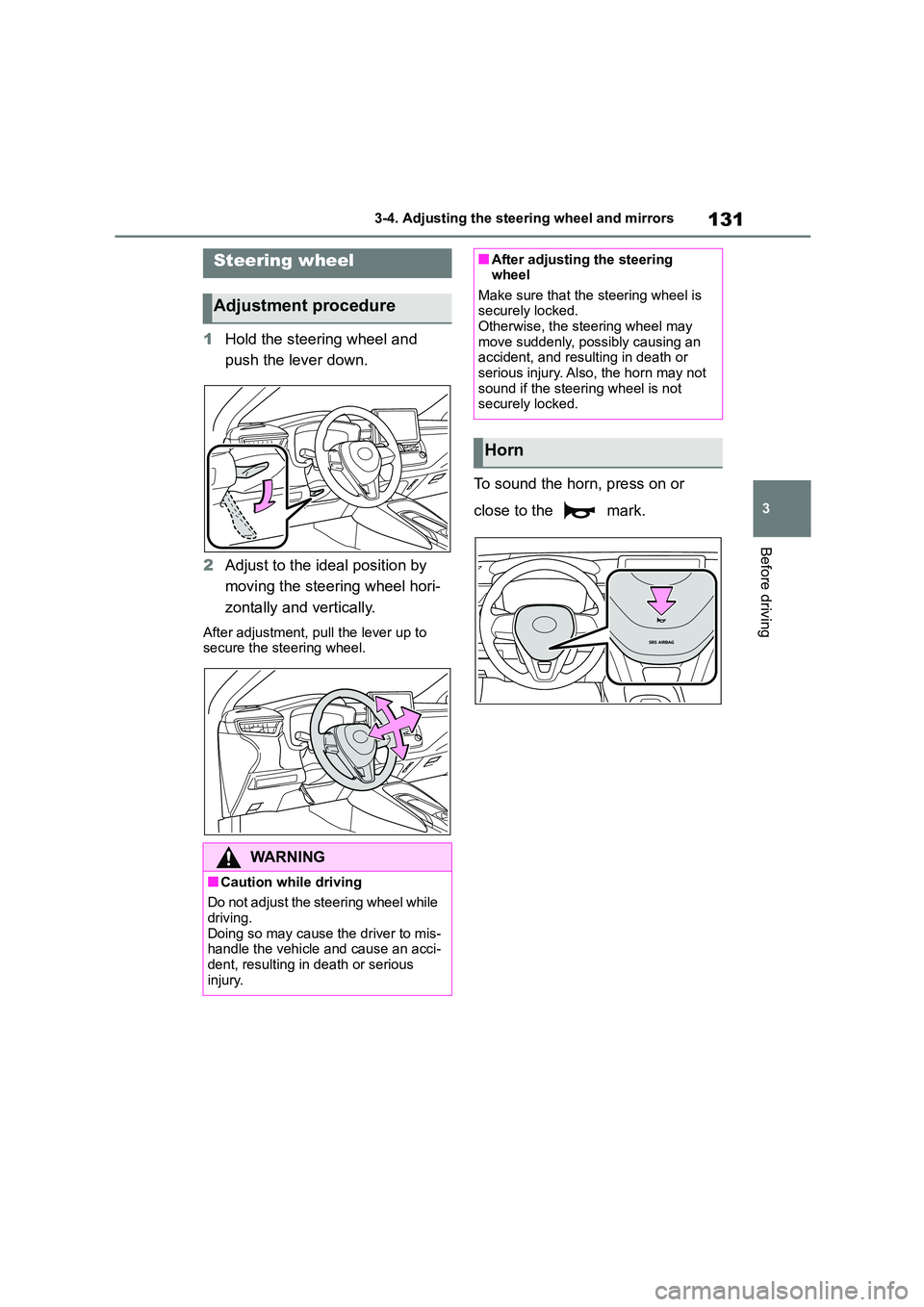
1 Hold the steering wheel and
push the lever down.
2 Adjust to the ideal position by
moving the steering wheel hori-
zontally and vertically.
After adjustment, pull the lever up to
secure the steering wheel.
To sound the horn, press on or
close to the mark.
Steering wheel
Adjustment procedure
WA R N I N G
■Caution while driving
Do not adjust the steering wheel while driving.
Doing so may cause the driver to mis-
handle the vehicle and cause an acci- dent, resulting in death or serious
injury.
■After adjusting the steering wheel
Make sure that the steering wheel is
securely locked. Otherwise, the steering wheel may
move suddenly, possibly causing an
accident, and resulting in death or serious injury. Also, the horn may not
sound if the steering wheel is not
securely locked.
Horn
Page 136 of 678
1343-4. Adjusting the steering wheel and mirrors
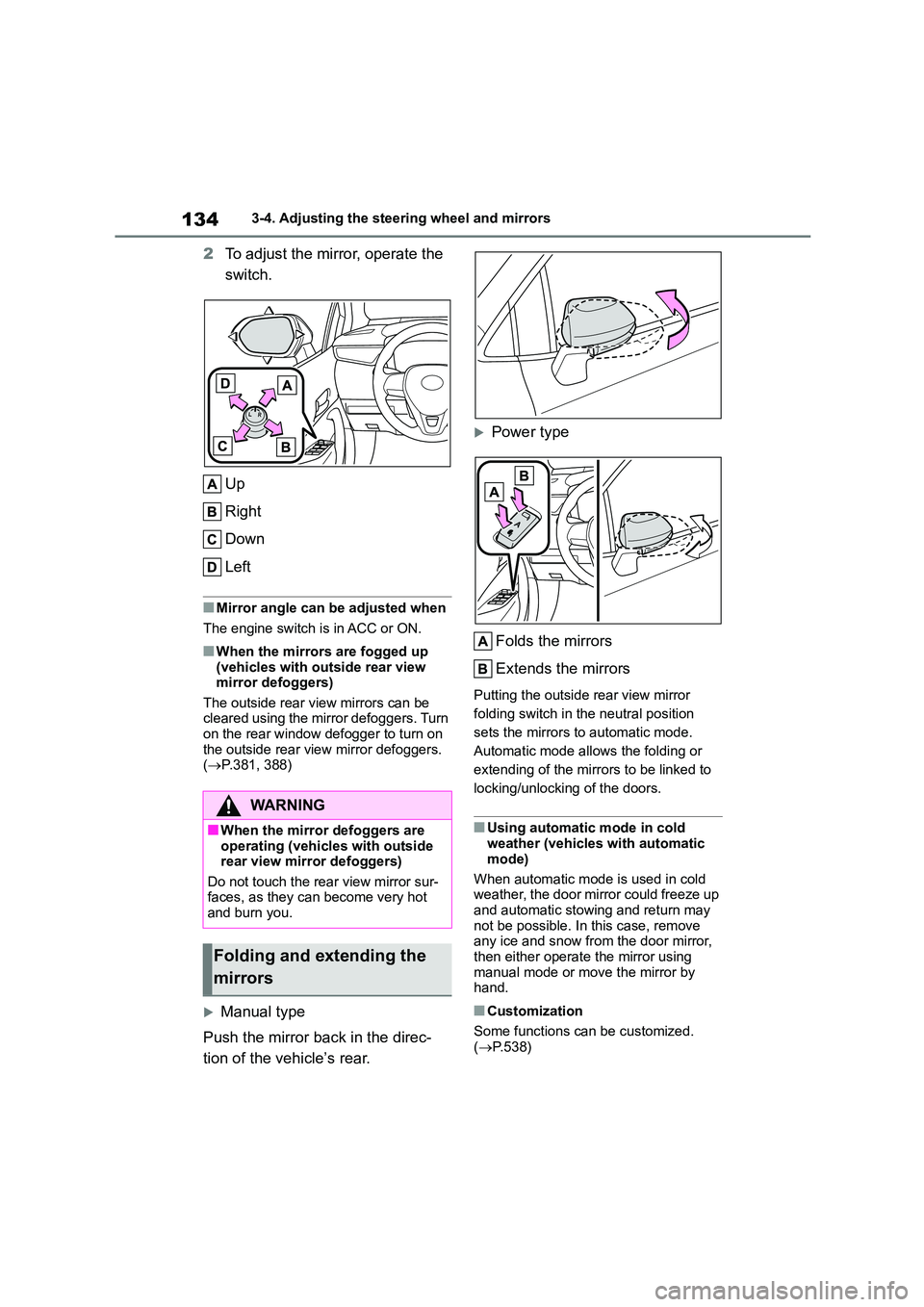
2To adjust the mirror, operate the
switch.
Up
Right
Down
Left
■Mirror angle can be adjusted when
The engine switch is in ACC or ON.
■When the mirrors are fogged up
(vehicles with outside rear view mirror defoggers)
The outside rear view mirrors can be
cleared using the mirror defoggers. Turn on the rear window defogger to turn on
the outside rear view mirror defoggers.
( P.381, 388)
Manual type
Push the mirror back in the direc-
tion of the vehicle’s rear.
Power type
Folds the mirrors
Extends the mirrors
Putting the outside rear view mirror
folding switch in the neutral position
sets the mirrors to automatic mode.
Automatic mode allows the folding or
extending of the mirrors to be linked to
locking/unlocking of the doors.
■Using automatic mode in cold
weather (vehicles with automatic
mode)
When automatic mode is used in cold weather, the door mirror could freeze up
and automatic stowing and return may
not be possible. In this case, remove any ice and snow from the door mirror,
then either operate the mirror using
manual mode or move the mirror by hand.
■Customization
Some functions can be customized.
( P.538)
WA R N I N G
■When the mirror defoggers are operating (vehicles with outside
rear view mirror defoggers)
Do not touch the rear view mirror sur- faces, as they can become very hot
and burn you.
Folding and extending the
mirrors
Page 139 of 678
137
3
3-5. Opening and closing the windows
Before driving
direction again. After the door win-
dow is completely closed, continue holding the switch for a further 1 sec-
ond or more.
If you release the switch while the win- dow is moving, start again from the
beginning.
If the window reverses and cannot be fully closed or opened, have the vehicle
inspected by any authorized Toyota
retailer or Toyota authorized repairer, or any reliable repairer.
■Door lock linked window operation
●Vehicles without a smart entry & start
system: The power windows can be
opened and closed using the key.*
( P. 1 1 4 )
Vehicles with a smart entry & start system: The power windows can be
opened and closed using the mechan-
ical key.* ( P.512)
●The power windows can be opened
and closed using the wireless remote
control.* ( P.113)*: These settings must be customized at
any authorized Toyota retailer or
Toyota authorized repairer, or any reli-
able repairer.
■Customization
Some functions can be customized.
( P.538)
WA R N I N G
Observe the following precautions.
Failure to do so may result in death or serious injury.
■Closing the windows
●The driver is responsible for all the
power window operations, including
the operation for the passengers. In order to prevent accidental opera-
tion, especially by a child, do not let
a child operate the power windows. It is possible for children and other
passengers to have body parts
caught in the power window. Also, when riding with a child, it is recom-
mended to use the window lock
switch. (P.138)
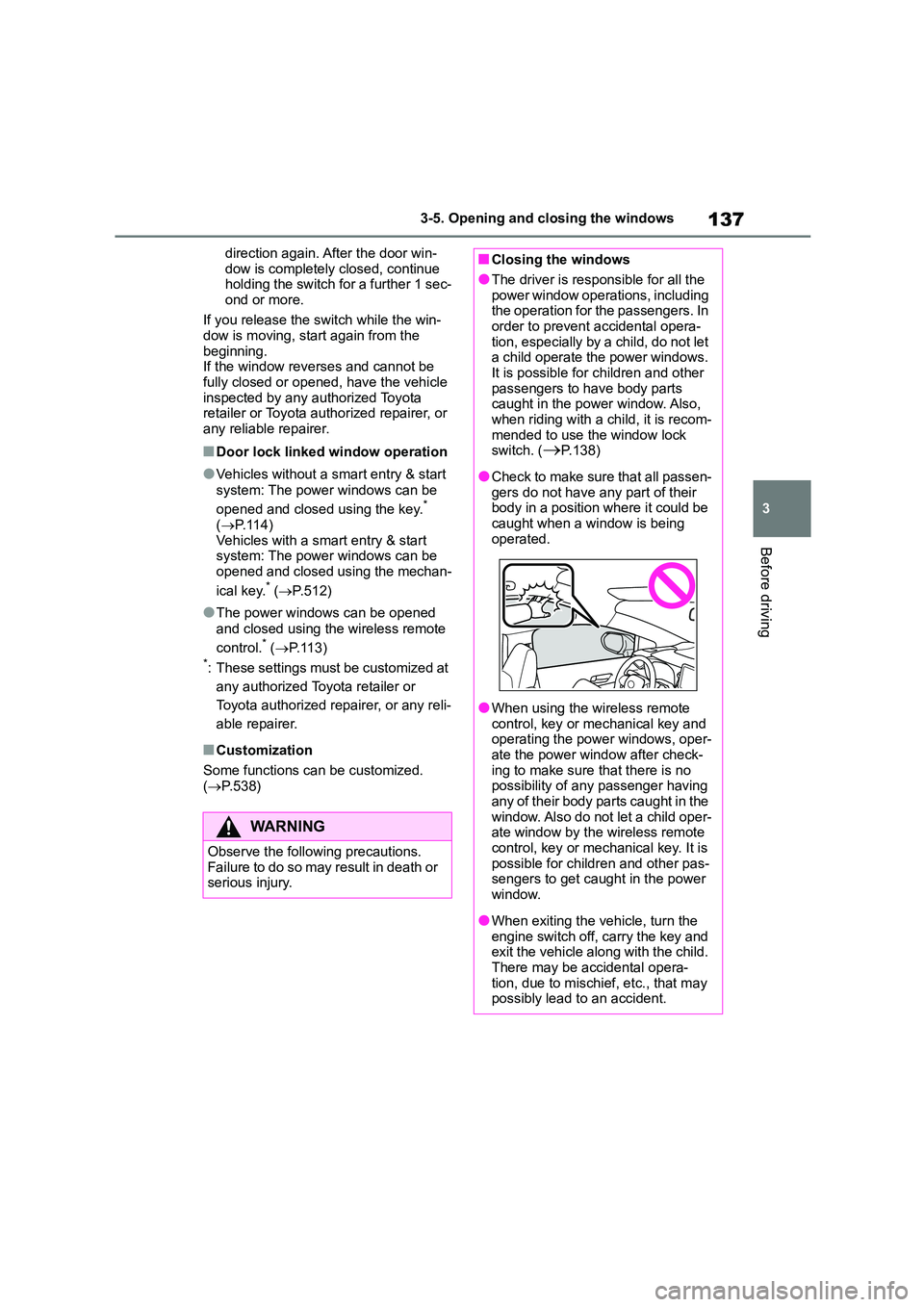
●Check to make sure that all passen-
gers do not have any part of their body in a position where it could be
caught when a window is being
operated.
●When using the wireless remote
control, key or mechanical key and operating the power windows, oper-
ate the power window after check-
ing to make sure that there is no possibility of any passenger having
any of their body parts caught in the
window. Also do not let a child oper- ate window by the wireless remote
control, key or mech anical key. It is
possible for children and other pas- sengers to get caught in the power
window.
●When exiting the vehicle, turn the
engine switch off, carry the key and
exit the vehicle along with the child.
There may be accidental opera- tion, due to mischief, etc., that may
possibly lead to an accident.
Page 140 of 678

1383-5. Opening and closing the windows
This function can be used to pre-
vent children from accidentally
opening or closing a passenger
window.
Press the switch.
The indicator will come on and the
passenger windows will be locked.
The passenger windows can still be
opened and closed using the driver’s
switch even if the lock switch is on.
■The power windows can be oper- ated when
The engine switch is in ON.
■When the battery is disconnected
The window lock switch is disabled. If necessary, press the window lock switch
after reconnecting the battery.
WA R N I N G
■Jam protection function
●Never use any part of your body to
intentionally activate the jam pro- tection function.
●The jam protection function may not work if something gets jammed just
before the window is fully closed.
Be careful not to get any part of
your body jammed in the window.
■Catch protection function
●Never use any part of your body or clothing to intentionally activate the
catch protection function.
●The catch protection function may
not work if something gets caught
just before the window is fully opened. Be careful not to get any
part of your body or clothing caught
in the window.
Preventing accidental opera-
tion (window lock switch)
Page 141 of 678

139
3
3-5. Opening and closing the windows
Before driving
*: If equipped
■Opening and closing
1 Opens the moon roof*
The moon roof stops slightly before the
fully open position to reduce wind
noise. Press the switch again to fully
open the moon roof.
2 Closes the moon roof*
*: Lightly press either side of the moon
roof switch to stop the moon roof
partway.
■Tilting up and down
1 Tilts the moon roof up*
2Tilts the moon roof down*
*: Lightly press either side of the moon
roof switch to stop the moon roof
partway.
■The moon roof can be operated
when
The engine switch is in ON.
■Operating the moon roof after turn- ing the engine off
The moon roof can be operated for
approximately 45 seconds after the engine switch is turned to ACC or OFF.
It cannot, however, be operated once
either front door is opened.
■Jam protection function
If an object is detected between the moon roof and the frame while the moon
roof is closing or tilting down, travel is
stopped and the moon roof opens slightly.
■Sunshade
The sunshade can be opened and
closed manually. However, the sun- shade will open automatically when the
moon roof is opened.
■Door lock linked moon roof opera-
tion
●Vehicles without a smart entry & start
system: The moon roof can be
opened and closed using the key.* ( P. 1 1 4 )
Vehicles with a smart entry & start
system: The moon roof can be opened and closed using the mechan-
ical key.* ( P.512)
●The moon roof can be opened and
closed using the wireless remote con-
trol.* ( P.113)*: These settings must be customized at
any authorized Toyota retailer or
Toyota authorized repairer, or any reli-
able repairer.
Moon roof*
Use the overhead switches to
open and close the moon roof
and tilt it up and down.
Operating the moon roof
Page 147 of 678
145
4
4-1. Before driving
Driving
4-1.Before driving
■Starting the engine
P.159, 160
■Driving
Multidrive
1 With the brake pedal depressed,
shift the shift lever to D.
( P.165)
2 Release the parking brake.
( P.172, 173)
3 Gradually release the brake
pedal and gently depress the
accelerator pedal to accelerate
the vehicle.
Manual transmission
1 While depressing the clutch
pedal, shift the shift lever to 1.
( P.169)
2 Release the parking brake.
( P.172, 173)
3 Gradually release the clutch
pedal. At the same time, gently
depress the accelerator pedal to
accelerate the vehicle.
■Stopping
Multidrive
1 With the shift lever in D, depress
the brake pedal.
2 If necessary, set the parking
brake.
If the vehicle is to be stopped for an
extended period of time, shift the shift lever to P. ( P.165)
Manual transmission
1 While depressing the clutch
pedal, depress the brake pedal.
2 If necessary, set the parking
brake.
If the vehicle is to be stopped for an extended period of time, shift the shift
lever to N. ( P.169)
■Parking the vehicle
Multidrive
1 With the shift lever in D, depress
the brake pedal to stop the vehi-
cle completely.
2 Set the parking brake (P.172,
173), and shift the shift lever to
P. ( P.165)
Check the parking brake indicator is
illuminated.
3 Vehicles without a smart entry &
start system: Turn the engine
switch to OFF to stop the
engine.
Vehicles with a smart entry &
start system: Press the engine
switch to stop the engine.
4 Slowly release the brake pedal.
5 Lock the door, making sure that
you have the key on your per-
son.
If parking on a hill, block the wheels as needed.
Driving the vehicle
The following procedures
should be observed to ensure
safe driving:
Driving procedure
Page 148 of 678
1464-1. Before driving
Manual transmission
1 While depressing the clutch
pedal, depress the brake pedal.
2 Set the parking brake. (P.172,
173)
Check that the parking brake indicator
is illuminated.
3 Shift the shift lever to N.
( P.169)
If parking on a hill, shift the shift lever to
1 or R and block the wheels as needed.
4 Vehicles without a smart entry &
start system: Turn the engine
switch to OFF to stop the
engine.
Vehicles with a smart entry &
start system: Press the engine
switch to stop the engine.
5 Slowly release the brake pedal.
6 Lock the door, making sure that
you have the key on your per-
son.
■Starting off on a steep uphill
Multidrive
1 Make sure that the parking
brake is set and shift the shift
lever to D.
2 Gently depress the accelerator
pedal.
3 Release the parking brake.
Manual transmission
1 Make sure that the parking
brake is set and shift the shift
lever to 1.
2 Lightly depress the accelerator
pedal at the same time as grad-
ually releasing the clutch pedal.
3 Release the parking brake.
■Driving in the rain
●Drive carefully when it is raining,
because visibility will be reduced, the windows may become fogged-up, and
the road will be slippery.
●Drive carefully when it starts to rain,
because the road surface will be
especially slippery.
●Refrain from high speeds when driv-
ing on an expressway in the rain, because there may be a layer of water
between the tires and the road sur-
face, preventing the steering and brakes from operating properly.
■Engine speed while driving (vehi-
cles with a Multidrive)
In the following conditions, the engine speed may become high while driving.
This is due to automatic up-shifting con-
trol or down-shifting implementation to meet driving conditions. It does not indi-
cate sudden acceleration.
●The vehicle is judged to be driving
uphill or downhill
●When the accelerator pedal is released
●When the brake pedal is depressed while sport mode is selected
■Restraining the engine output
(Brake Override System)
●When the accelerator and brake ped-
als are depressed at the same time,
the engine output may be restrained.
●A warning message is displayed on
the multi-information display while the system is operating.
■Restraining sudden start
(Drive-Start Control [vehicles with a
Multidrive])
●When the following unusual operation
Page 152 of 678

1504-1. Before driving
WA R N I N G
●Always apply the parking brake,
shift the shift lever to P (vehicles
with a Multidrive), stop the engine and lock the vehicle.
Do not leave the vehicle unat-
tended while the engine is running. If the vehicle is parked with the shift
lever in P but the parking brake is
not set, the vehicl e may start to
move, possibly leading to an acci- dent.
●Do not touch the exhaust pipes while the engine is running or
immediately after turning the engine
off. Doing so may cause burns.
■When taking a nap in the vehicle
Always turn the engine off. Otherwise,
if you accidentally move the shift lever
or depress the accelerator pedal, this could cause an accident or fire due to
engine overheating. Additionally, if the
vehicle is parked in a poorly ventilated area, exhaust gases may collect and
enter the vehicle, leading to death or
a serious health hazard.
■When braking
●When the brakes are wet, drive more cautiously.
Braking distance increases when
the brakes are wet, and this may cause one side of the vehicle to
brake differently than the other
side. Also, the parking brake may not securely hold the vehicle.
●If the brake booster device does not operate, do not follow other vehi-
cles closely and avoid hills or sharp
turns that require braking. In this case, braking is still possible,
but the brake pedal should be
depressed more firmly than usual. Also, the braking distance will
increase. Have your brakes fixed
immediately.
●Do not pump the brake pedal if the engine stalls.
Each push on the brake pedal uses
up the reserve for the power-assisted brakes.
●The brake system consists of 2 indi-vidual hydraulic systems; if one of
the systems fails, the other will still
operate. In this case, the brake pedal should be depressed more
firmly than usual and the braking
distance will increase. Have your brakes fixed immediately.
■If the vehicle becomes stuck
Do not spin the wheels excessively
when a driven wheel is up in the air,
or the vehicle is stuck in sand, mud, etc. This may damage the driveline
components or propel the vehicle for-
ward or backward, causing an acci- dent.
NOTICE
■When driving the vehicle (vehi-
cles with a Multidrive)
●Do not depress the accelerator and brake pedals at the same time dur-
ing driving, as this may restrain the
engine output.
●Do not use the accelerator pedal or
depress the accelerator and brake pedals at the same time to hold the
vehicle on a hill.
■When driving the vehicle (vehi-
cles with a manual transmission)
●Do not depress the accelerator and brake pedals at the same time dur-
ing driving, as this may restrain the
engine output.
●Do not shift gears unless the clutch
pedal is fully depressed. After shift- ing, do not release the clutch pedal
abruptly. Doing so may damage the
clutch, transmission and gears.
Page 154 of 678

1524-1. Before driving
Cargo and luggage
Take notice of the following
information about storage pre-
cautions, cargo capacity and
load:
WA R N I N G
■Things that must not be carried
in the trunk
The following things may cause a fire if loaded in the trunk:
●Receptacles containing gasoline
●Aerosol cans
■Storage precautions
Observe the following precautions.
Failure to do so may prevent the ped- als from being depressed properly,
may block the driver’s vision, or may
result in items hitting the driver or passengers, possibly causing an acci-
dent.
●Stow cargo and luggage in the trunk
whenever possible.
●When you fold down the rear seats,
long items should not be placed
directly behind the front seats.
●Do not place cargo or luggage in or
on the following locations.
• At the feet of the driver
• On the front passenger or rear seats (when stacking items)
• On the package tray
• On the instrument panel
• On the dashboard
●Secure all items in the occupant compartment.
■Load and distribution
●Do not overload your vehicle.
●Do not apply loads unevenly.Improper loading may cause deteri-
oration of steering or braking con-
trol which may cause death or serious injury.
Page 155 of 678
153
4
4-1. Before driving
Driving
Check the allowable towing capac-
ity, GVM (Gross Vehicle Mass),
MPAC (Maximum Permissible Axle
Capacity), and permissible drawbar
load before towing. ( P.524)
Toyota recommends the use of the
Toyota hitch/bracket for your vehi-
cle. Other products of a suitable
nature and comparable quality may
also be used.
For vehicles where the towing
device blocks any of the lights or
license plate, the following shall be
observed:
Do not use towing devices that
cannot be easily removed or
repositioned.
Towing devices must be
removed or repositioned when
not in use.
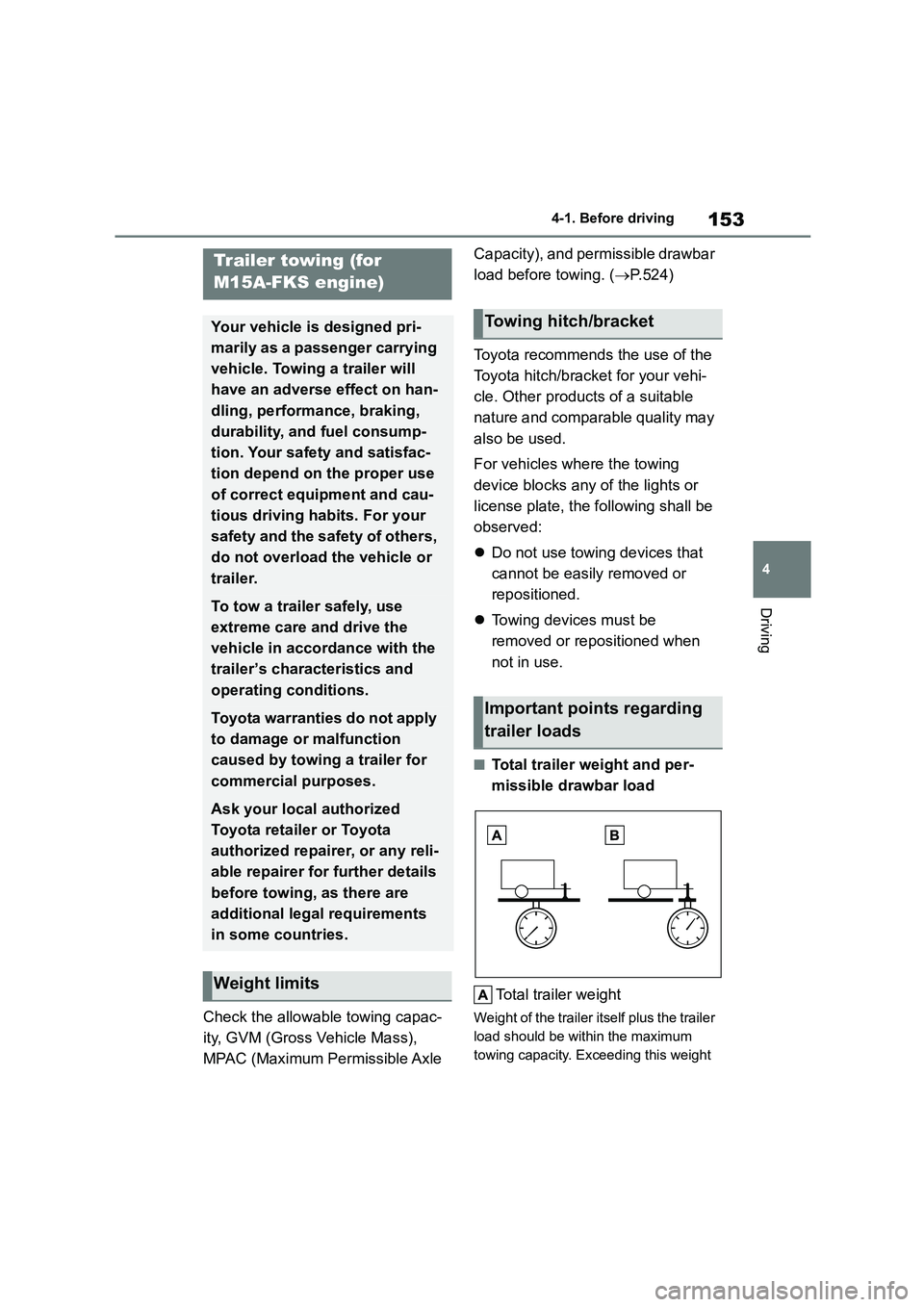
■Total trailer weight and per-
missible drawbar load
Total trailer weight
Weight of the trailer itself plus the trailer
load should be within the maximum
towing capacity. Exceeding this weight
Trailer towing (for
M15A-FKS engine)
Your vehicle is designed pri-
marily as a passenger carrying
vehicle. Towing a trailer will
have an adverse effect on han-
dling, performance, braking,
durability, and fuel consump-
tion. Your safety and satisfac-
tion depend on the proper use
of correct equipment and cau-
tious driving habits. For your
safety and the safety of others,
do not overload the vehicle or
trailer.
To tow a trailer safely, use
extreme care and drive the
vehicle in accordance with the
trailer’s characteristics and
operating conditions.
Toyota warranties do not apply
to damage or malfunction
caused by towing a trailer for
commercial purposes.
Ask your local authorized
Toyota retailer or Toyota
authorized repairer, or any reli-
able repairer for further details
before towing, as there are
additional legal requirements
in some countries.
Weight limits
Towing hitch/bracket
Important points regarding
trailer loads