emergency towing TOYOTA COROLLA 2022 Owners Manual (in English)
[x] Cancel search | Manufacturer: TOYOTA, Model Year: 2022, Model line: COROLLA, Model: TOYOTA COROLLA 2022Pages: 678, PDF Size: 147.24 MB
Page 4 of 678
2TABLE OF CONTENTS
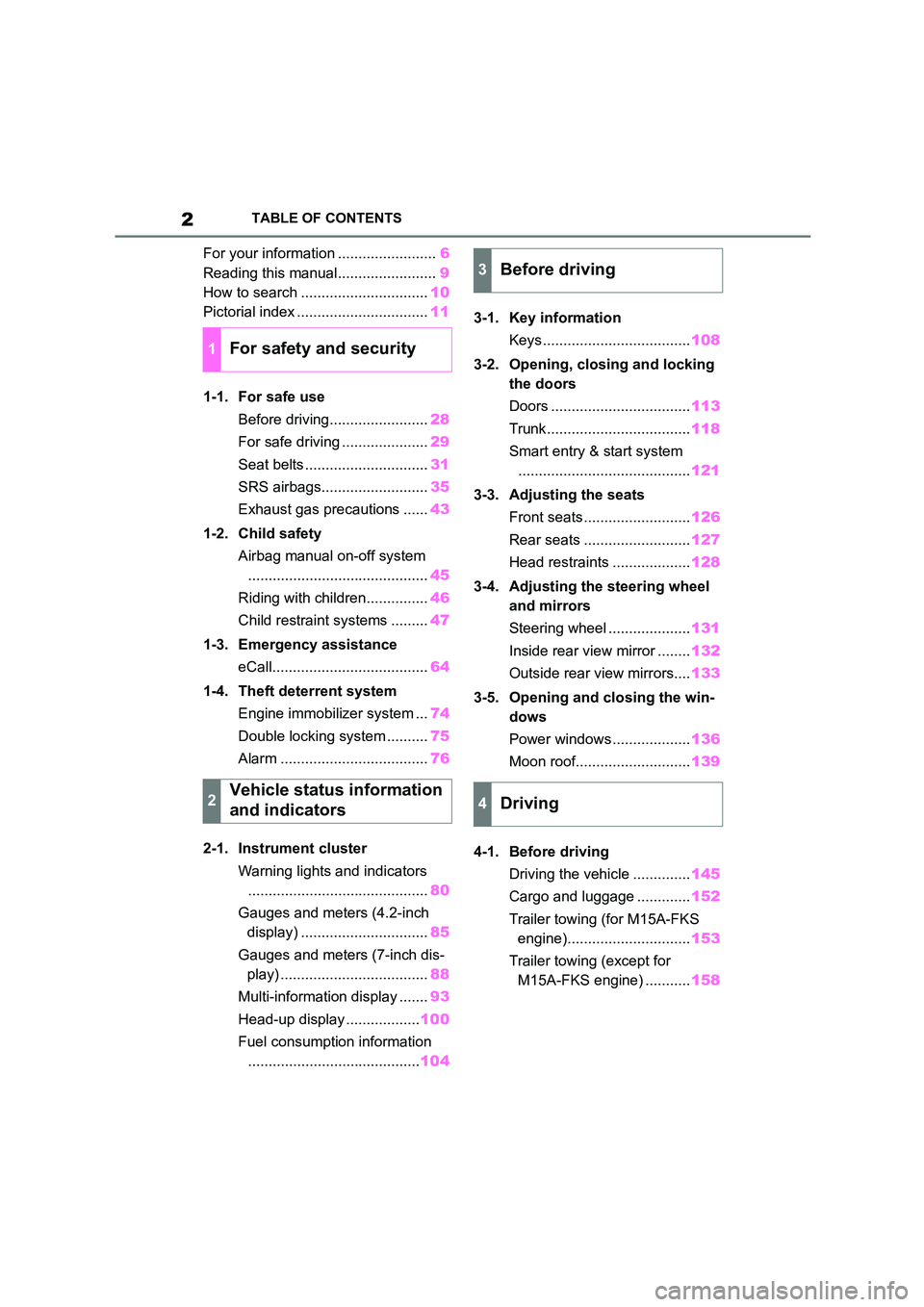
For your information ........................6
Reading this manual........................ 9
How to search ............................... 10
Pictorial index ................................ 11
1-1. For safe use
Before driving........................ 28
For safe driving ..................... 29
Seat belts .............................. 31
SRS airbags.......................... 35
Exhaust gas precautions ...... 43
1-2. Child safety
Airbag manual on-off system
............................................ 45
Riding with children............... 46
Child restraint systems ......... 47
1-3. Emergency assistance
eCall...................................... 64
1-4. Theft deterrent system
Engine immobilizer system ... 74
Double locking system .......... 75
Alarm .................................... 76
2-1. Instrument cluster
Warning lights and indicators
............................................ 80
Gauges and meters (4.2-inch
display) ............................... 85
Gauges and meters (7-inch dis-
play) .................................... 88
Multi-information display ....... 93
Head-up display .................. 100
Fuel consumption information
.......................................... 104
3-1. Key information
Keys .................................... 108
3-2. Opening, closing and locking
the doors
Doors .................................. 113
Trunk................................... 118
Smart entry & start system
.......................................... 121
3-3. Adjusting the seats
Front seats .......................... 126
Rear seats .......................... 127
Head restraints ................... 128
3-4. Adjusting the steering wheel
and mirrors
Steering wheel .................... 131
Inside rear view mirror ........ 132
Outside rear view mirrors.... 133
3-5. Opening and closing the win-
dows
Power windows ................... 136
Moon roof............................ 139
4-1. Before driving
Driving the vehicle .............. 145
Cargo and luggage ............. 152
Trailer towing (for M15A-FKS
engine).............................. 153
Trailer towing (except for
M15A-FKS engine) ........... 158
1For safety and security
2Vehicle status information
and indicators
3Before driving
4Driving
Page 15 of 678
13Pictorial index
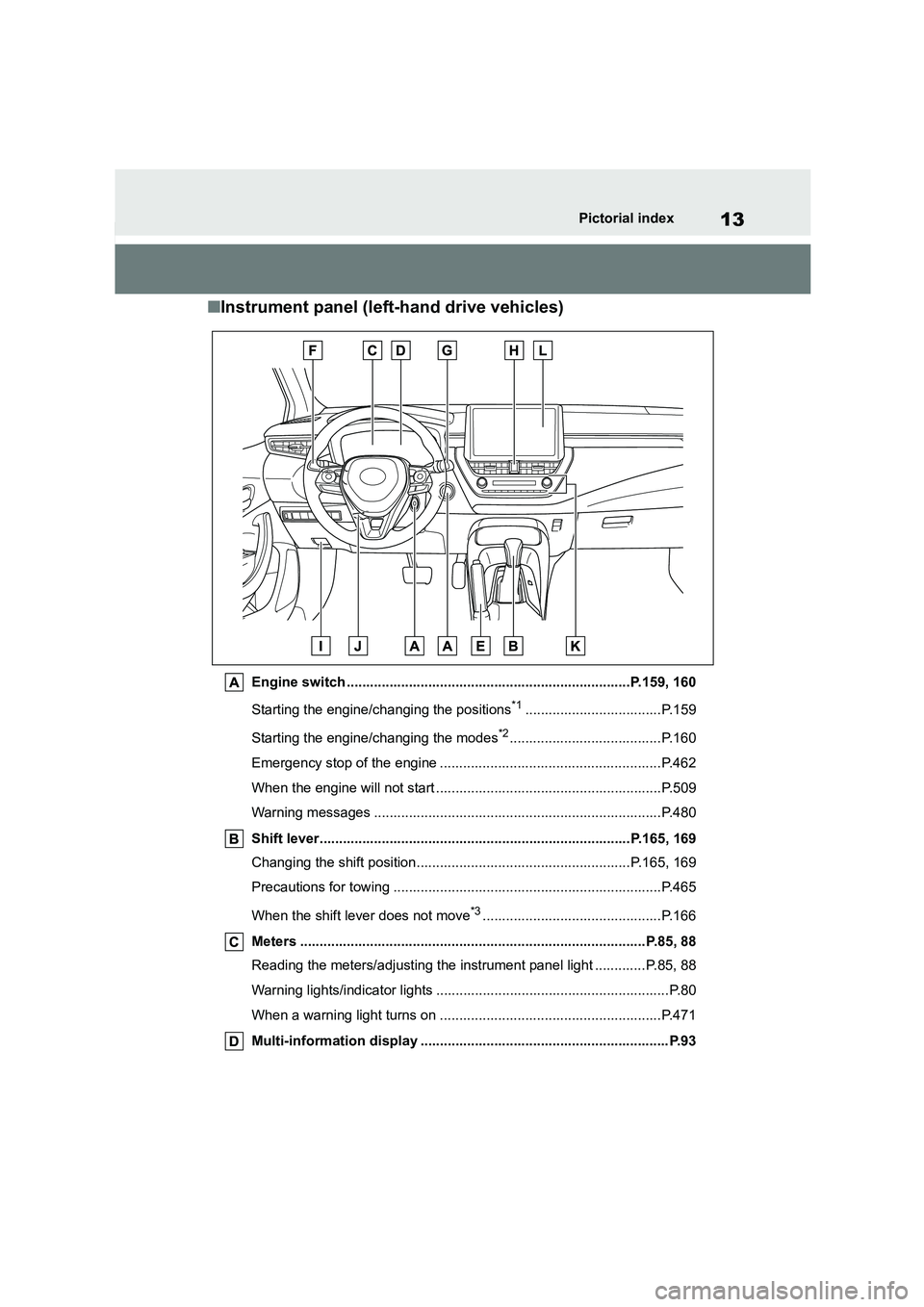
■Instrument panel (left-hand drive vehicles)
Engine switch .........................................................................P.159, 160
Starting the engine/changing the positions*1...................................P.159
Starting the engine/changing the modes*2.......................................P.160
Emergency stop of the engine .........................................................P.462
When the engine will not start ..........................................................P.509
Warning messages ..........................................................................P.480
Shift lever................................................................................P.165, 169
Changing the shift position.......................................................P.165, 169
Precautions for towing .....................................................................P.465
When the shift lever does not move*3..............................................P.166
Meters .........................................................................................P.85, 88
Reading the meters/adjusting the instrument panel light ............. P.85, 88
Warning lights/indicator lights ............................................................P.80
When a warning light turns on .........................................................P.471
Multi-information display ................................................................P.93
Page 22 of 678
20Pictorial index
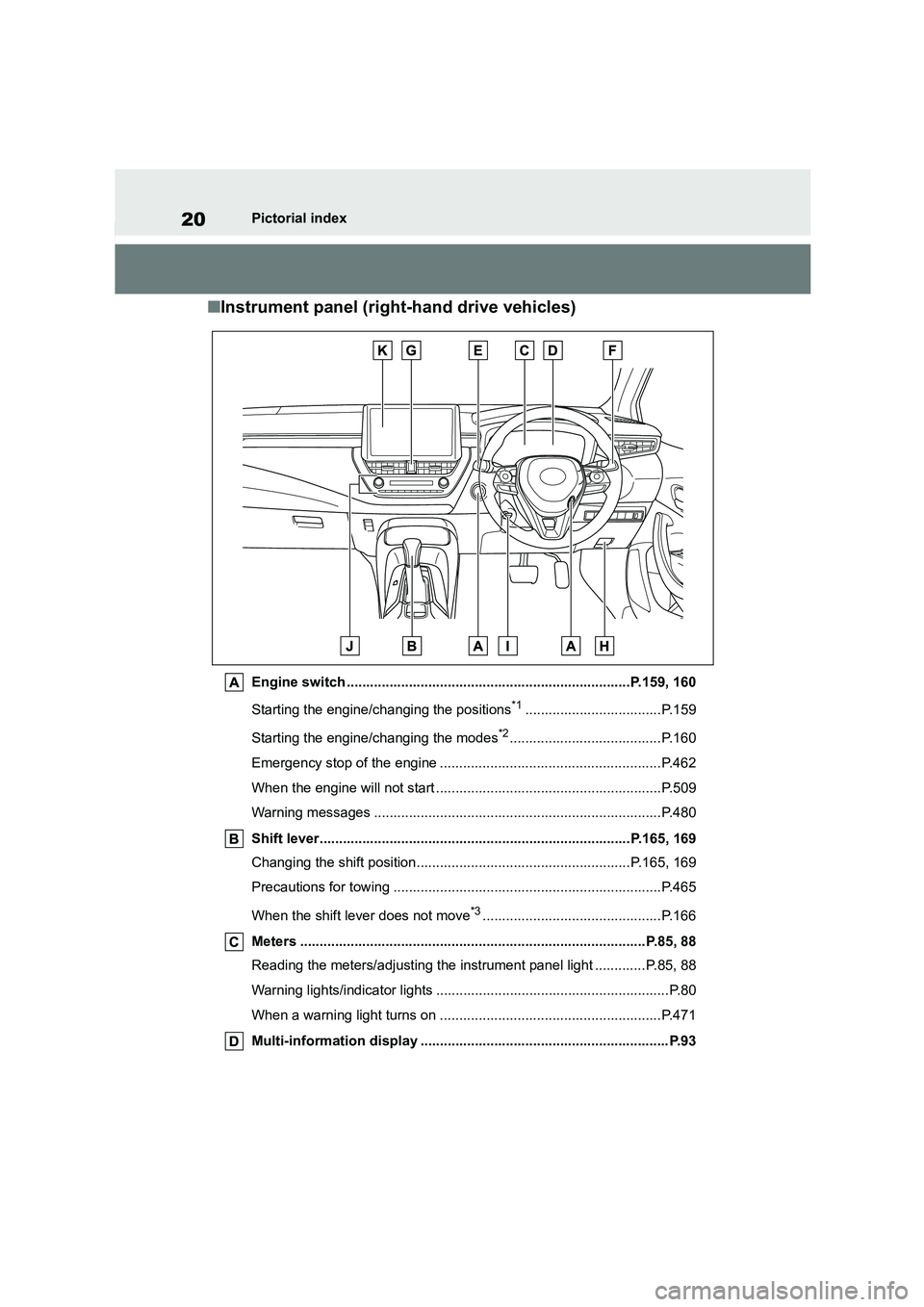
■Instrument panel (right-hand drive vehicles)
Engine switch .........................................................................P.159, 160
Starting the engine/changing the positions*1...................................P.159
Starting the engine/changing the modes*2.......................................P.160
Emergency stop of the engine .........................................................P.462
When the engine will not start ..........................................................P.509
Warning messages ..........................................................................P.480
Shift lever................................................................................P.165, 169
Changing the shift position.......................................................P.165, 169
Precautions for towing .....................................................................P.465
When the shift lever does not move*3..............................................P.166
Meters .........................................................................................P.85, 88
Reading the meters/adjusting the instrument panel light ............. P.85, 88
Warning lights/indicator lights ............................................................P.80
When a warning light turns on .........................................................P.471
Multi-information display ................................................................P.93
Page 159 of 678
157
4
4-1. Before driving
Driving
of your vehicle and trailer and
ensure that the vehicle-to-vehicle
distance is sufficient before execut-
ing lane changes.
■Transmission information
Multidrive
To maintain engine braking effi-
ciency and charging system perfor-
mance when using engine braking,
do not use the transmission in D,
must be in M and select gear step 4
or lower. ( P. 1 6 5 )
Manual transmission
Refrain from driving in 6th gear to
maintain the effectiveness of
engine braking and to maintain
charging system performance.
■If the engine overheats
Towing a loaded trailer up a long,
steep incline in temperatures
exceeding 30°C (85°F) may result
in the engine overheating. If the
engine coolant temperature gauge
indicates that the engine is over-
heating, turn the air conditioning off
immediately, leave the road and
stop the vehicle in a safe place.
( P.518)
■When parking the vehicle
Always place wheel chocks under
the wheels of both the vehicle and
trailer. Firmly set the parking brake
and shift the shift lever to P
(Multidrive) and 1 or R (manual
transmission).
WA R N I N G
Follow all the instructions described in
this section. Failure to do so could
cause an accident resulting in death or serious injury.
■Trailer towing precautions
When towing, make sure that none of
the weight limits are exceeded.
( P.153)
■Vehicle speed in towing
Observe the legal maximum speeds
for trailer towing.
■Before descending hills or long
declines
Reduce speed and downshift. How-
ever, never downshift suddenly while
descending steep or long downhill grades.
■Operation of the brake pedal
Do not hold the brake pedal
depressed often or for long periods of
time. Doing so may result in the brake overheating or reduce braking effects.
■To avoid accident or injury
●Vehicles with a compact spare tire:
Do not tow a trailer when the com-
pact spare tire is installed on your vehicle.
●Vehicles with the emergency tire puncture repair kit: Do not tow a
trailer when the tire installed is
repaired with the emergency tire puncture repair kit.
●Do not use the following systems when trailer towing.
• Cruise control (if equipped)
• Dynamic radar cruise control (if
equipped)
• Dynamic radar cruise control with
full-speed range (if equipped)
Page 212 of 678
2104-5. Using the driving support systems
WA R N I N G
■Before using LTA system
●Do not rely solely upon the LTA sys-
tem. The LTA system does not automatically drive the vehicle or
reduce the amount of attention that
must be paid to the area in front of the vehicle. The driver must always
assume full responsibility for driving
safely by paying careful attention to
the surrounding conditions and operating the steering wheel to cor-
rect the path of the vehicle. Also,
the driver must take adequate breaks when fatigued, such as from
driving for a long period of time.
●Failure to perform appropriate driv-
ing operations and pay careful
attention may lead to an accident, resulting in death or serious injury.
●When not using the LTA system, use the LTA switch to turn the sys-
tem off.
■Situations unsuitable for LTA
system
In the following situations, use the LTA switch to turn the system off. Fail-
ure to do so may lead to an accident,
resulting in death or serious injury.
●Vehicle is driven on a road surface
which is slippery due to rainy weather, fallen snow, freezing, etc.
●Vehicle is driven on a snow-cov-ered road.
●White (yellow) lines are difficult to see due to rain, snow, fog, dust,
etc.
●Vehicle is driven in a temporary
lane or restricted lane due to con-
struction work.
●Vehicle is driven in a construction
zone.
●A spare tire, tire chains, etc. are
equipped.
●When the tires have been exces- sively worn, or when the tire infla-
tion pressure is low.
●When tires of a size other than
specified are installed.
●Vehicle is driven in traffic lanes
other than that highways and free-
ways.
●When your vehicle is towing a
trailer or during emergency towing
■Preventing LTA system malfunc-
tions and operations performed by mistake
●Do not modify the headlights or
place stickers, etc. on the surface of the lights.
●Do not modify the suspension etc. If the suspension etc. needs to be
replaced, contact any authorized
Toyota retailer or Toyota authorized repairer, or any reliable repairer.
●Do not install or place anything on the hood or grille. Also, do not
install a grille guar d (bull bars, kan-
garoo bar, etc.).
●If your windshield needs repairs,
contact any authorized Toyota retailer or Toyota authorized
repairer, or any reliable repairer.
■Conditions in which functions
may not operate properly
In the following situations, the func- tions may not operate properly and
the vehicle may depart from its lane.
Drive safely by always paying careful attention to your surroundings and
operate the steering wheel to correct
the path of the vehicle without relying
solely on the functions.
Page 222 of 678
2204-5. Using the driving support systems
WA R N I N G
●When tires of a size other than
specified are installed.
●Vehicle is driven in traffic lanes
other than that highways and free-
ways.
●When your vehicle is towing a
trailer or during emergency towing
■Preventing LDA system malfunc-
tions and operations performed
by mistake
●Do not modify the headlights or
place stickers, etc. on the surface of
the lights.
●Do not modify the suspension etc. If
the suspension etc. needs to be replaced, contact any authorized
Toyota retailer or Toyota authorized
repairer, or any reliable repairer.
●Do not install or place anything on
the hood or grille. Also, do not install a grille guard (bull bars, kan-
garoo bar, etc.).
●If your windshield needs repairs,
contact any authorized Toyota
retailer or Toyota authorized repairer, or any reliable repairer.
■Conditions in which functions may not operate properly
In the following situations, the func-
tions may not operate properly and the vehicle may depart from its lane.
Drive safely by always paying careful
attention to your surroundings and operate the steering wheel to correct
the path of the vehicle without relying
solely on the functions.
●Vehicle is being driven around a
sharp curve.
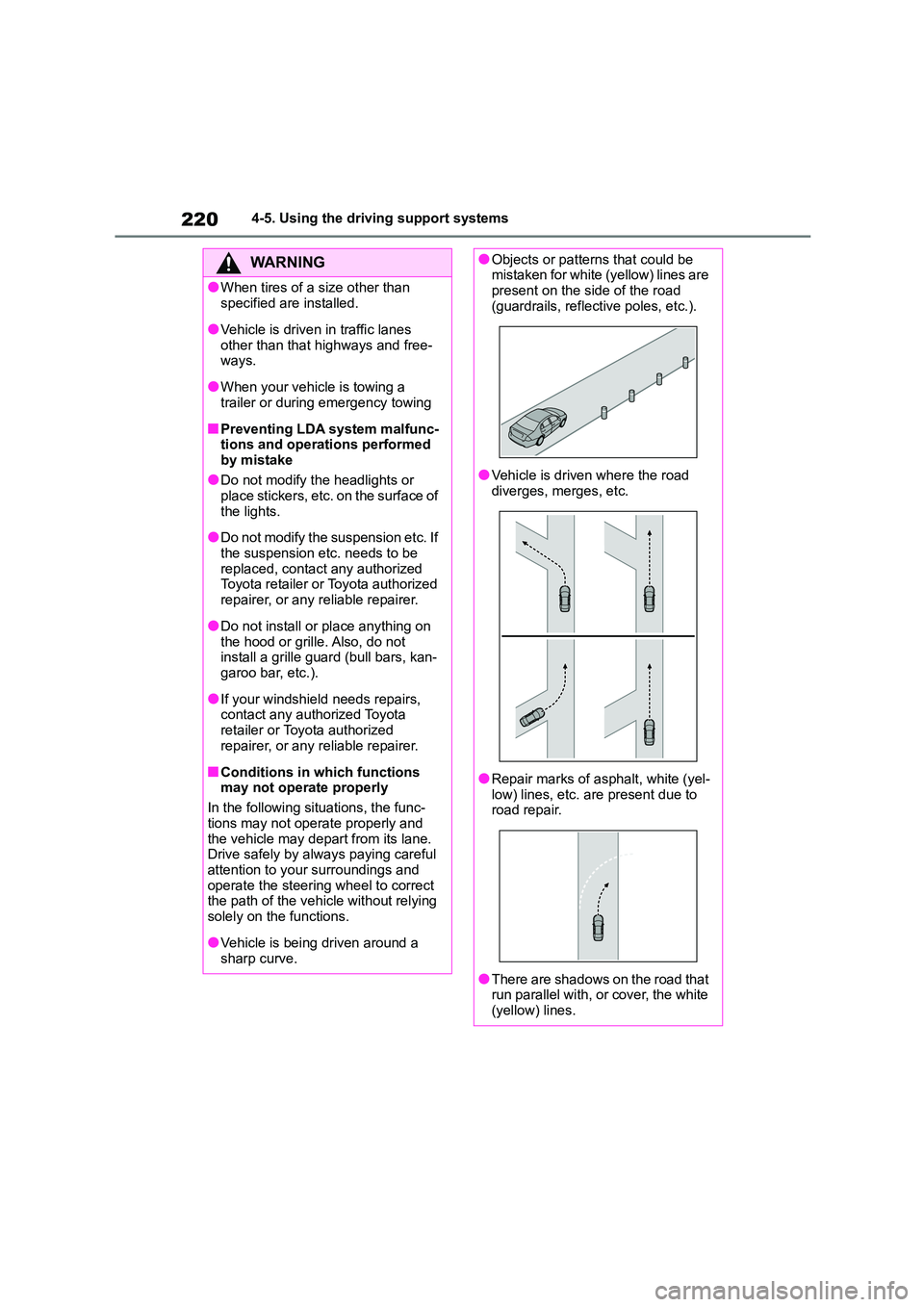
●Objects or patterns that could be mistaken for white (yellow) lines are
present on the side of the road
(guardrails, reflective poles, etc.).
●Vehicle is driven where the road
diverges, merges, etc.
●Repair marks of asphalt, white (yel- low) lines, etc. are present due to
road repair.
●There are shadows on the road that
run parallel with, or cover, the white
(yellow) lines.
Page 231 of 678
229
4
4-5. Using the driving support systems
Driving
WA R N I N G
■Situations unsuitable for
dynamic radar cruise control
with full-speed range
Do not use dynamic radar cruise con-
trol with full-speed range in any of the
following situations. Doing so may result in inappropriate speed control
and could cause an accident resulting
in death or serious injury.
●Roads where there are pedestrians,
cyclists, etc.
●In heavy traffic
●On roads with sharp bends
●On winding roads
●On slippery roads, such as those
covered with rain, ice or snow
●On steep downhills, or where there
are sudden changes between sharp
up and down gradients
Vehicle speed may exceed the set
speed when driving down a steep hill.
●At entrances to freeways and high-
ways
●When weather conditions are bad
enough that they may prevent the
sensors from detecting correctly (fog, snow, sandstorm, heavy rain,
etc.)
●When there is rain, snow, etc. on
the front surface of the radar or
front camera
●In traffic conditions that require fre-
quent repeated acceleration and deceleration
●When your vehicle is towing a trailer or during emergency towing
●When an approach warning buzzer is heard often
Page 242 of 678
2404-5. Using the driving support systems
WA R N I N G
●Assisting the driver to judge proper
following distance
The dynamic radar cruise control determines whether the following dis-
tance between the driver’s own vehi-
cle and a designated vehicle traveling ahead is within a set range. It is not
capable of making any other type of
judgement. Therefore, it is absolutely
necessary for the driver to remain vig- ilant and to determine whether or not
there is a possibility of danger in any
given situation.
●Assisting the driver to operate the
vehicle
The dynamic radar cruise control
does not include functions which will
prevent or avoid collisions with vehi- cles ahead of your vehicle. Therefore,
if there is ever any possibility of dan-
ger, the driver must take immediate and direct control of the vehicle and
act appropriately in order to ensure
the safety of all involved.
■Situations unsuitable for
dynamic radar cruise control
Do not use dynamic radar cruise con-
trol in any of the following situations.
Doing so may result in inappropriate speed control and could cause an
accident resulting in death or serious
injury.
●Roads where there are pedestrians,
cyclists, etc.
●In heavy traffic
●On roads with sharp bends
●On winding roads
●On slippery roads, such as those
covered with rain, ice or snow
●On steep downhills, or where there are sudden changes between sharp
up and down gradients
Vehicle speed may exceed the set speed when driving down a steep hill.
●At entrances to freeways and high-ways
●When weather conditions are bad enough that they may prevent the
sensors from detecting correctly
(fog, snow, sandstorm, heavy rain, etc.)
●When there is rain, snow, etc. on the front surface of the radar or
front camera
●In traffic conditions that require fre-
quent repeated acceleration and
deceleration
●When your vehicle is towing a
trailer or during emergency towing
●When an approach warning buzzer
is heard often
Page 253 of 678
251
4
4-5. Using the driving support systems
Driving
new speed.
■Automatic cruise control
cancelation
Cruise control will stop maintaining the
vehicle speed in any of the following sit-
uations.
●Actual vehicle speed falls more than
approximately 16 km/h (10 mph) below the preset vehicle speed.
At this time, the memorized set speed
is not retained.
●Actual vehicle speed is below approxi-
mately 30 km/h (20 mph).
●VSC is activated.
●TRC is activated for a period of time.
●When the VSC or TRC system is turned off by pressing the VSC off
switch.
■If the warning message for the
cruise control is shown on the multi-information display
Press the cruise control main switch
once to deactivate the system, and then press the switch again to reactivate the
system. If the cruise control speed can-
not be set or if the cruise control cancels immediately after being activated, there
may be a malfunction in the cruise con-
trol system. Have t he vehicle inspected by any authorized Toyota retailer or
Toyota authorized repairer, or any relia-
ble repairer.
WA R N I N G
■To avoid operating the cruise control by mistake
Switch the cruise control off using the
cruise control main switch when not in use.
■Situations unsuitable for cruise control
Do not use cruise control in any of the
following situations. Doing so may result in loss of control
and could cause an accident resulting
in death or serious injury.
●In heavy traffic
●On roads with sharp bends
●On winding roads
●On slippery roads, such as those covered with rain, ice or snow
●On steep hills
Vehicle speed may exceed the set
speed when driving down a steep hill.
●When your vehicle is towing a
trailer or during emergency towing
Page 256 of 678
2544-5. Using the driving support systems
*: If equipped
WA R N I N G
■To avoid operating the speed lim-
iter by mistake
Switch the speed limiter off using the speed limiter main switch when not in
use.
■Situations unsuitable for speed
limiter
Do not use speed limiter in any of the
following situations. Doing so may result in loss of control
and could cause an accident resulting
in death or serious injury.
●On slippery roads, such as those
covered with rain, ice or snow
●On steep hills
●When your vehicle is towing a
trailer or during emergency towing
RSA (Road Sign Assist)*
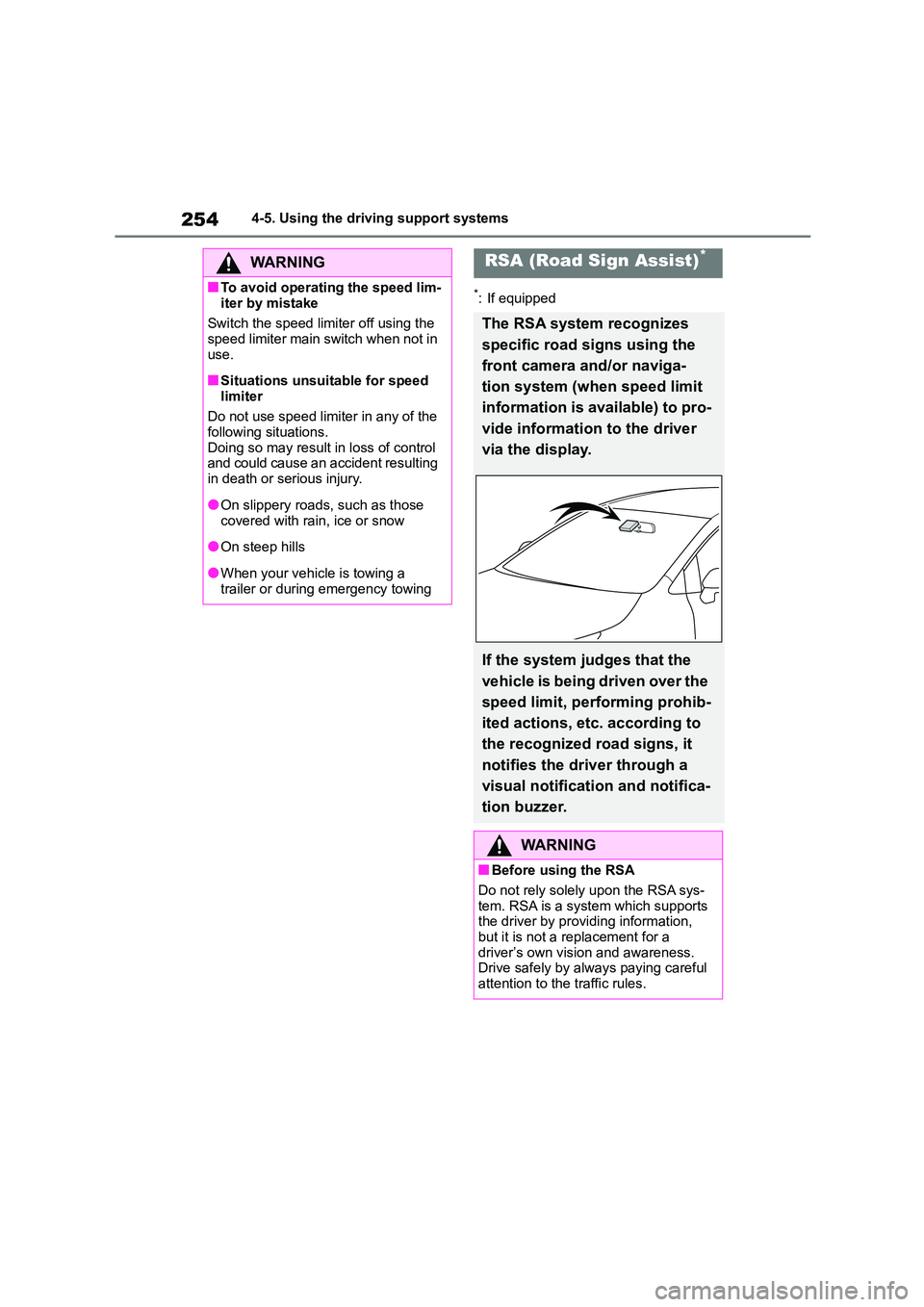
The RSA system recognizes
specific road signs using the
front camera and/or naviga-
tion system (when speed limit
information is available) to pro-
vide information to the driver
via the display.
If the system judges that the
vehicle is being driven over the
speed limit, performing prohib-
ited actions, etc. according to
the recognized road signs, it
notifies the driver through a
visual notification and notifica-
tion buzzer.
WA R N I N G
■Before using the RSA
Do not rely solely upon the RSA sys-
tem. RSA is a system which supports the driver by providing information,
but it is not a replacement for a
driver’s own vision and awareness. Drive safely by always paying careful
attention to the traffic rules.