fog light TOYOTA COROLLA 2022 Owners Manual (in English)
[x] Cancel search | Manufacturer: TOYOTA, Model Year: 2022, Model line: COROLLA, Model: TOYOTA COROLLA 2022Pages: 678, PDF Size: 147.24 MB
Page 5 of 678
3TABLE OF CONTENTS
1
6
5
4
3
2
9
8
7
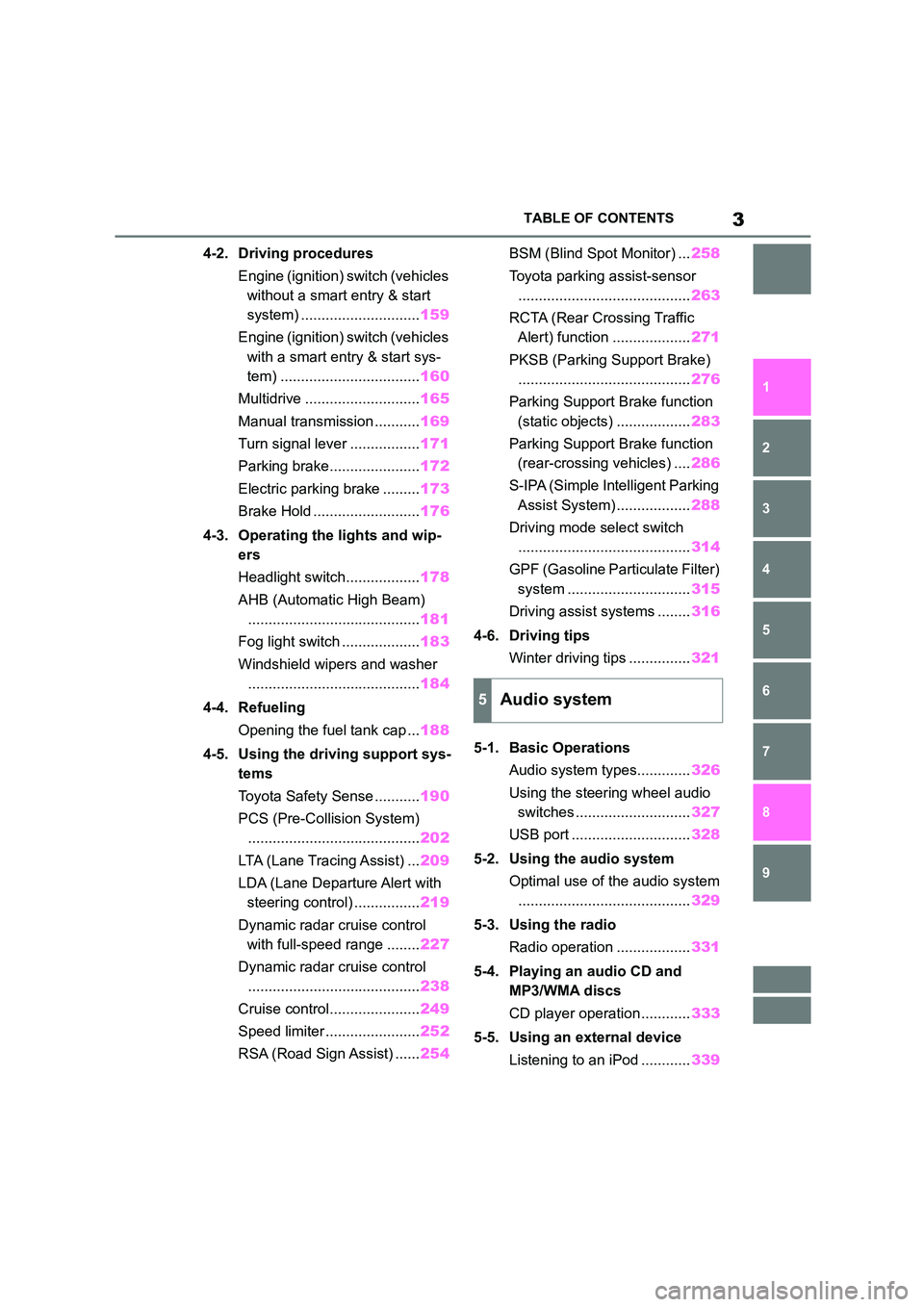
4-2. Driving procedures
Engine (ignition) switch (vehicles
without a smart entry & start
system) ............................. 159
Engine (ignition) switch (vehicles
with a smart entry & start sys-
tem) .................................. 160
Multidrive ............................ 165
Manual transmission ........... 169
Turn signal lever ................. 171
Parking brake...................... 172
Electric parking brake ......... 173
Brake Hold .......................... 176
4-3. Operating the lights and wip-
ers
Headlight switch.................. 178
AHB (Automatic High Beam)
.......................................... 181
Fog light switch ................... 183
Windshield wipers and washer
.......................................... 184
4-4. Refueling
Opening the fuel tank cap ... 188
4-5. Using the driving support sys-
tems
Toyota Safety Sense ........... 190
PCS (Pre-Collision System)
.......................................... 202
LTA (Lane Tracing Assist) ... 209
LDA (Lane Departure Alert with
steering control) ................ 219
Dynamic radar cruise control
with full-speed range ........ 227
Dynamic radar cruise control
.......................................... 238
Cruise control...................... 249
Speed limiter ....................... 252
RSA (Road Sign Assist) ...... 254
BSM (Blind Spot Monitor) ... 258
Toyota parking assist-sensor
.......................................... 263
RCTA (Rear Crossing Traffic
Alert) function ................... 271
PKSB (Parking Support Brake)
.......................................... 276
Parking Support Brake function
(static objects) .................. 283
Parking Support Brake function
(rear-crossing vehicles) .... 286
S-IPA (Simple Intelligent Parking
Assist System) .................. 288
Driving mode select switch
.......................................... 314
GPF (Gasoline Particulate Filter)
system .............................. 315
Driving assist systems ........ 316
4-6. Driving tips
Winter driving tips ............... 321
5-1. Basic Operations
Audio system types............. 326
Using the steering wheel audio
switches ............................ 327
USB port ............................. 328
5-2. Using the audio system
Optimal use of the audio system
.......................................... 329
5-3. Using the radio
Radio operation .................. 331
5-4. Playing an audio CD and
MP3/WMA discs
CD player operation ............ 333
5-5. Using an external device
Listening to an iPod ............ 339
5Audio system
Page 6 of 678
4TABLE OF CONTENTS
Listening to USB memory device
.......................................... 344
5-6. Using Bluetooth® devices
Bluetooth® audio/phone...... 349
Using the steering wheel
switches ............................ 354
Register a Bluetooth® device
.......................................... 354
5-7. “SETUP” menu
Using the “SETUP” menu
(“Bluetooth” menu)............ 356
Using the “SETUP” menu (“TEL”
menu) ............................... 358
5-8. Bluetooth® Audio
Operating a Bluetooth® enabled
portable player .................. 362
5-9. Bluetooth® Phone
Making a phone call ............ 364
When receiving a phone call
.......................................... 365
Speaking on the phone ....... 365
5-10. Bluetooth®
Bluetooth®.......................... 367
6-1. Using the air conditioning
system and defogger
Manual air conditioning system
.......................................... 380
Automatic air conditioning sys-
tem.................................... 385
Heated steering wheel/seat
heaters.............................. 392
6-2. Using the interior lights
Interior lights list .................. 394
6-3. Using the storage features
List of storage features ....... 396
Trunk features..................... 399
6-4. Other interior features
Other interior features ......... 401
7-1. Maintenance and care
Cleaning and protecting the
vehicle exterior ................. 410
Cleaning and protecting the
vehicle interior .................. 413
7-2. Maintenance
Maintenance requirements
.......................................... 416
7-3. Do-it-yourself maintenance
Do-it-yourself service precau-
tions .................................. 418
Hood ................................... 419
Positioning a floor jack ........ 420
Engine compartment........... 422
Tires .................................... 429
Tire inflation pressure ......... 444
Wheels ................................ 445
Air conditioning filter ........... 447
Wireless remote control/elec-
tronic key battery .............. 449
Checking and replacing fuses
.......................................... 452
Light bulbs .......................... 455
8-1. Essential information
Emergency flashers ............ 462
6Interior features
7Maintenance and care
8When trouble arises
Page 14 of 678
12Pictorial index
To prevent freezing (windshield wiper de-icer)*2......................P.383, 390
Fuel filler door ................................................................................P.188
Refueling method .............................................................................P.189
Fuel type/fuel tank capacity .............................................................P.526
Tires ................................................................................................P.429
Tire size/inflation pressure ...............................................................P.533
Winter tires/tire chains .....................................................................P.321
Checking/rotation/tire pressure warn ing system ..............................P.429
Coping with flat tires.................................................................P.482, 498
Hood ................................................................................................P.419
Opening ...........................................................................................P.419
Engine oil .........................................................................................P.527
Coping with overheating ..................................................................P.518
Headlights/front position lights/daytime running lights/turn signal
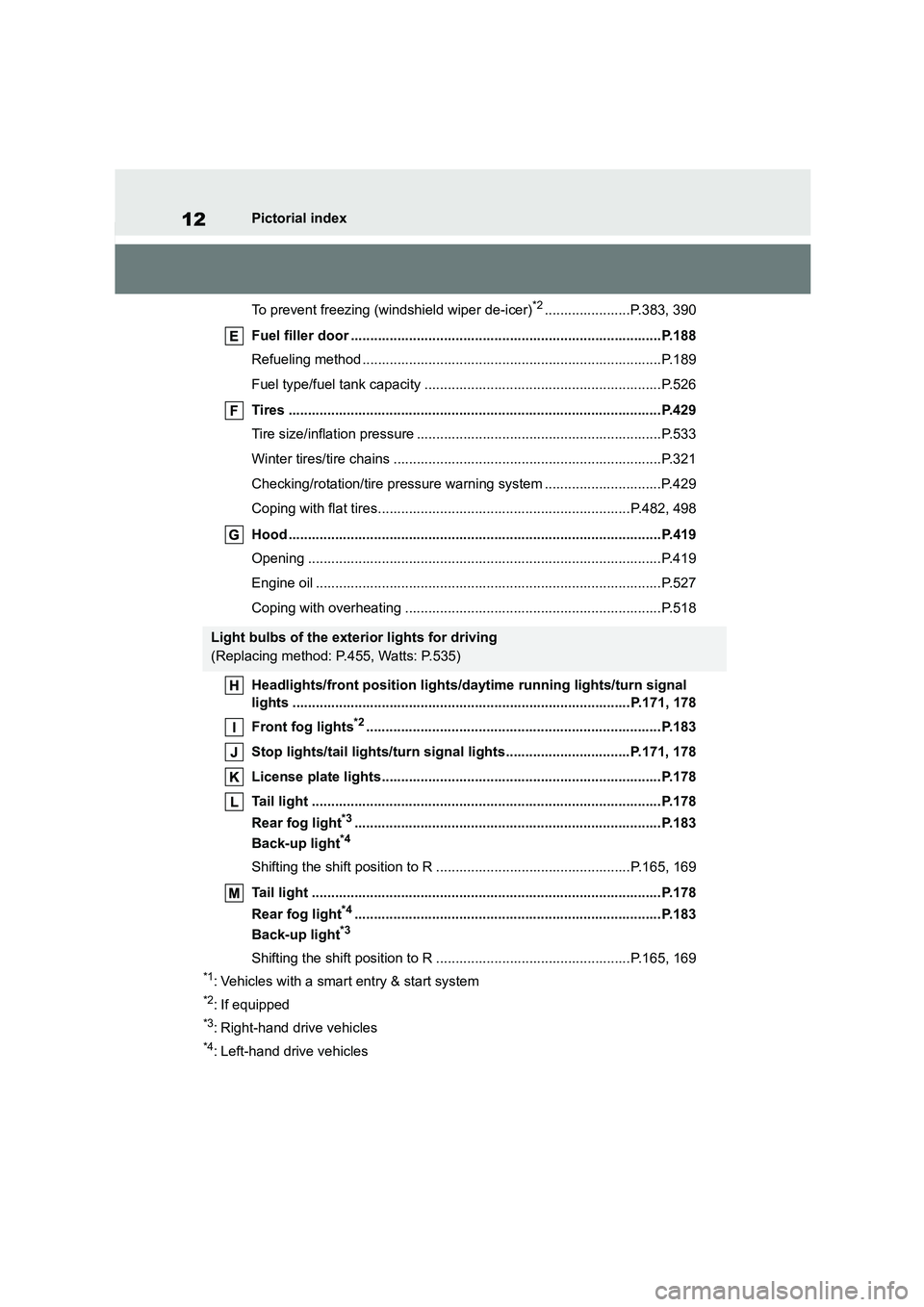
lights .......................................................................................P.171, 178
Front fog lights*2............................................................................P.183
Stop lights/tail lights/turn signal lights................................P.171, 178
License plate lights........................................................................P.178
Tail light ..........................................................................................P.178
Rear fog light*3...............................................................................P.183
Back-up light*4
Shifting the shift position to R ..................................................P.165, 169
Tail light ..........................................................................................P.178
Rear fog light*4...............................................................................P.183
Back-up light*3
Shifting the shift position to R ..................................................P.165, 169
*1: Vehicles with a smart entry & start system
*2: If equipped
*3: Right-hand drive vehicles
*4: Left-hand drive vehicles
Light bulbs of the exterior lights for driving
(Replacing method: P.455, Watts: P.535)
Page 16 of 678
14Pictorial index
Display ...............................................................................................P.93
When a warning message is displayed............................................P.480
Parking brake*4..............................................................................P.172
Applying/releasing............................................................................P.172
Precautions for winter season..........................................................P.322
Warning light/message.............................................................P.172, 471
Turn signal lever ............................................................................P.171
Headlight switch ............................................................................P.178
Headlights/front position lights/tail lights/daytime running lights ......P.178
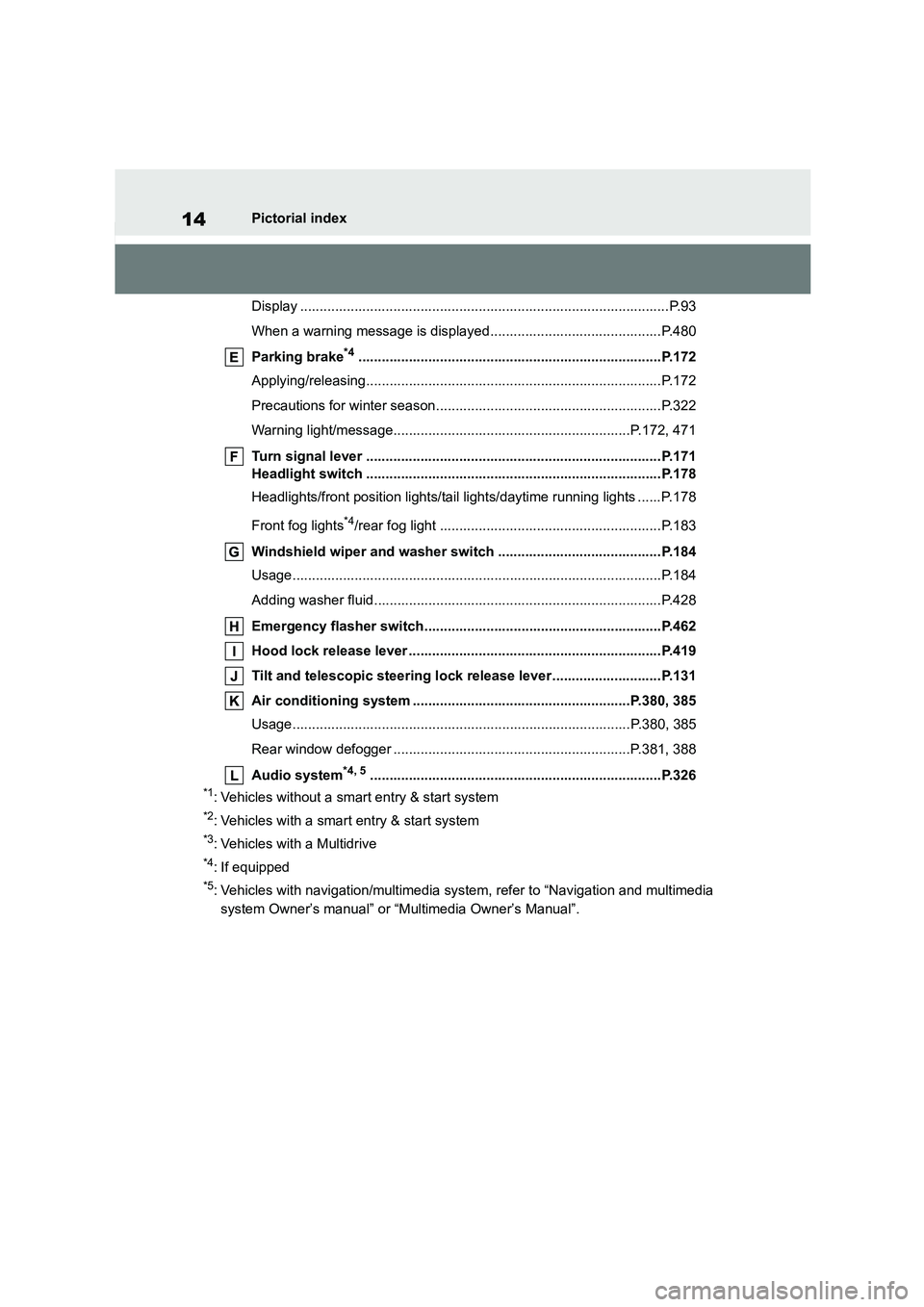
Front fog lights*4/rear fog light .........................................................P.183
Windshield wiper and washer switch ..........................................P.184
Usage...............................................................................................P.184
Adding washer fluid..........................................................................P.428
Emergency flasher switch.............................................................P.462
Hood lock release lever .................................................................P.419
Tilt and telescopic steering lock release lever ............................P.131
Air conditioning system ........................................................P.380, 385
Usage.......................................................................................P.380, 385
Rear window defogger .............................................................P.381, 388
Audio system*4, 5...........................................................................P.326
*1: Vehicles without a smart entry & start system
*2: Vehicles with a smart entry & start system
*3: Vehicles with a Multidrive
*4: If equipped
*5: Vehicles with navigation/mu ltimedia system, refer to “Navigation and multimedia
system Owner’s manual” or “Multimedia Owner’s Manual”.
Page 23 of 678
21Pictorial index
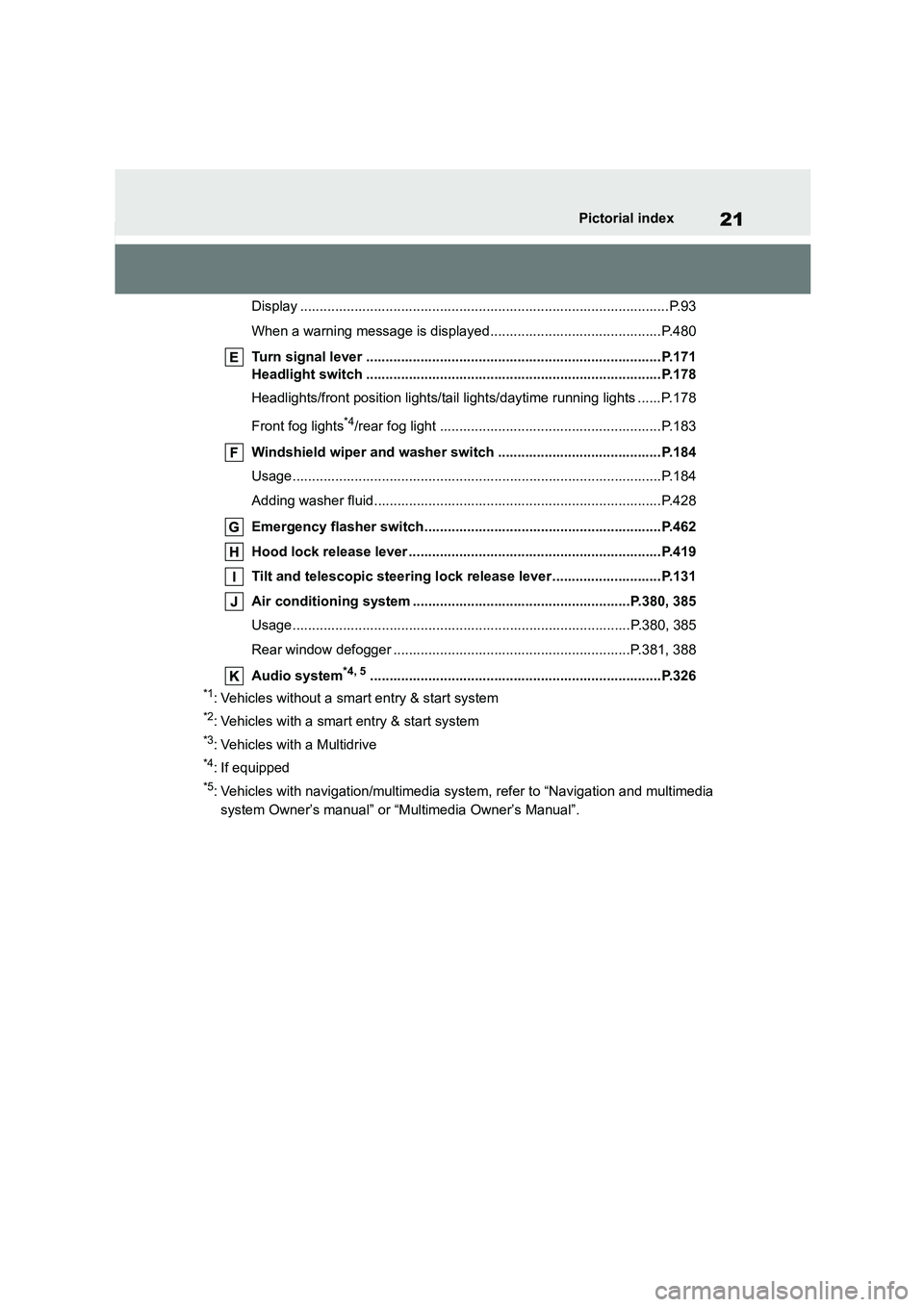
Display ...............................................................................................P.93
When a warning message is displayed............................................P.480
Turn signal lever ............................................................................P.171
Headlight switch ............................................................................P.178
Headlights/front position lights/tail lights/daytime running lights ......P.178
Front fog lights*4/rear fog light .........................................................P.183
Windshield wiper and washer switch ..........................................P.184
Usage...............................................................................................P.184
Adding washer fluid..........................................................................P.428
Emergency flasher switch.............................................................P.462
Hood lock release lever .................................................................P.419
Tilt and telescopic steering lock release lever ............................P.131
Air conditioning system ........................................................P.380, 385
Usage.......................................................................................P.380, 385
Rear window defogger .............................................................P.381, 388
Audio system*4, 5...........................................................................P.326
*1: Vehicles without a smart entry & start system
*2: Vehicles with a smart entry & start system
*3: Vehicles with a Multidrive
*4: If equipped
*5: Vehicles with navigation/mu ltimedia system, refer to “Navigation and multimedia
system Owner’s manual” or “Multimedia Owner’s Manual”.
Page 85 of 678
83
2
2-1. Instrument cluster
Vehicle status information and indicators
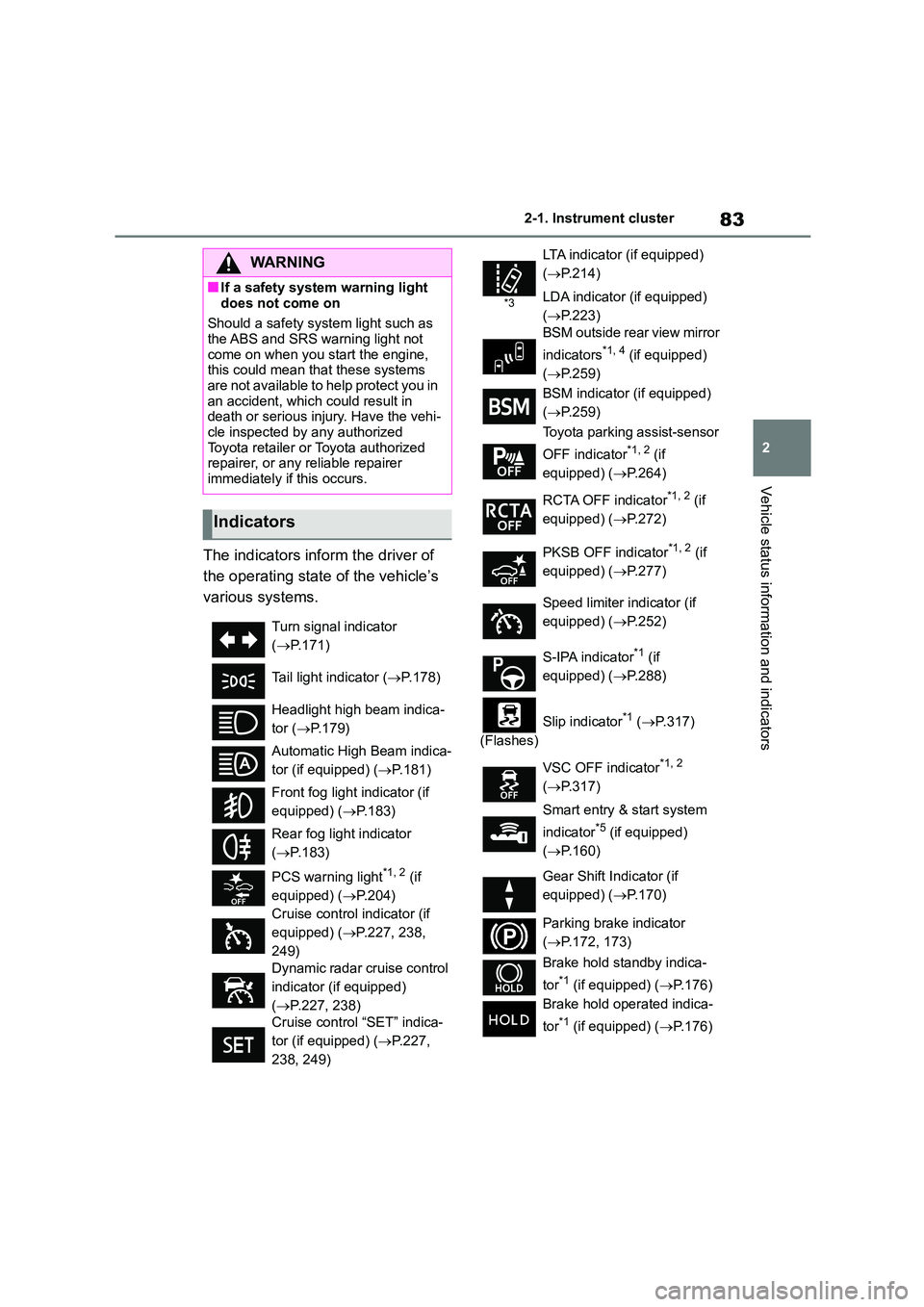
The indicators inform the driver of
the operating state of the vehicle’s
various systems.
WA R N I N G
■If a safety system warning light
does not come on
Should a safety system light such as the ABS and SRS warning light not
come on when you start the engine,
this could mean that these systems are not available to help protect you in
an accident, which could result in
death or serious injury. Have the vehi-
cle inspected by any authorized Toyota retailer or Toyota authorized
repairer, or any reliable repairer
immediately if this occurs.
Indicators
Turn signal indicator
( P.171)
Tail light indicator ( P.178)
Headlight high beam indica-
tor ( P.179)
Automatic High Beam indica-
tor (if equipped) ( P.181)
Front fog light indicator (if
equipped) ( P.183)
Rear fog light indicator
( P.183)
PCS warning light*1, 2 (if
equipped) ( P.204)
Cruise control indicator (if
equipped) ( P.227, 238,
249)
Dynamic radar cruise control
indicator (if equipped)
( P.227, 238)
Cruise control “SET” indica-
tor (if equipped) ( P.227,
238, 249)
*3
LTA indicator (if equipped)
( P.214)
LDA indicator (if equipped)
( P.223)
BSM outside rear view mirror
indicators*1, 4 (if equipped)
( P.259)
BSM indicator (if equipped)
( P.259)
Toyota parking assist-sensor
OFF indicator*1, 2 (if
equipped) ( P.264)
RCTA OFF indicator*1, 2 (if
equipped) ( P.272)
PKSB OFF indicator*1, 2 (if
equipped) ( P.277)
Speed limiter indicator (if
equipped) ( P.252)
S-IPA indicator*1 (if
equipped) ( P.288)
(Flashes)
Slip indicator*1 ( P.317)
VSC OFF indicator*1, 2
( P.317)
Smart entry & start system
indicator*5 (if equipped)
( P.160)
Gear Shift Indicator (if
equipped) ( P.170)
Parking brake indicator
( P.172, 173)
Brake hold standby indica-
tor*1 (if equipped) ( P.176)
Brake hold operated indica-
tor*1 (if equipped) ( P.176)
Page 145 of 678
4
143
4
Driving
Driving
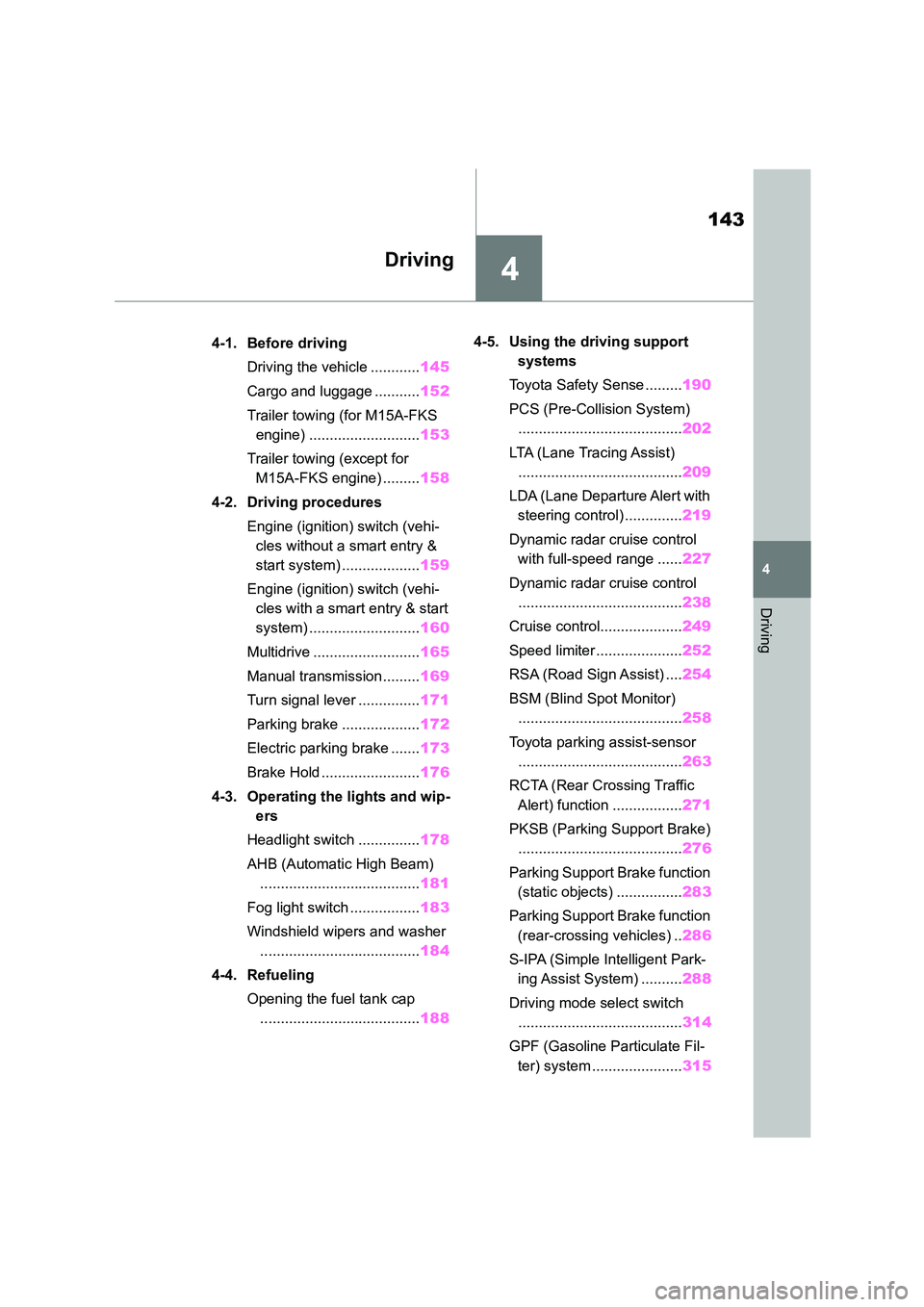
.4-1. Before driving
Driving the vehicle ............ 145
Cargo and luggage ........... 152
Trailer towing (for M15A-FKS
engine) ........................... 153
Trailer towing (except for
M15A-FKS engine) ......... 158
4-2. Driving procedures
Engine (ignition) switch (vehi-
cles without a smart entry &
start system) ................... 159
Engine (ignition) switch (vehi-
cles with a smart entry & start
system) ........................... 160
Multidrive .......................... 165
Manual transmission ......... 169
Turn signal lever ............... 171
Parking brake ................... 172
Electric parking brake ....... 173
Brake Hold ........................ 176
4-3. Operating the lights and wip-
ers
Headlight switch ............... 178
AHB (Automatic High Beam)
....................................... 181
Fog light switch ................. 183
Windshield wipers and washer
....................................... 184
4-4. Refueling
Opening the fuel tank cap
....................................... 188
4-5. Using the driving support
systems
Toyota Safety Sense ......... 190
PCS (Pre-Collision System)
........................................ 202
LTA (Lane Tracing Assist)
........................................ 209
LDA (Lane Departure Alert with
steering control) .............. 219
Dynamic radar cruise control
with full-speed range ...... 227
Dynamic radar cruise control
........................................ 238
Cruise control.................... 249
Speed limiter ..................... 252
RSA (Road Sign Assist) .... 254
BSM (Blind Spot Monitor)
........................................ 258
Toyota parking assist-sensor
........................................ 263
RCTA (Rear Crossing Traffic
Alert) function ................. 271
PKSB (Parking Support Brake)
........................................ 276
Parking Support Brake function
(static objects) ................ 283
Parking Support Brake function
(rear-crossing vehicles) .. 286
S-IPA (Simple Intelligent Park-
ing Assist System) .......... 288
Driving mode select switch
........................................ 314
GPF (Gasoline Particulate Fil-
ter) system ...................... 315
Page 148 of 678
1464-1. Before driving
Manual transmission
1 While depressing the clutch
pedal, depress the brake pedal.
2 Set the parking brake. (P.172,
173)
Check that the parking brake indicator
is illuminated.
3 Shift the shift lever to N.
( P.169)
If parking on a hill, shift the shift lever to
1 or R and block the wheels as needed.
4 Vehicles without a smart entry &
start system: Turn the engine
switch to OFF to stop the
engine.
Vehicles with a smart entry &
start system: Press the engine
switch to stop the engine.
5 Slowly release the brake pedal.
6 Lock the door, making sure that
you have the key on your per-
son.
■Starting off on a steep uphill
Multidrive
1 Make sure that the parking
brake is set and shift the shift
lever to D.
2 Gently depress the accelerator
pedal.
3 Release the parking brake.
Manual transmission
1 Make sure that the parking
brake is set and shift the shift
lever to 1.
2 Lightly depress the accelerator
pedal at the same time as grad-
ually releasing the clutch pedal.
3 Release the parking brake.
■Driving in the rain
●Drive carefully when it is raining,
because visibility will be reduced, the windows may become fogged-up, and
the road will be slippery.
●Drive carefully when it starts to rain,
because the road surface will be
especially slippery.
●Refrain from high speeds when driv-
ing on an expressway in the rain, because there may be a layer of water
between the tires and the road sur-
face, preventing the steering and brakes from operating properly.
■Engine speed while driving (vehi-
cles with a Multidrive)
In the following conditions, the engine speed may become high while driving.
This is due to automatic up-shifting con-
trol or down-shifting implementation to meet driving conditions. It does not indi-
cate sudden acceleration.
●The vehicle is judged to be driving
uphill or downhill
●When the accelerator pedal is released
●When the brake pedal is depressed while sport mode is selected
■Restraining the engine output
(Brake Override System)
●When the accelerator and brake ped-
als are depressed at the same time,
the engine output may be restrained.
●A warning message is displayed on
the multi-information display while the system is operating.
■Restraining sudden start
(Drive-Start Control [vehicles with a
Multidrive])
●When the following unusual operation
Page 180 of 678
1784-3. Operating the lights and wipers
4-3.Operating the lights and wipers
Operating the switch turns
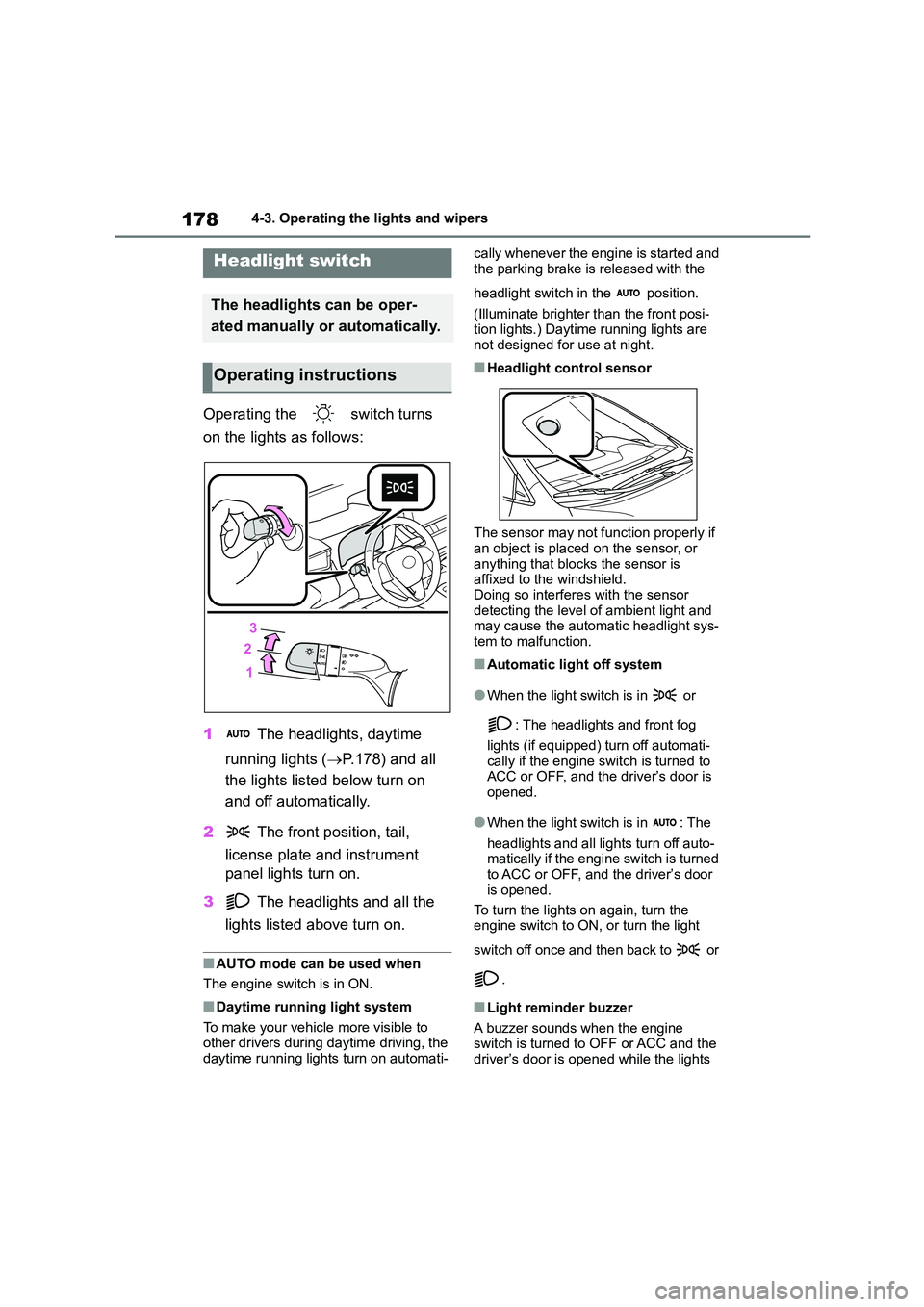
on the lights as follows:
1 The headlights, daytime
running lights ( P.178) and all
the lights listed below turn on
and off automatically.
2 The front position, tail,
license plate and instrument
panel lights turn on.
3 The headlights and all the
lights listed above turn on.
■AUTO mode can be used when
The engine switch is in ON.
■Daytime running light system
To make your vehicle more visible to
other drivers during daytime driving, the daytime running lights turn on automati-
cally whenever the engine is started and
the parking brake is released with the
headlight switch in the position.
(Illuminate brighter than the front posi-
tion lights.) Daytime running lights are not designed for use at night.
■Headlight control sensor
The sensor may not function properly if an object is placed on the sensor, or
anything that blo cks the sensor is
affixed to the windshield. Doing so interferes with the sensor
detecting the level of ambient light and
may cause the autom atic headlight sys- tem to malfunction.
■Automatic light off system
●When the light switch is in or
: The headlights and front fog
lights (if equipped) turn off automati-
cally if the engine switch is turned to ACC or OFF, and the driver’s door is
opened.
●When the light switch is in : The
headlights and all lights turn off auto-
matically if the engine switch is turned to ACC or OFF, and the driver’s door
is opened.
To turn the lights on again, turn the engine switch to ON, or turn the light
switch off once and then back to or
.
■Light reminder buzzer
A buzzer sounds when the engine switch is turned to OFF or ACC and the
driver’s door is opened while the lights
Headlight switch
The headlights can be oper-
ated manually or automatically.
Operating instructions
Page 184 of 678
1824-3. Operating the lights and wipers
• When the vehicle is cut in front of by
another vehicle • When vehicles ahead cannot be
detected due to repeated curves, road
dividers or roadside trees • When vehicles ahead appear in a far-
away lane on a wide road
• When the lights of vehicles ahead are not on
●The high beams may be turned off if a vehicle ahead that is using fog lights
without its headlights turned on is
detected.
●House lights, streetlights, traffic sig-
nals, and illuminated billboards or signs and other reflective objects may
cause the high beams to change to
the low beams, or the low beams to remain on.
●The following factors may affect the amount of time taken for the high
beams to turn on or off:
• The brightness of the headlights, fog lights, and tail lights of vehicles ahead
• The movement and direction of vehi-
cles ahead • When a vehicle ahead only has oper-
ational lights on one side
• When a vehicle ahead is a two-wheeled vehicle
• The condition of the road (gradient,
curve, condition of the road surface, etc.)
• The number of passengers and
amount of luggage in the vehicle
●The high beams may turn on or off
unexpectedly.
●Bicycles or similar vehicles may not
be detected.
●In the following sit uations the system
may not be able to correctly detect the
surrounding brightness level. This may cause the low beams to remain
on or the high beams to flash or daz-
zle pedestrians or vehicles ahead. In such a case, it is necessary to manu-
ally switch between the high and low
beams. • When driving in inclement weather
(heavy rain, snow, fog, sandstorms,
etc.)
• When the windshield is obscured by fog, mist, ice, dirt, etc.
• When the windshield is cracked or
damaged • When the camera sensor is deformed
or dirty
• When the temperature of the camera sensor is extremely high
• When the surrounding brightness
level is equal to that of headlights, tail lights or fog lights
• When headlights or tail lights of vehi-
cles ahead are turned off, dirty, chang- ing color, or not aimed properly
• When the vehicle is hit by water,
snow, dust, etc. from a preceding vehicle
• When driving through an area of inter-
mittently changing brightness and darkness
• When frequently and repeatedly driv-
ing ascending/descending roads, or roads with rough, bumpy or uneven
surfaces (such as stone-paved roads,
gravel roads, etc.) • When frequently and repeatedly tak-
ing curves or driving on a winding
road • When there is a highly reflective
object ahead of the vehicle, such as a
sign or mirror • When the back of a preceding vehicle
is highly reflective, such as a con-
tainer on a truck • When the vehicle’s headlights are
damaged or dirty, or are not aimed
properly • When the vehicle is listing or titling
due to a flat tire, a trailer being towed,
etc. • When the headlights are changed
between the high beams and low
beams repeatedly in an abnormal
manner • When the driver believes that the high
beams may be flashing or dazzling
pedestrians or other drivers