power steering TOYOTA COROLLA 2022 Owners Manual (in English)
[x] Cancel search | Manufacturer: TOYOTA, Model Year: 2022, Model line: COROLLA, Model: TOYOTA COROLLA 2022Pages: 678, PDF Size: 147.24 MB
Page 4 of 678
2TABLE OF CONTENTS
For your information ........................6
Reading this manual........................ 9
How to search ............................... 10
Pictorial index ................................ 11
1-1. For safe use
Before driving........................ 28
For safe driving ..................... 29
Seat belts .............................. 31
SRS airbags.......................... 35
Exhaust gas precautions ...... 43
1-2. Child safety
Airbag manual on-off system
............................................ 45
Riding with children............... 46
Child restraint systems ......... 47
1-3. Emergency assistance
eCall...................................... 64
1-4. Theft deterrent system
Engine immobilizer system ... 74
Double locking system .......... 75
Alarm .................................... 76
2-1. Instrument cluster
Warning lights and indicators
............................................ 80
Gauges and meters (4.2-inch
display) ............................... 85
Gauges and meters (7-inch dis-
play) .................................... 88
Multi-information display ....... 93
Head-up display .................. 100
Fuel consumption information
.......................................... 104
3-1. Key information
Keys .................................... 108
3-2. Opening, closing and locking
the doors
Doors .................................. 113
Trunk................................... 118
Smart entry & start system
.......................................... 121
3-3. Adjusting the seats
Front seats .......................... 126
Rear seats .......................... 127
Head restraints ................... 128
3-4. Adjusting the steering wheel
and mirrors
Steering wheel .................... 131
Inside rear view mirror ........ 132
Outside rear view mirrors.... 133
3-5. Opening and closing the win-
dows
Power windows ................... 136
Moon roof............................ 139
4-1. Before driving
Driving the vehicle .............. 145
Cargo and luggage ............. 152
Trailer towing (for M15A-FKS
engine).............................. 153
Trailer towing (except for
M15A-FKS engine) ........... 158
1For safety and security
2Vehicle status information
and indicators
3Before driving
4Driving
Page 17 of 678
15Pictorial index
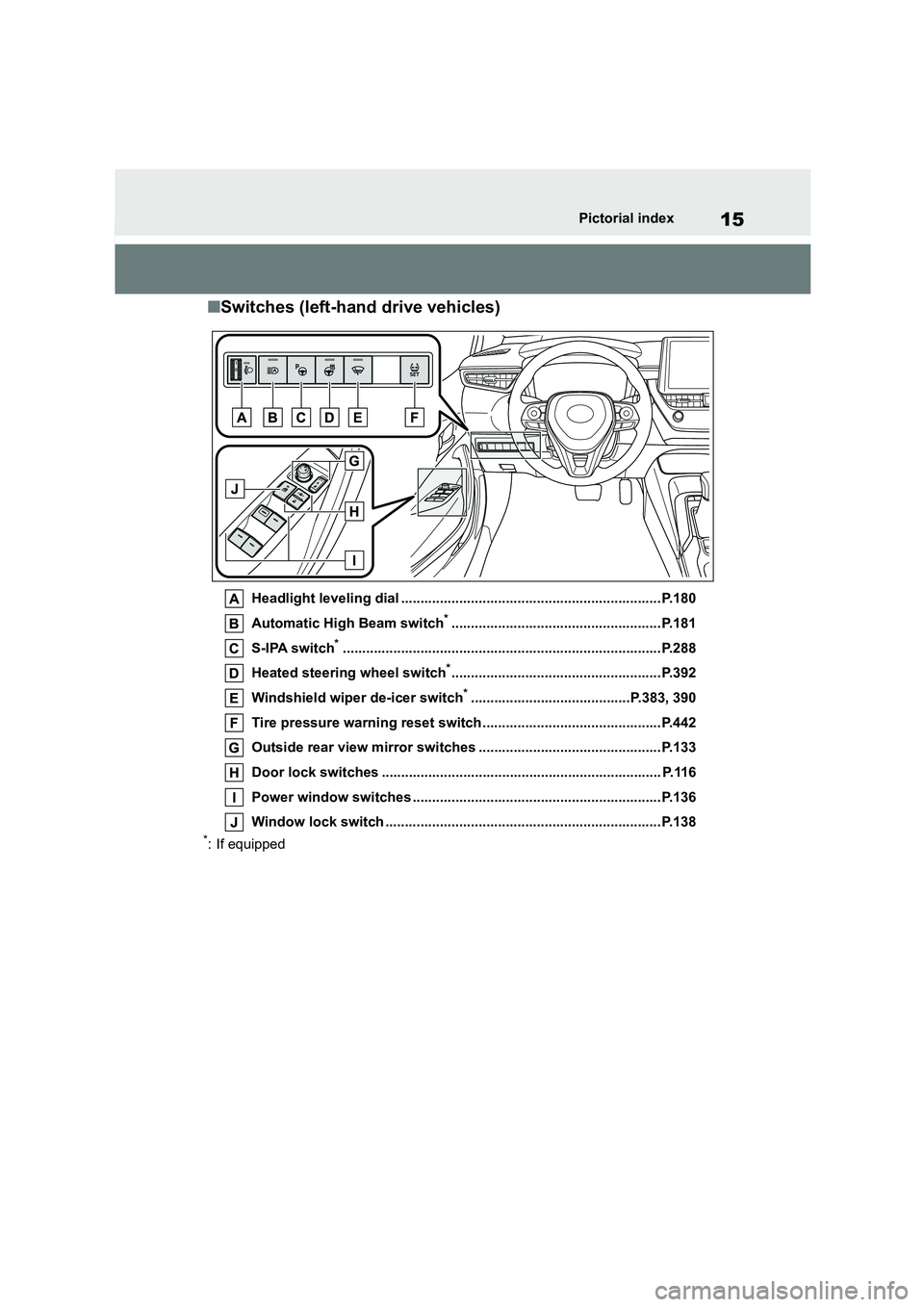
■Switches (left-hand drive vehicles)
Headlight leveling dial ...................................................................P.180
Automatic High Beam switch*......................................................P.181
S-IPA switch*..................................................................................P.288
Heated steering wheel switch*......................................................P.392
Windshield wiper de-icer switch*.........................................P.383, 390
Tire pressure warning reset switch ..............................................P.442
Outside rear view mirror switches ...............................................P.133
Door lock switches ........................................................................ P.116
Power window switches ................................................................P.136
Window lock switch .......................................................................P.138
*: If equipped
Page 84 of 678
822-1. Instrument cluster
*1: These lights come on when the
engine switch is turned to ON to indi-
cate that a system check is being
performed. They will turn off after the
engine is started, or after a few sec-
onds. There may be a malfunction in
a system if the lights do not come
on, or turn off. Have the vehicle
inspected by any authorized Toyota
retailer or Toyota authorized repairer,
or any reliable repairer.
*2: As these lights are displayed on the
multi-information display, they will
not turn on when a system check, as
described in*1 above, is being per-
formed.
*3: This light illuminates on the
multi-information display.
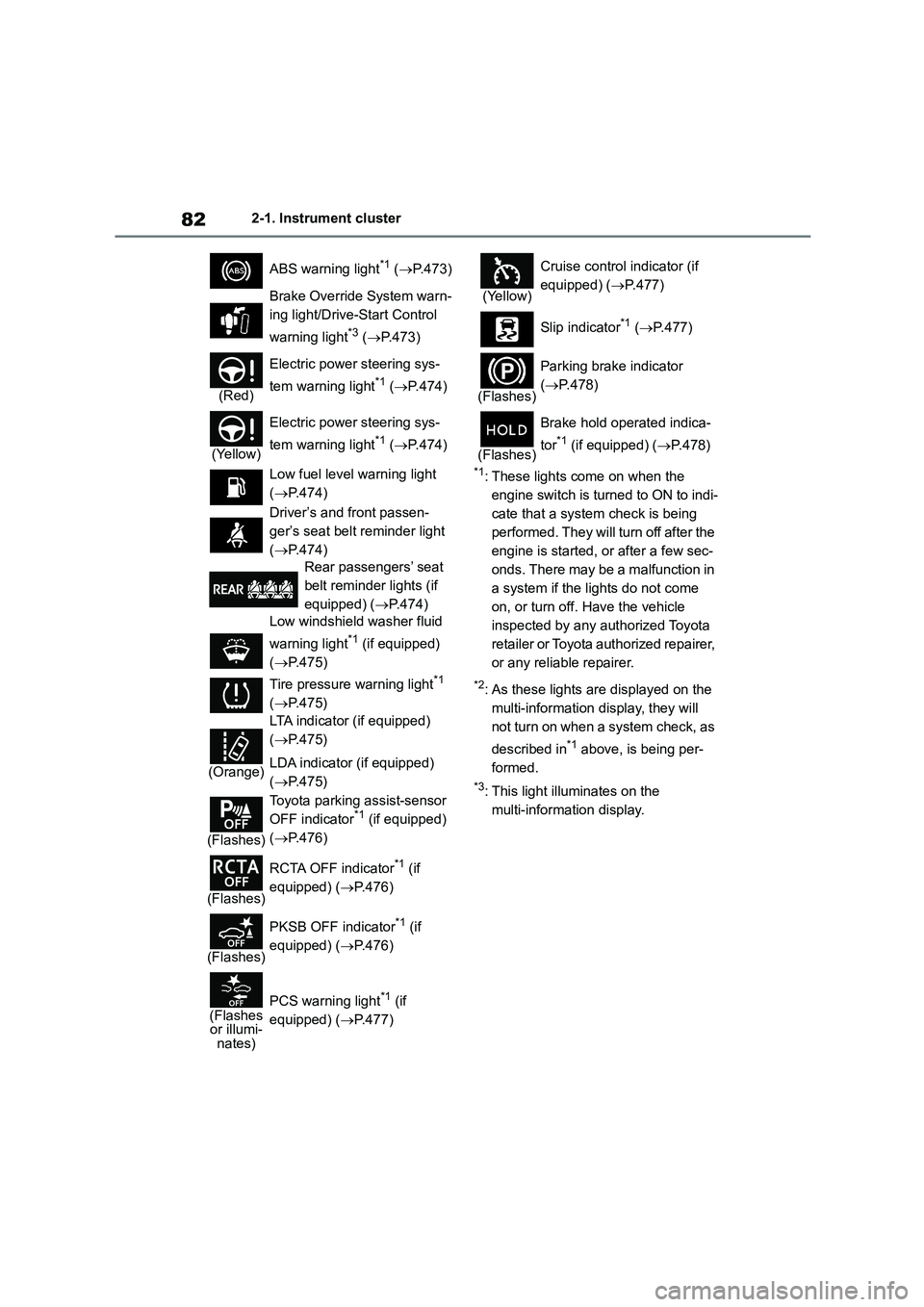
ABS warning light*1 ( P.473)
Brake Override System warn-
ing light/Drive-S tart Control
warning light*3 ( P.473)
(Red)
Electric power steering sys-
tem warning light*1 ( P.474)
(Yellow)
Electric power steering sys-
tem warning light*1 ( P.474)
Low fuel level warning light
( P.474)
Driver’s and front passen-
ger’s seat belt reminder light
( P.474)
Rear passengers’ seat
belt reminder lights (if
equipped) ( P.474)
Low windshield washer fluid
warning light*1 (if equipped)
( P.475)
Tire pressure warning light*1
( P.475)
(Orange)
LTA indicator (if equipped)
( P.475)
LDA indicator (if equipped)
( P.475)
(Flashes)
Toyota parking assist-sensor
OFF indicator*1 (if equipped)
( P.476)
(Flashes)
RCTA OFF indicator*1 (if
equipped) ( P.476)
(Flashes)
PKSB OFF indicator*1 (if
equipped) ( P.476)
(Flashes or illumi-nates)
PCS warning light*1 (if
equipped) ( P.477)
(Yellow)
Cruise control indicator (if
equipped) ( P.477)
Slip indicator*1 ( P.477)
(Flashes)
Parking brake indicator
( P.478)
(Flashes)
Brake hold operated indica-
tor*1 (if equipped) ( P.478)
Page 109 of 678
3
107
3
Before driving
Before driving
.3-1. Key information
Keys.................................. 108
3-2. Opening, closing and locking
the doors
Doors ................................ 113
Trunk................................. 118
Smart entry & start system
....................................... 121
3-3. Adjusting the seats
Front seats........................ 126
Rear seats ........................ 127
Head restraints ................. 128
3-4. Adjusting the steering wheel
and mirrors
Steering wheel .................. 131
Inside rear view mirror ...... 132
Outside rear view mirrors
....................................... 133
3-5. Opening and closing the win-
dows
Power windows................. 136
Moon roof ......................... 139
Page 136 of 678
1343-4. Adjusting the steering wheel and mirrors
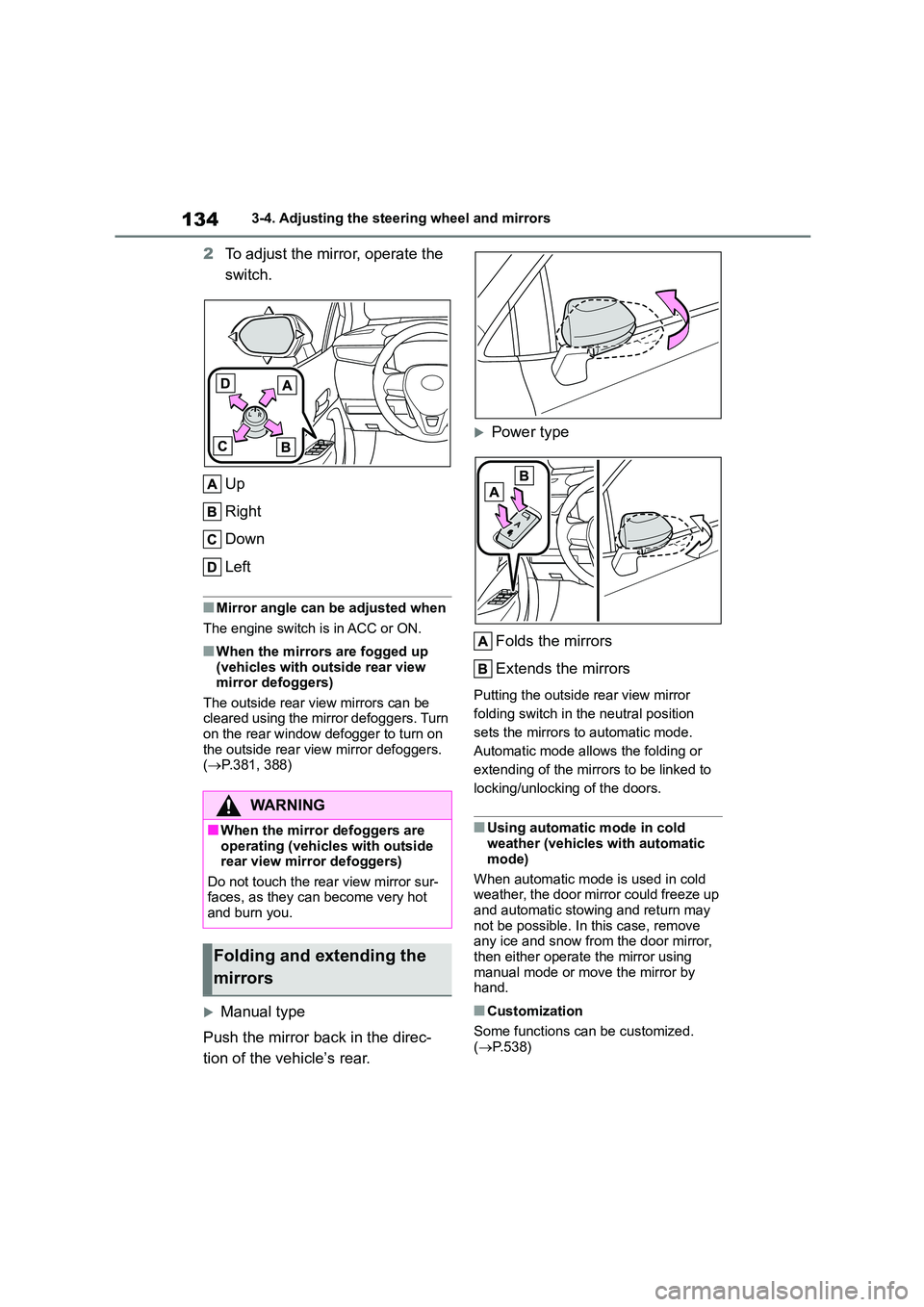
2To adjust the mirror, operate the
switch.
Up
Right
Down
Left
■Mirror angle can be adjusted when
The engine switch is in ACC or ON.
■When the mirrors are fogged up
(vehicles with outside rear view mirror defoggers)
The outside rear view mirrors can be
cleared using the mirror defoggers. Turn on the rear window defogger to turn on
the outside rear view mirror defoggers.
( P.381, 388)
Manual type
Push the mirror back in the direc-
tion of the vehicle’s rear.
Power type
Folds the mirrors
Extends the mirrors
Putting the outside rear view mirror
folding switch in the neutral position
sets the mirrors to automatic mode.
Automatic mode allows the folding or
extending of the mirrors to be linked to
locking/unlocking of the doors.
■Using automatic mode in cold
weather (vehicles with automatic
mode)
When automatic mode is used in cold weather, the door mirror could freeze up
and automatic stowing and return may
not be possible. In this case, remove any ice and snow from the door mirror,
then either operate the mirror using
manual mode or move the mirror by hand.
■Customization
Some functions can be customized.
( P.538)
WA R N I N G
■When the mirror defoggers are operating (vehicles with outside
rear view mirror defoggers)
Do not touch the rear view mirror sur- faces, as they can become very hot
and burn you.
Folding and extending the
mirrors
Page 150 of 678
1484-1. Before driving
WA R N I N G
●During normal driving, do not turn
off the engine. Turning the engine
off while driving will not cause loss of steering or braking control, but
the power assist to these systems
will be lost. This will make it more difficult to steer and brake, so you
should pull over and stop the vehi-
cle as soon as it is safe to do so.
However, in the event of an emer- gency, such as if it becomes impos-
sible to stop the vehicle in the
normal way: P. 4 6 2
●Use engine braking (downshift) to
maintain a safe speed when driving down a steep hill.
Using the brakes continuously may
cause the brakes to overheat and lose effectiveness. (P.165, 169)
●Do not adjust the positions of the steering wheel, the seat, or the
inside or outside rear view mirrors
while driving. Doing so may result in a loss of
vehicle control.
●Always check that all passengers’
arms, heads or other parts of their
body are not outside the vehicle.
■When driving on slippery road
surfaces
●Sudden braking, acceleration and
steering may cause tire slippage
and reduce your ability to control the vehicle.
●Sudden acceleration, engine brak-ing due to shifting, or changes in
engine speed could cause the vehi-
cle to skid.
●After driving through a puddle, lightly depress the brake pedal to
make sure that the brakes are func-
tioning properly. Wet brake pads may prevent the brakes from func-
tioning properly. If the brakes on
only one side are wet and not func- tioning properly, steering control
may be affected.
■When shifting the shift lever
●Vehicles with a Multidrive: Do not
let the vehicle roll backward while a forward driving position is selected,
or roll forward while the shift lever is
in R. Doing so may cause the engine to
stall or lead to poor brake and
steering performance, resulting in an accident or damage to the vehi-
cle.
●Vehicles with a Multidrive: Do not
shift the shift lever to P while the
vehicle is moving. Doing so can damage the transmis-
sion and may result in a loss of
vehicle control.
●Do not shift the shift lever to R while
the vehicle is moving forward. Doing so can damage the transmis-
sion and may result in a loss of
vehicle control.
●Do not shift the shift lever to a driv-
ing position while the vehicle is moving backward.
Doing so can damage the transmis-
sion and may result in a loss of vehicle control.
●Moving the shift lever to N while the vehicle is moving will disengage the
engine from the transmission.
Engine braking is not available
when N is selected.
Page 153 of 678
151
4
4-1. Before driving
Driving
NOTICE
●Observe the following precautions.
Failure to do so may cause exces-
sive premature wear or damage to the clutch, eventually making it diffi-
cult to accelerate and start off from
a stop. Have the vehicle inspected by any authorized Toyota retailer or
Toyota authorized repairer, or any
reliable repairer.
• Do not rest your foot on the clutch pedal or depress it any time other
than when shifting.
Doing so may cause clutch trouble.
• Do not use any gear other than the
1st gear when starting off and mov- ing forward.
Doing so may damage the clutch.
• Do not use the clutch pedal to
adjust vehicle speed.
Doing so may damage the clutch.
• When stopping the vehicle with the
shift lever in a position other than N, make sure to fully depress the
clutch pedal and stop the vehicle
using the brakes.
●Do not shift the shift lever to R with-
out the vehicle completely stopped. Doing so may damage the clutch,
transmission and gears.
■When parking the vehicle (vehi-
cles with a Multidrive)
Always set the parking brake and shift the shift lever to P. Failure to do so
may cause the vehicle to move or the
vehicle may accelerate suddenly if the accelerator pedal is accidentally
depressed.
■Avoiding damage to vehicle parts
●Do not turn the steering wheel fully
in either direction and hold it there for an extended period of time.
Doing so may damage the power
steering motor.
●When driving over bumps in the road, drive as slowly as possible to
avoid damaging the wheels, under-
side of the vehicle, etc.
■If you get a flat tire while driving
A flat or damaged tire may cause the following situations. Hold the steering
wheel firmly and gradually depress
the brake pedal to slow down the vehicle.
●It may be difficult to control your vehicle.
●The vehicle will make abnormal sounds or vibrations.
●The vehicle will lean abnormally.
Information on what to do in case of a
flat tire (P.482, 498)
■When encountering flooded
roads
Do not drive on a road that has
flooded after heavy rain etc. Doing so
may cause the following serious dam- age to the vehicle:
●Engine stalling
●Short in electrical components
●Engine damage caused by water
immersion
In the event that you drive on a
flooded road and the vehicle
becomes flooded or stuck in mud or sand, be sure to have any authorized
Toyota retailer or Toyota authorized
repairer, or any reliable repairer check the following:
●Brake function
●Changes in the quantity and quality
of the engine oil, transaxle fluid,
clutch fluid, differential oil, etc.
●Lubricant condition for the bearings
and suspension joints (where possi- ble), and the function of all joints,
bearings, etc.
Page 164 of 678
1624-2. Driving procedures
Multidrive
1 Stop the vehicle completely.
2 Set the parking brake (P.172,
173), and shift th e shift lever to
P.
Check the parking brake indicator is
illuminated.
3 Press the engine switch.
The engine will stop, and the meter dis-
play will be extinguished.
4 Release the brake pedal and
check that “ACCESSORY” or
“IGNITION ON” is not shown on
the multi-information display.
Manual transmission
1 Stop the vehicle completely.
2 Set the parking brake. (P.172,
173)
Check the parking brake indicator is illuminated.
3 Shift the shift lever to N.
( P.169)
4 Press the engine switch.
The engine will stop, and the meter dis-
play will be extinguished.
5 Release the brake pedal and
check that “ACCESSORY” or
“IGNITION ON” is not shown on
the multi-information display.
WA R N I N G
■Caution while driving
If engine failure occurs while the vehi-
cle is moving, do not lock or open the doors until the vehicle reaches a safe
and complete stop. Activation of the
steering lock in this circumstance may lead to an accident, resulting in death
or serious injury.
NOTICE
■When starting the engine
●Do not race a cold engine.
●If the engine becomes difficult to
start or stalls frequently, have your vehicle checked by any authorized
Toyota retailer or Toyota authorized
repairer, or any reliable repairer immediately.
■Symptoms indicating a malfunc-tion with the engine switch
If the engine switch seems to be oper-
ating somewhat differently than usual,
such as the switch sticking slightly, there may be a malfunction. Contact
any authorized Toyota retailer or
Toyota authorized repairer, or any reli- able repairer immediately.
Stopping the engine
WA R N I N G
■Stopping the engine in an emer-gency
●If you want to stop the engine in an
emergency while driving the vehi- cle, press and hold the engine
switch for more than 2 seconds, or
press it briefly 3 times or more in succession. ( P.462)
However, do not touch the engine
switch while driving except in an emergency. Turning the engine off
while driving will not cause loss of
steering or braking control, but the power assist to these systems will
be lost. This will make it more diffi-
cult to steer and brake, so you should pull over and stop the vehi-
cle as soon as it is safe to do so.
Page 308 of 678
3064-5. Using the driving support systems
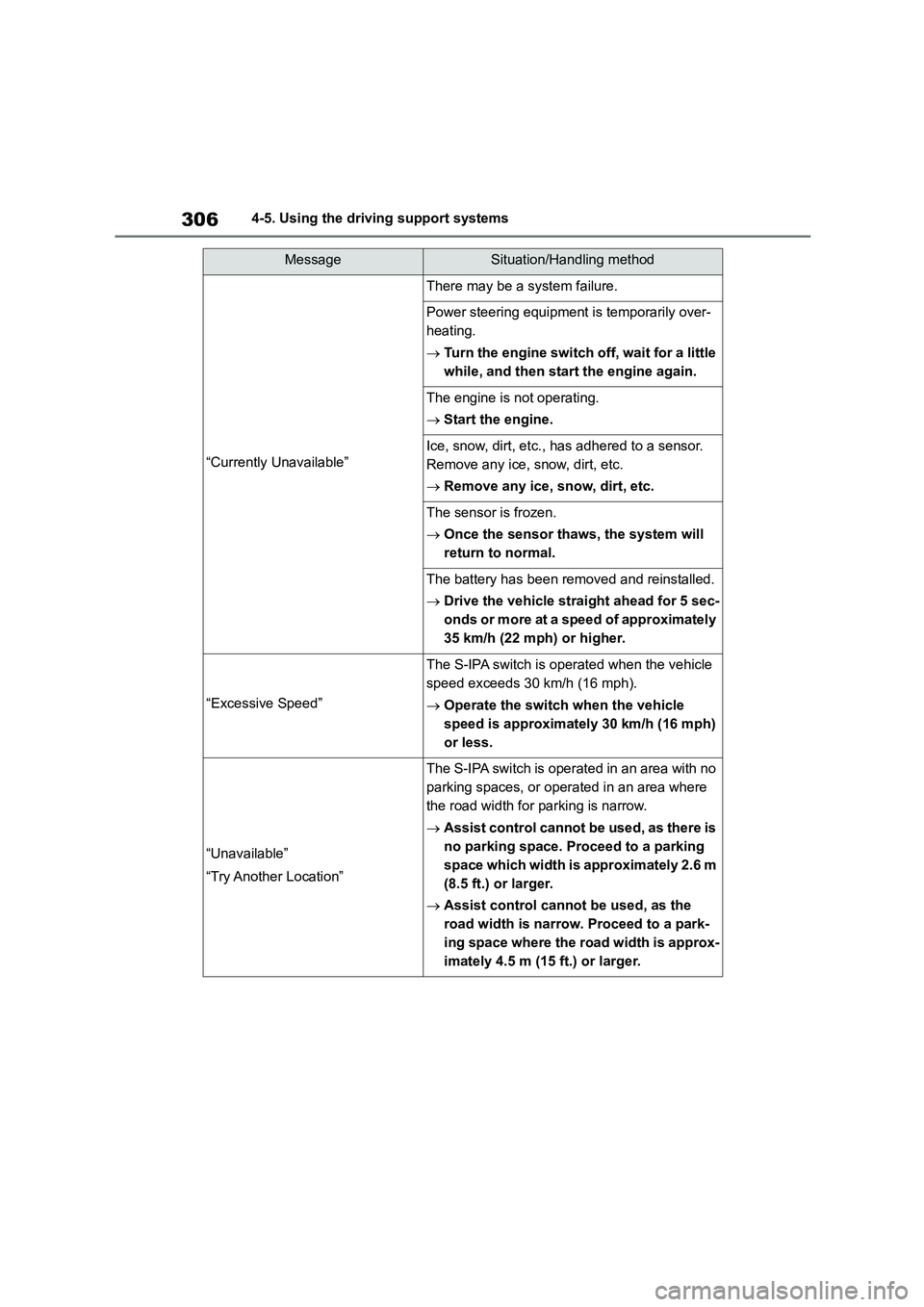
“Currently Unavailable”
There may be a system failure.
Power steering equipment is temporarily over-
heating.
Turn the engine switch off, wait for a little
while, and then start the engine again.
The engine is not operating.
Start the engine.
Ice, snow, dirt, etc., has adhered to a sensor.
Remove any ice, snow, dirt, etc.
Remove any ice, snow, dirt, etc.
The sensor is frozen.
Once the sensor thaws, the system will
return to normal.
The battery has been removed and reinstalled.
Drive the vehicle straight ahead for 5 sec-
onds or more at a speed of approximately
35 km/h (22 mph) or higher.
“Excessive Speed”
The S-IPA switch is operated when the vehicle
speed exceeds 30 km/h (16 mph).
Operate the switch when the vehicle
speed is approximately 30 km/h (16 mph)
or less.
“Unavailable”
“Try Another Location”
The S-IPA switch is operated in an area with no
parking spaces, or operated in an area where
the road width for parking is narrow.
Assist control cannot be used, as there is
no parking space. Proceed to a parking
space which width is approximately 2.6 m
(8.5 ft.) or larger.
Assist control cannot be used, as the
road width is narrow. Proceed to a park-
ing space where the road width is approx-
imately 4.5 m (15 ft.) or larger.
MessageSituation/Handling method
Page 316 of 678
3144-5. Using the driving support systems
*: If equipped
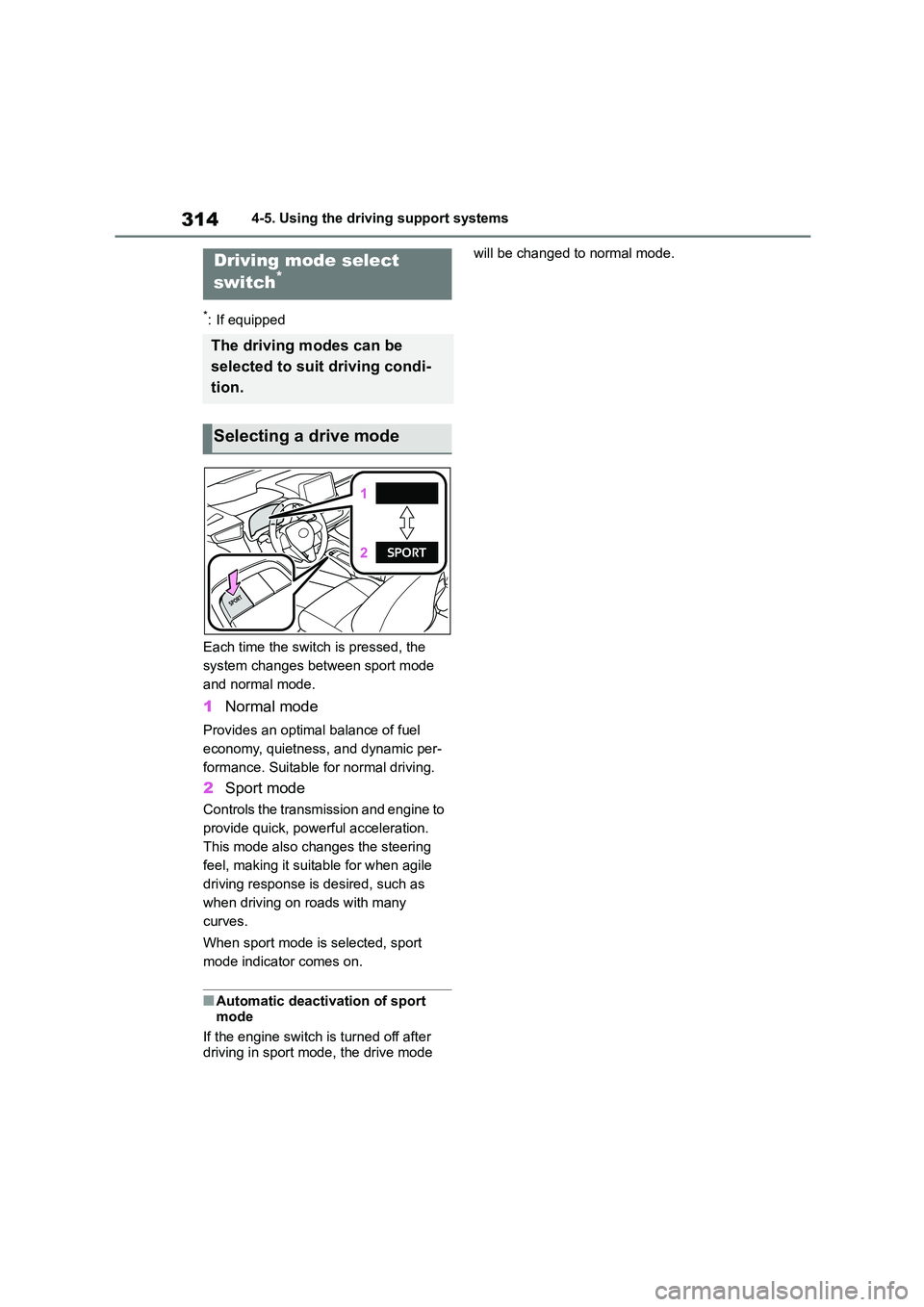
Each time the switch is pressed, the
system changes betw een sport mode
and normal mode.
1 Normal mode
Provides an optimal balance of fuel
economy, quietness, and dynamic per-
formance. Suitable for normal driving.
2 Sport mode
Controls the transmission and engine to
provide quick, powerful acceleration.
This mode also changes the steering
feel, making it suitable for when agile
driving response is desired, such as
when driving on roads with many
curves.
When sport mode is selected, sport
mode indicator comes on.
■Automatic deactivation of sport
mode
If the engine switch is turned off after
driving in sport mode, the drive mode
will be changed to normal mode.Driving mode select
switch*
The driving modes can be
selected to suit driving condi-
tion.
Selecting a drive mode