battery TOYOTA COROLLA HATCHBACK 2020 (in English) Workshop Manual
[x] Cancel search | Manufacturer: TOYOTA, Model Year: 2020, Model line: COROLLA HATCHBACK, Model: TOYOTA COROLLA HATCHBACK 2020Pages: 572, PDF Size: 13.8 MB
Page 500 of 572
5008-2. Steps to take in an emergency
COROLLA H/B_U
■When the electronic key does
not work properly
●Make sure that the smart key sys-
tem has not been deactivated in
the customization setting. If it is
off, turn the function on. (Custom-
izable features P.531)
●Check if battery-saving mode is
set. If it is set, cancel the function.
( P.109)
Use the mechanical key
( P.100) in order to perform the
following operations:
If you lose your keys
New genuine mechanical
keys can be made by your
Toyota dealer using another
mechanical key and the key
number stamped on your
key number plate.
Keep the plate in a safe
place such as your wallet,
not in the vehicle.
NOTICE
■When an electronic key is lost
If the electronic key remains lost,
the risk of vehicle theft increases
significantly. Visit your Toyota
dealer immediately with all
remaining electronic keys that
were provided wit h your vehicle.
If the electronic key
does not operate prop-
erly
If communication between
the electronic key and vehi-
cle is interrupted ( P.109)
or the electronic key cannot
be used because the battery
is depleted, the smart key
system and wireless remote
control cannot be used. In
such cases, the doors can
be opened and the engine
can be started by following
the procedure below.
NOTICE
■In case of a smart key system
malfunction or other
key-related problems
Take your vehicle with all the elec-
tronic keys provided with your
vehicle to your Toyota dealer.
Locking and unlocking
the doors
Page 502 of 572
5028-2. Steps to take in an emergency
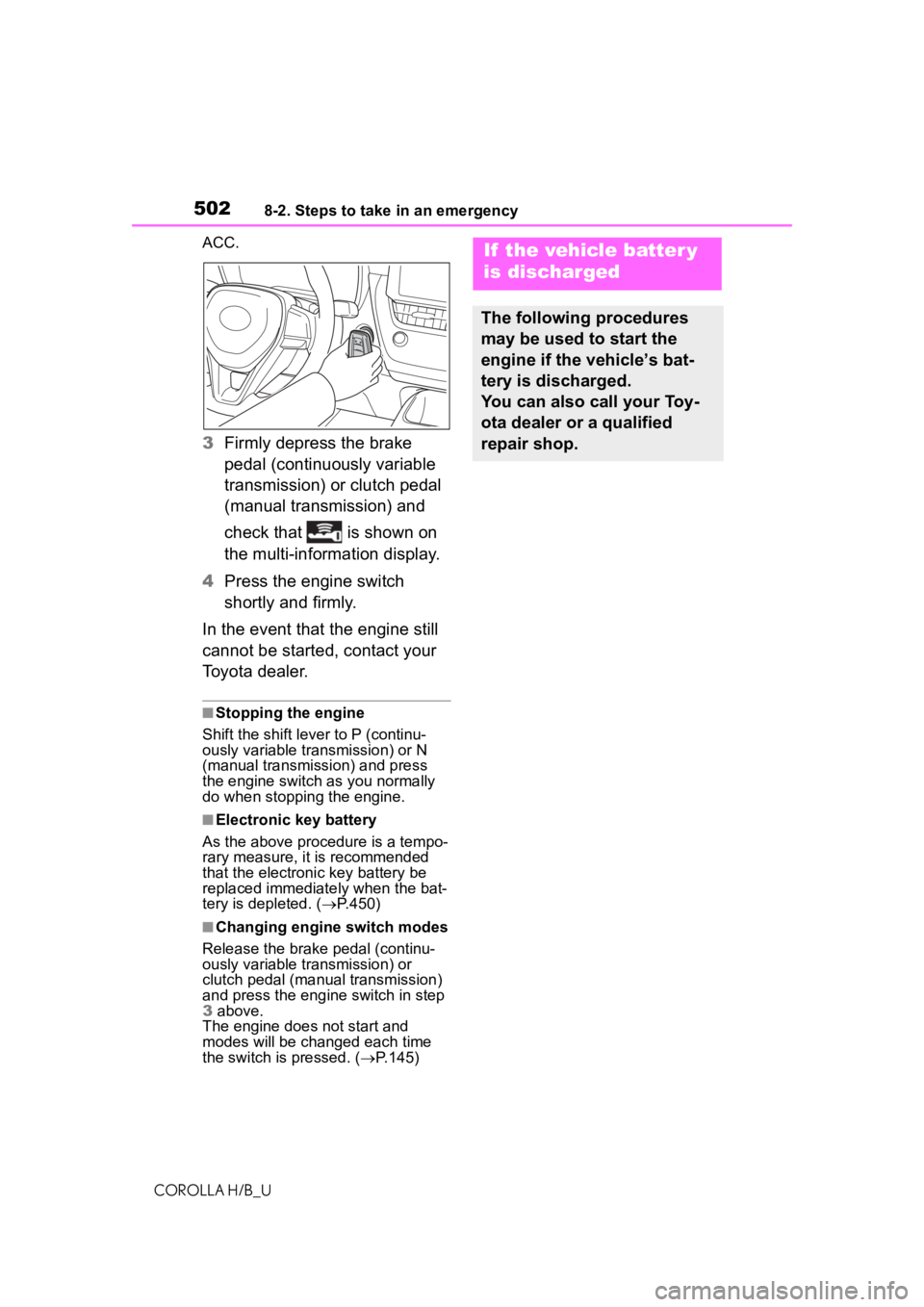
COROLLA H/B_UACC.
3
Firmly depress the brake
pedal (continuously variable
transmission) or clutch pedal
(manual transmission) and
check that is shown on
the multi-information display.
4 Press the engine switch
shortly and firmly.
In the event that the engine still
cannot be started, contact your
Toyota dealer.
■Stopping the engine
Shift the shift lever to P (continu-
ously variable transmission) or N
(manual transmission) and press
the engine switch as you normally
do when stopping the engine.
■Electronic key battery
As the above proc edure is a tempo-
rary measure, it is recommended
that the electronic key battery be
replaced immediate ly when the bat-
tery is depleted. ( P.450)
■Changing engine switch modes
Release the brake pedal (continu-
ously variable transmission) or
clutch pedal (manual transmission)
and press the engine switch in step
3 above.
The engine does not start and
modes will be cha nged each time
the switch is pressed. ( P.145)
If the vehicle batter y
is discharged
The following procedures
may be used to start the
engine if the vehicle’s bat-
tery is discharged.
You can also call your Toy-
ota dealer or a qualified
repair shop.
Page 503 of 572
5038-2. Steps to take in an emergency
COROLLA H/B_U
8
When trouble arises
If you have a set of jumper (or
booster) cables and a second
vehicle with a 12-volt battery,
you can jump start your vehicle
by following the steps below.
1 Vehicles with an alarm
( P.66): Confirm that the
electronic key is being car-
ried.
When connecting the jumper (or booster) cables, depending on the
situation, the alarm may activate
and doors locked. (
P. 6 7 )2 Open the hood. ( P.427)
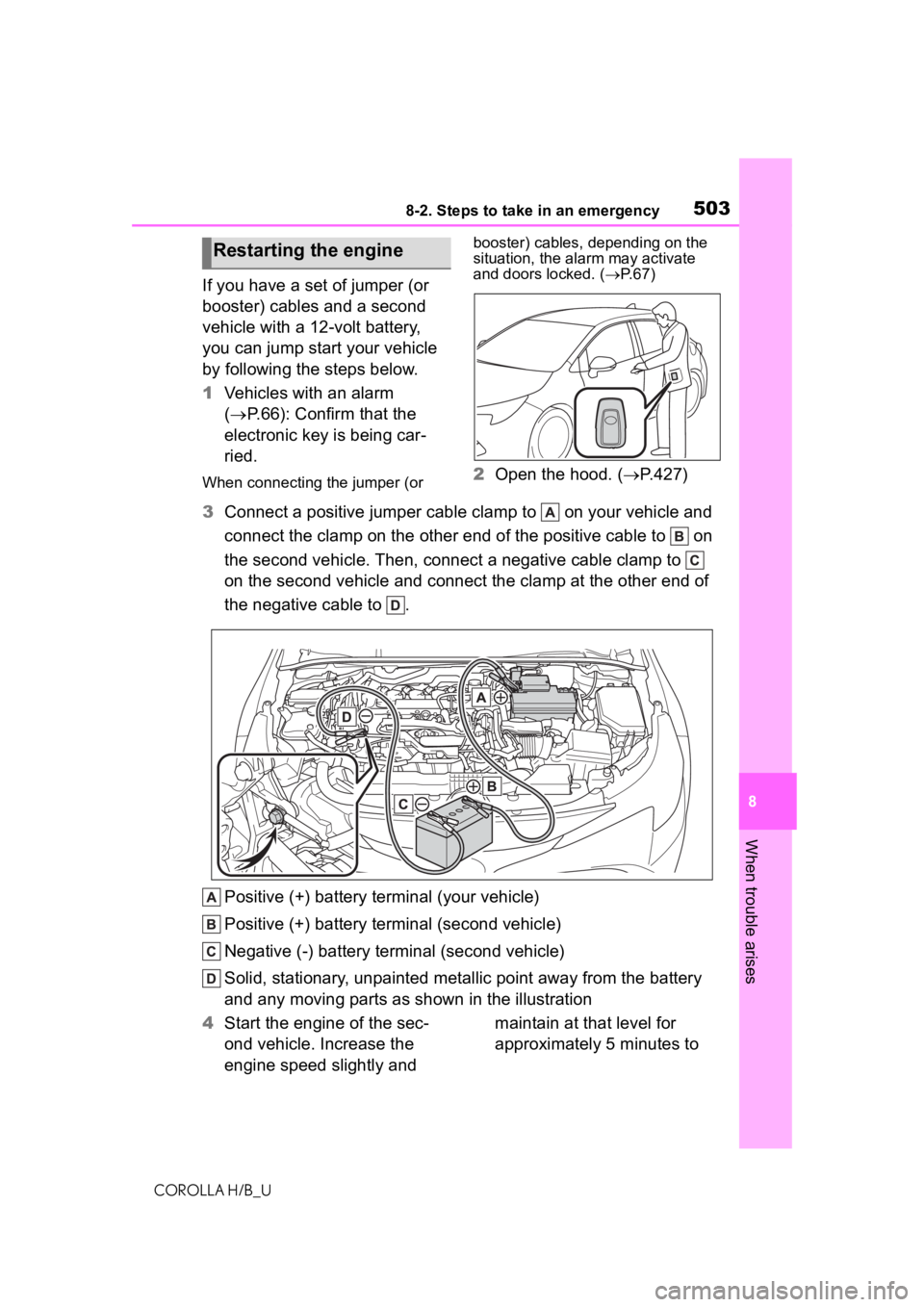
3 Connect a positive jumper cable clamp to on your vehicle and
connect the clamp on the other end of the positive cable to on
the second vehicle. Then, connect a negative cable clamp to
on the second vehicle and connect the clamp at the other end of
the negative cable to .
Positive (+) battery terminal (your vehicle)
Positive (+) battery terminal (second vehicle)
Negative (-) battery term inal (second vehicle)
Solid, stationary, unpainted metallic point away from the batte ry
and any moving parts as shown in the illustration
4 Start the engine of the sec-
ond vehicle. Increase the
engine speed slightly and maintain at that level for
approximately 5 minutes to
Restarting the engine
Page 504 of 572
5048-2. Steps to take in an emergency
COROLLA H/B_U
recharge the battery of your
vehicle.
5 Open and close any of the
doors of your vehicle with the
engine switch OFF.
6 Maintain the engine speed of
the second vehicle and start
the engine of your vehicle by
turning the engine switch to
ON.
7 Once the vehicle’s engine
has started, remove the
jumper cables in the exact
reverse order from which
they were connected.
Once the engine starts, have the
vehicle inspected at your Toyota
dealer as soon as possible.
■Starting the engine when the
battery is discharged
The engine cannot be started by
push-starting.
■To prevent battery discharge
●Turn off the headlights and the
audio system while the engine is
off.
●Turn off any unnecessary electri-
cal components when the vehicle
is running at a low speed for an
extended period, such as in heavy
traffic.
■When the battery is removed or
discharged
●Information stor ed in the ECU is
cleared. When the battery is
depleted, have the vehicle
inspected at you r Toyota dealer.
●Some systems may require initial-
ization. ( P.539)
■When removing the battery ter-
minals
When the battery terminals are
removed, the information stored in
the ECU is cleared. Before remov-
ing the battery term inals, contact
your Toyota dealer.
■Charging the battery
The electricity stored in the battery
will discharge grad ually even when
the vehicle is not in use, due to nat-
ural discharge and the draining
effects of certain electrical appli-
ances. If the vehicle is left for a long
time, the battery may discharge,
and the engine may be unable to
start. (The battery recharges auto-
matically during driving.)
■When recharging or replacing
the battery
●In some cases, it may not be pos-
sible to unlock the doors using the
smart key system when the bat-
tery is discharged. Use the wire-
less remote control or the
mechanical key to lock or unlock
the doors.
●The engine may not start on the
first attempt after the battery has
recharged but will start normally
after the second attempt. This is
not a malfunction.
●The engine switch mode is memo-
rized by the vehicle. When the
battery is reconnected, the system
will return to the mode it was in
before the bat tery was dis-
charged. Before disconnecting the
battery, turn the engine switch off.
If you are unsure what mode the
engine switch wa s in before the
battery discharged, be especially
careful when reconnecting the
battery.
■When replacing the battery
●Use a battery that conforms to
European regulations.
●Use a battery that the case size is
same as the previous one (LN2),
20 hour rate capacity (20HR) is
Page 505 of 572
5058-2. Steps to take in an emergency
COROLLA H/B_U
8
When trouble arises
equivalent (60Ah) or greater, and
performance rating (CCA) is
equivalent (360A) or greater.
• If the sizes differ, the battery can- not be properly secured.
• If the 20 hour rate capacity is low,
even if the time period where the
vehicle is not used is a short time,
the battery may discharge and the
engine may not be able to start.
●For details, consu lt your Toyota
dealer.
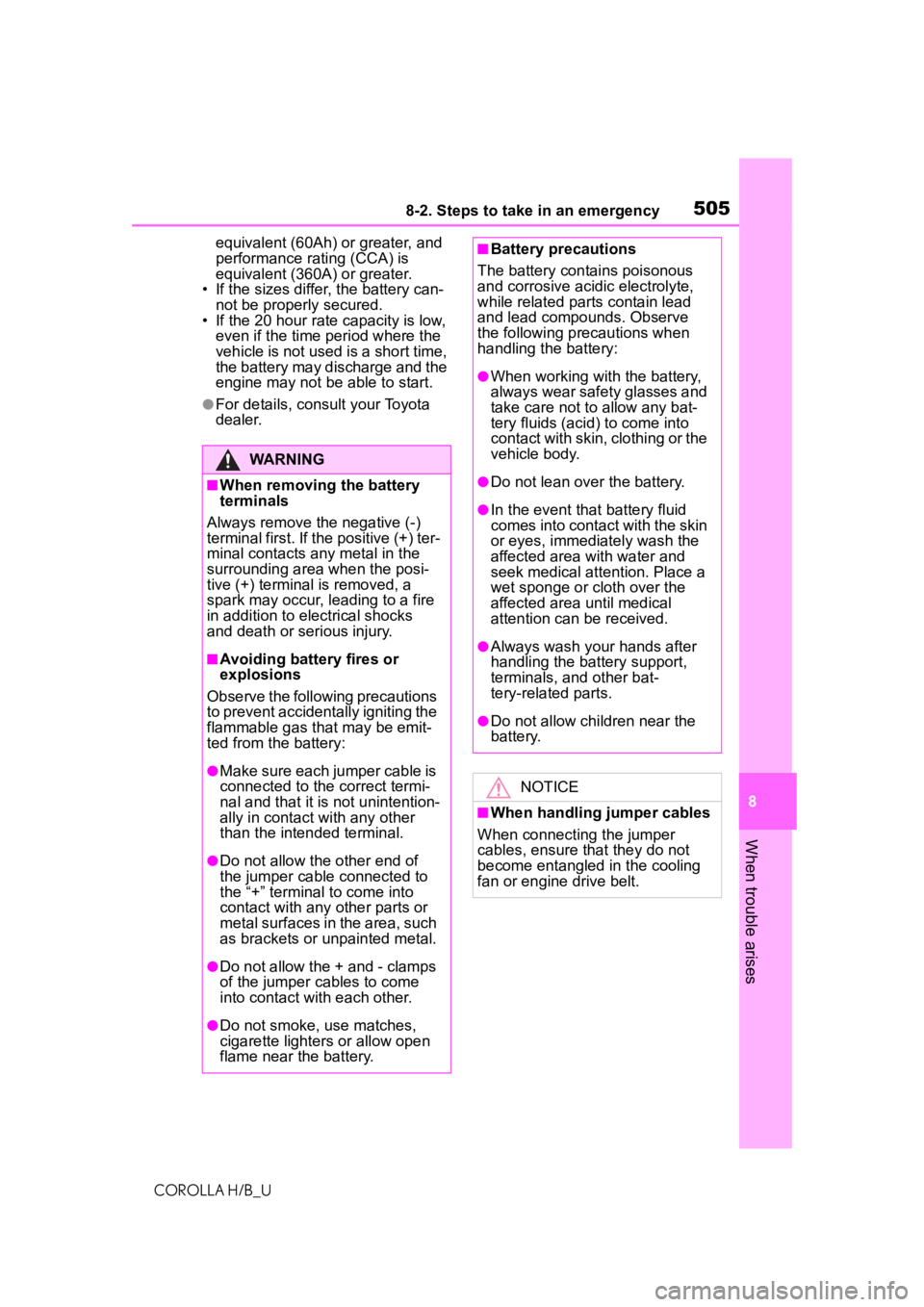
WARNING
■When removing the battery
terminals
Always remove the negative (-)
terminal first. If the positive (+) ter-
minal contacts any metal in the
surrounding area when the posi-
tive (+) terminal is removed, a
spark may occur, l eading to a fire
in addition to electrical shocks
and death or serious injury.
■Avoiding battery fires or
explosions
Observe the following precautions
to prevent accidentally igniting the
flammable gas that may be emit-
ted from the battery:
●Make sure each jumper cable is
connected to the correct termi-
nal and that it is not unintention-
ally in contact with any other
than the intended terminal.
●Do not allow the other end of
the jumper cable connected to
the “+” terminal to come into
contact with any other parts or
metal surfaces in the area, such
as brackets or unpainted metal.
●Do not allow the + and - clamps
of the jumper cables to come
into contact with each other.
●Do not smoke, use matches,
cigarette lighters or allow open
flame near the battery.
■Battery precautions
The battery contains poisonous
and corrosive acidic electrolyte,
while related parts contain lead
and lead compounds. Observe
the following precautions when
handling the battery:
●When working with the battery,
always wear safety glasses and
take care not to allow any bat-
tery fluids (acid) to come into
contact with skin, clothing or the
vehicle body.
●Do not lean over the battery.
●In the event that battery fluid
comes into contact with the skin
or eyes, immediately wash the
affected area with water and
seek medical attention. Place a
wet sponge or cloth over the
affected area until medical
attention can be received.
●Always wash your hands after
handling the battery support,
terminals, and other bat-
tery-related parts.
●Do not allow children near the
battery.
NOTICE
■When handling jumper cables
When connecting the jumper
cables, ensure that they do not
become entangled in the cooling
fan or engine drive belt.
Page 513 of 572
5139-1. Specifications
COROLLA H/B_U
9
Vehicle specifications
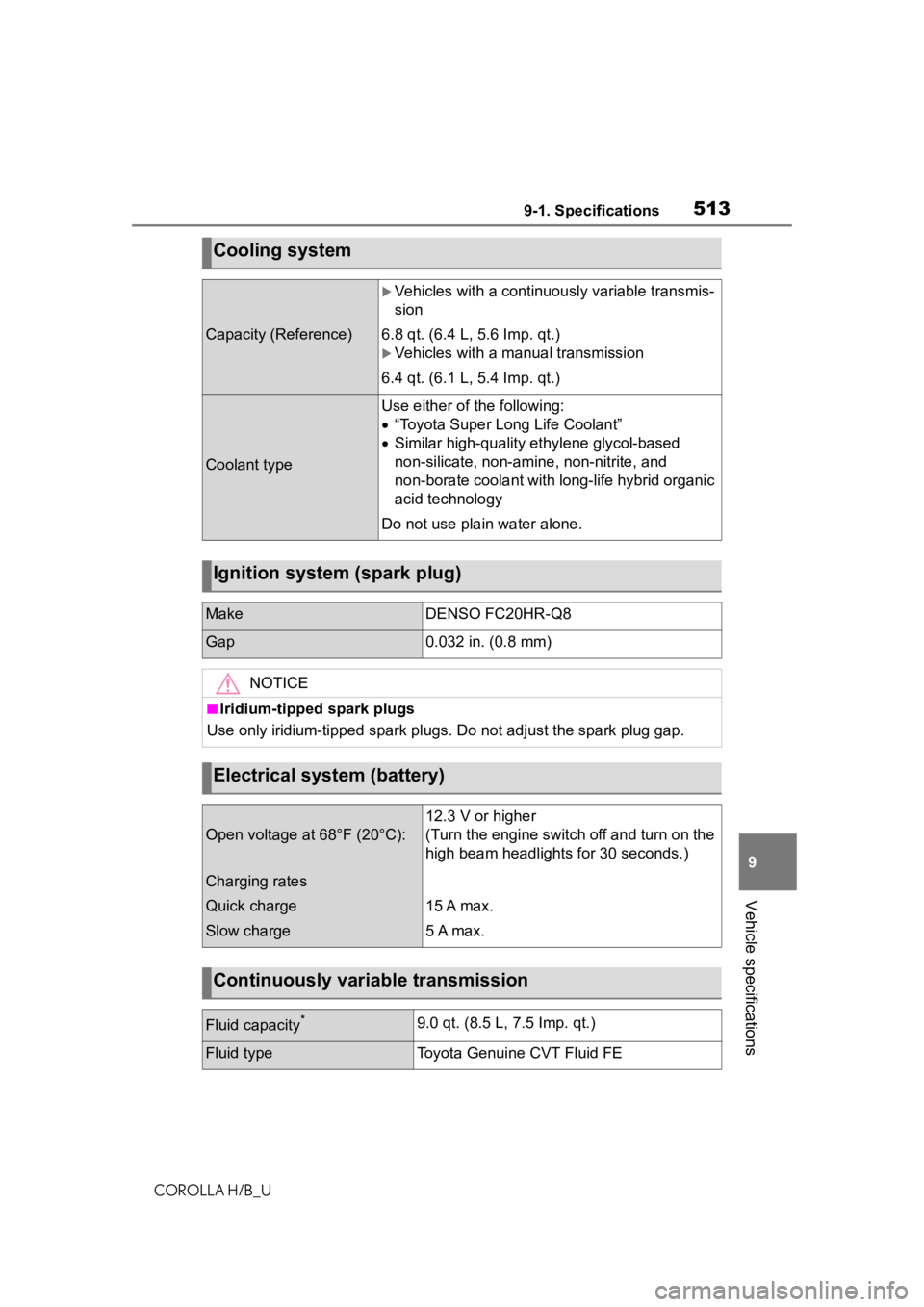
Cooling system
Capacity (Reference)
Vehicles with a continuously variable transmis-
sion
6.8 qt. (6.4 L, 5.6 Imp. qt.)
Vehicles with a manual transmission
6.4 qt. (6.1 L, 5.4 Imp. qt.)
Coolant type
Use either o f the following:
“Toyota Super Long Life Coolant”
Similar high-quality et hylene glycol-based
non-silicate, non -amine, non-nitrite, and
non-borate coolant with long-life hybrid organic
acid technology
Do not use pla in water alone.
Ignition system (spark plug)
MakeDENSO FC20HR-Q8
Gap0.032 in. (0.8 mm)
NOTICE
■Iridium-tipped spark plugs
Use only iridium-tipped spark plugs. Do not adjust the spark pl ug gap.
Electrical system (battery)
Open voltage at 68°F (20°C):
12.3 V or higher
(Turn the engine switch off and turn on the
high beam headlights for 30 seconds.)
Charging rates
Quick charge
Slow charge
15 A max.
5 A max.
Continuously variable transmission
Fluid capacity*9.0 qt. (8.5 L, 7.5 Imp. qt.)
Fluid typeToyota Genuine CVT Fluid FE
Page 525 of 572
5259-1. Specifications
COROLLA H/B_U
9
Vehicle specifications
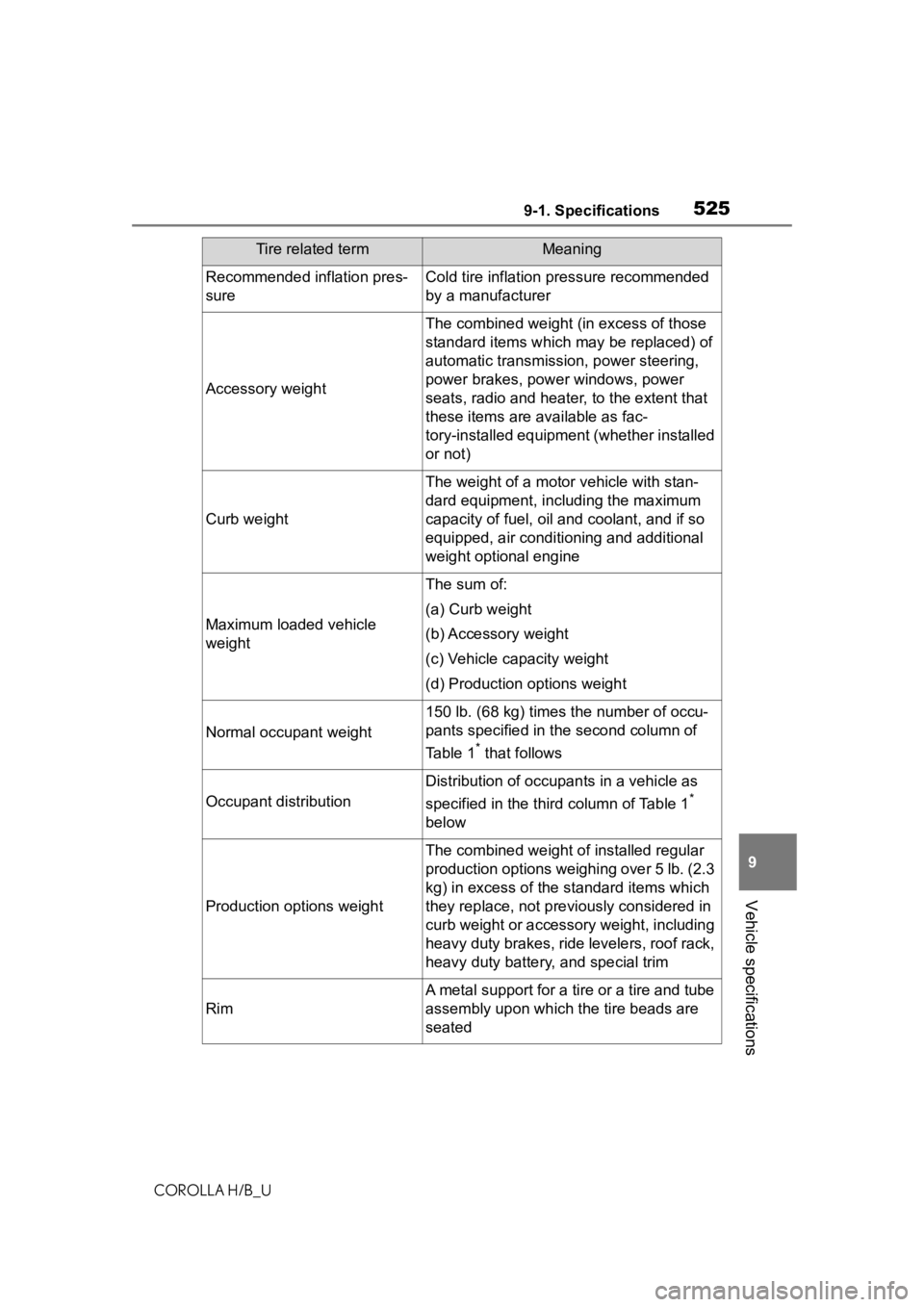
Recommended inflation pres-
sureCold tire inflation pressure recommended
by a manufacturer
Accessory weight
The combined weight (in excess of those
standard items which may be replaced) of
automatic transmission, power steering,
power brakes, power windows, power
seats, radio and heater, to the extent that
these items are available as fac-
tory-installed equipment (whether installed
or not)
Curb weight
The weight of a motor vehicle with stan-
dard equipment, including the maximum
capacity of fuel, oil and coolant, and if so
equipped, air conditioning and additional
weight optional engine
Maximum loaded vehicle
weight
The sum of:
(a) Curb weight
(b) Accessory weight
(c) Vehicle capacity weight
(d) Production options weight
Normal occupant weight
150 lb. (68 kg) times the number of occu-
pants specified in the second column of
Table 1
* that follows
Occupant distribution
Distribution of occupan ts in a vehicle as
specified in the thi rd column of Table 1
*
below
Production options weight
The combined weight o f installed regular
production options weighing over 5 lb. (2.3
kg) in excess of the s tandard items which
they replace, not previously considered in
curb weight or accessory weight, including
heavy duty brakes, ride levelers, roof rack,
heavy duty battery, and special trim
Rim
A metal support for a tire or a tire and tube
assembly upon which the tire beads are
seated
Tire related termMeaning
Page 539 of 572
5399-3. Initialization
COROLLA H/B_U
9
Vehicle specifications
9-3.Initialization
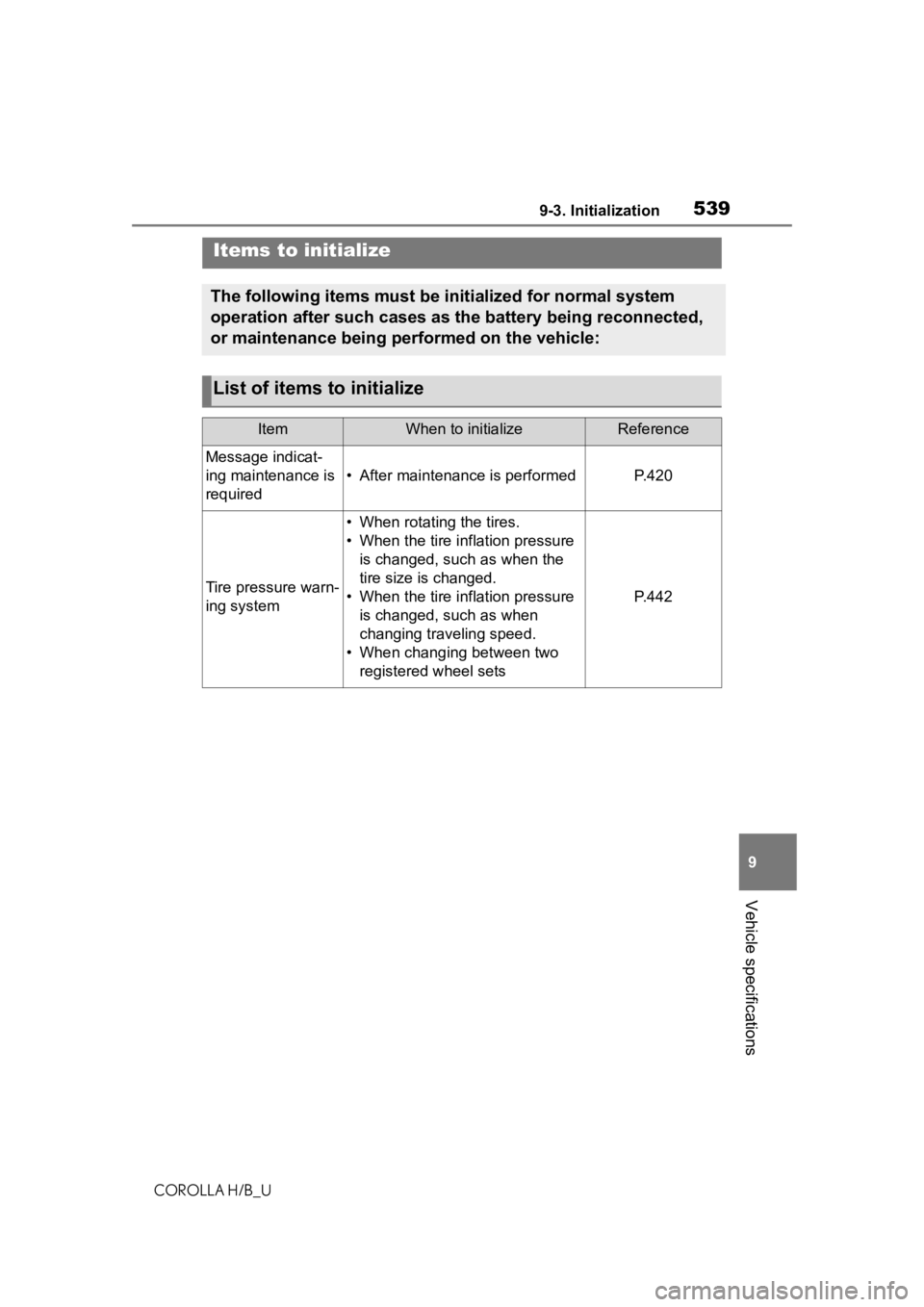
Items to initialize
The following items must be initialized for normal system
operation after such cases as the battery being reconnected,
or maintenance being performed on the vehicle:
List of items to initialize
ItemWhen to initializeReference
Message indicat-
ing maintenance is
required
• After maintenance is performedP. 4 2 0
Tire pressure warn-
ing system
• When rotating the tires.
• When the tire inflation pressure is changed, such as when the
tire size is changed.
• When the tire inflation pressure is changed, such as when
changing traveling speed.
• When changing between two registered wheel sets
P. 4 4 2
Page 552 of 572
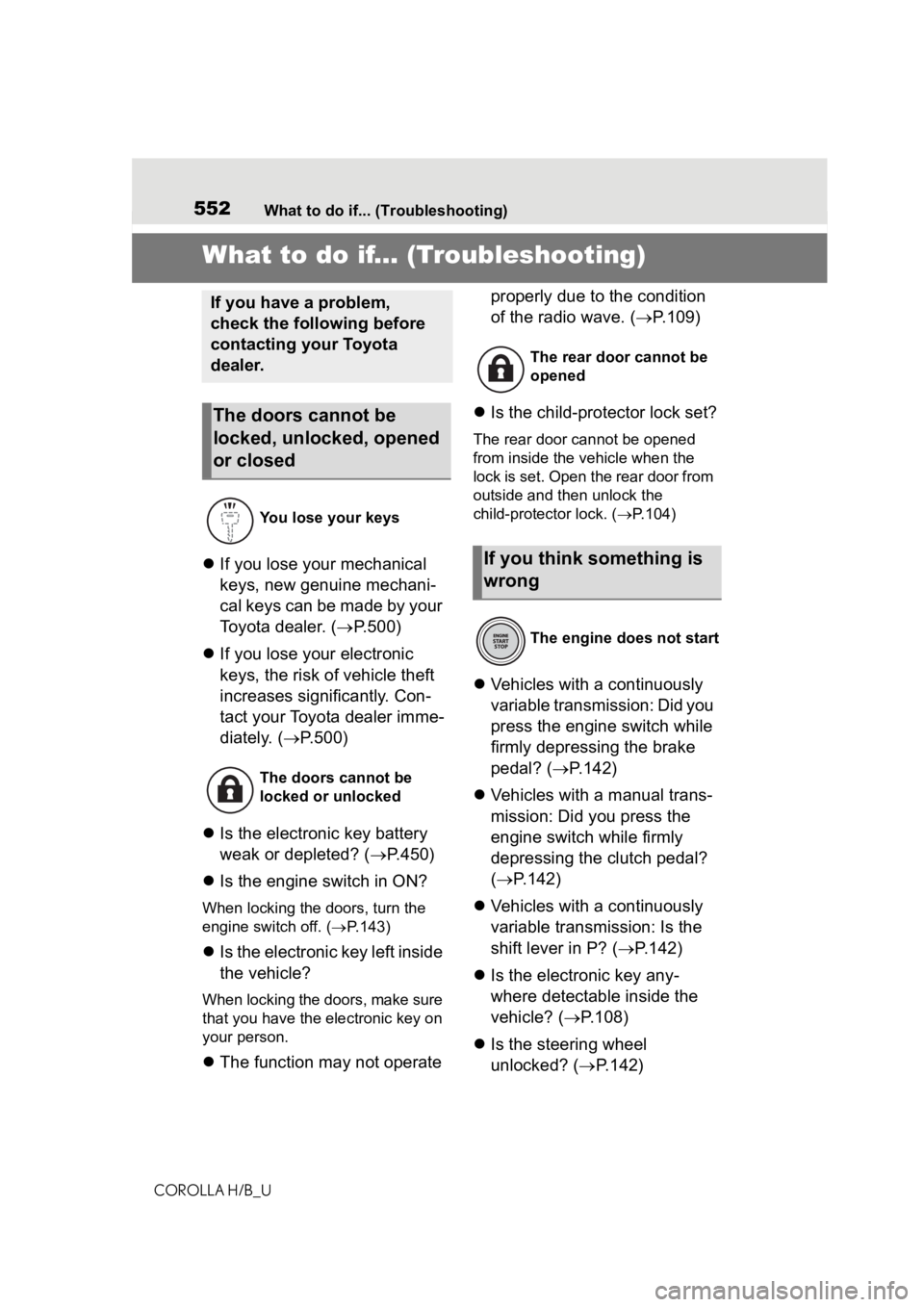
552What to do if... (Troubleshooting)
COROLLA H/B_U
1-1.What to do if... (Troubleshooting)What to do if... (Troubleshooting)
If you lose your mechanical
keys, new genuine mechani-
cal keys can be made by your
Toyota dealer. ( P.500)
If you lose your electronic
keys, the risk of vehicle theft
increases significantly. Con-
tact your Toyota dealer imme-
diately. ( P.500)
Is the electronic key battery
weak or depleted? ( P.450)
Is the engine switch in ON?
When locking the doors, turn the
engine switch off. ( P.143)
Is the electronic key left inside
the vehicle?
When locking the doors, make sure
that you have the electronic key on
your person.
The function may not operate properly due to the condition
of the radio wave. (
P.109)
Is the child-protector lock set?
The rear door cannot be opened
from inside the vehicle when the
lock is set. Open the rear door from
outside and then unlock the
child-protector lock. ( P.104)
Vehicles with a continuously
variable transmission: Did you
press the engine switch while
firmly depressing the brake
pedal? ( P.142)
Vehicles with a manual trans-
mission: Did you press the
engine switch while firmly
depressing the clutch pedal?
( P.142)
Vehicles with a continuously
variable transmission: Is the
shift lever in P? ( P.142)
Is the electronic key any-
where detectable inside the
vehicle? ( P.108)
Is the steering wheel
unlocked? ( P.142)
If you have a problem,
check the following before
contacting your Toyota
dealer.
The doors cannot be
locked, unlocked, opened
or closed
You lose your keys
The doors cannot be
locked or unlocked
The rear door cannot be
opened
If you think something is
wrong
The engine does not start
Page 553 of 572
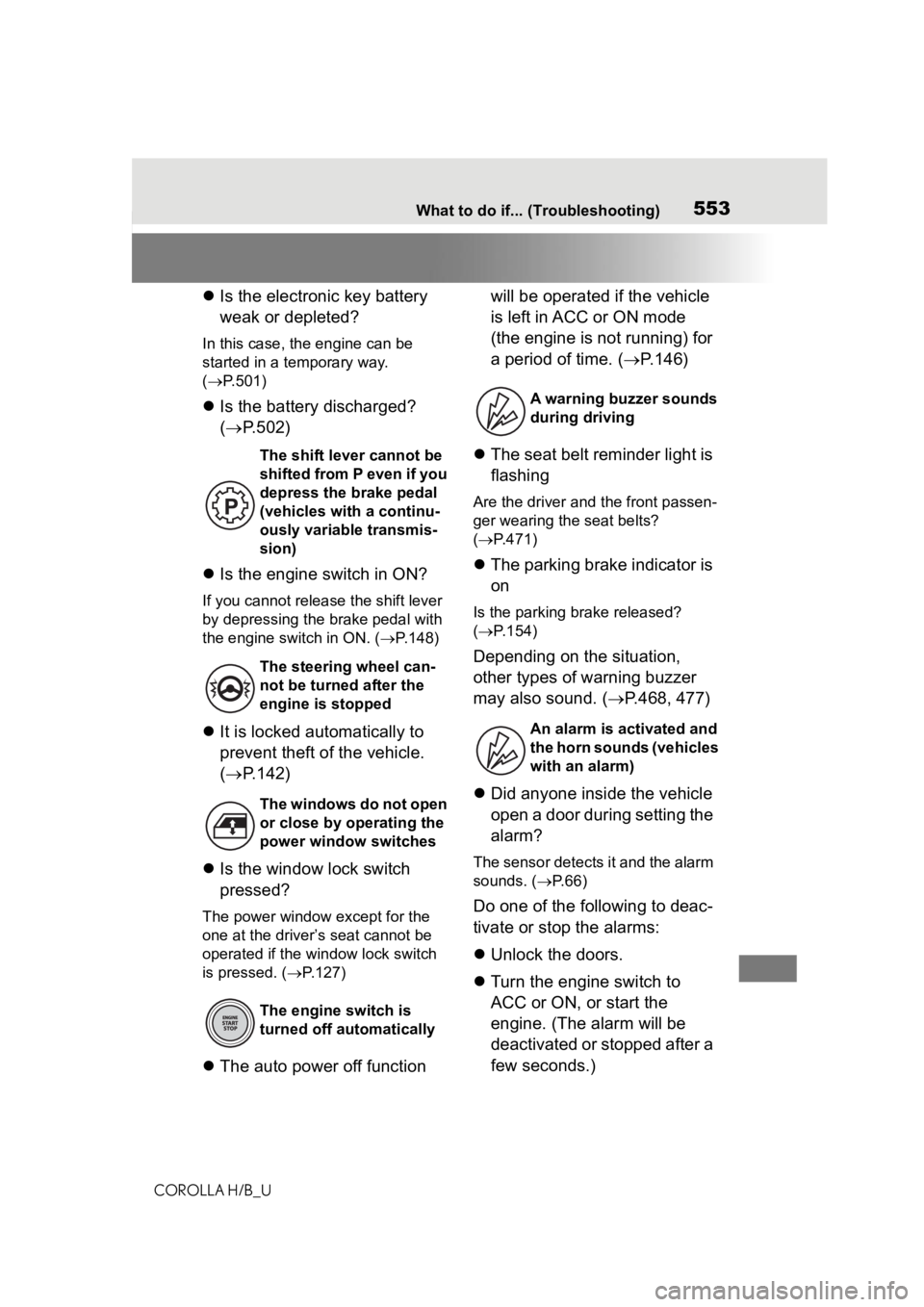
553What to do if... (Troubleshooting)
COROLLA H/B_U
Is the electronic key battery
weak or depleted?
In this case, the engine can be
started in a temporary way.
( P.501)
Is the battery discharged?
( P.502)
Is the engine switch in ON?
If you cannot release the shift lever
by depressing the brake pedal with
the engine switch in ON. ( P.148)
It is locked automatically to
prevent theft of the vehicle.
( P.142)
Is the window lock switch
pressed?
The power window except for the
one at the driver’s seat cannot be
operated if the win dow lock switch
is pressed. ( P.127)
The auto power off function will be operated if the vehicle
is left in ACC or ON mode
(the engine is not running) for
a period of time. (
P.146)
The seat belt reminder light is
flashing
Are the driver and the front passen-
ger wearing the seat belts?
( P.471)
The parking brake indicator is
on
Is the parking br ake released?
( P.154)
Depending on the situation,
other types of warning buzzer
may also sound. ( P.468, 477)
Did anyone inside the vehicle
open a door during setting the
alarm?
The sensor detects it and the alarm
sounds. ( P. 6 6 )
Do one of the following to deac-
tivate or stop the alarms:
Unlock the doors.
Turn the engine switch to
ACC or ON, or start the
engine. (The alarm will be
deactivated or stopped after a
few seconds.)
The shift lever cannot be
shifted from P even if you
depress the brake pedal
(vehicles with a continu-
ously variable transmis-
sion)
The steering wheel can-
not be turned after the
engine is stopped
The windows do not open
or close by operating the
power window switches
The engine switch is
turned off automatically
A warning buzzer sounds
during driving
An alarm is activated and
the horn sounds (vehicles
with an alarm)