flat tire TOYOTA COROLLA HATCHBACK 2020 Warranties & Maintenance Guides (in English)
[x] Cancel search | Manufacturer: TOYOTA, Model Year: 2020, Model line: COROLLA HATCHBACK, Model: TOYOTA COROLLA HATCHBACK 2020Pages: 260, PDF Size: 8.54 MB
Page 106 of 260
KENDA
104
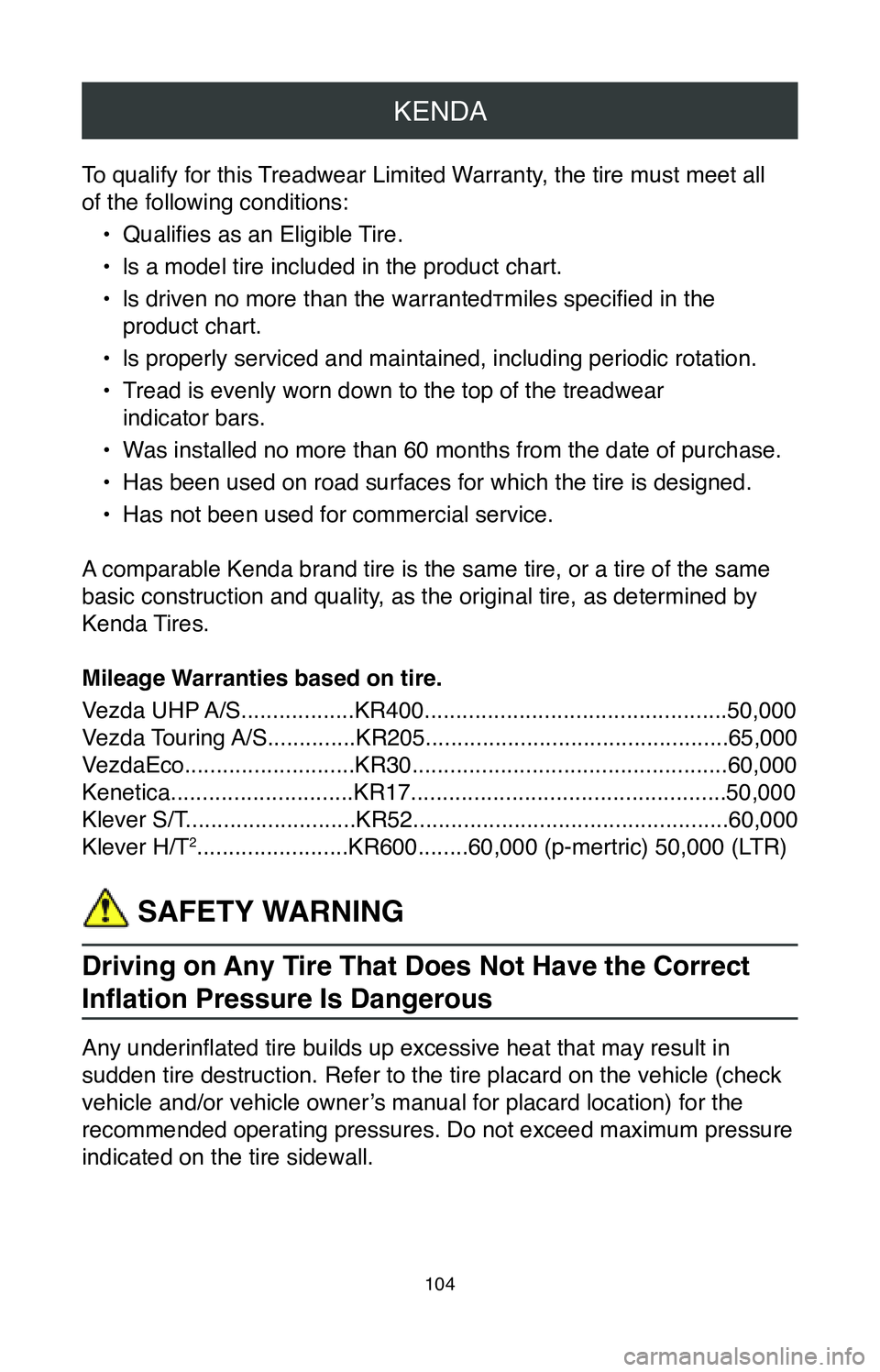
To qualify for this Treadwear Limited Warranty, the tire must meet all
of the following conditions:•
Qualifies as an Eligible Tire.
•
ls a model tire included in the product chart.
•
ls driven no more than the warrantedтmiles specified in the
product chart.
•
ls properly serviced and maintained, including periodic rotation.
•
Tread is evenly worn down to the top of the treadwear
indicator bars.
•
Was installed no more than 60 months from the date of purchase.
•
Has been used on road surfaces for which the tire is designed.
•
Has not been used for commercial service.
A comparable Kenda brand tire is the same tire, or a tire of the same
basic construction and quality, as the original tire, as determined by
Kenda Tires.
Mileage Warranties based on tire.
Vezda UHP A/S..................KR400.............................................\
...50,000
Vezda Touring A/S..............KR205................................................65\
,000
VezdaEco...........................KR30..................................\
................60,000
Kenetica.............................KR17...............................\
...................50,000
Klever S/T...........................KR52.........................................\
.........60,000
Klever H/T
2........................KR600........60,000 (p-mertric) 50,000 (LTR)
SAFETY WARNING
Driving on Any Tire That Does Not Have the Correct
Inflation Pressure Is Dangerous
Any underinflated tire builds up excessive heat that may result in
sudden tire destruction. Refer to the tire placard on the vehicle (check
vehicle and/or vehicle owner’s manual for placard location) for the
recommended operating pressures. Do not exceed maximum pressure
indicated on the tire sidewall.
Page 107 of 260
KENDA
105
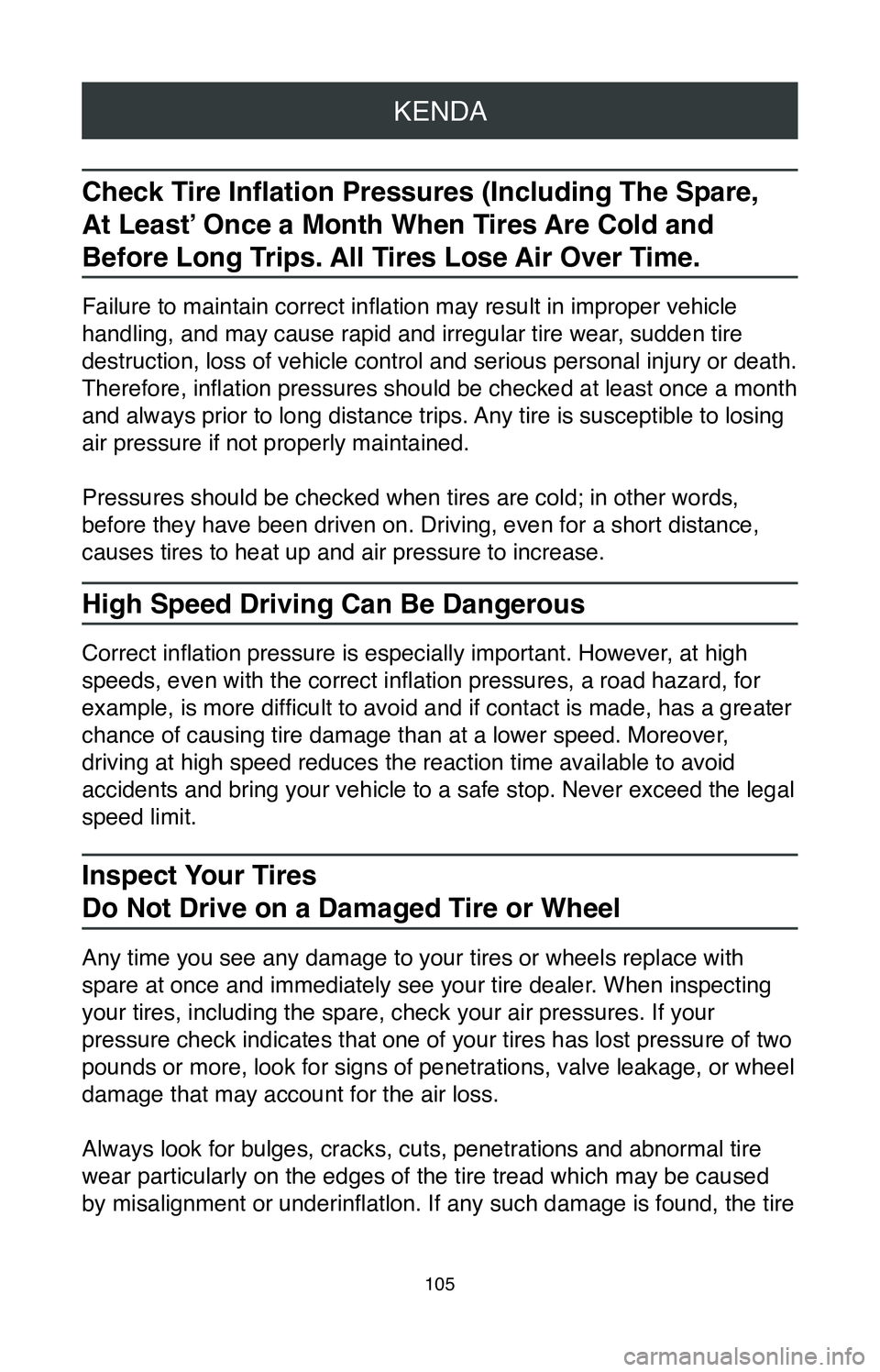
Check Tire Inflation Pressures (Including The Spare,
At Least’ Once a Month When Tires Are Cold and
Before Long Trips. All Tires Lose Air Over Time.
Failure to maintain correct inflation may result in improper vehicle
handling, and may cause rapid and irregular tire wear, sudden tire
destruction, loss of vehicle control and serious personal injury or death.
Therefore, inflation pressures should be checked at least once a month
and always prior to long distance trips. Any tire is susceptible to losing
air pressure if not properly maintained.
Pressures should be checked when tires are cold; in other words,
before they have been driven on. Driving, even for a short distance,
causes tires to heat up and air pressure to increase.
High Speed Driving Can Be Dangerous
Correct inflation pressure is especially important. However, at high
speeds, even with the correct inflation pressures, a road hazard, for
example, is more difficult to avoid and if contact is made, has a greater
chance of causing tire damage than at a lower speed. Moreover,
driving at high speed reduces the reaction time available to avoid
accidents and bring your vehicle to a safe stop. Never exceed the legal \
speed limit.
Inspect Your Tires
Do Not Drive on a Damaged Tire or Wheel
Any time you see any damage to your tires or wheels replace with
spare at once and immediately see your tire dealer. When inspecting
your tires, including the spare, check your air pressures. If your
pressure check indicates that one of your tires has lost pressure of two\
pounds or more, look for signs of penetrations, valve leakage, or wheel \
damage that may account for the air loss.
Always look for bulges, cracks, cuts, penetrations and abnormal tire
wear particularly on the edges of the tire tread which may be caused
by misalignment or underinflatlon. If any such damage is found, the tire
Page 108 of 260
KENDA
106
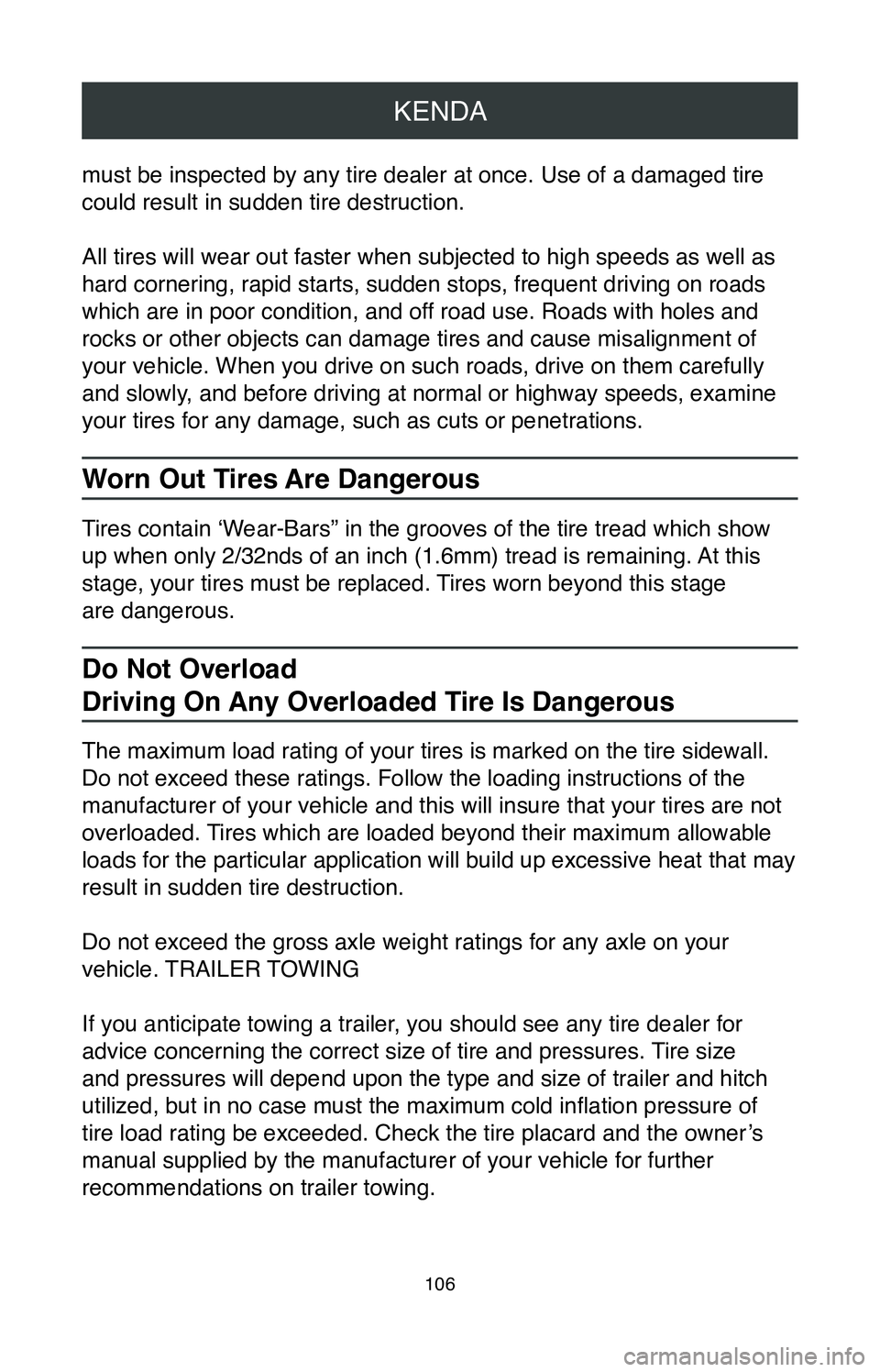
must be inspected by any tire dealer at once. Use of a damaged tire
could result in sudden tire destruction.
All tires will wear out faster when subjected to high speeds as well as
hard cornering, rapid starts, sudden stops, frequent driving on roads
which are in poor condition, and off road use. Roads with holes and
rocks or other objects can damage tires and cause misalignment of
your vehicle. When you drive on such roads, drive on them carefully
and slowly, and before driving at normal or highway speeds, examine
your tires for any damage, such as cuts or penetrations.
Worn Out Tires Are Dangerous
Tires contain ‘Wear-Bars” in the grooves of the tire tread which show
up when only 2/32nds of an inch (1.6mm) tread is remaining. At this
stage, your tires must be replaced. Tires worn beyond this stage
are dangerous.
Do Not Overload
Driving On Any Overloaded Tire Is Dangerous
The maximum load rating of your tires is marked on the tire sidewall.
Do not exceed these ratings. Follow the loading instructions of the
manufacturer of your vehicle and this will insure that your tires are no\
t
overloaded. Tires which are loaded beyond their maximum allowable
loads for the particular application will build up excessive heat that m\
ay
result in sudden tire destruction.
Do not exceed the gross axle weight ratings for any axle on your
vehicle. TRAILER TOWING
If you anticipate towing a trailer, you should see any tire dealer for
advice concerning the correct size of tire and pressures. Tire size
and pressures will depend upon the type and size of trailer and hitch
utilized, but in no case must the maximum cold inflation pressure of
tire load rating be exceeded. Check the tire placard and the owner’s
manual supplied by the manufacturer of your vehicle for further
recommendations on trailer towing.
Page 109 of 260
KENDA
107
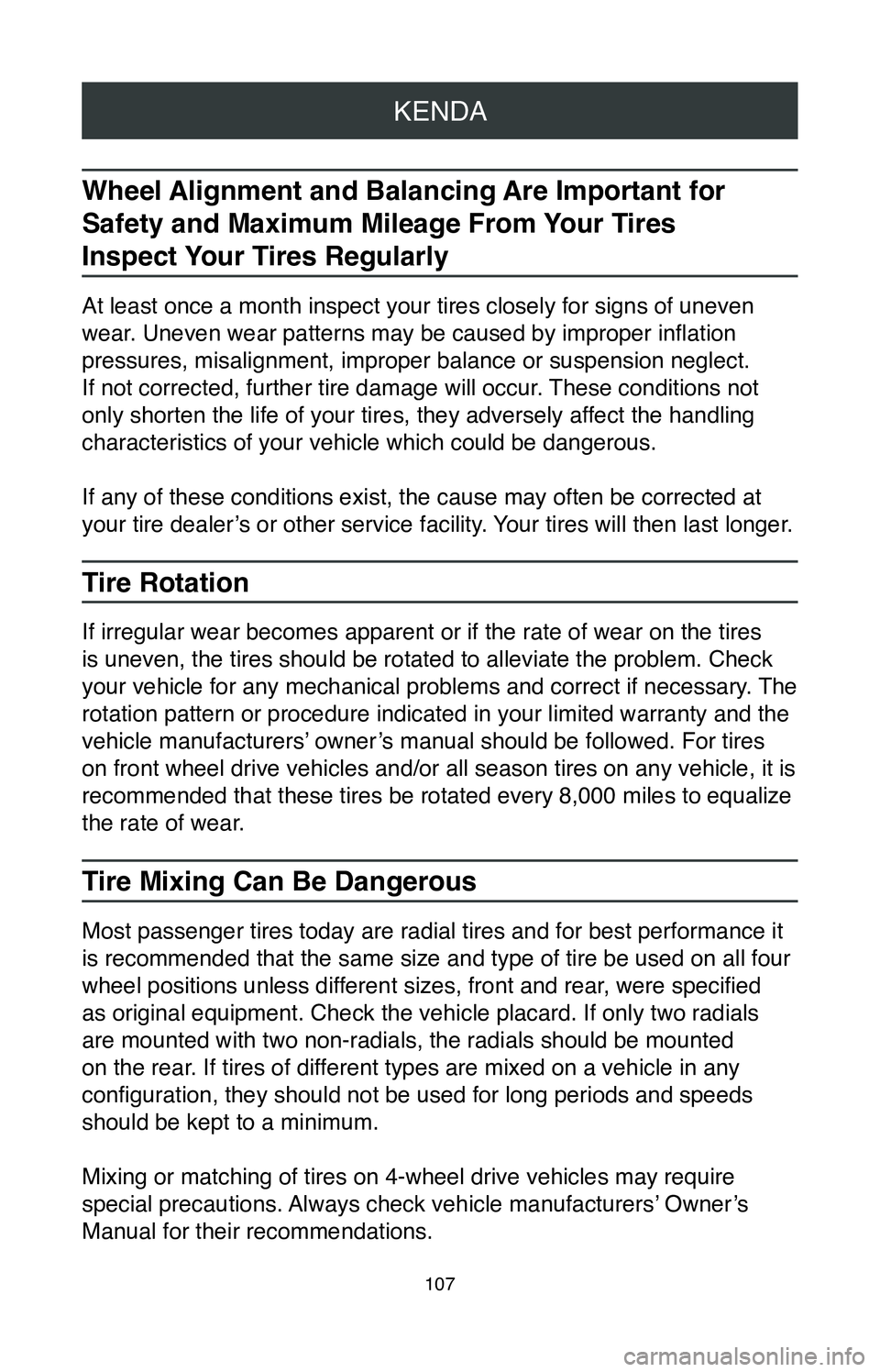
Wheel Alignment and Balancing Are Important for
Safety and Maximum Mileage From Your Tires
Inspect Your Tires Regularly
At least once a month inspect your tires closely for signs of uneven
wear. Uneven wear patterns may be caused by improper inflation
pressures, misalignment, improper balance or suspension neglect.
If not corrected, further tire damage will occur. These conditions not
only shorten the life of your tires, they adversely affect the handling
characteristics of your vehicle which could be dangerous.
If any of these conditions exist, the cause may often be corrected at
your tire dealer’s or other service facility. Your tires will then last longer.
Tire Rotation
If irregular wear becomes apparent or if the rate of wear on the tires
is uneven, the tires should be rotated to alleviate the problem. Check
your vehicle for any mechanical problems and correct if necessary. The
rotation pattern or procedure indicated in your limited warranty and the\
vehicle manufacturers’ owner’s manual should be followed. For tires
on front wheel drive vehicles and/or all season tires on any vehicle, it\
is
recommended that these tires be rotated every 8,000 miles to equalize
the rate of wear.
Tire Mixing Can Be Dangerous
Most passenger tires today are radial tires and for best performance it \
is recommended that the same size and type of tire be used on all four
wheel positions unless different sizes, front and rear, were specified
as original equipment. Check the vehicle placard. If only two radials
are mounted with two non-radials, the radials should be mounted
on the rear. If tires of different types are mixed on a vehicle in any
configuration, they should not be used for long periods and speeds
should be kept to a minimum.
Mixing or matching of tires on 4-wheel drive vehicles may require
special precautions. Always check vehicle manufacturers’ Owner’s
Manual for their recommendations.
Page 114 of 260
MAXXIS
11 2
• The Tire has been properly cared for, and reasonable and
necessary maintenance has been performed, in accordance with
the Vehicle Owner’s Manual and/or this Limited Warranty.
•
The Tire has been operated only under normal service conditions.
•
The Tire’s owner resides in the United States or Canada.
What Is Warranted and for How Long
• Failures, defects, and malfunctions due to defective materials
and/or defective workmanship.
•
Ride problems, vibration problems, and/or out-of-round
•
Tires, if the Tire is within the first 1/32nd inch of tread depth
(0.8 mm).
•
Within 60 months from the date of your purchase of the new
Vehicle, or at least 2/32nd inch (1.6 mm) of tread depth remaining
on the Tire, whichever comes first, except if the Tire is a temporary
spare tire, in which case the tire must be within the first 1/32nds
inch (0.8 mm) of tread depth.
What Is Not Covered by this Limited Warranty Policy
• Tire failure, defect, malfunction or damage resulting from
improper operation or maintenance such as, but not limited to,
overloading, excessive speed and inflation practices causing
excessive operational temperatures that exceed specifications,
misapplication, tire/wheel imbalance, vandalism, use of puncture
sealants and/or chemical corrosion.
•
Road hazards, including but not limited to cuts, snags, punctures,
bruises, impact brakes, tire plugs, and/or any other damage
caused by tire repair.
•
Ride problems, vibration problems, and/or out-of-round Tires,
if Maxxis determines the problem is not the result of a defect
covered under this Limited Warranty, regardless of the tread depth
of the Tire.
•
Irregular treadwear resulting from improper wheel alignment, under
or over inflation, tire abuse (such as spinning), improper mounting
or dismounting, vehicle mechanical problems (such as faulty, worn
Page 115 of 260
MAXXIS
11 3
or malfunctioning brakes and/or suspension), damaged wheels,
tire truing, snow/ice chain usage, flat spots caused by braking, or
Tires involved in accidents.
•
Tire alterations such as, but not limited to, bead or sidewall
decorative material and/or adding a white inlay (whitewall) to
the tire.
•
Failure, defect, malfunction or damage to Tires used on vehicles
engaged in racing or special applications, such as police pursuit.
•
Claims made by persons other than the original consumer
purchaser.
Limitation of Warranty
• Any implied warranty or condition, whether statutory or
otherwise, including that of merchantability or fitness for a
particular purpose, is limited to the duration of this written
Limited Warranty.
•
Maxxis is not responsible for loss of time, inconvenience, loss
of use of vehicle, and/or costs of towing or transportation, or
any other consequential, incidental or indirect damages.
•
Some States (or Provinces) do not allow limitations on how long
an implied warranty or condition lasts, so the above limitation may
not apply to you. Some States (or Provinces) do not allow the
exclusion or limitation of incidental or consequential damages, so
these limitations or exclusions may not apply to you.
•
This Limited Warranty is only applicable in the United States
and Canada.
•
This Limited Warranty is not intended as a representation that a
tire failure cannot occur.
•
This Limited Warranty is the entire warranty given by Maxxis, and
Maxxis’ complete obligation with respect to the Tires is stated in
this Limited Warranty. No one has the authority to imply, suggest,
agree, represent, warrant, or promise contrary to the terms of this
Limited Warranty.
•
This Limited Warranty gives you specific legal rights and you may
also have other rights which vary from State to State or Province
to Province.
Page 117 of 260
MAXXIS
11 5
Warranty Claim Procedure
• You must present the Tire to a Vehicle Manufacturer Dealer or a
Maxxis Dealer.
•
You must present proof of the date of your purchase of the Vehicle
(car dealer invoice). If you do not present this proof, the warranty
claim will be considered only if the Tire is within five years of its
date of manufacture.
•
You must present the Tire that is the subject of the warranty
claim and all service and maintenance records required by this
Limited Warranty.
•
If there is no Maxxis Dealer or Vehicle Manufacturer Dealer near
you, call the Maxxis Technology Center at 1-866-509-7067.
Safety Maintenance Information
Improper tire mounting and inflation and overloading may cause
serious injury or property damage. Maxxis recommends that you
read and follow all safety information contained in the tire safety
information section of this booklet, vehicle placard in the Vehicle
and/or the Vehicle Owner’s Manual. Information regarding safety
and maintenance also can be found on the sidewall of the Tire.
Please also comply with the following: •
Check air pressure every month when tires are “cold.” Use an
accurate tire air pressure gauge. Do not reduce pressure when
tires are hot. Proper inflation is essential. Under inflation produces
flexing of the sidewalls and builds up heat to the point that
premature tire failure may occur. Over inflation can cause the tire
to be more susceptible to impact damage.
•
Never overload your tires. The maximum load capacity and
maximum inflation pressure are molded into the sidewall of your
tire. Overloading builds up excessive heat and can lead to early
tire failure.
•
Avoid damaging objects (such as chuckholes, glass, rocks and
curbs) which may cause internal tire damage. Continued use
of a tire that has suffered internal damage, which may not be
visible externally, can lead to dangerous tire failure. Determination
Page 118 of 260
MAXXIS
11 6
of internal damage will require dismounting of the tire and
examination by trained tire personnel.
•
Improper tire mounting and inflation procedures may cause the tire
beads to break with explosive force during installation of the tire on
the rim. Tire and rim must match in size. Rim parts must match by
manufacturer’s design. Clean rim. Lubricate rim and beads. Do not
exceed the maximum recommended pressure to seat the beads.
Only trained tire personnel should mount tires.
•
Use of worn-out tires (less than 2/32nd inch (1.6 mm) of tread
depth) increases the probability of tire failure.
•
Excessive speeds create heat buildup in a tire, leading to possible
tire failure.
•
Maxxis strongly recommends tire rotation every 5,000 to 7,500
miles (8,000 to 12,000 kilometers).
•
The Maxxis brand temporary spare tire weighs less than a
conventional radial tire. The temporary tire should be used only in
emergencies and returned to the trunk as soon as it is convenient
to have your standard tire repaired or replaced.
Contact Information
Any time you see damage to your Tires or wheels, immediately
contact a Vehicle Manufacturer Dealer or Maxxis Dealer. If
further assistance is required, please contact:
Maxxis International - U.S.A.
1-866-509-7067
Or write:
Maxxis Technology Center
480 Old Peachtree Road
Suwanee, GA 30024
USA
Page 120 of 260
MICHELIN
11 8
What Is Not Covered
This warranty does not cover tires damaged due to misuse, abuse or
accident such as:•
Road hazards (e.g., cuts, snags, bruises, impact damage or
punctures);
•
Incorrect mounting of the tire, tire/wheel imbalance or
improper repair;
•
Misapplication, improper maintenance, racing, underinflation,
overinflation or other abuse;
•
Uneven or rapid wear which is caused by mechanical irregularity
in the vehicle such as wheel misalignment (a measured tread
difference of 2/32nds of an inch or more across the face of the
tread on the same tire);
•
Accident, fire, chemical corrosion, tire alteration or vandalism;
•
Flat spotting caused by improper storage or brakelock;
•
The addition of liquid, solid or gaseous materials other than air,
nitrogen or carbon dioxide (for example, waterbase sealers or
balancing substances);
•
Minor cosmetic ozone or weather cracking;
•
Use of MICHELIN® Self-Supporting Zero Pressure (ZP) tires
without a properly operating low air pressure warning system.
•
Use of MICHELIN tires that is inconsistent with the safety and/or
maintenance information provided in your owner’s manual.
Other limitations include but are not limited to the following: •
Michelin does not cover Original Equipment tires for mileage.
What Will Michelin Do?
If a tire is covered, and 2/32nds of an inch (1.6mm) or less of the
original tread is worn (or 25% or less, whichever is more beneficial to
you), and it is within 12 months of the date of purchase, Michelin will\
,
free of charge, replace your tire with a comparable new MICHELIN
®
replacement tire, mount the tire, and balance the tire. You must pay the
cost of any other service charges and applicable taxes.
Page 122 of 260
MICHELIN
120
all air! That means time to exit from the highway and get to a place
where the tire can be inspected, replaced, or possibly returned to
service. The distance that can safely be travelled following an air loss
incident will depend upon the conditions under which the vehicle is
operating, the degree of air loss, the extent of the damage causing the \
air loss, the ambient temperature, the load, and the operating speed
of the vehicle. The fewer miles you travel after an air loss incident, the
greater the likelihood that the tire can be re-inflated (or, if punctured,
repaired) and returned to service.
Michelin Tires with the Acoustic Logo Michelin tires with the Acoustic logo are covered
under this warranty. These tires are treated with
acoustic foam, and have specific instructions for repair
by tire professionals at Michelin authorized dealers.
Michelin Tires with the Self-Seal Logo
Michelin tires with the Self-Seal logo are covered
under this warranty. These tires are designed to seal
in the event of a puncture, and have specific
instructions for repair by tire professionals at Michelin
authorized dealers.
What Conditions And Exclusions Apply?
This warranty does not provide compensation for loss of time, loss of
use of vehicle, inconvenience or consequential damage. Some states
do not allow the exclusion or limitation of incidental or consequential \
damages, so these limitations or exclusions may not apply to you.
This warranty limits the length of all express and implied claims. Some \
states do not allow limitations on how long an implied warranty lasts,
so this limitation may not apply to you.
Tires presented for claim remain the property of the consumer, and
Michelin is not responsible for loss of or damage to tires which are
in the custody or control of a Michelin tire retailer for the purpose of\
inspection for warranty claims. In the event of a disputed claim, the