tow TOYOTA COROLLA HATCHBACK 2022 Owners Manual (in English)
[x] Cancel search | Manufacturer: TOYOTA, Model Year: 2022, Model line: COROLLA HATCHBACK, Model: TOYOTA COROLLA HATCHBACK 2022Pages: 758, PDF Size: 155.26 MB
Page 4 of 758
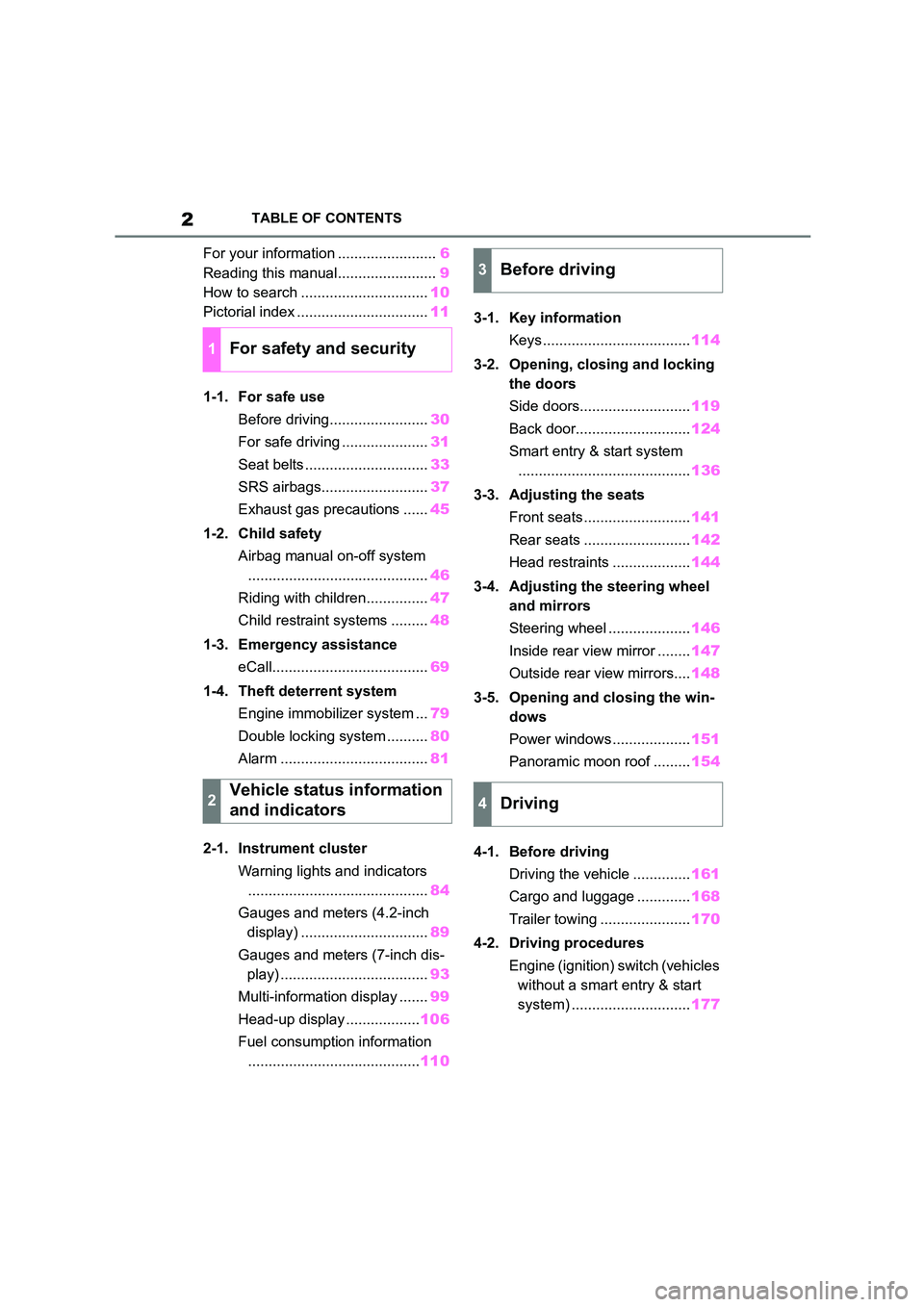
2TABLE OF CONTENTS
For your information ........................6
Reading this manual........................ 9
How to search ............................... 10
Pictorial index ................................ 11
1-1. For safe use
Before driving........................ 30
For safe driving ..................... 31
Seat belts .............................. 33
SRS airbags.......................... 37
Exhaust gas precautions ...... 45
1-2. Child safety
Airbag manual on-off system
............................................ 46
Riding with children............... 47
Child restraint systems ......... 48
1-3. Emergency assistance
eCall...................................... 69
1-4. Theft deterrent system
Engine immobilizer system ... 79
Double locking system .......... 80
Alarm .................................... 81
2-1. Instrument cluster
Warning lights and indicators
............................................ 84
Gauges and meters (4.2-inch
display) ............................... 89
Gauges and meters (7-inch dis-
play) .................................... 93
Multi-information display ....... 99
Head-up display .................. 106
Fuel consumption information
.......................................... 110
3-1. Key information
Keys .................................... 114
3-2. Opening, closing and locking
the doors
Side doors........................... 119
Back door............................ 124
Smart entry & start system
.......................................... 136
3-3. Adjusting the seats
Front seats .......................... 141
Rear seats .......................... 142
Head restraints ................... 144
3-4. Adjusting the steering wheel
and mirrors
Steering wheel .................... 146
Inside rear view mirror ........ 147
Outside rear view mirrors.... 148
3-5. Opening and closing the win-
dows
Power windows ................... 151
Panoramic moon roof ......... 154
4-1. Before driving
Driving the vehicle .............. 161
Cargo and luggage ............. 168
Trailer towing ...................... 170
4-2. Driving procedures
Engine (ignition) switch (vehicles
without a smart entry & start
system) ............................. 177
1For safety and security
2Vehicle status information
and indicators
3Before driving
4Driving
Page 7 of 758
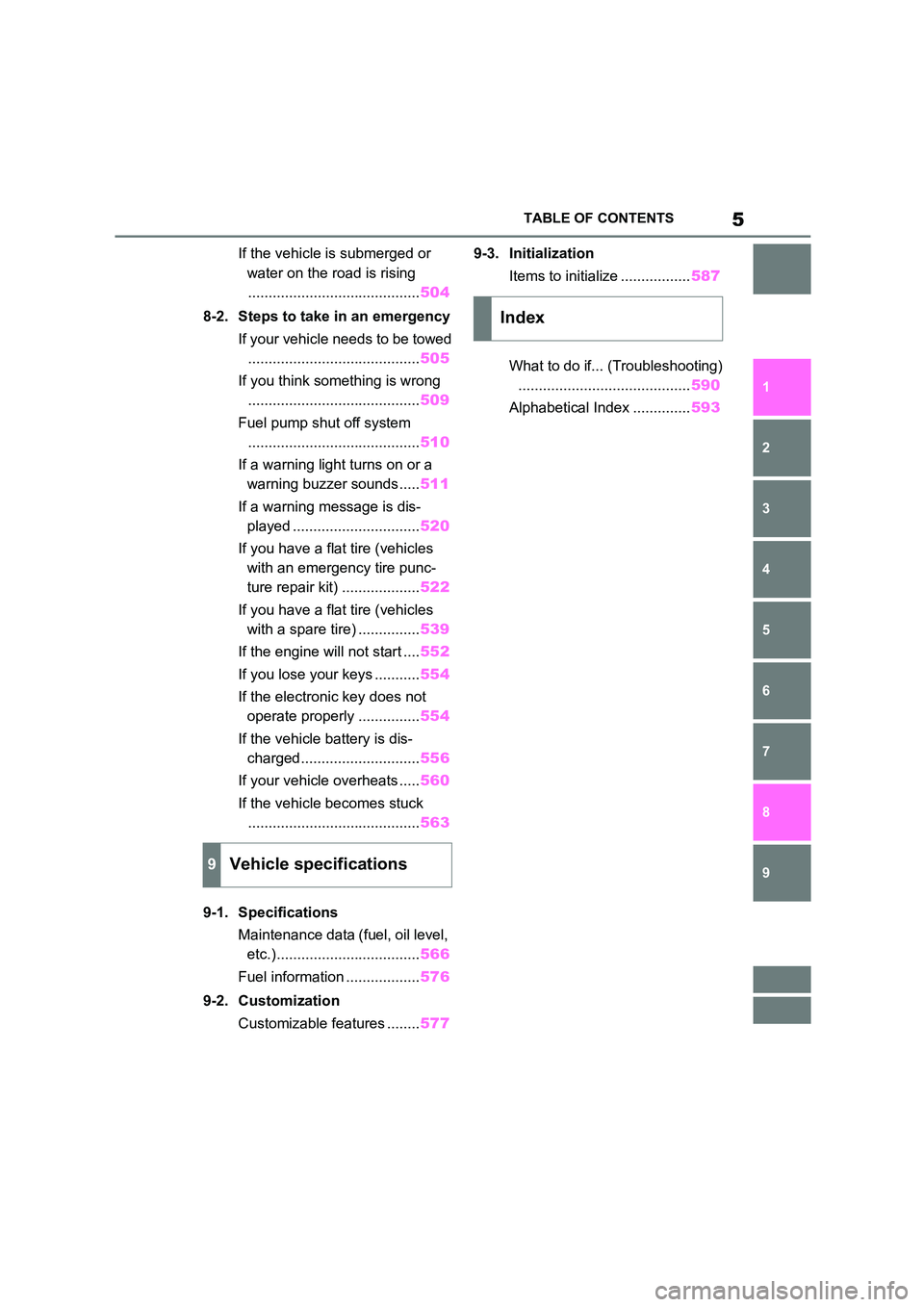
5TABLE OF CONTENTS
1
6
5
4
3
2
9
8
7
If the vehicle is submerged or
water on the road is rising
.......................................... 504
8-2. Steps to take in an emergency
If your vehicle needs to be towed
.......................................... 505
If you think something is wrong
.......................................... 509
Fuel pump shut off system
.......................................... 510
If a warning light turns on or a
warning buzzer sounds ..... 511
If a warning message is dis-
played ............................... 520
If you have a flat tire (vehicles
with an emergency tire punc-
ture repair kit) ................... 522
If you have a flat tire (vehicles
with a spare tire) ............... 539
If the engine will not start .... 552
If you lose your keys ........... 554
If the electronic key does not
operate properly ............... 554
If the vehicle battery is dis-
charged............................. 556
If your vehicle overheats ..... 560
If the vehicle becomes stuck
.......................................... 563
9-1. Specifications
Maintenance data (fuel, oil level,
etc.)................................... 566
Fuel information .................. 576
9-2. Customization
Customizable features ........ 577
9-3. Initialization
Items to initialize ................. 587
What to do if... (Troubleshooting)
.......................................... 590
Alphabetical Index .............. 593
9Vehicle specifications
Index
Page 17 of 758
15Pictorial index
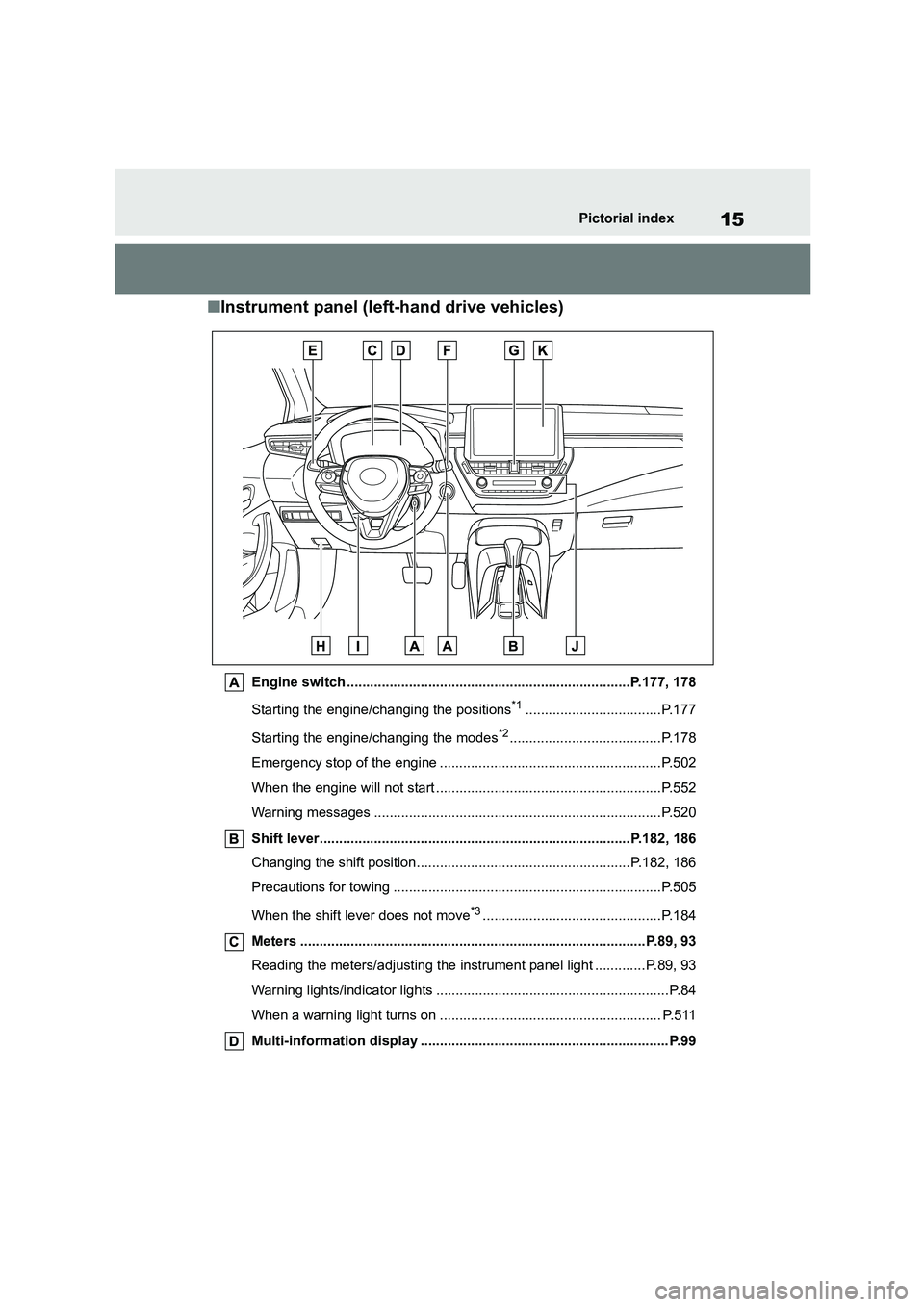
■Instrument panel (left-hand drive vehicles)
Engine switch .........................................................................P.177, 178
Starting the engine/changing the positions*1...................................P.177
Starting the engine/changing the modes*2.......................................P.178
Emergency stop of the engine .........................................................P.502
When the engine will not start ..........................................................P.552
Warning messages ..........................................................................P.520
Shift lever................................................................................P.182, 186
Changing the shift position.......................................................P.182, 186
Precautions for towing .....................................................................P.505
When the shift lever does not move*3..............................................P.184
Meters .........................................................................................P.89, 93
Reading the meters/adjusting the instrument panel light ............. P.89, 93
Warning lights/indicator lights ............................................................P.84
When a warning light turns on ......................................................... P.511
Multi-information display ................................................................P.99
Page 24 of 758
22Pictorial index
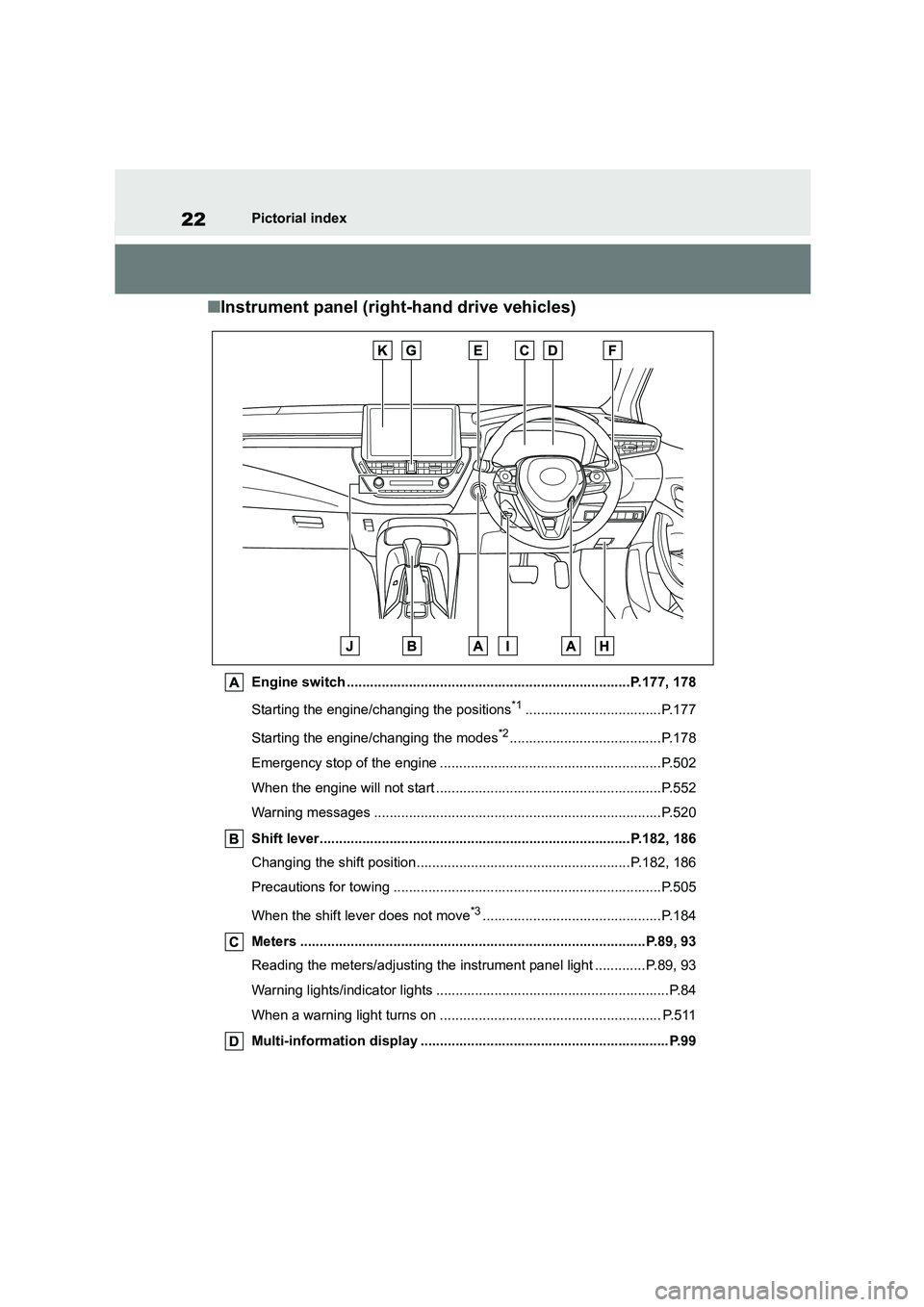
■Instrument panel (right-hand drive vehicles)
Engine switch .........................................................................P.177, 178
Starting the engine/changing the positions*1...................................P.177
Starting the engine/changing the modes*2.......................................P.178
Emergency stop of the engine .........................................................P.502
When the engine will not start ..........................................................P.552
Warning messages ..........................................................................P.520
Shift lever................................................................................P.182, 186
Changing the shift position.......................................................P.182, 186
Precautions for towing .....................................................................P.505
When the shift lever does not move*3..............................................P.184
Meters .........................................................................................P.89, 93
Reading the meters/adjusting the instrument panel light ............. P.89, 93
Warning lights/indicator lights ............................................................P.84
When a warning light turns on ......................................................... P.511
Multi-information display ................................................................P.99
Page 37 of 758
35
1
1-1. For safe use
For safety and security
the release button .
■Emergency locking retractor (ELR)
The retractor will lock the belt during a sudden stop or on impact. It may also
lock if you lean forward too quickly. A
slow, easy motion will allow the belt to extend so that you can move around
fully.
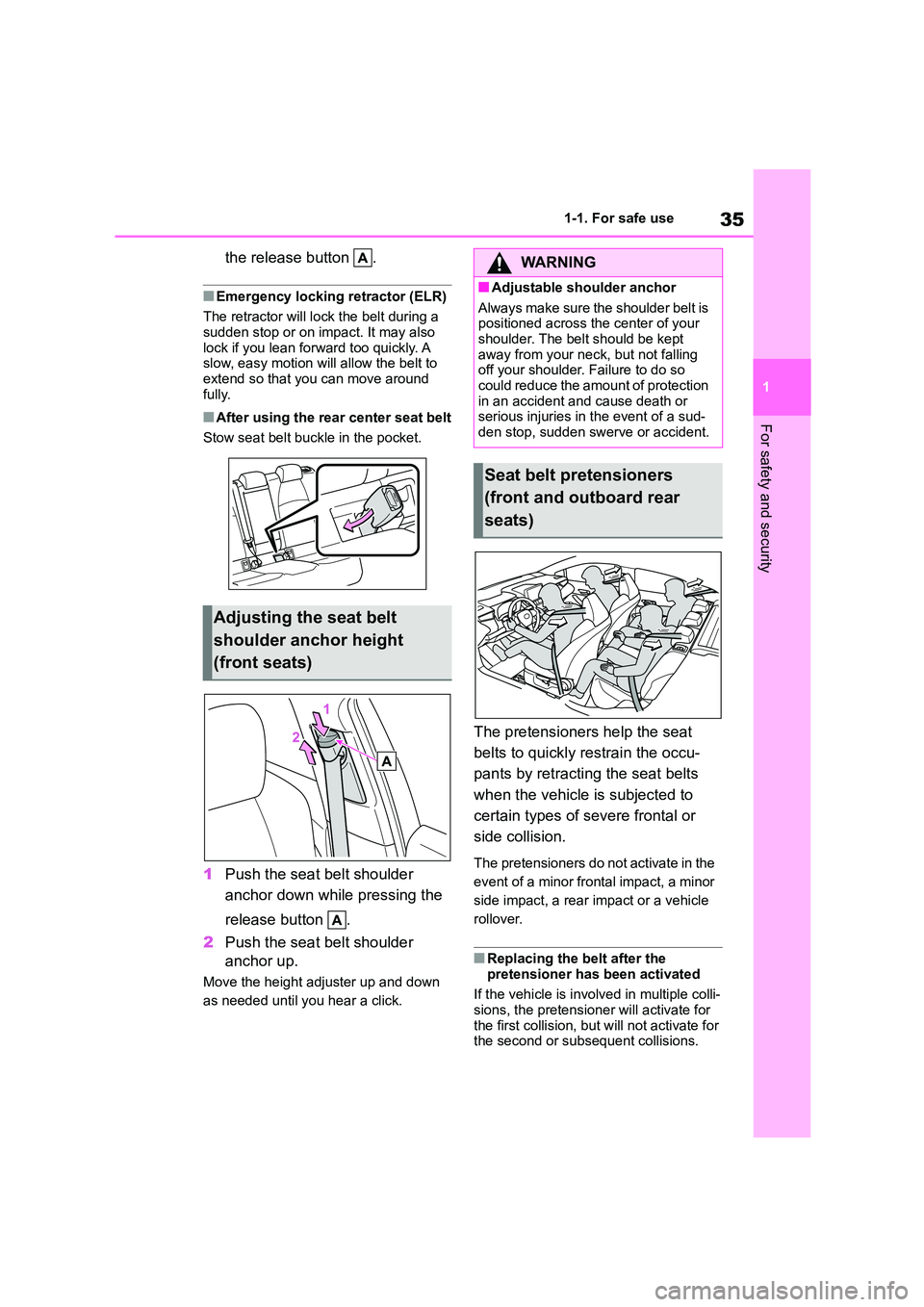
■After using the rear center seat belt
Stow seat belt buckle in the pocket.
1 Push the seat belt shoulder
anchor down while pressing the
release button .
2 Push the seat belt shoulder
anchor up.
Move the height adjuster up and down
as needed until you hear a click.
The pretensioners help the seat
belts to quickly restrain the occu-
pants by retracting the seat belts
when the vehicle is subjected to
certain types of severe frontal or
side collision.
The pretensioners do not activate in the
event of a minor frontal impact, a minor
side impact, a rear impact or a vehicle
rollover.
■Replacing the belt after the
pretensioner has been activated
If the vehicle is involved in multiple colli- sions, the pretensioner will activate for
the first collision, but will not activate for
the second or subsequent collisions.
Adjusting the seat belt
shoulder anchor height
(front seats)
WA R N I N G
■Adjustable shoulder anchor
Always make sure the shoulder belt is
positioned across the center of your shoulder. The belt should be kept
away from your neck, but not falling
off your shoulder. Failure to do so could reduce the amount of protection
in an accident and cause death or
serious injuries in the event of a sud-
den stop, sudden sw erve or accident.
Seat belt pretensioners
(front and outboard rear
seats)
Page 44 of 758
421-1. For safe use
WA R N I N G
●The SRS driver airbag deploys with
considerable force, and can cause
death or serious injury especially if the driver is very close to the
airbag.
Since the risk zone for the driver’s airbag is the first 50 - 75 mm (2 - 3 in.)
of inflation, placing yourself 250 mm
(10 in.) from your driver airbag pro-
vides you with a clear margin of safety. This distance is measured
from the center of the steering wheel
to your breastbone. If you sit less than 250 mm (10 in.) away now, you can
change your driving position in sev-
eral ways:
• Move your seat to the rear as far as
you can while still reaching the ped-
als comfortably.
• Slightly recline the back of the seat.
Although vehicle designs vary, many drivers can achieve the 250
mm (10 in.) distance, even with the
driver seat all the way forward, sim- ply by reclining the back of the seat
somewhat. If reclining the back of
your seat makes it hard to see the road, raise yourself by using a firm,
non-slippery cushion, or raise the
seat if your vehicle has that feature.
• If your steering wheel is adjustable,
tilt it downward. This points the airbag toward your chest instead of
your head and neck.
The seat should be adjusted as rec-
ommended above, while still main-
taining control of the foot pedals, steering wheel, and your view of the
instrument panel controls.
●The SRS front passenger airbag also deploys with considerable
force, and can cause death or seri-
ous injury especially if the front pas- senger is very close to the airbag.
The front passenger seat should be
as far from the airbag as possible with the seatback adjusted, so the
front passenger sits upright.
●Improperly seated and/or restrained
infants and children can be killed or
seriously injured by a deploying airbag. An infant or child who is too
small to use a seat belt should be
properly secured using a child restraint system. Toyota strongly
recommends that all infants and
children be placed in the rear seats of the vehicle and properly
restrained. The rear seats are safer
for infants and children than the front passenger seat. (P. 4 8 )
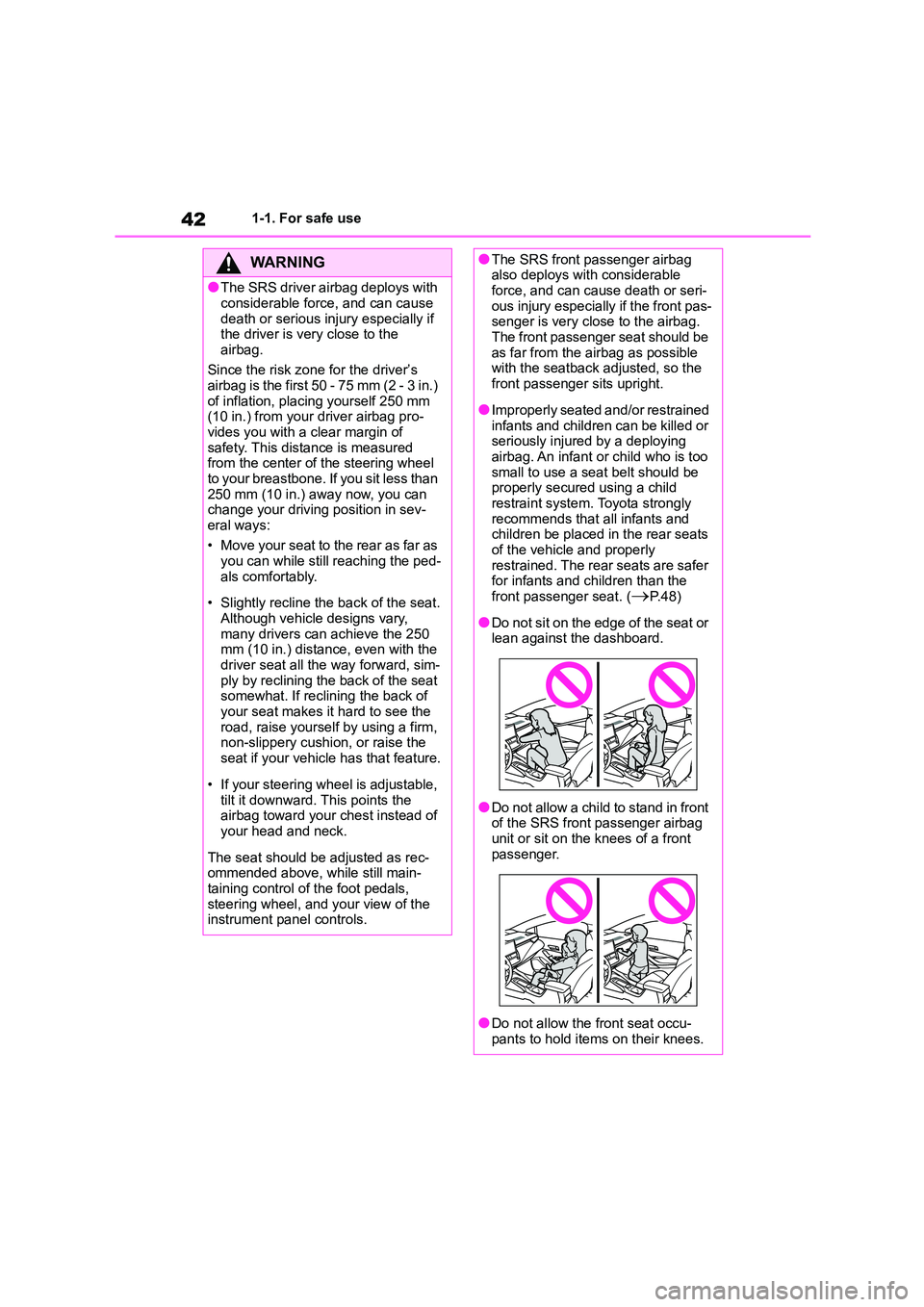
●Do not sit on the edge of the seat or lean against the dashboard.
●Do not allow a child to stand in front of the SRS front passenger airbag
unit or sit on the knees of a front
passenger.
●Do not allow the front seat occu-
pants to hold items on their knees.
Page 45 of 758
43
1
1-1. For safe use
For safety and security
WA R N I N G
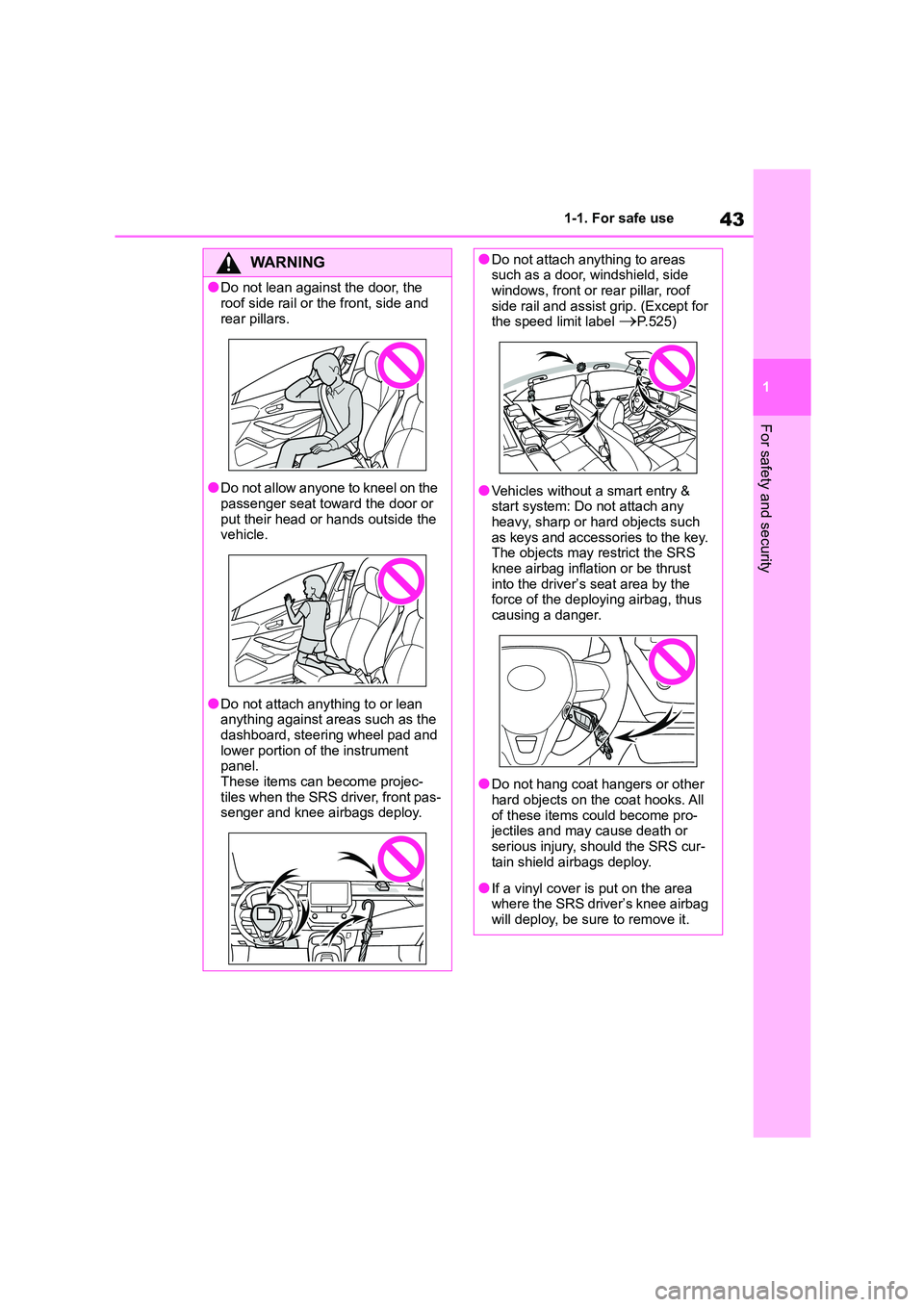
●Do not lean against the door, the
roof side rail or the front, side and
rear pillars.
●Do not allow anyone to kneel on the
passenger seat toward the door or
put their head or hands outside the vehicle.
●Do not attach anything to or lean anything against areas such as the
dashboard, steering wheel pad and
lower portion of the instrument panel.
These items can become projec-
tiles when the SRS driver, front pas- senger and knee airbags deploy.
●Do not attach anything to areas such as a door, windshield, side
windows, front or rear pillar, roof
side rail and assist grip. (Except for the speed limit label P.525)
●Vehicles without a smart entry & start system: Do not attach any
heavy, sharp or hard objects such
as keys and accessories to the key. The objects may restrict the SRS
knee airbag inflation or be thrust
into the driver’s seat area by the force of the deploying airbag, thus
causing a danger.
●Do not hang coat hangers or other
hard objects on the coat hooks. All
of these items could become pro- jectiles and may cause death or
serious injury, should the SRS cur-
tain shield airbags deploy.
●If a vinyl cover is put on the area
where the SRS driver’s knee airbag will deploy, be sure to remove it.
Page 67 of 758
65
1
1-2. Child safety
For safety and security
1 If installing the child restraint
system to the front passenger
seat is unavoidable, refer to
P.50 for the front passenger seat
adjustment.
2 If the head restraint interferes
with your child restraint system,
and the head restraint can be
removed, remove the head
restraint.
Otherwise, put the head
restraint in the upper most posi-
tion. ( P.144)
3 Run the seat belt through the
child restraint system and insert
the plate into th e buckle. Make
sure that the belt is not twisted.
Securely fix the seat belt to the
child restraint s ystem in accord-
ance to the directions enclosed
with the child restraint system.
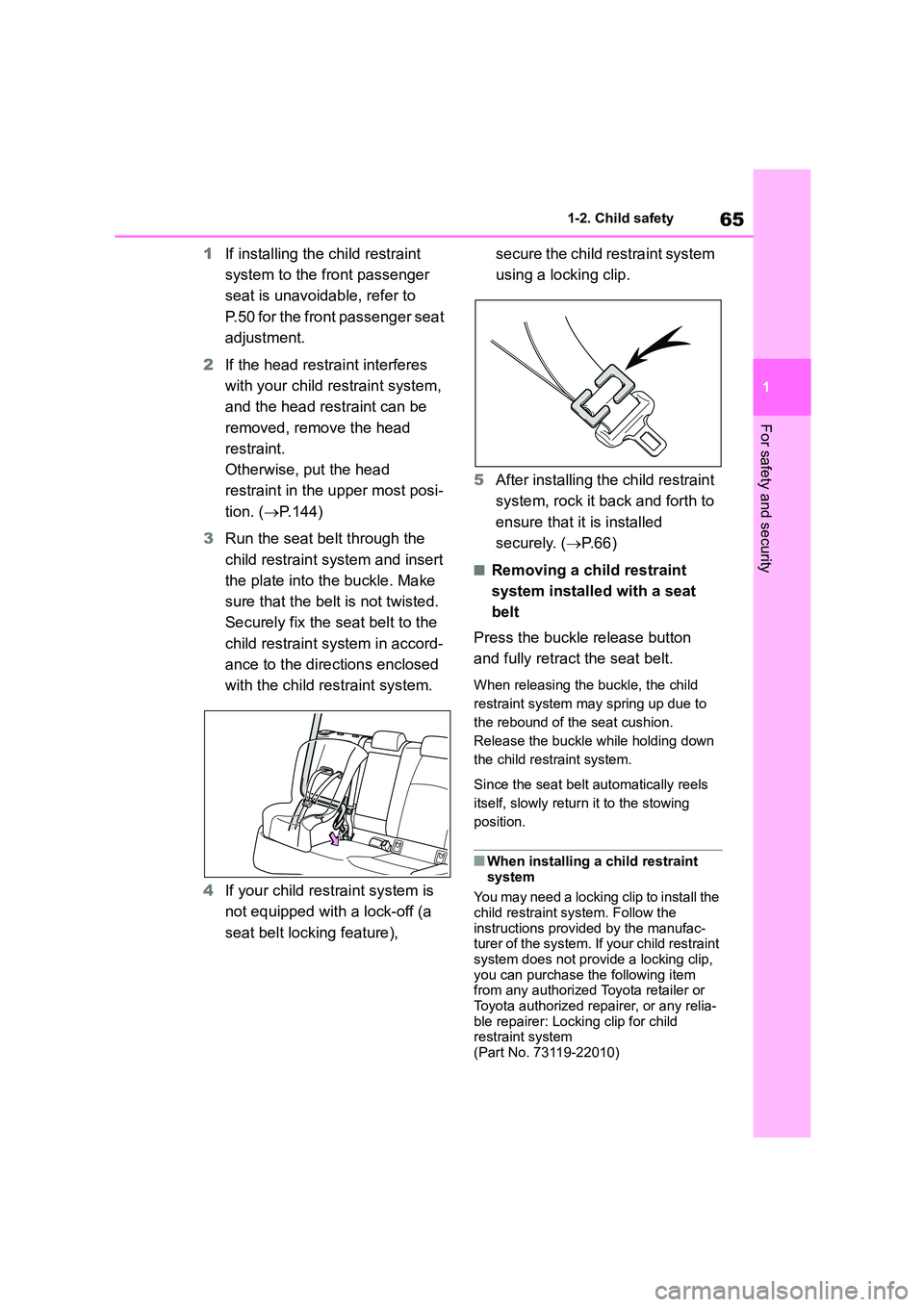
4 If your child restraint system is
not equipped with a lock-off (a
seat belt locking feature),
secure the child restraint system
using a locking clip.
5 After installing the child restraint
system, rock it back and forth to
ensure that it is installed
securely. ( P. 6 6 )
■Removing a child restraint
system installed with a seat
belt
Press the buckle release button
and fully retract the seat belt.
When releasing the buckle, the child
restraint system may spring up due to
the rebound of the seat cushion.
Release the buckle while holding down
the child restraint system.
Since the seat belt automatically reels
itself, slowly return it to the stowing
position.
■When installing a child restraint system
You may need a locking clip to install the
child restraint system. Follow the
instructions provided by the manufac- turer of the system. If your child restraint
system does not prov ide a locking clip,
you can purchase the following item from any authorized Toyota retailer or
Toyota authorized repairer, or any relia-
ble repairer: Locking clip for child restraint system
(Part No. 73119-22010)
Page 119 of 758
117
3
3-1. Key information
Before driving
Opens and closes the power
back door*2 ( P.127)
*1: This setting must be customized at
any authorized Toyota retailer or
Toyota authorized repairer, or any
reliable repairer.
*2: If equipped
■Conditions affecting the operation
of the smart entry & start system or
wireless remote control
Vehicles without a smart entry & start
system
The wireless remote control function
may not operate normally in the follow-
ing situations:
●When the wireless key battery is
depleted
●Near a TV tower, electric power plant,
gas station, radio station, large dis- play, airport or other facility that gen-
erates strong radio waves or electrical
noise
●When carrying a portable radio, cellu-
lar phone or other wireless communi- cation devices
●When the wireless key is in contact with, or is covered by a metallic object
●When a wireless key (that emits radio
waves) is being used nearby
●If window tint with a metallic content or
metallic objects are attached to the rear window
Vehicles with a smart entry & start system
P.138
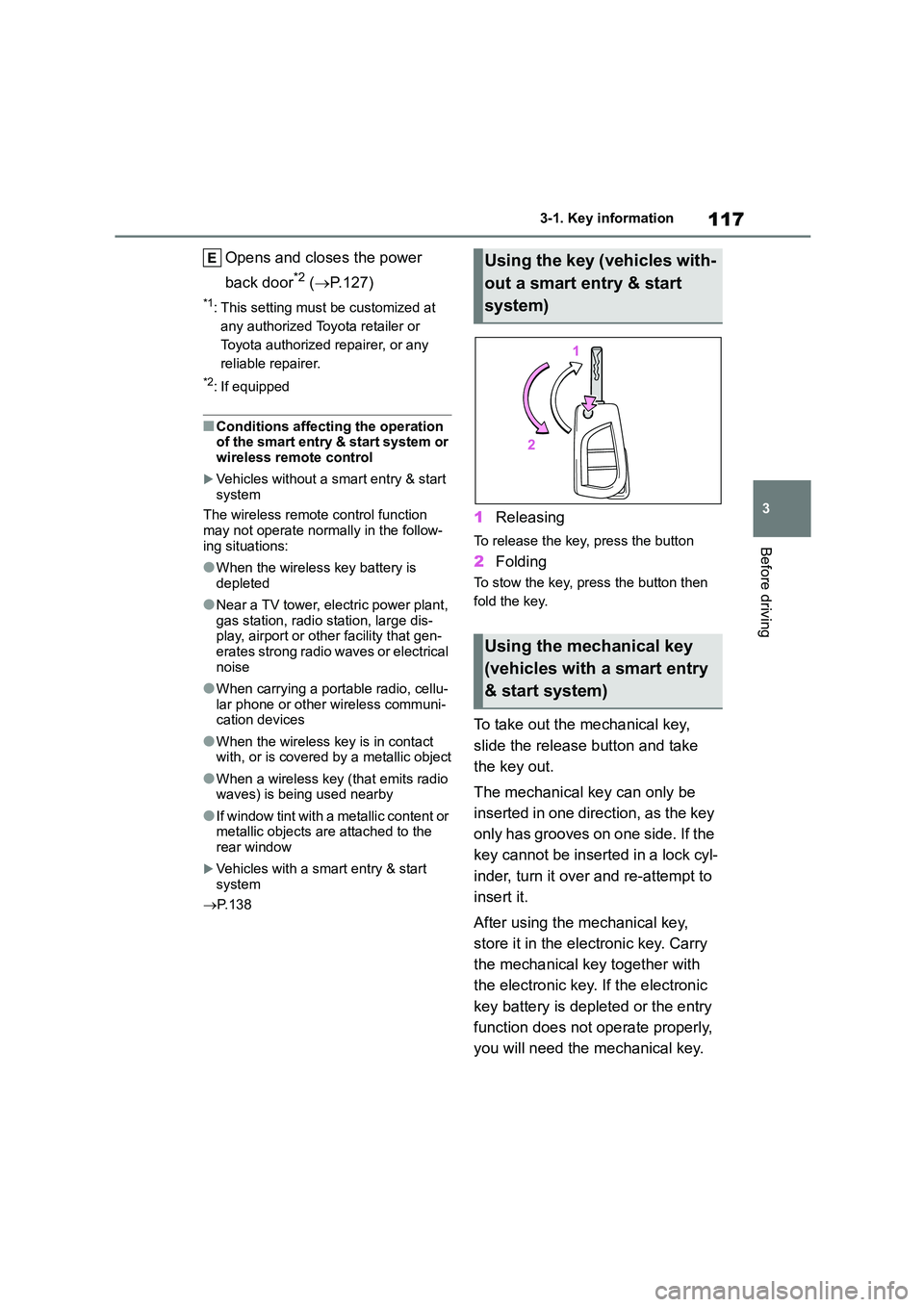
1Releasing
To release the key, press the button
2Folding
To stow the key, press the button then
fold the key.
To take out the mechanical key,
slide the release button and take
the key out.
The mechanical key can only be
inserted in one direction, as the key
only has grooves on one side. If the
key cannot be inserted in a lock cyl-
inder, turn it over and re-attempt to
insert it.
After using the mechanical key,
store it in the electronic key. Carry
the mechanical key together with
the electronic key. If the electronic
key battery is depleted or the entry
function does not operate properly,
you will need the mechanical key.
Using the key (vehicles with-
out a smart entry & start
system)
Using the mechanical key
(vehicles with a smart entry
& start system)
Page 132 of 758
1303-2. Opening, closing and locking the doors
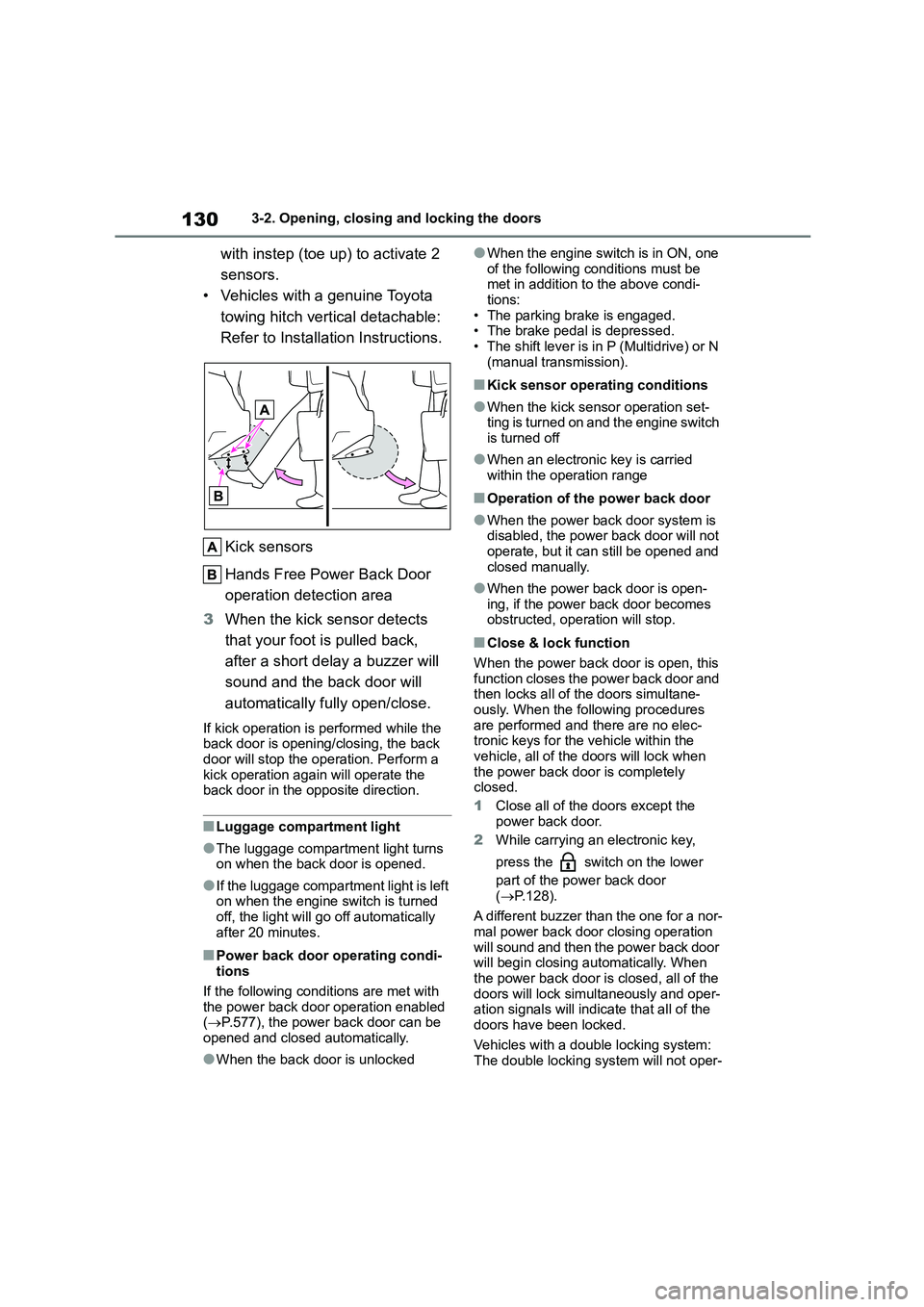
with instep (toe up) to activate 2
sensors.
• Vehicles with a genuine Toyota
towing hitch vertical detachable:
Refer to Installation Instructions.
Kick sensors
Hands Free Power Back Door
operation detection area
3 When the kick sensor detects
that your foot is pulled back,
after a short delay a buzzer will
sound and the back door will
automatically fully open/close.
If kick operation is performed while the
back door is opening/closing, the back door will stop the operation. Perform a
kick operation again will operate the
back door in the opposite direction.
■Luggage compartment light
●The luggage compartment light turns
on when the back door is opened.
●If the luggage compartment light is left
on when the engine switch is turned off, the light will go off automatically
after 20 minutes.
■Power back door operating condi-
tions
If the following conditions are met with
the power back door operation enabled
( P.577), the power back door can be opened and closed automatically.
●When the back door is unlocked
●When the engine switch is in ON, one
of the following conditions must be met in addition to the above condi-
tions:
• The parking brake is engaged. • The brake pedal is depressed.
• The shift lever is in P (Multidrive) or N
(manual transmission).
■Kick sensor operating conditions
●When the kick sensor operation set-
ting is turned on and the engine switch is turned off
●When an electronic key is carried within the operation range
■Operation of the power back door
●When the power back door system is disabled, the power back door will not
operate, but it can still be opened and
closed manually.
●When the power back door is open-
ing, if the power back door becomes obstructed, operation will stop.
■Close & lock function
When the power back door is open, this
function closes the power back door and then locks all of the doors simultane-
ously. When the following procedures
are performed and there are no elec- tronic keys for the vehicle within the
vehicle, all of the doors will lock when
the power back door is completely closed.
1 Close all of the doors except the
power back door.
2 While carrying an electronic key,
press the switch on the lower
part of the power back door
( P.128).
A different buzzer than the one for a nor-
mal power back door closing operation will sound and then the power back door
will begin closing automatically. When
the power back door is closed, all of the doors will lock simultaneously and oper-
ation signals will indicate that all of the
doors have been locked.
Vehicles with a double locking system:
The double locking syst em will not oper-