weight TOYOTA COROLLA HATCHBACK 2023 User Guide
[x] Cancel search | Manufacturer: TOYOTA, Model Year: 2023, Model line: COROLLA HATCHBACK, Model: TOYOTA COROLLA HATCHBACK 2023Pages: 436, PDF Size: 8.72 MB
Page 300 of 436

3006-3. Do-it-yourself maintenance
Tire pressure gauge
1 Remove the tire valve cap.
2 Press the tip of the tire pres-
sure gauge onto the tire
valve.
3 Read the pressure using the
gauge gradations.
4 If the tire inflation pressure is
not at the recommended
level, adjust the pressure.
If you add too much air, press
the center of the valve to
deflate.
5 After completing the tire infla-
tion pressure measurement
and adjustment, apply soapy
water to the valve and check
for leakage.
6 Put the tire valve cap back
on.
■Tire inflation pressure check
interval
You should check tire inflation pres-
sure every two weeks, or at least
once a month. Do not forget to
check the spare.
■Effects of incorrect tire inflation
pressure
Driving with incorrect tire inflation
pressure may result in the following:
●Reduced fuel economy
●Reduced driving comfort and poor
handling
●Reduced tire life due to wear
●Reduced safety
●Damage to the drive train
If a tire needs frequent inflating,
have it checked by your Toyota
dealer.
■Instructions for checking tire
inflation pressure
When checking tire inflation pres-
sure, observe the following:
●Check only when the tires are
cold.
If your vehicle has been parked for
at least 3 hours or has not been
driven for more than 1 mile or 1.5
km, you will get an accurate cold
tire inflation pressure reading.
●Always use a tire pressure gauge.
It is difficult to j udge if a tire is
properly inflated based only on its
appearance.
●It is normal for the tire inflation
pressure to be higher after driving
as heat is generated in the tire. Do
not reduce tire inflation pressure
after driving.
●Never exceed the vehicle capacity
weight.
Passengers and luggage weight
should be placed so that the vehi-
cle is balanced.
WARNING
■Proper inflation is critical to
save tire performance
Keep your tires properly inflated.
If the tires are not properly
inflated, the following conditions
may occur which could lead to an
accident resulting in death or seri-
ous injury:
●Excessive wear
●Uneven wear
●Poor handling
●Possibility of blowouts resulting
from overheated tires
●Air leaking from between tire
and wheel
●Wheel deformation and/or tire
damage
Page 302 of 436
3026-3. Do-it-yourself maintenance
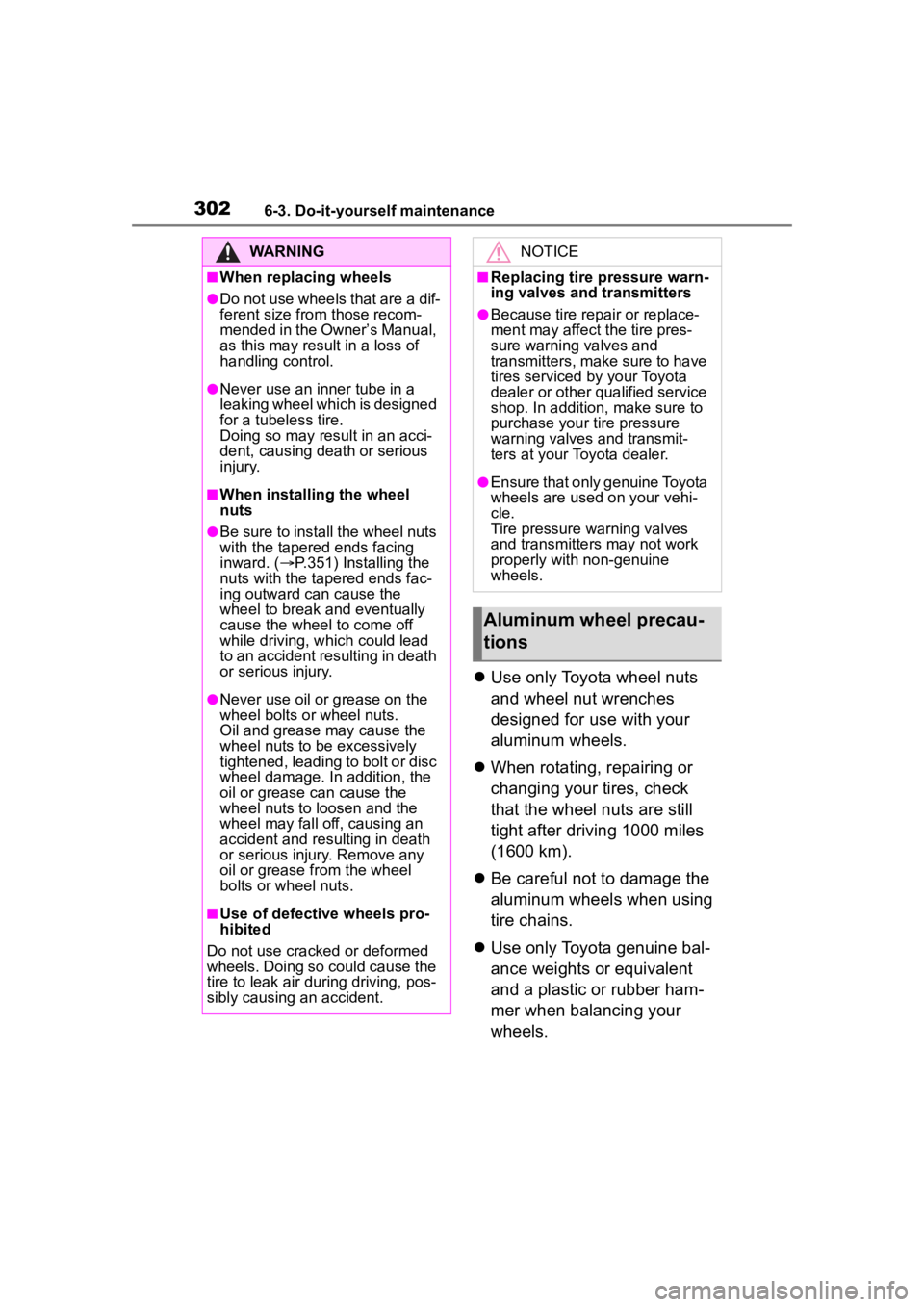
Use only Toyota wheel nuts
and wheel nut wrenches
designed for use with your
aluminum wheels.
When rotating, repairing or
changing your tires, check
that the wheel nuts are still
tight after driving 1000 miles
(1600 km).
Be careful not to damage the
aluminum wheels when using
tire chains.
Use only Toyota genuine bal-
ance weights or equivalent
and a plastic or rubber ham-
mer when balancing your
wheels.
WARNING
■When replacing wheels
●Do not use wheels that are a dif-
ferent size from those recom-
mended in the Owner’s Manual,
as this may result in a loss of
handling control.
●Never use an inner tube in a
leaking wheel which is designed
for a tubeless tire.
Doing so may result in an acci-
dent, causing death or serious
injury.
■When installing the wheel
nuts
●Be sure to install the wheel nuts
with the tapered ends facing
inward. ( P.351) Installing the
nuts with the tapered ends fac-
ing outward can cause the
wheel to break a nd eventually
cause the wheel to come off
while driving, which could lead
to an accident resulting in death
or serious injury.
●Never use oil or grease on the
wheel bolts or wheel nuts.
Oil and grease may cause the
wheel nuts to be excessively
tightened, leading to bolt or disc
wheel damage. In addition, the
oil or grease can cause the
wheel nuts to loosen and the
wheel may fall off, causing an
accident and resulting in death
or serious injury. Remove any
oil or grease from the wheel
bolts or wheel nuts.
■Use of defective wheels pro-
hibited
Do not use cracked or deformed
wheels. Doing so could cause the
tire to leak air during driving, pos-
sibly causing an accident.
NOTICE
■Replacing tire pressure warn-
ing valves and transmitters
●Because tire repair or replace-
ment may affect the tire pres-
sure warning valves and
transmitters, make sure to have
tires serviced by your Toyota
dealer or other qualified service
shop. In additio n, make sure to
purchase your tire pressure
warning valves and transmit-
ters at your Toyota dealer.
●Ensure that only genuine Toyota
wheels are used on your vehi-
cle.
Tire pressure warning valves
and transmitters may not work
properly with non-genuine
wheels.
Aluminum wheel precau-
tions
Page 366 of 436
3668-1. Specifications
8-1.Specifications
*: Unladen vehicles
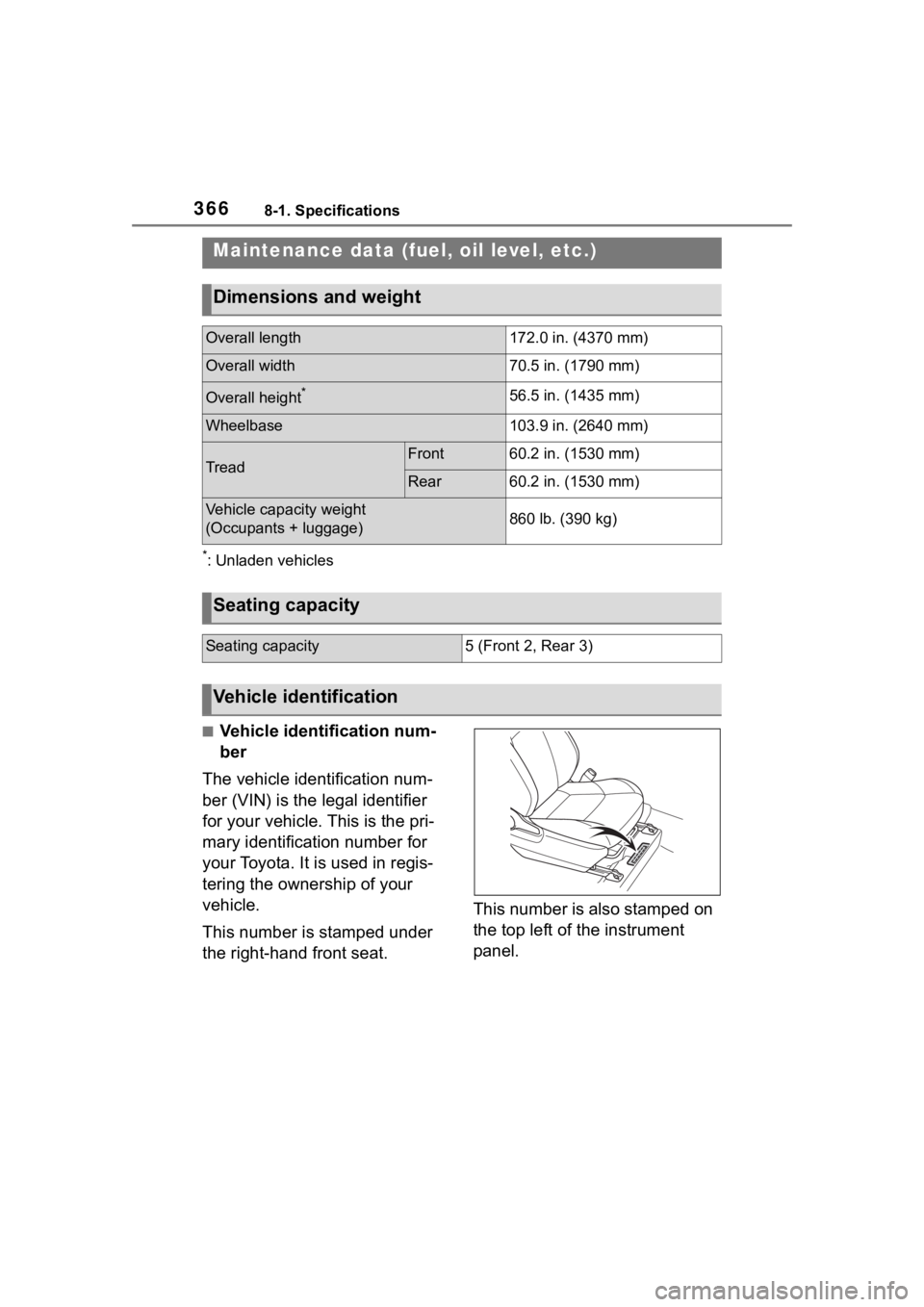
■Vehicle identification num-
ber
The vehicle identification num-
ber (VIN) is the legal identifier
for your vehicle. This is the pri-
mary identification number for
your Toyota. It is used in regis-
tering the ownership of your
vehicle.
This number is stamped under
the right-hand front seat. This number is also stamped on
the top left of the instrument
panel.
Maintenance data (fuel, oil level, etc.)
Dimensions and weight
Overall length172.0 in. (4370 mm)
Overall width70.5 in. (1790 mm)
Overall height*56.5 in. (1435 mm)
Wheelbase103.9 in. (2640 mm)
TreadFront60.2 in. (1530 mm)
Rear60.2 in. (1530 mm)
Vehicle capacity weight
(Occupants + luggage)860 lb. (390 kg)
Seating capacity
Seating capacity5 (Front 2, Rear 3)
Vehicle identification
Page 380 of 436
3808-1. Specifications
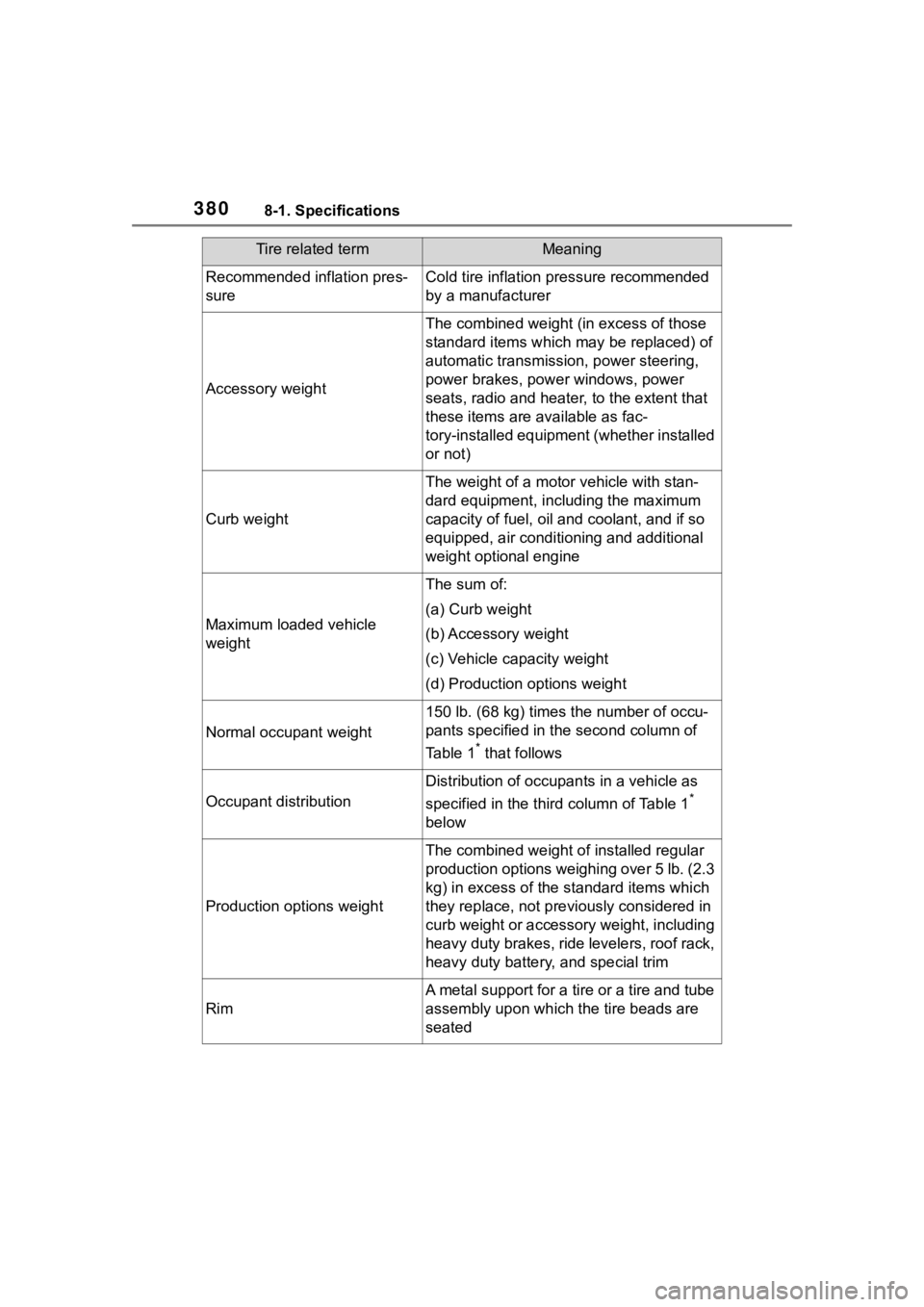
Recommended inflation pres-
sureCold tire inflation pressure recommended
by a manufacturer
Accessory weight
The combined weight (in excess of those
standard items which may be replaced) of
automatic transmission, power steering,
power brakes, power windows, power
seats, radio and heater, to the extent that
these items are available as fac-
tory-installed equipment (whether installed
or not)
Curb weight
The weight of a motor vehicle with stan-
dard equipment, including the maximum
capacity of fuel, oil and coolant, and if so
equipped, air conditioning and additional
weight optional engine
Maximum loaded vehicle
weight
The sum of:
(a) Curb weight
(b) Accessory weight
(c) Vehicle capacity weight
(d) Production options weight
Normal occupant weight
150 lb. (68 kg) times the number of occu-
pants specified in the second column of
Table 1
* that follows
Occupant distribution
Distribution of occupan ts in a vehicle as
specified in the thi rd column of Table 1
*
below
Production options weight
The combined weight o f installed regular
production options weighing over 5 lb. (2.3
kg) in excess of the s tandard items which
they replace, not previously considered in
curb weight or accessory weight, including
heavy duty brakes, ride levelers, roof rack,
heavy duty battery, and special trim
Rim
A metal support for a tire or a tire and tube
assembly upon which the tire beads are
seated
Tire related termMeaning
Page 381 of 436
3818-1. Specifications
8
Vehicle specifications
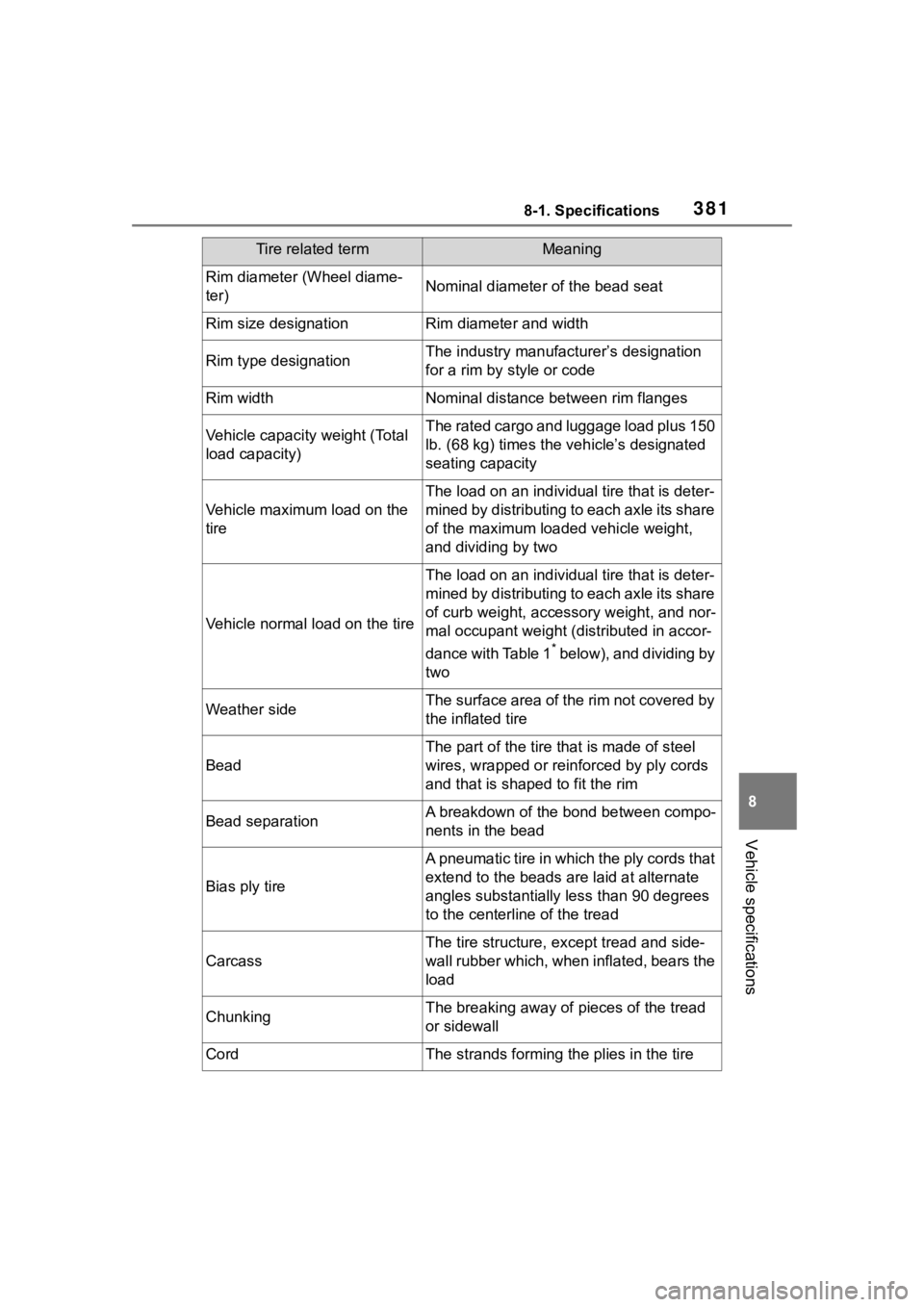
Rim diameter (Wheel diame-
ter)Nominal diameter of the bead seat
Rim size designationRim diameter and width
Rim type designationThe industry manufacturer’s designation
for a rim by style or code
Rim widthNominal distance between rim flanges
Vehicle capacity weight (Total
load capacity)The rated cargo and luggage load plus 150
lb. (68 kg) times the vehicle’s designated
seating capacity
Vehicle maximum load on the
tire
The load on an individual tire that is deter-
mined by distributing to each axle its share
of the maximum loaded vehicle weight,
and dividing by two
Vehicle normal load on the tire
The load on an individual tire that is deter-
mined by distributing to each axle its share
of curb weight, accessory weight, and nor-
mal occupant weight (distributed in accor-
dance with Table 1
* below), and dividing by
two
Weather sideThe surface area of the rim not covered by
the inflated tire
Bead
The part of the tire that is made of steel
wires, wrapped or rein forced by ply cords
and that is shaped to fit the rim
Bead separationA breakdown of the bond between compo-
nents in the bead
Bias ply tire
A pneumatic tire in which the ply cords that
extend to the beads are laid at alternate
angles substantially l ess than 90 degrees
to the centerlin e of the tread
Carcass
The tire structure, ex cept tread and side-
wall rubber which, when inflated, bears the
load
ChunkingThe breaking away of pieces of the tread
or sidewall
CordThe strands forming the plies in the tire
Tire related termMeaning
Page 382 of 436
3828-1. Specifications
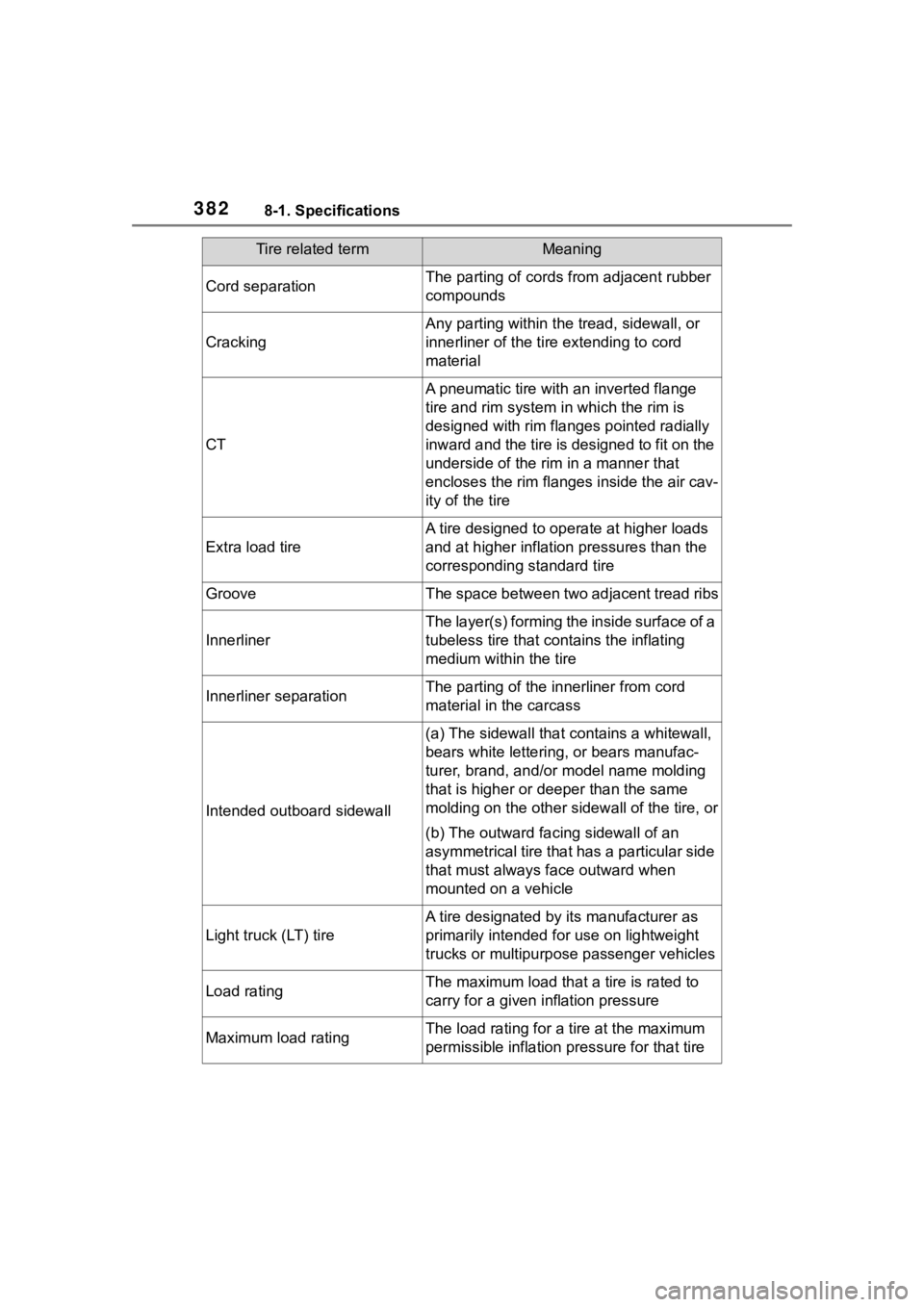
Cord separationThe parting of cords from adjacent rubber
compounds
Cracking
Any parting within the tread, sidewall, or
innerliner of the ti re extending to cord
material
CT
A pneumatic tire with an inverted flange
tire and rim system i n which the rim is
designed with rim flanges pointed radially
inward and the tire is designed to fit on the
underside of the rim in a manner that
encloses the rim flanges inside the air cav-
ity of the tire
Extra load tire
A tire designed to operate at higher loads
and at higher inflation pressures than the
corresponding standard tire
GrooveThe space between two adjacent tread ribs
Innerliner
The layer(s) forming th e inside surface of a
tubeless tire that contains the inflating
medium within the tire
Innerliner separationThe parting of the innerliner from cord
material in the carcass
Intended outboard sidewall
(a) The sidewall that contains a whitewall,
bears white lettering, or bears manufac-
turer, brand, and/or model name molding
that is higher or deeper than the same
molding on the other sidewall of the tire, or
(b) The outward facing sidewall of an
asymmetrical tire that has a particular side
that must always fa ce outward when
mounted on a vehicle
Light truck (LT) tire
A tire designated by i ts manufacturer as
primarily intended for use on lightweight
trucks or multipurpose passenger vehicles
Load ratingThe maximum load that a tire is rated to
carry for a given inflation pressure
Maximum load ratingThe load rating for a tire at the maximum
permissible inflation pressure for that tire
Tire related termMeaning
Page 383 of 436
3838-1. Specifications
8
Vehicle specifications
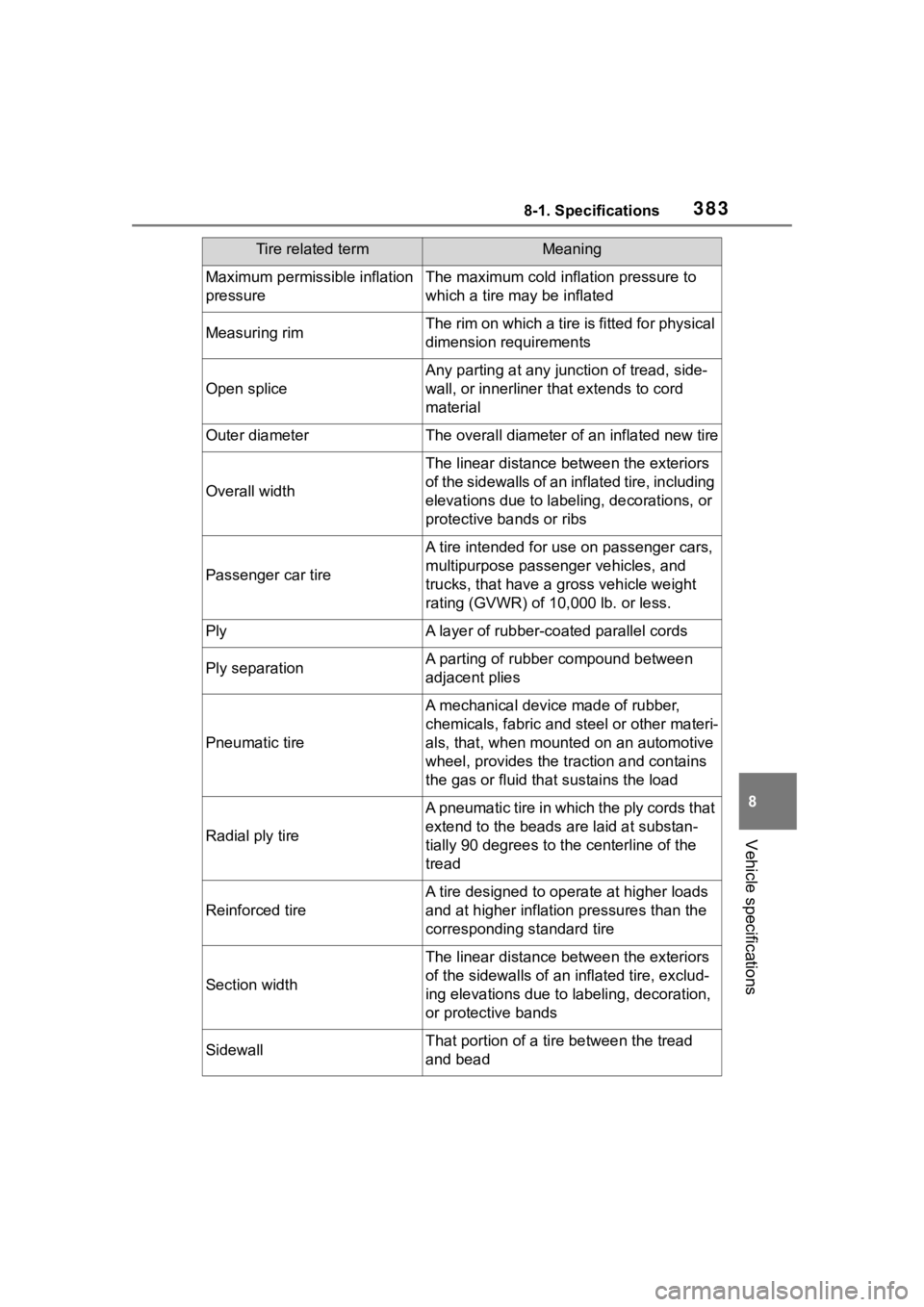
Maximum permissible inflation
pressureThe maximum cold inflation pressure to
which a tire may be inflated
Measuring rimThe rim on which a tire is fitted for physical
dimension requirements
Open splice
Any parting at any junction of tread, side-
wall, or innerliner that extends to cord
material
Outer diameterThe overall diameter of an inflated new tire
Overall width
The linear distance bet ween the exteriors
of the sidewalls of an inflated tire, including
elevations due to labe ling, decorations, or
protective bands or ribs
Passenger car tire
A tire intended for us e on passenger cars,
multipurpose passenger vehicles, and
trucks, that have a gross vehicle weight
rating (GVWR) of 10,000 lb. or less.
PlyA layer of rubber-coated parallel cords
Ply separationA parting of rubber compound between
adjacent plies
Pneumatic tire
A mechanical device made of rubber,
chemicals, fabric and steel or other materi-
als, that, when mount ed on an automotive
wheel, provides the tr action and contains
the gas or fluid that sustains the load
Radial ply tire
A pneumatic tire in which the ply cords that
extend to the beads are laid at substan-
tially 90 degrees to the centerline of the
tread
Reinforced tire
A tire designed to operate at higher loads
and at higher inflation pressures than the
corresponding standard tire
Section width
The linear distance bet ween the exteriors
of the sidewalls of an inflated tire, exclud-
ing elevations due to labeling, decoration,
or protective bands
SidewallThat portion of a ti re between the tread
and bead
Tire related termMeaning
Page 421 of 436

421Alphabetical Index
Open window ....................... 118
PDA (Proactive Driving Assist)........................................... 325
Seat belt ............................... 323
Warning lights ........................ 320 ABS ...................................... 322
Brake hold operated indicator........................................... 327
Brake Override System ........ 322
Brake system ....................... 320
Charging system .................. 321
Cruise control indicator ........ 325
Drive-Start Control ............... 322
Driving assist information indica- tor ....................................... 326
Dynamic radar cruise control indicator.............................. 325
Electric power steering ......... 322
High coolant temperature ..... 320
LDA indicator ........................ 325
Low engine oil pressure ....... 321
Low fuel level ....................... 323
LTA indicator ......................... 324
Malfunction indicator lamp ... 321
Parking brake indicator ........ 326
PDA indicator ....................... 325
Pre-collision system ............. 324
Seat belt reminder light ........ 323
Slip indicator......................... 326
SRS ...................................... 321
Tire pressure ........................ 324
Warning messages................. 330
Washer Checking .............................. 281
Preparing and c hecking before
winter.................................. 230
Switch................................... 154
Washing and waxing .............. 260
Weight Cargo capacity ..................... 131
Load limits ............................ 131
Weight .................................. 366 Wheels .....................................301
Replacing .............................301
Size ......................................370
Window lock switch ............... 119
Windows Power windows .................... 117
Rear window defogger .........237
Washer .................................154
Windshield wipers ..................154
Winter driving tips ..................230
Wireless charger.....................251
Wireless remote control Battery-Saving Function .......103
Locking/Unlocking ..................93
Replacing the battery ...........304
Refer to “MULTIMEDIA OWNER’S MANUAL” for
information regarding the
equipment listed below.
· Navigation system
· Audio/visual system
· Rear view monitor system