key TOYOTA DYNA 100/150 2012 (in English) User Guide
[x] Cancel search | Manufacturer: TOYOTA, Model Year: 2012, Model line: DYNA 100/150, Model: TOYOTA DYNA 100/150 2012Pages: 240, PDF Size: 15.05 MB
Page 26 of 240
20KEYS AND DOORS
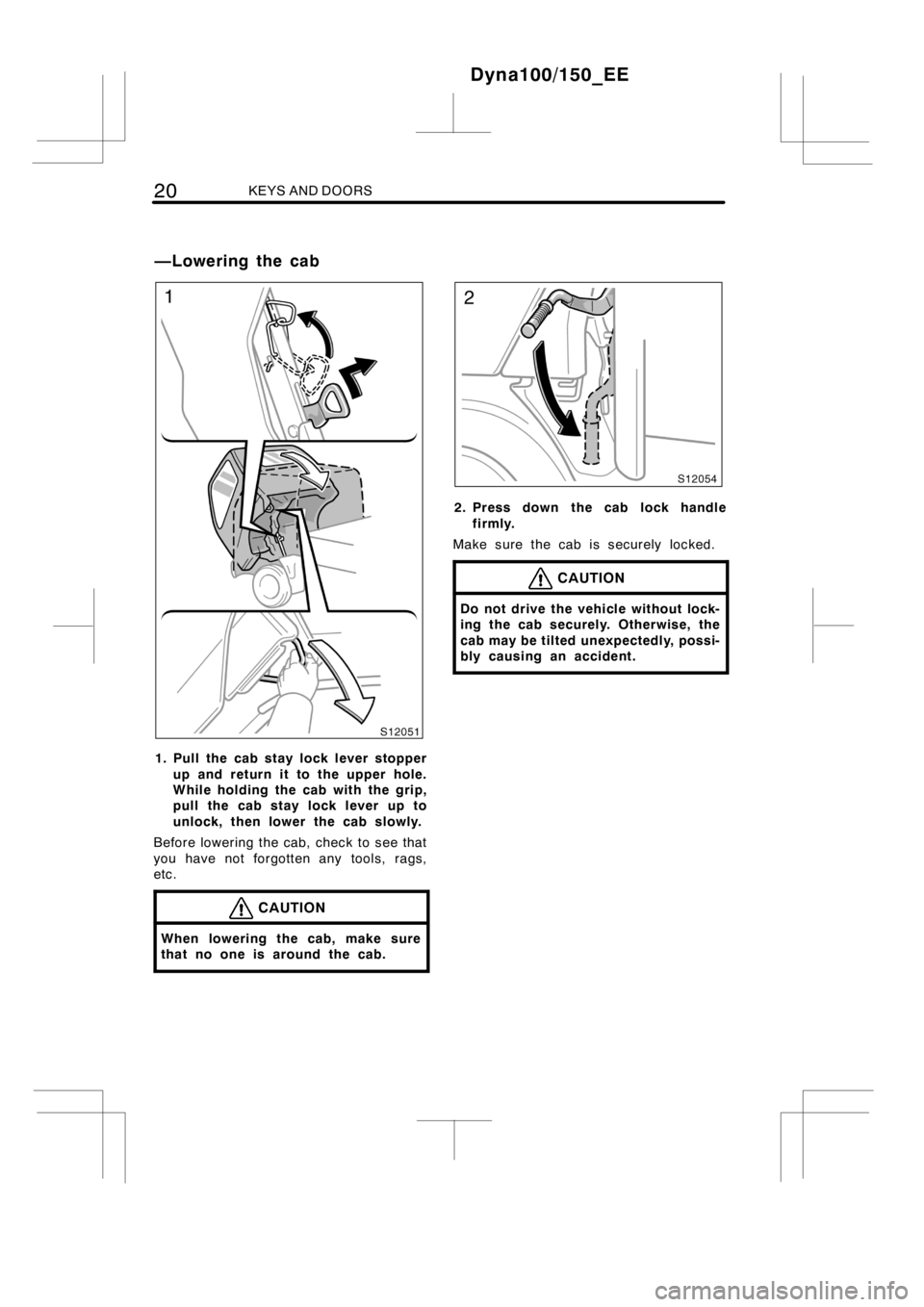
1. Pull the cab stay lock lever stopper
up and return it to the upper hole.
While holding the cab with the grip,
pull the cab stay lock lever up to
unlock, then lower the cab slowly.
Before lowering the cab, check to see that
you have not forgotten any tools, rags,
etc.
CAUTION
When lowering the cab, make sure
that no one is around the cab.
2. Press down the cab lock handle
firmly.
Make sure the cab is securely locked.
CAUTION
Do not drive the vehicle without lock-
ing the cab securely. Otherwise, the
cab may be tilted unexpectedly, possi-
bly causing an accident.
Dyna100/150_EE
—Lowering the cab
Page 27 of 240
KEYS AND DOORS21
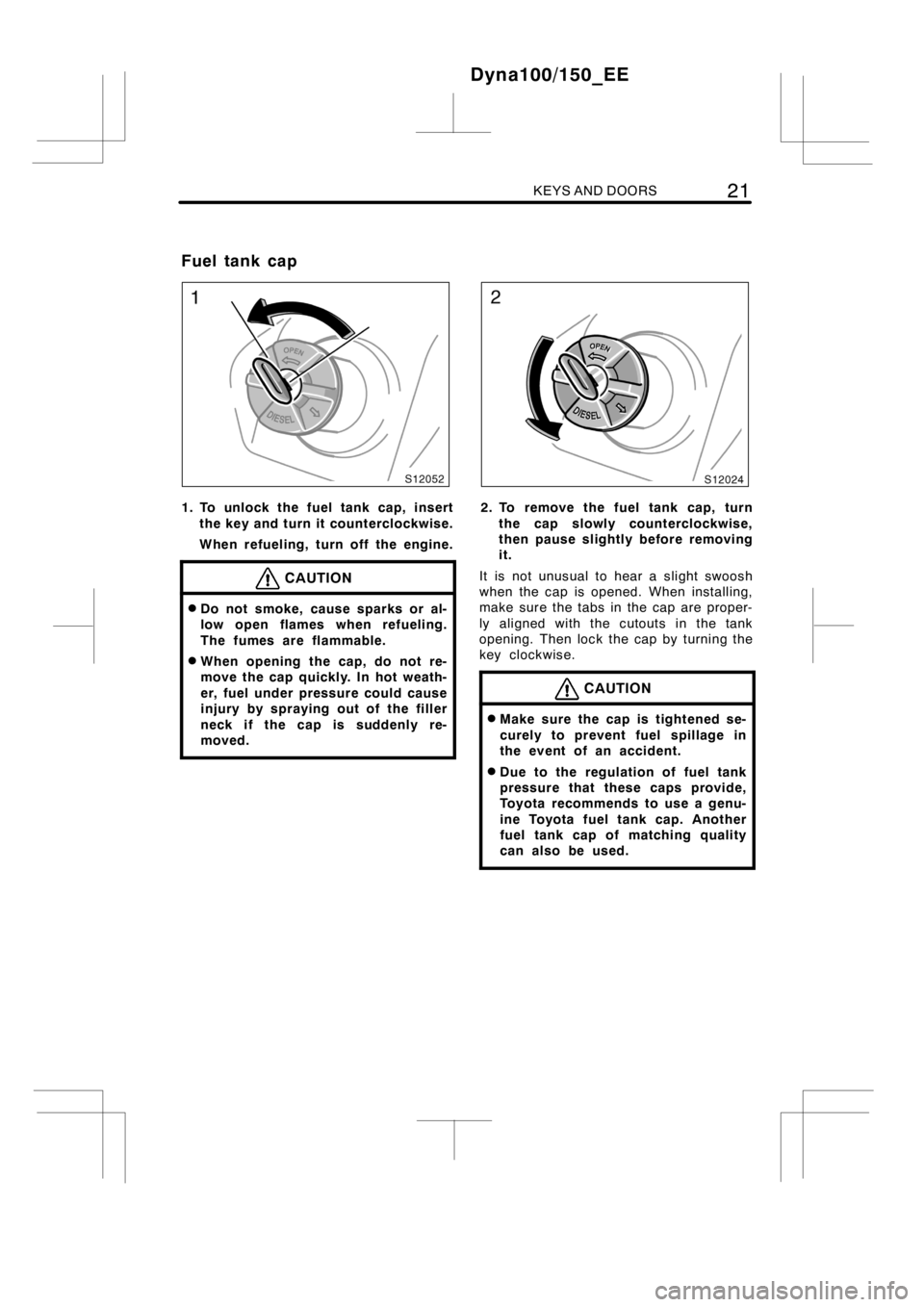
1. To unlock the fuel tank cap, insert
the key and turn it counterclockwise.
When refueling, turn off the engine.
CAUTION
DDo not smoke, cause sparks or al-
low open flames when refueling.
The fumes are flammable.
DWhen opening the cap, do not re-
move the cap quickly. In hot weath-
er, fuel under pressure could cause
injury by spraying out of the filler
neck if the cap is suddenly re-
moved.
2. To remove the fuel tank cap, turn
the cap slowly counterclockwise,
then pause slightly before removing
it.
It is not unusual to hear a slight swoosh
when the cap is opened.When installing,
make sure the tabs in the cap are proper-
ly aligned with the cutouts in the tank
opening. Then lock the cap by turning the
key clockwise.
CAUTION
DMake sure the cap is tightened se-
curely to prevent fuel spillage in
the event of an accident.
DDue to the regulation of fuel tank
pressure that these caps provide,
Toyota recommends to use a genu-
ine Toyota fuel tank cap. Another
fuel tank cap of matching quality
can also be used.
Dyna100/150_EE
Fuel tank cap
Page 28 of 240

22KEYS AND DOORS
Dyna100/150_EE
Page 53 of 240

SEATS, SEAT BELTS, STEERING WHEEL AND MIRRORS47
Provided information in the table shows your child restraint system suitability for various
seating positions. This table is applicable to only EU countries.
Front seat Rear seat
Passenger
seatCenter Outside
0
Up to 10 kg (22 lb.)
(0—9 months)
0
+
Up to 13 kg (28 lb.)
(0—2 years)
I
9to18kg
(20to39lb.)
(9 months—4 years)
II, III
15 to 36 kg
(34to79lb.)
(4—12 years)
Seating position
Mass groups
L1
L1
L3X
X
X
XU
U
U
U L2Center
X
X
UF
UF
Key of letters inserted in the above table:
U: Suitable for “universal” category child restraintsystemapproved for the use in this
mass group
UF: Suitable for forward−facing “universal” category child restraintsystemapproved for
the use in this mass group
L1: Suitable for “TOYOTA BABYSAFE (0 to 13 kg)” approved for the use in this mass
group
L2: Suitable for “TOYOTA DUO (without ISOFIX, 9 to 18 kg)” approved for the use in
this mass group
L3: Suitable for “TOYOTA KID (15 to 36 kg)” approved for the use in this mass group
X: Not suitable seat position for children in this mass group
Other child restraint system which is different from the system mentioned in the table
can be used, but the suitability of the systems must be carefully checked with the child
restraint system manufacturer concerned and the seller of those seats.
Dyna100/150_EE
—Child restraint system suitability for various seating positions
Page 84 of 240

78GAUGES, METERS AND SERVICE REMINDER INDICATORS
(j) Timing Belt Replacement Warning
Light
This light will come on every time when
the trip amount gets between 140000 km
and 150000 km in kilometer reading or
90000 miles in mile reading to indicate
that the timing belt should be replaced.
When it comes on, have the belt replaced
and the warning light reset by any autho-
rized Toyota dealer or repairer, or another
duly qualified and equipped professional.
NOTICE
Continued driving without having the
belt replaced will result in a broken
belt and engine damage.
(k) Fuel Filter Warning Light
The light warns you that the amount of
accumulated water in the fuel filter has
reached the specified level.
If it comes on, drain the water immediate-
ly. (See page 200 in Section 7−2for
instructions for how to drain the water.)
NOTICE
Never drive the vehicle with the warn-
ing light on. Continued driving with
water accumulated in the fuel filter
will damage the fuel injection pump.
(l) Engine Oil Change Reminder Light
This light comes on to remind you to
change the engine oil and oil filter.
If the light comes on, change the engine
oil and oil filter at your earliest conve-
nience. For detailed information, see “Oil
maintenance managementsystem” on
page 70 in this Section.(m) Light Reminder Buzzer
This buzzer will sound if the driver ’s door
is opened while the engine switch is
turned to the “LOCK” position with the
headlight switch on. Removing the key will
not stop the buzzer as long as the head-
light switch is on.
CHECKING SERVICE REMINDER
INDICATORS (except the low fuel level
warning light)
1. Apply the parking brake.
2. Turn the engine switch to the “ACC”
position.
The SRS warning light should come on.
It goes off after about 6 seconds.
3. Turn the engine switch to the “ON”
position, but do not start the engine.
All the service reminder indicators ex-
cept the SRS warning light should
come on. The “ABS” warning light goes
off after a few seconds. The engine oil
change reminder light goes off after
about 5 seconds.
If any service reminder indicator or warn-
ing buzzer does not function as described
above, have it checked by any authorized
Toyota dealer or repairer, or another duly
qualified and equipped professional, as
soon as possible.
Dyna100/150_EE
Page 86 of 240
80ENGINE (IGNITION) SWITCH, TRANSMISSION AND PARKING BRAKE
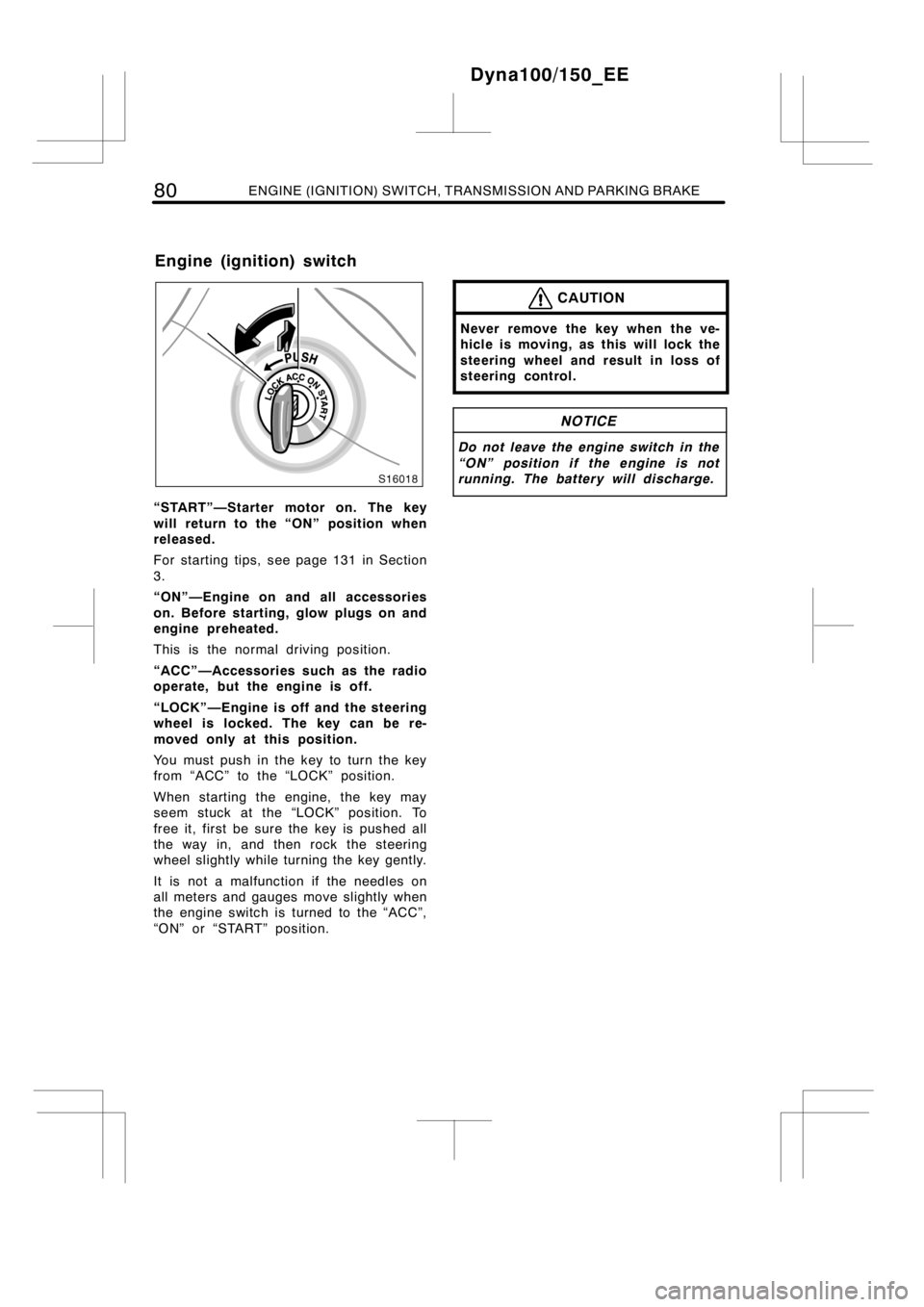
“START”—Starter motor on. The key
will return to the “ON” position when
released.
For starting tips, see page 131 in Section
3.
“ON”—Engine on and all accessories
on. Before starting, glow plugs on and
engine preheated.
This is the normal driving position.
“ACC”—Accessories such as the radio
operate, but the engine is off.
“LOCK”—Engine is off and the steering
wheel is locked. The key can be re-
moved only at this position.
You must push in the key to turn the key
from “ACC” to the “LOCK” position.
When starting the engine, the key may
seem stuck at the “LOCK” position. To
free it, first be sure the key is pushed all
the way in, and then rock the steering
wheel slightly while turning the key gently.
It is not a malfunction if the needles on
all meters and gauges move slightly when
the engine switch is turned to the “ACC”,
“ON” or “START” position.
CAUTION
Never remove the key when the ve-
hicle is moving, as this will lock the
steering wheel and result in loss of
steering control.
NOTICE
Do not leave the engine switch in the
“ON” position if the engine is not
running. The battery will discharge.
Dyna100/150_EE
Engine (ignition) switch
Page 139 of 240
STARTING AND DRIVING133
Before starting the engine, be sure to fol-
low the instructions in “(a) Before crank-
ing”.
Normal starting procedure
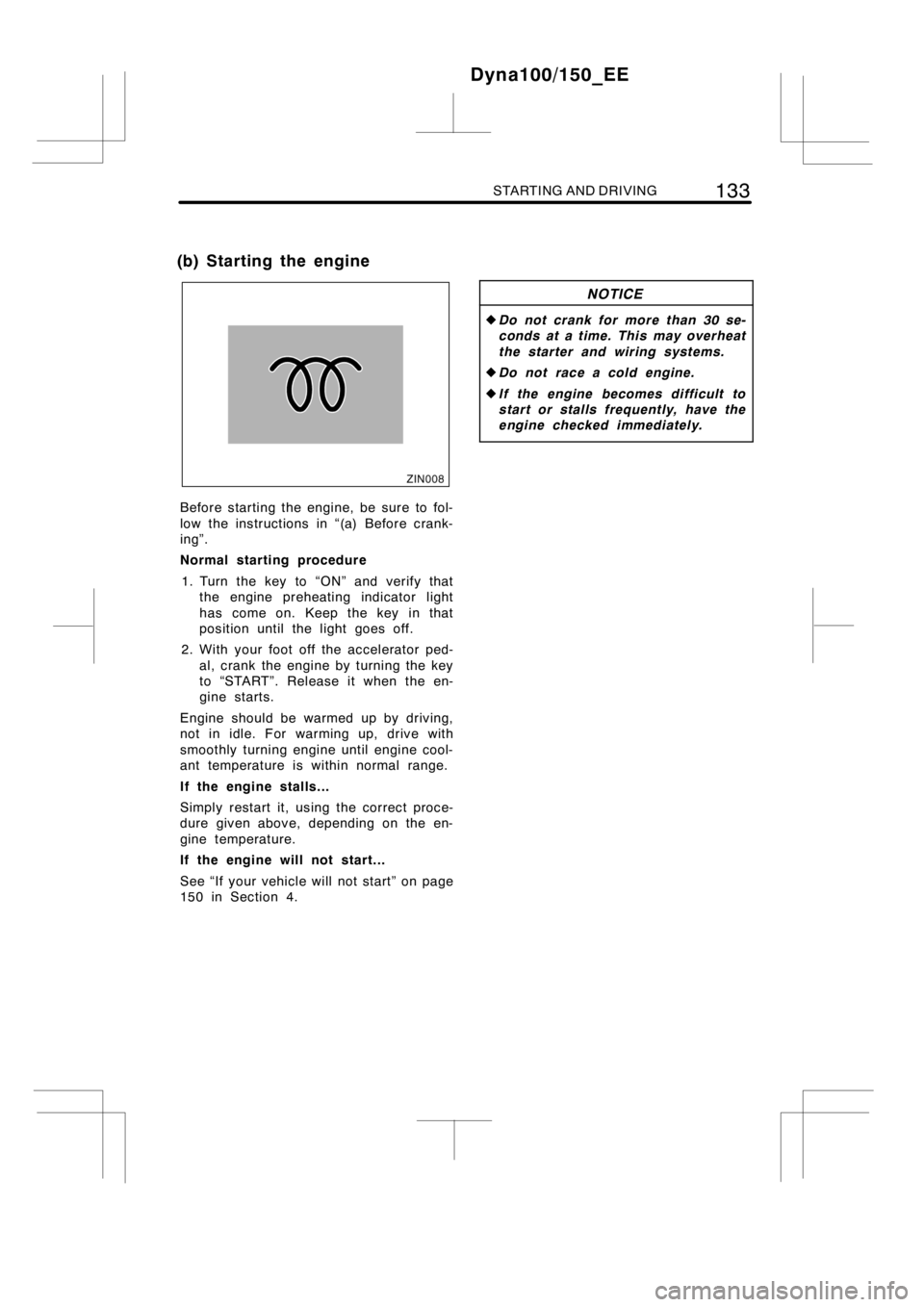
1. Turn the key to “ON” and verify that
the engine preheating indicator light
has come on. Keep the key in that
position until the light goes off.
2. With your foot off the accelerator ped-
al, crank the engine by turning the key
to “START”. Release it when the en-
gine starts.
Engine should be warmed up by driving,
not in idle. For warming up, drive with
smoothly turning engine until engine cool-
ant temperature is within normal range.
If the engine stalls...
Simply restart it, using the correct proce-
dure given above, depending on the en-
gine temperature.
If the engine will not start...
See “If your vehicle will not start” on page
150 in Section 4.
NOTICE
zDo not crank for more than 30 se-
conds at a time. This may overheat
the starter and wiring systems.
zDo not race a cold engine.
zIf the engine becomes difficult to
start or stalls frequently, have the
engine checked immediately.
Dyna100/150_EE
(b) Starting the engine
Page 144 of 240

138STARTING AND DRIVING
Keep the door locks from freezing.
Squirt lock de−icer or glycerine into the
locks to keep them from freezing. To open
a frozen lock, try heating the key before
inserting it.
Use a washer fluid containing an anti-
freeze solution.
This product is available at any authorized
Toyota dealer or repairer and most auto
parts stores or another qualified professio-
nal. Follow the manufacturer ’s directions
for how much to mix with water.
NOTICE
Do not use engine antifreeze or any
other substitute because it may dam-
age your vehicle’s paint.
Do not use your parking brake when
there is a possibility it could freeze.
When parking, put the transmission into
first or reverse and block the front
wheels. Do not use the parking brake, or
snow or water accumulated in and around
the parking brake mechanism may freeze,
making it hard to release.
Keep ice and snow from accumulating
under the fenders.
Ice and snow built up under your fenders
can make steering difficult. During bad
winter driving, stop and check under the
fenders occasionally.
Depending on where you are driving,
we recommend you carry some emer-
gency equipment.
Some of the things you might put in the
vehicle are tire chains, window scraper,
bag of sand or salt, flares, small shovel,
jumper cables, etc.Your vehicle is designed primarily as a
passenger−and−load−carrying vehicle. Tow-
ing a trailer will have an adverse effect on
handling, performance,braking,durability
and driving economy (fuel consumption,
etc.). Your safety and satisfaction depend
on the proper use of correct equipment
and cautious driving habits. For your safe-
ty and the safety of others, you must not
overload your vehicle or trailer. Ask your
local authorized Toyota dealer or repairer,
or another duly qualified and equipped
professional, for further details before tow-
ing, as there are additional legal require-
ments in some countries.
WEIGHT LIMITS
Before towing, confirm the towing capacity,
gross vehicle mass (GVM), maximum per-
missible axle capacity (MPAC) and draw-
bar load. They are listed on page 222 in
Section 8.
When towing a trailer, observe the follow-
ing:
DThe total trailer weight (trailer weight
plus its cargo load) is within the towing
capacity.
DWhen the total trailer weight is greater
than the vehicle weight, we recommend
the use of a friction stabilizer (sway
control device).
DWhen the total trailer weight is over
2000 kg (4409 lb.), a friction stabilizer
(sway control device) is required.
Dyna100/150_EE
Trailer towing
Page 155 of 240

IN CASE OF AN EMERGENCY149
Section 4
IN CASE OF AN EMERGENCY
DIf your vehicle will not start 150..........................
DIf your engine stalls while driving 155....................
DIf you cannot increase engine speed 155.................
DIf your vehicle overheats 156...........................
DIf you have a flat tire 157...............................
DIf your vehicle becomes stuck 170.......................
DIf your vehicle needs to be towed 171....................
DIf you lose your keys 174...............................
DIf your vehicle has to be stopped in an emergency 175....
Dyna100/150_EE
Page 177 of 240
IN CASE OF AN EMERGENCY171
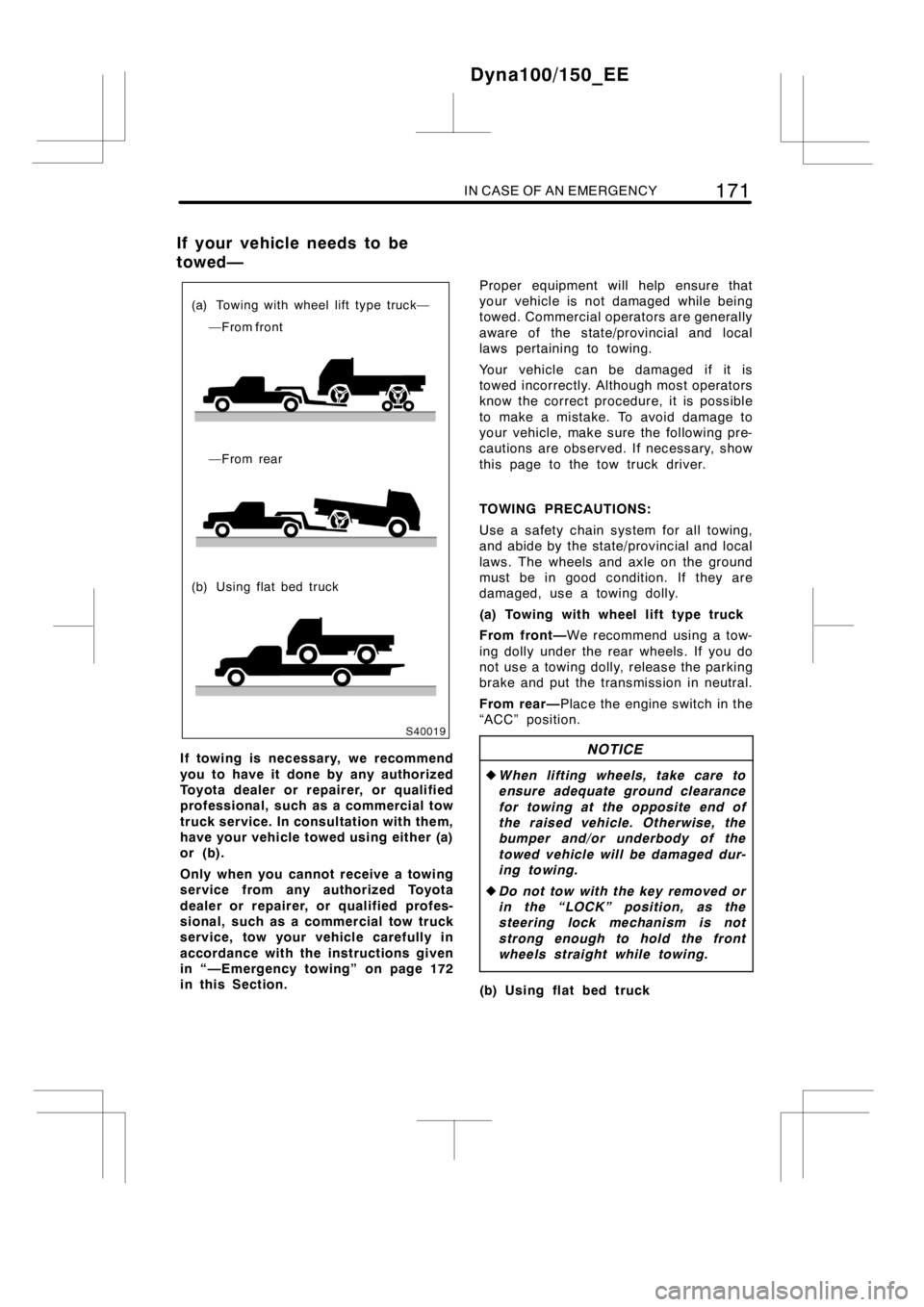
(a) Towing with wheel lift type truck—
—From front
—From rear
(b) Using flat bed truck
If towing is necessary, we recommend
you to have it done by any authorized
Toyota dealer or repairer, or qualified
professional, such as a commercial tow
truck service. In consultation with them,
have your vehicle towed using either (a)
or (b).
Only when you cannot receive a towing
service from any authorized Toyota
dealer or repairer, or qualified profes-
sional, such as a commercial tow truck
service, tow your vehicle carefully in
accordance with the instructions given
in “—Emergency towing” on page 172
in this Section.Proper equipment will help ensure that
your vehicle is not damaged while being
towed. Commercial operators are generally
aware of the state/provincial and local
laws pertaining to towing.
Your vehicle can be damaged if it is
towed incorrectly. Although most operators
know the correct procedure, it is possible
to make a mistake. To avoid damage to
your vehicle, make sure the following pre-
cautions are observed. If necessary, show
this page to the tow truck driver.
TOWING PRECAUTIONS:
Use a safety chain system for all towing,
and abide by the state/provincial and local
laws. The wheels and axle on the ground
must be in good condition. If they are
damaged, use a towing dolly.
(a) Towing with wheel lift type truck
From front—We recommend using a tow-
ing dolly under the rear wheels. If you do
not use a towing dolly, release the parking
brake and put the transmission in neutral.
From rear—Place the engine switch in the
“ACC” position.NOTICE
zWhen lifting wheels, take care to
ensure adequate ground clearance
for towing at the opposite end of
the raised vehicle. Otherwise, the
bumper and/or underbody of the
towed vehicle will be damaged dur-
ing towing.
zDo not tow with the key removed or
in the “LOCK” position, as the
steering lock mechanism is not
strong enough to hold the front
wheels straight while towing.
(b) Using flat bed truck
Dyna100/150_EE
If your vehicle needs to be
towed—