seats TOYOTA FJ CRUISER 2010 1.G Owner's Guide
[x] Cancel search | Manufacturer: TOYOTA, Model Year: 2010, Model line: FJ CRUISER, Model: TOYOTA FJ CRUISER 2010 1.GPages: 439, PDF Size: 11.02 MB
Page 90 of 439

90 1-7. Safety information
CAUTION
■SRS airbag precautions
●The SRS front passenger airbag also deploys with considerable force, and
can cause death or serious injury especially if the front passenger is very
close to the airbag. The front passenger seat should be as far from the air-
bag as possible with the seatback adjusted, so the front passenger sits
upright.
●Improperly seated and/or restrained infants and children can be killed or
seriously injured by a deploying airbag. An infant or child who is too small
to use a seat belt should be properly secured using a child restraint sys-
tem. Toyota strongly recommends that all infants and children be placed in
the rear seats of the vehicle and properly restrained. The rear seats are
the safest for infants and children. (P. 100)
●If the seat belt extender has been con-
nected to the driver’s seat belt buckle
but the seat belt extender has not also
been fastened to the latch plate of the
driver’s seat belt, the SRS driver’s air-
bag system will judge that the driver is
wearing the seat belt even though the
seat belt has not been connected. In
this case, the driver’s airbag may not
activate correctly in a collision, resulting
in death or serious injury in the event of
collision. Be sure to wear the seat belt
with the seat belt extender.
Page 93 of 439

93 1-7. Safety information
1
Before driving
Deactivating the curtain shield airbags in a vehicle rollover
ON/OFF (hold for a few sec-
onds)
The RSCA OFF indicator turns
on. (only when the engine switch
is in the ON position.)
The roll sensing function for the
curtain shield airbags and seat
belt pretensioners will turn back
on automatically each time the
engine switch is turned on.
CAUTION
■Modification and disposal of SRS airbag system components
Do not dispose of your vehicle or perform any of the following modifications
without consulting your Toyota dealer.
The SRS airbags may malfunction or deploy (inflate) accidentally, causing
death or serious injury.
●Installation, removal, disassembly and repair of the SRS airbags.
●Repairs, modifications, removal or replacement of the steering wheel,
instrument panel, dashboard, seats or seat upholstery, front and rear pil-
lars or roof side rails.
●Repairs or modifications of the front fender, front bumper, or side of the
occupant compartment.
●Installation of snow plows, winches, etc. to the front grille (bull bars, kan-
garoo bar etc.).
●Modifications to the vehicle's suspension system.
●Installation of electronic devices such as mobile two-way radios or CD
players.
●Modifications to your vehicle for a person with a physical disability.
Page 99 of 439

99 1-7. Safety information
1
Before driving
CAUTION
■Front passenger occupant classification system precautions
●If an adult sits in the front passenger seat, the AIR BAG ON indicator light
is illuminated. If the AIR BAG OFF indicator is illuminated, ask the passen-
ger to sit up straight, well back in the seat, feet on the floor, and with the
seat belt worn correctly. If the AIR BAG OFF indicator still remain illumi-
nated, either ask the passenger to move to the rear seat, or if that is not
possible, move the front passenger seat fully rearward.
●When it is unavoidable to install the forward-facing child restraint system
on the front passenger seat, install the child restraint system on the front
passenger seat in the proper order. (P. 104)
●Do not modify or remove the front seats.
●Do not kick the front passenger seat or subject it to severe impact. Other-
wise, the SRS warning light may come on to indicate a malfunction of the
detection system. In this case, contact your Toyota dealer immediately.
●Child restraint systems installed on the rear seat should not contact the
front seatbacks.
●Do not use a seat accessory, such as a cushion or seat cover, that covers
the seat cushion surface.
●Do not attach a commercial seatback table or other heavy item to the back
of the front passenger seat.
●Do not modify or replace the upholstery of the front seat.
Page 104 of 439

104
1-7. Safety information
Installing child restraints
Follow the child restraint system manufacturer's instructions. Firmly
secure child restraints to the rear seats using the LATCH anchors or
a seat belt. Attach the top tether strap when installing a child
restraint.
The lap/shoulder belt can be used if your child restraint system is
not compatible with the LATCH (Lower Anchors and Tethers for Chil-
dren) system.
Child restraint LATCH anchors
LATCH anchors are provided
for the outside rear seats. (But-
tons displaying the location of
the anchors are attached to the
seats.)
Seat belts equipped with a
child restraint locking mecha-
nism (ALR/ELR belts except
driver’s seat belt) (P. 57)
Page 105 of 439

105 1-7. Safety information
1
Before driving
Anchor bracket (for top tether
strap)
Anchor brackets are provided
for all rear seats.
Page 186 of 439

186 2-5. Driving information
CAUTION
■Things that must not be carried in the luggage compartment
The following things may cause a fire if loaded in the luggage compart-
ment.
●Receptacles containing gasoline
●Aerosol cans
■Storage precautions
Observe the following precautions.
Failing to do so may result in death or serious injury.
●Do not place cargo or luggage in or on the following locations as the
item may get under the clutch, brake or accelerator pedal and prevent
the pedals from being depressed properly, block the driver’s vision, or
hit the driver or passengers, causing an accident.
• Driver’s feet
• Front passenger or rear seats (when stacking items)
• Instrument panel
• Dashboard
• Auxiliary box or tray that has no lid
●Secure all items in the occupant compartment, as they may shift and
injure someone during sudden braking, sudden swerving or an acci-
dent.
●Never allow anyone to ride in the luggage compartment. It is not
designed for passengers. They should ride in their seats with their seat
belts properly fastened. Otherwise, they are much more likely to suffer
death or serious injury, in the event of sudden braking, sudden swerv-
ing or an accident.
■Capacity and distribution
●Do not exceed the maximum axle weight rating or the total vehicle
weight rating.
●Even if the total load of occupant’s weight and the cargo load is less
than the total load capacity, do not apply the load unevenly. Improper
loading may cause deterioration of steering or braking control which
may cause death or serious injury.
Page 264 of 439
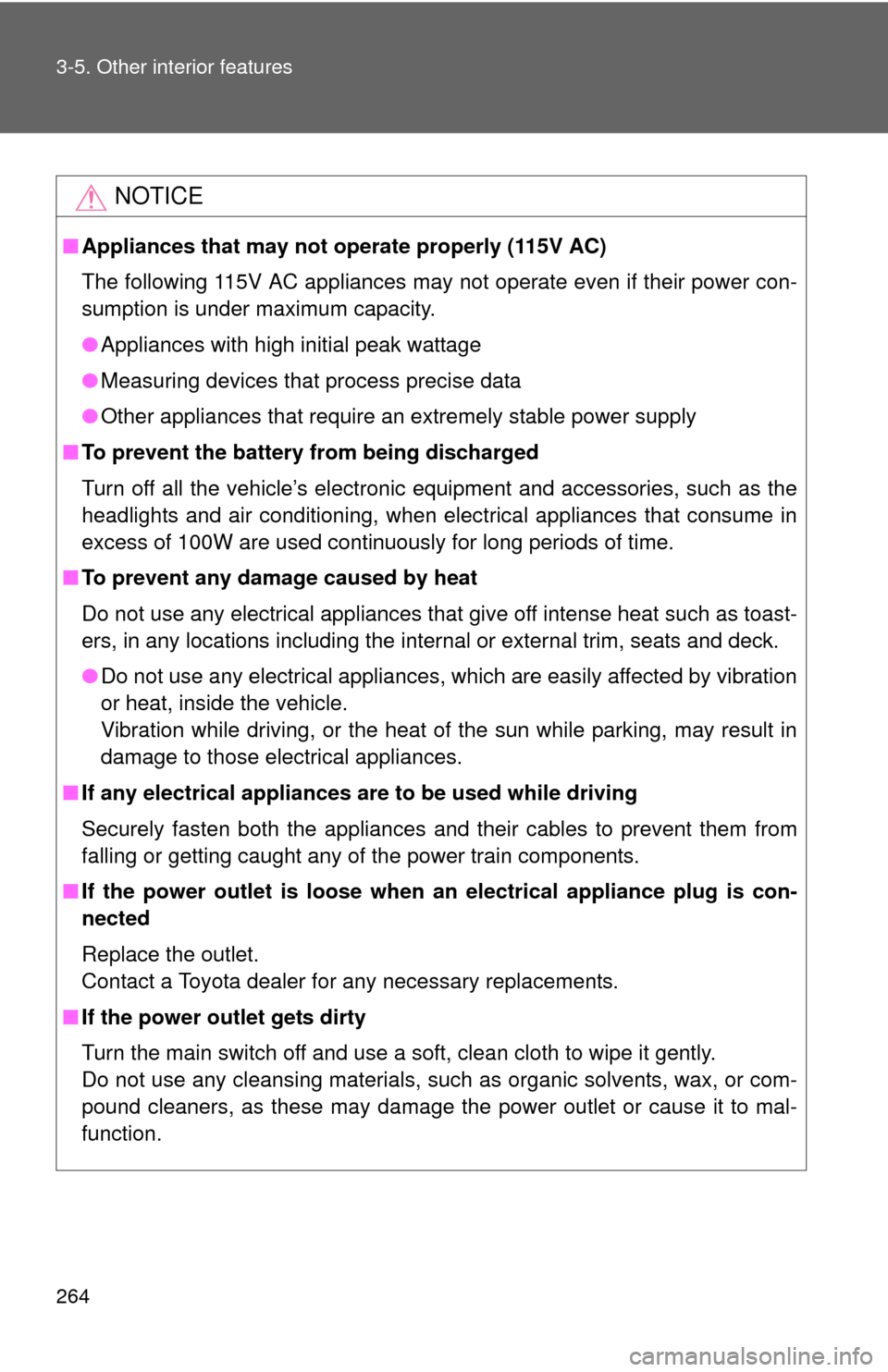
264 3-5. Other interior features
NOTICE
■Appliances that may not operate properly (115V AC)
The following 115V AC appliances may not operate even if their power con-
sumption is under maximum capacity.
●Appliances with high initial peak wattage
●Measuring devices that process precise data
●Other appliances that require an extremely stable power supply
■To prevent the battery from being discharged
Turn off all the vehicle’s electronic equipment and accessories, such as the
headlights and air conditioning, when electrical appliances that consume in
excess of 100W are used continuously for long periods of time.
■To prevent any damage caused by heat
Do not use any electrical appliances that give off intense heat such as toast-
ers, in any locations including the internal or external trim, seats and deck.
●Do not use any electrical appliances, which are easily affected by vibration
or heat, inside the vehicle.
Vibration while driving, or the heat of the sun while parking, may result in
damage to those electrical appliances.
■If any electrical appliances are to be used while driving
Securely fasten both the appliances and their cables to prevent them from
falling or getting caught any of the power train components.
■If the power outlet is loose when an electrical appliance plug is con-
nected
Replace the outlet.
Contact a Toyota dealer for any necessary replacements.
■If the power outlet gets dirty
Turn the main switch off and use a soft, clean cloth to wipe it gently.
Do not use any cleansing materials, such as organic solvents, wax, or com-
pound cleaners, as these may damage the power outlet or cause it to mal-
function.
Page 287 of 439
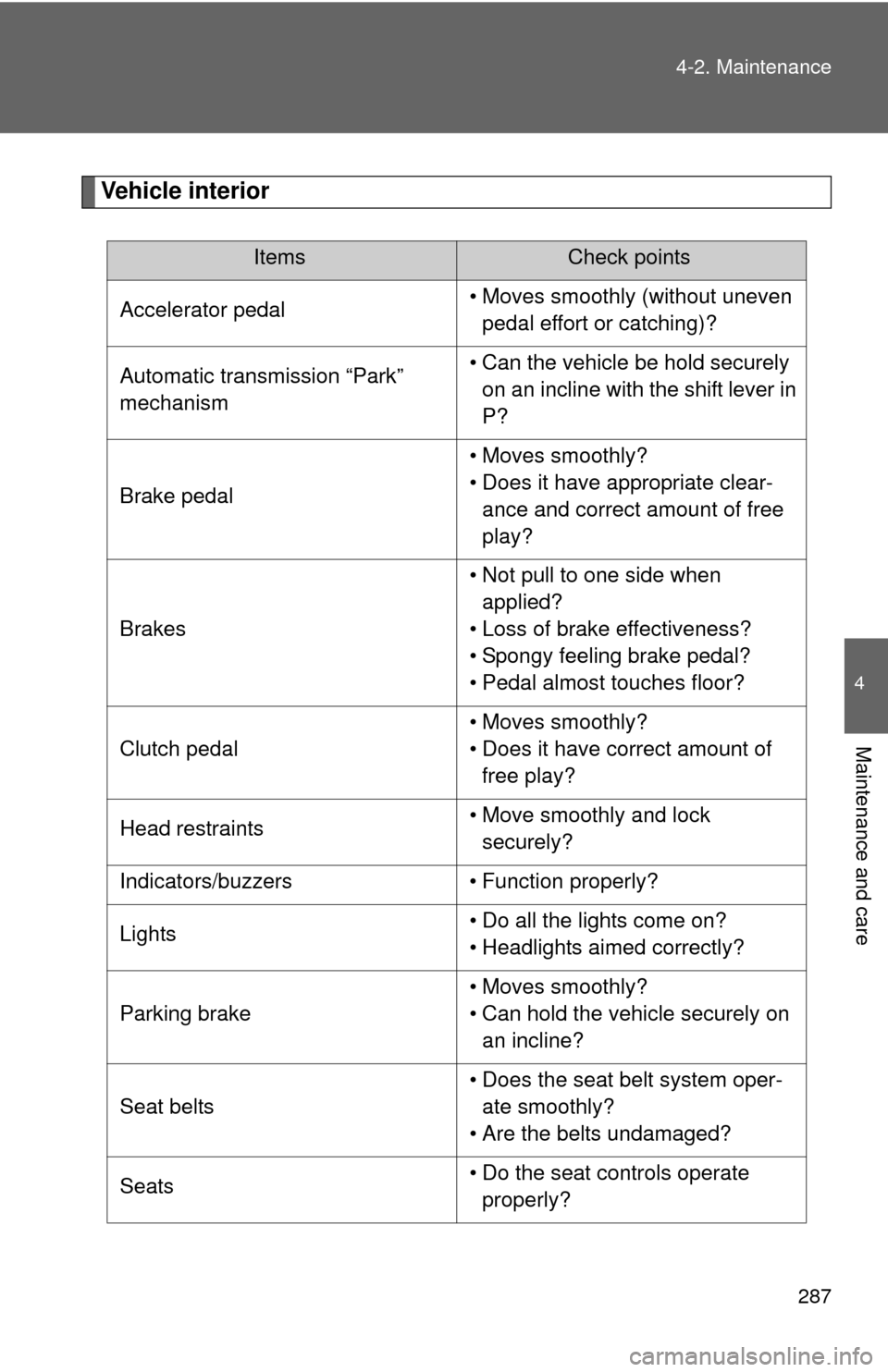
287 4-2. Maintenance
4
Maintenance and care
Vehicle interior
ItemsCheck points
Accelerator pedal• Moves smoothly (without uneven
pedal effort or catching)?
Automatic transmission “Park”
mechanism• Can the vehicle be hold securely
on an incline with the shift lever in
P?
Brake pedal• Moves smoothly?
• Does it have appropriate clear-
ance and correct amount of free
play?
Brakes• Not pull to one side when
applied?
• Loss of brake effectiveness?
• Spongy feeling brake pedal?
• Pedal almost touches floor?
Clutch pedal• Moves smoothly?
• Does it have correct amount of
free play?
Head restraints• Move smoothly and lock
securely?
Indicators/buzzers • Function properly?
Lights• Do all the lights come on?
• Headlights aimed correctly?
Parking brake• Moves smoothly?
• Can hold the vehicle securely on
an incline?
Seat belts• Does the seat belt system oper-
ate smoothly?
• Are the belts undamaged?
Seats• Do the seat controls operate
properly?
Page 409 of 439

406 6-1. Specifications
Warning: The temperature grades for this tire are established for a
tire that is properly inflated and not overloaded.
Excessive speed, underinflation, or excessive loading, either
separately or in combination, can cause heat buildup and possible
tire failure.
Glossary of tire terminology
Tire related termMeaning
Cold tire inflation
pressure
Tire pressure when the vehicle has been
parked for three hours or more, or has not
been driven more than 1 mile or 1.5 km under
that condition
Maximum inflation
pressureThe maximum cold inflated pressure to which a
tire may be inflated, shown on the sidewall of
the tire
Recommended
inflation pressureCold tire inflation pressure recommended by a
manufacturer
Accessory weight
The combined weight (in excess of those
standard items which may be replaced) of
transmission, power steering, power brakes,
power windows, power seats, radio and heater,
to the extent that these items are available as
factory-installed equipment (whether installed
or not)
Curb weight
The weight of a motor vehicle with standard
equipment, including the maximum capacity of
fuel, oil and coolant, and if so equipped, air
conditioning and additional weight optional
engine
Maximum loaded
vehicle weight
The sum of:
(a) Curb weight
(b) Accessory weight
(c) Vehicle capacity weight
(d) Production options weight
Page 426 of 439

423 Alphabetical index
Care
Exterior ................................. 278
Interior .................................. 280
Seat belts ............................. 280
Cargo capacity ........................ 184
Cargo net hook ........................ 269
CD player ................................. 220
Center differential lock ........... 162
Certification label ............ 191, 389
Chains ...................................... 189
Child restraint system
Booster seats, definition ....... 100
Booster seats, installation .... 110
Convertible seats, definition . 100
Convertible seats,
installation .......................... 108
Front passenger occupant
classification system ............ 95
Infant seat, definition ............ 100
Infant seats, installation ........ 107
Installing CRS with LATCH
anchors .............................. 106
Installing CRS with seat
belts ................................... 104
Installing CRS with top tether
straps ................................. 111
Child safety
Airbag precautions ................. 90
Battery precautions ...... 304, 381
Child restraint system ........... 100
How your child should wear
the seat belt ......................... 59
Installing child restraints ....... 104
Power window lock switch ...... 71
Power window precautions..... 72
Removed key battery
precautions ........................ 323
Seat belt extender
precautions .......................... 60
Seat belt precautions.............. 60
Cleaning
Exterior ................................. 278
Interior .................................. 280Seat belts ..............................280
Clinometer ................................143
Clock ........................................ 256
Clutch start cancel switch.......173
Compass ...........................143, 271
Condenser ................................300
Cooling system
Engine overheating ...............382
CRS ...........................................100
Cruise control...........................150
Cup holders ..............247, 248, 251
Curtain shield airbags ...............82
Customizable features.............412
Daytime running light
system ....................................146
Defogger
Rear window .........................210
Dimension.................................388
Dinghy towing ..........................201
Do-it-yourself maintenance.....289
Doors
Access doors...........................36
Door glasses ...........................71
Door lock ...........................30, 33
Open door warning light ........357
Side doors ...............................33
Side mirrors .............................68
Driver’s seat belt reminder
buzzer .....................................357
Driver's seat belt reminder
light .........................................357
Driving
Break-in tips ..........................118
Correct posture .......................80
Driving assist systems...........174
Procedures ............................126
Winter driving tips..................188C
D