flat tire TOYOTA FJ CRUISER 2010 1.G Owners Manual
[x] Cancel search | Manufacturer: TOYOTA, Model Year: 2010, Model line: FJ CRUISER, Model: TOYOTA FJ CRUISER 2010 1.GPages: 439, PDF Size: 11.02 MB
Page 1 of 439

TABLE OF CONTENTS
1
1Before drivingAdjusting and operating features such as door locks,
mirrors, and steering column.
2When drivingDriving, stopping and safe-driving information.
3Interior
featuresAir conditioning and audio systems, as well as other in-
terior features for a comfortable driving experience.
4Maintenance
and careCleaning and protecting your vehicle, performing do-it-
yourself maintenance, and maintenance information.
5When trouble
arisesWhat to do if the vehicle needs to be towed, gets a flat
tire, or is involved in an accident.
6Vehicle
specificationsDetailed vehicle information.
7For ownersReporting safety defects for U.S. owners and seat belt
instructions for Canadian owners
IndexAlphabetical listing of information contained in this
manual.
Page 4 of 439
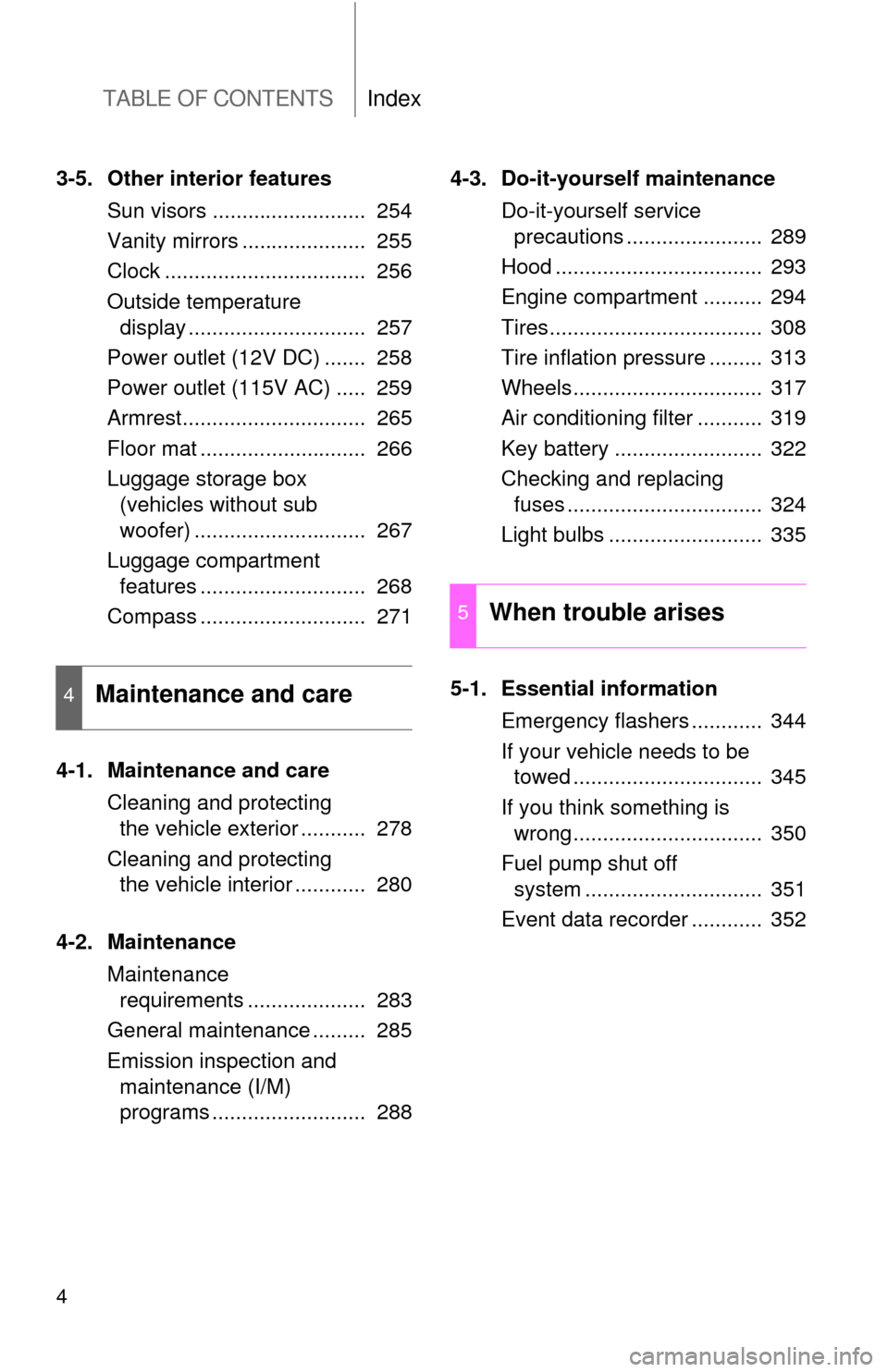
TABLE OF CONTENTSIndex
4
3-5. Other interior features
Sun visors .......................... 254
Vanity mirrors ..................... 255
Clock .................................. 256
Outside temperature
display .............................. 257
Power outlet (12V DC) ....... 258
Power outlet (115V AC) ..... 259
Armrest............................... 265
Floor mat ............................ 266
Luggage storage box
(vehicles without sub
woofer) ............................. 267
Luggage compartment
features ............................ 268
Compass ............................ 271
4-1. Maintenance and care
Cleaning and protecting
the vehicle exterior ........... 278
Cleaning and protecting
the vehicle interior ............ 280
4-2. Maintenance
Maintenance
requirements .................... 283
General maintenance ......... 285
Emission inspection and
maintenance (I/M)
programs .......................... 2884-3. Do-it-yourself maintenance
Do-it-yourself service
precautions ....................... 289
Hood ................................... 293
Engine compartment .......... 294
Tires.................................... 308
Tire inflation pressure ......... 313
Wheels................................ 317
Air conditioning filter ........... 319
Key battery ......................... 322
Checking and replacing
fuses ................................. 324
Light bulbs .......................... 335
5-1. Essential information
Emergency flashers ............ 344
If your vehicle needs to be
towed ................................ 345
If you think something is
wrong ................................ 350
Fuel pump shut off
system .............................. 351
Event data recorder ............ 352
4Maintenance and care
5When trouble arises
Page 5 of 439

1
2
3
4
5
6
7
5
5-2. Steps to take in an emergency
If a warning light turns on
or a warning buzzer
sounds... ........................... 354
If you have a flat tire............ 364
If the engine will not start .... 376
If the shift lever cannot be
shifted from P.................... 377
If you lose your keys ........... 378
If the vehicle battery is
discharged ........................ 379
If your vehicle overheats ..... 382
If the vehicle becomes
stuck ................................. 385
6-1. Specifications
Maintenance data
(fuel, oil level, etc.) ............ 388
Fuel information .................. 398
Tire information ................... 401
6-2. Customization
Customizable features ........ 412
Items to initialize ................. 414Reporting safety defects
for U.S. owners ................ 416
Seat belt instructions for
Canadian owners
(in French) ........................ 417
Abbreviation list ........................ 420
Alphabetical index .................... 422
What to do if... ........................... 430
6Vehicle specifications
7For owners
Index
Page 7 of 439

7
A
Tires
●Rotation
●Replacement
●Inflation pressure
●Information
P. 308
P. 364
P. 313
P. 401
Access doors P. 36
Fuel filler door P. 73
Rear turn signal lights P. 133
Stop/tail and rear side
marker lights
P. 145
Side doors P. 33
: If equipped
Page 125 of 439
125 2-1. Driving procedures
2
When driving
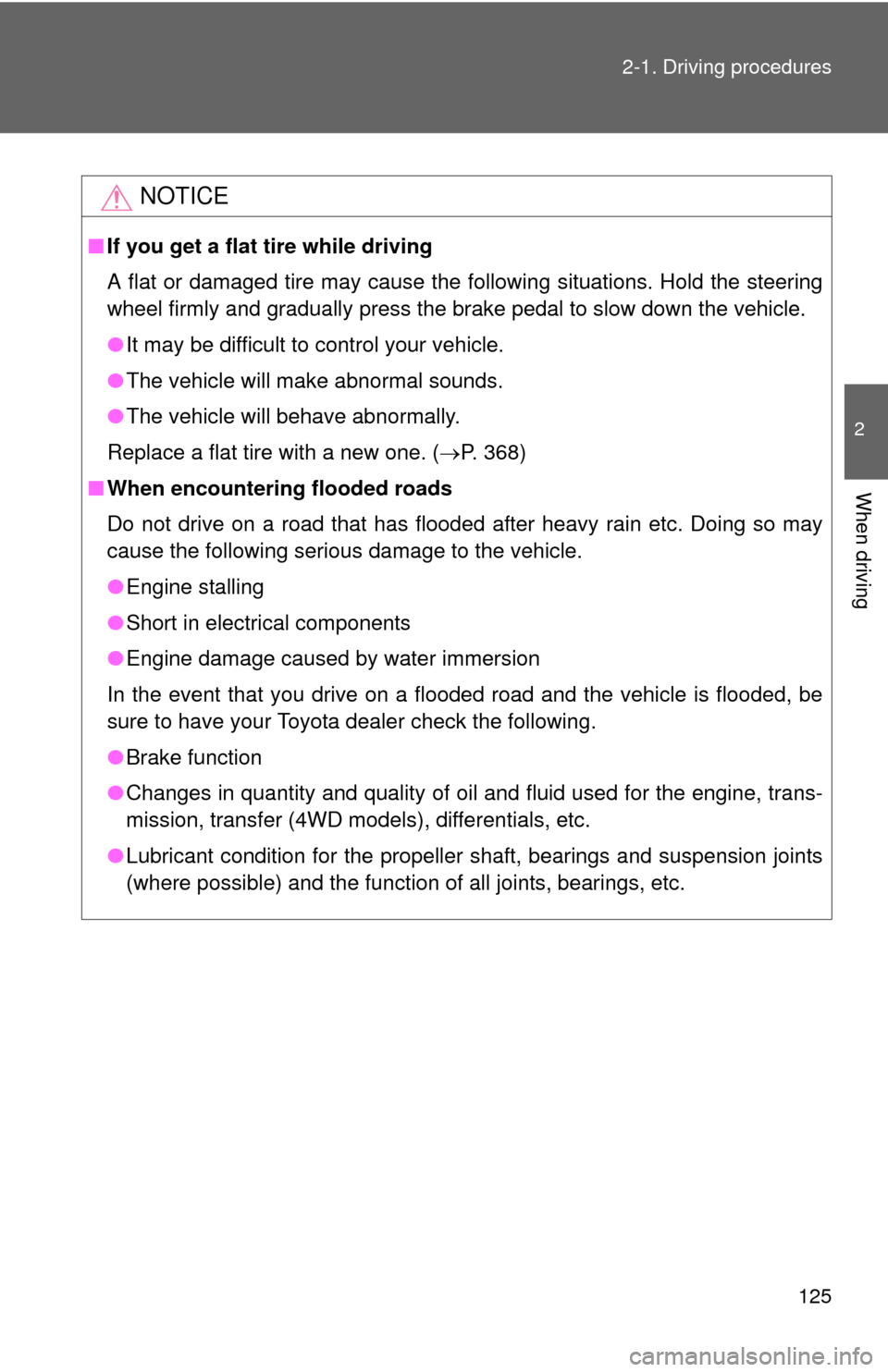
NOTICE
■If you get a flat tire while driving
A flat or damaged tire may cause the following situations. Hold the steering
wheel firmly and gradually press the brake pedal to slow down the vehicle.
●It may be difficult to control your vehicle.
●The vehicle will make abnormal sounds.
●The vehicle will behave abnormally.
Replace a flat tire with a new one. (P. 368)
■When encountering flooded roads
Do not drive on a road that has flooded after heavy rain etc. Doing so may
cause the following serious damage to the vehicle.
●Engine stalling
●Short in electrical components
●Engine damage caused by water immersion
In the event that you drive on a flooded road and the vehicle is flooded, be
sure to have your Toyota dealer check the following.
●Brake function
●Changes in quantity and quality of oil and fluid used for the engine, trans-
mission, transfer (4WD models), differentials, etc.
●Lubricant condition for the propeller shaft, bearings and suspension joints
(where possible) and the function of all joints, bearings, etc.
Page 178 of 439

178 2-4. Using other driving systems
CAUTION
■When VSC is activated
The slip indicator flashes and a warning buzzer sounds. Always drive care-
fully. Reckless driving may cause an accident. Exercise particular care when
the indicator flashes and a buzzer sounds.
■TRAC may not operate effectively when
Directional control and power may not be achievable while driving on slip-
pery road surfaces, even if TRAC is operating.
Do not drive the vehicle in conditions where stability and power may be lost.
■Replacing tires
Make sure that all tires are of the same size, brand, tread pattern and total
load capacity. In addition, make sure that the tires are inflated to the appro-
priate tire pressure level.
The ABS and VSC will not function correctly if different tires are fitted on the
vehicle.
Contact your Toyota dealer for further information when replacing tires or
wheels.
■Handling of tires and suspension
Using tires with any kind of problem or modifying the suspension will affect
the driving assist systems, and may cause the system to malfunction.
Page 194 of 439
194 2-5. Driving information
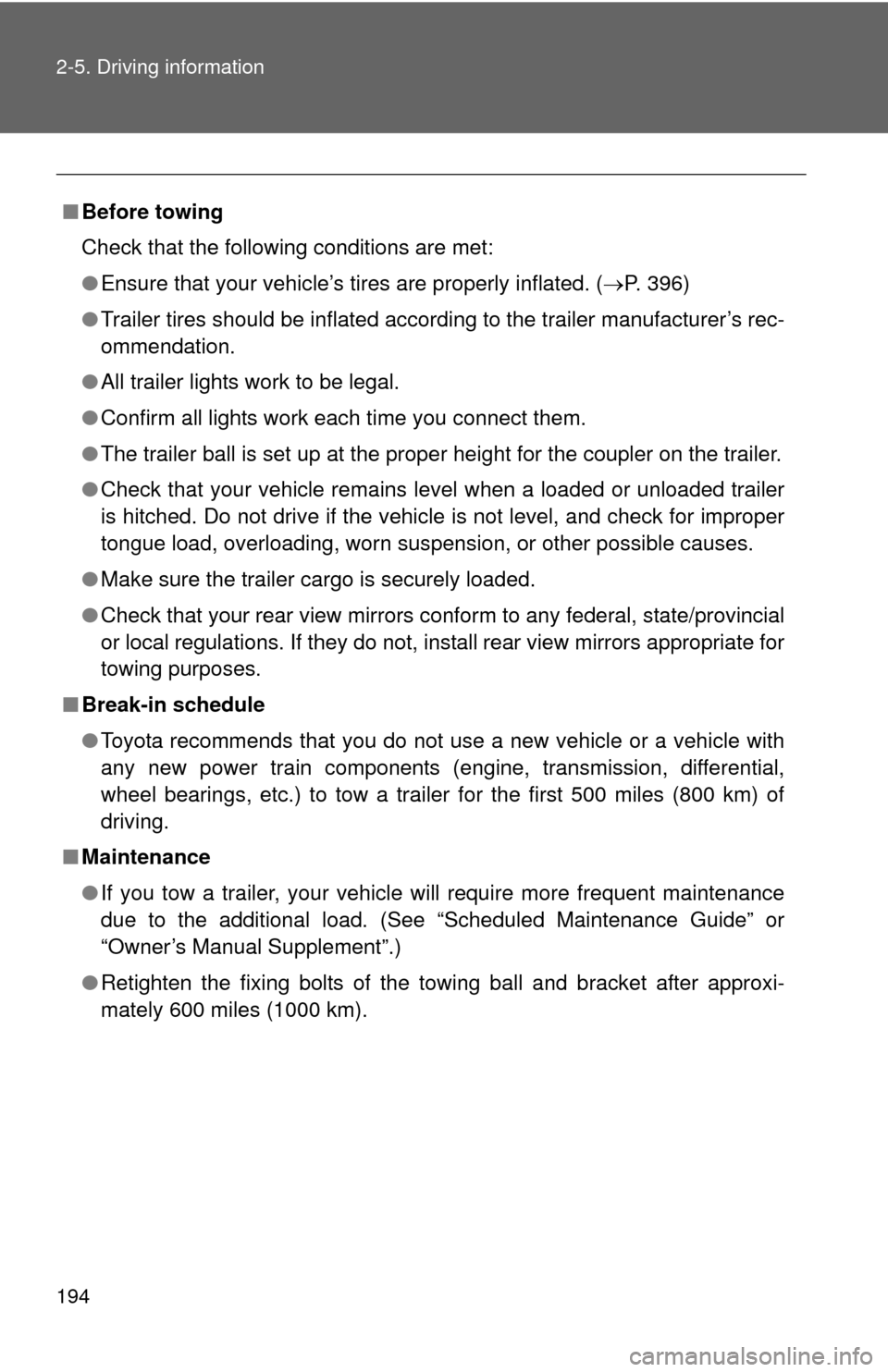
■Before towing
Check that the following conditions are met:
●Ensure that your vehicle’s tires are properly inflated. (P. 396)
●Trailer tires should be inflated according to the trailer manufacturer’s rec-
ommendation.
●All trailer lights work to be legal.
●Confirm all lights work each time you connect them.
●The trailer ball is set up at the proper height for the coupler on the trailer.
●Check that your vehicle remains level when a loaded or unloaded trailer
is hitched. Do not drive if the vehicle is not level, and check for improper
tongue load, overloading, worn suspension, or other possible causes.
●Make sure the trailer cargo is securely loaded.
●Check that your rear view mirrors conform to any federal, state/provincial
or local regulations. If they do not, install rear view mirrors appropriate for
towing purposes.
■Break-in schedule
●Toyota recommends that you do not use a new vehicle or a vehicle with
any new power train components (engine, transmission, differential,
wheel bearings, etc.) to tow a trailer for the first 500 miles (800 km) of
driving.
■Maintenance
●If you tow a trailer, your vehicle will require more frequent maintenance
due to the additional load. (See “Scheduled Maintenance Guide” or
“Owner’s Manual Supplement”.)
●Retighten the fixing bolts of the towing ball and bracket after approxi-
mately 600 miles (1000 km).
Page 277 of 439
Maintenance and care4
277
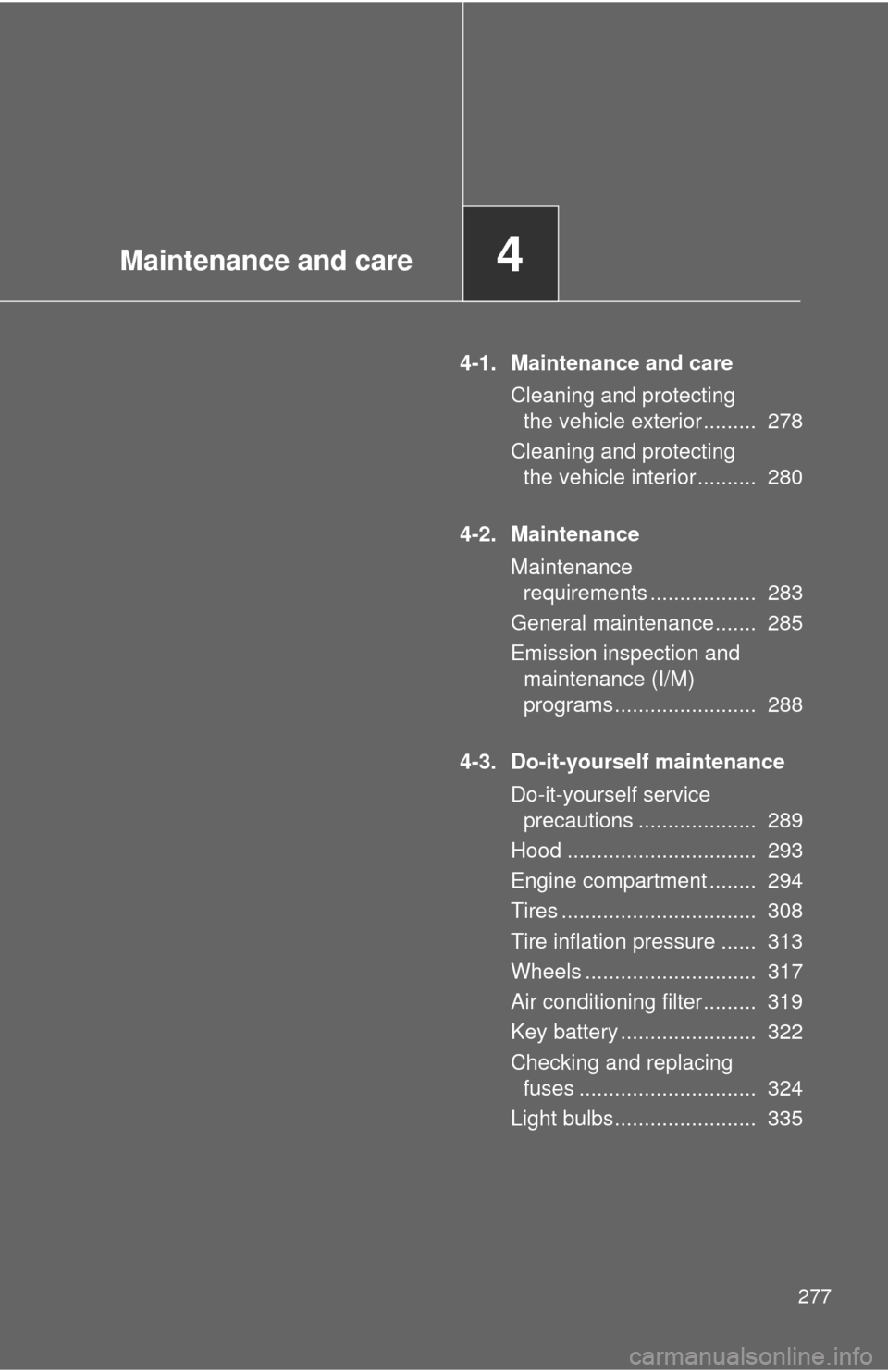
4-1. Maintenance and care
Cleaning and protecting
the vehicle exterior ......... 278
Cleaning and protecting
the vehicle interior .......... 280
4-2. Maintenance
Maintenance
requirements .................. 283
General maintenance....... 285
Emission inspection and
maintenance (I/M)
programs........................ 288
4-3. Do-it-yourself maintenance
Do-it-yourself service
precautions .................... 289
Hood ................................ 293
Engine compartment ........ 294
Tires ................................. 308
Tire inflation pressure ...... 313
Wheels ............................. 317
Air conditioning filter......... 319
Key battery ....................... 322
Checking and replacing
fuses .............................. 324
Light bulbs........................ 335
Page 288 of 439
288 4-2. Maintenance
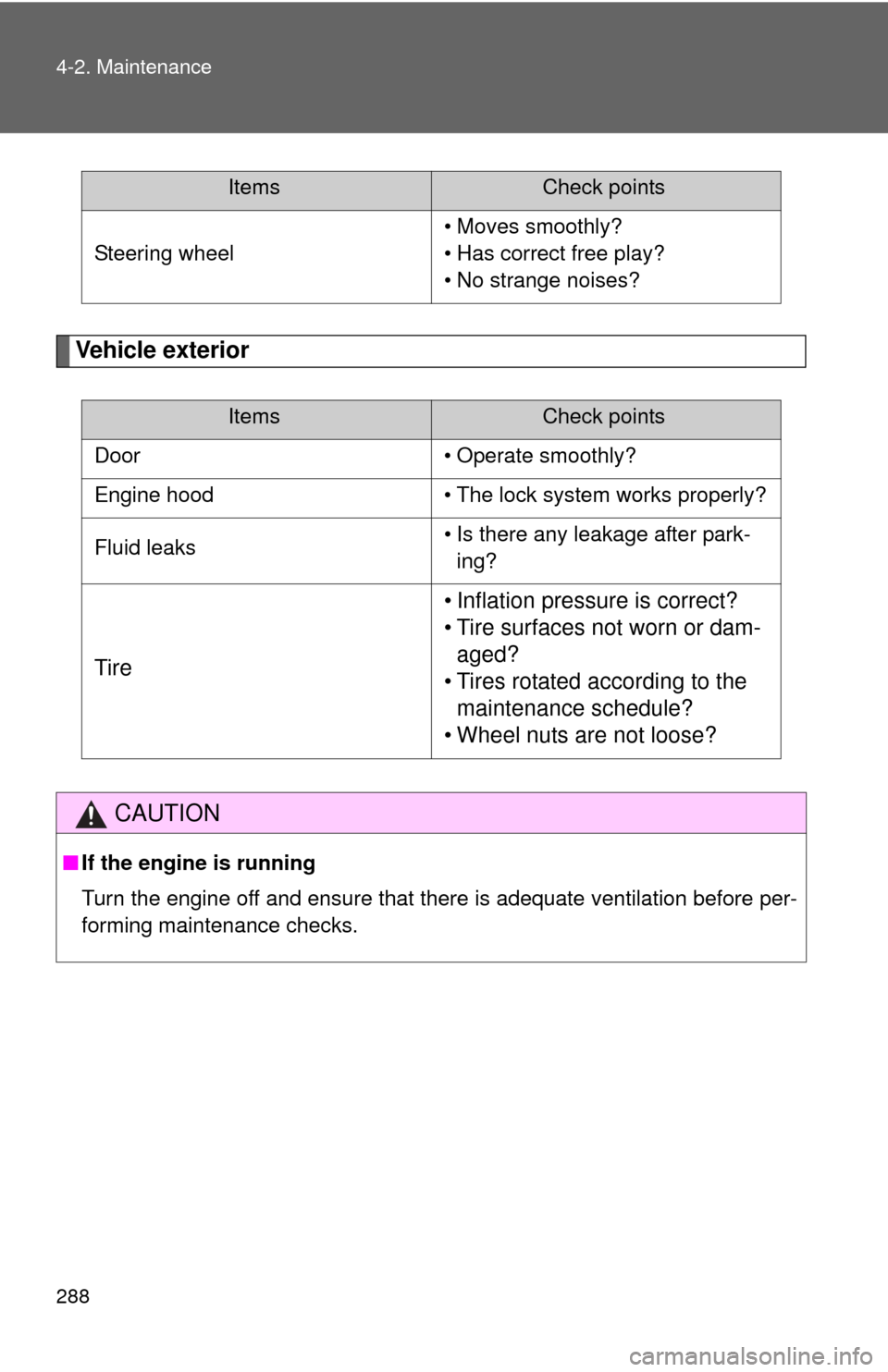
Vehicle exterior
Steering wheel• Moves smoothly?
• Has correct free play?
• No strange noises?
ItemsCheck points
Door • Operate smoothly?
Engine hood • The lock system works properly?
Fluid leaks• Is there any leakage after park-
ing?
Tire• Inflation pressure is correct?
• Tire surfaces not worn or dam-
aged?
• Tires rotated according to the
maintenance schedule?
• Wheel nuts are not loose?
CAUTION
■If the engine is running
Turn the engine off and ensure that there is adequate ventilation before per-
forming maintenance checks.
ItemsCheck points
Page 291 of 439
290 4-3. Do-it-yourself maintenance
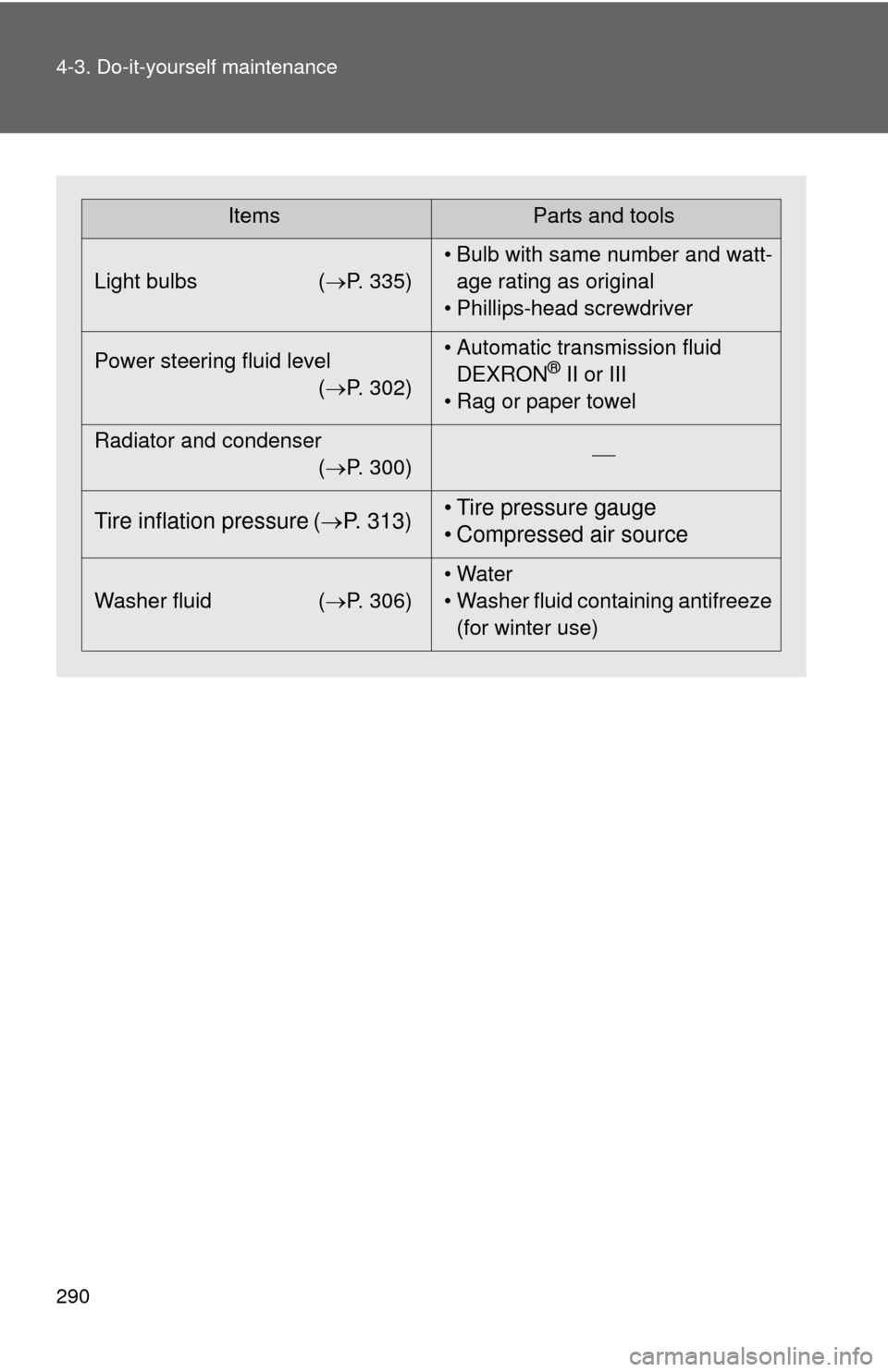
ItemsParts and tools
Light bulbs (P. 335)• Bulb with same number and watt-
age rating as original
• Phillips-head screwdriver
Power steering fluid level
(P. 302)• Automatic transmission fluid
DEXRON
® II or III
• Rag or paper towel
Radiator and condenser
(P. 300)
Tire inflation pressure (P. 313)• Tire pressure gauge
• Compressed air source
Washer fluid (P. 306)• Water
• Washer fluid containing antifreeze
(for winter use)