rear differential TOYOTA FJ CRUISER 2010 1.G Owners Manual
[x] Cancel search | Manufacturer: TOYOTA, Model Year: 2010, Model line: FJ CRUISER, Model: TOYOTA FJ CRUISER 2010 1.GPages: 439, PDF Size: 11.02 MB
Page 3 of 439
1
2
3
4
5
6
7
3
2-3. Operating the lights and
wipers
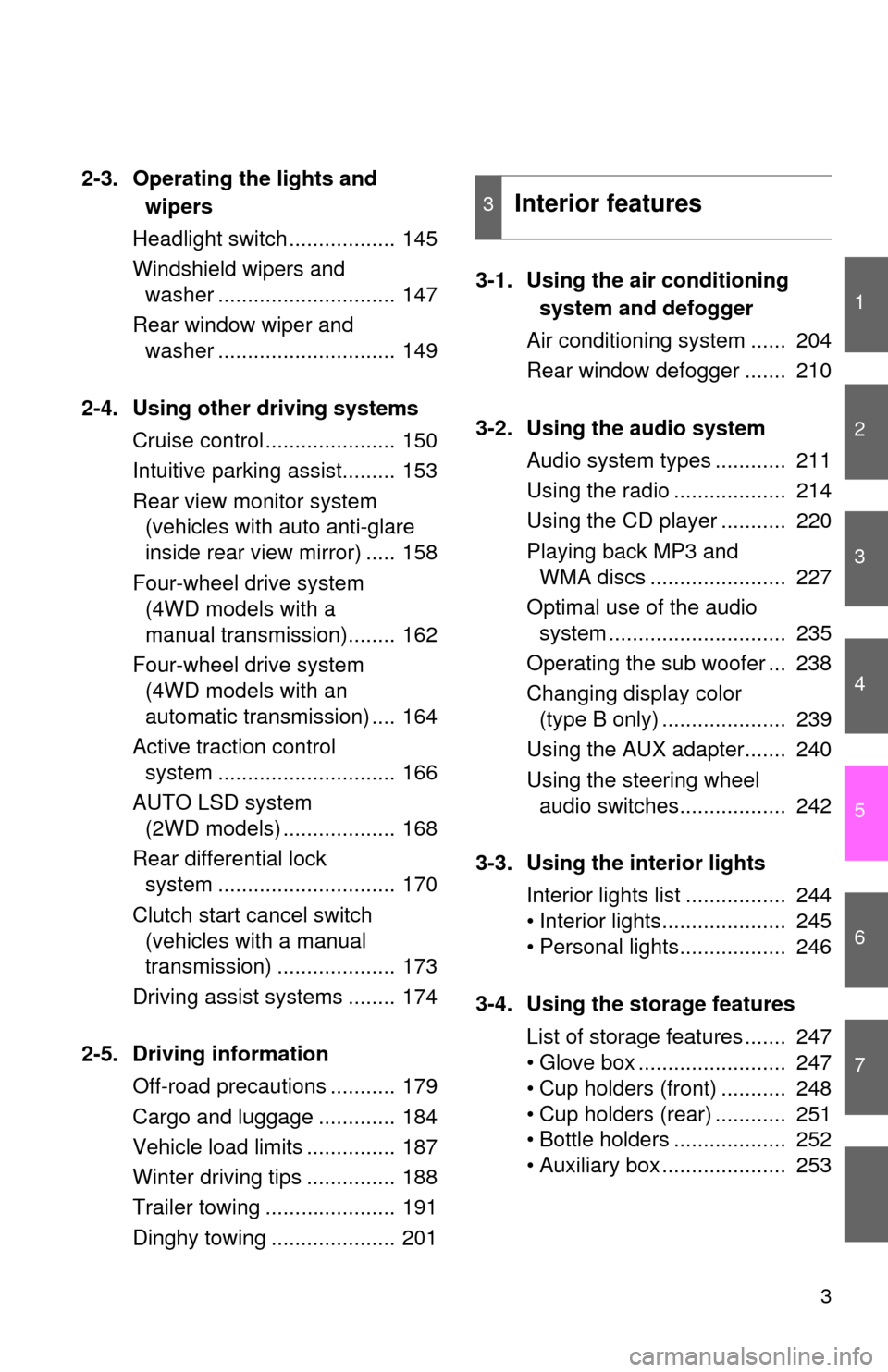
Headlight switch .................. 145
Windshield wipers and
washer .............................. 147
Rear window wiper and
washer .............................. 149
2-4. Using other driving systems
Cruise control ...................... 150
Intuitive parking assist......... 153
Rear view monitor system
(vehicles with auto anti-glare
inside rear view mirror) ..... 158
Four-wheel drive system
(4WD models with a
manual transmission)........ 162
Four-wheel drive system
(4WD models with an
automatic transmission) .... 164
Active traction control
system .............................. 166
AUTO LSD system
(2WD models) ................... 168
Rear differential lock
system .............................. 170
Clutch start cancel switch
(vehicles with a manual
transmission) .................... 173
Driving assist systems ........ 174
2-5. Driving information
Off-road precautions ........... 179
Cargo and luggage ............. 184
Vehicle load limits ............... 187
Winter driving tips ............... 188
Trailer towing ...................... 191
Dinghy towing ..................... 2013-1. Using the air conditioning
system and defogger
Air conditioning system ...... 204
Rear window defogger ....... 210
3-2. Using the audio system
Audio system types ............ 211
Using the radio ................... 214
Using the CD player ........... 220
Playing back MP3 and
WMA discs ....................... 227
Optimal use of the audio
system .............................. 235
Operating the sub woofer ... 238
Changing display color
(type B only) ..................... 239
Using the AUX adapter....... 240
Using the steering wheel
audio switches.................. 242
3-3. Using the interior lights
Interior lights list ................. 244
• Interior lights..................... 245
• Personal lights.................. 246
3-4. Using the storage features
List of storage features ....... 247
• Glove box ......................... 247
• Cup holders (front) ........... 248
• Cup holders (rear) ............ 251
• Bottle holders ................... 252
• Auxiliary box ..................... 253
3Interior features
Page 115 of 439
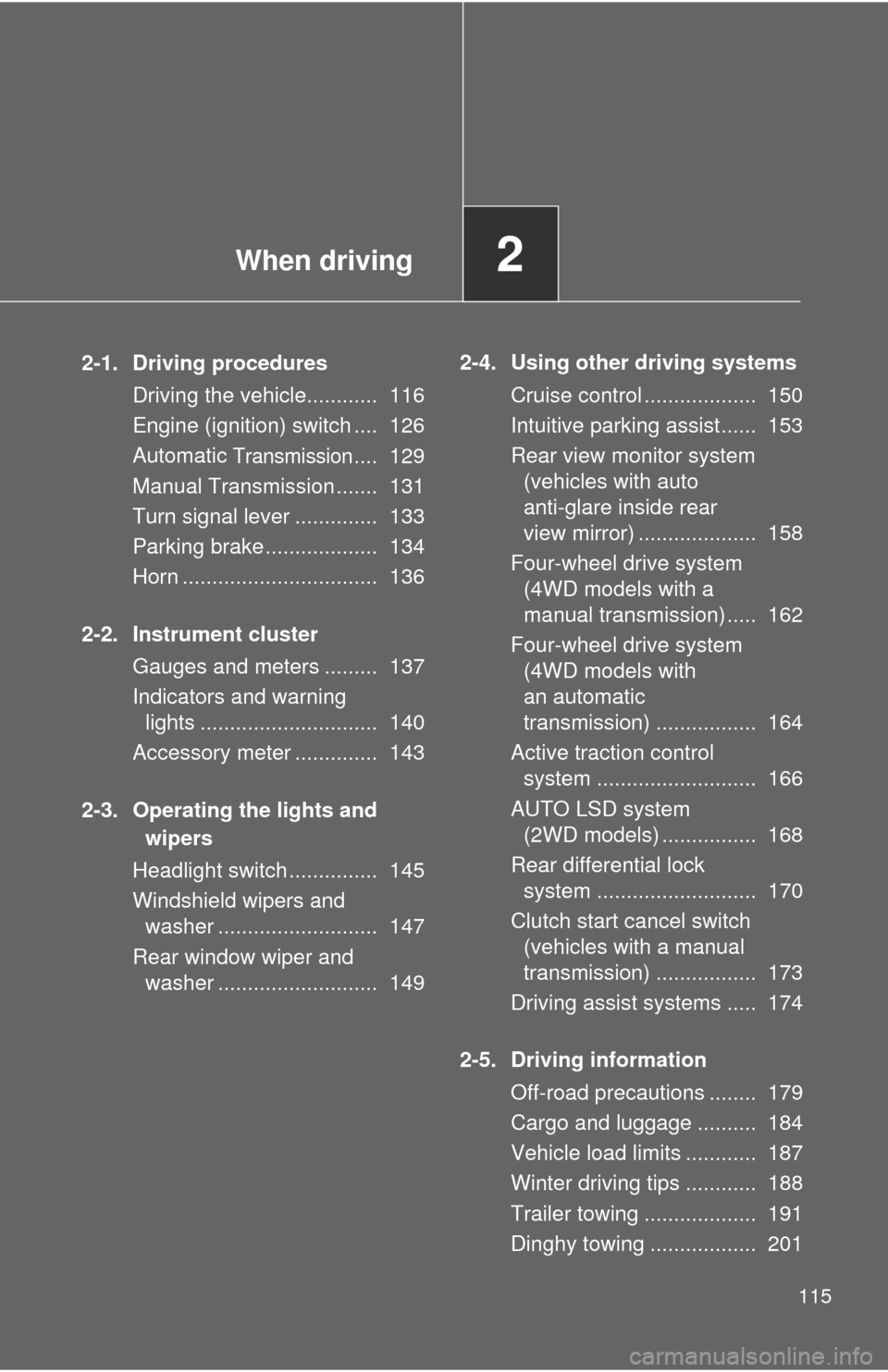
When driving2
115
2-1. Driving procedures
Driving the vehicle............ 116
Engine (ignition) switch .... 126
Automatic
Transmission.... 129
Manual Transmission ....... 131
Turn signal lever .............. 133
Parking brake ................... 134
Horn ................................. 136
2-2. Instrument cluster
Gauges and meters ......... 137
Indicators and warning
lights .............................. 140
Accessory meter .............. 143
2-3. Operating the lights and
wipers
Headlight switch ............... 145
Windshield wipers and
washer ........................... 147
Rear window wiper and
washer ........................... 1492-4. Using other driving systems
Cruise control ................... 150
Intuitive parking assist...... 153
Rear view monitor system
(vehicles with auto
anti-glare inside rear
view mirror) .................... 158
Four-wheel drive system
(4WD models with a
manual transmission) ..... 162
Four-wheel drive system
(4WD models with
an automatic
transmission) ................. 164
Active traction control
system ........................... 166
AUTO LSD system
(2WD models) ................ 168
Rear differential lock
system ........................... 170
Clutch start cancel switch
(vehicles with a manual
transmission) ................. 173
Driving assist systems ..... 174
2-5. Driving information
Off-road precautions ........ 179
Cargo and luggage .......... 184
Vehicle load limits ............ 187
Winter driving tips ............ 188
Trailer towing ................... 191
Dinghy towing .................. 201
Page 141 of 439
141 2-2. Instrument cluster
2
When driving
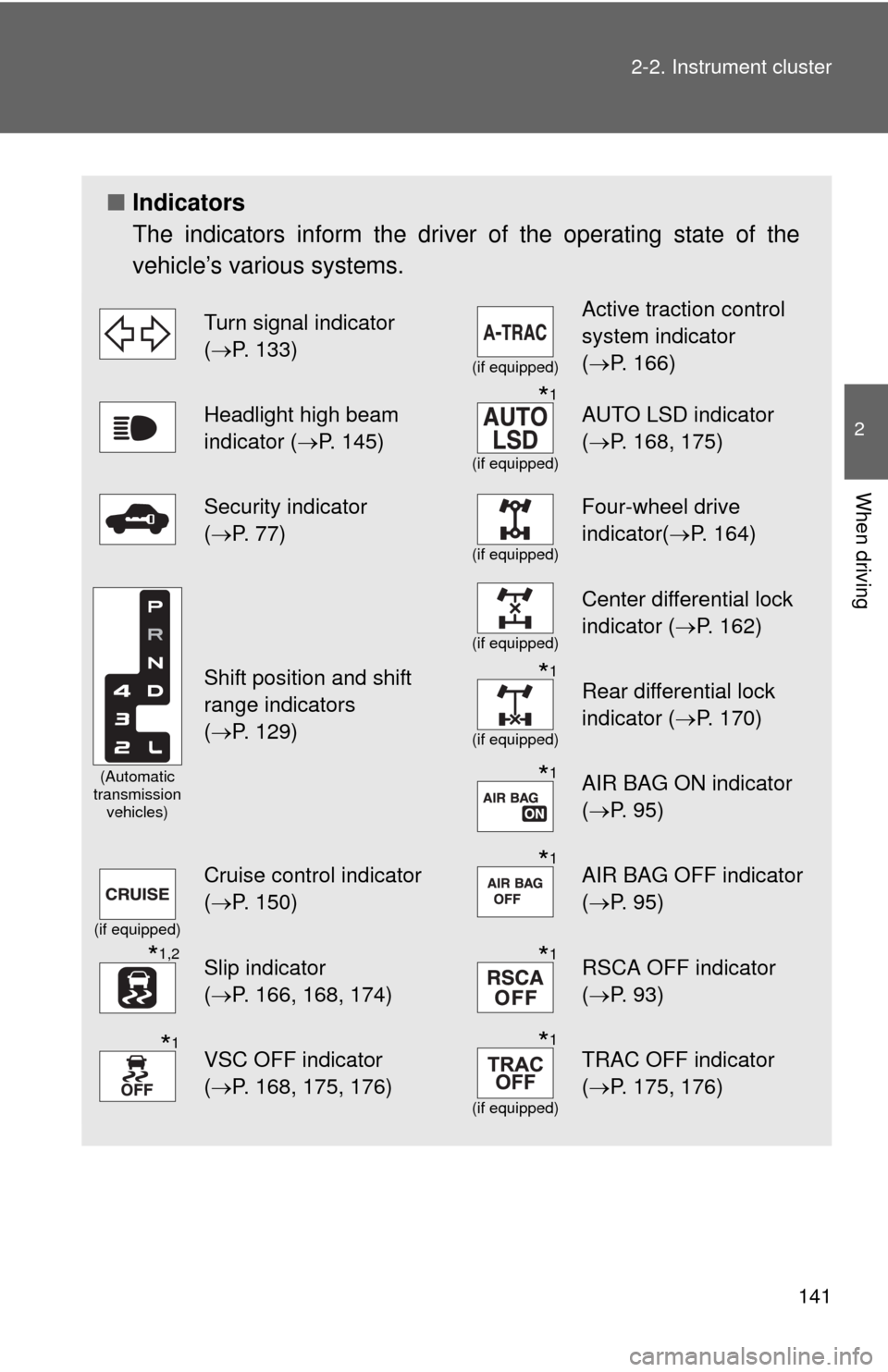
■Indicators
The indicators inform the driver of the operating state of the
vehicle’s various systems.
Turn signal indicator
(P. 133)
(if equipped)
Active traction control
system indicator
(P. 166)
Headlight high beam
indicator (P. 145)*1
(if equipped)
AUTO LSD indicator
(P. 168, 175)
Security indicator
(P. 77)
(if equipped)
Four-wheel drive
indicator(P. 164)
(Automatic
transmission
vehicles)
Shift position and shift
range indicators
(P. 129)
(if equipped)
Center differential lock
indicator (P. 162)
*1
(if equipped)
Rear differential lock
indicator (P. 170)
*1AIR BAG ON indicator
(P. 95)
(if equipped)
Cruise control indicator
(P. 150)*1AIR BAG OFF indicator
(P. 95)
*1,2Slip indicator
(P. 166, 168, 174)*1RSCA OFF indicator
(P. 93)
*1VSC OFF indicator
(P. 168, 175, 176)*1
(if equipped)
TRAC OFF indicator
(P. 175, 176)
Page 167 of 439
167 2-4. Using other driving systems
2
When driving
■When the rear differential is locked (vehicles with the rear differential
lock system)
The active traction control system is activated only when the vehicle speed
is less than 4 mph (6 km/h).
■Sounds and vibrations caused by the active traction control system
●A sound may be heard from the engine compartment when the engine is
started or just after the vehicle begins to move. This sound does not indi-
cate that a malfunction has occurred in the system.
●Vibrations may be felt through the vehicle body and steering. It may
occur when the system is operating.
■If the brake system overheats
The system will cease operation and a buzzer will sound to alert the driver.
Stop the vehicle in a safe place. (There is no problem with continuing normal
driving.)
CAUTION
■The active traction control system may not operate effectively when
Directional control and power may not be achievable while driving on slip-
pery road surfaces, even if the active traction control system is operating.
Do not drive the vehicle in conditions where stability and power may be lost.
Page 170 of 439
170
2-4. Using other driving systems
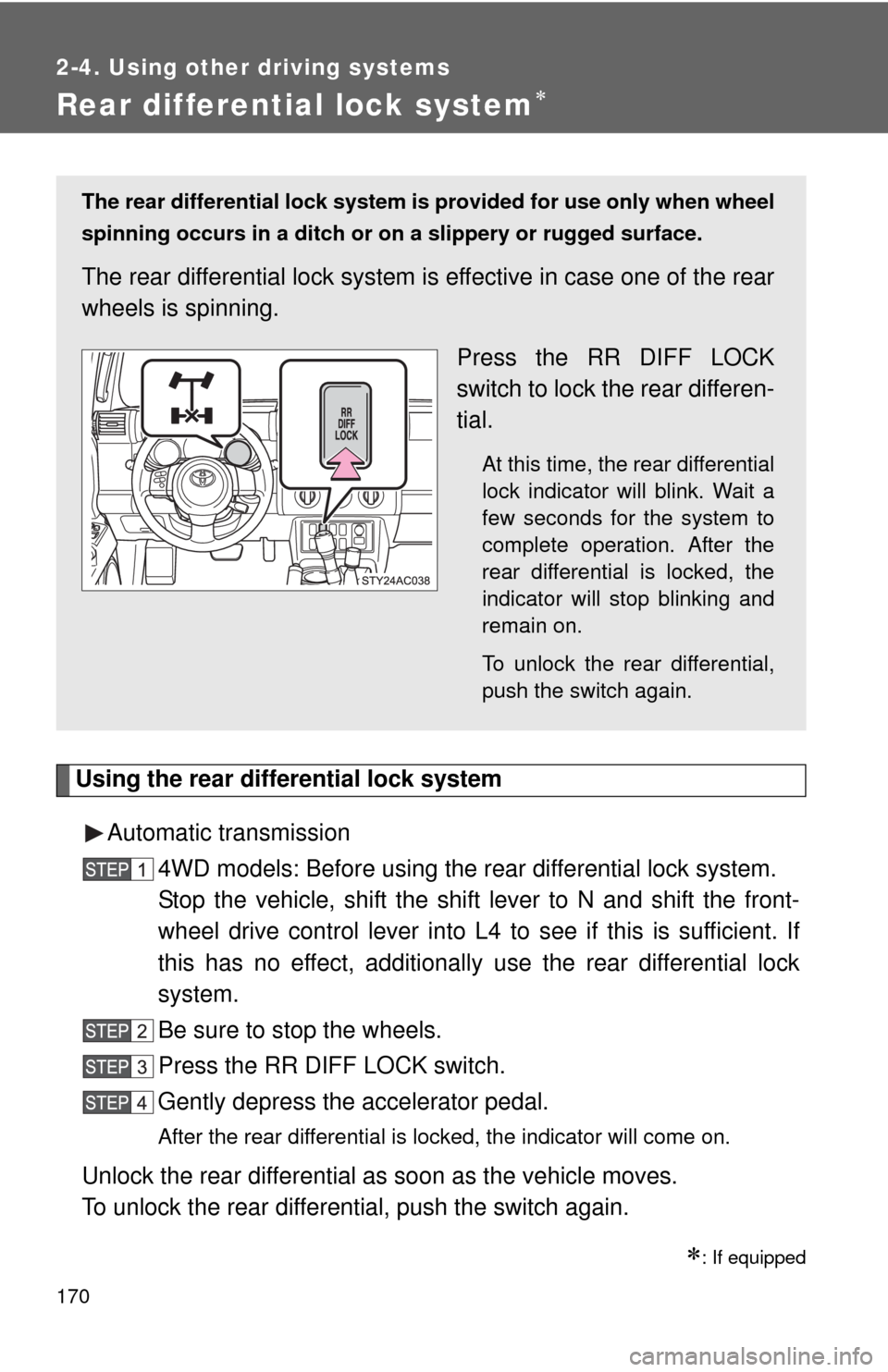
Rear differential lock system
Using the rear differential lock system
Automatic transmission
4WD models: Before using the rear differential lock system.
Stop the vehicle, shift the shift lever to N and shift the front-
wheel drive control lever into L4 to see if this is sufficient. If
this has no effect, additionally use the rear differential lock
system.
Be sure to stop the wheels.
Press the RR DIFF LOCK switch.
Gently depress the accelerator pedal.
After the rear differential is locked, the indicator will come on.
Unlock the rear differential as soon as the vehicle moves.
To unlock the rear differential, push the switch again.
: If equipped
The rear differential lock system is provided for use only when wheel
spinning occurs in a ditch or on a slippery or rugged surface.
The rear differential lock system is effective in case one of the rear
wheels is spinning.
Press the RR DIFF LOCK
switch to lock the rear differen-
tial.
At this time, the rear differential
lock indicator will blink. Wait a
few seconds for the system to
complete operation. After the
rear differential is locked, the
indicator will stop blinking and
remain on.
To unlock the rear differential,
push the switch again.
Page 171 of 439
171 2-4. Using other driving systems
2
When driving
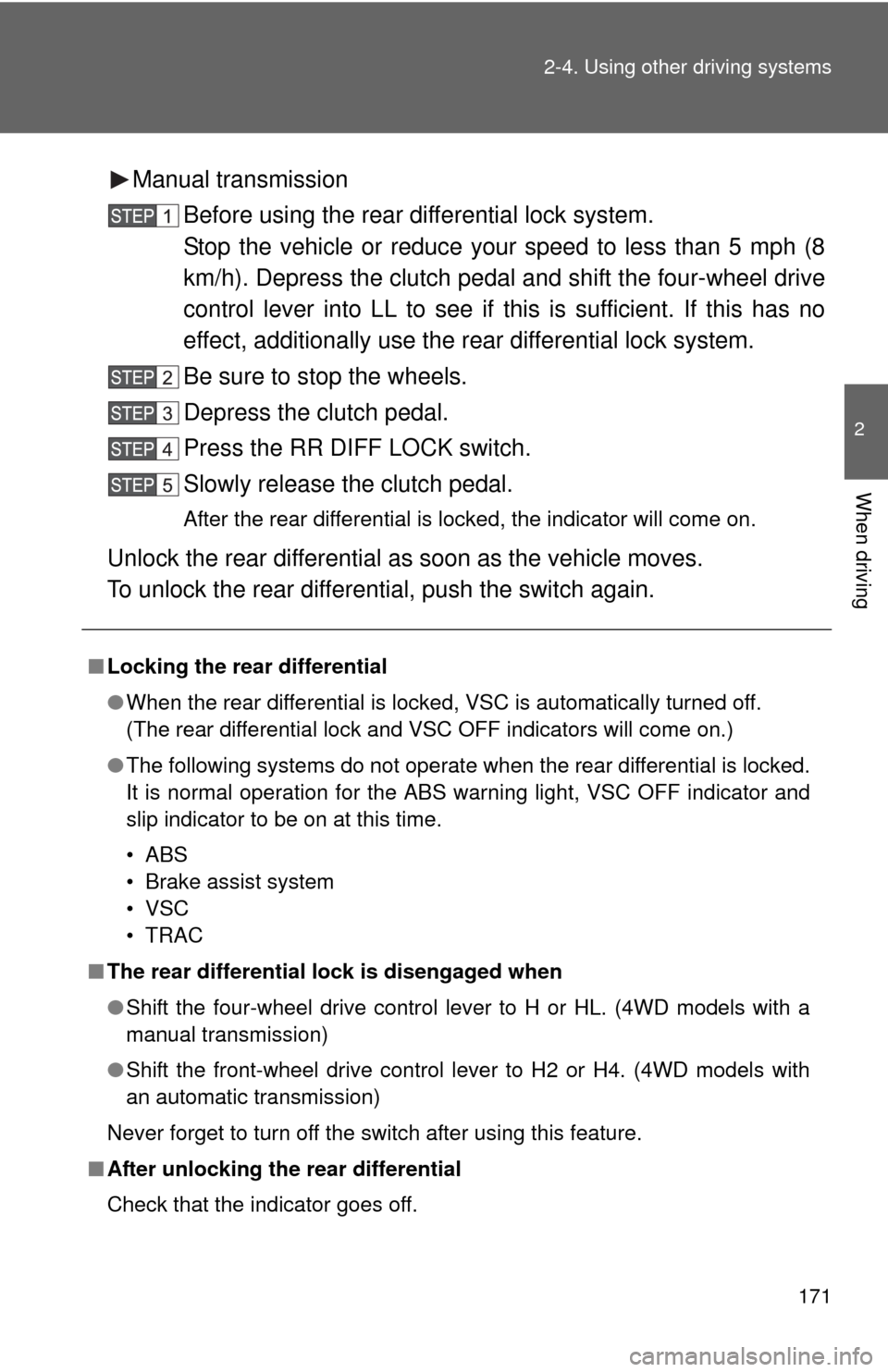
Manual transmission
Before using the rear differential lock system.
Stop the vehicle or reduce your speed to less than 5 mph (8
km/h). Depress the clutch pedal and shift the four-wheel drive
control lever into LL to see if this is sufficient. If this has no
effect, additionally use the rear differential lock system.
Be sure to stop the wheels.
Depress the clutch pedal.
Press the RR DIFF LOCK switch.
Slowly release the clutch pedal.
After the rear differential is locked, the indicator will come on.
Unlock the rear differential as soon as the vehicle moves.
To unlock the rear differential, push the switch again.
■Locking the rear differential
●When the rear differential is locked, VSC is automatically turned off.
(The rear differential lock and VSC OFF indicators will come on.)
●The following systems do not operate when the rear differential is locked.
It is normal operation for the ABS warning light, VSC OFF indicator and
slip indicator to be on at this time.
•ABS
• Brake assist system
•VSC
•TRAC
■The rear differential lock is disengaged when
●Shift the four-wheel drive control lever to H or HL. (4WD models with a
manual transmission)
●Shift the front-wheel drive control lever to H2 or H4. (4WD models with
an automatic transmission)
Never forget to turn off the switch after using this feature.
■After unlocking the rear differential
Check that the indicator goes off.
Page 172 of 439

172 2-4. Using other driving systems
CAUTION
■To avoid an accident
●Do not use the rear differential lock system except when wheel spinning
occurs in a ditch or on a slippery or ragged surface. Large steering effort
and careful cornering control will be required.
●Do not lock the rear differential until the wheels have stopped spinning.
Otherwise, the vehicle may move in an unexpected direction when the dif-
ferential lock is engaged, resulting in an accident. This may also lead to
possible damage to rear differential lock component parts.
●Do not drive over 5 mph (8 km/h) when the rear differential is locked.
●Do not keep driving with the RR DIFF LOCK switch on.
Page 194 of 439
194 2-5. Driving information
■Before towing
Check that the following conditions are met:
●Ensure that your vehicle’s tires are properly inflated. (P. 396)
●Trailer tires should be inflated according to the trailer manufacturer’s rec-
ommendation.
●All trailer lights work to be legal.
●Confirm all lights work each time you connect them.
●The trailer ball is set up at the proper height for the coupler on the trailer.
●Check that your vehicle remains level when a loaded or unloaded trailer
is hitched. Do not drive if the vehicle is not level, and check for improper
tongue load, overloading, worn suspension, or other possible causes.
●Make sure the trailer cargo is securely loaded.
●Check that your rear view mirrors conform to any federal, state/provincial
or local regulations. If they do not, install rear view mirrors appropriate for
towing purposes.
■Break-in schedule
●Toyota recommends that you do not use a new vehicle or a vehicle with
any new power train components (engine, transmission, differential,
wheel bearings, etc.) to tow a trailer for the first 500 miles (800 km) of
driving.
■Maintenance
●If you tow a trailer, your vehicle will require more frequent maintenance
due to the additional load. (See “Scheduled Maintenance Guide” or
“Owner’s Manual Supplement”.)
●Retighten the fixing bolts of the towing ball and bracket after approxi-
mately 600 miles (1000 km).
Page 334 of 439
333 4-3. Do-it-yourself maintenance
4
Maintenance and care
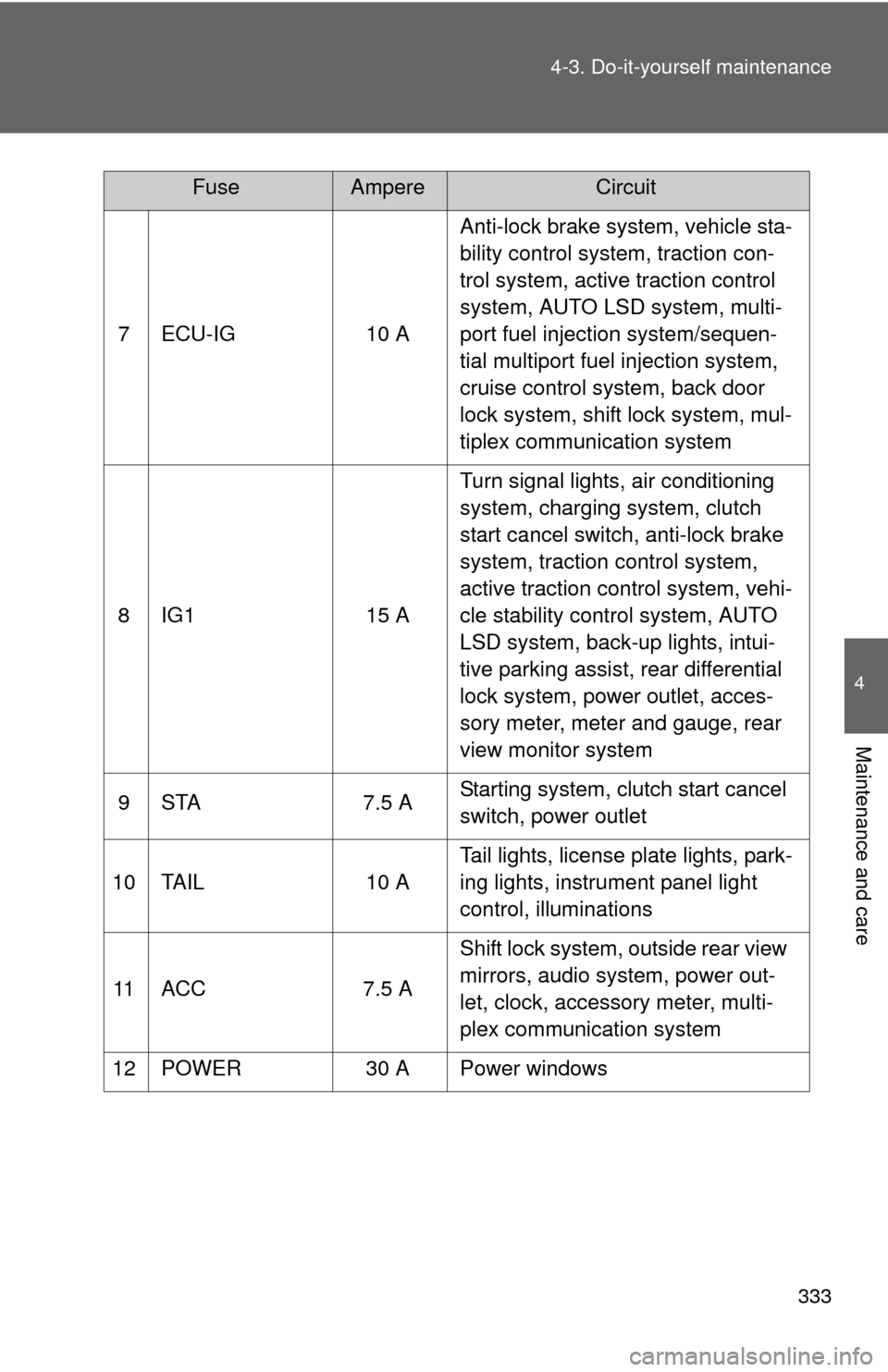
7 ECU-IG 10 AAnti-lock brake system, vehicle sta-
bility control system, traction con-
trol system, active traction control
system, AUTO LSD system, multi-
port fuel injection system/sequen-
tial multiport fuel injection system,
cruise control system, back door
lock system, shift lock system, mul-
tiplex communication system
8 IG1 15 ATurn signal lights, air conditioning
system, charging system, clutch
start cancel switch, anti-lock brake
system, traction control system,
active traction control system, vehi-
cle stability control system, AUTO
LSD system, back-up lights, intui-
tive parking assist, rear differential
lock system, power outlet, acces-
sory meter, meter and gauge, rear
view monitor system
9 STA 7.5 AStarting system, clutch start cancel
switch, power outlet
10 TAIL 10 ATail lights, license plate lights, park-
ing lights, instrument panel light
control, illuminations
11 A C C 7 . 5 AShift lock system, outside rear view
mirrors, audio system, power out-
let, clock, accessory meter, multi-
plex communication system
12 POWER 30 A Power windows
FuseAmpereCircuit
Page 396 of 439
393 6-1. Specifications
6
Vehicle specifications
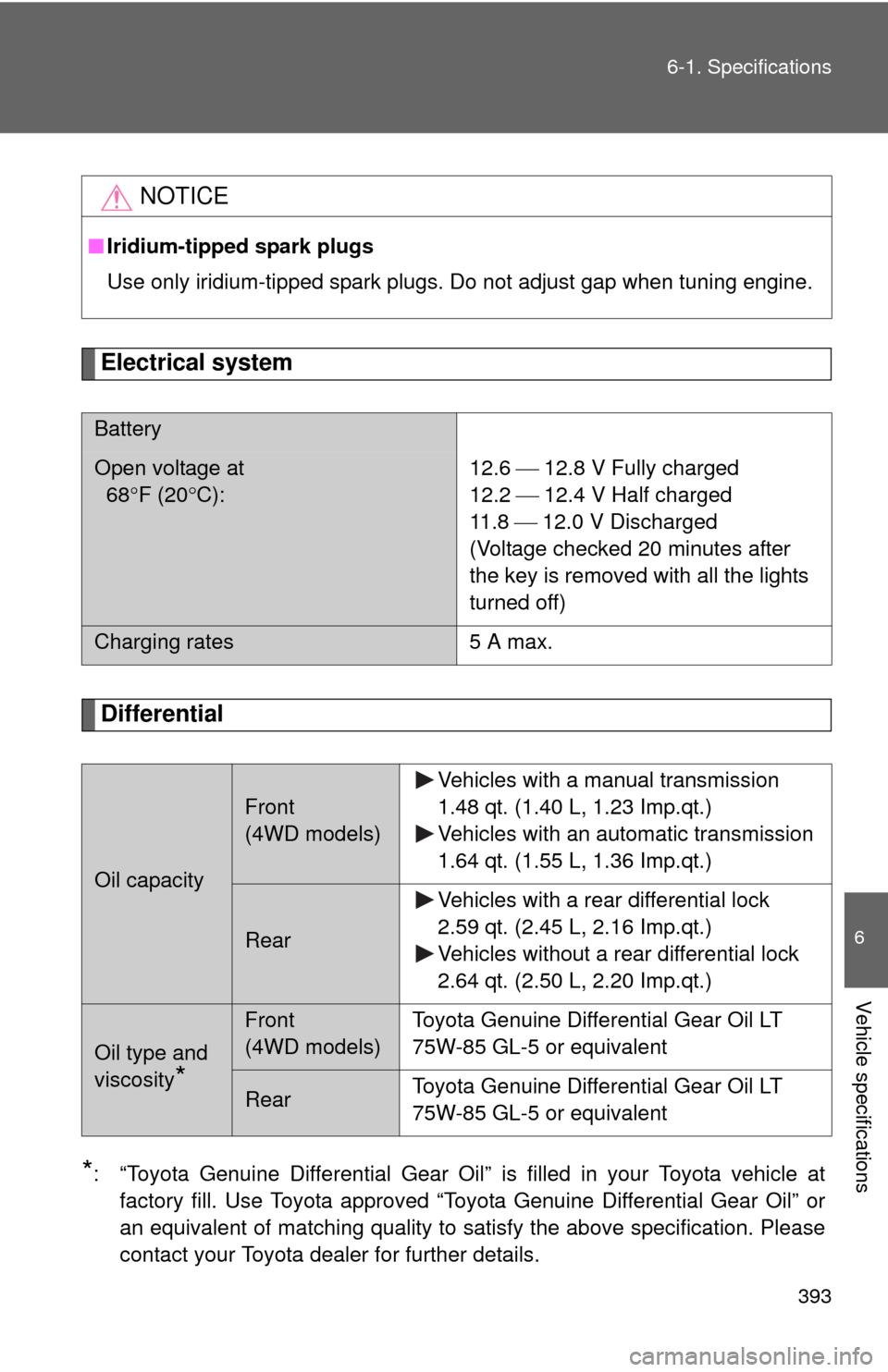
Electrical system
Differential
*: “Toyota Genuine Differential Gear Oil” is filled in your Toyota vehicle at
factory fill. Use Toyota approved “Toyota Genuine Differential Gear Oil” or
an equivalent of matching quality to satisfy the above specification. Please
contact your Toyota dealer for further details.
NOTICE
■Iridium-tipped spark plugs
Use only iridium-tipped spark plugs. Do not adjust gap when tuning engine.
Battery
Open voltage at
68F (20C):12.6 12.8 V Fully charged
12.2 12.4 V Half charged
11 . 8 12.0 V Discharged
(Voltage checked 20 minutes after
the key is removed with all the lights
turned off)
Charging rates 5 A max.
Oil capacity
Front
(4WD models)Vehicles with a manual transmission
1.48 qt. (1.40 L, 1.23 Imp.qt.)
Vehicles with an automatic transmission
1.64 qt. (1.55 L, 1.36 Imp.qt.)
RearVehicles with a rear differential lock
2.59 qt. (2.45 L, 2.16 Imp.qt.)
Vehicles without a rear differential lock
2.64 qt. (2.50 L, 2.20 Imp.qt.)
Oil type and
viscosity
*
Front
(4WD models)Toyota Genuine Differential Gear Oil LT
75W-85 GL-5 or equivalent
RearToyota Genuine Differential Gear Oil LT
75W-85 GL-5 or equivalent