tire pressure TOYOTA FJ CRUISER 2010 1.G Owners Manual
[x] Cancel search | Manufacturer: TOYOTA, Model Year: 2010, Model line: FJ CRUISER, Model: TOYOTA FJ CRUISER 2010 1.GPages: 439, PDF Size: 11.02 MB
Page 4 of 439
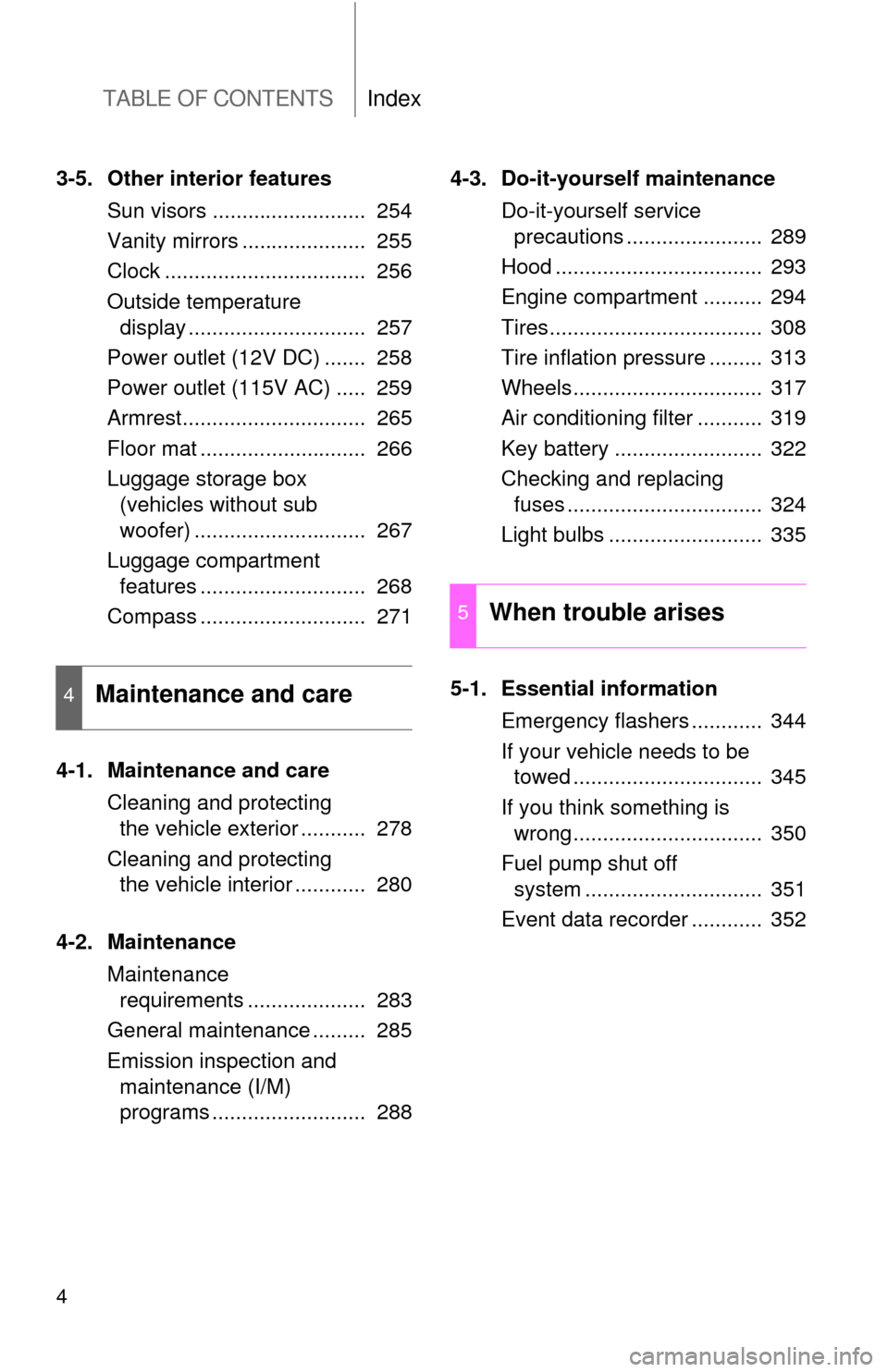
TABLE OF CONTENTSIndex
4
3-5. Other interior features
Sun visors .......................... 254
Vanity mirrors ..................... 255
Clock .................................. 256
Outside temperature
display .............................. 257
Power outlet (12V DC) ....... 258
Power outlet (115V AC) ..... 259
Armrest............................... 265
Floor mat ............................ 266
Luggage storage box
(vehicles without sub
woofer) ............................. 267
Luggage compartment
features ............................ 268
Compass ............................ 271
4-1. Maintenance and care
Cleaning and protecting
the vehicle exterior ........... 278
Cleaning and protecting
the vehicle interior ............ 280
4-2. Maintenance
Maintenance
requirements .................... 283
General maintenance ......... 285
Emission inspection and
maintenance (I/M)
programs .......................... 2884-3. Do-it-yourself maintenance
Do-it-yourself service
precautions ....................... 289
Hood ................................... 293
Engine compartment .......... 294
Tires.................................... 308
Tire inflation pressure ......... 313
Wheels................................ 317
Air conditioning filter ........... 319
Key battery ......................... 322
Checking and replacing
fuses ................................. 324
Light bulbs .......................... 335
5-1. Essential information
Emergency flashers ............ 344
If your vehicle needs to be
towed ................................ 345
If you think something is
wrong ................................ 350
Fuel pump shut off
system .............................. 351
Event data recorder ............ 352
4Maintenance and care
5When trouble arises
Page 7 of 439

7
A
Tires
●Rotation
●Replacement
●Inflation pressure
●Information
P. 308
P. 364
P. 313
P. 401
Access doors P. 36
Fuel filler door P. 73
Rear turn signal lights P. 133
Stop/tail and rear side
marker lights
P. 145
Side doors P. 33
: If equipped
Page 178 of 439

178 2-4. Using other driving systems
CAUTION
■When VSC is activated
The slip indicator flashes and a warning buzzer sounds. Always drive care-
fully. Reckless driving may cause an accident. Exercise particular care when
the indicator flashes and a buzzer sounds.
■TRAC may not operate effectively when
Directional control and power may not be achievable while driving on slip-
pery road surfaces, even if TRAC is operating.
Do not drive the vehicle in conditions where stability and power may be lost.
■Replacing tires
Make sure that all tires are of the same size, brand, tread pattern and total
load capacity. In addition, make sure that the tires are inflated to the appro-
priate tire pressure level.
The ABS and VSC will not function correctly if different tires are fitted on the
vehicle.
Contact your Toyota dealer for further information when replacing tires or
wheels.
■Handling of tires and suspension
Using tires with any kind of problem or modifying the suspension will affect
the driving assist systems, and may cause the system to malfunction.
Page 190 of 439
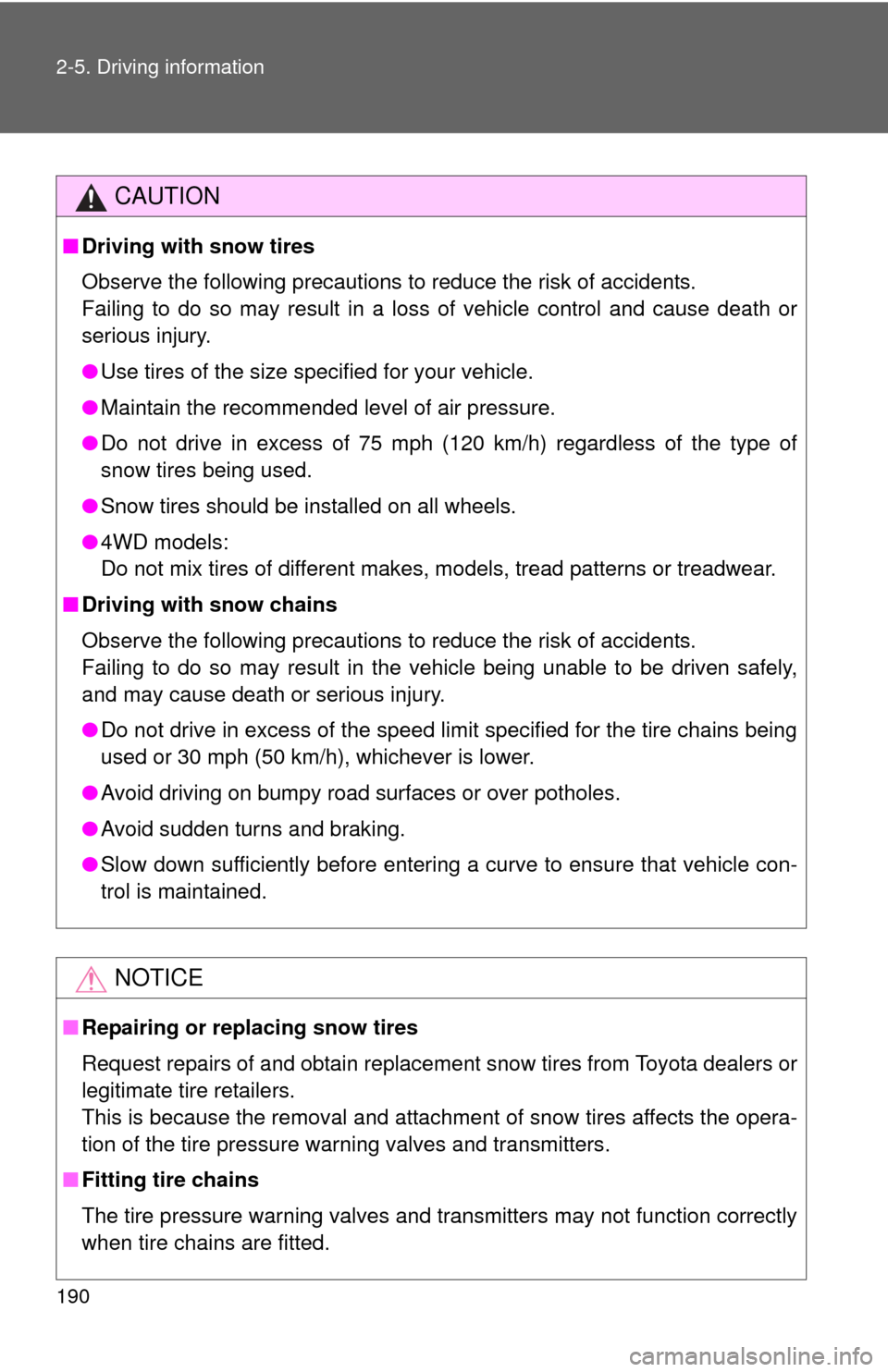
190 2-5. Driving information
CAUTION
■Driving with snow tires
Observe the following precautions to reduce the risk of accidents.
Failing to do so may result in a loss of vehicle control and cause death or
serious injury.
●Use tires of the size specified for your vehicle.
●Maintain the recommended level of air pressure.
●Do not drive in excess of 75 mph (120 km/h) regardless of the type of
snow tires being used.
●Snow tires should be installed on all wheels.
●4WD models:
Do not mix tires of different makes, models, tread patterns or treadwear.
■Driving with snow chains
Observe the following precautions to reduce the risk of accidents.
Failing to do so may result in the vehicle being unable to be driven safely,
and may cause death or serious injury.
●Do not drive in excess of the speed limit specified for the tire chains being
used or 30 mph (50 km/h), whichever is lower.
●Avoid driving on bumpy road surfaces or over potholes.
●Avoid sudden turns and braking.
●Slow down sufficiently before entering a curve to ensure that vehicle con-
trol is maintained.
NOTICE
■Repairing or replacing snow tires
Request repairs of and obtain replacement snow tires from Toyota dealers or
legitimate tire retailers.
This is because the removal and attachment of snow tires affects the opera-
tion of the tire pressure warning valves and transmitters.
■Fitting tire chains
The tire pressure warning valves and transmitters may not function correctly
when tire chains are fitted.
Page 277 of 439
Maintenance and care4
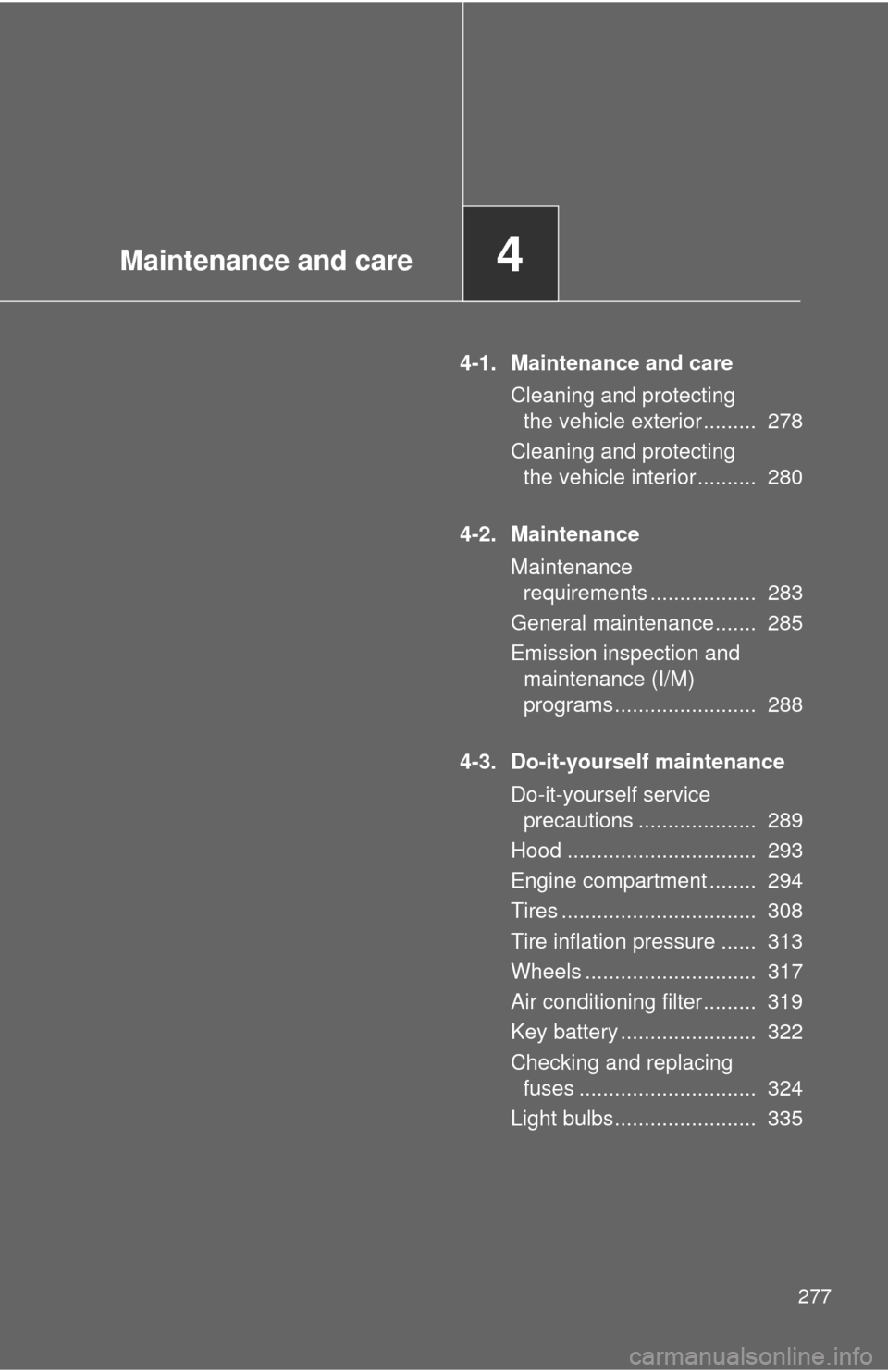
277
4-1. Maintenance and care
Cleaning and protecting
the vehicle exterior ......... 278
Cleaning and protecting
the vehicle interior .......... 280
4-2. Maintenance
Maintenance
requirements .................. 283
General maintenance....... 285
Emission inspection and
maintenance (I/M)
programs........................ 288
4-3. Do-it-yourself maintenance
Do-it-yourself service
precautions .................... 289
Hood ................................ 293
Engine compartment ........ 294
Tires ................................. 308
Tire inflation pressure ...... 313
Wheels ............................. 317
Air conditioning filter......... 319
Key battery ....................... 322
Checking and replacing
fuses .............................. 324
Light bulbs........................ 335
Page 288 of 439
288 4-2. Maintenance
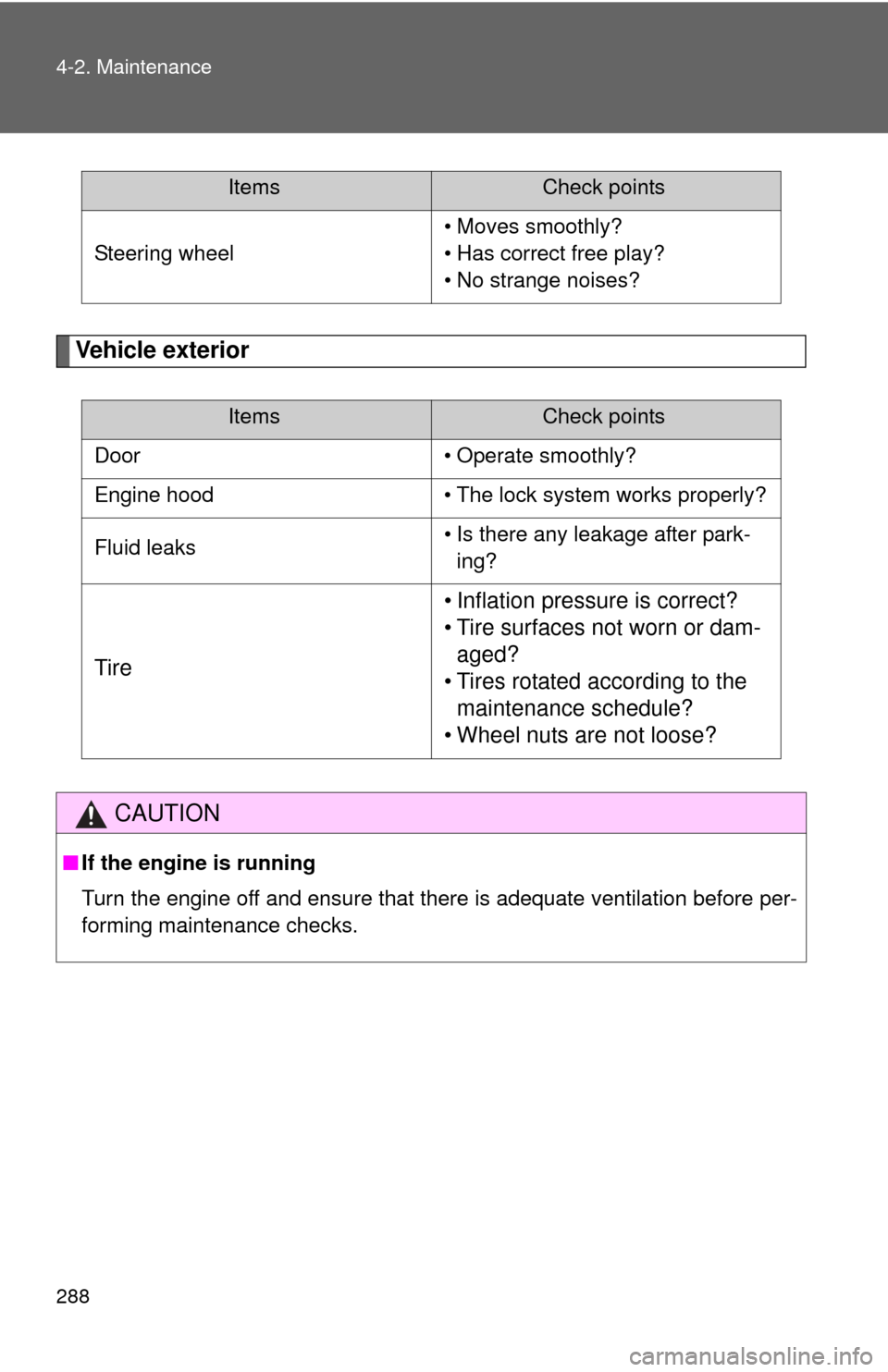
Vehicle exterior
Steering wheel• Moves smoothly?
• Has correct free play?
• No strange noises?
ItemsCheck points
Door • Operate smoothly?
Engine hood • The lock system works properly?
Fluid leaks• Is there any leakage after park-
ing?
Tire• Inflation pressure is correct?
• Tire surfaces not worn or dam-
aged?
• Tires rotated according to the
maintenance schedule?
• Wheel nuts are not loose?
CAUTION
■If the engine is running
Turn the engine off and ensure that there is adequate ventilation before per-
forming maintenance checks.
ItemsCheck points
Page 291 of 439
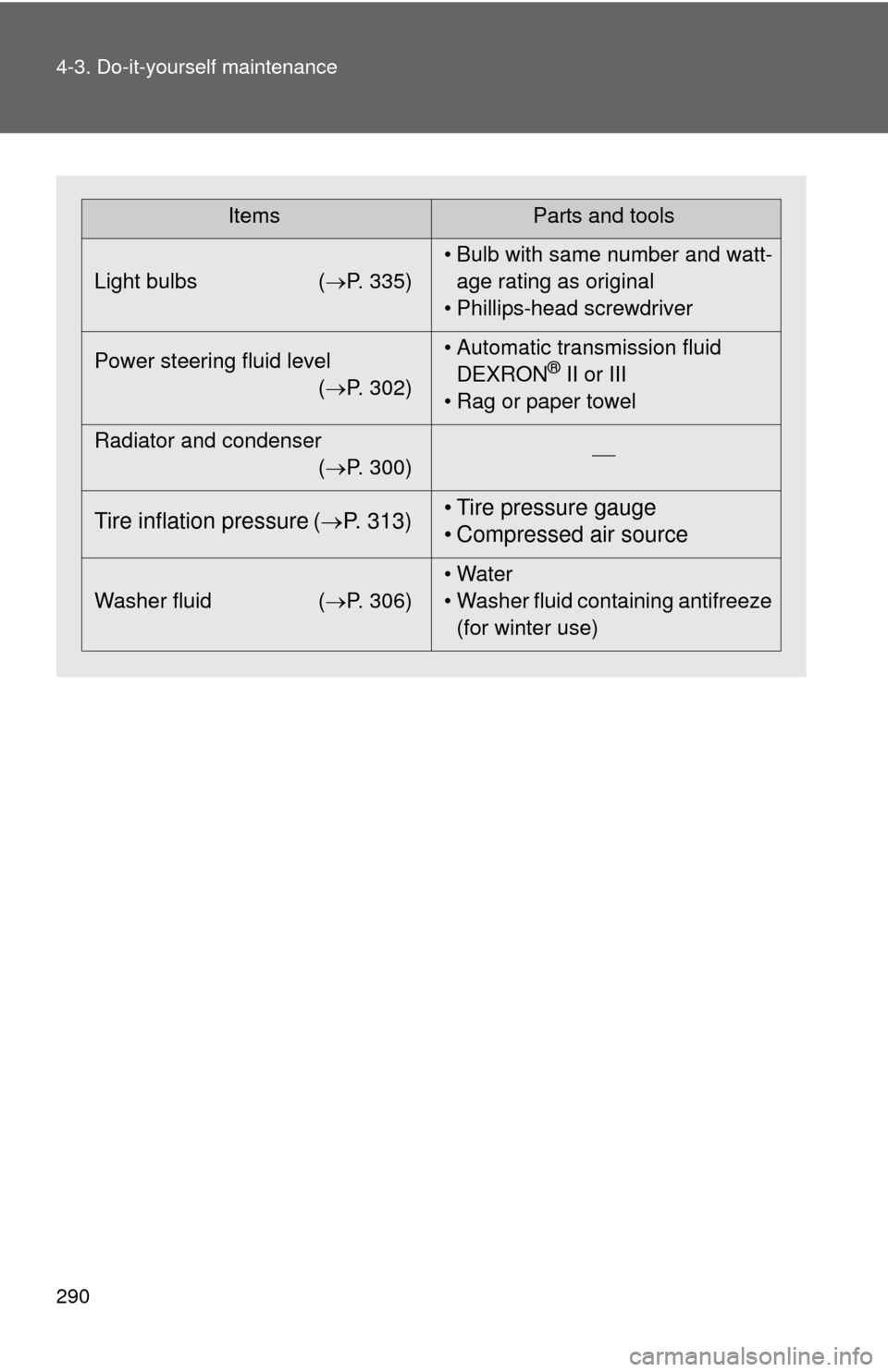
290 4-3. Do-it-yourself maintenance
ItemsParts and tools
Light bulbs (P. 335)• Bulb with same number and watt-
age rating as original
• Phillips-head screwdriver
Power steering fluid level
(P. 302)• Automatic transmission fluid
DEXRON
® II or III
• Rag or paper towel
Radiator and condenser
(P. 300)
Tire inflation pressure (P. 313)• Tire pressure gauge
• Compressed air source
Washer fluid (P. 306)• Water
• Washer fluid containing antifreeze
(for winter use)
Page 309 of 439

308
4-3. Do-it-yourself maintenance
Tires
Replace or rotate tires in accordance with maintenance sched-
ules and treadwear.
■Checking tires
New tread
Treadwear indicator
Worn tread
The location of treadwear
indicators is shown by the
“TWI” or “ ” marks, etc.,
molded on the sidewall of
each tire.
Check spare tire condition
and inflation pressure if not
rotated.
■Tire rotation
Rotate the tires in the order
shown.
To equalize tire wear and
extend tire life, Toyota recom-
mends that tire rotation is
carried out at the same inter-
val as tire inspection.
■The tire pressure warning system
Your Toyota is equipped with a tire pressure warning system that
uses tire pressure warning valves and transmitters to detect low
tire inflation pressure before serious problems arise. (P. 357)
213
Front
Page 310 of 439

309 4-3. Do-it-yourself maintenance
4
Maintenance and care
Installing tire pressure warning valves and transmitters
When replacing tires or wheels, tire pressure warning valves and
transmitters must also be installed.
When new tire pressure warning valves and transmitters are
installed, new tire pressure warning valve and transmitter ID codes
must be registered in the tire pressure warning computer and tire
pressure warning system must be initialized. Have tire pressure
warning valve and transmitter ID codes registered by your Toyota
dealer.
Registering ID codes
The tire pressure warning valve and transmitter is equipped with a
unique ID code. When replacing a tire pressure warning valve and
transmitter, it is necessary to register the ID code of tire pressure
warning valve and transmitter. Have the ID code registered by your
Toyota dealer.
■When to replace your vehicle's tires
Tires should be replaced if:
●You have tire damage such as cuts, splits, cracks deep enough to
expose the fabric or bulges indicating internal damage
●A tire goes flat repeatedly or cannot be properly repaired due to the
size or location of a cut or other damage
If you are not sure, consult with your Toyota dealer.
■Replacing tires and wheels
If the ID code of the tire pressure warning valve and transmitter is not
registered, the tire pressure warning system will not work properly. After
driving for about 20 minutes, the tire pressure warning light comes on
after blinking for 1 minute to indicate a system malfunction.
■Tire life
Any tire over 6 years old must be checked by a qualified technician even
if they have seldom or never been used or damage is not obvious.
Page 311 of 439

310 4-3. Do-it-yourself maintenance
■If the tread wears down below 0.16 in. (4 mm) on snow tires
The effectiveness of snow tires is lost.
■Maximum load of tire
Check that the number given by dividing the maximum load by 1.10 of
the replacement tire is greater than 1/2 of the Gross Axle Weight Ratings
(GAWR) of either the front axle or the rear axle, whichever is greater.
■Tire types
1 Summer tires
Summer tires are high-speed performance tires best suited to highway
driving under dry conditions. Since summer tires do not have the same
traction performance as snow tires, summer tires are inadequate for
driving on snow-covered or icy roads. For driving on snow-covered
roads or icy roads, the use of snow tires is recommended. When
installing snow tires, be sure to replace all four tires.
2 All season tires
All season tires are designed to provide better traction in snow and to
be adequate for driving in most winter conditions, as well as for use
year round. All season tires, however, do not have adequate traction
performance compared with snow tires in heavy or loose snow. Also,
all season tires fall short in acceleration and handling performance
compared with summer tires in highway driving.
3Snow tires
For driving on snow-covered roads or icy roads, we recommend using
snow tires. If you need snow tires, select tires of the same size, con-
struction and load capacity as the originally installed tires. Since your
vehicle has radial tires as original equipment, make sure your snow
tires also have radial construction. Do not install studded tires without
first checking local regulations for possible restriction. Snow tires
should be installed on all wheels. (P. 188)
For the GAWR, see the Certification
Label. For the maximum load of the
tire, see the load limit at maximum cold
tire inflation pressure mentioned on the
sidewall of the tire. (P. 401)