clutch TOYOTA FJ CRUISER 2011 1.G User Guide
[x] Cancel search | Manufacturer: TOYOTA, Model Year: 2011, Model line: FJ CRUISER, Model: TOYOTA FJ CRUISER 2011 1.GPages: 528, PDF Size: 10.93 MB
Page 162 of 528

162 2-4. Using other driving systems
■Shifting between H and HL
●You need not to depress the clutch pedal.
● If the center differential lock indicator does not come on when you shift
from H to HL, drive straight ahead while accelerating or decelerating.
● If the center differential lock indicator does not go off when you shift from
HL to H, drive straight ahead while accelerating or decelerating, or drive
in reverse.
■ Shifting from HL to LL
Stop the vehicle or reduce your speed to less than 5 mph (8 km/h).
Depress the clutch pedal and move the four-wheel drive control lever.
■ Shifting from LL to HL
Depress the clutch pedal and move the four-wheel drive control lever.
■ Shifting to LL
VSC is automatically turned off.
CAUTION
■Caution while driving
Avoid turning suddenly while the center differential is locked. If you do turn
suddenly, the difference in turning speeds between the front and rear wheels
may have a similar effect to braking, thus making driving difficult.
Page 167 of 528
167
2-4. Using other driving systems
2
When driving
Active traction control system
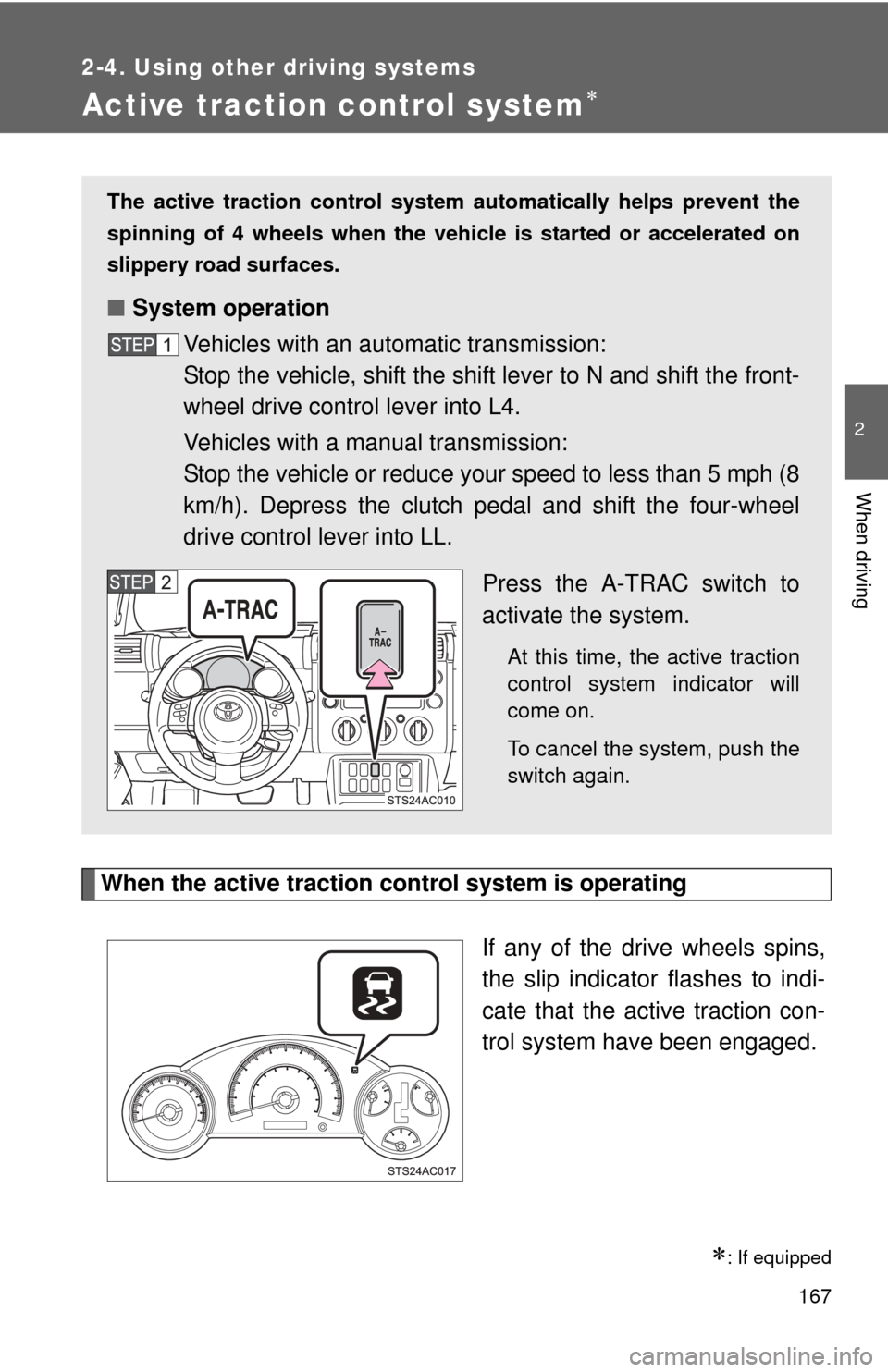
When the active traction control system is operatingIf any of the drive wheels spins,
the slip indicator flashes to indi-
cate that the active traction con-
trol system have been engaged.
: If equipped
The active traction control system automatically helps prevent the
spinning of 4 wheels when the vehicle is started or accelerated on
slippery road surfaces.
■ System operation
Vehicles with an automatic transmission:
Stop the vehicle, shift the shift lever to N and shift the front-
wheel drive control lever into L4.
Vehicles with a manual transmission:
Stop the vehicle or reduce your speed to less than 5 mph (8
km/h). Depress the clutch pedal and shift the four-wheel
drive control lever into LL.
Press the A-TRAC switch to
activate the system.
At this time, the active traction
control system indicator will
come on.
To cancel the system, push the
switch again.
Page 172 of 528
172 2-4. Using other driving systems
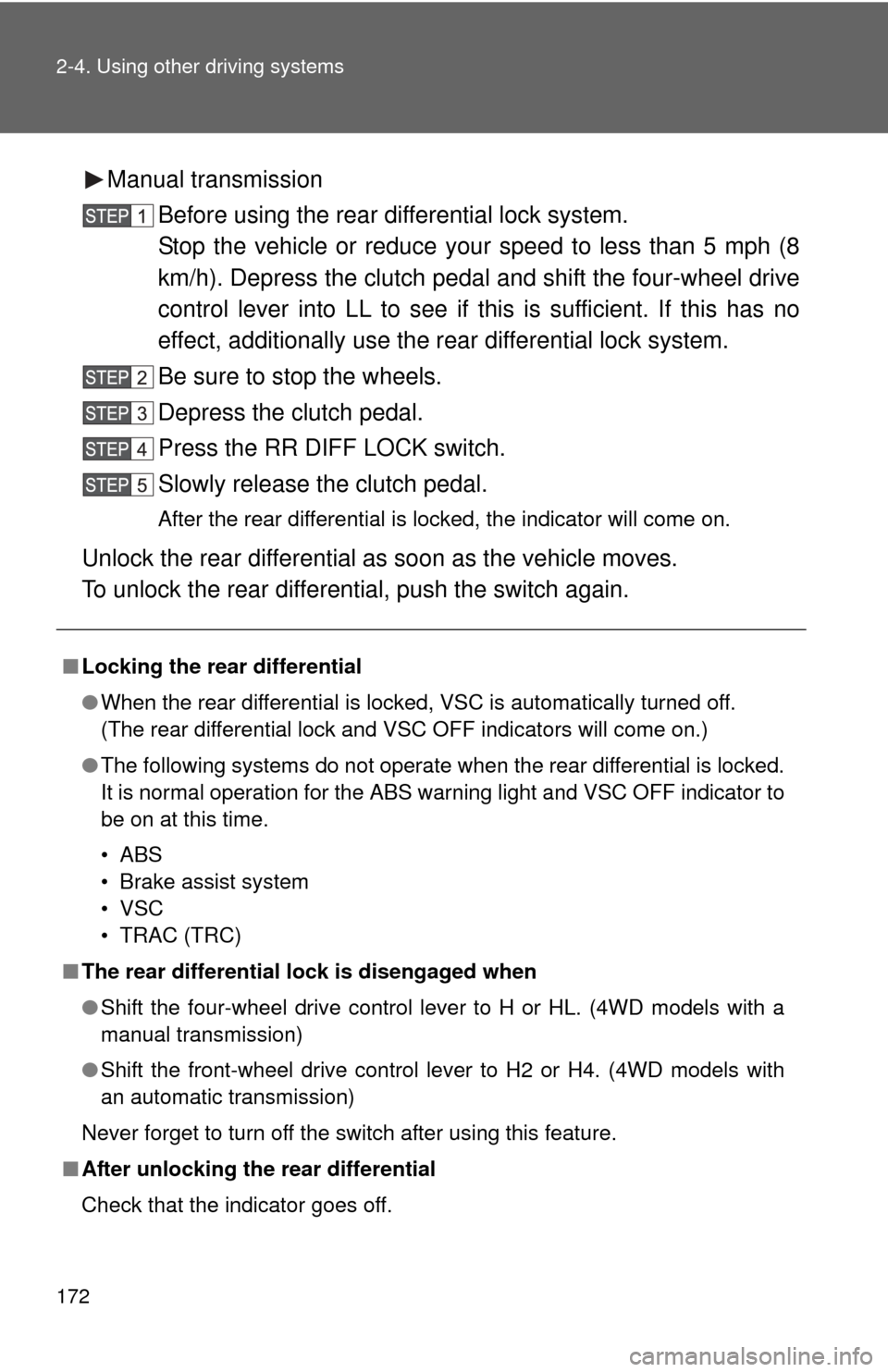
Manual transmissionBefore using the rear differential lock system.
Stop the vehicle or reduce your speed to less than 5 mph (8
km/h). Depress the clutch pedal and shift the four-wheel drive
control lever into LL to see if this is sufficient. If this has no
effect, additionally use the r ear differential lock system.
Be sure to stop the wheels.
Depress the clutch pedal.
Press the RR DIFF LOCK switch.
Slowly release the clutch pedal.
After the rear differential is locked, the indicator will come on.
Unlock the rear differential as soon as the vehicle moves.
To unlock the rear differential, push the switch again.
■ Locking the rear differential
●When the rear differential is locked, VSC is automatically turned off.
(The rear differential lock and VSC OFF indicators will come on.)
● The following systems do not operate when the rear differential is locked.
It is normal operation for the ABS warning light and VSC OFF indicator to
be on at this time.
•ABS
• Brake assist system
•VSC
• TRAC (TRC)
■ The rear differential lock is disengaged when
●Shift the four-wheel drive control lever to H or HL. (4WD models with a
manual transmission)
● Shift the front-wheel drive control lever to H2 or H4. (4WD models with
an automatic transmission)
Never forget to turn off the switch after using this feature.
■ After unlocking the rear differential
Check that the indicator goes off.
Page 174 of 528
174
2-4. Using other driving systems
Clutch star t cancel switch (vehicles with a manual transmission)
■Clutch start system
The system is designed to keep the starter motor from operating if the clutch
pedal is not depressed all the way down.
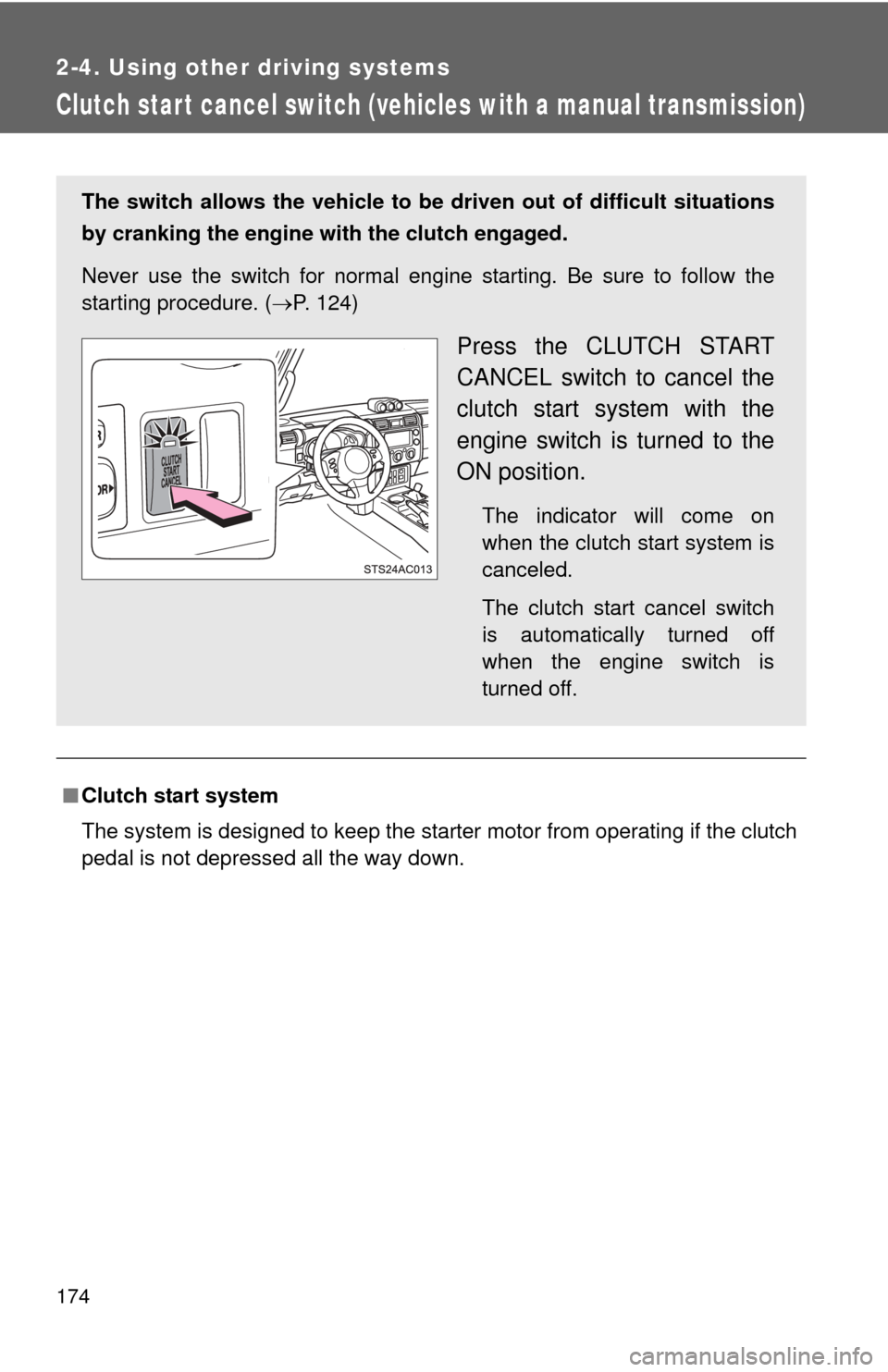
The switch allows the vehicle to be driven out of difficult situations
by cranking the engine with the clutch engaged.
Never use the switch for normal engine starting. Be sure to follow the
starting procedure. ( P. 124)
Press the CLUTCH START
CANCEL switch to cancel the
clutch start system with the
engine switch is turned to the
ON position.
The indicator will come on
when the clutch start system is
canceled.
The clutch start cancel switch
is automatically turned off
when the engine switch is
turned off.
Page 187 of 528

187
2-5. Driving information
2
When driving
CAUTION
■Things that must not be carried in the luggage compartment
The following things may cause a fire if loaded in the luggage compart-
ment.
●Receptacles containing gasoline
●Aerosol cans
■Storage precautions
Observe the following precautions.
Failing to do so may result in death or serious injury.
●Do not place cargo or luggage in or on the following locations as the
item may get under the clutch, brake or accelerator pedal and prevent
the pedals from being depressed properly, block the driver’s vision, or
hit the driver or passengers, causing an accident.
• Driver’s feet
• Front passenger or rear seats (when stacking items)
• Instrument panel
• Dashboard
• Auxiliary box or tray that has no lid
●Do not stack anything in the luggage compartment higher than the
seatbacks.
Such items may be thrown about and possibly injure people in the
vehicle during sudden braking or in an accident.
●Secure all items in the occupant compartment, as they may shift and
injure someone during sudden braking, sudden swerving or an acci-
dent.
●Never allow anyone to ride in the luggage compartment. It is not
designed for passengers. They should ride in their seats with their seat
belts properly fastened. Otherwise,
they are much more likely to suffer
death or serious injury, in the event of sudden braking, sudden swerv-
ing or an accident.
Page 201 of 528
201
2-5. Driving information
2
When driving
●
Always place wheel blocks under both the vehicle and the trailer
wheels when parking. Apply the parking brake firmly, and put the
transmission in P (automatic transmission) or in 1 or R (manual
transmission). Avoid parking on a slope, but if unavoidable, do so
only after performing the following:
Apply the brakes and keep them applied.
Have someone place wheel blocks under both the vehicle and
trailer wheels.
When the wheel blocks are in pl ace, release the brakes slowly
until the blocks absorb the load.
Apply the parking brake firmly.
Shift into 1 or R (manual transmission) or P (automatic trans-
mission) and turn off the engine.
● When restarting after parking on a slope:
With the transmission in P (automatic transmission) or the
clutch pedal (manual transmission) depressed, start the
engine. On vehicles with an au tomatic transmission, be sure
to keep the brake pedal pressed.
Shift into a forward gear. If reversing, shift into R.
Release the parking brake (also brake pedal on vehicles with
an automatic transmission), and slowly pull or back away from
the wheel blocks. Stop and apply the brakes.
Have someone retrieve the blocks.
Page 331 of 528

331
3-7. Other interior features
3
Interior features
Maximum available capacity of the power outlet
■ While the vehicle is being driven
The maximum capacity of the po wer outlet is always 115V AC/
100W.
■ When the vehicle is stationary
The maximum capacity of the power outlet varies depending on
the following conditions.
●The maximum capacity is 115V AC/400W when the following
condition applies:
• The shift lever is in P or N. (automatic transmission)
• The shift lever is in N and the clutch pedal is not depressed.
(manual transmission)
A maximum capacity of 400W can only be restored by turning
the power outlet main switch off and then on again under condi-
tion described above.
● The maximum capacity is 115V AC/100W when the following
condition applies:
• The shift lever is moved to any positions other than P and N.
(automatic transmission)
• The clutch pedal is depressed. (manual transmission)
Page 333 of 528
333
3-7. Other interior features
3
Interior features
■
If the protection circuit is activated and the power supply is cut, con-
duct the following procedure:
Park the vehicle in a safe place, and then securely apply the park-
ing brake.
Check and ensure the following conditions
• The shift lever is in P or N. (automatic transmission)
• The shift lever is in N and the clutch pedal is not depressed.(manual transmission)
Make sure that the power consumption of the electric appliance is
within the maximum capacity of the power outlet and the appliance
is not broken.
Press the power outlet main switch again.
When the cabin temperature is high, open the windows to cool the tempera-
ture down. Once it reaches the normal temperature, turn the power outlet
main switch on again.
If the power supply is not resumed even after performing the above proce-
dure, have the vehicle inspected by a Toyota dealer.
CAUTION
■ Using a power outlet
Observe the following precautions to reduce the risk of injury.
●Use of the power outlet when it is wet with drinking water or snow may
result in electrical shocks and is extremely dangerous. The power outlet
must be thoroughly dried before use.
● Do not allow children to use or play with the power outlet.
● Be careful not to get any part of your body caught in the power outlet lid.
● When using electrical appliances, strictly follow any cautions and notices
written on their labels and in the manufacturers’ instruction manuals.
● Do not modify, disassemble or repair the power outlet or its inverter, in any
way. Doing so may result in unexpected malfunctions or accidents, which
could cause serious damage or injuries. Contact a Toyota dealer for any
necessary repairs.
Page 359 of 528

359
4-2. Maintenance
4
Maintenance and care
Vehicle interior
ItemsCheck points
Accelerator pedal • Moves smoothly (without uneven
pedal effort or catching)?
Automatic transmission “Park”
mechanism • Can the vehicle be hold securely
on an incline with the shift lever in
P?
Brake pedal • Moves smoothly?
• Does it have appropriate clear-
ance and correct amount of free
play?
Brakes • Not pull to one side when
applied?
• Loss of brake effectiveness?
• Spongy feeling brake pedal?
• Pedal almost touches floor?
Clutch pedal • Moves smoothly?
• Does it have correct amount of
free play?
Head restraints • Move smoothly and lock
securely?
Indicators/buzzers • Function properly?
Lights • Do all the lights come on?
• Headlights aimed correctly?
Parking brake • Moves smoothly?
• Can hold the vehicle securely on
an incline?
Seat belts • Does the seat belt system oper-
ate smoothly?
• Are the belts undamaged?
Seats • Do the seat controls operate
properly?
Page 408 of 528

408 4-3. Do-it-yourself maintenance
7 ECU-IG10 AAnti-lock brake system, vehicle sta-
bility control system, traction con-
trol system, active traction control
system, AUTO LSD system, cruise
control system, back door lock sys-
tem, shift lock system, multiplex
communication system
8 IG1 15 ATurn signal lights, air conditioning
system, charging system, clutch
start cancel switch, anti-lock brake
system, traction control system,
active traction control system, vehi-
cle stability control system, AUTO
LSD system, back-up lights, intui-
tive parking assist, rear differential
lock system, power outlet, acces-
sory meter, meter and gauge, rear
view monitor system
9 STA 7.5 AStarting system, clutch start cancel
switch, power outlet
10 TAIL 10 ATail lights, license plate lights, park-
ing lights, instrument panel light
control, illuminations
11 A C C 7 . 5 AShift lock system, outside rear view
mirrors, audio system, power out-
let, clock, accessory meter, multi-
plex communication system
12 POWER 30 A Power windows
FuseAmpereCircuit