trailer TOYOTA FJ CRUISER 2014 1.G Owner's Manual
[x] Cancel search | Manufacturer: TOYOTA, Model Year: 2014, Model line: FJ CRUISER, Model: TOYOTA FJ CRUISER 2014 1.GPages: 572, PDF Size: 9.45 MB
Page 228 of 572

228 2-5. Driving information
■Break-in schedule
If your vehicle is new or equipped with any new power train components
(such as an engine, transmission, differential or wheel bearing), Toyota rec-
ommends that you do not tow a trailer until the vehicle has been driven \
for
over 500 miles (800 km).
After the vehicle has been driven for over 500 miles (800 km), you can s\
tart
towing. However, for the next 500 miles (800 km), drive the vehicle at a
speed of less than 50 mph (80 km/h) when towing a trailer, and avoid full
throttle acceleration.
■ Maintenance
●If you tow a trailer, your vehicle will require more frequent maintenance
due to the additional load. (See “Owner’s Warranty Information Booklet”
or “Scheduled Maintenance Guide/Owner’s Manual Supplement”.)
● Retighten the fixing bolts of the towing ball and bracket after approxi-
mately 600 miles (1000 km) of trailer towing.
■ If trailer sway occurs
One or more factors (crosswinds, passing vehicles, rough roads, etc.) can
adversely affect handling of your vehicle and trailer, causing instability.
●If trailer swaying occurs:
• Firmly grip the steering wheel. Steer straight ahead.
Do not try to control trailer swaying by turning the steering wheel.
• Begin releasing the accelerator pedal immediately but very gradually to reduce speed.
Do not increase speed. Do not apply vehicle brakes.
If you make no extreme correction with the steering or brakes, your vehicle
and trailer should stabilize.
● After the trailer swaying has stopped:
• Stop in a safe place. Get all occupants out of the vehicle.
• Check the tires of the vehicle and the trailer.
• Check the load in the trailer.
Make sure the load has not shifted.
Make sure the tongue weight is appropriate, if possible.
• Check the load in the vehicle. Make sure the vehicle is not overloaded after occupants get in.
Page 229 of 572

229
2-5. Driving information
2
When driving
If you cannot find any problems, the speed at which trailer swaying occu\
rred
is beyond the limit of your particular vehicle-trailer combination.
Drive at a lower speed to prevent instability. Remember that swaying of the
towing vehicle-trailer increases as speed increases.
CAUTION
■
Trailer towing precautions
To tow a trailer safely, use extreme care and drive the vehicle in accordance
with the trailer’s characteristics and operating conditions. Failure to do so
could cause an accident resulting in death or serious injury. Vehicle stability
and braking performance are affected by trailer stability, brake setting and
performance, and the hitch. Your vehicle will handle differently when towing
a trailer.
■ To avoid accident or injury
●Do not exceed the TWR, unbraked TWR, GCWR, GVWR or GAWR.
● If the gross trailer weight is over 2000 lb. (907 kg), a sway control device
with sufficient capacity is required.
● Adjust the tongue weight within the appropriate range. Place heavier loads
as close to the trailer axle as possible.
● Do not exceed 65 mph (104 km/h), the posted towing speed limit or the
speed limit for your trailer as set forth in your trailer owner’s manual,
whichever is lowest. Slow down sufficiently before making a turn, in cross
winds, on wet or slippery surface, etc. to help avoid an accident. If you
experience a vehicle-trailer instabilit y from reducing a certain speed, slow
down and make sure you keep your vehicle speed under the speed of
which you experience the instability.
● Do not make jerky, abrupt or sharp turns.
● Do not apply the brakes suddenly as you may skid, resulting in jackknifing
and loss of vehicle control. This is especially true on wet or slippery sur-
faces.
● Do not exceed the trailer hitch assembly weight, gross vehicle weight,
gross axle weight and trailer tongue weight capacities.
● Do not use cruise control when towing.
Page 230 of 572
230 2-5. Driving information
CAUTION
■To avoid accident or injury
●Slow down and downshift before descending steep or long downhill
grades. Do not make sudden downshifts while descending steep or long
downhill grades.
● Vehicle-trailer instability is more likely on steep long downhills. Before
descending steep or long downhill grades, slow down and downshift. Do
not make sudden downshifts when descending steep or long downhill
grades. Avoid holding the brake pedal down too long or applying the
brakes too frequently. This could cause the brakes to overheat and result
in reduced braking efficiency.
■ Hitch
Trailer hitch assemblies have different weight capacities established by the
hitch manufacturer. Even though the vehicle may be physically capable of
towing a higher weight, the operator must determine the maximum weight
rating of the particular hitch assembly and never exceed the maximum
weight rating specified for the trailer-hitch. Exceeding the maximum weight
rating set by the trailer-hitch manufacturer can cause an accident resulting in
death or serious personal injury.
■ When towing a trailer
Toyota recommends trailers with brakes that conform to any applicable fed-
eral and state/provincial regulations.
●If the gross trailer weight exceeds unbraked TWR, trailer brakes are
required. Toyota recommends trailers with brakes that conform to all appli-
cable federal and state/provincial regulations.
● Never tap into your vehicle’s hydraulic system, as this will lower the vehi-
cle’s braking effectiveness.
● Never tow a trailer without using a safety chain securely attached to both
the trailer and the vehicle. If damage occurs to the coupling unit or hitch
ball, there is danger of the trailer wandering into another lane.
Page 231 of 572

231
2-5. Driving information
2
When driving
NOTICE
■
When installing a trailer hitch
Use only the position recommended by your Toyota dealer. Do not install the
trailer hitch on the bumper; this may cause body damage.
■ Do not directly splice trailer lights
Do not directly splice trailer lights. Directly splicing trailer lights may damage
your vehicle’s electrical system and cause a malfunction.
Page 450 of 572

450 4-3. Do-it-yourself maintenance
FuseAmpereCircuit
1 SPARE 10 A Spare fuse
2 SPARE 15 A Spare fuse
3 TOWING TAIL 15 A Trailer lights
4 RR FOG 10 A No circuit
5 OFFROAD LP 15 A Offroad lamp
6 STOP 10 A Stop lights, high mounted stop-
light, anti-lock brake system, trac-
tion control system, active traction
control system, vehicle stability
control system, AUTO LSD system,
multiport fuel injection system/
sequential multiport fuel injection
system, shift lock system
7 AUX LP 15 A Driving lamp
8 OBD 7.5 A On-board diagnosis system
9 HEAD (LO RH) 10 A Right-hand headlight (low beam)
10 HEAD (LO LH) 10 A Left-hand headlight (low beam) 11 HEAD (HI RH) 10 A Right-hand headlight (high beam)
12 HEAD (HI LH) 10 A Left-hand headlight (high beam)
13 EFI NO.2 10 A Multiport fuel injection system/
sequential multiport fuel injection
system, AI system
14 INJ 10 A Multiport fuel injection system/
sequential multiport fuel injection
system
15 DRL 7.5 A Daytime running light system
16 DEFOG 30 A Rear window defogger
17 DEFOG NO.2 10 A Multiport fuel injection system/
sequential multiport fuel injection
system
Page 512 of 572
512
6-1. Specifications
Maintenance data (fuel, oil level, etc.)
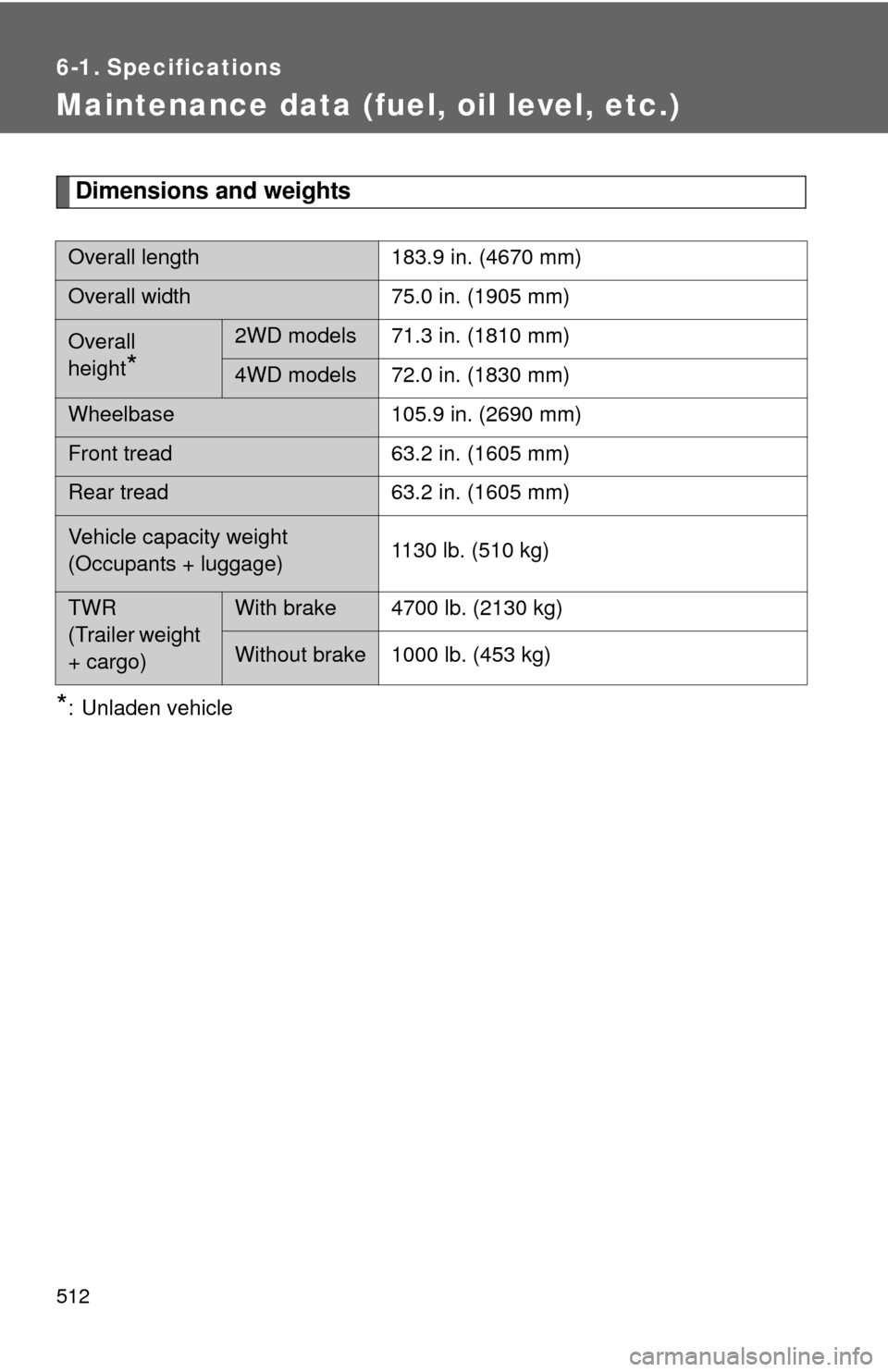
Dimensions and weights
*: Unladen vehicle
Overall length183.9 in. (4670 mm)
Overall width75.0 in. (1905 mm)
Overall
height
*
2WD models 71.3 in. (1810 mm)
4WD models 72.0 in. (1830 mm)
Wheelbase105.9 in. (2690 mm)
Front tread 63.2 in. (1605 mm)
Rear tread 63.2 in. (1605 mm)
Vehicle capacity weight
(Occupants + luggage)1130 lb. (510 kg)
TWR
(Trailer weight
+ cargo)With brake 4700 lb. (2130 kg)
Without brake 1000 lb. (453 kg)
Page 557 of 572

557
Abbreviation list
TIN Tire Identification Number
TPMS Tire Pressure Warning System TRAC Traction Control
TWI Treadwear indicators
TWR Trailer Weight Rating VIN Vehicle Identification Number
VSC Vehicle Stability Control
ABBREVIATIONSMEANING
Page 566 of 572

566 Alphabetical index
Tools ......................................... 484
Total load capacity................... 210
TowingDinghy towing........................ 232
Emergency towing................. 467
Trailer towing......................... 214
TRAC ......................................... 196
Traction control system .......... 196
Trip meter ................................. 140
Turn signal lights Lever ..................................... 136
Replacing light bulbs ............. 456
Switch.................................... 136
Wattage ................................. 522
Vanity mirrors........................... 362
Vehicle data recordings ............23
Vehicle identification number ................................... 513
Vehicle stability control........... 196
Voltmeter .................................. 140
VSC............................................ 196
Warning buzzers Key reminder ......................... 480
Seat belt reminder ................. 477
Warning lights
ABS ....................................... 475
Airbag system ....................... 475
Anti-lock brake system .......... 475
Automatic transmission fluidtemperature ........................ 477
Brake system ........................ 474
Charging system .... ............... 475
Driver’s seat belt ................... 477 Electronic engine control
system ................................ 475
Four-wheel drive system ....... 475
Front passenger occupant classification system ........... 475
Front passenger’s seat belt... 477
Low brake fluid ...................... 474
Low engine oil pressure ........ 475
Low fuel level ........................ 477
Low tire inflation pressure ..... 477
Low washer fluid ................... 477
Malfunction indicator lamp .... 475
Open door ............................. 477
Seat belt ................................ 477
Seat belt pretensioner system ................................ 475
SRS....................................... 475
SRS airbag system ............... 475
Tire pressure ......................... 477
Tire pressure warning
system ................................ 477
Unengaged “Park”................. 475
Washer
Checking ............................... 423
Preparing and checking before winter ....................... 211
Switch ........................... 151, 153
Washing and waxing ............... 394
Weight Cargo capacity ...................... 206
Load limits ............................. 210
Trailer weight rating ...... 219, 512
TWR .............................. 219, 512
Weight ................................... 512
V
W