brake TOYOTA FJ CRUISER 2014 1.G Owners Manual
[x] Cancel search | Manufacturer: TOYOTA, Model Year: 2014, Model line: FJ CRUISER, Model: TOYOTA FJ CRUISER 2014 1.GPages: 572, PDF Size: 9.45 MB
Page 2 of 572

TABLE OF CONTENTSIndex
2
1-1. Key informationKeys ..................................... 30
1-2. Opening, closing and locking the doors
Wireless remote control ....... 32
Side doors ............................ 35
Access doors........................ 38
Back door ............................. 40
Glass hatch .......................... 45
1-3. Adjustable components (seats, mirrors,
steering wheel)
Front seats ........................... 49
Rear seats ............................ 51
Head restraints ..................... 57
Seat belts ............................. 60
Steering wheel ..................... 66
Anti-glare inside rear view mirror.......................... 67
Outside rear view mirrors ..... 71
1-4. Opening and closing the windows
Power windows .................... 74
1-5. Refueling Opening the fuel tank cap .... 76 1-6. Theft deterrent system
Engine immobilizer system ... 79
Theft prevention labels (U.S.A.)............................... 81
1-7. Safety information Correct driving posture ......... 82
SRS airbags ......................... 84
Front passenger occupant classification system ........... 97
Child restraint systems ....... 102
Installing child restraints ..... 106
2-1. Driving procedures Driving the vehicle .............. 118
Engine (ignition) switch....... 129
Automatic Transmission ..... 132
Manual Transmission ......... 134
Turn signal lever ................. 136
Parking brake ..................... 137
Horn .................................... 139
2-2. Instrument cluster Gauges and meters ............ 140
Indicators and warning lights ................................. 143
Accessory meter ................. 146
1Before driving
2When driving
Page 13 of 572
13
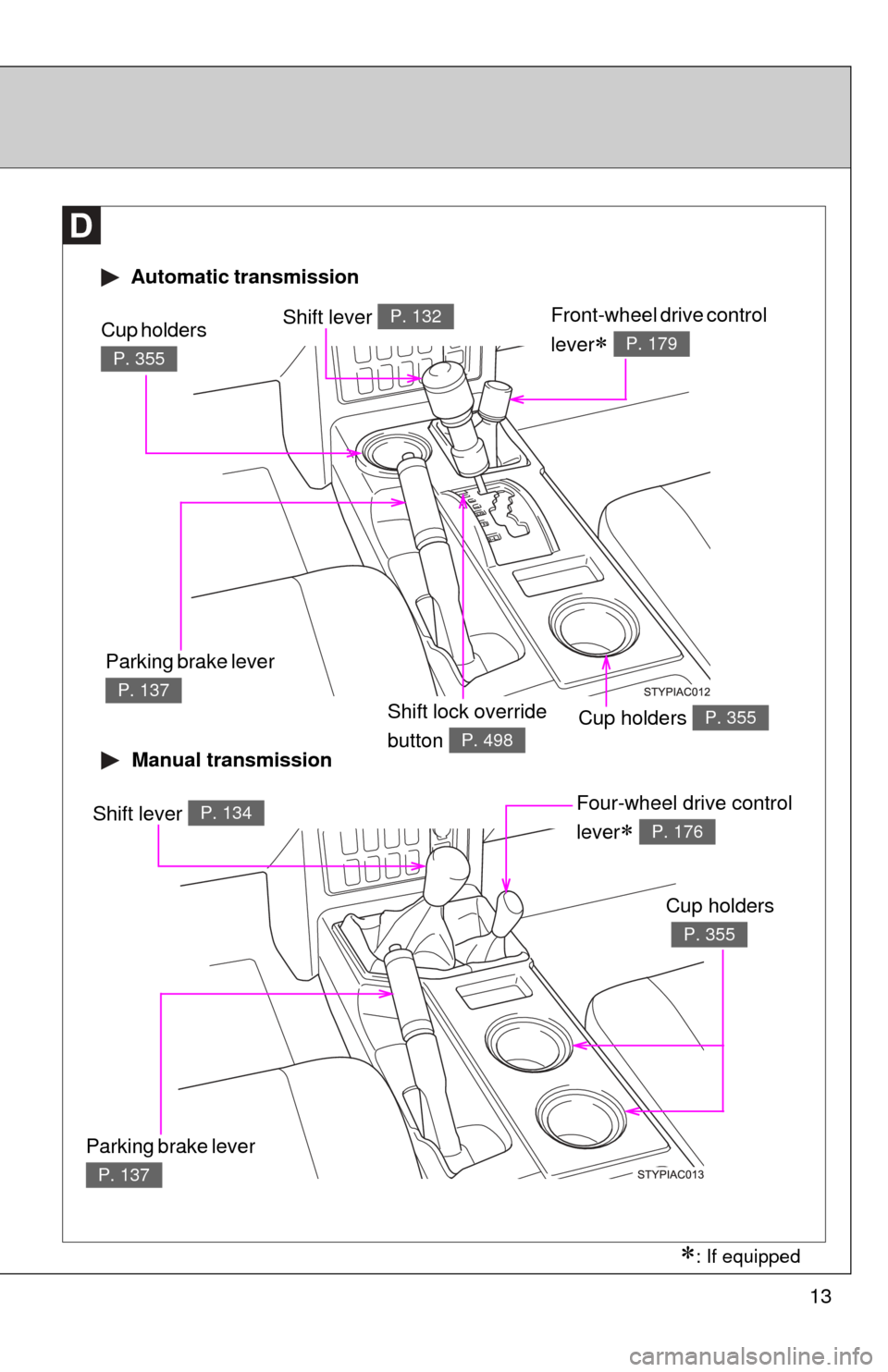
Automatic transmission
Manual transmission
Shift lever P. 132Front-wheel drive control
lever
P. 179
Cup holders P. 355
Cup holders
P. 355
Parking brake lever
P. 137
Shift lever P. 134Four-wheel drive control
lever
P. 176
Cup holders
P. 355
Parking brake lever
P. 137
Shift lock override
button
P. 498
: If equipped
Page 23 of 572

23
Installation of a mobile two-way radio system
The installation of a mobile two-way radio system in your vehicle could affect
electronic systems such as:
●Multiport fuel injection system/sequential multiport fuel injection system
● Cruise control system
● Anti-lock brake system
● SRS airbag system
● Seat belt pretensioner system
Be sure to check with your Toyota dealer for precautionary measures or spe-
cial instructions regarding installation of a mobile two-way radio system.
Vehicle data recordings
Your Toyota is equipped with several sophisticated computers that will record
certain data, such as:
• Engine speed
• Accelerator status
• Brake status
• Vehicle speed
• Shift position (except manual transmission)
The recorded data varies according to the vehicle grade level and options
with which it is equipped. Furthermore, these computers do not record con-
versations, sounds or pictures.
● Data usage
Toyota may use the data recorded in these computers to diagnose malfunc-
tions, conduct research and development, and improve quality.
Toyota will not disclose the recorded data to a third party except:
• With the consent of the vehicle owner or with the consent of the lessee if the vehicle is leased
• In response to an official request by the police, a court of law or a govern-
ment agency
• For use by Toyota in a lawsuit
• For research purposes where the data is not tied to a specific vehicle or
vehicle owner
Page 24 of 572

24
Event data recorder
This vehicle is equipped with an event data recorder (EDR). The main pur-
pose of an EDR is to record, in certain crash or near crash-like situations,
such as an air bag deployment or hitting a road obstacle, data that will assist
in understanding how a vehicle’s systems performed. The EDR is designed
to record data related to vehicle dynamics and safety systems for a short
period of time, typically 30 seconds or less.
The EDR in this vehicle is designed to record such data as:
• How various systems in your vehicle were operating;
• Whether or not the driver and passenger safety belts were buckled/fas-tened;
• How far (if at all) the driver was depressing the accelerator and/or brake pedal; and,
• How fast the vehicle was traveling.
These data can help provide a better understanding of the circumstances in
which crashes and injuries occur.
NOTE: EDR data are recorded by your vehicle only if a nontrivial crash situa-
tion occurs; no data are recorded by the EDR under normal driving condi-
tions and no personal data (e.g., name, gender, age, and crash location) are
recorded. However, other parties, such as law enforcement, could combine
the EDR data with the type of personally identifying data routinely acquired
during a crash investigation.
To read data recorded by an EDR, special equipment is required, and access
to the vehicle or the EDR is needed. In addition to the vehicle manufacturer,
other parties, such as law enforcement, that have the special equipment, can
read the information if they have access to the vehicle or the EDR.
Page 117 of 572
When driving2
117
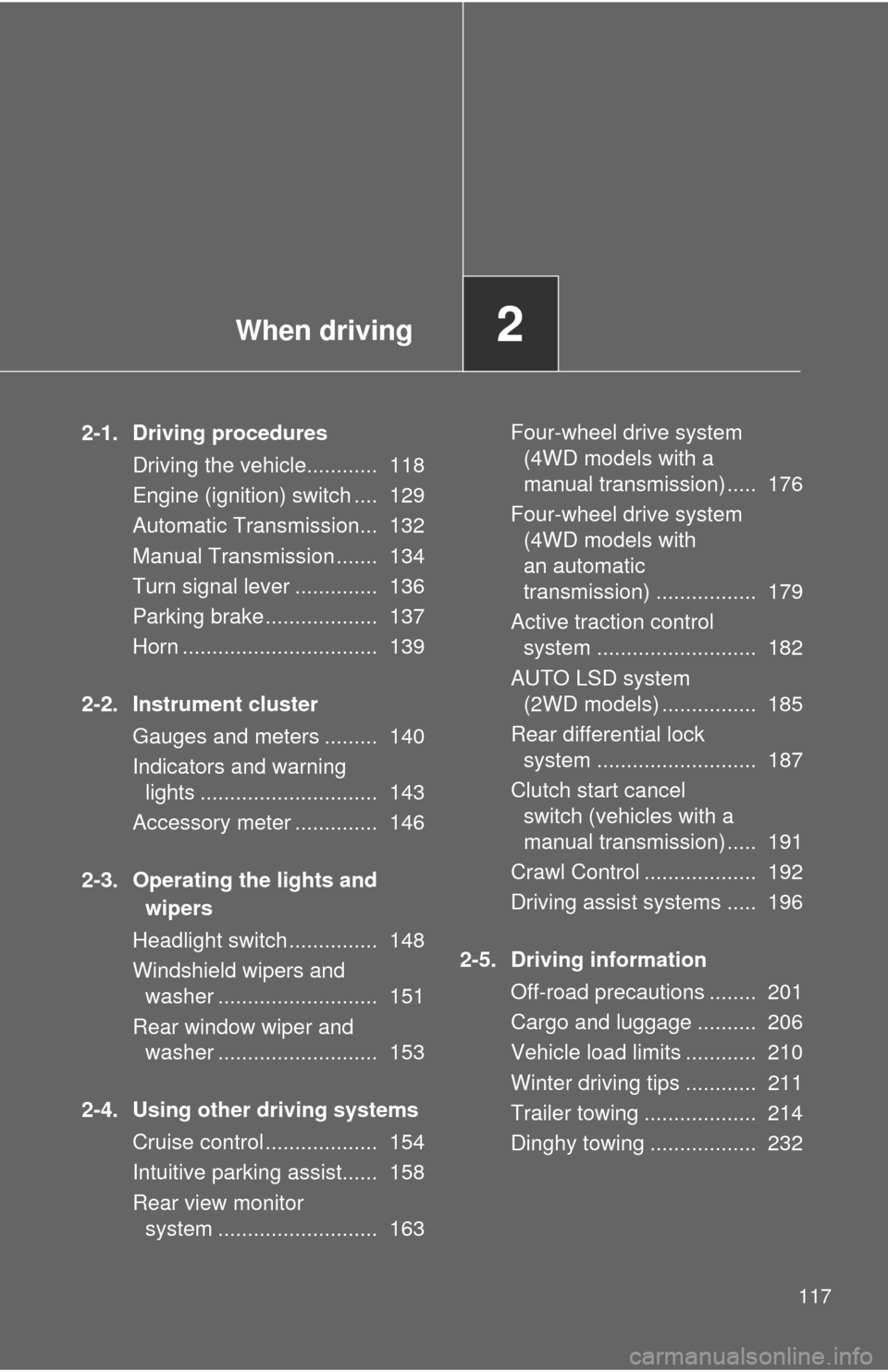
2-1. Driving proceduresDriving the vehicle............ 118
Engine (ignition) switch .... 129
Automatic Transmission... 132
Manual Transmission ....... 134
Turn signal lever .............. 136
Parking brake ................... 137
Horn ................................. 139
2-2. Instrument cluster Gauges and meters ......... 140
Indicators and warning lights .............................. 143
Accessory meter .............. 146
2-3. Operating the lights and wipers
Headlight switch ............... 148
Windshield wipers and washer ........................... 151
Rear window wiper and washer ........................... 153
2-4. Using other driving systems Cruise control ................... 154
Intuitive parking assist...... 158
Rear view monitor system ........................... 163 Four-wheel drive system
(4WD models with a
manual transmission) ..... 176
Four-wheel drive system (4WD models with
an automatic
transmission) ................. 179
Active traction control system ........................... 182
AUTO LSD system (2WD models) ................ 185
Rear differential lock system ........................... 187
Clutch start cancel switch (vehicles with a
manual transmission) ..... 191
Crawl Control ................... 192
Driving assist systems ..... 196
2-5. Driving information Off-road precautions ........ 201
Cargo and luggage .......... 206
Vehicle load limits ............ 210
Winter driving tips ............ 211
Trailer towing ................... 214
Dinghy towing .................. 232
Page 118 of 572
118
2-1. Driving procedures
Driving the vehicle
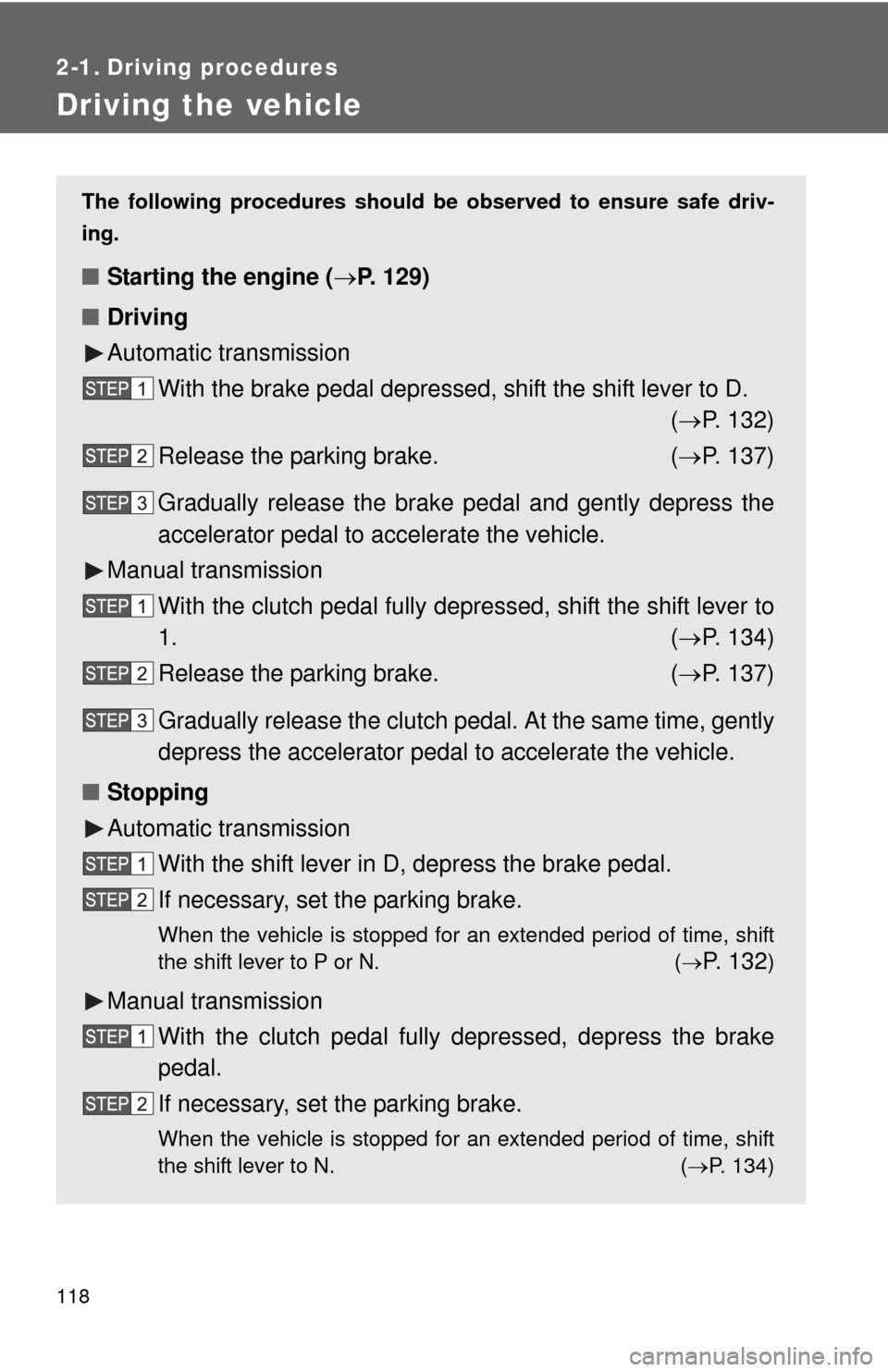
The following procedures should be observed to ensure safe driv-
ing.
■ Starting the engine ( P. 129)
■ Driving
Automatic transmission
With the brake pedal depressed, shift the shift lever to D. ( P. 132)
Release the parking brake. ( P. 137)
Gradually release the brake pedal and gently depress the
accelerator pedal to accelerate the vehicle.
Manual transmission With the clutch pedal fully depressed, shift the shift lever to
1. ( P. 134)
Release the parking brake. ( P. 137)
Gradually release the clutch pedal. At the same time, gently
depress the accelerator pedal to accelerate the vehicle.
■ Stopping
Automatic transmission
With the shift lever in D, depress the brake pedal.
If necessary, set the parking brake.
When the vehicle is stopped for an extended period of time, shift
the shift lever to P or N. (
P. 1 3 2)
Manual transmission
With the clutch pedal fully depressed, depress the brake
pedal.
If necessary, set the parking brake.
When the vehicle is stopped for an extended period of time, shift
the shift lever to N. ( P. 134)
Page 119 of 572
119
2-1. Driving procedures
2
When driving
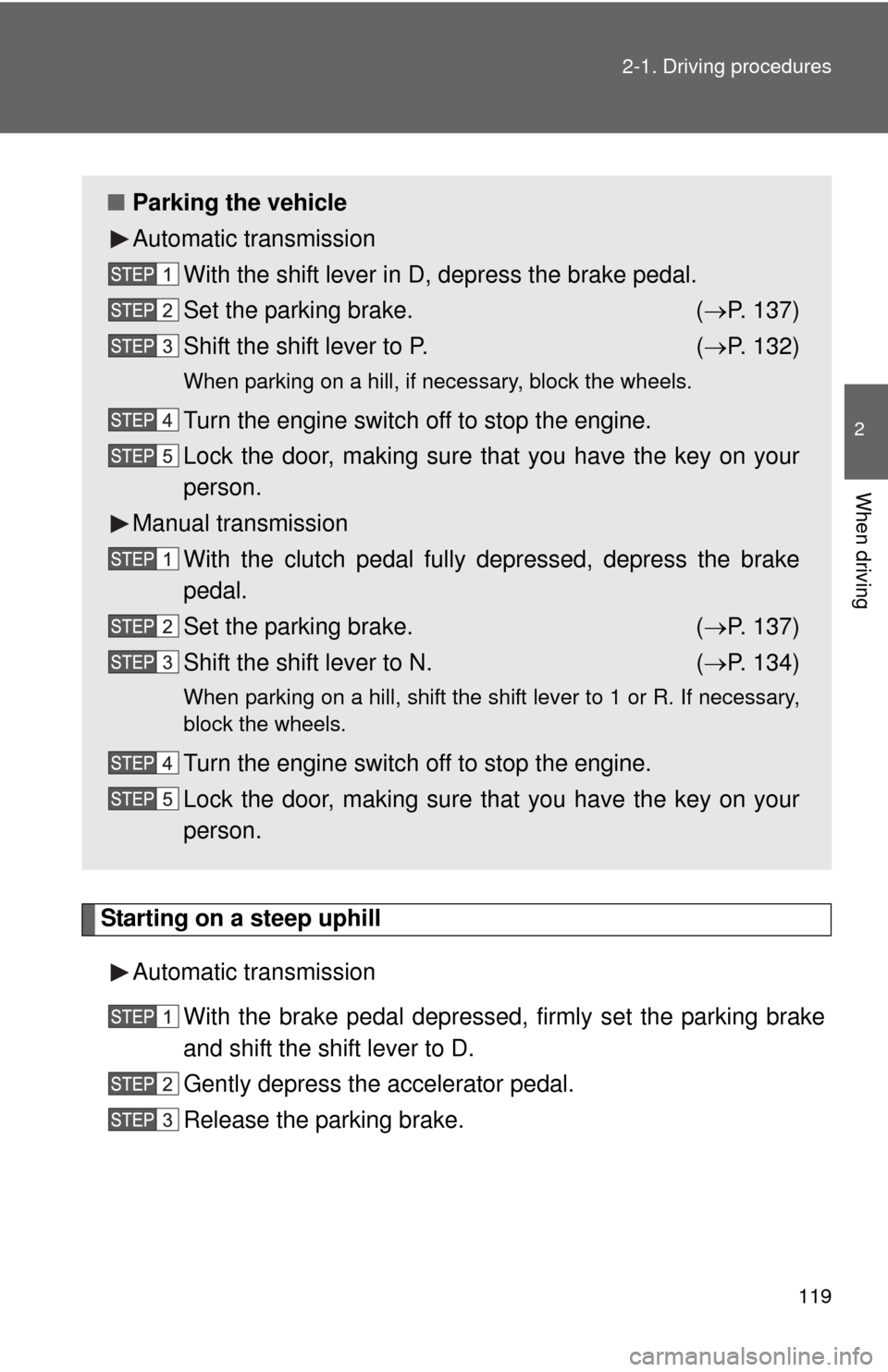
Starting on a steep uphill
Automatic transmission With the brake pedal depressed, firmly set the parking brake
and shift the shift lever to D.
Gently depress the accelerator pedal.
Release the parking brake.
■Parking the vehicle
Automatic transmission
With the shift lever in D, depress the brake pedal.
Set the parking brake. ( P. 137)
Shift the shift lever to P. ( P. 132)
When parking on a hill, if necessary, block the wheels.
Turn the engine switch off to stop the engine.
Lock the door, making sure that you have the key on your
person.
Manual transmission
With the clutch pedal fully depressed, depress the brake
pedal.
Set the parking brake. ( P. 137)
Shift the shift lever to N. ( P. 134)
When parking on a hill, shift the shift lever to 1 or R. If necessary,
block the wheels.
Turn the engine switch off to stop the engine.
Lock the door, making sure that you have the key on your
person.
Page 120 of 572
120 2-1. Driving procedures
Manual transmissionWith the parking brake firmly set and the clutch pedal fully
depressed, shift the shift lever to 1.
Lightly depress the accelerator pedal at the same time as
gradually releasing the clutch pedal.
Release the parking brake.
■Driving in the rain
●Drive carefully when it is raining, because visibility will be reduced, the
windows may become fogged-up, and the road will be slippery.
● Drive carefully when it starts to rain, because the road surface will be
especially slippery.
● Refrain from high speeds when driving on an expressway in the rain,
because there may be a layer of water between the tires and the road
surface, preventing the steering and brakes from operating properly.
■ Engine speed while driving (vehicl es with an automatic transmission)
In the following conditions, the engine speed may become high while driving.
This is due to automatic up-shifting control or down-shifting implementation
to meet driving conditions. It does not indicate sudden acceleration.
● The vehicle is judged to be driving uphill or downhill
● When the accelerator pedal is released
■ Breaking in your new Toyota
To extend the life of the vehicle, the following precautions are recommended
to observe:
●For the first 200 miles (300 km):
Avoid sudden stops.
● For the first 500 miles (800 km):
Do not tow a trailer.
● For the first 1000 miles (1600 km):
• Do not drive at extremely high speeds.
• Avoid sudden acceleration.
• Do not drive continuously in the low gears.
• Do not drive at a constant speed for extended periods.
Page 121 of 572
121
2-1. Driving procedures
2
When driving
■
Drum-in disc type parking brake system
Your vehicle has a drum-in-disc type parking brake system. This type of
brake system needs bedding-down of the brake shoes periodically or when-
ever the parking brake shoes and/or drum are replaced. Have your Toyota
dealer perform the bedding down operation.
■ Operating your vehicle in a foreign country
Comply with the relevant vehicle registration laws and confirm the availability
of the correct fuel. ( P. 514)
■ When turning off the engine
The emission system operating sounds may continue for a short time after
the engine is turned off. This is not a malfunction, and helps to ensure opti-
mal performance of the emission system.
CAUTION
■When starting the vehicle
Vehicles with an automatic transmission: Always keep your foot on the brake
pedal while stopped with the engine running. This prevents the vehicle from
creeping.
■ When driving the vehicle
●Do not drive if you are unfamiliar with the location of the brake and accel-
erator pedals to avoid depressing the wrong pedal.
• Accidentally depressing the accelerator pedal instead of the brake
pedal will result in sudden acceleration that may lead to an accident
that could result in death or serious injury.
• When backing up, you may twist your body around, leading to difficulty in operating the pedals. Make sure to operate the pedals properly.
• Make sure to keep a correct driving posture even when moving the vehicle only slightly, allowing you to depress the brake and accelerator
pedals properly.
• Depress the brake pedal using your right foot. Depressing the brake pedal using your left foot may delay response in an emergency, which
could lead to an accident that could result in death or serious injury.
● Do not drive the vehicle over or st op the vehicle near flammable materials.
The exhaust system and exhaust gases can be extremely hot. This may
cause a fire if there is any flammable material nearby.
Page 122 of 572
122 2-1. Driving procedures
CAUTION
■When driving the vehicle
●Vehicles with an automatic transmission: Do not let the vehicle roll back-
wards while the shift lever is in a driving position, or roll forward while the
shift lever is in R.
Doing so may cause the engine to stall or lead to poor brake and steering
performance, resulting in an accident or damage to the vehicle.
● If the smell of exhaust is noticed inside the vehicle, open the windows and
check that the back door and glass hatch are closed. Large amounts of
exhaust in the vehicle can cause driver drowsiness and an accident,
resulting in death or a serious health hazard. Have the vehicle inspected
by your Toyota dealer immediately.
● On vehicles with an automatic transmission, do not shift the shift lever to P
while the vehicle is moving.
Doing so can damage the transmission and may result in a loss of vehicle\
control.
● Do not shift the shift lever to R while the vehicle is moving forward.
Doing so can damage the transmission and may result in a loss of vehicle\
control.
● Do not shift the shift lever to D (automatic transmission) or 1 (manual
transmission) while the vehicle is moving backward.
Doing so can damage the transmission and may result in a loss of vehicle\
control.
● Moving the shift lever to N while the vehicle is moving will disengage the
engine from the transmission. Engine braking is not available when N is
selected.
● During normal driving, do not turn off the engine. Turning the engine off
while driving will not cause loss of steering or braking control, but the
power assist to these systems will be lost. This will make it more difficult to
steer and brake, so you should pull over and stop the vehicle as soon as it
is safe to do so.
However, in the event of an emergency, such as if it becomes impossible
to stop the vehicle in the normal way: P. 509