clutch TOYOTA FJ CRUISER 2014 1.G Owners Manual
[x] Cancel search | Manufacturer: TOYOTA, Model Year: 2014, Model line: FJ CRUISER, Model: TOYOTA FJ CRUISER 2014 1.GPages: 572, PDF Size: 9.45 MB
Page 3 of 572

1
2
3
4
5
6
7
3
2-3. Operating the lights and wipers
Headlight switch .................. 148
Windshield wipers and washer .............................. 151
Rear window wiper and washer .............................. 153
2-4. Using other driving systems Cruise control ...................... 154
Intuitive parking assist......... 158
Rear view monitor system... 163
Four-wheel drive system (4WD models with a
manual transmission)........ 176
Four-wheel drive system (4WD models with an
automatic transmission) .... 179
Active traction control system .............................. 182
AUTO LSD system (2WD models) ................... 185
Rear differential lock system .............................. 187
Clutch start cancel switch (vehicles with a manual
transmission) .................... 191
Crawl Control ...................... 192
Driving assist systems ........ 196
2-5. Driving information Off-road precautions ........... 201
Cargo and luggage ............. 206
Vehicle load limits ............... 210
Winter driving tips ............... 211
Trailer towing ...................... 214
Dinghy towing ..................... 232 3-1. Using the air conditioning
system and defogger
Air conditioning system ...... 236
Rear window defogger ....... 243
3-2. Using the audio system Audio system ...................... 244
Using the radio ................... 248
Using the CD player ........... 255
Playing MP3 and WMA discs ....................... 263
Operating an iPod .............. 270
Operating a USB memory ............................ 278
Optimal use of the audio system .............................. 286
Using the AUX port/ USB port........................... 289
Using the steering wheel audio switches.................. 290
Antenna .............................. 293
3-3. Using the Bluetooth
®
audio system
Bluetooth
® audio system .... 296
Using the Bluetooth®
audio system .................... 300
Operating a Bluetooth
®
enabled portable player.... 305
Setting up a Bluetooth
®
enabled portable player.... 307
Bluetooth
® audio system
setup ................................ 312
3Interior features
Page 19 of 572
19
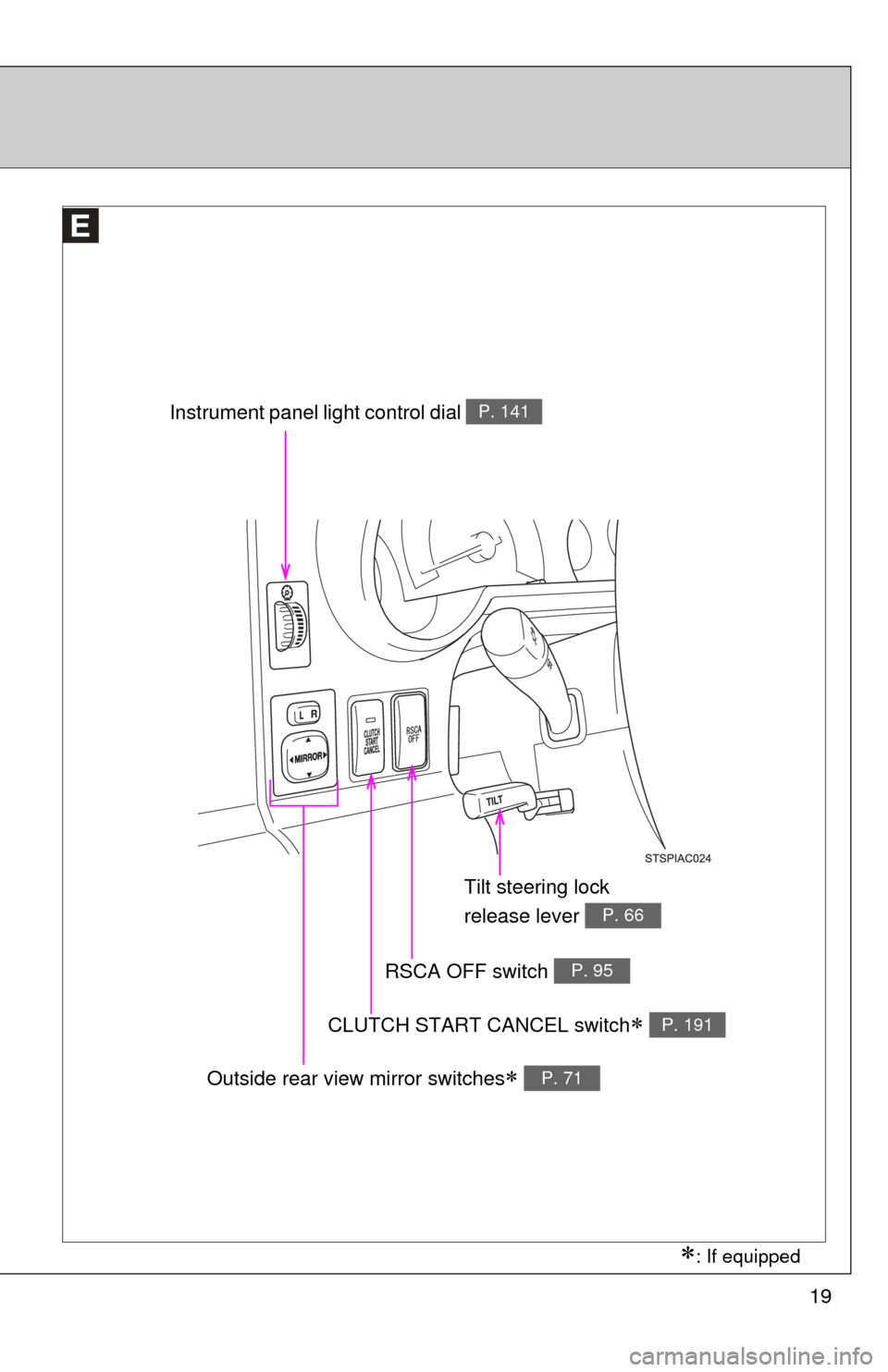
Instrument panel light control dial P. 141
CLUTCH START CANCEL switch P. 191
Outside rear view mirror switches P. 71
Tilt steering lock
release lever
P. 66
RSCA OFF switch P. 95
: If equipped
Page 117 of 572
When driving2
117
2-1. Driving proceduresDriving the vehicle............ 118
Engine (ignition) switch .... 129
Automatic Transmission... 132
Manual Transmission ....... 134
Turn signal lever .............. 136
Parking brake ................... 137
Horn ................................. 139
2-2. Instrument cluster Gauges and meters ......... 140
Indicators and warning lights .............................. 143
Accessory meter .............. 146
2-3. Operating the lights and wipers
Headlight switch ............... 148
Windshield wipers and washer ........................... 151
Rear window wiper and washer ........................... 153
2-4. Using other driving systems Cruise control ................... 154
Intuitive parking assist...... 158
Rear view monitor system ........................... 163 Four-wheel drive system
(4WD models with a
manual transmission) ..... 176
Four-wheel drive system (4WD models with
an automatic
transmission) ................. 179
Active traction control system ........................... 182
AUTO LSD system (2WD models) ................ 185
Rear differential lock system ........................... 187
Clutch start cancel switch (vehicles with a
manual transmission) ..... 191
Crawl Control ................... 192
Driving assist systems ..... 196
2-5. Driving information Off-road precautions ........ 201
Cargo and luggage .......... 206
Vehicle load limits ............ 210
Winter driving tips ............ 211
Trailer towing ................... 214
Dinghy towing .................. 232
Page 118 of 572
118
2-1. Driving procedures
Driving the vehicle
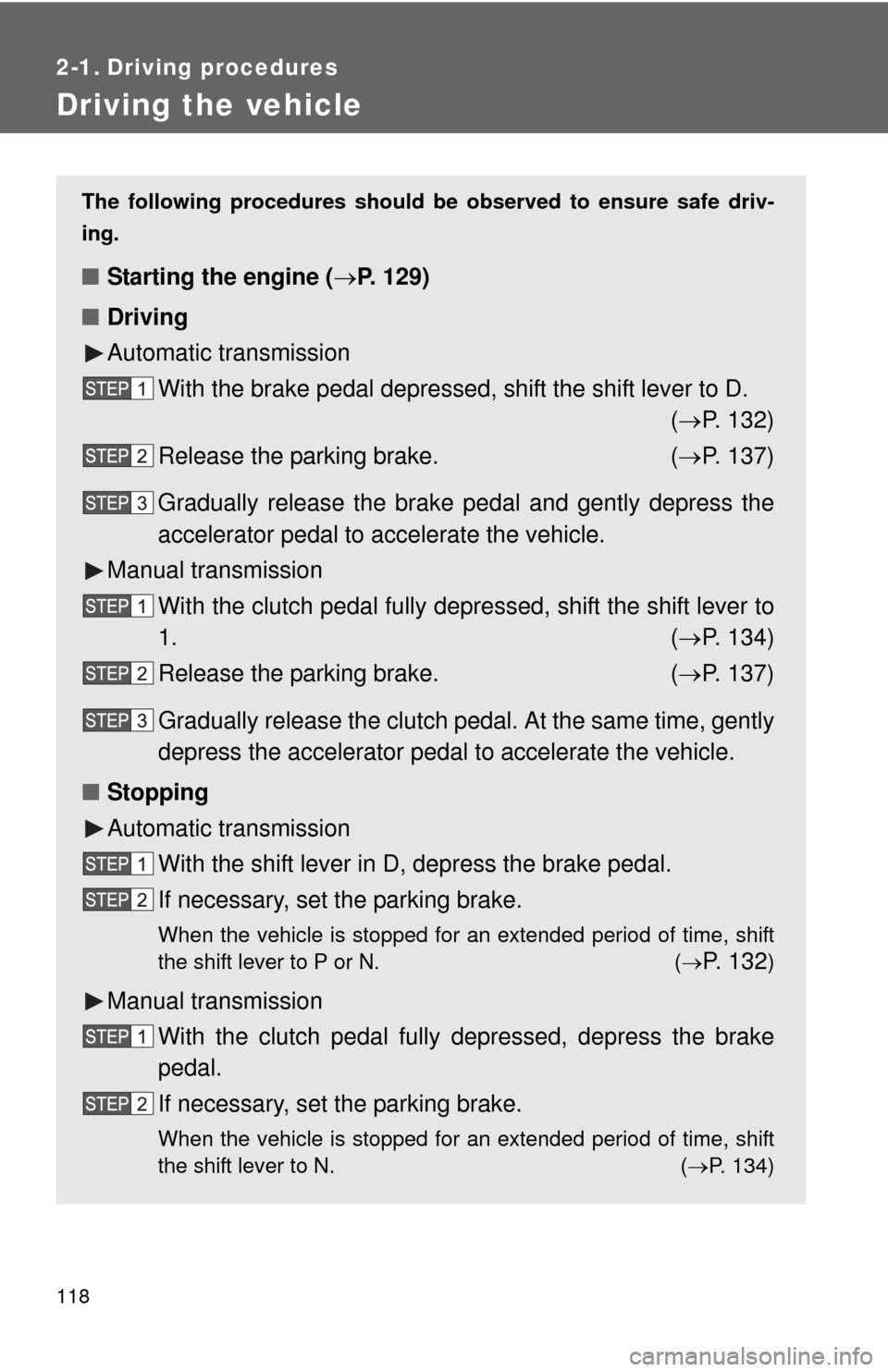
The following procedures should be observed to ensure safe driv-
ing.
■ Starting the engine ( P. 129)
■ Driving
Automatic transmission
With the brake pedal depressed, shift the shift lever to D. ( P. 132)
Release the parking brake. ( P. 137)
Gradually release the brake pedal and gently depress the
accelerator pedal to accelerate the vehicle.
Manual transmission With the clutch pedal fully depressed, shift the shift lever to
1. ( P. 134)
Release the parking brake. ( P. 137)
Gradually release the clutch pedal. At the same time, gently
depress the accelerator pedal to accelerate the vehicle.
■ Stopping
Automatic transmission
With the shift lever in D, depress the brake pedal.
If necessary, set the parking brake.
When the vehicle is stopped for an extended period of time, shift
the shift lever to P or N. (
P. 1 3 2)
Manual transmission
With the clutch pedal fully depressed, depress the brake
pedal.
If necessary, set the parking brake.
When the vehicle is stopped for an extended period of time, shift
the shift lever to N. ( P. 134)
Page 119 of 572
119
2-1. Driving procedures
2
When driving
Starting on a steep uphill
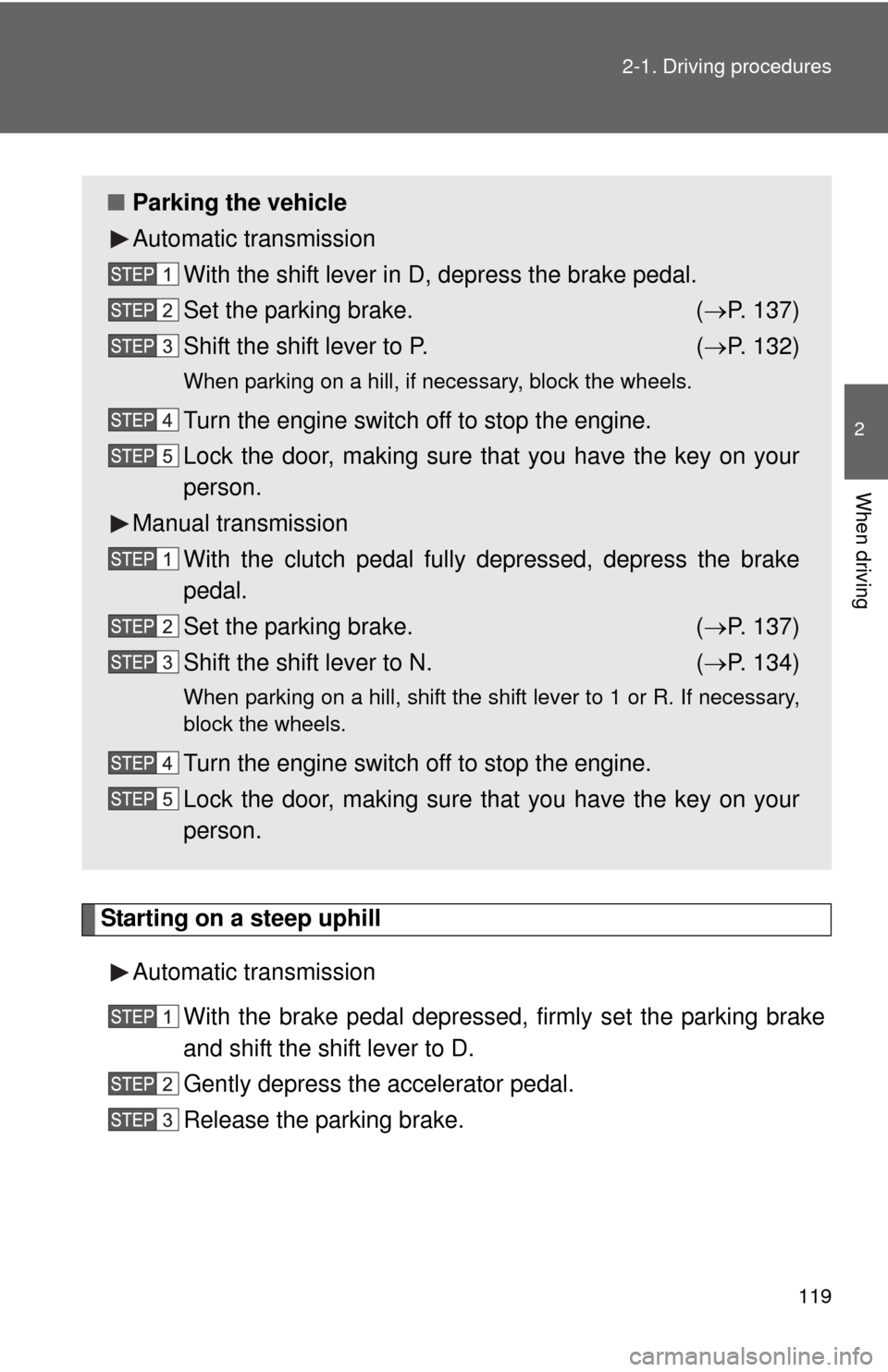
Automatic transmission With the brake pedal depressed, firmly set the parking brake
and shift the shift lever to D.
Gently depress the accelerator pedal.
Release the parking brake.
■Parking the vehicle
Automatic transmission
With the shift lever in D, depress the brake pedal.
Set the parking brake. ( P. 137)
Shift the shift lever to P. ( P. 132)
When parking on a hill, if necessary, block the wheels.
Turn the engine switch off to stop the engine.
Lock the door, making sure that you have the key on your
person.
Manual transmission
With the clutch pedal fully depressed, depress the brake
pedal.
Set the parking brake. ( P. 137)
Shift the shift lever to N. ( P. 134)
When parking on a hill, shift the shift lever to 1 or R. If necessary,
block the wheels.
Turn the engine switch off to stop the engine.
Lock the door, making sure that you have the key on your
person.
Page 120 of 572

120 2-1. Driving procedures
Manual transmissionWith the parking brake firmly set and the clutch pedal fully
depressed, shift the shift lever to 1.
Lightly depress the accelerator pedal at the same time as
gradually releasing the clutch pedal.
Release the parking brake.
■Driving in the rain
●Drive carefully when it is raining, because visibility will be reduced, the
windows may become fogged-up, and the road will be slippery.
● Drive carefully when it starts to rain, because the road surface will be
especially slippery.
● Refrain from high speeds when driving on an expressway in the rain,
because there may be a layer of water between the tires and the road
surface, preventing the steering and brakes from operating properly.
■ Engine speed while driving (vehicl es with an automatic transmission)
In the following conditions, the engine speed may become high while driving.
This is due to automatic up-shifting control or down-shifting implementation
to meet driving conditions. It does not indicate sudden acceleration.
● The vehicle is judged to be driving uphill or downhill
● When the accelerator pedal is released
■ Breaking in your new Toyota
To extend the life of the vehicle, the following precautions are recommended
to observe:
●For the first 200 miles (300 km):
Avoid sudden stops.
● For the first 500 miles (800 km):
Do not tow a trailer.
● For the first 1000 miles (1600 km):
• Do not drive at extremely high speeds.
• Avoid sudden acceleration.
• Do not drive continuously in the low gears.
• Do not drive at a constant speed for extended periods.
Page 127 of 572

127
2-1. Driving procedures
2
When driving
NOTICE
■
When driving the vehicle
Vehicles with an automatic transmission
● Do not depress the accelerator and brake pedals at the same time during
driving, as this may restrain driving torque.
● Do not use the accelerator pedal or depress the accelerator and brake
pedals at the same time to hold the vehicle on a hill.
Vehicles with a manual transmission
● Do not depress the accelerator and brake pedals at the same time during
driving, as this may restrain driving torque.
● Do not rest your foot on the clutch pedal while driving.
Doing so may cause clutch trouble.
● Do not use any gear other than the first gear when starting off and moving
forward.
Doing so may damage the clutch.
● Do not use the clutch to hold the vehicle when stopping on an uphill grade.
Doing so may damage the clutch.
■ When parking the vehicle
Vehicles with an automatic transmission: Always put the shift lever in P.
Failure to do so may cause the vehicle to move or the vehicle may acceler-
ate suddenly if the accelerator pedal is accidentally depressed.
■ To avoid damage to vehicle parts
●Do not turn the steering wheel fully in either direction and hold it there for a
long time.
Doing so may damage the power steering pump.
● When driving over bumps in the road, drive as slowly as possible to avoid
damaging the wheels, underside of the vehicle, etc.
Page 129 of 572
129
2-1. Driving procedures
2
When driving
Engine (ignition) switch
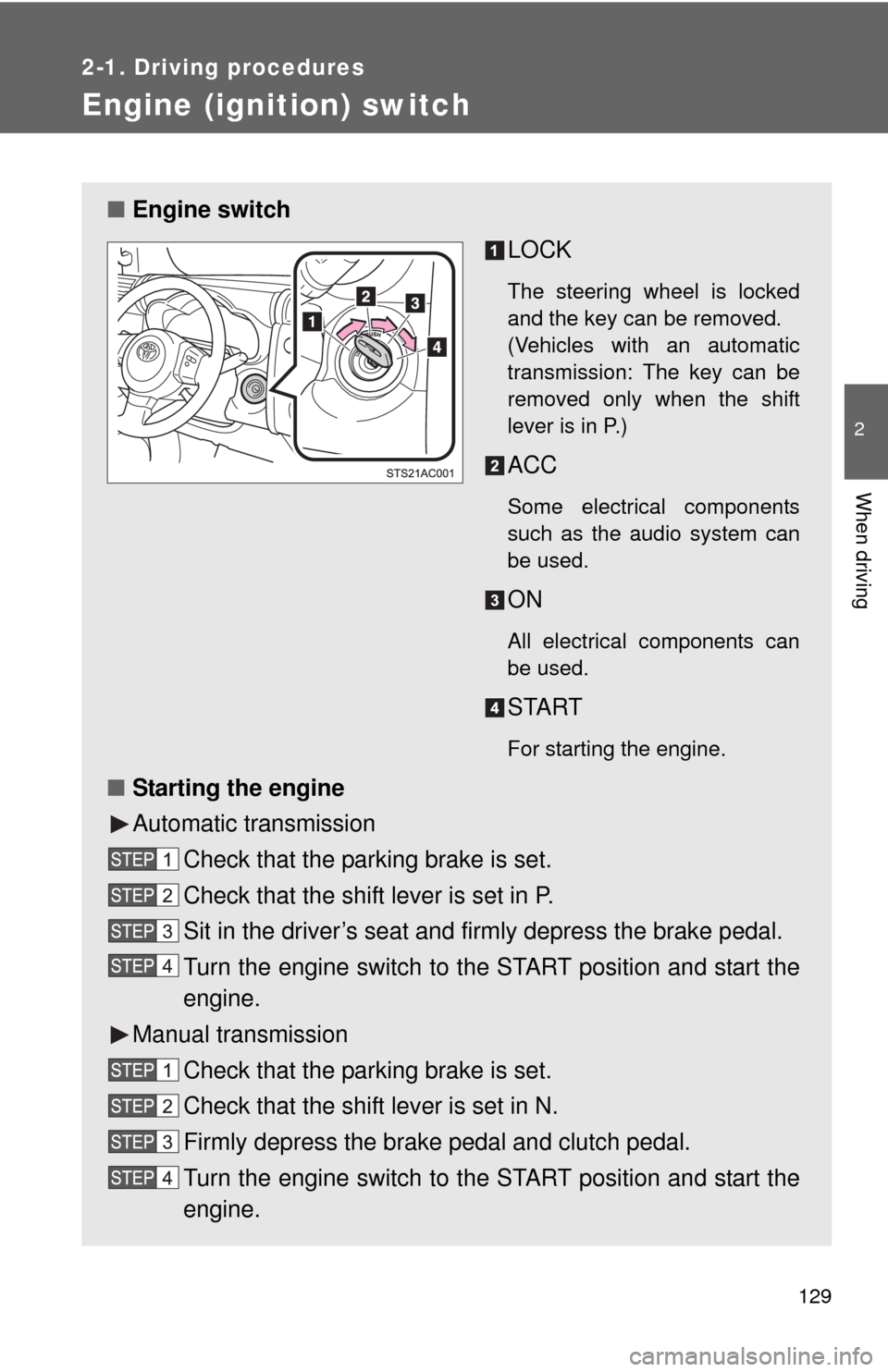
■Engine switch
LOCK
The steering wheel is locked
and the key can be removed.
(Vehicles with an automatic
transmission: The key can be
removed only when the shift
lever is in P.)
ACC
Some electrical components
such as the audio system can
be used.
ON
All electrical components can
be used.
START
For starting the engine.
■Starting the engine
Automatic transmission
Check that the parking brake is set.
Check that the shift lever is set in P.
Sit in the driver’s seat and firmly depress the brake pedal.
Turn the engine switch to the START position and start the
engine.
Manual transmission Check that the parking brake is set.
Check that the shift lever is set in N.
Firmly depress the brake pedal and clutch pedal.
Turn the engine switch to the START position and start the
engine.
Page 134 of 572
134
2-1. Driving procedures
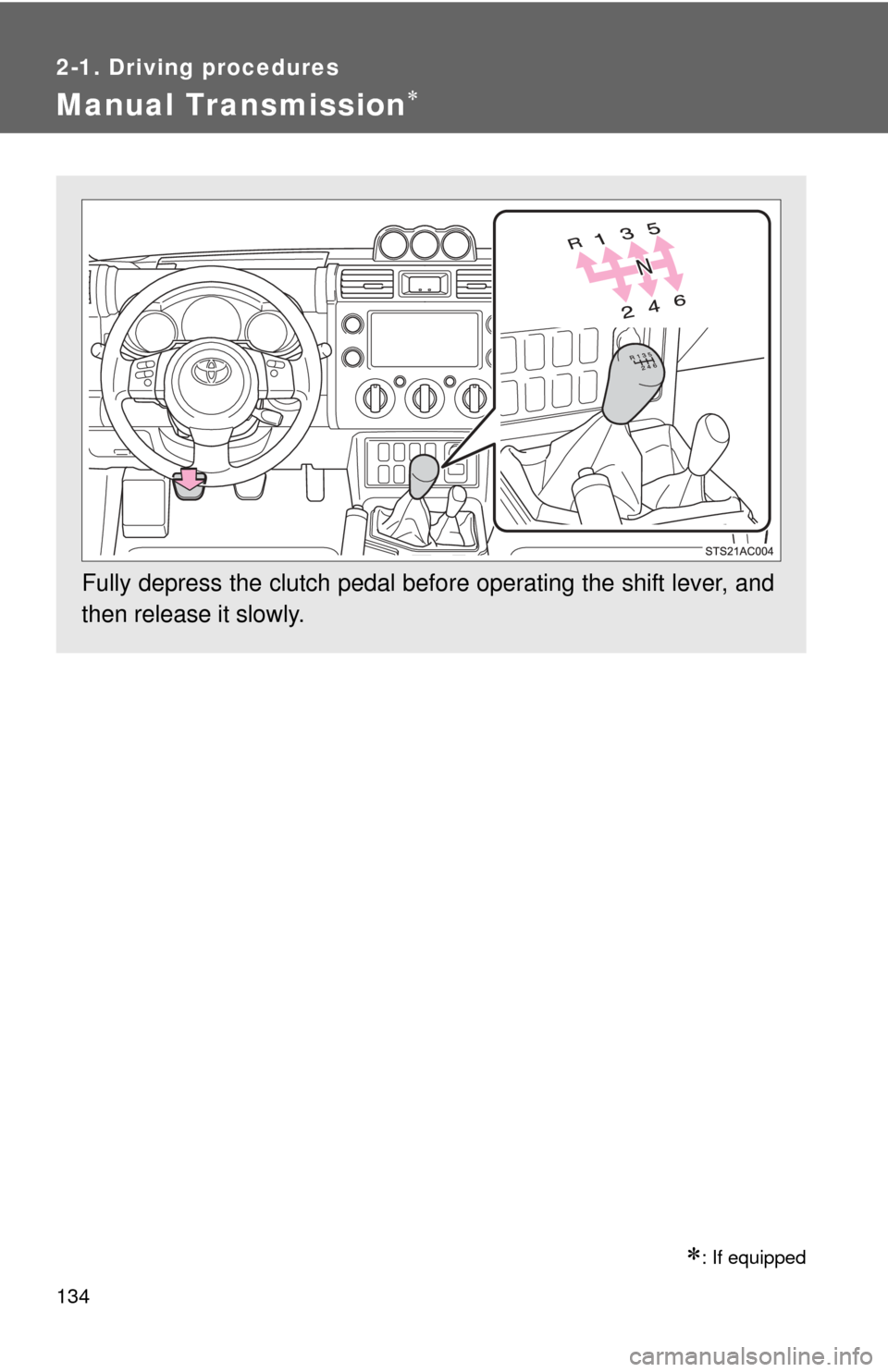
Manual Transmission
: If equipped
Fully depress the clutch pedal before operating the shift lever, and
then release it slowly.
Page 156 of 572
156 2-4. Using other driving systems
■Cruise control can be set when
●Vehicles with an automatic transmission: The shift lever is in the D or
range 4.
● Vehicle speed is above approximately 25 mph (40 km/h).
■ Accelerating after setting the vehicle speed
●The vehicle can be accelerated normally. After acceleration, the set
speed resumes.
● Even without canceling the cruise control, the set speed can be
increased by first accelerating the vehicle to the desired speed and then
pushing the lever down to set the new speed.
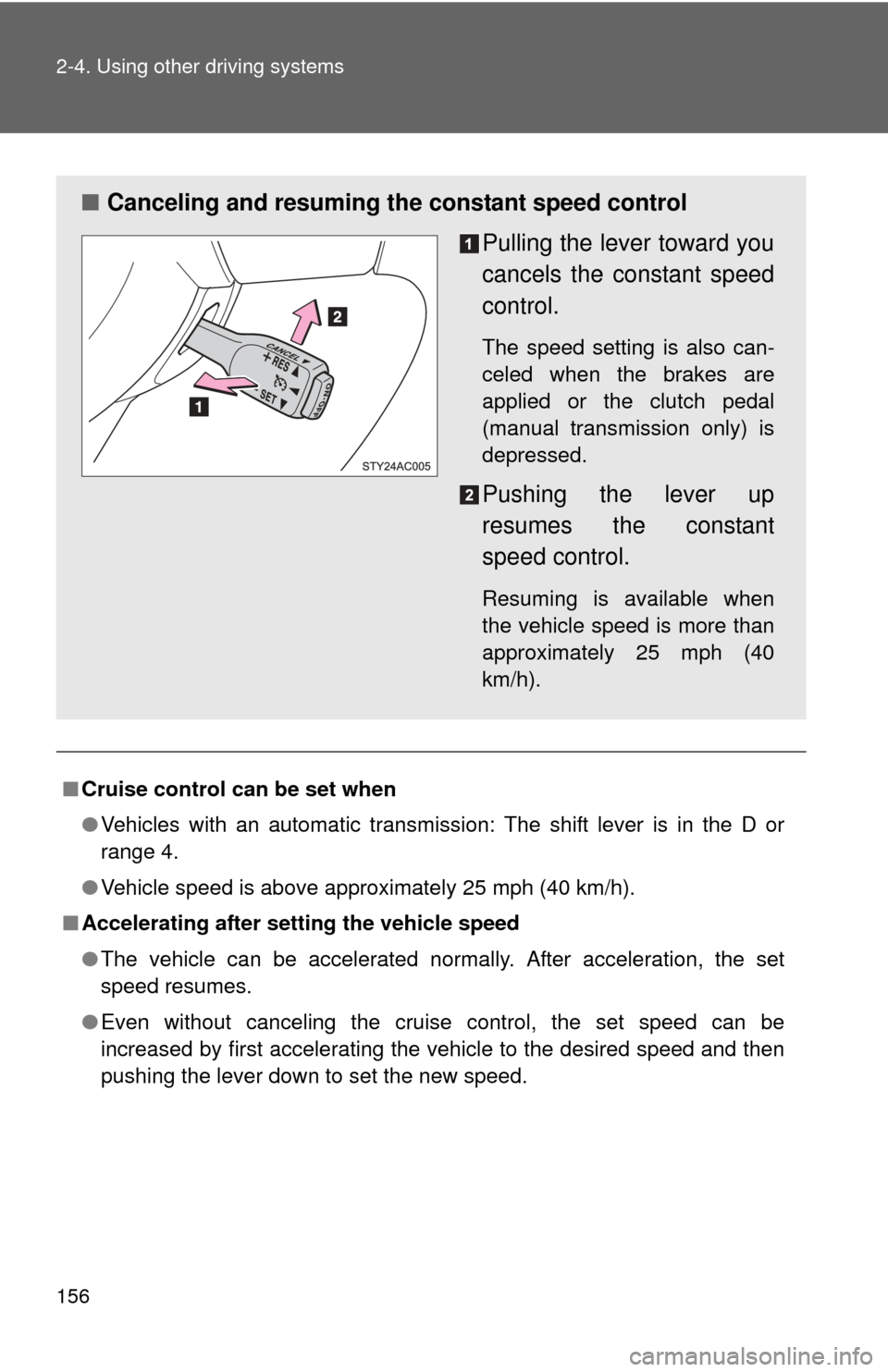
■ Canceling and resuming the constant speed control
Pulling the lever toward you
cancels the constant speed
control.
The speed setting is also can-
celed when the brakes are
applied or the clutch pedal
(manual transmission only) is
depressed.
Pushing the lever up
resumes the constant
speed control.
Resuming is available when
the vehicle speed is more than
approximately 25 mph (40
km/h).