brakes TOYOTA GR YARIS 2021 Owner's Manual
[x] Cancel search | Manufacturer: TOYOTA, Model Year: 2021, Model line: GR YARIS, Model: TOYOTA GR YARIS 2021Pages: 458, PDF Size: 105.69 MB
Page 314 of 458
312
YARIS(GR) Owner's Manual_Europe_M52L09_en
7-2. Steps to take in an emergency
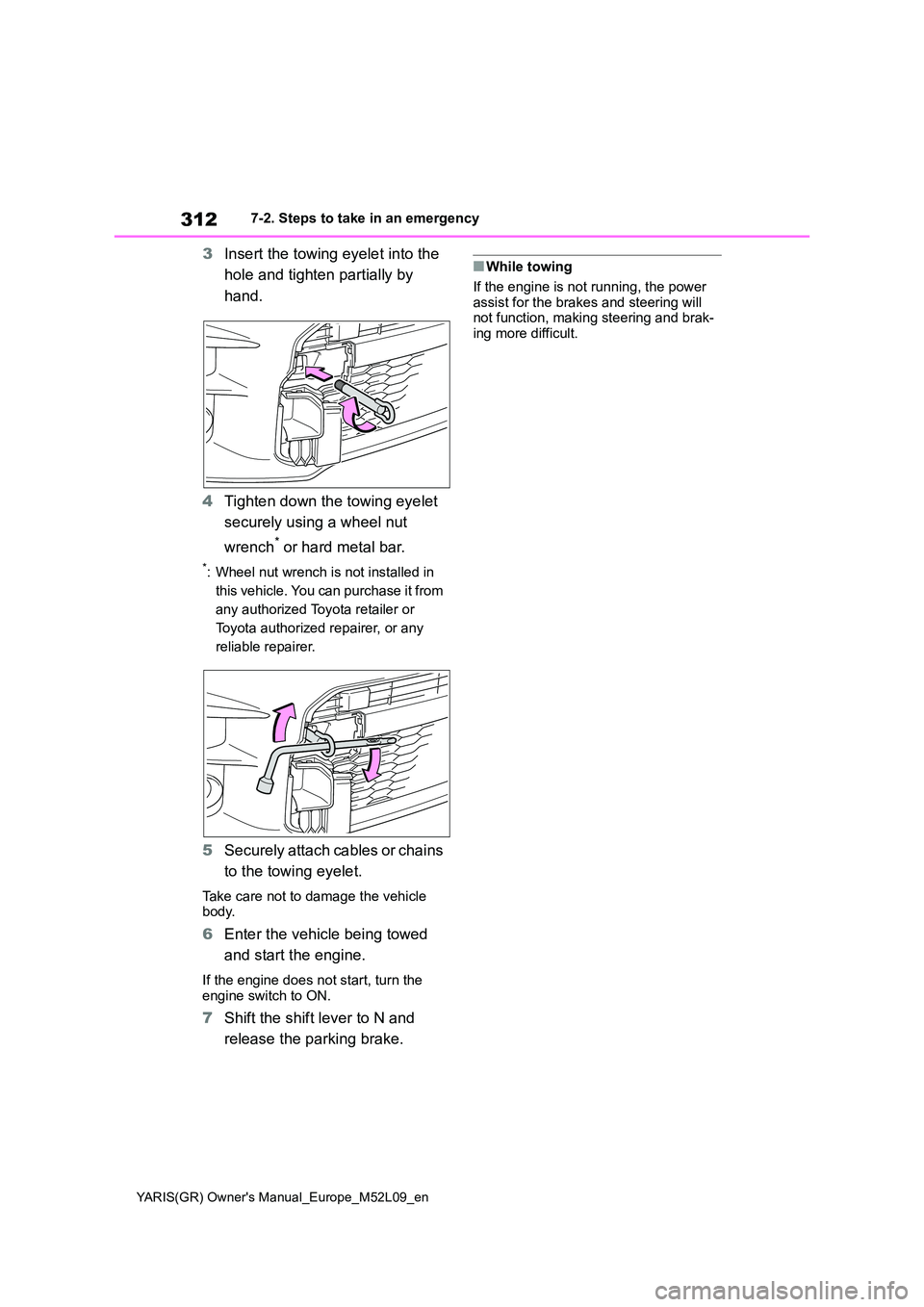
3Insert the towing eyelet into the
hole and tighten partially by
hand.
4 Tighten down the towing eyelet
securely using a wheel nut
wrench* or hard metal bar.
*: Wheel nut wrench is not installed in
this vehicle. You can purchase it from
any authorized Toyota retailer or
Toyota authorized repairer, or any
reliable repairer.
5 Securely attach cables or chains
to the towing eyelet.
Take care not to damage the vehicle body.
6 Enter the vehicle being towed
and start the engine.
If the engine does not start, turn the
engine switch to ON.
7 Shift the shift lever to N and
release the parking brake.
■While towing
If the engine is not running, the power
assist for the brakes and steering will not function, making steering and brak-ing more difficult.
Page 324 of 458
322
YARIS(GR) Owner's Manual_Europe_M52L09_en
7-2. Steps to take in an emergency
ble.
■Electric power steering system
warning light (warning buzzer)
When the battery charge becomes insufficient or the voltage temporarily
drops, the electric power steering sys- tem warning light may come on and the warning buzzer may sound.
■When the tire pressure warning
light comes on
Inspect the tires to check if a tire is punctured.
If a tire is punctured: →P. 3 2 5
If none of the tires are punctured: Turn the engine switch off then turn it to
ON. Check if the tire pressure warning light comes on or blinks.
If the tire pressure warning light blinks
for approximately 1 minute then stays on
There may be a malfunction in the tire
pressure warning system. Have the vehicle inspected by any authorized Toyota retailer or Toyota authorized
repairer, or any reliable repairer immedi- ately.
If the tire pressure warning light
comes on
1 After the temperature of the tires has lowered sufficiently, check the infla-tion pressure of each tire and adjust
them to the specified level.
2 If the warning light does not turn off even after several minutes have elapsed, check that the inflation
pressure of each tire is at the speci- fied level and perform initialization. ( →P.282)
■The tire pressure warning light may
come on due to natural causes
The tire pressure warning light may come on due to natural causes such as
natural air leaks and tire inflation pres- sure changes caused by temperature. In this case, adjusting the tire inflation
pressure will turn off the warning light (after a few minutes).
■Conditions that the tire pressure
warning system may not function properly
→ P. 2 8 0
WARNING
■If both the ABS and the brake system warning lights remain on
Stop your vehicle in a safe place
immediately and contact any autho- rized Toyota retailer or Toyota autho-rized repairer, or any reliable repairer.
The vehicle will become extremely unstable during braking, and the ABS system may fail, which could cause
an accident resulting in death or seri- ous injury.
■When the electric power steer-ing system warning light comes on
When the light comes on yellow, the assist to the power steering is restricted. When the light comes on
red, the assist to the power steering is lost and handling operations of the steering wheel become extremely
heavy. When steering wheel operations are heavier than usual, grip the steering
wheel firmly and operate it using more force than usual.
■If the tire pressure warning light comes on
Be sure to observe the following pre-
cautions. Failure to do so could cause a loss of vehicle control and result in death or
serious injury.
●Stop your vehicle in a safe place as
soon as possible. Adjust the tire inflation pressure immediately.
●Avoid abrupt maneuvering and braking.If the vehicle tires deteriorate, you
could lose control of the steering wheel or the brakes.
Page 337 of 458
335
7
YARIS(GR) Owner's Manual_Europe_M52L09_en
7-2. Steps to take in an emergency
When trouble arises
WARNING
●Do not touch the wheels or the area around the brakes immediately
after the vehicle has been driven. After the vehicle has been driven, the wheels and the area around the
brakes may be extremely hot. Touching these areas with hands, feet or other body parts may result
in burns.
●Connect the valve and hose
securely with the tire installed on the vehicle. If the hose is not prop-erly connected to the valve, air
leakage may occur as sealant may be sprayed out.
●If the hose comes off the valve while inflating the tire, there is a risk that the hose will move abruptly due
to air pressure.
●After inflation of the tire has com-
pleted, the sealant may splatter when the hose is disconnected or some air is let out of the tire.
●Follow the operation procedure to repair the tire. If the procedures not
followed, the sealant may spray out.
●Keep back from the tire while it is being repaired, as there is a chance of it bursting while the repair opera-
tion is being performed. If you notice any cracks or deformation of the tire, turn off the compressor
switch and stop the repair operation immediately.
●The repair kit may overheat if oper-ated for a long period of time. Do not operate the repair kit continu-
ously for more than 40 minutes.
●Parts of the repair kit become hot during operation. Be careful when handling the repair kit during and
after operation. Do not touch the metal part around the connecting area between the bottle and com-
pressor. It will be extremely hot.
●Do not attach the vehicle speed
warning sticker to an area other than the one indicated. If the sticker is attached to an area where an
SRS airbag is located, such as the pad of the steering wheel, it may prevent the SRS airbag from oper-
ating properly.
●To avoid risk of burst or severe
leakage, do not drop or damage the bottle. Visually inspect the bottle before use. Do not use a bottle with
shock, crack, scratch, leakage or any other damage. In such case, immediately replace.
■Driving to spread the liquid seal-ant evenly
Observe the following precautions to reduce the risk of accidents.Failing to do so may result in a loss of
vehicle control and cause death or serious injury.
●Drive the vehicle carefully at a low speed. Be especially careful when turning and cornering.
●If the vehicle does not drive straight or you feel a pull through the steer-
ing wheel, stop the vehicle and check the following.
• Tire condition. The tire may have separated from the wheel.
• Tire inflation pressure. If the tire inflation pressure is 130 kPa (1.3
kgf/cm2 or bar, 19 psi) or less, the
tire may be severely damaged.
Page 358 of 458
356
YARIS(GR) Owner's Manual_Europe_M52L09_en
8-1. Specifications
Your Toyota vehicle is filled with “Toyota Genuine Differential Gear Oil” at
the factory.
Use Toyota approved “Toyota Genuine Differential Gear Oil” or an equiva-
lent of matching quality to satisfy the above specification. Please contact
any authorized Toyota retailer or Toyota authorized repairer, or any reliable
repairer for further details.
*1: Minimum pedal clearance when depressed with a force of 300 N (31.0 kgf, 67.4
lbf) while the engine is running.
*2: Right-hand drive vehicles
*3: Left-hand drive vehicles
*4: Parking brake lever travel when pulled up with a force of 200 N (20.4 kgf, 45.0
lbf)
*5: If a fluid type with “TOYOTA GENUI NE BRAKE FLUID DOT4, CLASS6”, FMVSS
No.116 DOT4 or SAE J1704LV is not available, fluid type with TOYOTA GENU-
INE BRAKE FLUID DOT3, FMVSS No.116 DOT3 or SAE J1703 may be used
with no detriment to brake durability.
Rear differential
Oil capacity0.5 L (0.5 qt.,0.4 Imp.qt.)
Oil type and viscosityToyota Genuine Differential gear oil LX 75W-85
GL-5 or equivalent
NOTICE
■Differential gear oil type precaution
Using differential gear oil other than the specified oil may cause abnormal noise or vibration, or damage the differential gear of your vehicle.
Brakes
Pedal clearance*198 mm (3.9 in.) Min.*2
100 mm (4.0 in.) Min.*3
Pedal free play1 6 mm (0.04 0.24 in.)
Parking brake lever travel*45 8 clicks
Fluid type
“TOYOTA GENUINE BRAKE FLUID DOT4,
CLASS6”*5, FMVSS No.116 DOT4 or SAE
J1704LV*5