seats TOYOTA GR86 2022 Owners Manual (in English)
[x] Cancel search | Manufacturer: TOYOTA, Model Year: 2022, Model line: GR86, Model: TOYOTA GR86 2022Pages: 582, PDF Size: 86.38 MB
Page 3 of 582

GR 86_EE
1
6
5
4
3
2
8
7
Pictorial indexSearch by illustration
For safety
and security
Make sure to read through them (Main topics: Child seat, theft deterrent system)
Vehicle status
information and
indicators
Reading driving-related information (Main topics: Meters, multi-information display)
Before drivingOpening and closing the doors and windows, adjustment before driving (Main topics: Keys, doors, seats, power windows)
DrivingOperations and advice which are necessary for driving (Main topics: Starting engine, refueling)
Interior featuresUsage of the interior features(Main topics: Air conditioner, storage features)
Maintenance
and care
Caring for your vehicle and maintenance procedures (Main topics: Interior and exterior, light bulbs)
When trouble
arises
What to do in case of malfunction and emergency (Main topics: Battery discharge, flat tire)
Ve h i c l e
specifications
Vehicle specifications, customizable features (Main topics: Fuel, oil, tire inflation pressure)
IndexSearch by symptom
Search alphabetically
Page 4 of 582
2TABLE OF CONTENTS
For your information ........................5
Reading this manual........................ 9
How to search ............................... 10
Pictorial index ................................ 11
1-1. For safe use
Before driving........................ 26
For safe driving ..................... 27
Seat belts .............................. 29
SRS airbags.......................... 32
Exhaust gas precautions ...... 54
1-2. Child safety
Riding with children............... 56
Child restraint systems ......... 56
1-3. Emergency assistance
eCall...................................... 70
1-4. Theft deterrent system
Engine immobilizer system ... 79
Double locking system .......... 80
Alarm .................................... 81
2-1. Instrument cluster
Warning lights and indicators
............................................ 84
Gauges and meters .............. 88
Multi-information display ....... 92
3-1. Key information
Keys .................................... 100
3-2. Opening, closing and locking
the doors and trunk
Doors .................................. 103
Trunk................................... 106
Smart entry & start system
.......................................... 109
3-3. Adjusting the seats
Front seats .......................... 117
Rear seats .......................... 119
Head restraints ................... 120
3-4. Adjusting the steering wheel
and mirrors
Steering wheel .................... 122
Inside rear view mirror ........ 123
Outside rear view mirrors.... 124
3-5. Opening, closing the windows
Power windows ................... 126
4-1. Before driving
Driving the vehicle .............. 130
Cargo and luggage ............. 137
Trailer towing ...................... 138
4-2. Driving procedures
Engine (ignition) switch ....... 139
Automatic transmission....... 143
Manual transmission ........... 147
Turn signal lever ................. 150
Parking brake...................... 151
ASC (Active Sound Control)
.......................................... 152
4-3. Operating the lights and wip-
ers
Headlight switch.................. 153
High Beam Assist................ 156
Rear fog lights..................... 159
1For safety and security
2Vehicle status information
and indicators
3Before driving
4Driving
Page 19 of 582

17Pictorial index
■Interior (left-hand drive vehicles)
SRS airbags ......................................................................................P.32
Floor mats.........................................................................................P.26
Front seats...................................................................................... P.117
Head restraints ...............................................................................P.120
Seat belts ..........................................................................................P.29
Console box/cup holders ..............................................................P.274
Inside lock buttons ........................................................................P.105
Cup holders*...................................................................................P.275
Rear seats ....................................................................................... P.119
*: If equipped
A
C
D
Page 25 of 582

23Pictorial index
■Interior (right-hand drive vehicles)
SRS airbags ......................................................................................P.32
Floor mats.........................................................................................P.26
Front seats...................................................................................... P.117
Head restraints ...............................................................................P.120
Seat belts ..........................................................................................P.29
Console box/cup holders ..............................................................P.274
Inside lock buttons ........................................................................P.105
Cup holders*...................................................................................P.275
Rear seats ....................................................................................... P.119
*: If equipped
A
C
D
Page 30 of 582

281-1. For safe use
Make sure that all occupants are
wearing their seat belts before driv-
ing the vehicle. ( P. 2 9 )
Use a child restraint system appro-
priate for the child until the child
becomes large enough to properly
wear the vehicle’s seat belt.
( P. 5 6 )
Make sure that you can see back-
ward clearly by adjusting the inside
and outside rear view mirrors prop-
erly. ( P.123, 124)
WA R N I N G
●Do not adjust the position of the
driver’s seat while driving.
Doing so could cause the driver to lose control of the vehicle.
●Do not place a cushion between the driver or passenger and the
seatback.
A cushion may prevent correct pos-
ture from being achieved, and reduce the effectiveness of the seat
belt and head restraint.
●Do not place anything under the
front seats.
Objects placed under the front seats may become jammed in the
seat tracks and stop the seat from
locking in place. This may lead to an accident and the adjustment
mechanism may also be damaged.
●Always observe the legal speed
limit when driving on public roads.
●When driving over long distances,
take regular breaks before you start
to feel tired. Also, if you feel tired or sleepy while
driving, do not force yourself to con-
tinue driving and take a break immediately.
Correct use of the seat belts
Adjusting the mirrors
Page 31 of 582

29
1
1-1. For safe use
For safety and security
Seat belts
Make sure that all occupants
are wearing their seat belts
before driving the vehicle.
WA R N I N G
Observe the following precautions to
reduce the risk of injury in the event of
sudden braking, sudden swerving or an accident.
Failure to do so may cause death or
serious injury.
■Wearing a seat belt
●Ensure that all passengers wear a seat belt.
●Always wear a seat belt properly.
●Each seat belt should be used by
one person only. Do not use a seat belt for more than one person at
once, including children.
●Toyota recommends that children
be seated in the rear seat and
always use a seat belt and/or an appropriate child restraint system.
●To achieve a proper seating posi- tion, do not recline the seat more
than necessary. The seat belt is
most effective when the occupants are sitting up straight and well back
in the seats.
●Do not wear the shoulder belt under
your arm.
●Always wear your seat belt low and
snug across your hips.
■Pregnant women
Obtain medical advice and wear the seat belt in the proper way. (P. 3 0 )
Women who are pregnant should
position the lap belt as low as possi- ble over the hips in the same manner
as other occupants, extending the
shoulder belt completely over the shoulder and avoiding belt contact
with the rounding of the abdominal
area.
If the seat belt is not worn properly,
not only the pregnant woman, but
also the fetus could suffer death or serious injury as a result of sudden
braking or a collision.
■People suffering illness
Obtain medical advice and wear the
seat belt in the proper way. (P. 3 0 )
■When children are in the vehicle
P. 6 6
■Seat belt damage and wear
●Do not damage the seat belts by allowing the belt, plate, or buckle to
be jammed in the door.
Page 33 of 582

31
1
1-1. For safe use
For safety and security
the release button .
■Emergency locking retractor (ELR)
The retractor will lock the belt during a sudden stop or on impact. It may also
lock if you lean forward too quickly.
When the seat belt locks, pull the belt strongly and then release the belt, then
a slow and easy pulling will allow the
belt to extend.
When fastening a front seat belt,
ensure that it is passed through the
seat belt guide. Passing the seat
belt through the guide enables the
seat belt to be easily extended.
When you get into or out of the rear
seats, release the seat belt from the
seat belt guide.
The pretensioners help the seat
belts to quickly restrain the occu-
pants by retracting the seat belts
when the vehicle is subjected to
certain types of se vere frontal colli-
sion.
The front seat belt pretensioners also
activate when the vehicle is subjected
to certain types of severe side collision.
The pretensioners do not activate in the
event of a minor frontal impact, a minor
side impact, a rear impact or a vehicle
rollover.
■Replacing the belt after the
pretensioner has been activated
If the vehicle is involved in multiple colli- sions, the pretensioner will activate for
the first collision, but will not activate for
the second or subsequent collisions.
Seat belt guide
WA R N I N G
■When using the seat belt guide
●Always make sure that the belt is
not twisted, and runs freely through
the guide.
●Regardless of whether the guide is
used or not, always secure the seat belt guide button.
●Do not hang from or pull the guide forcefully.
ASeat belt pretensioners
(front seats)
WA R N I N G
■Seat belt pretensioners
If the pretensioner has activated, the
SRS warning light will come on. In
that case, the seat belt cannot be used again and must be replaced at
any authorized Toyota retailer or
Toyota authorized repairer, or any reli- able repairer.
Page 41 of 582
39
1
1-1. For safe use
For safety and security
WA R N I N G
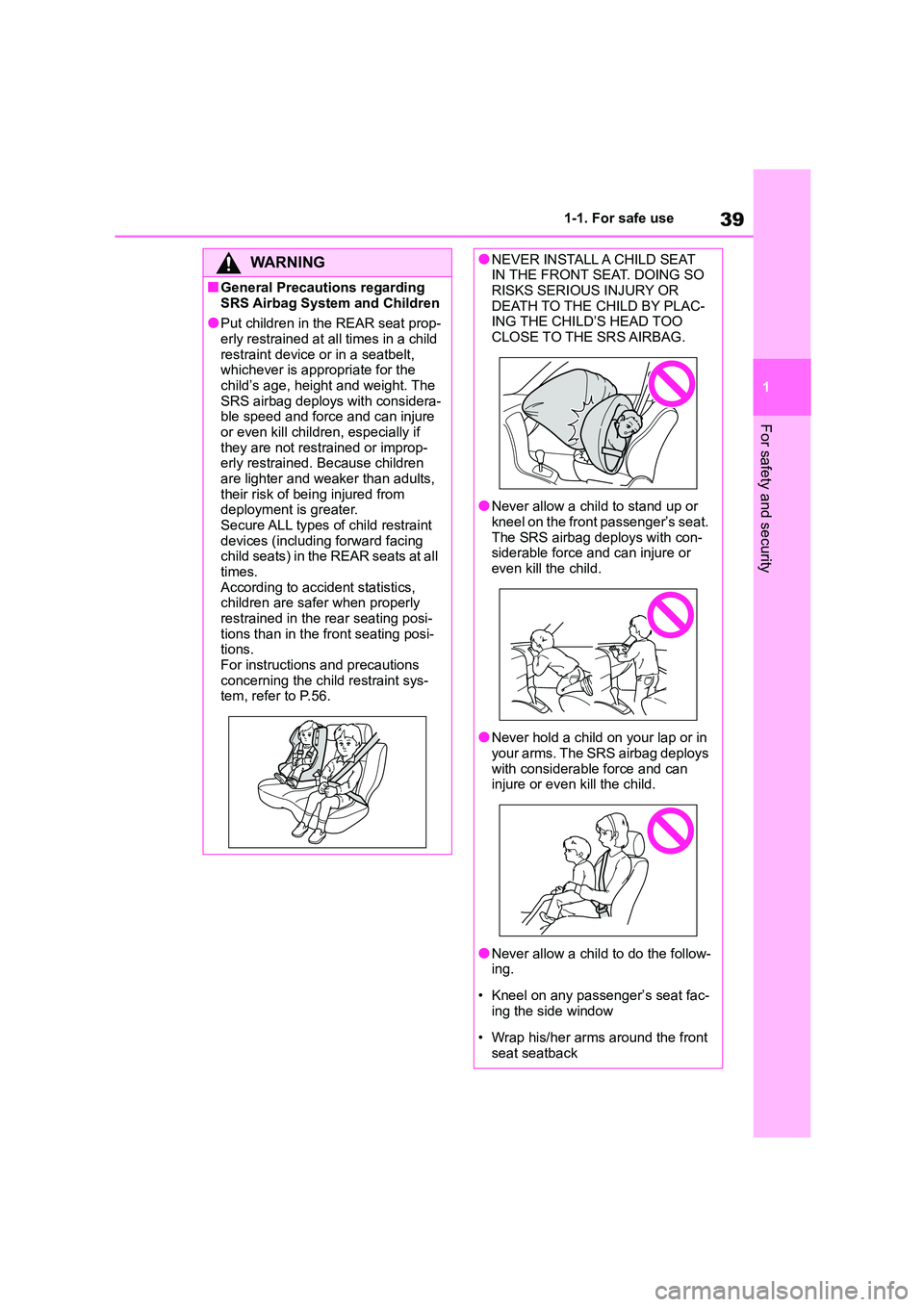
■General Precautions regarding
SRS Airbag System and Children
●Put children in the REAR seat prop- erly restrained at all times in a child
restraint device or in a seatbelt,
whichever is appropriate for the child’s age, height and weight. The
SRS airbag deploys with considera-
ble speed and force and can injure
or even kill children, especially if they are not restrained or improp-
erly restrained. Because children
are lighter and weaker than adults, their risk of being injured from
deployment is greater.
Secure ALL types of child restraint devices (including forward facing
child seats) in the REAR seats at all
times. According to accident statistics,
children are safer when properly
restrained in the rear seating posi- tions than in the front seating posi-
tions.
For instructions and precautions concerning the child restraint sys-
tem, refer to P.56.
●NEVER INSTALL A CHILD SEAT IN THE FRONT SEAT. DOING SO
RISKS SERIOUS INJURY OR
DEATH TO THE CHILD BY PLAC- ING THE CHILD’S HEAD TOO
CLOSE TO THE SRS AIRBAG.
●Never allow a child to stand up or
kneel on the front passenger’s seat.
The SRS airbag deploys with con- siderable force and can injure or
even kill the child.
●Never hold a child on your lap or in
your arms. The SRS airbag deploys
with considerable force and can injure or even kill the child.
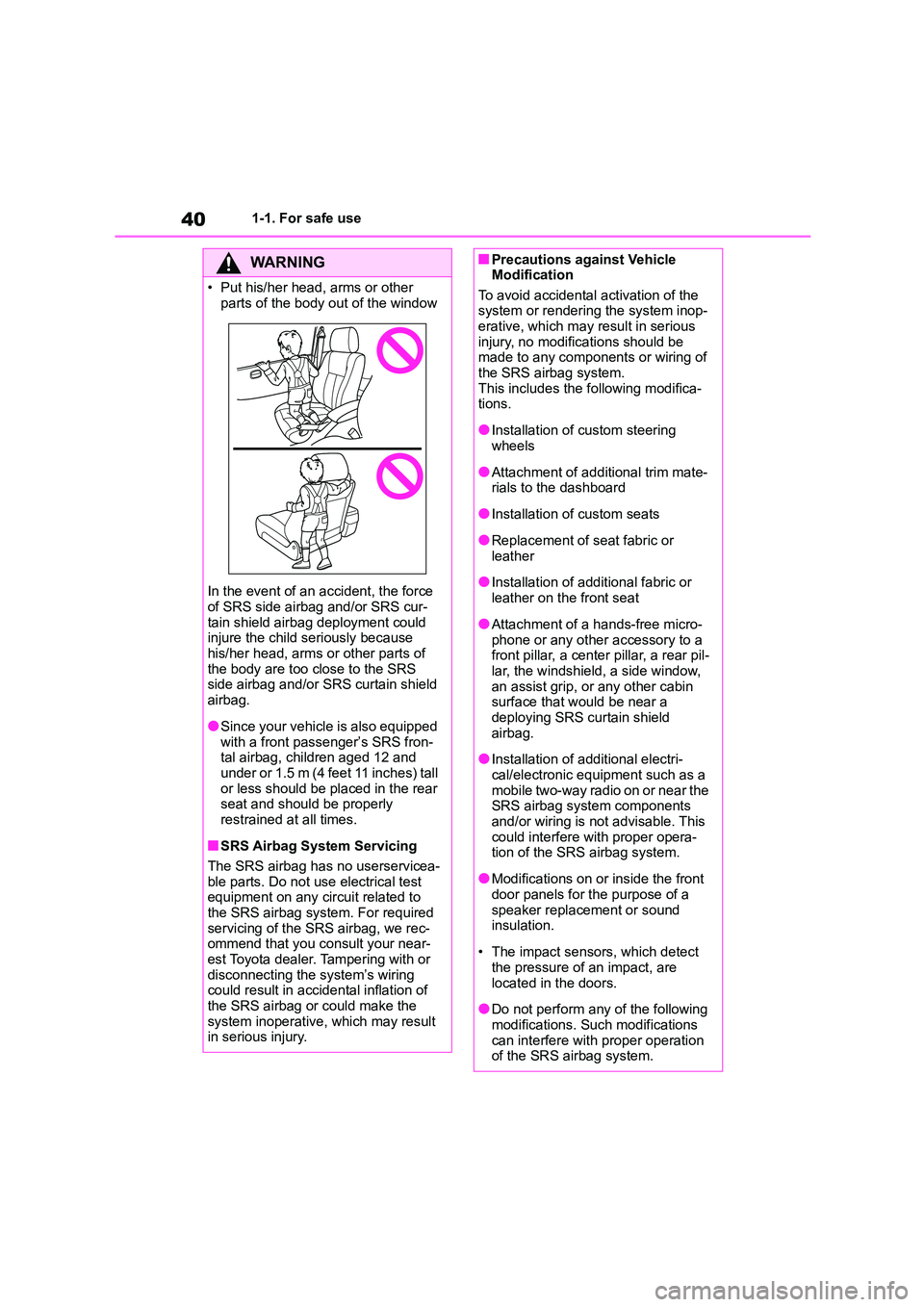
●Never allow a child to do the follow-ing.
• Kneel on any passenger’s seat fac-
ing the side window
• Wrap his/her arms around the front
seat seatback
Page 42 of 582
401-1. For safe use
WA R N I N G
• Put his/her head, arms or other
parts of the body out of the window
In the event of an accident, the force
of SRS side airbag and/or SRS cur-
tain shield airbag deployment could injure the child seriously because
his/her head, arms or other parts of
the body are too close to the SRS side airbag and/or SRS curtain shield
airbag.
●Since your vehicle is also equipped
with a front passenger’s SRS fron-
tal airbag, children aged 12 and under or 1.5 m (4 feet 11 inches) tall
or less should be placed in the rear
seat and should be properly restrained at all times.
■SRS Airbag System Servicing
The SRS airbag has no userservicea-
ble parts. Do not use electrical test
equipment on any circuit related to the SRS airbag system. For required
servicing of the SRS airbag, we rec-
ommend that you consult your near- est Toyota dealer. Tampering with or
disconnecting the system’s wiring
could result in accidental inflation of the SRS airbag or could make the
system inoperative, which may result
in serious injury.
■Precautions against Vehicle Modification
To avoid accidental activation of the
system or rendering the system inop- erative, which may result in serious
injury, no modifications should be
made to any components or wiring of the SRS airbag system.
This includes the following modifica-
tions.
●Installation of custom steering
wheels
●Attachment of additional trim mate-
rials to the dashboard
●Installation of custom seats
●Replacement of seat fabric or
leather
●Installation of additional fabric or
leather on the front seat
●Attachment of a hands-free micro-
phone or any other accessory to a
front pillar, a center pillar, a rear pil- lar, the windshield, a side window,
an assist grip, or any other cabin
surface that would be near a deploying SRS curtain shield
airbag.
●Installation of additional electri-
cal/electronic equipment such as a
mobile two-way radio on or near the SRS airbag system components
and/or wiring is not advisable. This
could interfere with proper opera- tion of the SRS airbag system.
●Modifications on or inside the front door panels for the purpose of a
speaker replacement or sound
insulation.
• The impact sensors, which detect
the pressure of an impact, are
located in the doors.
●Do not perform any of the following
modifications. Such modifications can interfere with proper operation
of the SRS airbag system.
Page 49 of 582

47
1
1-1. For safe use
For safety and security
3 If wearing excessive layers of cloth-
ing, the front passenger should remove any unnecessary items
before sitting in the front passen-
ger’s seat, or should sit in a rear seat.
4 Turn the engine switch to ON and
wait 6 seconds to allow the system
to complete self-checking. Following the system check, both indicators
turn off for 2 seconds. Now, the ON
indicator should illuminate while the OFF indicator remains off.
If the OFF indicator still remains illumi-
nated while the ON indicator remains off, ask the occupant to move to the rear
seat. We recommend that you immedi-
ately contact your Toyota dealer for an inspection.
■If the seatbelt buckle switch and/or
front passenger’s occupant detec-
tion system have failed
If the seatbelt buckle switch and/or front
passenger’s occupant detection system
have failed, the SRS warning light will illuminate. We recommend that you
have the system inspected by your
Toyota dealer immediately if the SRS warning light illuminates.
■When to contact your Toyota dealer
or another service center
If your vehicle has sustained impact, this may affect the proper function of the
front passenger’s SRS frontal airbag
system. We recommend that you have your vehicle inspected at your Toyota
dealer. Do not use the front passenger’s
seat while driving the vehicle to your Toyota dealer or another service center.
■System operation
The SRS airbags can function only
when the engine switch is in the ON.
When SRS airbags deploy, a sudden, fairly loud inflation noise will be heard
and some smoke will be released.
These occurrences are a normal result of the deployment. This smoke does not
indicate a fire in the vehicle.
WA R N I N G
■Warning labels
Warning labels are located on both
sides of the front passenger’s sun visor. Carefully read the description in
P.56.
■When using a child restraint sys-
tem
NEVER INSTALL A CHILD SEAT IN
THE FRONT SEAT EVEN IF THE FRONT PASSENGER’S SRS FRON-
TAL AIRBAG IS DEACTIVATED. Be
sure to install it in the REAR seat in a correct manner. Also, it is strongly
recommended that any forward facing
child seat or booster seat be installed in the REAR seat, and that even chil-
dren who have outgrown a child
restraint system be al so seated in the REAR seat. This is because children
sitting in the front passenger’s seat
may be killed or severely injured should the front passenger’s SRS
frontal airbag deploy. REAR seats are
the safest place for children.
■General Precautions regarding
front passenger’s SRS frontal airbag
When the front passenger’s seat is
occupied by an adult, do not place anything (shoes, umbrella, etc.) under
the front passenger’s seat. Doing so
may deactivate the front passenger’s SRS frontal airbag despite the fact
that the seat is occupied by an adult.
This may result in personal injury.
●Do not allow the rear seat occupant
to lift the front passenger's seat cushion using his/her feet.
●Do not squeeze any article between the front passenger's seat and side
trim/pillar, door or center console
box. This may lift the seat cushion.