fuel TOYOTA GT86 2012 User Guide
[x] Cancel search | Manufacturer: TOYOTA, Model Year: 2012, Model line: GT86, Model: TOYOTA GT86 2012Pages: 448, PDF Size: 13.47 MB
Page 83 of 448
83 1-5. Refueling
1
Before driving
FT86_EE
CAUTION
Refueling the vehicle
Observe the following precautions while refueling the vehicle.
Failure to do so may result in death or serious injury.
Do not handle fuel indoors.
After exiting the vehicle and before opening the fuel door, touch an
unpainted metal surface to discharge any static electricity. It is important to
discharge static electricity before refueling because sparks resulting from
static electricity can cause fuel vapors to ignite while refueling.
Always hold the grips on the fuel tank cap and turn it slowly to remove it.
A whooshing sound may be heard when the fuel tank cap is loosened.
Wait until the sound cannot be heard before fully removing the cap.
In hot weather, pressurized fuel may spray out of the filler neck and cause
injury.
Do not allow anyone that has not discharged static electricity from their
body to come close to an open fuel tank.
Do not allow others to approach the area of the vehicle near the fuel filler
pipe while refueling is in progress.
Do not inhale vaporized fuel.
Fuel contains substances that are harmful if inhaled.
Do not smoke while refueling the vehicle.
Doing so may cause the fuel to ignite and cause a fire.
Do not return to the vehicle or touch any person or object that is statically
charged.
This may cause static electricity to build up, resulting in a possible ignition
hazard.
Page 84 of 448
84 1-5. Refueling
FT86_EE
CAUTION
When refueling
Observe the following precautions to prevent fuel overflowing from the fuel
tank:
Securely insert the fuel nozzle into the fuel filler neck.
Stop filling the tank after the fuel nozzle automatically clicks off.
Do not top off the fuel tank.
Observe other precautions that are posted at the service station.
Turn the cap to the right until it clicks to ensure that it is fully tightened. If
the cap is not securely tightened, fuel spillage could occur in the event of
an accident, creating a fire hazard.
When replacing the fuel cap
Do not use anything but a genuine Toyota fuel tank cap designed for your
vehicle. Doing so may cause a fire or other incident which may result in
death or serious injury.
NOTICE
Refueling
Do not spill fuel during refueling.
Doing so may damage the vehicle, such as causing the emission control
system to operate abnormally or damaging fuel system components or the
vehicle's painted surface.
Never add any cleaning agents to the fuel tank. The addition of a cleaning
agent may cause damage to the fuel system.
Immediately put fuel in the tank whenever the low fuel warning light illumi-
nates. Engine misfires as a result of an empty tank could cause damage to
the engine.
Page 155 of 448
![TOYOTA GT86 2012 User Guide 155 2-1. Driving procedures
2
When driving
FT86_EE
New vehicle break-in driving (the first 1600 km [1000 miles])
The performance and long life of your vehicle are dependent on how you
handle and ca](/img/14/60007/w960_60007-154.png "TOYOTA GT86 2012 User Guide 155 2-1. Driving procedures
2
When driving
FT86_EE
New vehicle break-in driving (the first 1600 km [1000 miles])
The performance and long life of your vehicle are dependent on how you
handle and ca")
155 2-1. Driving procedures
2
When driving
FT86_EE
New vehicle break-in driving (the first 1600 km [1000 miles])
The performance and long life of your vehicle are dependent on how you
handle and care for your vehicle while it is new. Follow these instructions
during the first 1600 km (1000 miles):
Do not allow the engine speed to exceed 4000 rpm except in an emer-
gency.
Do not drive at one constant engine or vehicle speed for a long time,
either fast or slow.
Avoid starting suddenly and rapid acceleration, except in an emergency.
Avoid hard braking, except in an emergency.
The same break-in procedures should be applied to an overhauled
engine, newly mounted engine or when brake pads or brake linings are
replaced with new ones.
Drum-in-disc type parking brake system
Your vehicle has a drum-in-disc type parking brake system. This type of
brake system needs bedding-down of the brake shoes periodically or when-
ever the parking brake shoes and/or drum are replaced. Have any autho-
rized Toyota dealer or repairer, or another duly qualified and equipped
professional perform the bedding down.
After the engine starts
In order to secure a rich exhaust sound when starting the vehicle and envi-
ronmental performance, air intake and exhaust sounds become loud and
vibrations may increase for a little while after the engine starts. This is not a
malfunction.
Operating your vehicle in a foreign country
Comply with the relevant vehicle registration laws and confirm the availability
of the correct fuel. (P. 419)
Page 185 of 448
185 2-1. Driving procedures
2
When driving
FT86_EE
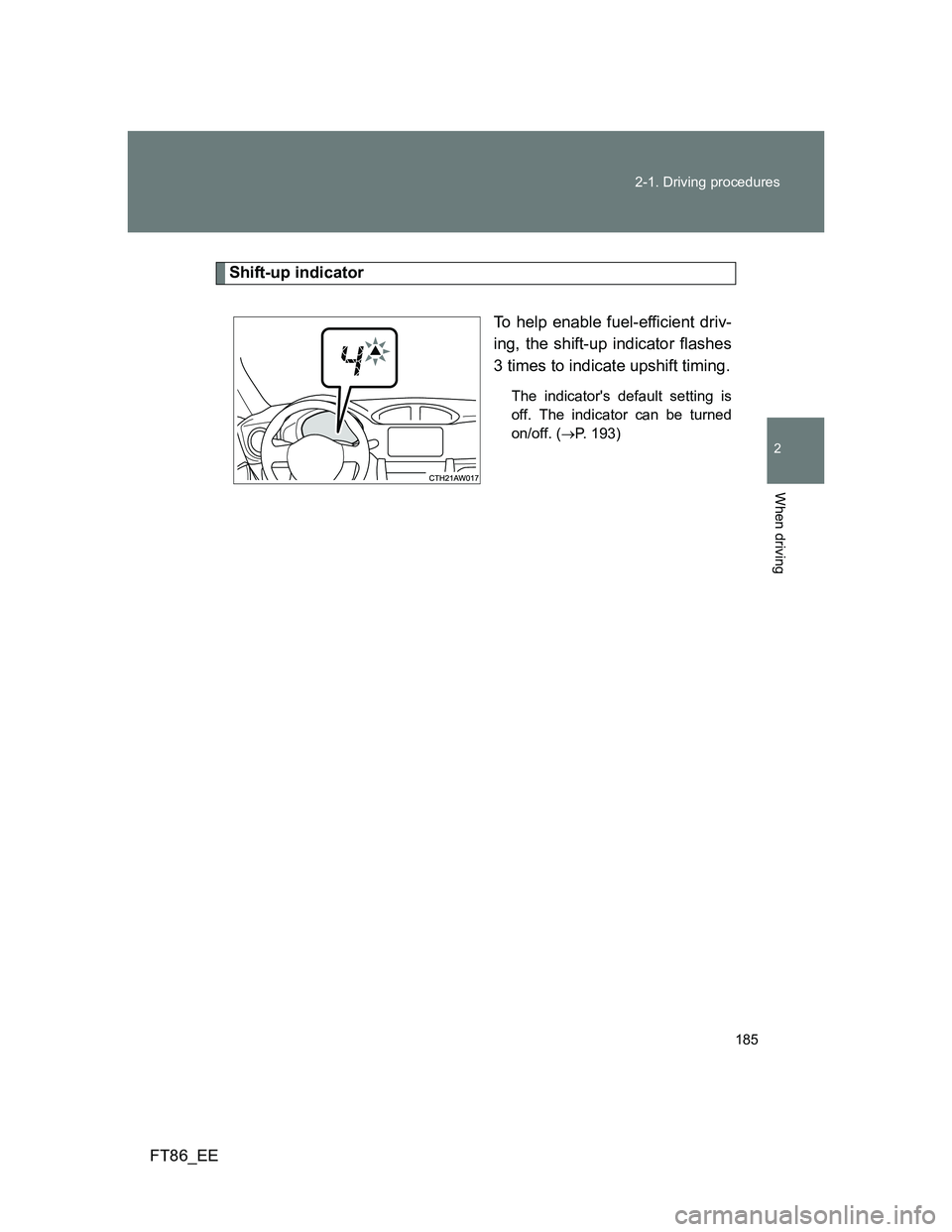
Shift-up indicator
To help enable fuel-efficient driv-
ing, the shift-up indicator flashes
3 times to indicate upshift timing.
The indicator's default setting is
off. The indicator can be turned
on/off. (
P. 193)
Page 190 of 448
190
FT86_EE
2-2. Instrument cluster
Gauges and meters
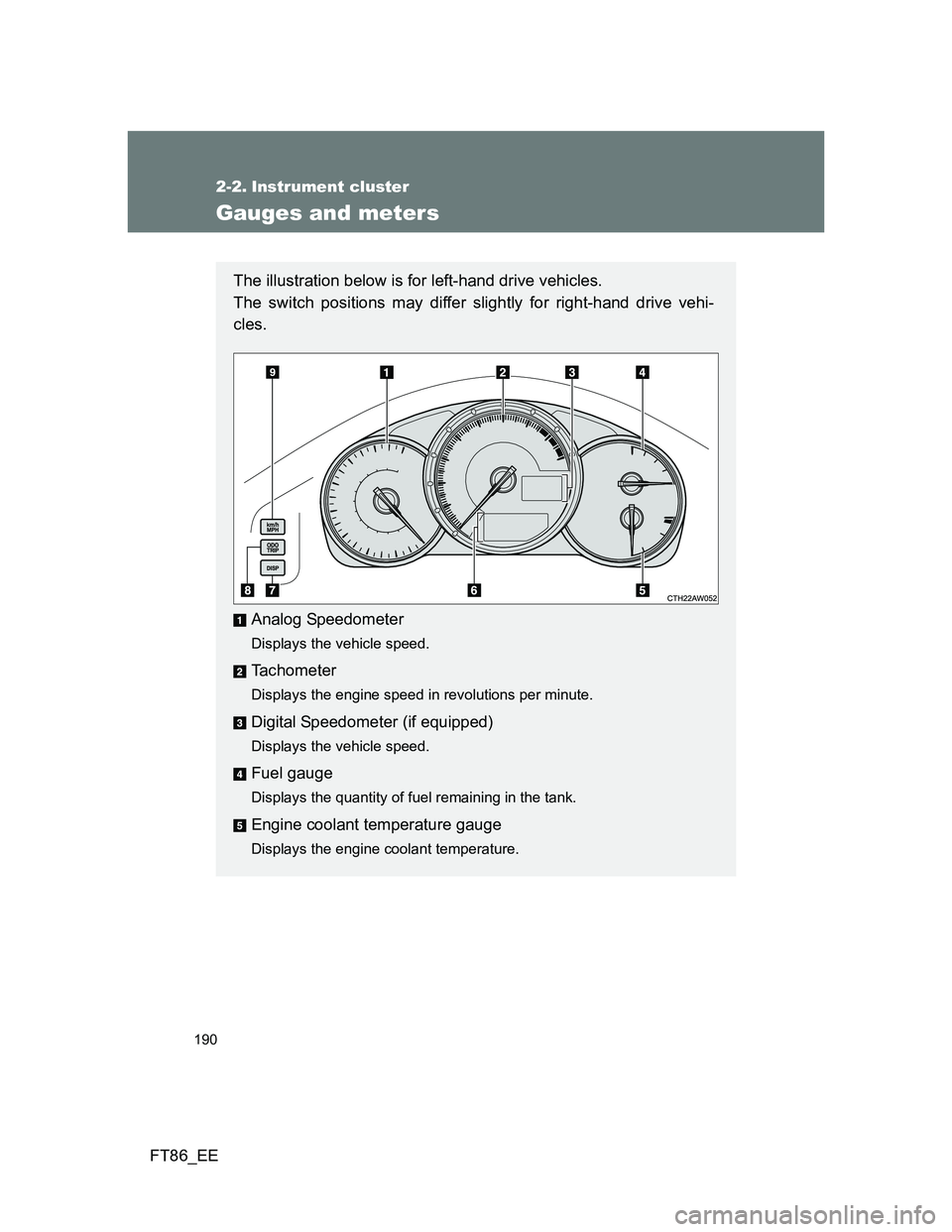
The illustration below is for left-hand drive vehicles.
The switch positions may differ slightly for right-hand drive vehi-
cles.
Analog Speedometer
Displays the vehicle speed.
Tachometer
Displays the engine speed in revolutions per minute.
Digital Speedometer (if equipped)
Displays the vehicle speed.
Fuel gauge
Displays the quantity of fuel remaining in the tank.
Engine coolant temperature gauge
Displays the engine coolant temperature.
Page 200 of 448
200
2-2. Instrument cluster
FT86_EE
Multi-infor mation display
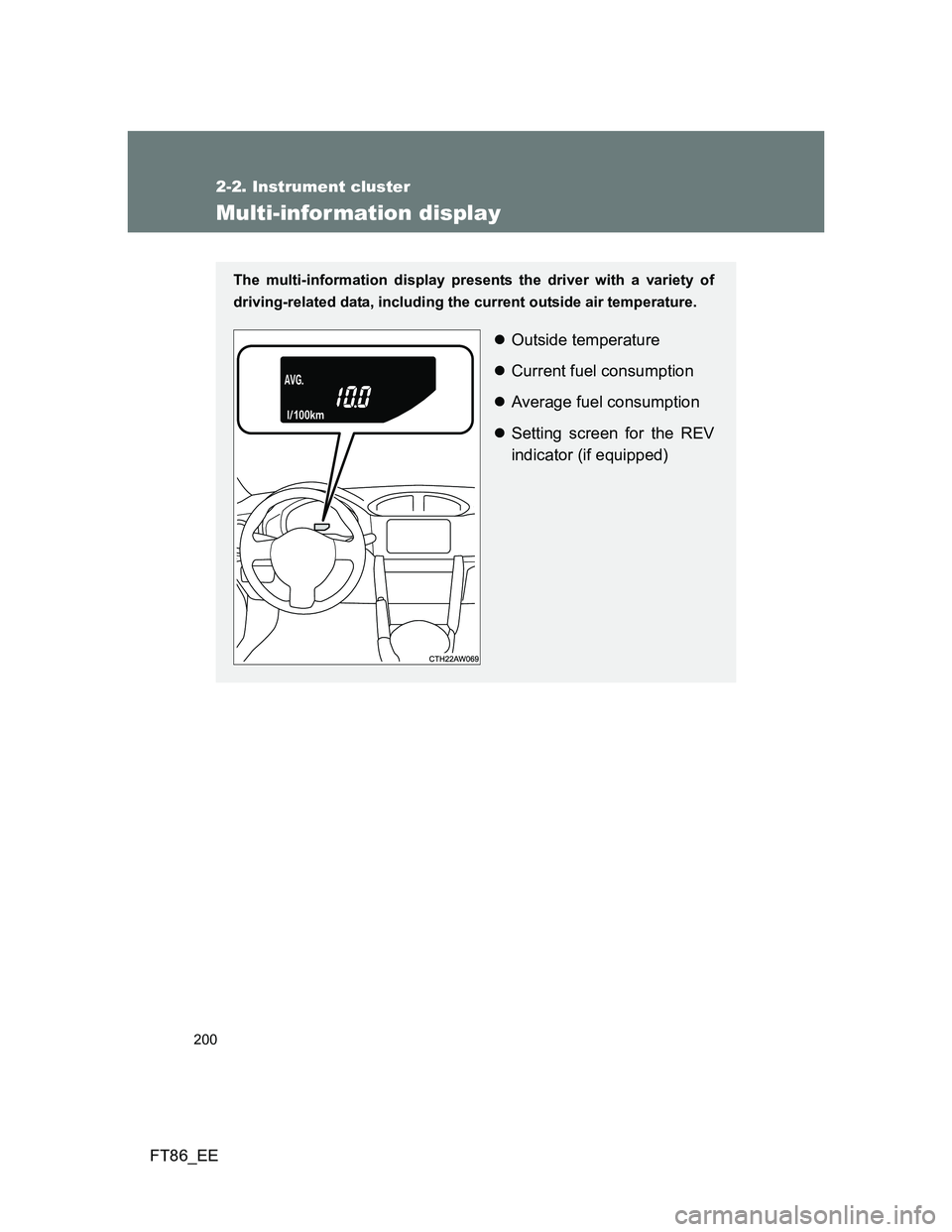
The multi-information display presents the driver with a variety of
driving-related data, including the current outside air temperature.
Outside temperature
Current fuel consumption
Average fuel consumption
Setting screen for the REV
indicator (if equipped)
Page 201 of 448
201 2-2. Instrument cluster
2
When driving
FT86_EE
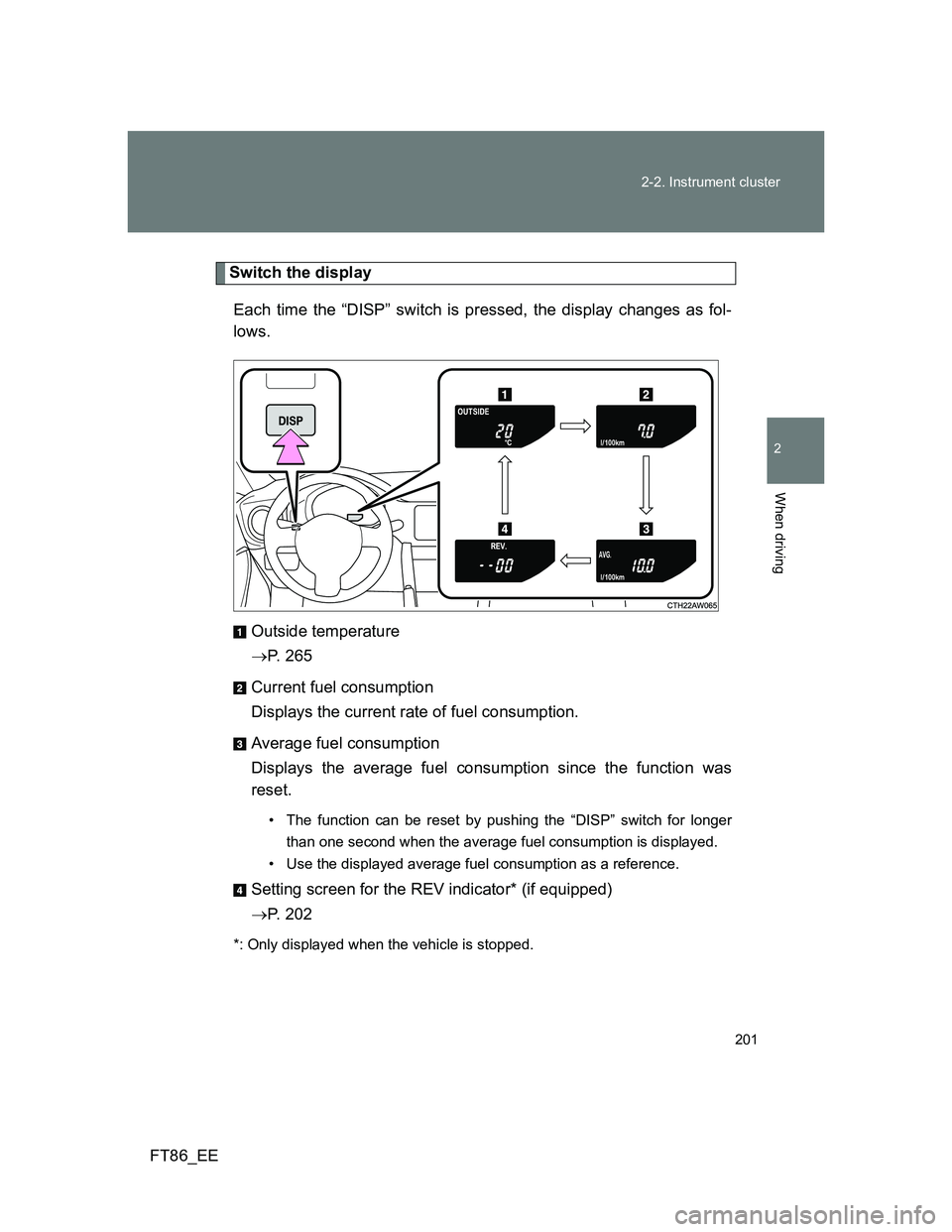
Switch the display
Each time the “DISP” switch is pressed, the display changes as fol-
lows.
Outside temperature
P. 265
Current fuel consumption
Displays the current rate of fuel consumption.
Average fuel consumption
Displays the average fuel consumption since the function was
reset.
• The function can be reset by pushing the “DISP” switch for longer
than one second when the average fuel consumption is displayed.
• Use the displayed average fuel consumption as a reference.
Setting screen for the REV indicator* (if equipped)
P. 202
*: Only displayed when the vehicle is stopped.
Page 227 of 448
227
2
When driving
FT86_EE
2-5. Driving information
Cargo and luggage
CAUTION
Things that must not be carried in the trunk
The following things may cause a fire if loaded in the trunk:
Receptacles containing gasoline
Aerosol cans
Take notice of the following information about storage precautions,
cargo capacity and load:
Stow cargo and luggage in the trunk whenever possible.
Be sure all items are secured in place.
To maintain vehicle balance while driving, position luggage
evenly within the luggage compartment.
For better fuel economy, do not carry unnecessary weight.
Page 279 of 448
279 4-1. Maintenance and care
4
Maintenance and care
FT86_EE
Automatic car washes
Fold the mirrors and remove the antenna before washing the vehicle.
Start washing from the front of the vehicle. Make sure to re-install the
antenna and extend the mirrors before driving.
Brushes used in automatic car washes may scratch the vehicle surface
and harm your vehicle’s paint.
Vehicles with a rear spoiler: In certain automatic car washes, the rear
spoiler may interfere with machine operation. This may prevent the vehi-
cle from being cleaned properly or result in damage to the rear spoiler.
High pressure car washes
Do not allow the nozzles of the car wash to come within close proximity
of the windows.
Before car wash, check that the fuel filler door on your vehicle is closed
properly.
Aluminum wheels
Remove any dirt immediately by using a neutral detergent. Do not use
hard brushes or abrasive cleaners. Do not use strong or harsh chemical
cleaners. Use the same mild detergent and wax as used on the paint.
Do not use detergent on the wheels when they are hot, for example after
driving for long distance in the hot weather.
Wash detergent from the wheels immediately after use.
Parts containing resin such as the bumper
Do not scrub with abrasive cleaners.
Page 292 of 448
292 4-3. Do-it-yourself maintenance
FT86_EE
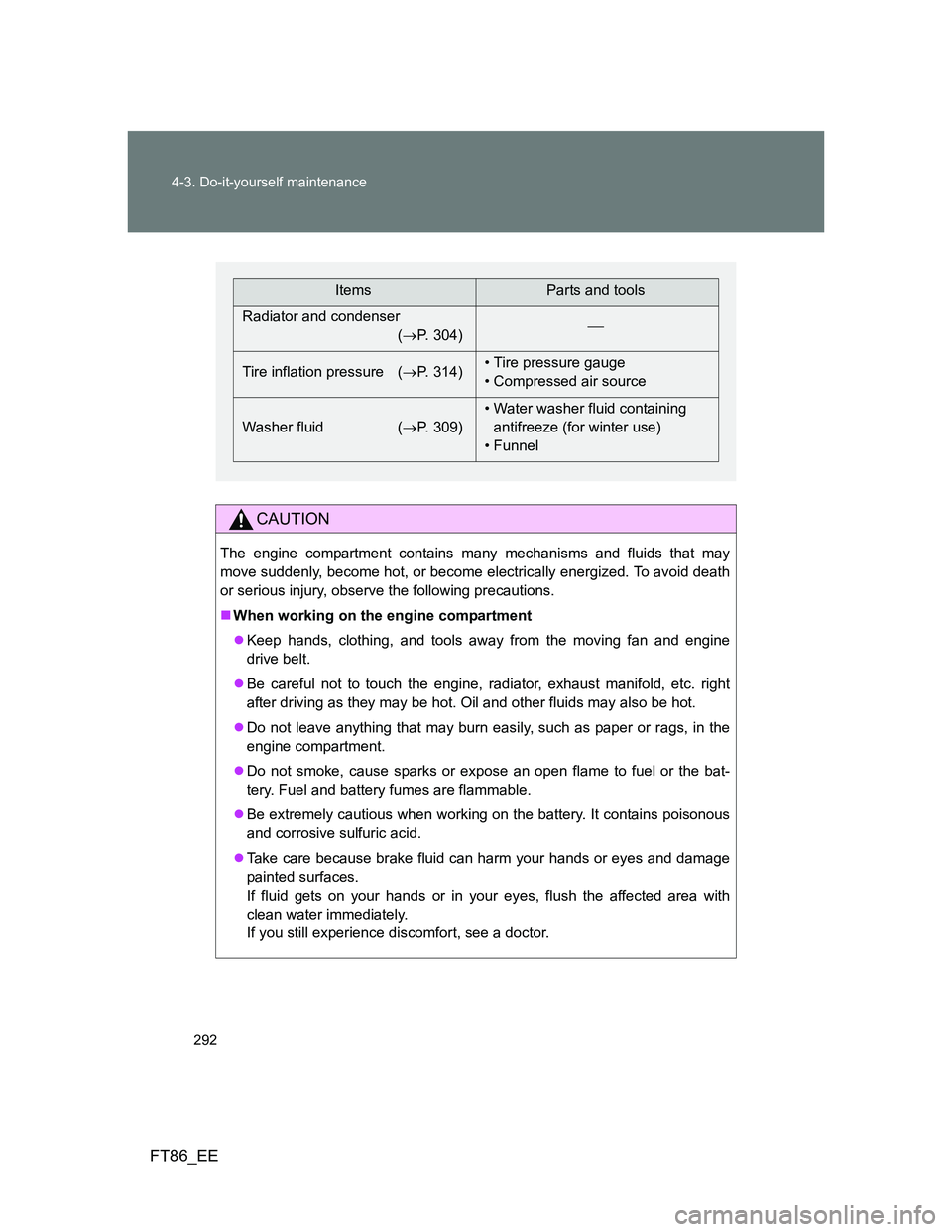
CAUTION
The engine compartment contains many mechanisms and fluids that may
move suddenly, become hot, or become electrically energized. To avoid death
or serious injury, observe the following precautions.
When working on the engine compartment
Keep hands, clothing, and tools away from the moving fan and engine
drive belt.
Be careful not to touch the engine, radiator, exhaust manifold, etc. right
after driving as they may be hot. Oil and other fluids may also be hot.
Do not leave anything that may burn easily, such as paper or rags, in the
engine compartment.
Do not smoke, cause sparks or expose an open flame to fuel or the bat-
tery. Fuel and battery fumes are flammable.
Be extremely cautious when working on the battery. It contains poisonous
and corrosive sulfuric acid.
Take care because brake fluid can harm your hands or eyes and damage
painted surfaces.
If fluid gets on your hands or in your eyes, flush the affected area with
clean water immediately.
If you still experience discomfort, see a doctor.
ItemsParts and tools
Radiator and condenser
(P. 304)
Tire inflation pressure (P. 314)• Tire pressure gauge
• Compressed air source
Washer fluid (P. 309)• Water washer fluid containing
antifreeze (for winter use)
• Funnel