ECU TOYOTA GT86 2012 Owner's Manual
[x] Cancel search | Manufacturer: TOYOTA, Model Year: 2012, Model line: GT86, Model: TOYOTA GT86 2012Pages: 448, PDF Size: 13.47 MB
Page 147 of 448
147 1-7. Safety information
1
Before driving
FT86_EE
CAUTION
When installing a child restraint system
If child restraint system regulations exist in the country where you reside,
please contact any authorized Toyota dealer or repairer, or another duly
qualified and equipped professional for the child restraint system installa-
tion.
When a junior seat is installed, always ensure that the shoulder belt is
positioned across the center of the child's shoulder. The belt should be
kept away from the child's neck, but not so that it could fall off the child's
shoulder. Failure to do so may result in death or serious injury in the event
of sudden braking, sudden swerving or an accident.
Do not allow children to play with the seat belt. If the seat belt becomes
twisted around a child’s neck, choking or other serious injuries may result
in death.
If this occurs and the buckle cannot be unfastened, scissors should be
used to cut the belt.
Ensure that the belt and plate are securely locked and the seat belt is not
twisted.
Shake the child restraint system left and right, and forward and backward
to ensure that it has been securely installed.
When adjusting the front passenger seat position after installing a child
restraint system, do so slowly.
Follow all installation instructions provided by the child restraint system
manufacturer.
To correctly attach a child restraint system to the anchors
When using the lower anchors, be sure that there are no foreign objects
around the anchors and that the seat belt is not caught behind the child
restraint system. Make sure the child restraint system is securely attached,
or it may cause death or serious injury to the child or other passengers in the
event of sudden braking, sudden swerve or an accident.
Page 155 of 448
![TOYOTA GT86 2012 Owners Manual 155 2-1. Driving procedures
2
When driving
FT86_EE
New vehicle break-in driving (the first 1600 km [1000 miles])
The performance and long life of your vehicle are dependent on how you
handle and ca](/img/14/60007/w960_60007-154.png "TOYOTA GT86 2012 Owners Manual 155 2-1. Driving procedures
2
When driving
FT86_EE
New vehicle break-in driving (the first 1600 km [1000 miles])
The performance and long life of your vehicle are dependent on how you
handle and ca")
155 2-1. Driving procedures
2
When driving
FT86_EE
New vehicle break-in driving (the first 1600 km [1000 miles])
The performance and long life of your vehicle are dependent on how you
handle and care for your vehicle while it is new. Follow these instructions
during the first 1600 km (1000 miles):
Do not allow the engine speed to exceed 4000 rpm except in an emer-
gency.
Do not drive at one constant engine or vehicle speed for a long time,
either fast or slow.
Avoid starting suddenly and rapid acceleration, except in an emergency.
Avoid hard braking, except in an emergency.
The same break-in procedures should be applied to an overhauled
engine, newly mounted engine or when brake pads or brake linings are
replaced with new ones.
Drum-in-disc type parking brake system
Your vehicle has a drum-in-disc type parking brake system. This type of
brake system needs bedding-down of the brake shoes periodically or when-
ever the parking brake shoes and/or drum are replaced. Have any autho-
rized Toyota dealer or repairer, or another duly qualified and equipped
professional perform the bedding down.
After the engine starts
In order to secure a rich exhaust sound when starting the vehicle and envi-
ronmental performance, air intake and exhaust sounds become loud and
vibrations may increase for a little while after the engine starts. This is not a
malfunction.
Operating your vehicle in a foreign country
Comply with the relevant vehicle registration laws and confirm the availability
of the correct fuel. (P. 419)
Page 159 of 448
159 2-1. Driving procedures
2
When driving
FT86_EE
CAUTION
If you hear a squealing or scraping noise (brake pad wear indicators)
Have the brake pads checked and replaced by any authorized Toyota dealer
or repairer, or another duly qualified and equipped professional as soon as
possible.
Rotor damage may result if the pads are not replaced when needed.
It is dangerous to drive the vehicle when the wear limits of the brake pads
and/or those of the brake discs are exceeded.
When the vehicle is stopped
Do not race the engine.
If the vehicle is in any gear other than P (vehicles with an automatic trans-
mission only) or N, the vehicle may accelerate suddenly and unexpectedly,
causing an accident.
Do not leave the vehicle with the engine running for a long time.
If such a situation cannot be avoided, park the vehicle in an open space
and check that exhaust fumes do not enter the vehicle interior.
On vehicles with an automatic transmission, in order to prevent accidents
due to the vehicle rolling away, always keep depressing the brake pedal
while the engine is running, and apply the parking brake as necessary.
If the vehicle is stopped on an incline, in order to prevent accidents caused
by the vehicle rolling forward or backward, always depress the brake pedal
and securely apply the parking brake as needed.
Avoid revving or racing the engine.
Running the engine at high speed while the vehicle is stopped may cause
the exhaust system to overheat, which could result in a fire if combustible
material is nearby.
Page 162 of 448
162 2-1. Driving procedures
FT86_EE
CAUTION
When braking
When the brakes are wet, drive more cautiously.
Braking distance increases when the brakes are wet, and this may cause
one side of the vehicle to brake differently than the other side. Also, the
parking brake may not securely hold the vehicle.
If the power brake assist function does not operate, do not follow other
vehicles closely and avoid hills or sharp turns that require braking.
In this case, braking is still possible, but the brake pedal should be
depressed more firmly than usual. Also, the braking distance will increase.
Do not pump the brake pedal if the engine stalls.
Each push on the brake pedal uses up the reserve for the power-assisted
brakes.
The brake system consists of 2 individual hydraulic systems; if one of the
systems fails, the other will still operate. In this case, the brake pedal
should be depressed more firmly than usual and the braking distance will
increase.
If this happens, do not continue to drive the vehicle. Have your brakes
fixed immediately.
Page 170 of 448
170 2-1. Driving procedures
FT86_EE
Operation of the “ENGINE START STOP” switch
When operating the “ENGINE START STOP” switch, one short, firm press is
enough. If the switch is pressed improperly, the engine may not start or the
“ENGINE START STOP” switch mode may not change. It is not necessary to
press and hold the switch.
Electronic key battery depletion
P. 4 2
Conditions affecting operation
P. 3 8
Note for the entry function
P. 3 9
If the engine does not start
The engine immobilizer system may not have been deactivated. (P. 85)
Contact any authorized Toyota dealer or repairer, or another duly qualified
and equipped professional.
Steering lock
After turning the “ENGINE START STOP” switch off and opening and closing
the doors, the steering wheel will be locked due to the steering lock function.
Operating the “ENGINE START STOP” switch again automatically cancels
the steering lock.
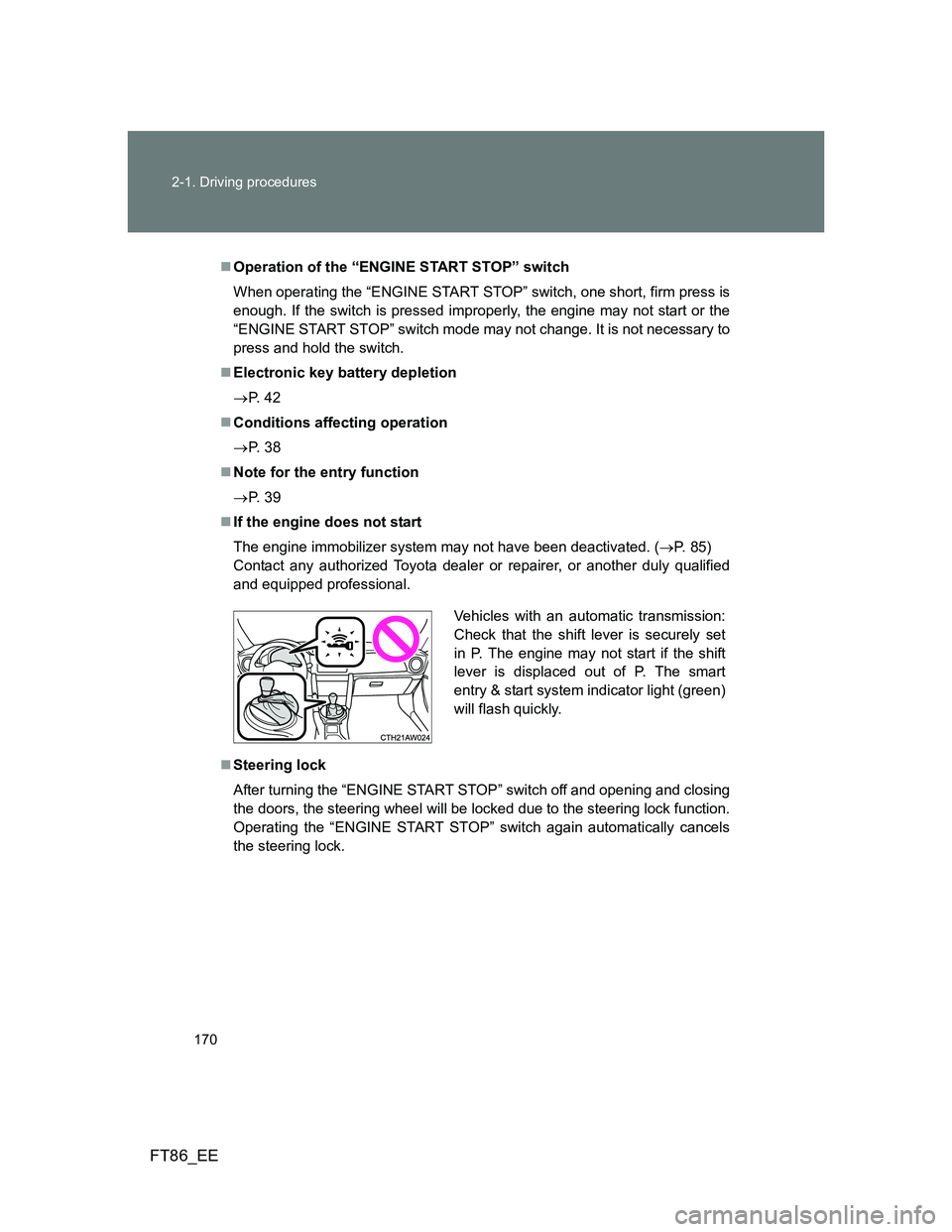
Vehicles with an automatic transmission:
Check that the shift lever is securely set
in P. The engine may not start if the shift
lever is displaced out of P. The smart
entry & start system indicator light (green)
will flash quickly.
Page 189 of 448
189
2-1. Driving procedures
2
When driving
FT86_EE
Horn
After adjusting the steering wheel
Make sure that the steering wheel is securely locked.
The horn may not sound if the steering wheel is not securely locked.
(P. 73)
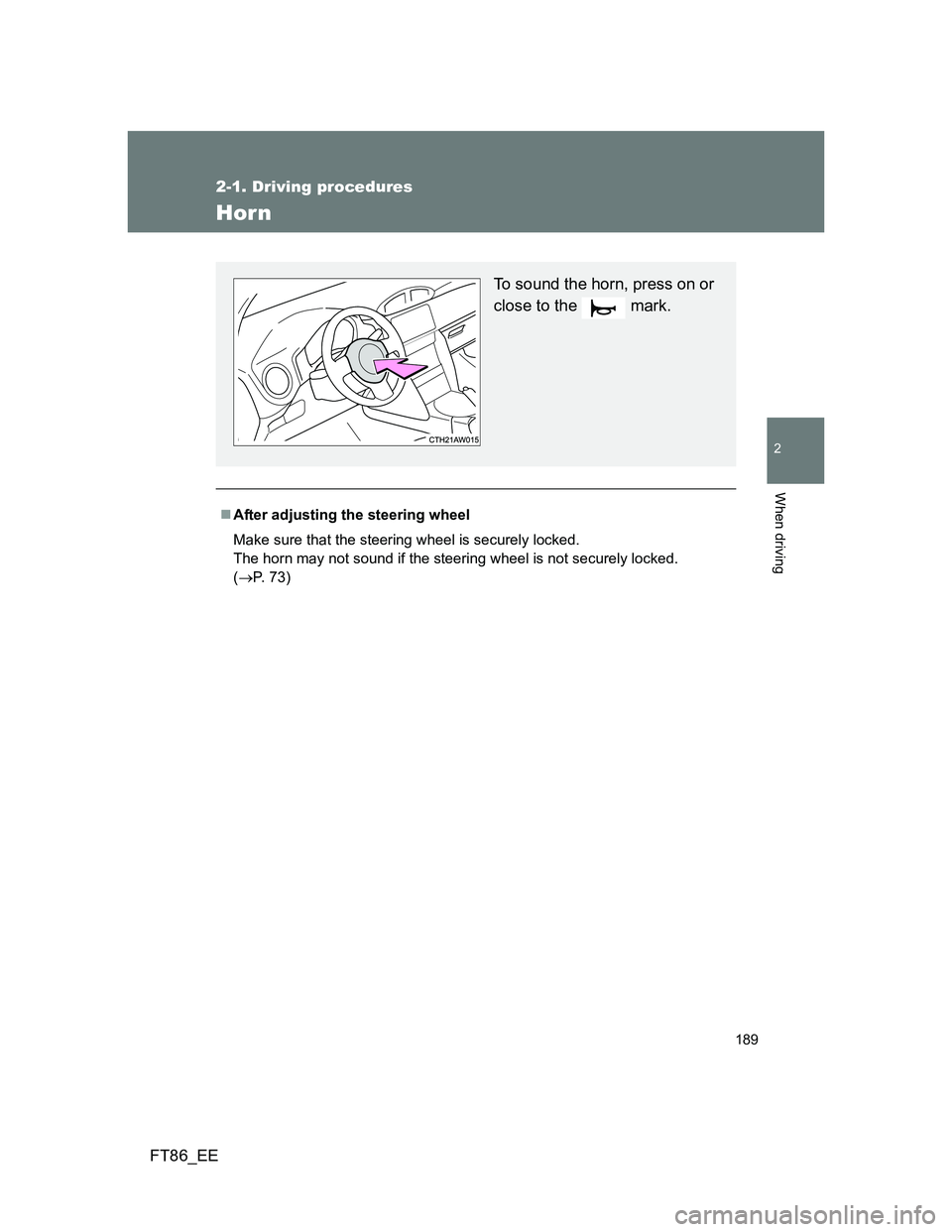
To sound the horn, press on or
close to the mark.
Page 196 of 448
196 2-2. Instrument cluster
FT86_EE
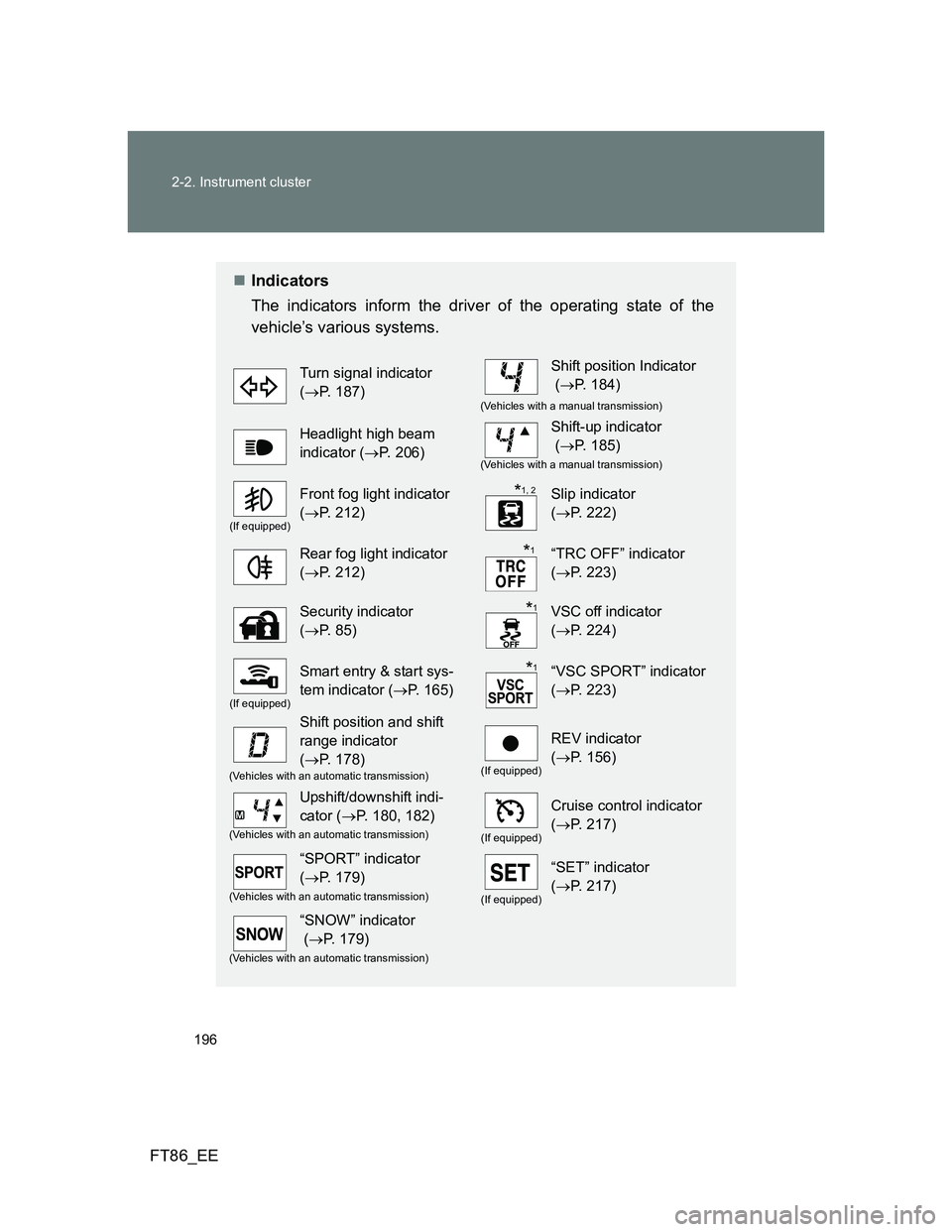
Indicators
The indicators inform the driver of the operating state of the
vehicle’s various systems.
Turn signal indicator
(P. 187)Shift position Indicator
(P. 184)
(Vehicles with a manual transmission)
Headlight high beam
indicator (P. 206)Shift-up indicator
(P. 185)
(Vehicles with a manual transmission)
(If equipped)
Front fog light indicator
(P. 212)Slip indicator
(P. 222)
Rear fog light indicator
(P. 212)“TRC OFF” indicator
(P. 223)
Security indicator
(P. 85)VSC off indicator
(P. 224)
(If equipped)
Smart entry & start sys-
tem indicator (P. 165)“VSC SPORT” indicator
(P. 223)
Shift position and shift
range indicator
(P. 178)
(If equipped)
REV indicator
(P. 156)
(Vehicles with an automatic transmission)
Upshift/downshift indi-
cator (P. 180, 182)
(If equipped)
Cruise control indicator
(P. 217)
(Vehicles with an automatic transmission)
“SPORT” indicator
(P. 179)
(If equipped)
“SET” indicator
(P. 217)
(Vehicles with an automatic transmission)
“SNOW” indicator
(P. 179)
(Vehicles with an automatic transmission)
*1, 2
*1
*1
*1
Page 212 of 448
212
2-3. Operating the lights and windshield wipers
FT86_EE
Fog light switch
The fog lights secure excellent visibility in difficult driving condi-
tions, such as in rain and fog.
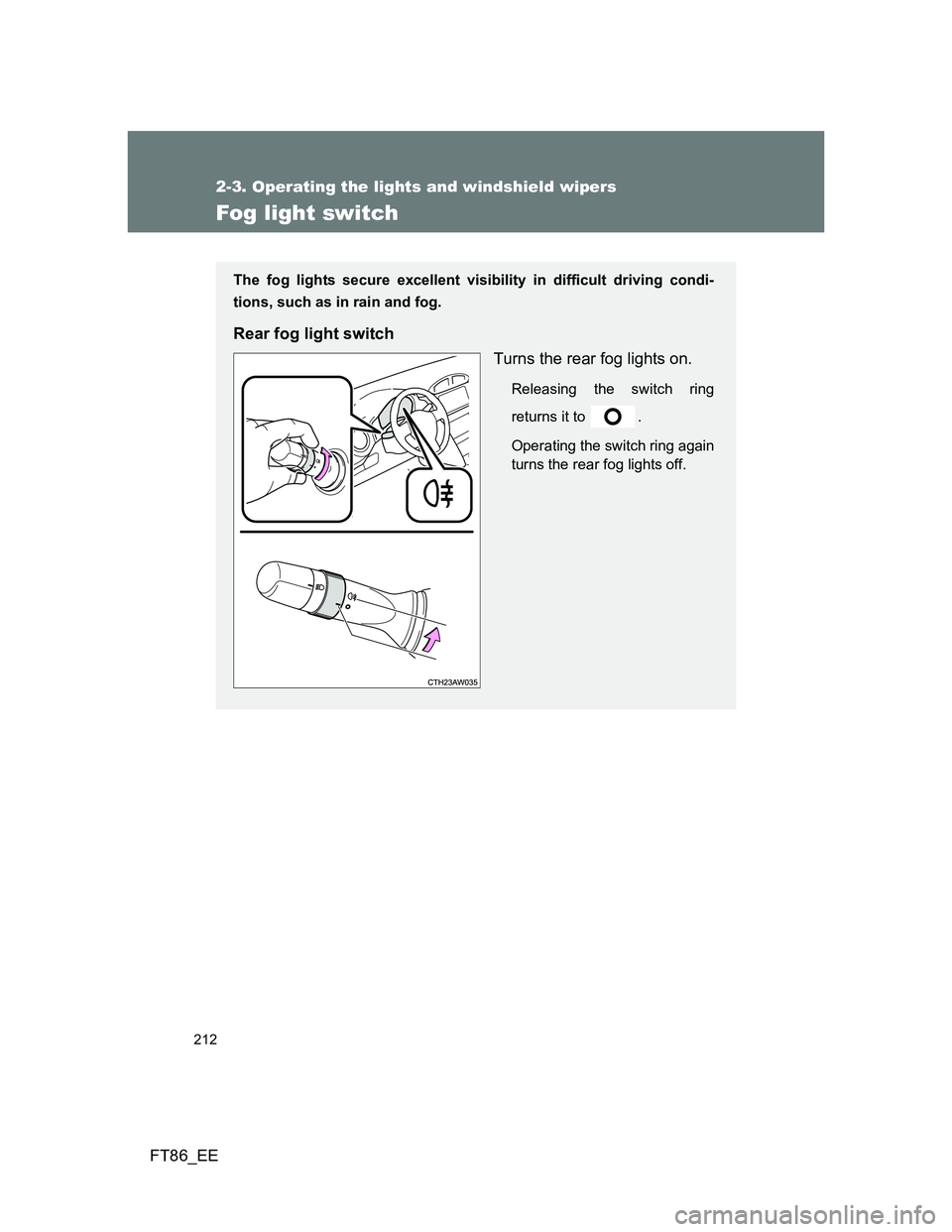
Rear fog light switch
Turns the rear fog lights on.
Releasing the switch ring
returns it to .
Operating the switch ring again
turns the rear fog lights off.
Page 223 of 448

223 2-4. Using other driving systems
2
When driving
FT86_EE
Disabling the TRC system
If the vehicle gets stuck in mud, dirt or snow, the TRC system may
reduce power from the engine to the wheels. Pressing to turn
the system off may make it easier for you to rock the vehicle in order
to free it.
To turn the TRC system off,
quickly press and release the
button.
The “TRC OFF” indicator light will
come on.
Press the button again to turn the
system back on.
“VSC SPORT” mode
Your vehicle is equipped with two types of control modes to accom-
modate various driving preferences. The control modes can be
selected with the “VSC SPORT” mode switch. Normal mode allows
secure and smooth normal driving. When the switch is pressed, “VSC
SPORT” mode is activated. Control characteristics such as the VSC
and TRC are adjusted to afford maneuverability closer to what a
driver may have imagined, while a sense of security is retained.
“VSC SPORT” mode/Normal
mode
The “VSC SPORT” indicator and
VSC off indicator come on when
in “VSC SPORT” mode.
Page 227 of 448
227
2
When driving
FT86_EE
2-5. Driving information
Cargo and luggage
CAUTION
Things that must not be carried in the trunk
The following things may cause a fire if loaded in the trunk:
Receptacles containing gasoline
Aerosol cans
Take notice of the following information about storage precautions,
cargo capacity and load:
Stow cargo and luggage in the trunk whenever possible.
Be sure all items are secured in place.
To maintain vehicle balance while driving, position luggage
evenly within the luggage compartment.
For better fuel economy, do not carry unnecessary weight.