belt TOYOTA GT86 2012 Owner's Manual
[x] Cancel search | Manufacturer: TOYOTA, Model Year: 2012, Model line: GT86, Model: TOYOTA GT86 2012Pages: 448, PDF Size: 13.47 MB
Page 97 of 448
97 1-7. Safety information
1
Before driving
FT86_EE
When you sell your vehicle
When you sell your vehicle, we urge you to explain to the buyer that it is
equipped with SRS airbags by alerting the buyer to the applicable section in
this Owner’s Manual.
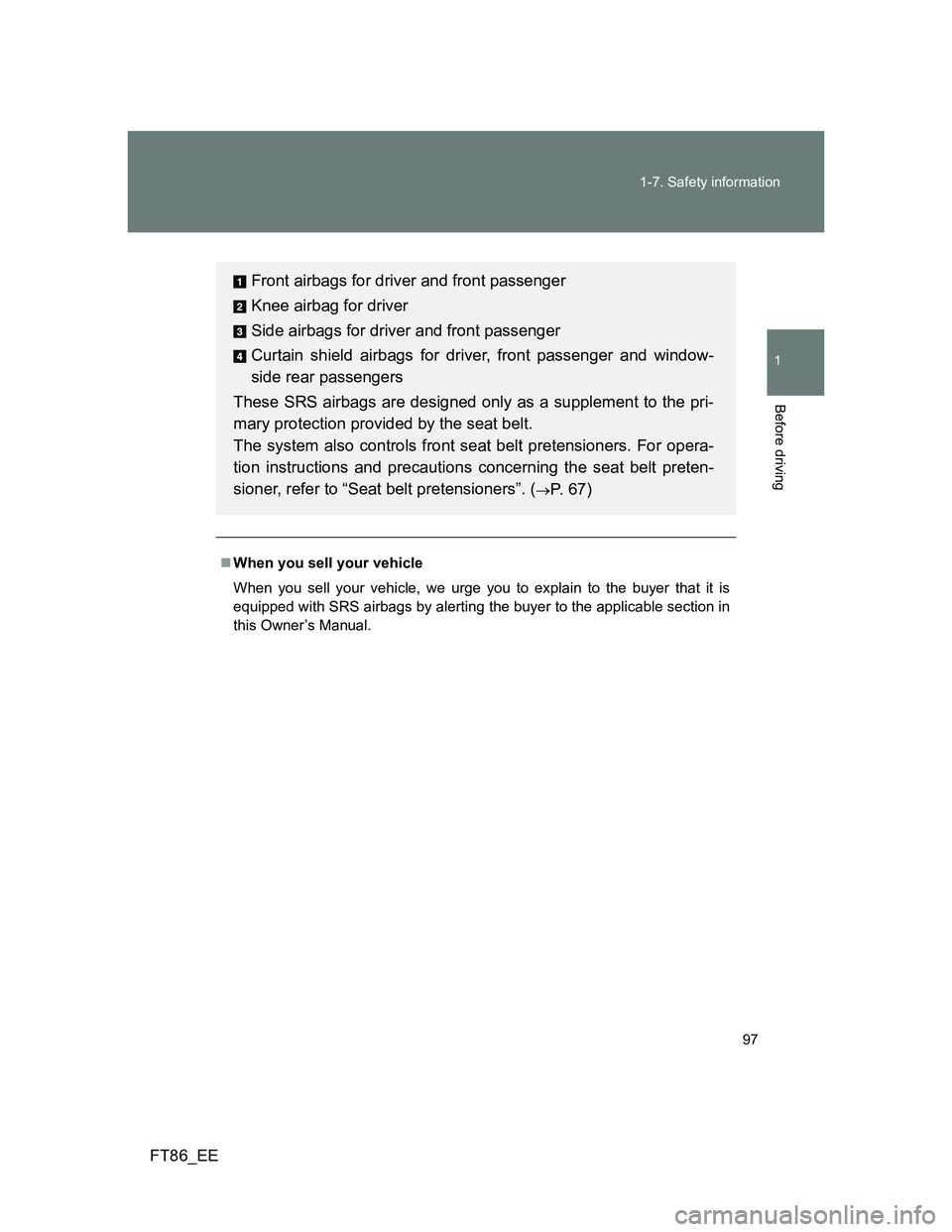
Front airbags for driver and front passenger
Knee airbag for driver
Side airbags for driver and front passenger
Curtain shield airbags for driver, front passenger and window-
side rear passengers
These SRS airbags are designed only as a supplement to the pri-
mary protection provided by the seat belt.
The system also controls front seat belt pretensioners. For opera-
tion instructions and precautions concerning the seat belt preten-
sioner, refer to “Seat belt pretensioners”. (
P. 67)
Page 98 of 448
98 1-7. Safety information
FT86_EE
CAUTION
SRS airbag
To obtain maximum protection in the event of an accident, the driver and
all passengers in the vehicle should always wear seat belts when the vehi-
cle is moving. The SRS airbag is designed only to be a supplement to the
primary protection provided by the seat belt. It does not eliminate the need
to fasten seat belts. In combination with the seat belts, it offers the best
combined protection in case of a serious accident.
Not wearing a seat belt increases the chance of severe injury or death in a
crash even when the vehicle has the SRS airbag.
For instructions and precautions concerning the seat belt system, refer to
“Seat belts”. (P. 66)
Do not sit or lean unnecessarily close to the SRS airbag. Because the
SRS airbag deploys with considerable speed - faster than the blink of an
eye - and force to protect in high speed collisions, the force of an airbag
can injure an occupant whose body is too close to SRS airbag.
It is also important to wear your seat belt to help avoid injuries that can
result when the SRS airbag contacts an occupant not in proper position
such as one thrown forward during pre-accident braking.
Even when properly positioned, there remains a possibility that an occu-
pant may suffer minor injury such as abrasions and bruises to the face or
arms because of the SRS airbag deployment force.
The SRS airbags deploy with considerable speed and force. Occupants
who are out of proper position when the SRS airbag deploys could suffer
very serious injuries. Because the SRS airbag needs enough space for
deployment, the driver should always sit upright and well back in the seat
as far from the steering wheel as practical while still maintaining full vehi-
cle control and the front passenger should move the seat as far back as
possible and sit upright and well back in the seat.
Do not place any objects over or near the SRS airbag cover or between
you and the SRS airbag. If the SRS airbag deploys, those objects could
interfere with its proper operation and could be propelled inside the vehicle
and cause injury.
Page 99 of 448
99 1-7. Safety information
1
Before driving
FT86_EE
CAUTION
SRS airbag
NEVER INSTALL A REARWARD FACING CHILD SEAT IN THE FRONT
SEAT. DOING SO RISKS SERIOUS INJURY OR DEATH TO THE CHILD
BY PLACING THE CHILD’S HEAD TOO CLOSE TO THE SRS AIRBAG.
Never allow a child to stand up or kneel on the front passenger’s seat, or
never hold a child on your lap or in your arms. The SRS airbag deploys
with considerable force and can injure or even kill the child.
A deploying SRS airbag releases hot gas. Occupants could get burned if
they come into direct contact with the hot gas.
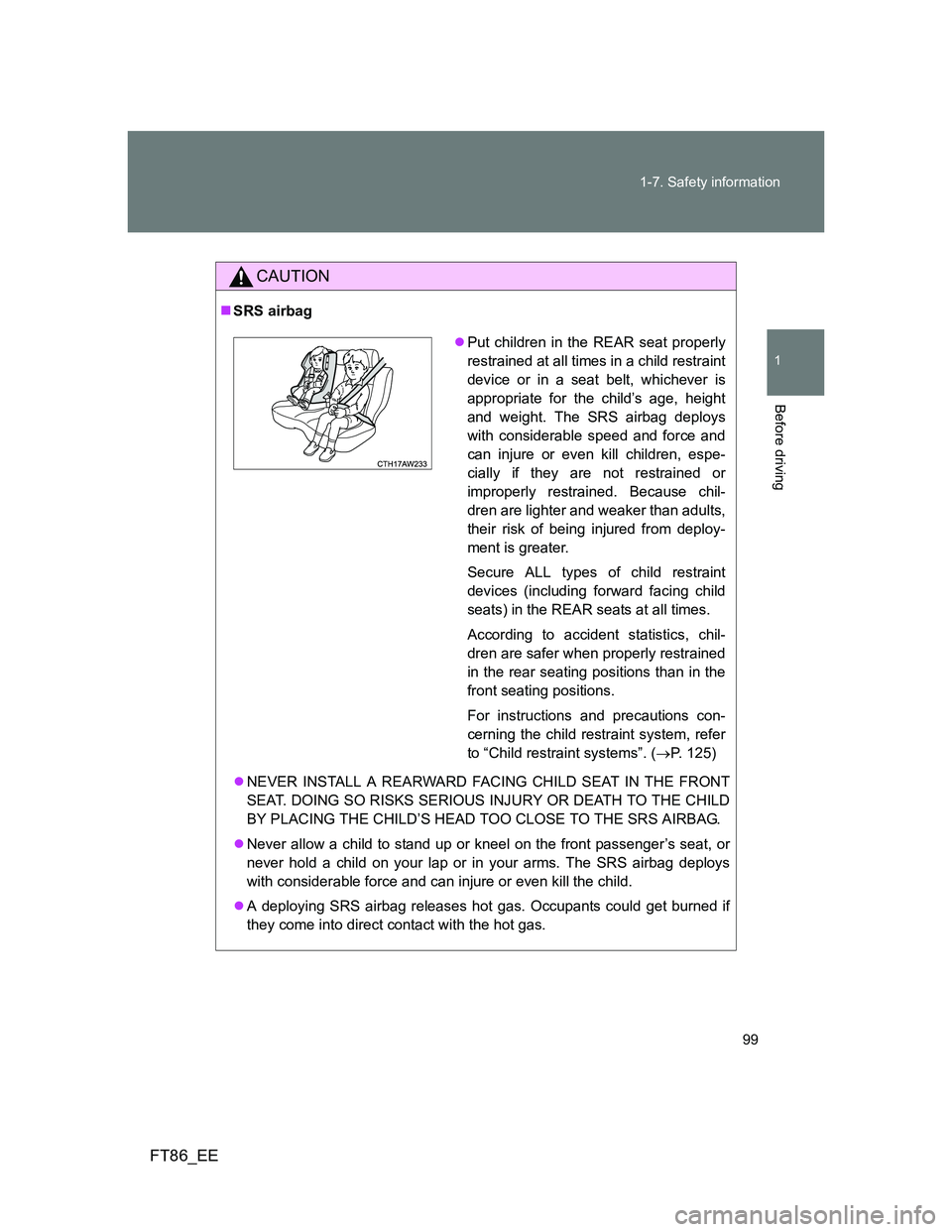
Put children in the REAR seat properly
restrained at all times in a child restraint
device or in a seat belt, whichever is
appropriate for the child’s age, height
and weight. The SRS airbag deploys
with considerable speed and force and
can injure or even kill children, espe-
cially if they are not restrained or
improperly restrained. Because chil-
dren are lighter and weaker than adults,
their risk of being injured from deploy-
ment is greater.
Secure ALL types of child restraint
devices (including forward facing child
seats) in the REAR seats at all times.
According to accident statistics, chil-
dren are safer when properly restrained
in the rear seating positions than in the
front seating positions.
For instructions and precautions con-
cerning the child restraint system, refer
to “Child restraint systems”. (P. 125)
Page 101 of 448
101 1-7. Safety information
1
Before driving
FT86_EE
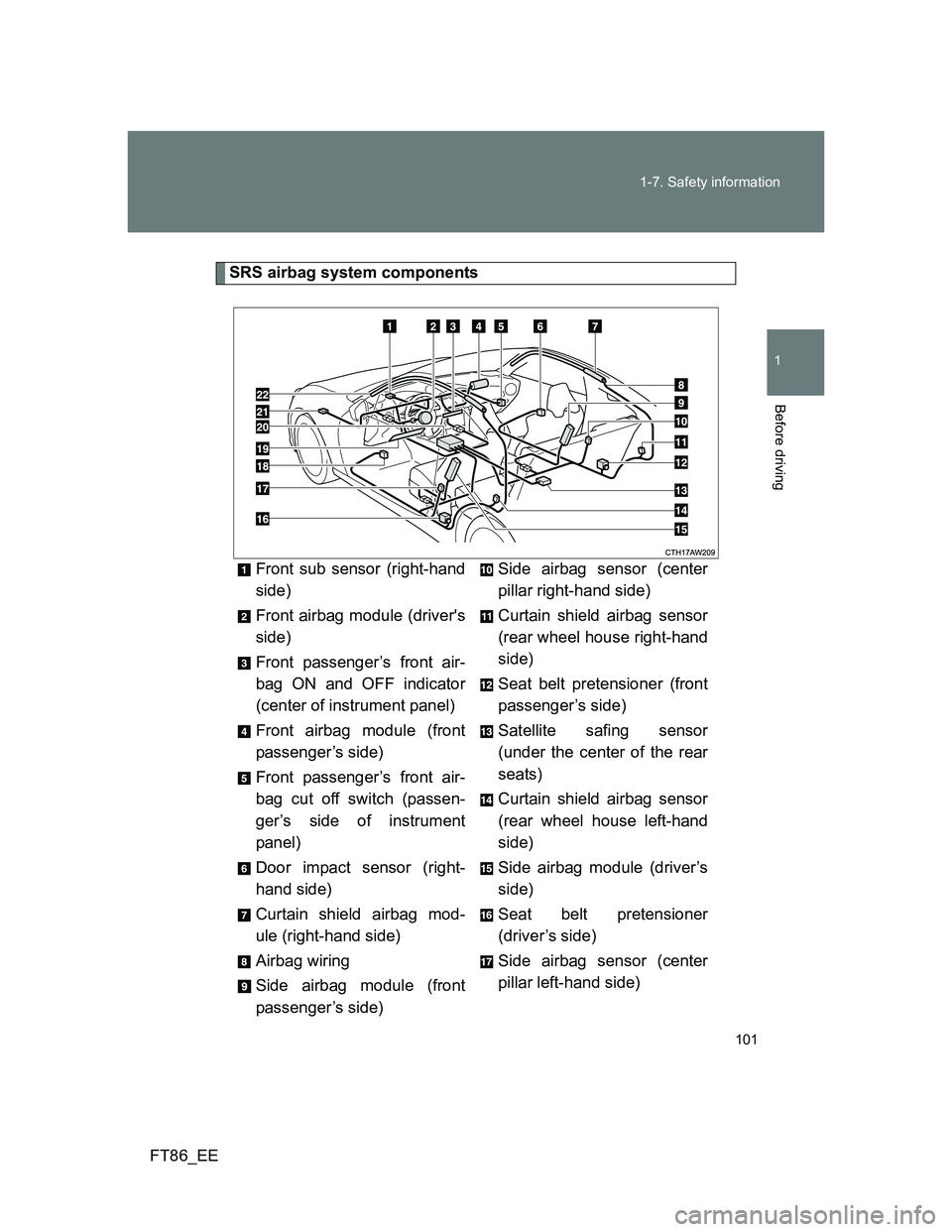
SRS airbag system components
Front sub sensor (right-hand
side)
Front airbag module (driver's
side)
Front passenger’s front air-
bag ON and OFF indicator
(center of instrument panel)
Front airbag module (front
passenger’s side)
Front passenger’s front air-
bag cut off switch (passen-
ger’s side of instrument
panel)
Door impact sensor (right-
hand side)
Curtain shield airbag mod-
ule (right-hand side)
Airbag wiring
Side airbag module (front
passenger’s side)Side airbag sensor (center
pillar right-hand side)
Curtain shield airbag sensor
(rear wheel house right-hand
side)
Seat belt pretensioner (front
passenger’s side)
Satellite safing sensor
(under the center of the rear
seats)
Curtain shield airbag sensor
(rear wheel house left-hand
side)
Side airbag module (driver’s
side)
Seat belt pretensioner
(driver’s side)
Side airbag sensor (center
pillar left-hand side)
Page 103 of 448
103 1-7. Safety information
1
Before driving
FT86_EE
SRS front airbag
The driver’s SRS front airbag is stowed in the center portion of the steering
wheel. The driver’s knee airbag is stowed under the steering column. The
passenger’s SRS front airbag is stowed near the top of the dashboard under
an “SRS AIRBAG” mark.
In a moderate to severe front collision, the following components deploy.
SRS front airbag for driver
SRS front airbag for front passenger
Knee airbag for driver
These components supplement the seat belts by reducing the impact to the
occupant’s head, chest and knees.
If the SRS airbags deploy (inflate)
Bruising and slight abrasions may result from contact with a deploying
(inflating) SRS airbag.
A loud noise and white powder will be emitted.
Parts of the airbag module (steering wheel hub, airbag cover and inflator)
as well as the front seats, parts of the front and rear pillars, and roof side
rails, may be hot for several minutes. The airbag itself may also be hot.
The windshield may crack.
Front-seat passenger airbag manual cut off switch
The passenger-side front airbag can be deactivated by the cut off switch
located in the instrumental panel side. When the cut off switch is turned to
the deactivation mode the passenger-side front airbag becomes deacti-
vated. When the cutoff switch is turned to the activation mode the passen-
ger-side front airbag becomes active to deploy. While the passenger-side
front airbag is active the A/B ON indicator is illuminated.
Page 104 of 448
104 1-7. Safety information
FT86_EE
Normal operation
When the system is malfunctioning
ONOFF
Front airbag for front passenger Activated Deactivated
Seat belt pretensioner for front pas-
senger
Activated Activated Side air bag for front passenger
Curtain shield air bag for front pas-
senger
SRS warning light Not illuminated Not illuminated
Airbag manual on-off indicator “ON” Illuminated Not illuminated
Airbag manual on-off indicator
“OFF”Not illuminated IlluminatedAirbag manual on-off
switch
Airbag system
Airbag systemOperation
Front airbag for front passenger Deactivated
Seat belt pretensioner for front pas-
senger
Activated Side air bag for front passenger
Curtain shield air bag for front pas-
senger
SRS warning light Illuminated
Airbag manual on-off indicator “ON” Not illuminated
Airbag manual on-off indicator
“OFF”Illuminated
Page 107 of 448
107 1-7. Safety information
1
Before driving
FT86_EE
The SRS front airbag (and also the knee airbag) is designed to deploy in the
event of an accident involving a moderate to severe front collision. It is not
designed to deploy in most lesser front impacts because the necessary pro-
tection can be achieved by the seat belt alone. Also, it is not designed to
deploy in most side or rear impacts or in most roll-over accidents because
deployment of the SRS front airbag would not help the occupant in those sit-
uations.
The SRS airbag is designed to function on a one-time-only basis.
SRS airbag deployment depends on the level of force experienced in the
passenger compartment during a collision. That level differs from one type of
collision to another, and it may have no bearing on the visible damage done
to the vehicle itself.
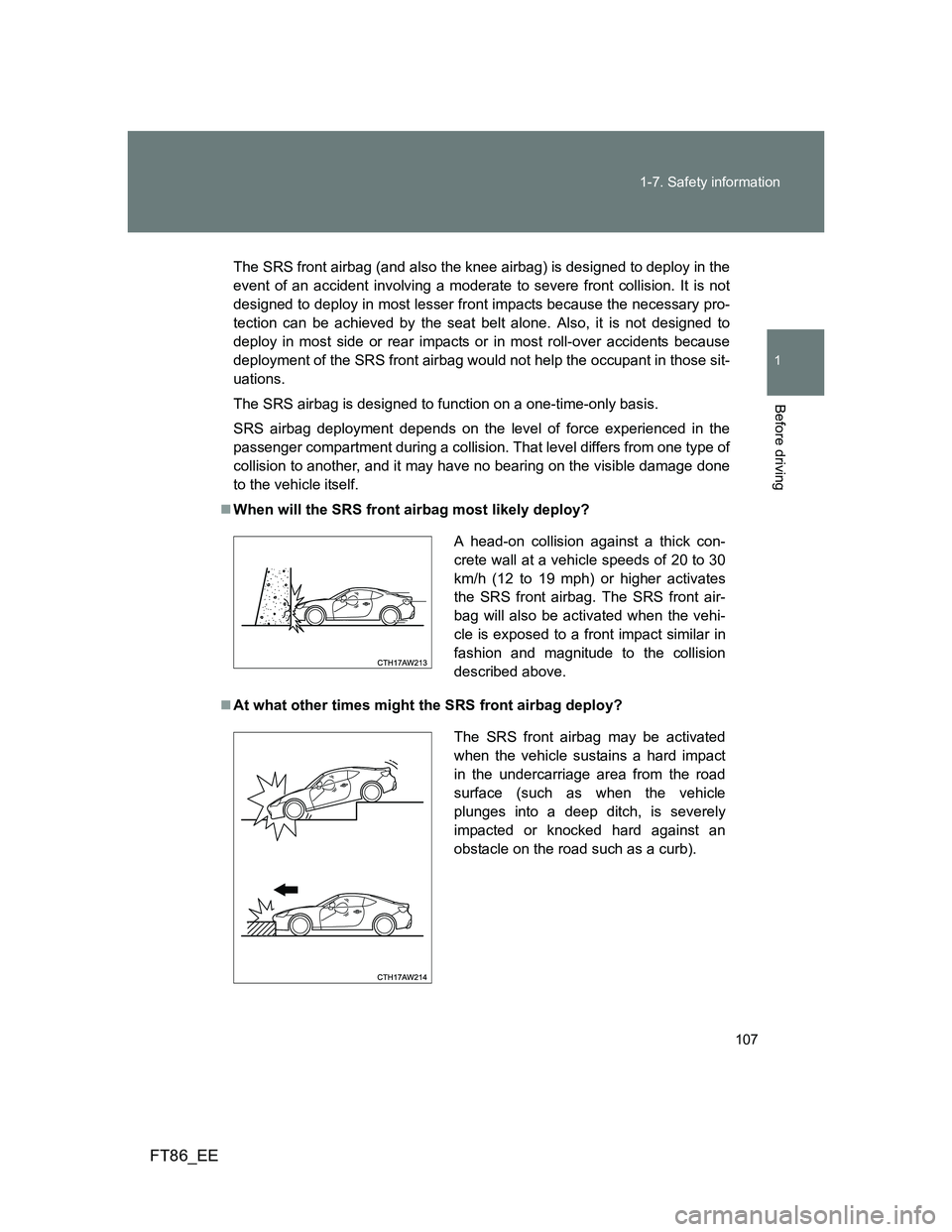
When will the SRS front airbag most likely deploy?
At what other times might the SRS front airbag deploy?
A head-on collision against a thick con-
crete wall at a vehicle speeds of 20 to 30
km/h (12 to 19 mph) or higher activates
the SRS front airbag. The SRS front air-
bag will also be activated when the vehi-
cle is exposed to a front impact similar in
fashion and magnitude to the collision
described above.
The SRS front airbag may be activated
when the vehicle sustains a hard impact
in the undercarriage area from the road
surface (such as when the vehicle
plunges into a deep ditch, is severely
impacted or knocked hard against an
obstacle on the road such as a curb).
Page 111 of 448
111 1-7. Safety information
1
Before driving
FT86_EE
SRS side airbag and SRS curtain shield airbag
The SRS side airbag is stored in the door side of each front seat seatback,
which bears an “SRS AIRBAG” label.
In a moderate to severe side impact collision, the SRS side airbag on the
impacted side of the vehicle deploys between the occupant and the door
panel and supplements the seat belt by reducing the impact on the occupant’s
chest.
The curtain shield airbag on each side of the cabin is stored in the roof side
(between the front pillar and a point over the rear seat). An “SRS AIRBAG”
mark is located at the top of each center pillar.
In a moderate to severe side impact collision, the SRS curtain shield airbag on
the impacted side of the vehicle deploys between the occupant and the side
window and supplements the seat belt by reducing the impact on the occu-
pant’s head.
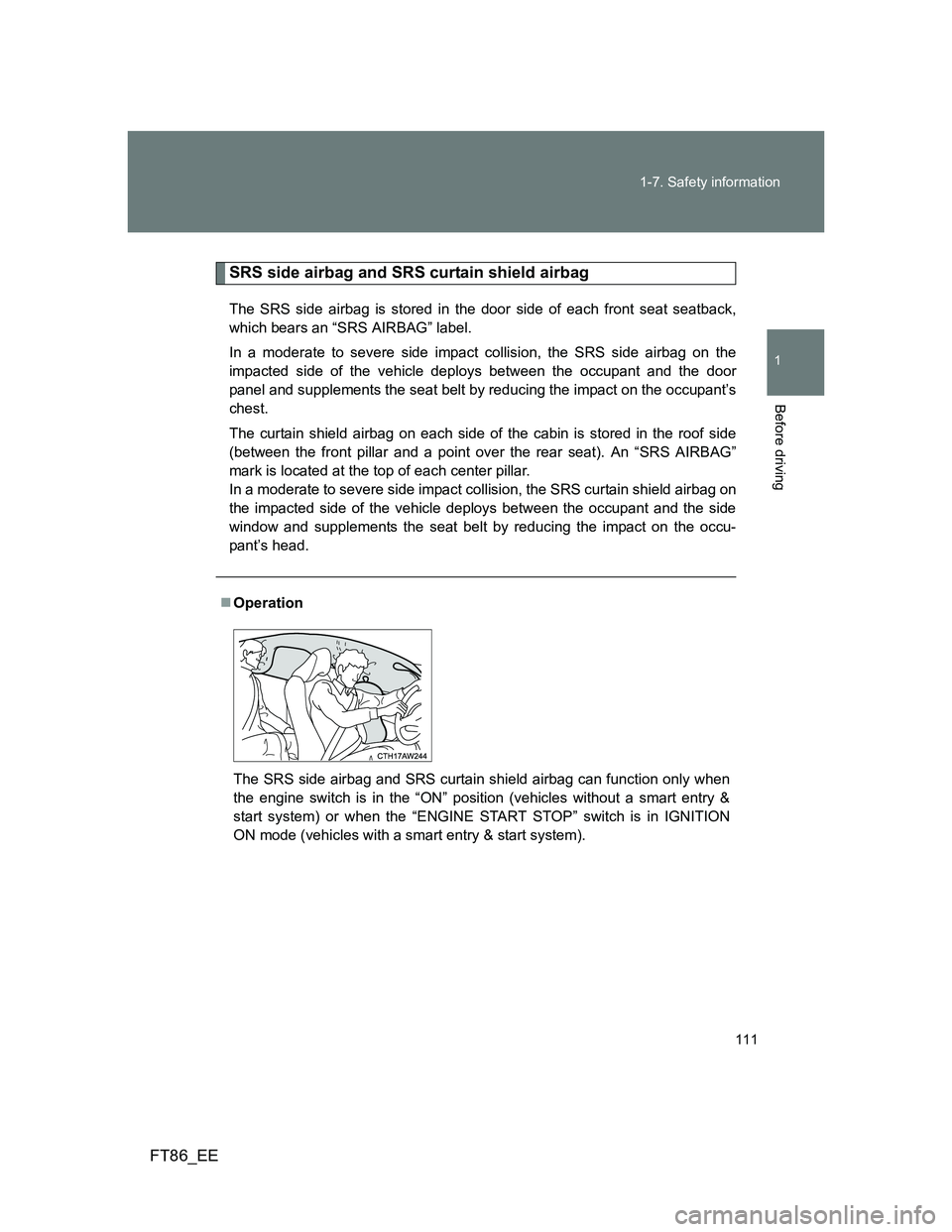
Operation
The SRS side airbag and SRS curtain shield airbag can function only when
the engine switch is in the “ON” position (vehicles without a smart entry &
start system) or when the “ENGINE START STOP” switch is in IGNITION
ON mode (vehicles with a smart entry & start system).
Page 117 of 448
117 1-7. Safety information
1
Before driving
FT86_EE
CAUTION
If the SRS airbags deploy
Do not touch the SRS side airbag system components around the front seat
seatback with bare hands right after deployment. Doing so can cause burns
because the components can be very hot as a result of deployment.
After deployment, do not touch any part of the SRS curtain shield airbag sys-
tem (from the front pillar to the part of the roof side over the rear seat). Doing
so can cause burns because the components can be very hot as a result of
deployment.
SRS airbag precautions
Observe the following precautions regarding the airbags.
Failure to do so may cause death or serious injury.
The driver and all passengers in the vehicle must wear their seat belts
properly.
The SRS airbags are supplemental devices to be used with the seat belts.
The SRS driver airbag deploys with considerable force, and can cause
death or serious injury especially if the driver is very close to the airbag.
Since the risk zone for driver airbag is the first 50 - 75 mm (2 - 3 in.) of
inflation, placing yourself 250 mm (10 in.) from your driver airbag provides
you with a clear margin of safety. This distance is measured from the cen-
ter of the steering wheel to your breastbone. If you sit less than 250 mm
(10 in.) away now, you can change your driving position in several ways:
• Move your seat to the rear as far as you can while still reaching the
pedals comfortably.
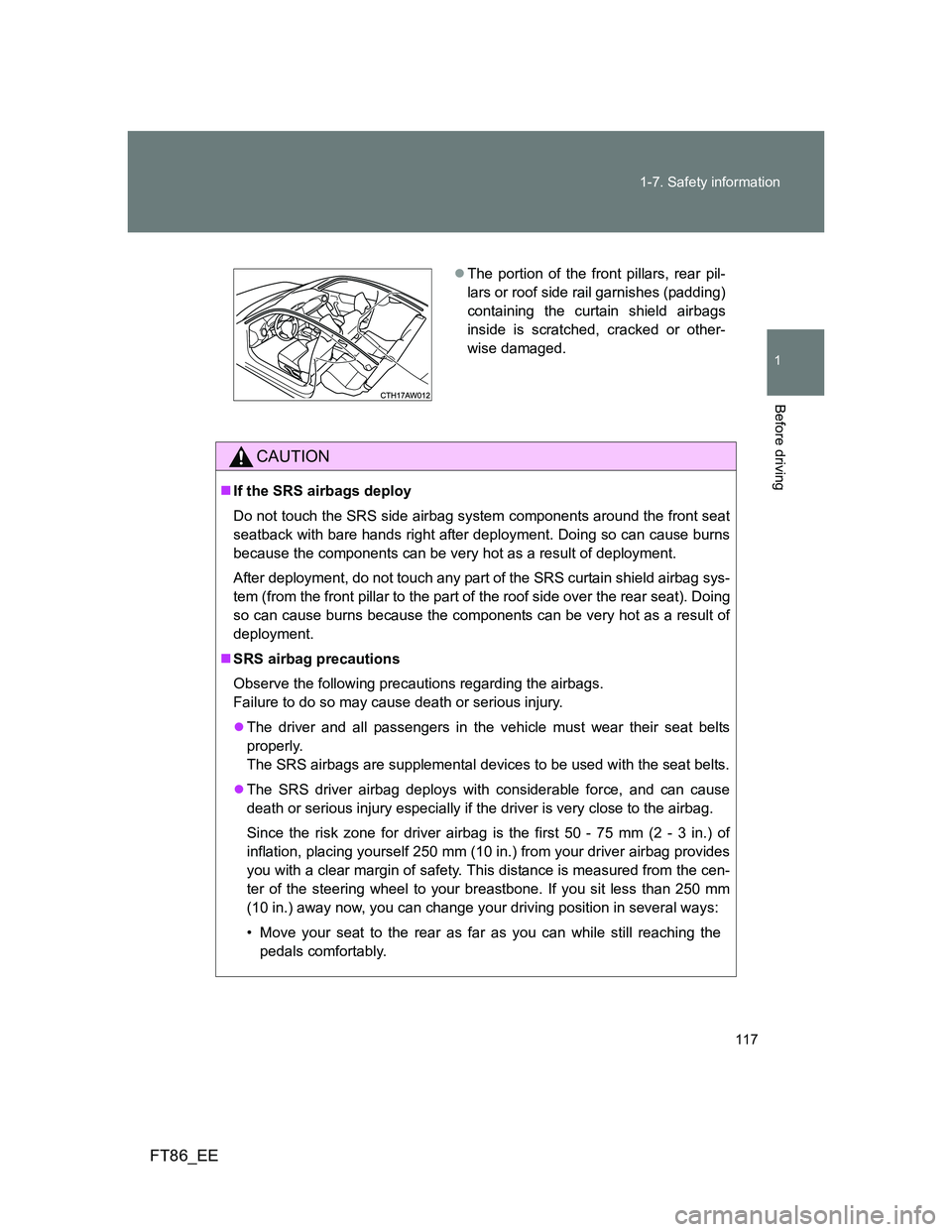
The portion of the front pillars, rear pil-
lars or roof side rail garnishes (padding)
containing the curtain shield airbags
inside is scratched, cracked or other-
wise damaged.
Page 118 of 448
118 1-7. Safety information
FT86_EE
CAUTION
SRS airbag precautions
• Slightly recline the back of the seat. Although vehicle designs vary,
many drivers can achieve the 250 mm (10 in.) distance, even with the
driver seat all the way forward, simply by reclining the back of the seat
somewhat. If reclining the back of your seat makes it hard to see the
road, raise yourself by using a firm, non-slippery cushion, or raise the
seat if your vehicle has that feature.
• If your steering wheel is adjustable, tilt it downward. This points the air-
bag toward your chest instead of your head and neck.
The seat should be adjusted as recommended above, while still maintain-
ing control of the foot pedals, steering wheel, and your view of the instru-
ment panel controls.
The SRS front passenger airbag also deploys with considerable force, and
can cause death or serious injury especially if the front passenger is very
close to the airbag. The front passenger seat should be as far from the air-
bag as possible with the seatback adjusted, so the front passenger sits
upright.
Improperly seated and/or restrained infants and children can be killed or
seriously injured by a deploying airbag. An infant or child who is too small
to use a seat belt should be properly secured using a child restraint sys-
tem. Toyota strongly recommends that all infants and children be placed in
the rear seats of the vehicle and properly restrained. The rear seats are
safer for infants and children than the front passenger seat. (P. 125)
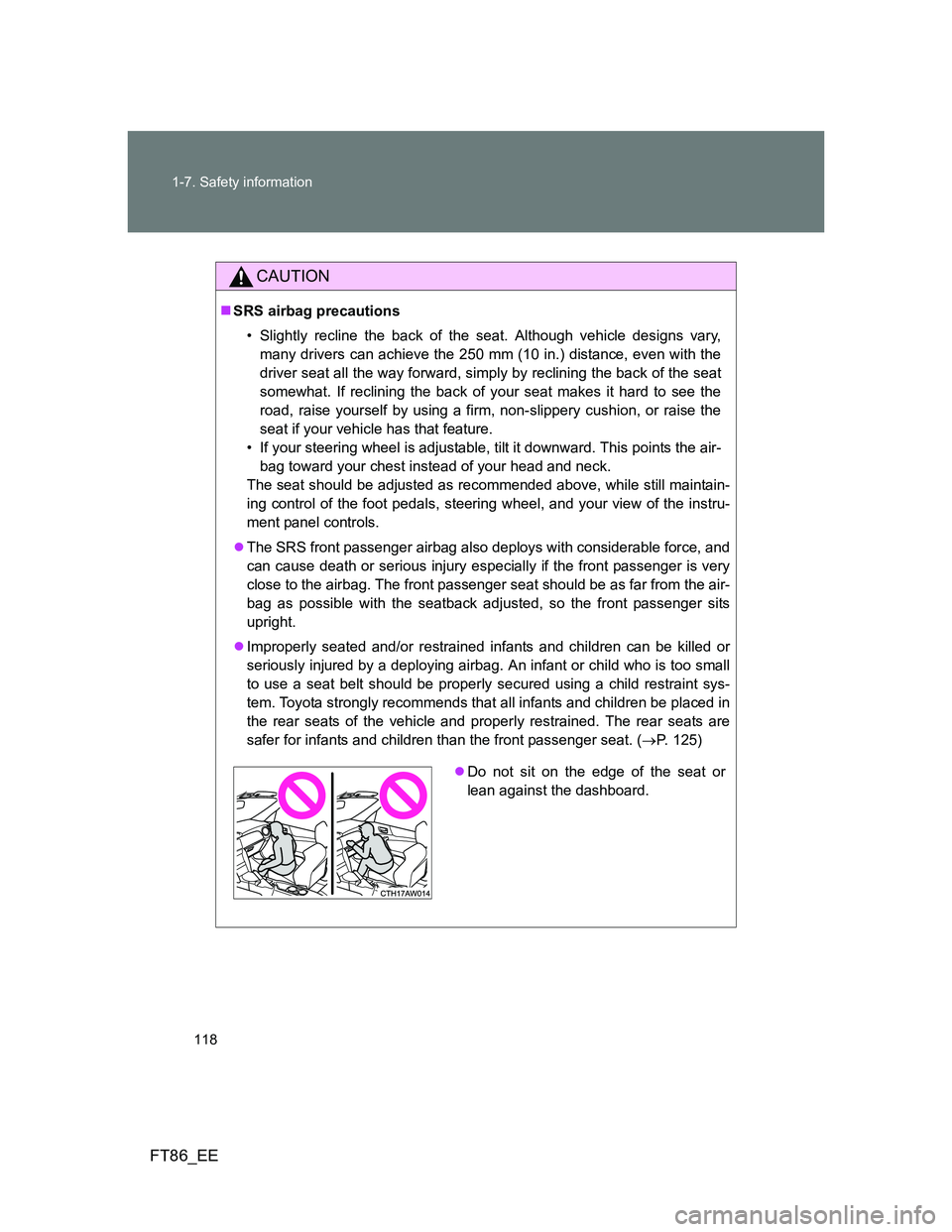
Do not sit on the edge of the seat or
lean against the dashboard.