maintenance TOYOTA GT86 2012 Owner's Manual
[x] Cancel search | Manufacturer: TOYOTA, Model Year: 2012, Model line: GT86, Model: TOYOTA GT86 2012Pages: 448, PDF Size: 13.47 MB
Page 293 of 448
293 4-3. Do-it-yourself maintenance
4
Maintenance and care
FT86_EE
CAUTION
When working near the electric cooling fans or radiator grille
Vehicles without a smart entry & start system: Be sure the engine switch is
off. With the engine switch in the “ON” position, the electric cooling fans may
automatically start to run if the air conditioning is on and/or the coolant tem-
perature is high. (P. 304)
Vehicles with a smart entry & start system: Be sure the “ENGINE START
STOP” switch is off. With the “ENGINE START STOP” switch in IGNITION
ON mode, the electric cooling fans may automatically start to run if the air
conditioning is on and/or the coolant temperature is high. (P. 304)
Safety glasses
Wear safety glasses to prevent flying or falling material, fluid spray, etc. from
getting in the eyes.
NOTICE
If you remove the air cleaner filter
Driving with the air cleaner filter removed may cause excessive engine wear
due to dirt in the air. Also a backfire could cause a fire in the engine compart-
ment.
If the fluid level is low or high
It is normal for the brake fluid level to go down slightly as the brake pads
wear or when the fluid level in the accumulator is high.
If the reservoir needs frequent refilling, it may indicate a serious problem.
Page 294 of 448
294
4-3. Do-it-yourself maintenance
FT86_EE
Hood
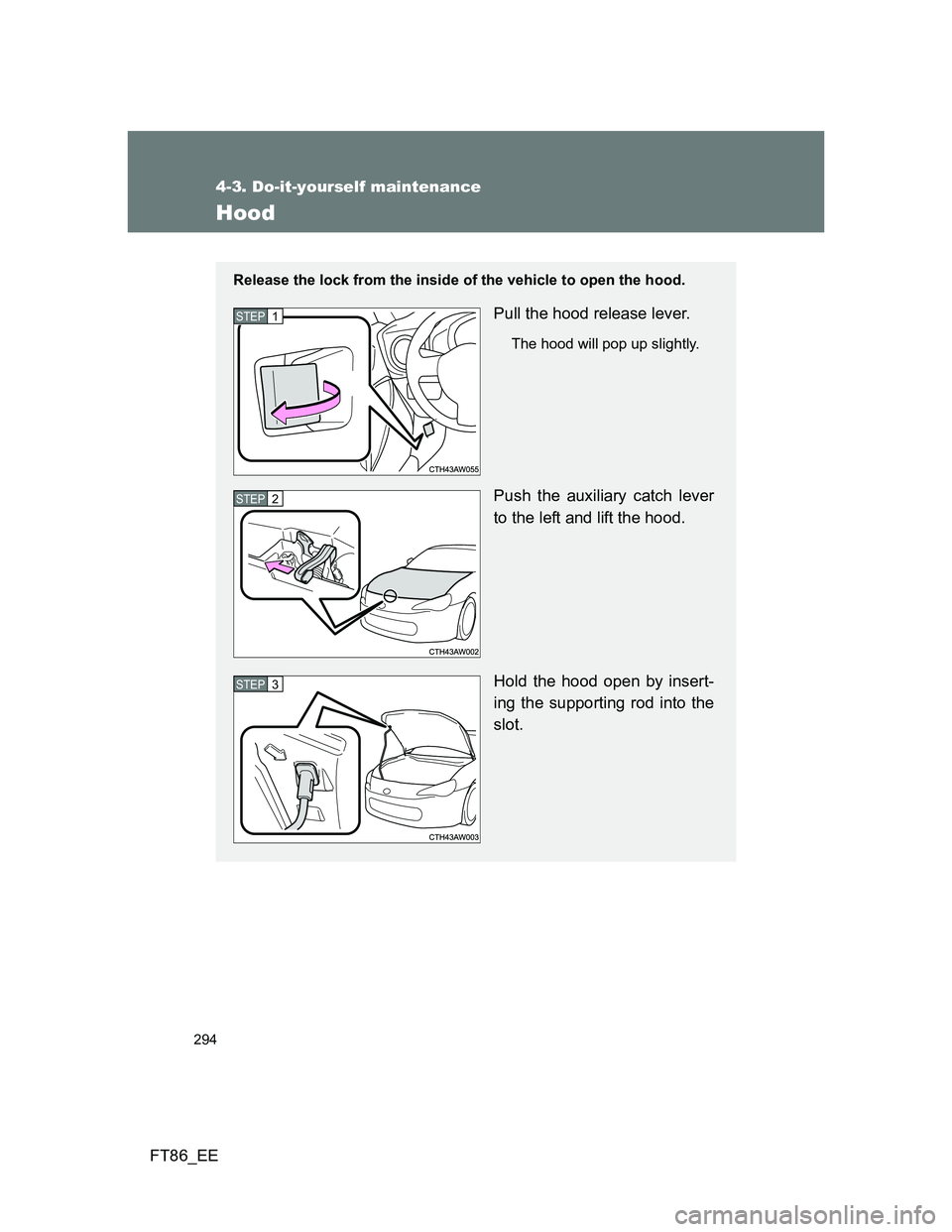
Release the lock from the inside of the vehicle to open the hood.
Pull the hood release lever.
The hood will pop up slightly.
Push the auxiliary catch lever
to the left and lift the hood.
Hold the hood open by insert-
ing the supporting rod into the
slot.
STEP 1
STEP 2
STEP 3
Page 295 of 448
295 4-3. Do-it-yourself maintenance
4
Maintenance and care
FT86_EE
CAUTION
Pre-driving check
Check that the hood is fully closed and locked.
If the hood is not locked properly it may open while the vehicle is in motion
and cause an accident, which may result in death or serious injury.
NOTICE
When opening the hood
Do not lift up or operate the wipers. Doing so may cause the hood and wip-
ers to contact, scratching the hood.
When closing the hood
Do not apply excessive weight or force when closing the hood as doing so
may result in damage.
Page 296 of 448
296
4-3. Do-it-yourself maintenance
FT86_EE
Positioning a floor jack
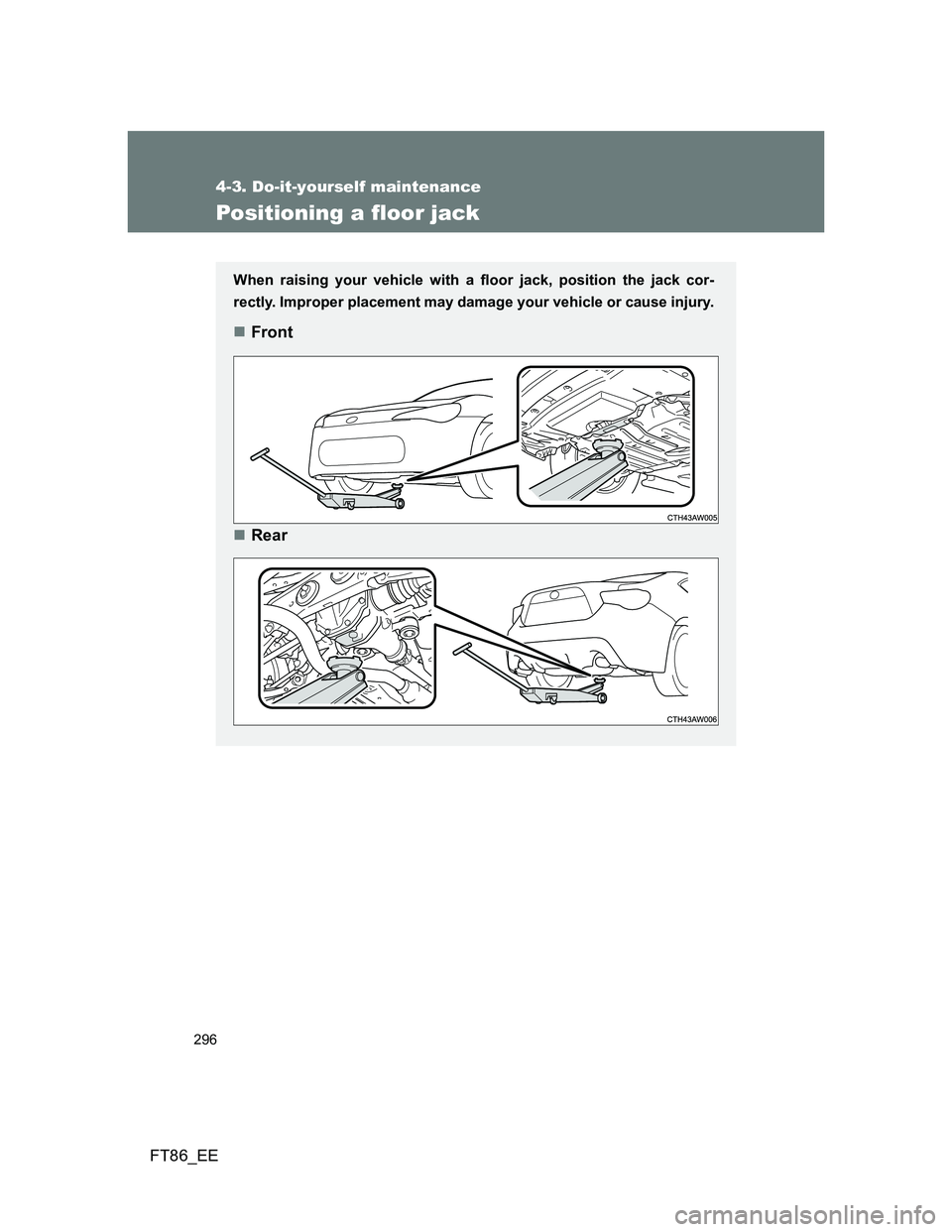
When raising your vehicle with a floor jack, position the jack cor-
rectly. Improper placement may damage your vehicle or cause injury.
Front
Rear
Page 297 of 448
297 4-3. Do-it-yourself maintenance
4
Maintenance and care
FT86_EE
CAUTION
When raising your vehicle
Make sure to observe the following precautions to reduce the possibility of
death or serious injury:
When using a floor jack, follow the instructions of the manual provided with
the jack.
Do not use the jack that was supplied with your vehicle.
Do not put any part of your body underneath the vehicle when it is sup-
ported only by the floor jack.
Always use floor jack and/or automotive jack stands on a solid, flat, level
surface.
Do not start the engine while the vehicle is supported by the floor jack.
Stop the vehicle on level, firm ground, firmly set the parking brake and shift
the shift lever to P (vehicles with an automatic transmission) or R (vehicles
with a manual transmission).
Make sure to set the floor jack properly at the jack point.
Raising the vehicle with an improperly positioned floor jack will damage
the vehicle and may cause the vehicle to fall off the floor jack.
Do not raise the vehicle while someone is in the vehicle.
When raising the vehicle, do not place any object on top of or underneath
the floor jack.
When raising the vehicle, ensure that there is sufficient surrounding space.
The vehicle’s position may change slightly when lowered.
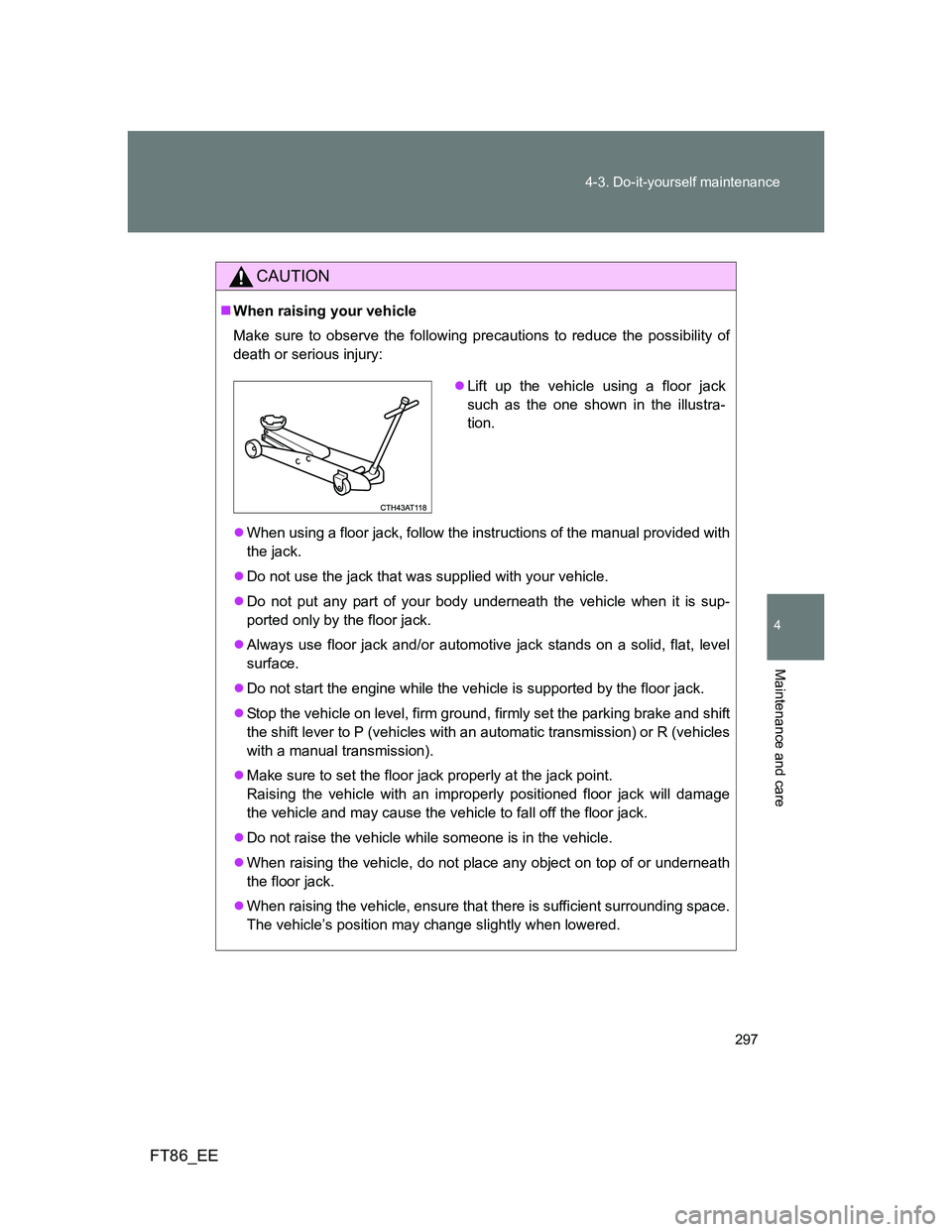
Lift up the vehicle using a floor jack
such as the one shown in the illustra-
tion.
Page 298 of 448
298
4-3. Do-it-yourself maintenance
FT86_EE
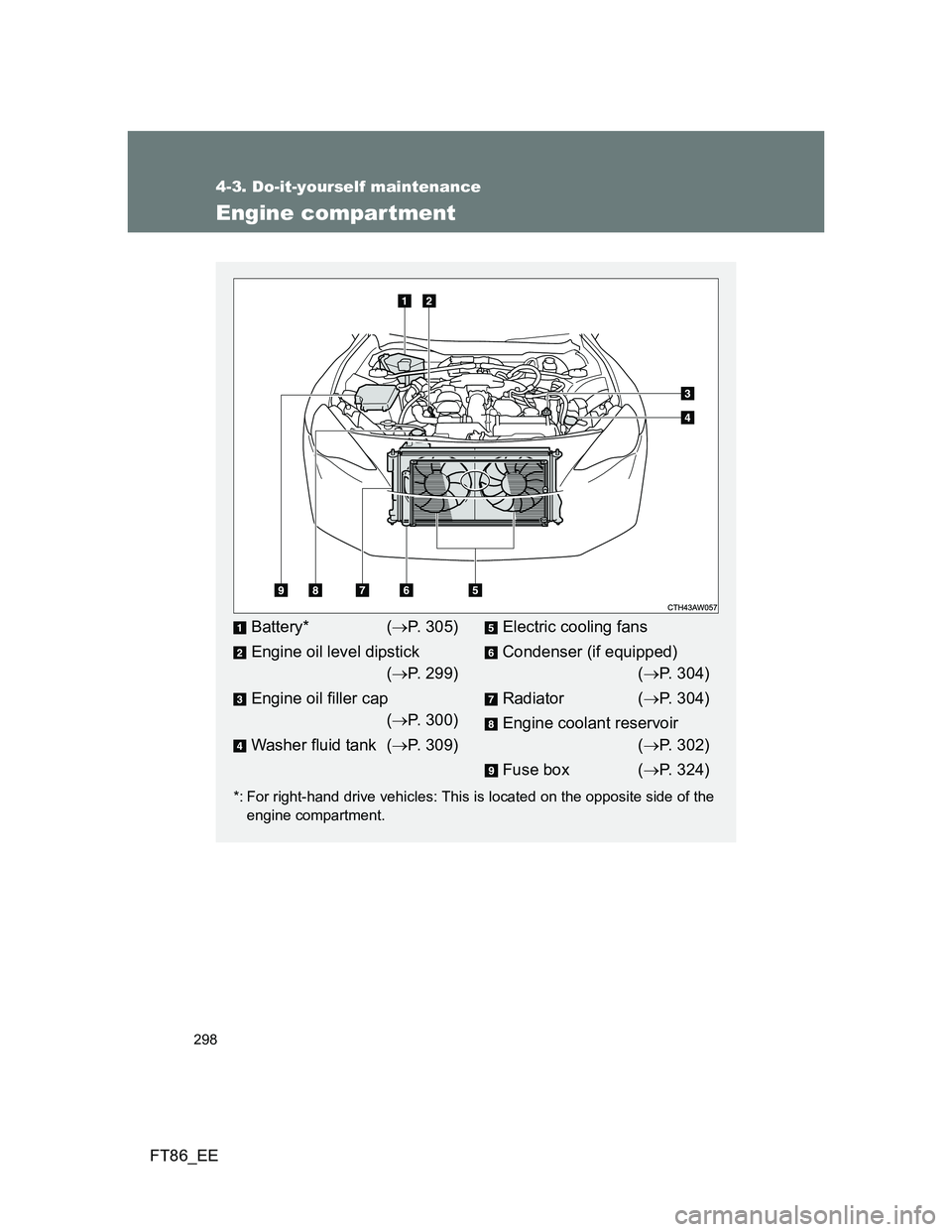
Engine compartment
*: For right-hand drive vehicles: This is located on the opposite side of the
engine compartment.
Battery* (P. 305)
Engine oil level dipstick
(P. 299)
Engine oil filler cap
(P. 300)
Washer fluid tank (P. 309)Electric cooling fans
Condenser (if equipped)
(P. 304)
Radiator (P. 304)
Engine coolant reservoir
(P. 302)
Fuse box (P. 324)
Page 299 of 448
299 4-3. Do-it-yourself maintenance
4
Maintenance and care
FT86_EE
Engine oil
With the engine at operating temperature and turned off, check the oil
level on the dipstick.
Checking the engine oil
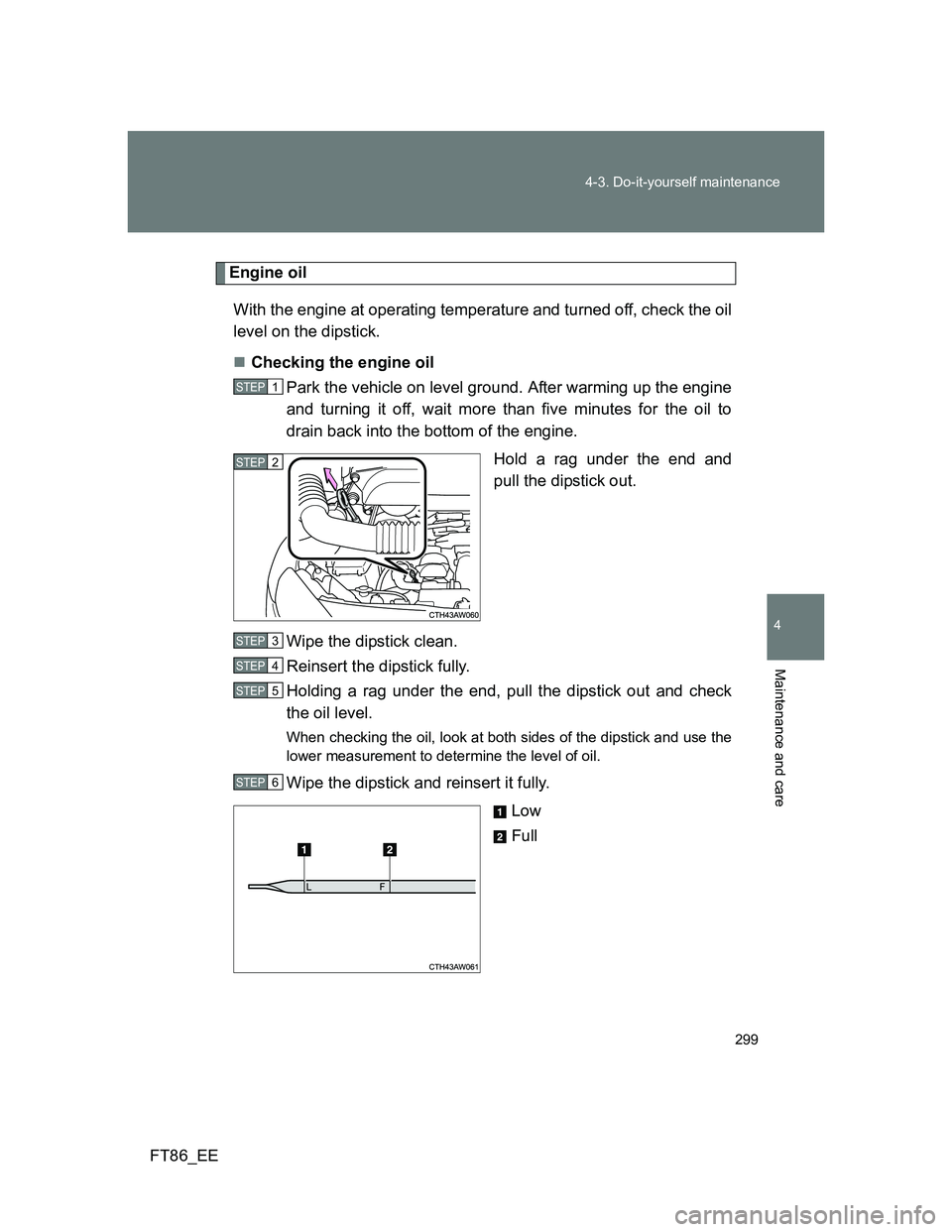
Park the vehicle on level ground. After warming up the engine
and turning it off, wait more than five minutes for the oil to
drain back into the bottom of the engine.
Hold a rag under the end and
pull the dipstick out.
Wipe the dipstick clean.
Reinsert the dipstick fully.
Holding a rag under the end, pull the dipstick out and check
the oil level.
When checking the oil, look at both sides of the dipstick and use the
lower measurement to determine the level of oil.
Wipe the dipstick and reinsert it fully.
Low
Full
STEP 1
STEP 2
STEP 3
STEP 4
STEP 5
STEP 6
Page 300 of 448
300 4-3. Do-it-yourself maintenance
FT86_EEAdding engine oil
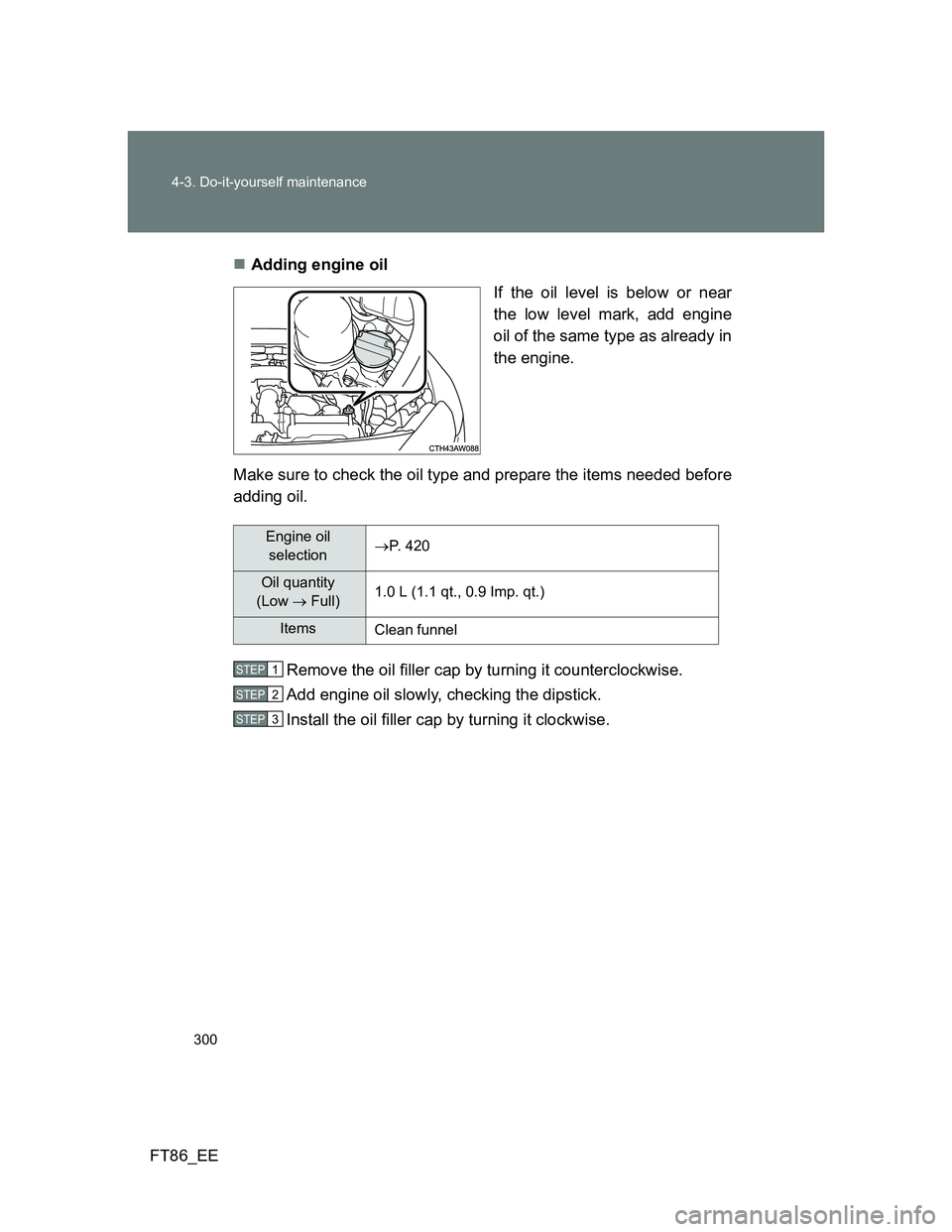
If the oil level is below or near
the low level mark, add engine
oil of the same type as already in
the engine.
Make sure to check the oil type and prepare the items needed before
adding oil.
Remove the oil filler cap by turning it counterclockwise.
Add engine oil slowly, checking the dipstick.
Install the oil filler cap by turning it clockwise.
Engine oil
selectionP. 420
Oil quantity
(Low Full)1.0 L (1.1 qt., 0.9 Imp. qt.)
Items
Clean funnel
STEP 1
STEP 2
STEP 3
Page 301 of 448
301 4-3. Do-it-yourself maintenance
4
Maintenance and care
FT86_EE
Engine oil consumption
The amount of engine oil consumed depends on the oil viscosity, the
quality of the oil and the way the vehicle is driven.
More oil is consumed under driving conditions such as high speeds and
frequent acceleration and deceleration.
A new engine consumes more oil.
When judging the amount of oil consumption, keep in mind that the oil
may have become diluted, making it difficult to judge the true level accu-
rately.
Oil consumption: Max. 1.0 L/1000 km (1.1 qt./600 miles, 0.9 Imp. qt./600
miles)
If your vehicle consumes more than 1.0 L (1.1 qt., 0.9 Imp. qt.) every
1000 km (600 miles), contact any authorized Toyota dealer or repairer, or
another duly qualified and equipped professional.
CAUTION
Used engine oil
Used engine oil contains potentially harmful contaminants which may
cause skin disorders such as inflammation or skin cancer, so care should
be taken to avoid prolonged and repeated contact. To remove used engine
oil from your skin, wash thoroughly with soap and water.
Dispose of used oil and filters only in a safe and acceptable manner. Do
not dispose of used oil and filters in household trash, in sewers or onto the
ground.
Call any authorized Toyota dealer or repairer, or another duly qualified and
equipped professional, service station or auto parts store for information
concerning recycling or disposal.
Do not leave used engine oil within the reach of children.
Page 302 of 448
302 4-3. Do-it-yourself maintenance
FT86_EE
Engine coolant
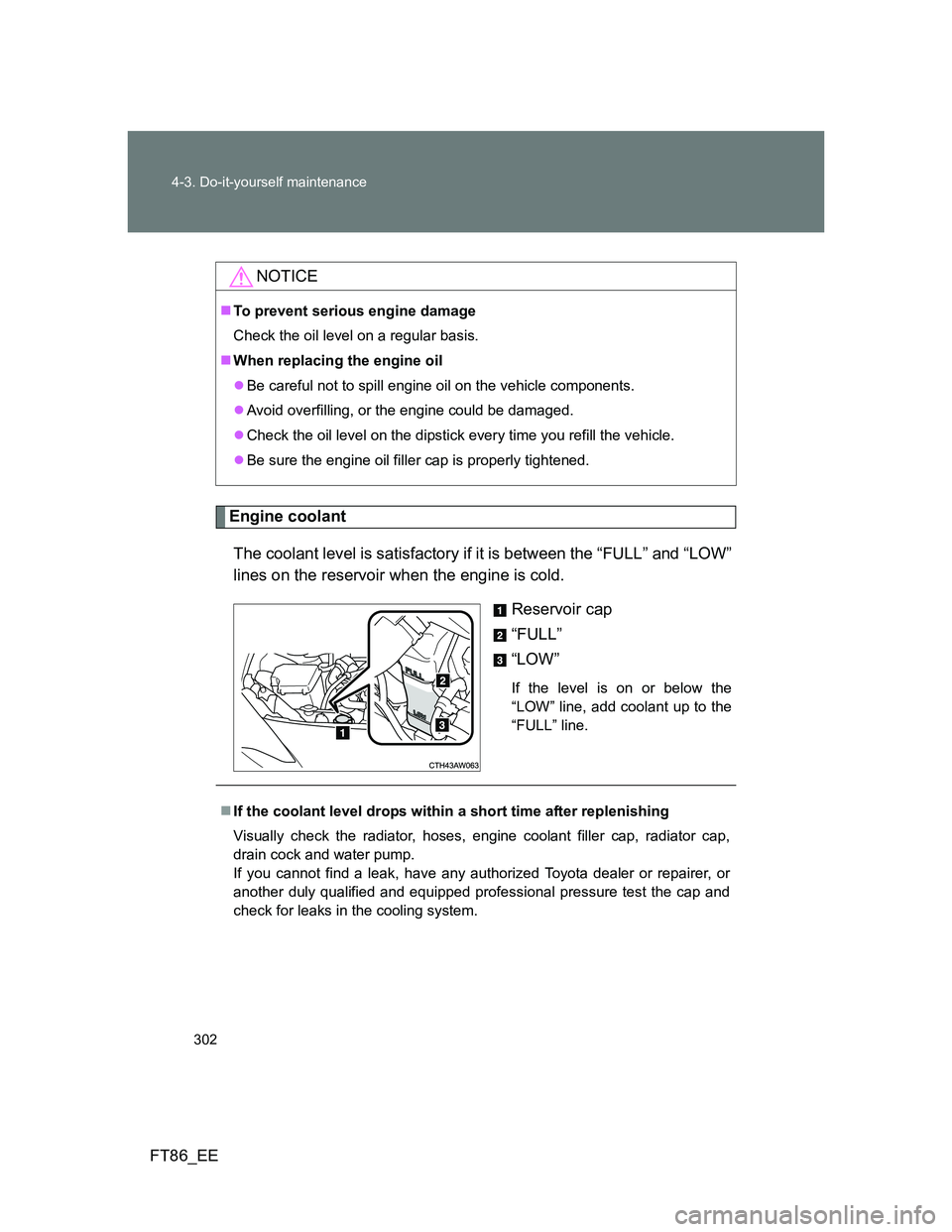
The coolant level is satisfactory if it is between the “FULL” and “LOW”
lines on the reservoir when the engine is cold.
Reservoir cap
“FULL”
“LOW”
If the level is on or below the
“LOW” line, add coolant up to the
“FULL” line.
NOTICE
To prevent serious engine damage
Check the oil level on a regular basis.
When replacing the engine oil
Be careful not to spill engine oil on the vehicle components.
Avoid overfilling, or the engine could be damaged.
Check the oil level on the dipstick every time you refill the vehicle.
Be sure the engine oil filler cap is properly tightened.
If the coolant level drops within a short time after replenishing
Visually check the radiator, hoses, engine coolant filler cap, radiator cap,
drain cock and water pump.
If you cannot find a leak, have any authorized Toyota dealer or repairer, or
another duly qualified and equipped professional pressure test the cap and
check for leaks in the cooling system.