tow TOYOTA GT86 2012 Owner's Manual
[x] Cancel search | Manufacturer: TOYOTA, Model Year: 2012, Model line: GT86, Model: TOYOTA GT86 2012Pages: 448, PDF Size: 13.47 MB
Page 337 of 448
337 4-3. Do-it-yourself maintenance
4
Maintenance and care
FT86_EESide turn signal lights
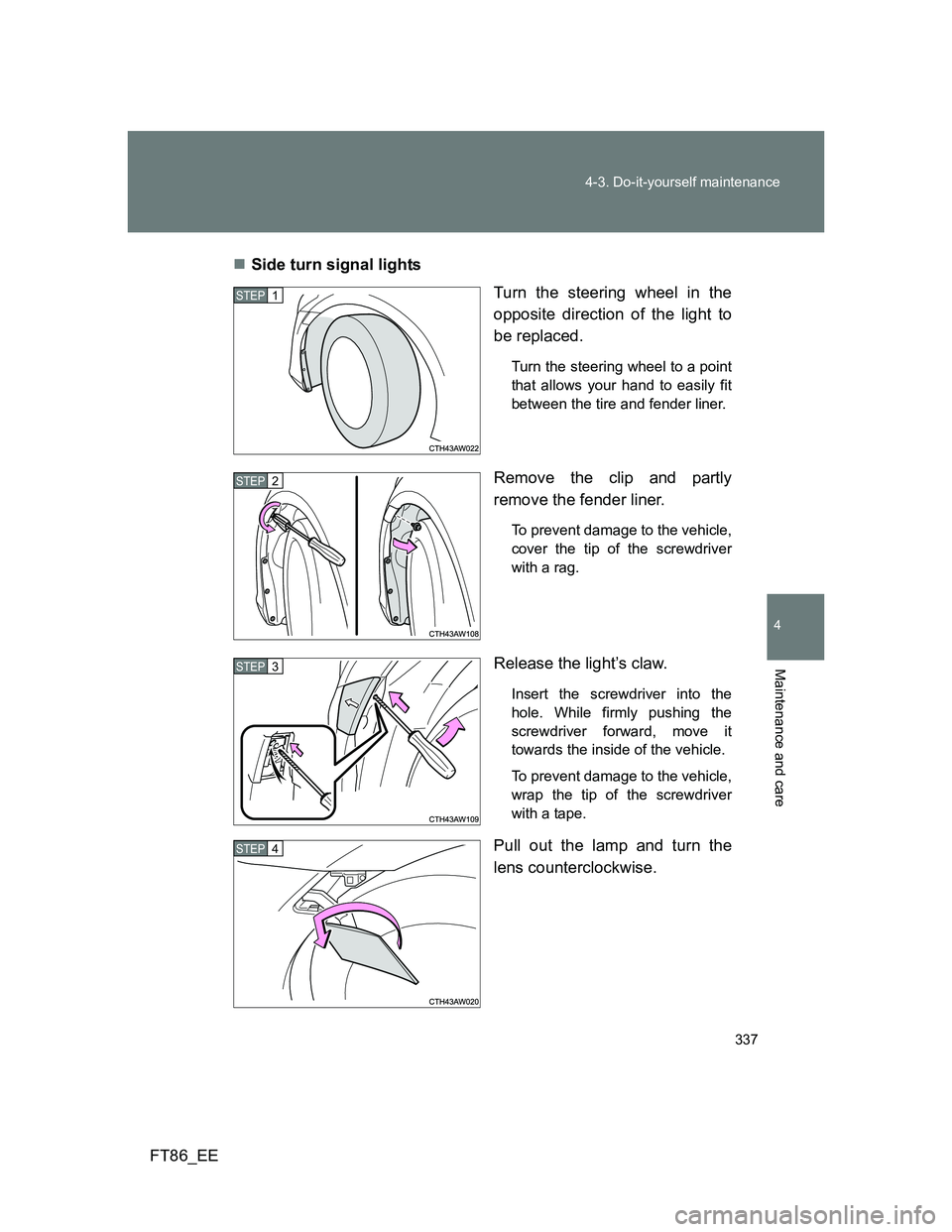
Turn the steering wheel in the
opposite direction of the light to
be replaced.
Turn the steering wheel to a point
that allows your hand to easily fit
between the tire and fender liner.
Remove the clip and partly
remove the fender liner.
To prevent damage to the vehicle,
cover the tip of the screwdriver
with a rag.
Release the light’s claw.
Insert the screwdriver into the
hole. While firmly pushing the
screwdriver forward, move it
towards the inside of the vehicle.
To prevent damage to the vehicle,
wrap the tip of the screwdriver
with a tape.
Pull out the lamp and turn the
lens counterclockwise.
STEP 1
STEP 2
STEP 3
STEP 4
Page 351 of 448
5When trouble arises
351
FT86_EE
5-1. Essential information
Emergency flashers .......... 352
If your vehicle needs to
be towed ......................... 353
If you think something is
wrong .............................. 360
Fuel pump shut off
system ............................ 361
5-2. Steps to take in an
emergency
If a warning light turns
on or a warning buzzer
sounds... ........................ 362
If you have a flat tire
(vehicles with a spare
tire) ................................. 371
If you have a flat tire
(vehicles with an
emergency tire puncture
repair kit)......................... 379
If the engine will not
start ................................ 394
If the shift lever cannot
be shifted from P ............ 397
If you lose your keys ......... 398If the electronic key does
not operate properly ....... 399
If the battery is
discharged ...................... 403
If your vehicle
overheats ........................ 408
If the vehicle becomes
stuck ............................... 411
If your vehicle has to
be stopped in an
emergency ...................... 413
Page 353 of 448
5
353
5-1. Essential information
When trouble arises
FT86_EE
If your vehicle needs to be towed
Before towing
The following may indicate a problem with your transmission. Contact
any authorized Toyota dealer or repairer, or another duly qualified
and equipped professional before towing.
The engine is running, but the vehicle will not move.
The vehicle makes an abnormal sound.
Emergency towing
If a tow truck is not available in an emergency, your vehicle may be
temporarily towed using a cable or chain secured to the emergency
towing eyelet. This should only be attempted on hard surfaced roads
for short distances at low speeds.
A driver must be in the vehicle to steer and operate the brakes. The
vehicle’s wheels, drive train, axles, steering and brakes must be in
good condition.
For vehicles with an automatic transmission, only the front towing
eyelet may be used.
If towing is necessary, we recommend having your vehicle towed by
any authorized Toyota dealer or repairer, or another duly qualified
and equipped professional or a commercial towing service, using a
lift-type truck or a flat bed truck.
Use a safety chain system for all towing, and abide by all state/pro-
vincial and local laws.
If towing from the rear, the vehicle's front wheels and axles must be
in good condition. (P. 357)
If they are damaged, use a towing dolly or flat bed truck.
Page 354 of 448
354 5-1. Essential information
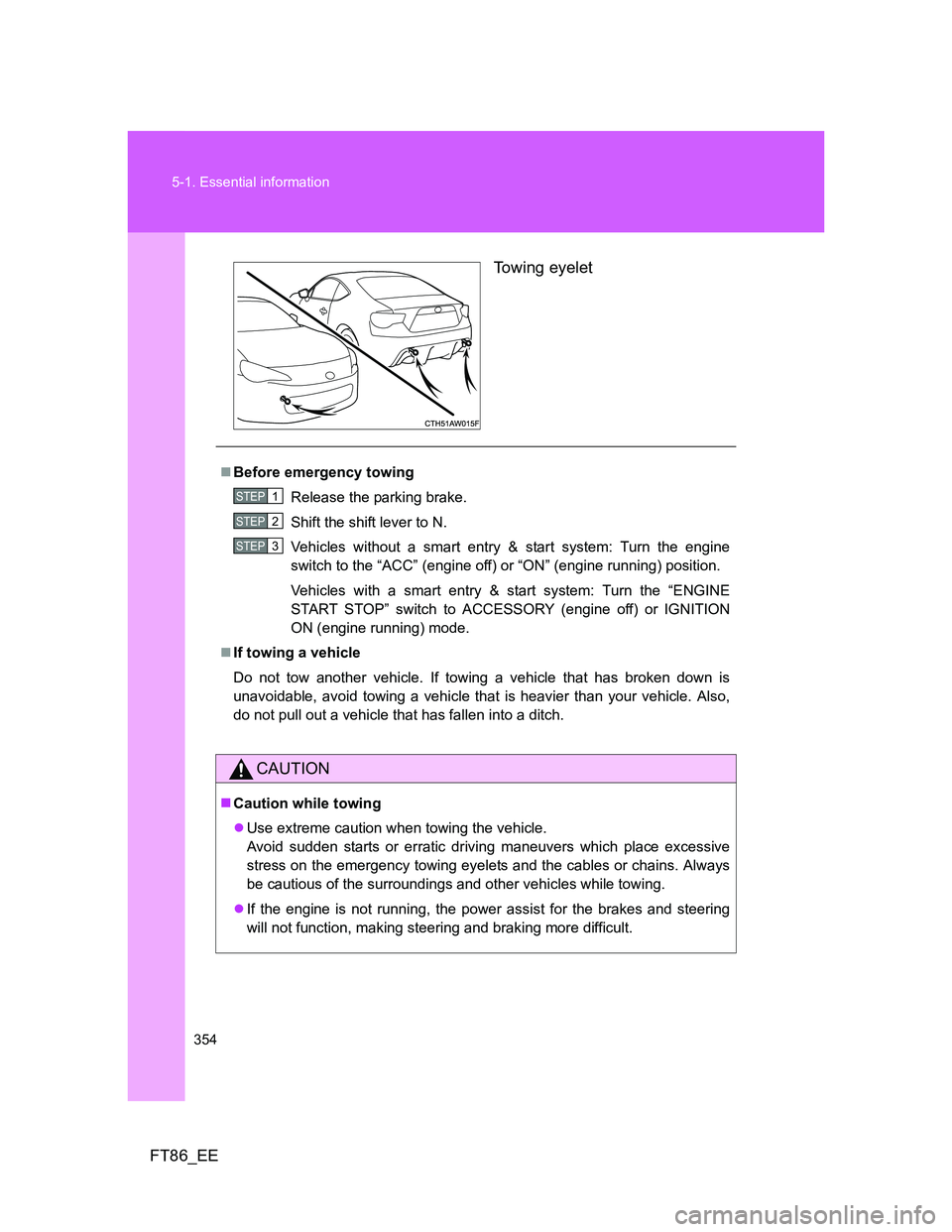
FT86_EETowing eyelet
Before emergency towing
Release the parking brake.
Shift the shift lever to N.
Vehicles without a smart entry & start system: Turn the engine
switch to the “ACC” (engine off) or “ON” (engine running) position.
Vehicles with a smart entry & start system: Turn the “ENGINE
START STOP” switch to ACCESSORY (engine off) or IGNITION
ON (engine running) mode.
If towing a vehicle
Do not tow another vehicle. If towing a vehicle that has broken down is
unavoidable, avoid towing a vehicle that is heavier than your vehicle. Also,
do not pull out a vehicle that has fallen into a ditch.
CAUTION
Caution while towing
Use extreme caution when towing the vehicle.
Avoid sudden starts or erratic driving maneuvers which place excessive
stress on the emergency towing eyelets and the cables or chains. Always
be cautious of the surroundings and other vehicles while towing.
If the engine is not running, the power assist for the brakes and steering
will not function, making steering and braking more difficult.
STEP 1
STEP 2
STEP 3
Page 355 of 448
5
355 5-1. Essential information
When trouble arises
FT86_EE
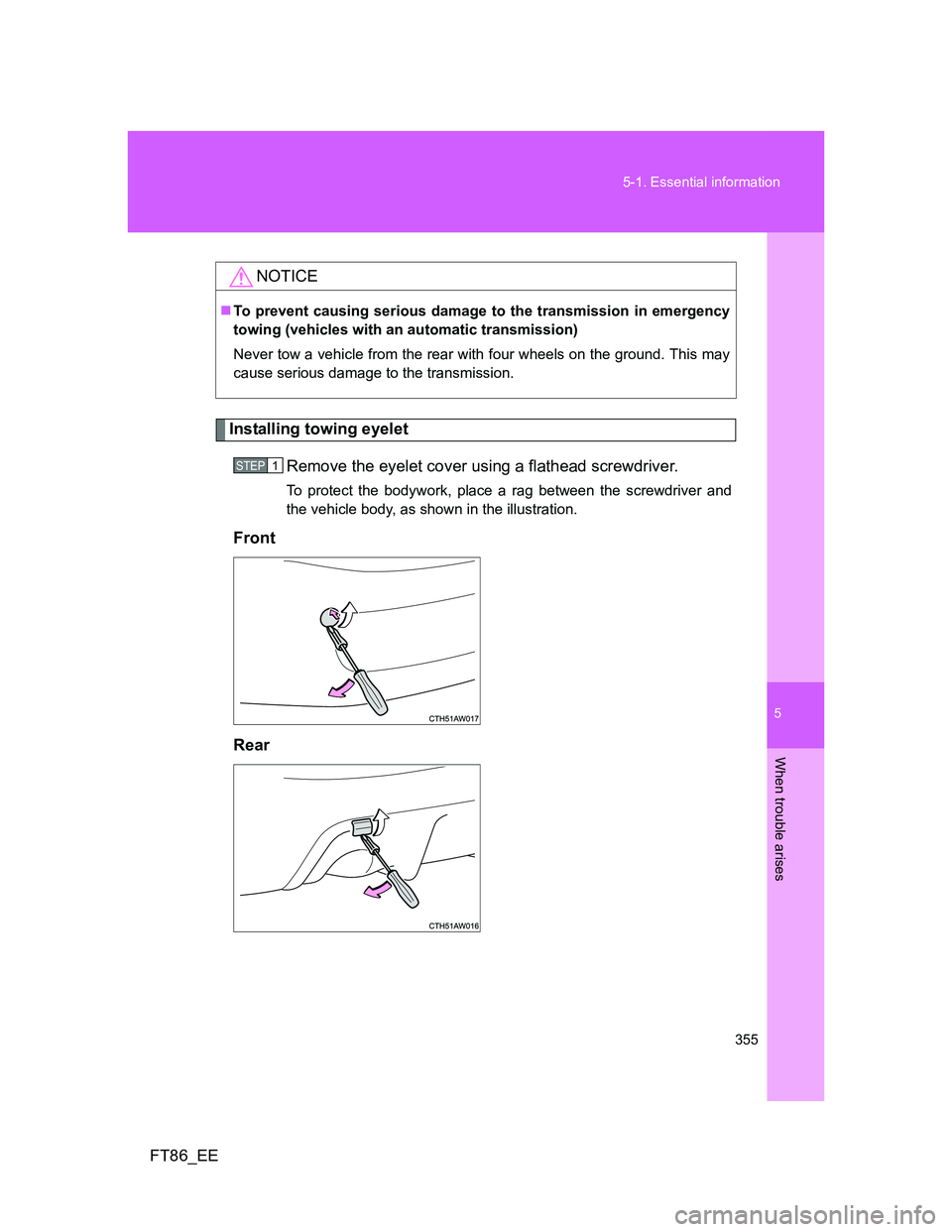
Installing towing eyelet
Remove the eyelet cover using a flathead screwdriver.
To protect the bodywork, place a rag between the screwdriver and
the vehicle body, as shown in the illustration.
Front
Rear
NOTICE
To prevent causing serious damage to the transmission in emergency
towing (vehicles with an automatic transmission)
Never tow a vehicle from the rear with four wheels on the ground. This may
cause serious damage to the transmission.
STEP 1
Page 356 of 448
356 5-1. Essential information
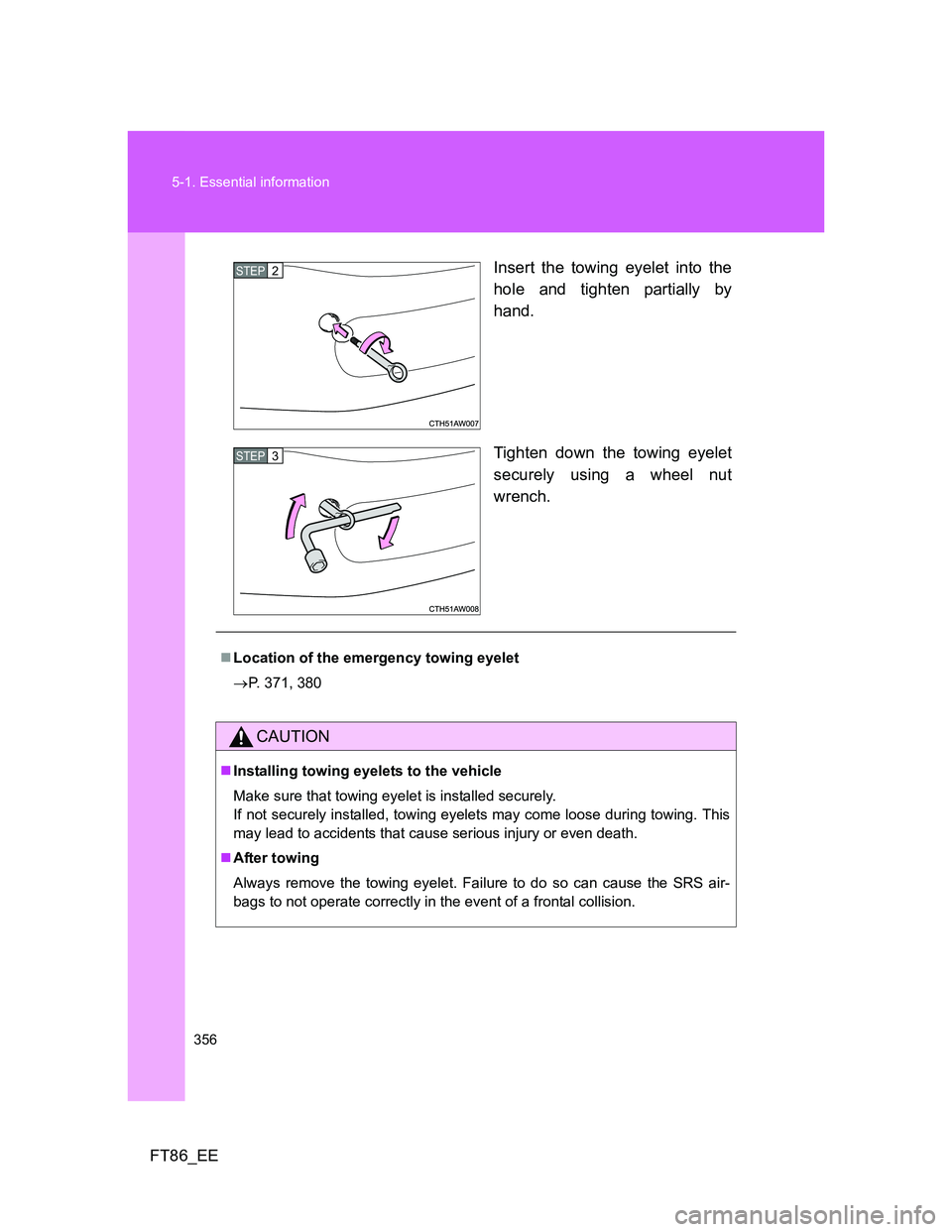
FT86_EEInsert the towing eyelet into the
hole and tighten partially by
hand.
Tighten down the towing eyelet
securely using a wheel nut
wrench.
STEP 2
STEP 3
Location of the emergency towing eyelet
P. 371, 380
CAUTION
Installing towing eyelets to the vehicle
Make sure that towing eyelet is installed securely.
If not securely installed, towing eyelets may come loose during towing. This
may lead to accidents that cause serious injury or even death.
After towing
Always remove the towing eyelet. Failure to do so can cause the SRS air-
bags to not operate correctly in the event of a frontal collision.
Page 357 of 448
5
357 5-1. Essential information
When trouble arises
FT86_EE
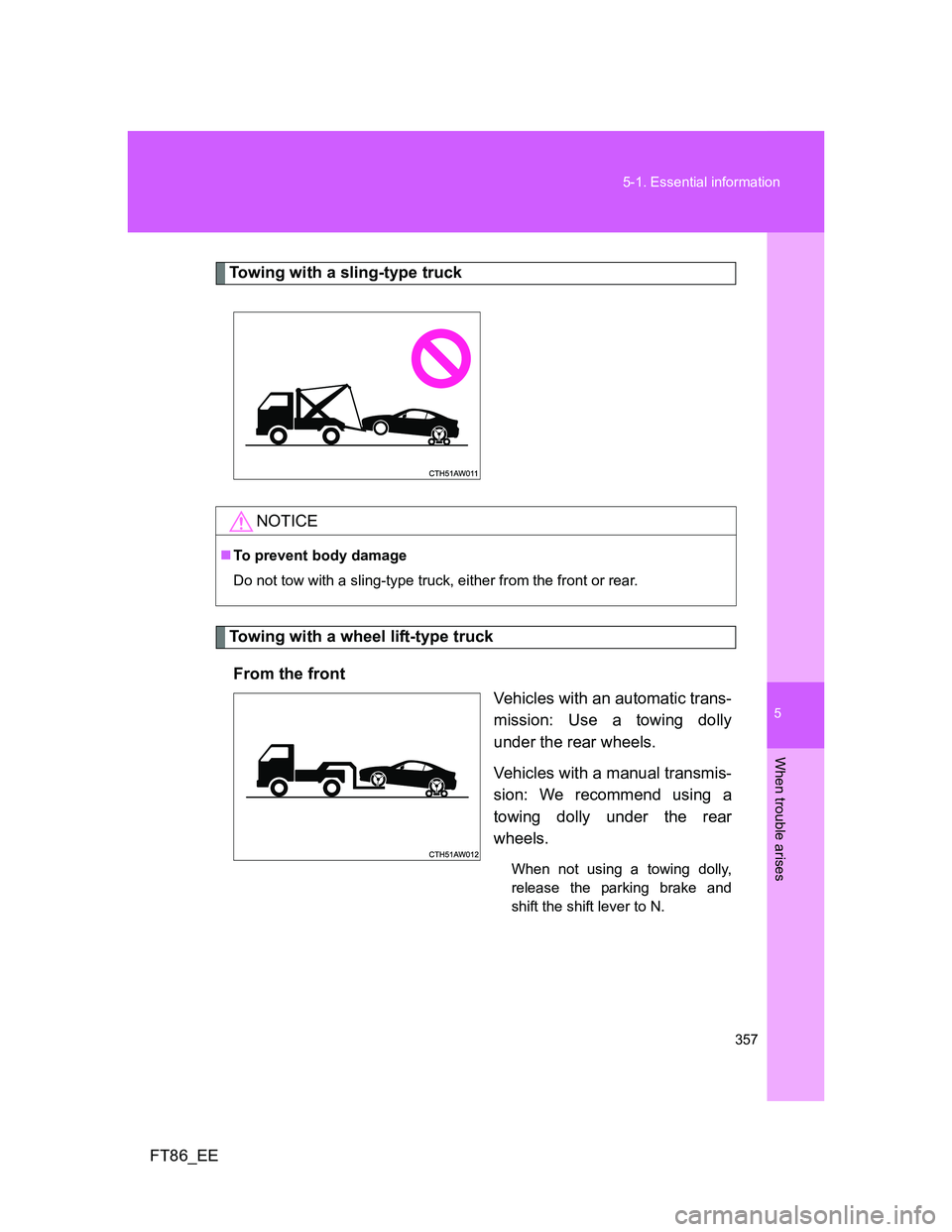
Towing with a sling-type truck
Towing with a wheel lift-type truck
From the front
Vehicles with an automatic trans-
mission: Use a towing dolly
under the rear wheels.
Vehicles with a manual transmis-
sion: We recommend using a
towing dolly under the rear
wheels.
When not using a towing dolly,
release the parking brake and
shift the shift lever to N.
NOTICE
To prevent body damage
Do not tow with a sling-type truck, either from the front or rear.
Page 358 of 448
358 5-1. Essential information
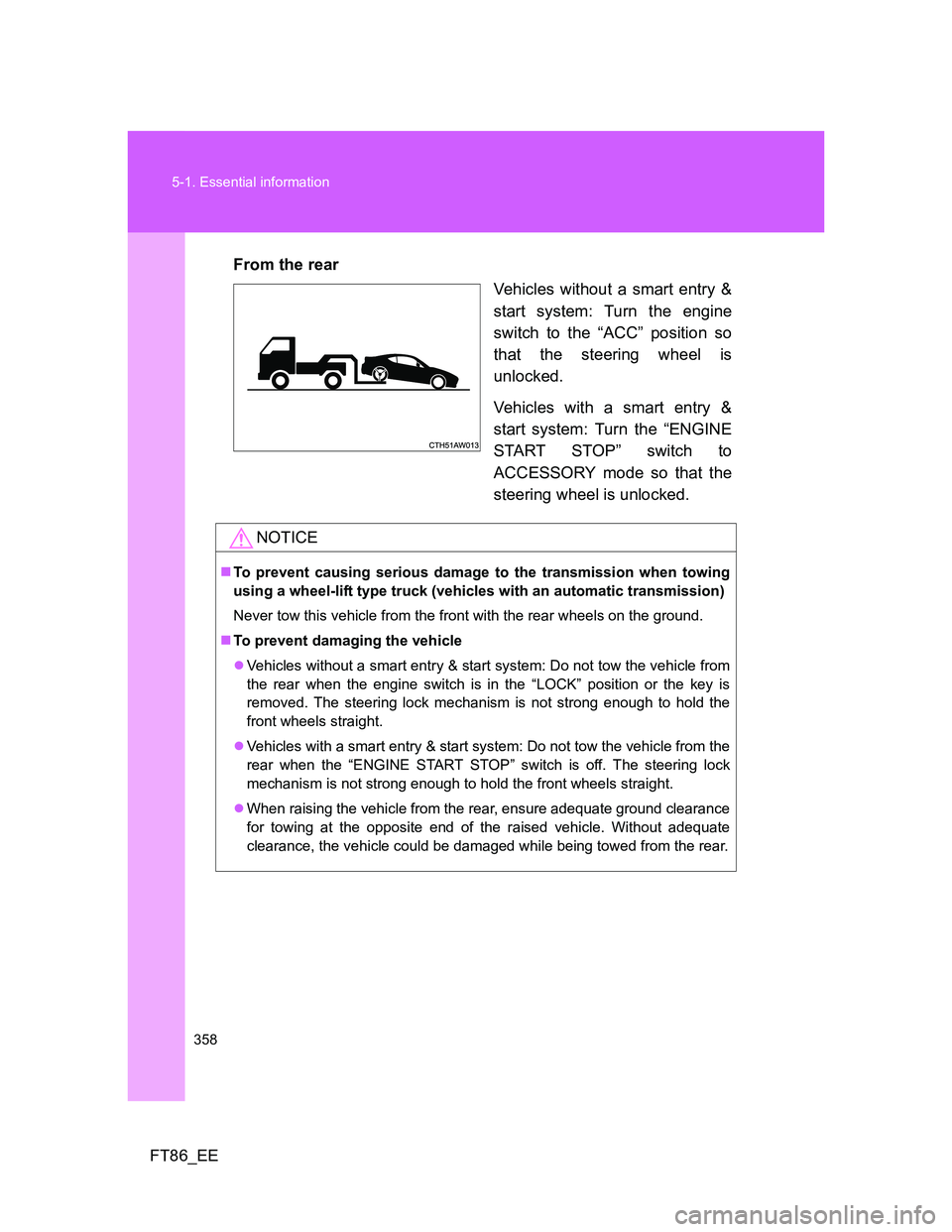
FT86_EEFrom the rear
Vehicles without a smart entry &
start system: Turn the engine
switch to the “ACC” position so
that the steering wheel is
unlocked.
Vehicles with a smart entry &
start system: Turn the “ENGINE
START STOP” switch to
ACCESSORY mode so that the
steering wheel is unlocked.
NOTICE
To prevent causing serious damage to the transmission when towing
using a wheel-lift type truck (vehicles with an automatic transmission)
Never tow this vehicle from the front with the rear wheels on the ground.
To prevent damaging the vehicle
Vehicles without a smart entry & start system: Do not tow the vehicle from
the rear when the engine switch is in the “LOCK” position or the key is
removed. The steering lock mechanism is not strong enough to hold the
front wheels straight.
Vehicles with a smart entry & start system: Do not tow the vehicle from the
rear when the “ENGINE START STOP” switch is off. The steering lock
mechanism is not strong enough to hold the front wheels straight.
When raising the vehicle from the rear, ensure adequate ground clearance
for towing at the opposite end of the raised vehicle. Without adequate
clearance, the vehicle could be damaged while being towed from the rear.
Page 371 of 448
5
371
5-2. Steps to take in an emergency
When trouble arises
FT86_EE
If you have a flat tire (vehicles with a spare tire)
Remove the flat tire and replace it with the spare provided.
Before jacking up the vehicle
Stop the vehicle on a hard, flat surface.
Set the parking brake.
Shift the shift lever to P (vehicles with an automatic transmis-
sion) or R (vehicles with a manual transmission).
Stop the engine.
Turn on the emergency flashers.
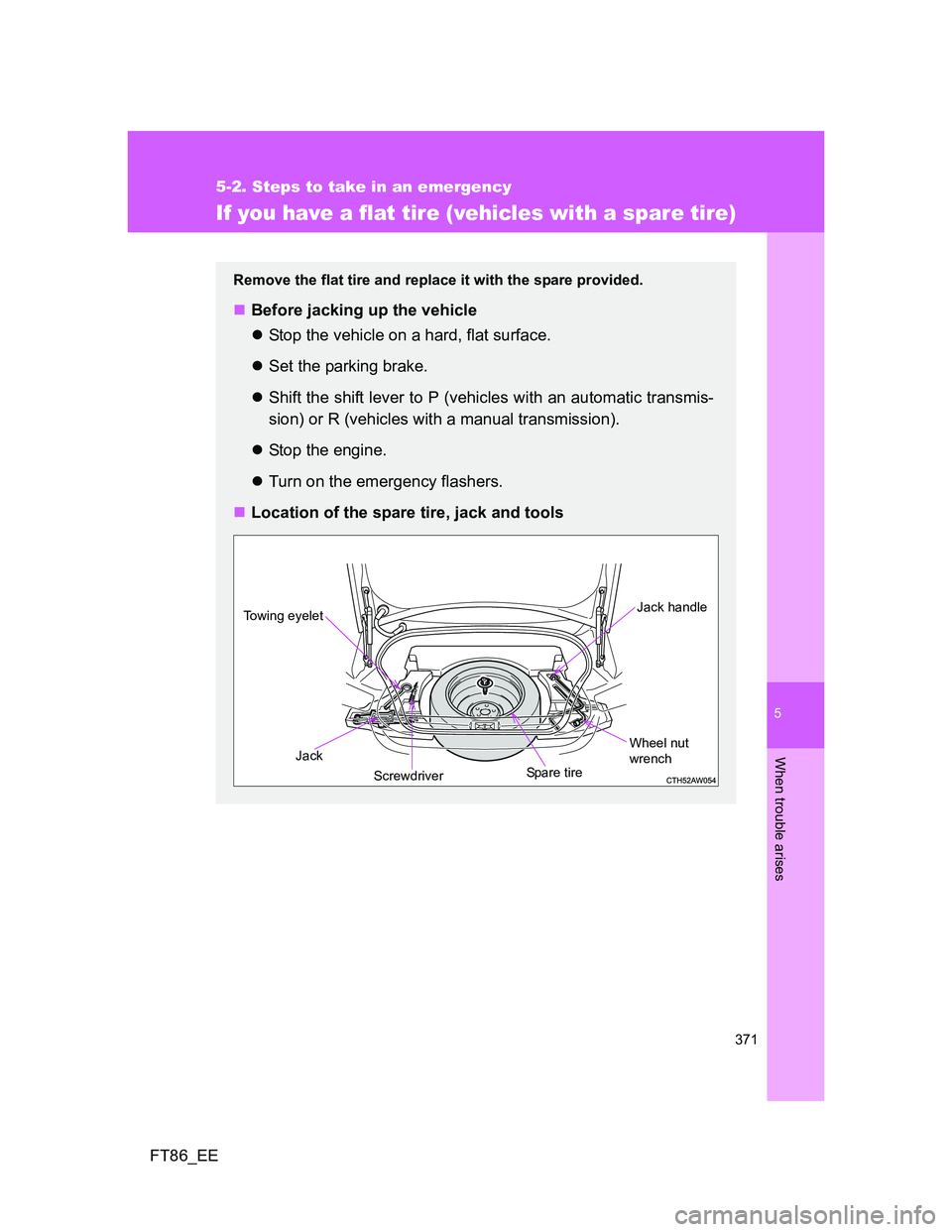
Location of the spare tire, jack and tools
Jack handle
Spare tire Towing eyelet
Screwdriver JackWheel nut
wrench
Page 375 of 448
5
375 5-2. Steps to take in an emergency
When trouble arises
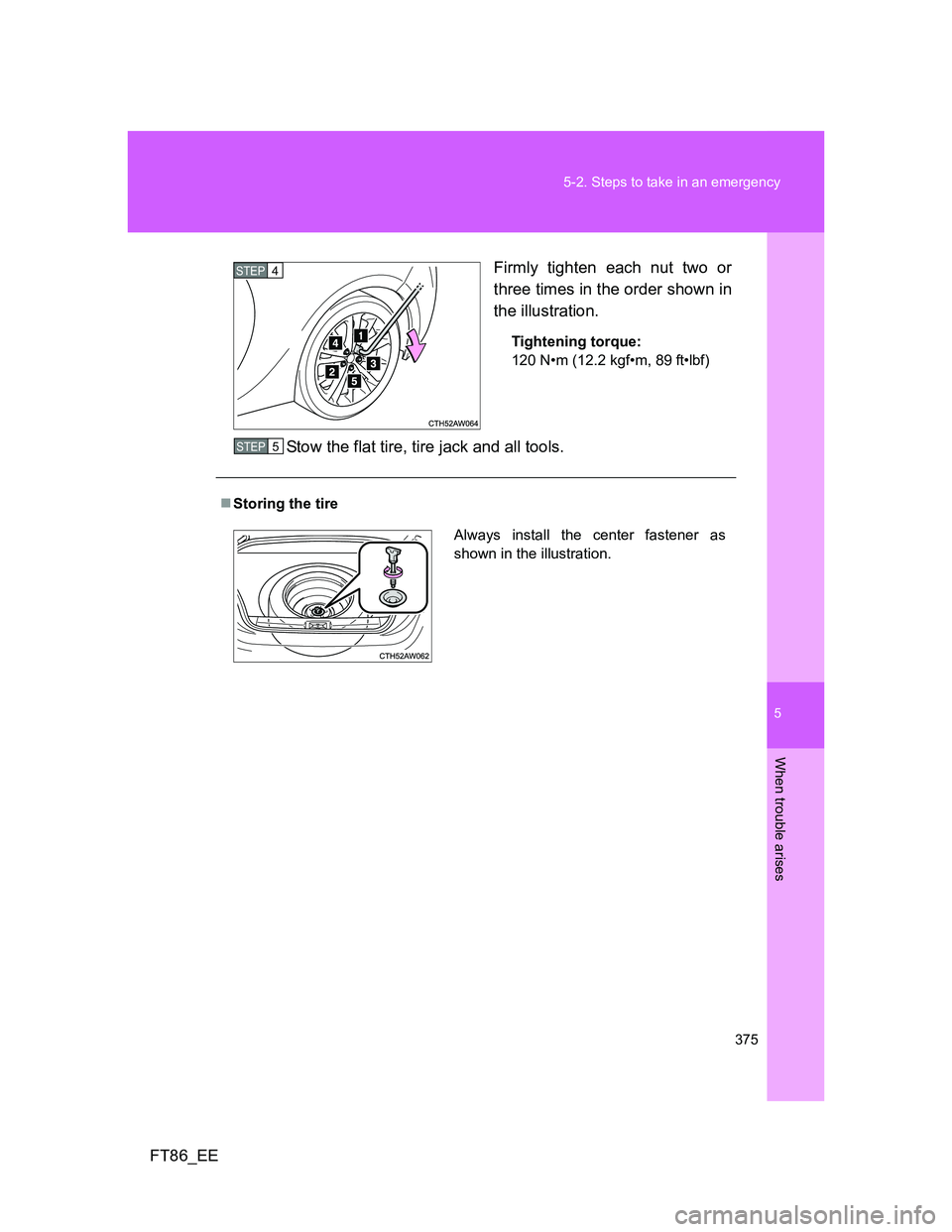
FT86_EEFirmly tighten each nut two or
three times in the order shown in
the illustration.
Tightening torque:
120 N•m (12.2 kgf•m, 89 ft•lbf)
Stow the flat tire, tire jack and all tools.
STEP 4
Storing the tire
STEP 5
Always install the center fastener as
shown in the illustration.