window TOYOTA GT86 2012 Owner's Manual
[x] Cancel search | Manufacturer: TOYOTA, Model Year: 2012, Model line: GT86, Model: TOYOTA GT86 2012Pages: 448, PDF Size: 13.47 MB
Page 111 of 448
111 1-7. Safety information
1
Before driving
FT86_EE
SRS side airbag and SRS curtain shield airbag
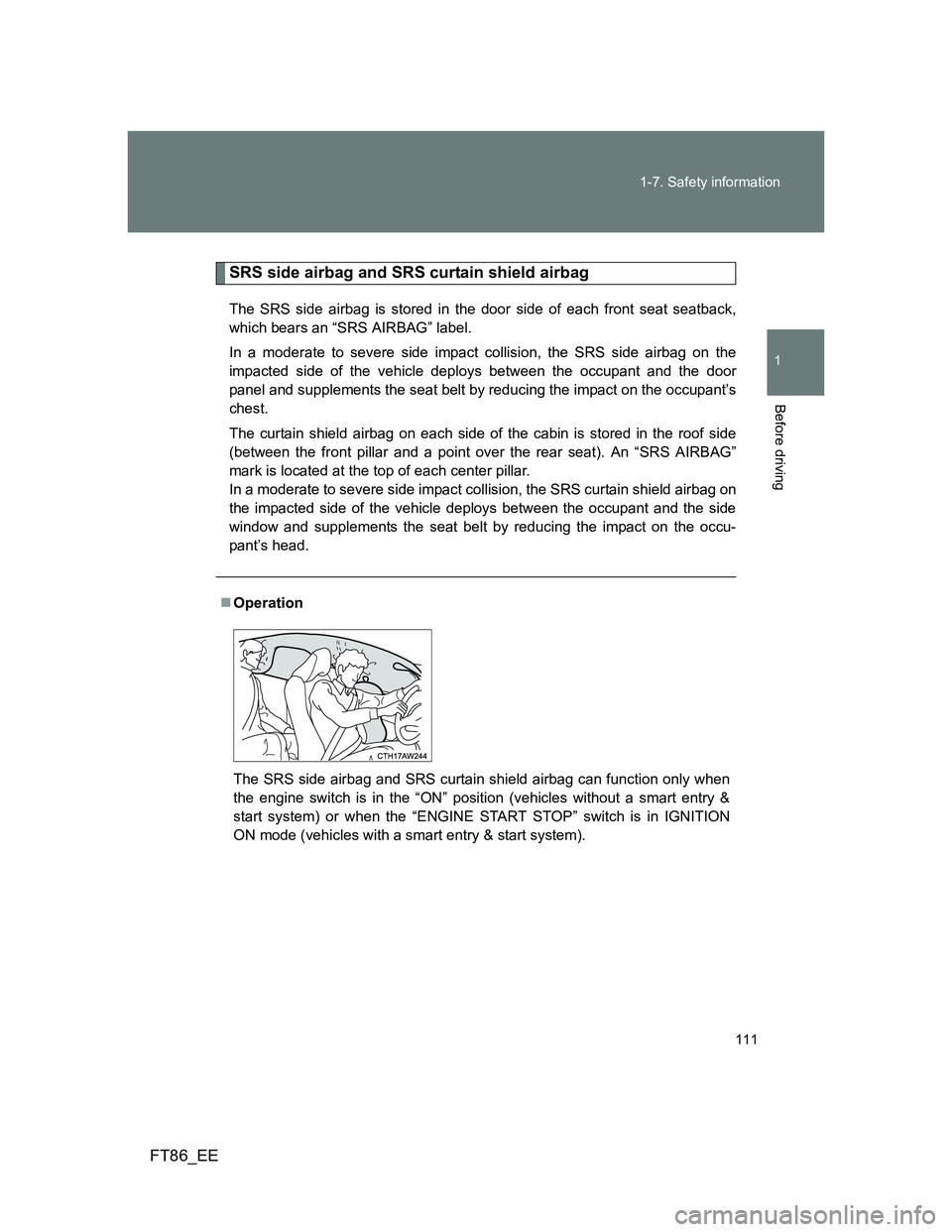
The SRS side airbag is stored in the door side of each front seat seatback,
which bears an “SRS AIRBAG” label.
In a moderate to severe side impact collision, the SRS side airbag on the
impacted side of the vehicle deploys between the occupant and the door
panel and supplements the seat belt by reducing the impact on the occupant’s
chest.
The curtain shield airbag on each side of the cabin is stored in the roof side
(between the front pillar and a point over the rear seat). An “SRS AIRBAG”
mark is located at the top of each center pillar.
In a moderate to severe side impact collision, the SRS curtain shield airbag on
the impacted side of the vehicle deploys between the occupant and the side
window and supplements the seat belt by reducing the impact on the occu-
pant’s head.
Operation
The SRS side airbag and SRS curtain shield airbag can function only when
the engine switch is in the “ON” position (vehicles without a smart entry &
start system) or when the “ENGINE START STOP” switch is in IGNITION
ON mode (vehicles with a smart entry & start system).
Page 120 of 448

120 1-7. Safety information
FT86_EE
CAUTION
SRS airbag precautions
If the vinyl cover is put on the area where the SRS knee airbag will deploy,
be sure to remove it.
Do not use seat accessories which cover the parts where the SRS side
airbags inflate as they may interfere with inflation of the airbags. Such
accessories may prevent the side airbags from activating correctly, disable
the system or cause the side airbags to inflate accidentally, resulting in
death or serious injury.
Do not strike or apply significant levels of force to the area of the SRS air-
bag components (P. 101).
Doing so can cause the SRS airbags to malfunction.
Do not touch any of the component parts immediately after the SRS air-
bags have deployed (inflated) as they may be hot.
If breathing becomes difficult after the SRS airbag has deployed, open a
door or window to allow fresh air in, or leave the vehicle if it is safe to do
so. Wash off any residue as soon as possible to prevent skin irritation.
Do not attach anything to areas such as
a door, windshield glass, side door
glass, rear quarter glass, front or rear
pillar, roof side rail and assist grip.
(Except for the speed limit label
P. 383)
Vehicles without a smart entry & start
system only: Do not attach any heavy,
sharp or hard objects such as keys and
accessories to the key. The objects
may restrict the SRS knee airbag infla-
tion or be thrust into the driver's seat
area by the force of the deploying air-
bag, thus causing a danger.
Page 154 of 448
154 2-1. Driving procedures
FT86_EE
Starting off on a steep uphill
Vehicles with an automatic transmission
Make sure that the parking brake is set and shift the shift lever
to D.
Gently depress the accelerator pedal.
Release the parking brake.
Vehicles with a manual transmission
With the parking brake firmly set and the clutch pedal fully
depressed, shift the shift lever to 1.
Lightly depress the accelerator pedal at the same time as
gradually releasing the clutch pedal.
Release the parking brake.
Driving in the rain
Drive carefully when it is raining, because visibility will be reduced, the
windows may become fogged-up, and the road will be slippery.
Drive carefully when it starts to rain, because the road surface will be
especially slippery.
Refrain from high speeds when driving on an expressway in the rain,
because there may be a layer of water between the tires and the road
surface, preventing the steering and brakes from operating properly.
Engine speed while driving (vehicles with an automatic transmission)
In the following conditions, the engine speed may become high while driving.
This is due to automatic up-shifting control or down-shifting implementation
to meet driving conditions. It does not indicate sudden acceleration.
The vehicle is judged to be driving uphill or downhill
When the accelerator pedal is released
When driving on curves
When the brake pedal is firmly depressed
STEP 1
STEP 2
STEP 3
STEP 1
STEP 2
STEP 3
Page 157 of 448
157 2-1. Driving procedures
2
When driving
FT86_EE
CAUTION
On vehicles with an automatic transmission, do not let the vehicle roll
backward while the shift lever is in a driving position, or roll forward while
the shift lever is in R.
Doing so may cause the engine to stall or lead to poor brake and steering
performance, resulting in an accident or damage to the vehicle.
If the smell of exhaust is noticed inside the vehicle, open the windows and
check that the trunk is closed. Large amounts of exhaust in the vehicle can
cause driver drowsiness and an accident, resulting in death or a serious
health hazard. Have the vehicle inspected by any authorized Toyota dealer
or repairer, or another duly qualified and equipped professional immedi-
ately.
On vehicles with a manual transmission, do not shift the shift lever to R
while the vehicle is moving forward.
Doing so can damage the transmission and may result in a loss of vehicle
control.
Do not shift the shift lever to D (vehicles with an automatic transmission) or
1 (vehicles with a manual transmission) while the vehicle is moving back-
ward.
Doing so can damage the transmission and may result in a loss of vehicle
control.
On vehicles with a manual transmission, do not release the clutch pedal
too quickly. Doing so may propel the vehicle forward, possibly causing an
accident.
Moving the shift lever to N while the vehicle is moving will disengage the
engine from the transmission. Engine braking is not available when N is
selected.
During normal driving, do not turn off the engine. Turning the engine off
while driving will not cause loss of steering or braking control, but the
power assist to these systems will be lost. This will make it more difficult to
steer and brake, so you should pull over and stop the vehicle as soon as it
is safe to do so.
However, in the event of an emergency, such as if it becomes impossible
to stop the vehicle in the normal way: P. 413
Page 160 of 448

160 2-1. Driving procedures
FT86_EE
CAUTION
When the vehicle is parked
Do not leave glasses, cigarette lighters, spray cans, or soft drink cans in
the vehicle when it is in the sun.
Doing so may result in the following:
• Gas may leak from a cigarette lighter or spray can, and may lead to a
fire.
• The temperature inside the vehicle may cause the plastic lenses and
plastic material of glasses to deform or crack.
• Soft drink cans may fracture, causing the contents to spray over the
interior of the vehicle, and may also cause a short circuit in the vehi-
cle's electrical components.
Do not leave cigarette lighters in the vehicle. If a cigarette lighter is in a
place such as the glove box or on the floor, it may be lit accidentally when
luggage is loaded or the seat is adjusted, causing a fire.
Do not attach suction cups to the windshield or windows. Do not place
containers such as air fresheners on the instrument panel or dashboard.
Suction cups or containers may act as lenses, causing a fire in the vehicle.
Do not leave a door or window open if the curved glass is coated with a
metallized film such as a silver-colored one. Reflected sunlight may cause
the glass to act as a lens, causing a fire.
Always apply the parking brake, shift the shift lever to P (vehicles with an
automatic transmission only), stop the engine and lock the vehicle.
Do not leave the vehicle unattended while the engine is running.
Do not touch the exhaust pipe while the engine is running or immediately
after turning the engine off.
Doing so may cause burns.
Do not leave the engine running in an area with snow build-up, or where it
is snowing. If snowbanks build up around the vehicle while the engine is
running, exhaust gases may collect and enter the vehicle. This may lead
to death or a serious health hazard.
Page 229 of 448

229
2-5. Driving information
2
When driving
FT86_EE
Winter driving tips
Carry out the necessary preparations and inspections before driving
the vehicle in winter. Always drive the vehicle in a manner appropri-
ate to the prevailing weather conditions.
Pre-winter preparations
Use fluids that are appropriate to the prevailing outside tem-
peratures.
• Engine oil
• Washer fluid
Have a service technician inspect the condition of the battery.
Have the vehicle fitted with four snow tires or purchase a set
of tire chains for the rear tires.
Make sure to install 4 tires that are of the specified size, and that all
4 tires are the same size, same maker, same brand and tread pat-
tern. Also, make sure to use tire chains that match the size of the
tires.
Before driving the vehicle
Perform the following according to the driving conditions.
Do not try to forcibly open a window or move a wiper that is
frozen. Pour warm water over the frozen area to melt the ice.
Wipe away the water immediately to prevent it from freezing.
To ensure proper operation of the climate control system fan,
remove any snow that has accumulated on the air inlet vents
in front of the windshield.
Check for and remove any excess ice or snow that may have
accumulated on the exterior lights, vehicle's roof, chassis,
around the tires or on the brakes.
Remove any snow or mud from the bottom of your shoes
before getting in the vehicle.
Page 230 of 448
230 2-5. Driving information
FT86_EE
If a door is opened and closed when its side window is frozen,
the window safety device will operate and the side window
open/close function linked to door operation may not operate
correctly. If this occurs, perform the following after the ice has
melted.
Open the side window until it is approximately halfway
open.
Fully close the window by pulling the switch up to the one-
touch closing position and continue holding the switch for 1
second or more after the window fully closes.
The window position is reset and the safety device operations will
be released.
When driving the vehicle
Accelerate the vehicle slowly, keep a safe distance between you
and the vehicle ahead, and drive at a reduced speed suitable to
road conditions.
When parking the vehicle (in the winter time or in the cold
latitudes)
Park the vehicle and move the shift lever to P (automatic trans-
mission) or 1 or R (manual transmission) without setting the
parking brake. The parking brake may freeze up, preventing it
from being released. If necessary, block the wheels to prevent
inadvertent sliding or creeping.
STEP 1
STEP 2
Page 235 of 448
3Interior features
235
FT86_EE
3-1. Using the air conditioning
system and defogger
Manual air conditioning
system ............................ 236
Automatic air conditioning
system ............................ 244
Rear window and
outside rear view
mirror defoggers ............. 252
3-2. Using the audio system
Using the AUX/USB
port ................................. 254
3-3. Using the interior lights
Interior lights list................ 255
• Interior light ..................... 256
3-4. Using the storage
features
List of storage features ..... 257
• Glove box ....................... 258
• Bottle holders ................. 259
• Cup holders/
console tray .................... 2603-5. Other interior features
Sun visors ......................... 262
Vanity mirrors.................... 263
Clock ................................. 264
Outside temperature
display ............................ 265
Ashtray.............................. 266
Power outlets .................... 267
Seat heaters ..................... 269
Floor mat........................... 271
Trunk features................... 274
Page 238 of 448

238 3-1. Using the air conditioning system and defogger
FT86_EE
Defogging the windshield
Set the air outlet selection dial to
position.
If the recirculated air mode is
used, it will automatically switch
to the outside air mode.
Perform the following operations accordingly:
To adjust the fan speed, turn the fan speed control dial.
To adjust the temperature setting, turn the temperature con-
trol dial.
Vehicles with the button: If the dehumidification func-
tion is not operating, press to operate the dehumidifi-
cation function.
To defog the windshield and the side windows early, turn the
air flow and temperature up.
STEP 1
STEP 2
Page 242 of 448
242 3-1. Using the air conditioning system and defogger
FT86_EE
Fogging up of the windows
Vehicles with the button: The windows will easily fog up when the
humidity in the vehicle is high. Turning
on will dehumidify the air
from the outlets and defog the windshield effectively.
Vehicles with the button: If you turn
off, the windows may
fog up more easily.
The windows may fog up if the recirculated air mode is used.
Outside/recirculated air mode
When driving on dusty roads such as tunnels or in heavy traffic, set the
outside/recirculated air mode button to the recirculated air mode. This is
recommended to prevent outside air from entering the vehicle interior.
Vehicles with the button: During cooling operation, setting the
recirculated air mode will also cool the vehicle interior effectively.
When the outside temperature falls to nearly 0°C (32°F) (vehicles with
the button)
The dehumidification function may not operate even when is
pressed.