tire pressure TOYOTA GT86 2014 Owners Manual
[x] Cancel search | Manufacturer: TOYOTA, Model Year: 2014, Model line: GT86, Model: TOYOTA GT86 2014Pages: 464, PDF Size: 10.65 MB
Page 4 of 464

TABLE OF CONTENTSIndex
4
4-1. Maintenance and care
Cleaning and protecting
the vehicle exterior
............. 282
Cleaning and protecting
the vehicle interior ............ 285
Cleaning and protecting
the Alcantara
® area .......... 289
4-2. Maintenance
Maintenance
requirements..................... 291
4-3. Do-it-yourself
maintenance
Do-it-yourself service
precautions ....................... 294
Hood ................................... 297
Positioning a floor jack ........ 299
Engine compartment........... 301
Tires .................................... 314
Tire inflation pressure ......... 323
Wheels ................................ 325
Air conditioning filter ........... 328
Wireless remote control/
electronic key battery........ 331
Checking and replacing
fuses ................................. 335
Light bulbs .......................... 3435-1. Essential information
Emergency flashers ........... 362
If your vehicle needs to
be towed .......................... 363
If you think something is
wrong ............................... 370
Fuel pump shut off
system.............................. 371
5-2. Steps to take in
an emergency
If a warning light turns
on or a warning buzzer
sounds... ......................... 372
If you have a flat tire
(vehicles with
a spare tire) ...................... 384
If you have a flat tire
(vehicles with
an emergency tire
puncture repair kit) ........... 393
If the engine will
not start ............................ 409
If the shift lever cannot be
shifted from P ................... 412
If you lose your keys .......... 413
If the electronic key does
not operate properly ......... 414
If the battery is
discharged ....................... 418
4Maintenance and care5When trouble arises
Page 7 of 464

7
Tires
Rotation
Replacement
Temporary repair
Inflation pressure
P. 314
P. 384
P. 393
P. 323
Rear window defogger P. 256
Trunk P. 58
Doors P. 55
Fuel filler door P. 87
Turn signal lights P. 191
: If equipped
License plate lights P. 208
Tail lights P. 208
Rear fog light P. 215
Page 14 of 464
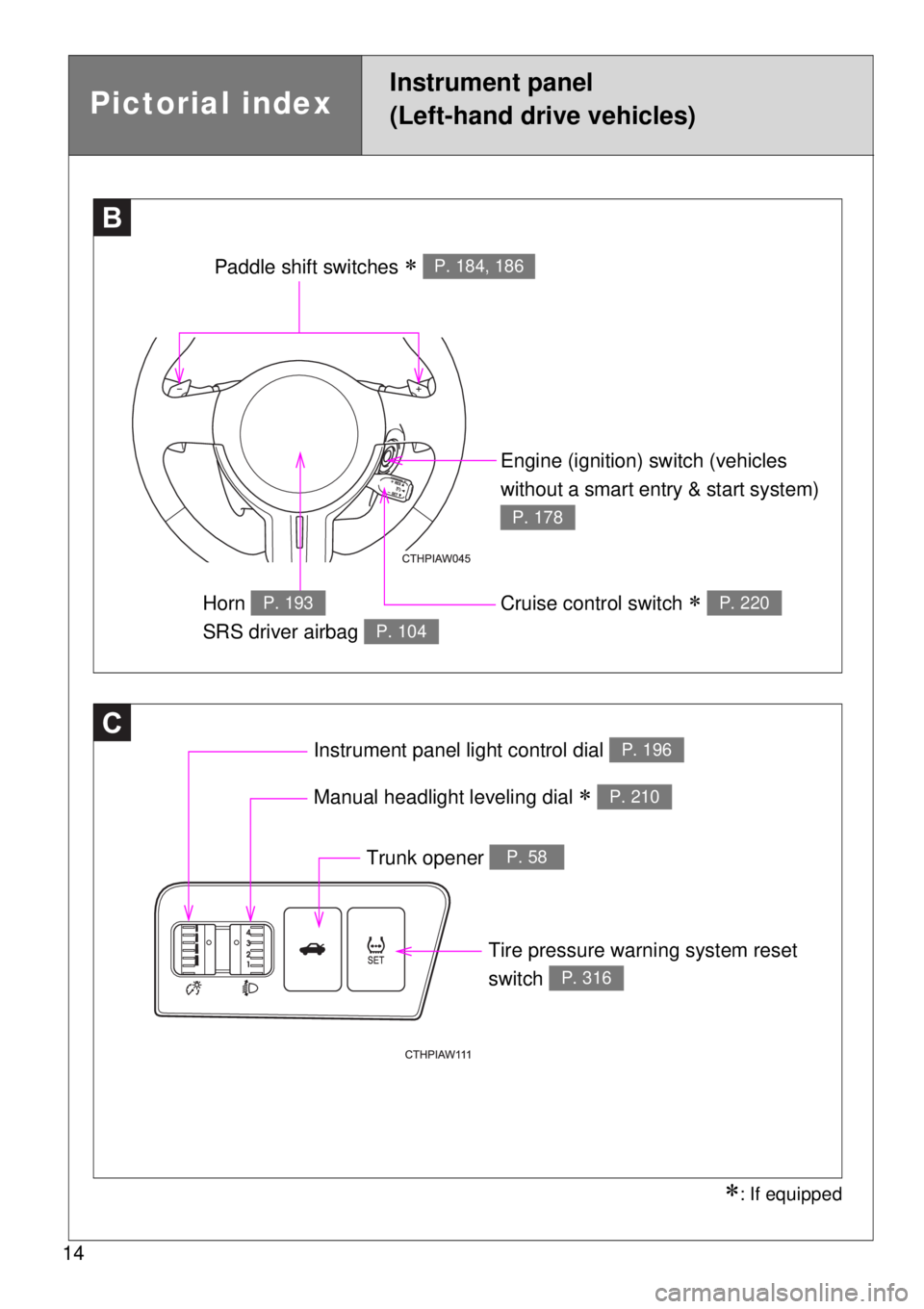
14
C
BB
Paddle shift switches P. 184, 186
Engine (ignition) switch (vehicles
without a smart entry & start system)
P. 178
Cruise control switch P. 220Horn
SRS driver airbag P. 193
P. 104
Instrument panel light control dial P. 196
Manual headlight leveling dial P. 210
Trunk opener P. 58
: If equipped
Pictorial index
Instrument panel
(Left-hand drive vehicles)
Tire pressure warning system reset
switch
P. 316
Page 21 of 464
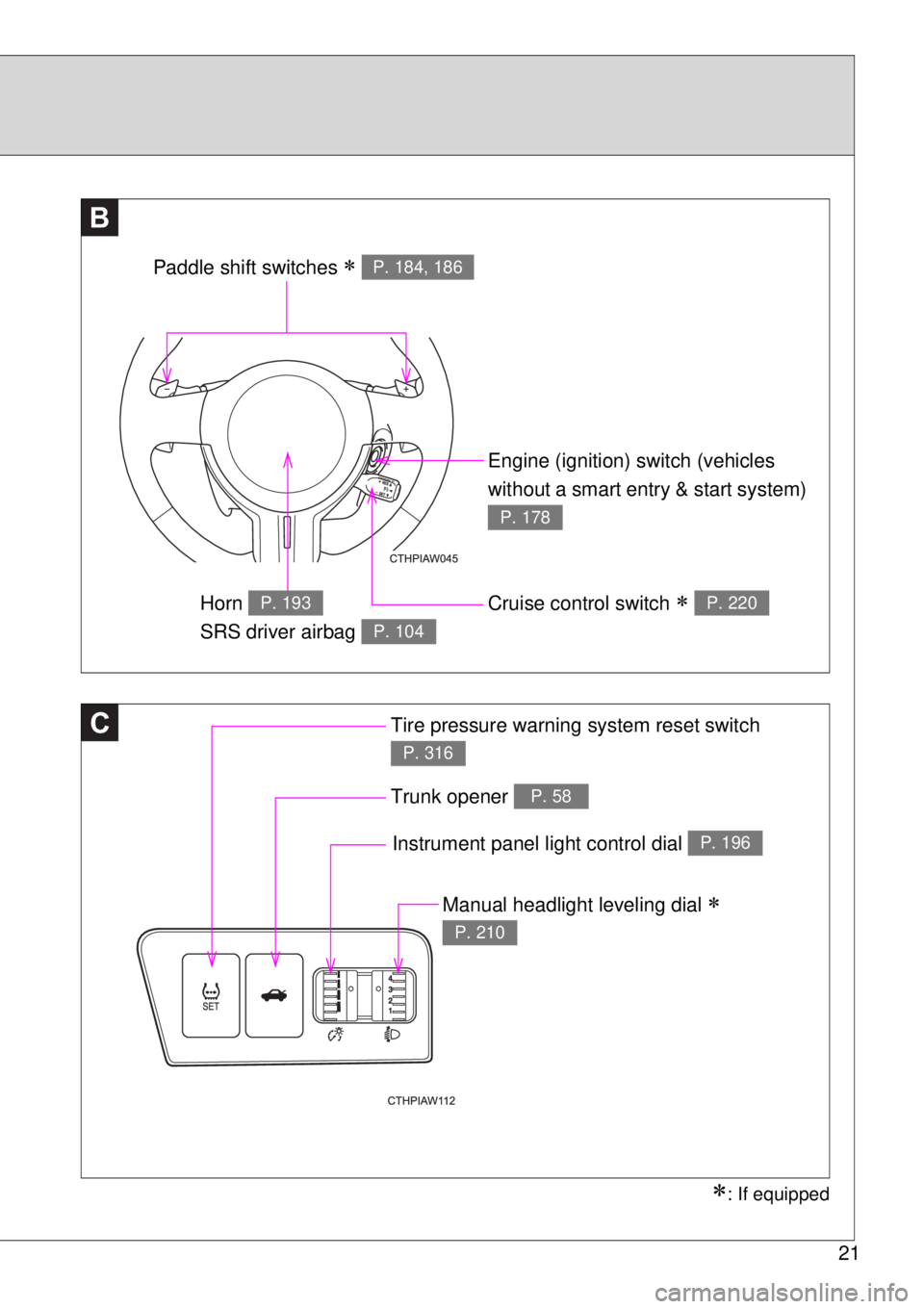
21
C
B
Engine (ignition) switch (vehicles
without a smart entry & start system)
P. 178
Cruise control switch P. 220Horn
SRS driver airbag P. 193
P. 104
Instrument panel light control dial P. 196
Manual headlight leveling dial
P. 210
Trunk opener P. 58
: If equipped
Paddle shift switches P. 184, 186
Tire pressure warning system reset switch
P. 316
Page 230 of 464

230 2-4. Using other driving systems
CAUTION
When the VSC and/or brake LSD function is activated
The slip indicator light flashes. Always drive carefully. Reckless driving may
cause an accident. Exercise particular care when the indicator light flashes.
When the TRC/VSC systems are turned off
Be especially careful and drive at a speed appropriate to the road condi-
tions. As these are the systems to help ensure vehicle stability and driving
force, do not turn the TRC/VSC systems off unless necessary.
Replacing tires
Make sure that all tires are of the specified size, brand, tread pattern and
total load capacity. In addition, make sure that the tires are inflated to the
recommended tire inflation pressure level.
The ABS, TRC and VSC systems will not function correctly if different tires
are installed on the vehicle.
Contact any authorized Toyota dealer or repairer, or another duly qualified
and equipped professional for further information when replacing tires or
wheels.
Handling of tires and suspension
Using tires with any kind of problem or modifying the suspension will affect
the driving assist systems, and may cause a system to malfunction.
Page 235 of 464

235 2-5. Driving information
2
When driving
Selecting tire chains
We recommend that you consult any authorized Toyota dealer or
repairer, or another duly qualified and equipped professional for infor-
mation about the chains that you can use.
Regulations on the use of tire chains
Regulations regarding the use of tire chains vary according to loca-
tion and type of road. Always check local regulations before installing
chains.
Tire chains
Observe the following precautions when installing and removing chains.
Install and remove tire chains in a safe location.
Install tire chains on the rear tires. Do not install tire chains on front tires.
Install tire chains on rear tires as tightly as possible. Retighten chains
after driving approximately 100 m (328 ft.).
Install tire chains following the instructions provided with the tire chains.
CAUTION
Driving with snow tires
Observe the following precautions to reduce the risk of accidents.
Failure to do so may result in a loss of vehicle control and cause death or
serious injury.
Use tires of the specified size, and that are the same size, same maker,
same brand and tread pattern.
Maintain the recommended level of air pressure.
Do not drive at speeds in excess of the speed limit or the speed limit spec-
ified for the snow tires being used.
Use snow tires on all, not just some wheels.
Page 236 of 464

236 2-5. Driving information
CAUTION
Driving with tire chains
Vehicles with an emergency tire puncture repair kit: When any of the tires
are punctured, you can seal the tire temporarily. However, do not use the
tire chain on a sealed tire. If any of the rear tires are punctured although it
is required to use tire chains, contact any authorized Toyota dealer or
repairer, or another duly qualified and equipped professional.
Observe the following precautions to reduce the risk of accidents.
Failing to do so may result in the vehicle being unable to be driven safely,
and may cause death or serious injury.
• Do not drive in excess of the speed limit specified for the tire chains
being used, or 30 km/h (19 mph), whichever is lower.
• Avoid driving on bumpy road surfaces or over potholes.
• Avoid sudden acceleration, abrupt steering, sudden braking and shifting
operations that cause sudden engine braking.
• Slow down sufficiently before entering a curve to ensure that vehicle con-
trol is maintained.
Always use the utmost care when driving with tire chains - overconfidence
because you are driving with tire chains could easily lead to a serious acci-
dent.
NOTICE
Using the tire chains
Use only chains that are of the correct size for your tires so as not to damage
the vehicle body or suspension.
Repairing or replacing snow tires
Request repairs or replacement of snow tires from Toyota dealers or legiti-
mate tire retailers.
This is because the removal and attachment of snow tires affects the opera-
tion of the tire pressure warning valves and transmitters.
Fitting tire chains
The tire pressure warning valves and transmitters may not function correctly
when tire chains are fitted.
Page 281 of 464
4Maintenance and care
281
4-1. Maintenance and care
Cleaning and protecting
the vehicle exterior ......... 282
Cleaning and protecting
the vehicle interior .......... 285
Cleaning and protecting
the Alcantara
® area ........ 289
4-2. Maintenance
Maintenance
requirements................... 291
4-3. Do-it-yourself
maintenance
Do-it-yourself service
precautions ..................... 294
Hood ................................. 297
Positioning a floor jack ...... 299
Engine compartment......... 301
Tires .................................. 314
Tire inflation pressure ....... 323
Wheels .............................. 325
Air conditioning filter ......... 328
Wireless remote control/
electronic key battery...... 331
Checking and replacing
fuses ............................... 335
Light bulbs ........................ 343
Page 295 of 464
295 4-3. Do-it-yourself maintenance
4
Maintenance and care
CAUTION
The engine compartment contains many mechanisms and fluids that may
move suddenly, become hot, or become electrically energized. To avoid death
or serious injury, observe the following precautions.
When working on the engine compartment
Keep hands, clothing, and tools away from the moving fan and engine
drive belt.
Be careful not to touch the engine, radiator, exhaust manifold, etc. right
after driving as they may be hot. Oil and other fluids may also be hot.
Do not leave anything that may burn easily, such as paper or rags, in the
engine compartment.
Do not smoke, cause sparks or expose an open flame to fuel or the bat-
tery. Fuel and battery fumes are flammable.
Be extremely cautious when working on the battery. It contains poisonous
and corrosive sulfuric acid.
Take care because brake fluid can harm your hands or eyes and damage
painted surfaces.
If fluid gets on your hands or in your eyes, flush the affected area with
clean water immediately.
If you still experience discomfort, see a doctor.
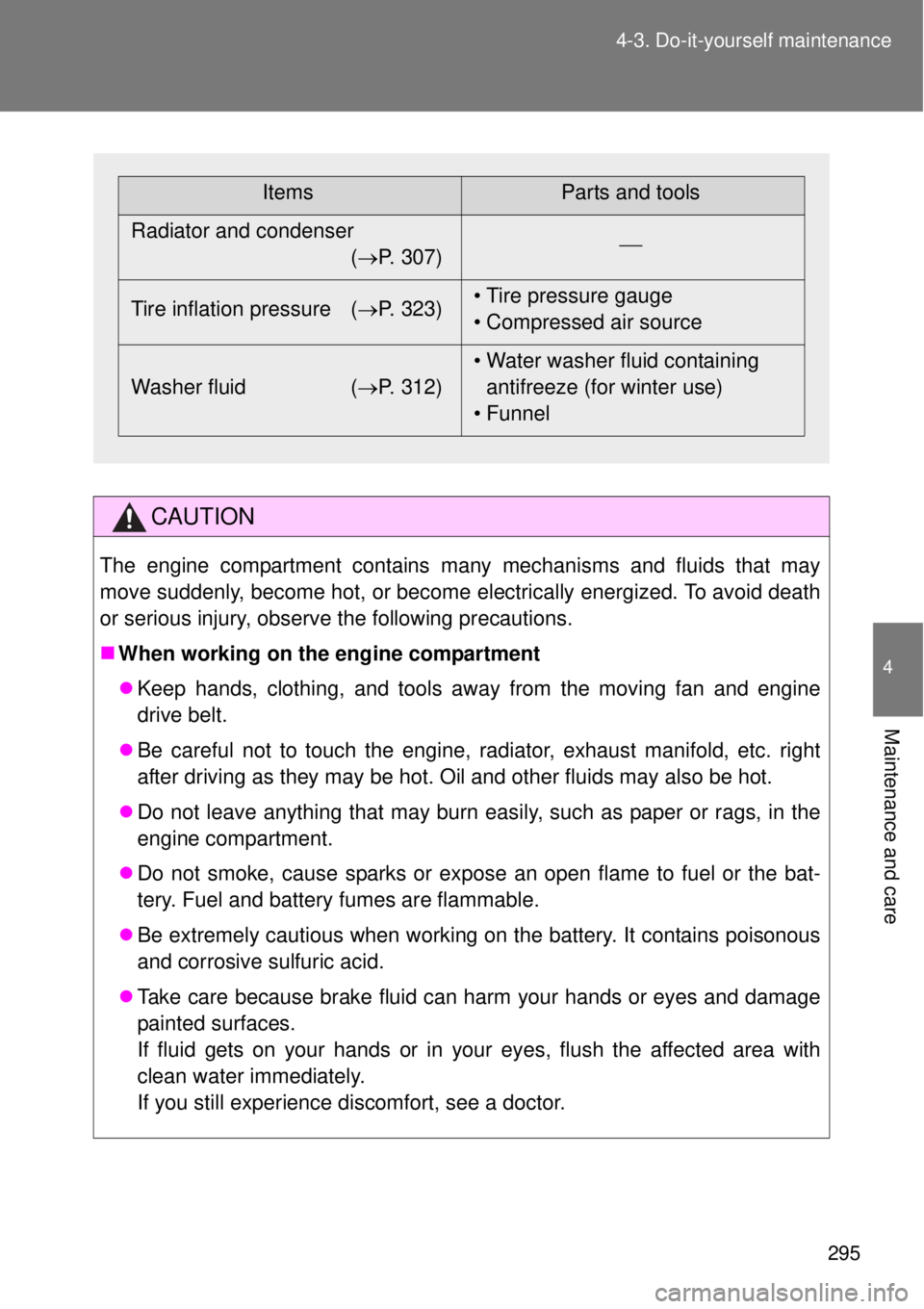
ItemsParts and tools
Radiator and condenser
(P. 307)
Tire inflation pressure (P. 323)• Tire pressure gauge
• Compressed air source
Washer fluid (P. 312)• Water washer fluid containing
antifreeze (for winter use)
• Funnel
Page 314 of 464
314
4-3. Do-it-yourself maintenance
Tires
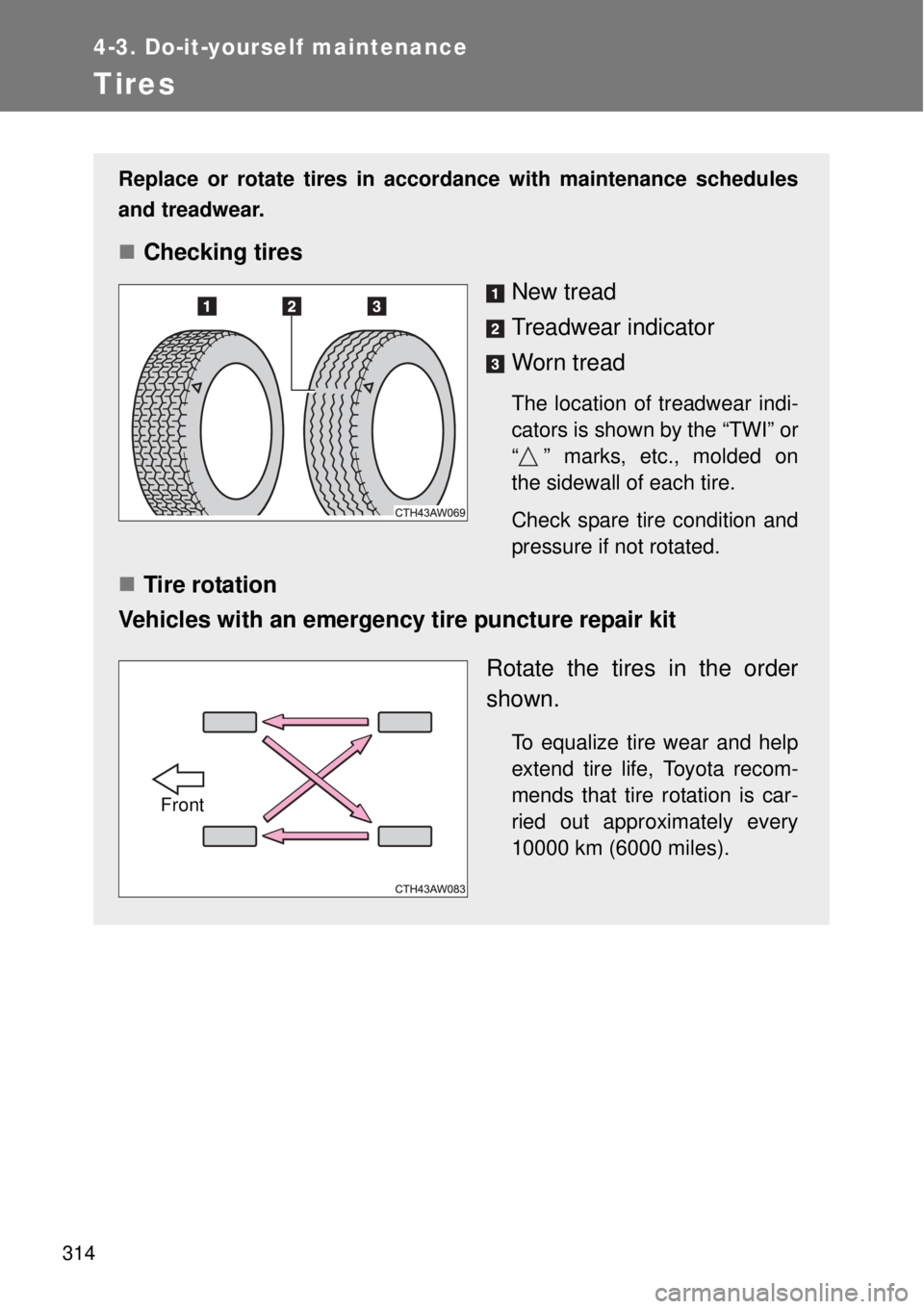
Replace or rotate tires in accordance with maintenance schedules
and treadwear.
Checking tires
New tread
Treadwear indicator
Worn tread
The location of treadwear indi-
cators is shown by the “TWI” or
“ ” marks, etc., molded on
the sidewall of each tire.
Check spare tire condition and
pressure if not rotated.
Tire rotation
Vehicles with an emergency tire puncture repair kit
Rotate the tires in the order
shown.
To equalize tire wear and help
extend tire life, Toyota recom-
mends that tire rotation is car-
ried out approximately every
10000 km (6000 miles).
Front