light TOYOTA GT86 2014 Owners Manual
[x] Cancel search | Manufacturer: TOYOTA, Model Year: 2014, Model line: GT86, Model: TOYOTA GT86 2014Pages: 464, PDF Size: 10.65 MB
Page 287 of 464

287 4-1. Maintenance and care
4
Maintenance and care
NOTICE
Cleaning detergents
Do not use organic substances such as benzene or gasoline, acidic or
alkaline solutions, dye, bleach or other detergent. Doing so may discolor
the vehicle interior or cause streaks or damage to painted surfaces.
Do not use polish wax or polish cleaner. The instrument panel's or other
interior part’s painted surface may be damaged.
Do not use a chemical agent containing silicone (highly-polymerized sili-
con compound) when cleaning any of the electrical appliances such as the
air conditioning, all switches and their surrounding areas.
If silicon (highly-polymerized silicon compound) contacts these compo-
nents, it may cause the electrical appliances to malfunction.
Preventing damage to leather surfaces
Observe the following precautions to avoid damage to and deterioration of
leather surfaces.
Remove any dust, dirt, sand, oil spots etc. on leather surfaces immedi-
ately.
Do not expose the vehicle to direct sunlight for extended periods of time.
Park the vehicle in the shade, especially during summer.
Do not place items made of vinyl, plastic, or that contain wax on the uphol-
stery, as they may stick to the leather surface if the vehicle interior heats
up significantly.
Water on the floor
Do not wash the vehicle floor with water.
Vehicle systems such as the audio system may be damaged if water comes
into contact with electrical components under the floor of the vehicle, and
may also cause the body to rust.
Page 289 of 464
289
4-1. Maintenance and care
4
Maintenance and care
Cleaning and protecting the Alcantara® area
: If equipped
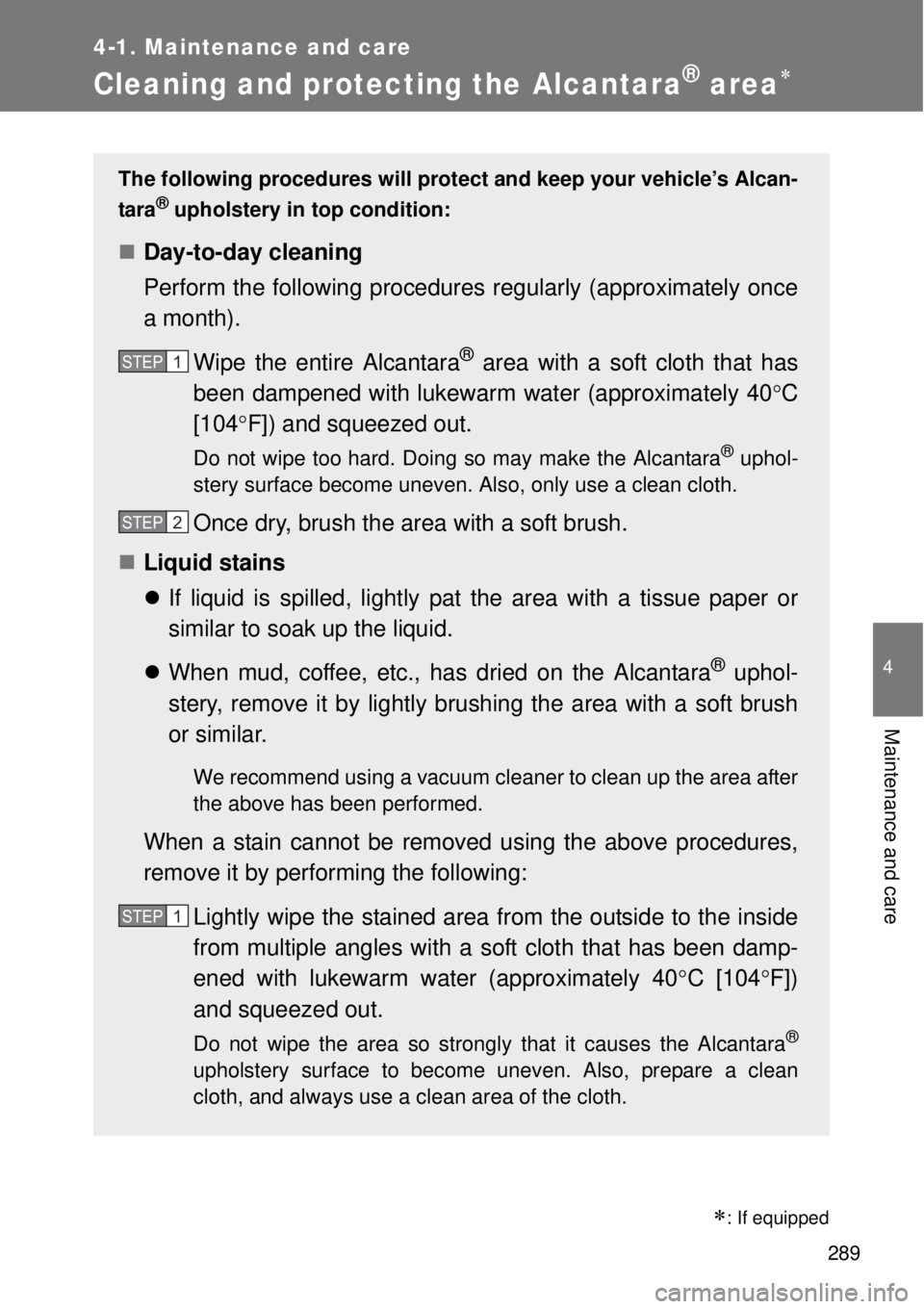
The following procedures will protect and keep your vehicle’s Alcan-
tara
® upholstery in top condition:
Day-to-day cleaning
Perform the following procedures regularly (approximately once
a month).
Wipe the entire Alcantara
® area with a soft cloth that has
been dampened with lukewarm water (approximately 40C
[104F]) and squeezed out.
Do not wipe too hard. Doing so may make the Alcantara® uphol-
stery surface become uneven. Also, only use a clean cloth.
Once dry, brush the area with a soft brush.
Liquid stains
If liquid is spilled, lightly pat the area with a tissue paper or
similar to soak up the liquid.
When mud, coffee, etc., has dried on the Alcantara
® uphol-
stery, remove it by lightly brushing the area with a soft brush
or similar.
We recommend using a vacuum cleaner to clean up the area after
the above has been performed.
When a stain cannot be removed using the above procedures,
remove it by performing the following:
Lightly wipe the stained area from the outside to the inside
from multiple angles with a soft cloth that has been damp-
ened with lukewarm water (approximately 40C [104F])
and squeezed out.
Do not wipe the area so strongly that it causes the Alcantara®
upholstery surface to become uneven. Also, prepare a clean
cloth, and always use a clean area of the cloth.
STEP 1
STEP 2
STEP 1
Page 290 of 464
290 4-1. Maintenance and care
When removing dirt or dust from the Alcantara® areas
Remove dirt or dust from the Alcantara
® areas by lighting brushing with a
soft brush. If this does not remove the dirt or dust, remove it using adhesive
tape.
NOTICE
When soaking up spilled liquids
Do not press down too firmly with the cloth, tissue paper etc., as doing so
may cause the liquid to further penetrate the material, making soaking up
the liquid more difficult.
If the Alcantara® upholstery surface becomes uneven,
lightly brush it with a soft brush.
Allow the surface to dry completely.
Oil stains
You will need the following items:
A cloth that has been dampened with benzene
A dry cloth
Using a dry cloth or tissue paper, wipe away as much of the
oil as possible to prevent the stained area from expanding.
After patting the area from the outside to the inside from
multiple angles using the cloth dampened with benzene,
soak up the oil and benzene that floats up by patting the
area with a dry cloth.
If the Alcantara
® upholstery surface becomes uneven,
lightly brush it with a soft brush.
STEP 2
STEP 3
STEP 1
STEP 2
STEP 3
Page 294 of 464
294
4-3. Do-it-yourself maintenance
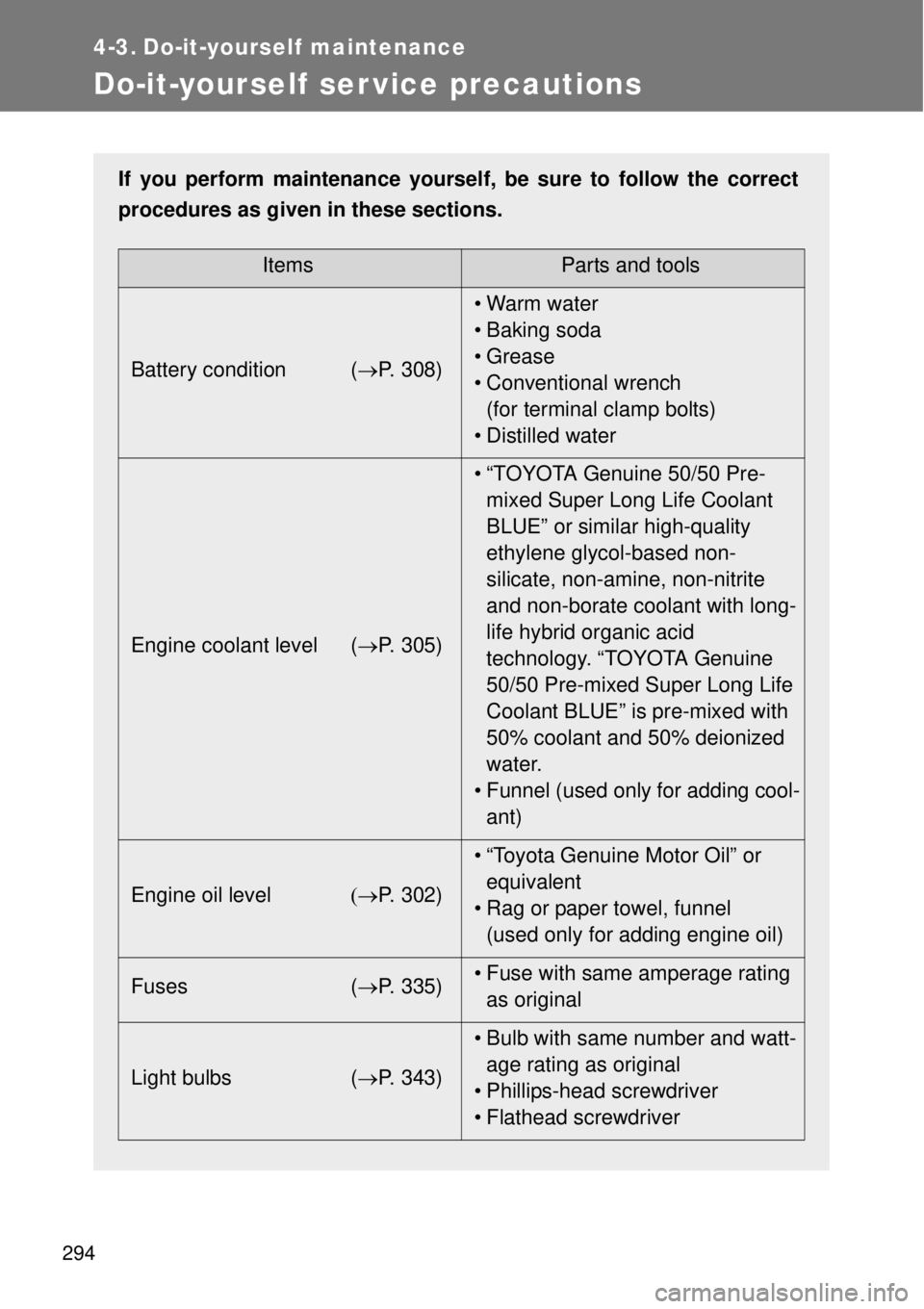
Do-it-yourself ser vice precautions
If you perform maintenance yourself, be sure to follow the correct
procedures as given in these sections.
ItemsParts and tools
Battery condition (P. 308)•Warm water
• Baking soda
• Grease
• Conventional wrench
(for terminal clamp bolts)
• Distilled water
Engine coolant level (P. 305)• “TOYOTA Genuine 50/50 Pre-
mixed Super Long Life Coolant
BLUE” or similar high-quality
ethylene glycol-based non-
silicate, non-amine, non-nitrite
and non-borate coolant with long-
life hybrid organic acid
technology. “TOYOTA Genuine
50/50 Pre-mixed Super Long Life
Coolant BLUE” is pre-mixed with
50% coolant and 50% deionized
water.
• Funnel (used only for adding cool-
ant)
Engine oil levelP. 302)• “Toyota Genuine Motor Oil” or
equivalent
• Rag or paper towel, funnel
(used only for adding engine oil)
Fuses (P. 335)• Fuse with same amperage rating
as original
Light bulbs (P. 343)• Bulb with same number and watt-
age rating as original
• Phillips-head screwdriver
• Flathead screwdriver
Page 296 of 464

296 4-3. Do-it-yourself maintenance
CAUTION
When working near the electric cooling fans or radiator grille
Vehicles without a smart entry & start system: Be sure the engine switch is
off. With the engine switch in the “ON” position, the electric cooling fans may
automatically start to run if the air conditioning is on and/or the coolant tem-
perature is high. (P. 307)
Vehicles with a smart entry & start system: Be sure the “ENGINE START
STOP” switch is off. With the “ENGINE START STOP” switch in IGNITION
ON mode, the electric cooling fans may automatically start to run if the air
conditioning is on and/or the coolant temperature is high. (P. 307)
Safety glasses
Wear safety glasses to prevent flying or falling material, fluid spray, etc. from
getting in the eyes.
NOTICE
If you remove the air cleaner filter
Driving with the air cleaner filter removed may cause excessive engine wear
due to dirt in the air.
If the fluid level is low or high
It is normal for the brake fluid level to go down slightly as the brake pads
wear or when the fluid level in the accumulator is high.
If the reservoir needs frequent refilling, it may indicate a serious problem.
Page 297 of 464
297
4-3. Do-it-yourself maintenance
4
Maintenance and care
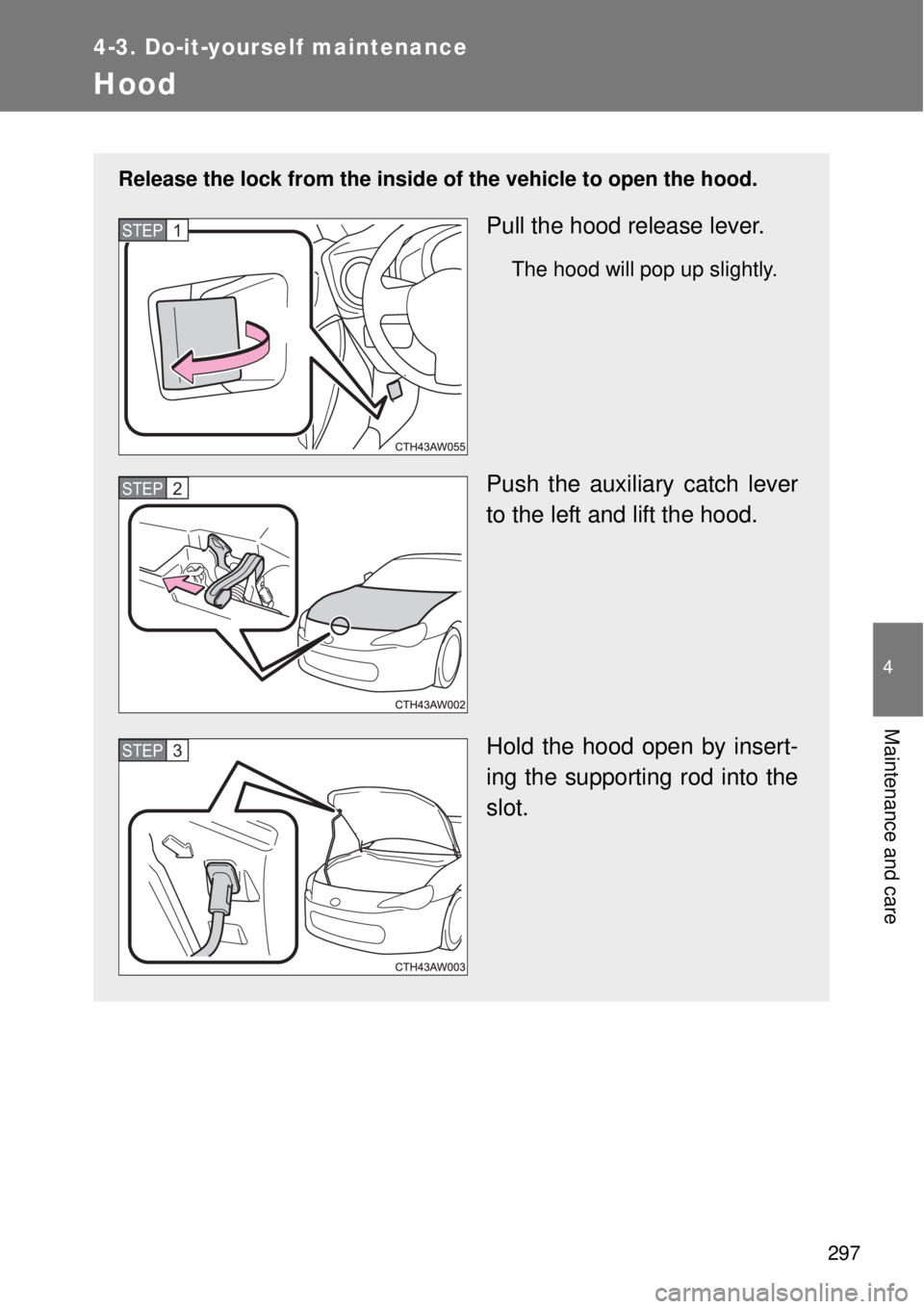
Hood
Release the lock from the inside of the vehicle to open the hood.
Pull the hood release lever.
The hood will pop up slightly.
Push the auxiliary catch lever
to the left and lift the hood.
Hold the hood open by insert-
ing the supporting rod into the
slot.
STEP 1
STEP 2
STEP 3
Page 300 of 464
300 4-3. Do-it-yourself maintenance
CAUTION
When raising your vehicle
Make sure to observe the following precautions to reduce the possibility of
death or serious injury:
When using a floor jack, follow the instructions of the manual provided with
the jack.
Do not use the jack that was supplied with your vehicle.
Do not put any part of your body underneath the vehicle when it is sup-
ported only by the floor jack.
Always use floor jack and/or automotive jack stands on a solid, flat, level
surface.
Do not start the engine while the vehicle is supported by the floor jack.
Stop the vehicle on level, firm ground, firmly set the parking brake and shift
the shift lever to P (vehicles with an automatic transmission) or R (vehicles
with a manual transmission).
Make sure to set the floor jack properly at the jack point.
Raising the vehicle with an improperly positioned floor jack will damage
the vehicle and may cause the vehicle to fall off the floor jack.
Do not raise the vehicle while someone is in the vehicle.
When raising the vehicle, do not place any object on top of or underneath
the floor jack.
When raising the vehicle, ensure that there is sufficient surrounding space.
The vehicle’s position may change slightly when lowered.
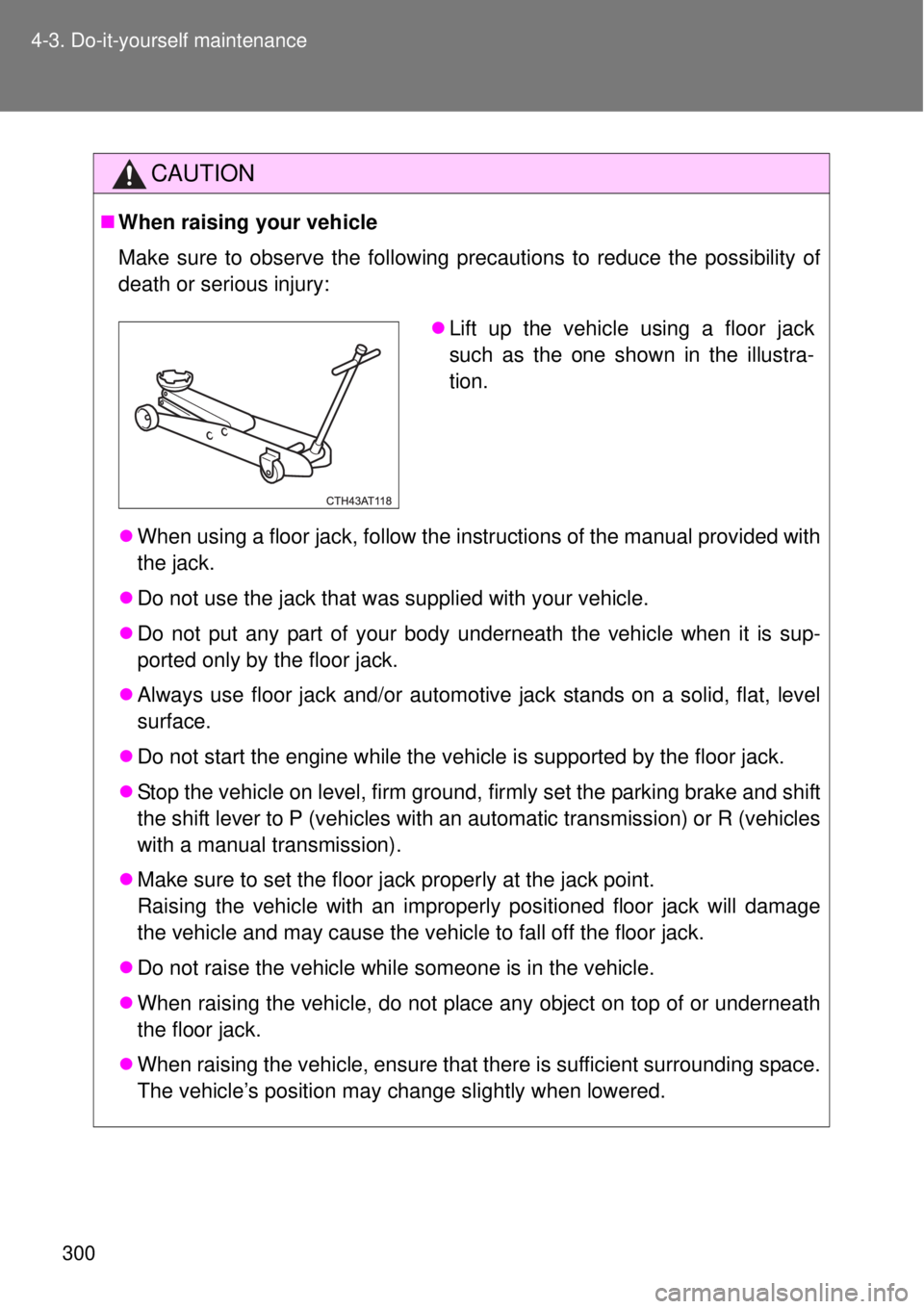
Lift up the vehicle using a floor jack
such as the one shown in the illustra-
tion.
Page 311 of 464

311 4-3. Do-it-yourself maintenance
4
Maintenance and care
CAUTION
Chemicals in the battery
A battery contains poisonous and corrosive sulfuric acid and may produce
hydrogen gas which is flammable and explosive. To reduce the risk of death
or serious injury, take the following precautions while working on or near the
battery:
Do not cause sparks by touching the battery terminals with tools.
Do not smoke or light a match near the battery.
Avoid contact with eyes, skin and clothes.
Never inhale or swallow electrolyte.
Wear protective safety glasses when working near the battery.
Keep children away from the battery.
Where to safely charge the battery
Always charge the battery in an open area. Do not charge the battery in a
garage or closed room where there is not sufficient ventilation.
Emergency measures regarding electrolyte
If electrolyte gets in your eyes
Flush your eyes with clean water for at least 15 minutes and get immedi-
ate medical attention. If possible, continue to apply water with a sponge or
cloth while traveling to the nearest medical facility.
If electrolyte gets on your skin
Wash the affected area thoroughly. If you feel pain or burning, get medical
attention immediately.
If electrolyte gets on your clothes
It can soak through clothing on to your skin. Immediately take off the cloth-
ing and follow the procedure above if necessary.
If you accidentally swallow electrolyte
Drink a large quantity of water or milk. Get emergency medical attention
immediately.
Page 316 of 464
316 4-3. Do-it-yourself maintenance
How to initialize the tire pressure warning system
Park the vehicle in a safe place and turn the “ENGINE START
STOP” switch (vehicles with a smart entry & start system) or
the engine switch (vehicles without a smart entry & start sys-
tem) off.
Initialization cannot be performed while the vehicle is moving.
Adjust the tire inflation pressure to the specified cold tire infla-
tion pressure level. (P. 443)
Make sure to adjust the tire pressure to the specified cold tire infla-
tion pressure level. The tire pressure warning system will operate
based on this pressure level.
Turn the “ENGINE START STOP” switch to IGNITION ON
mode (vehicles with a smart entry & start system) or engine
switch to the “ON” position (vehicles without a smart entry &
start system).
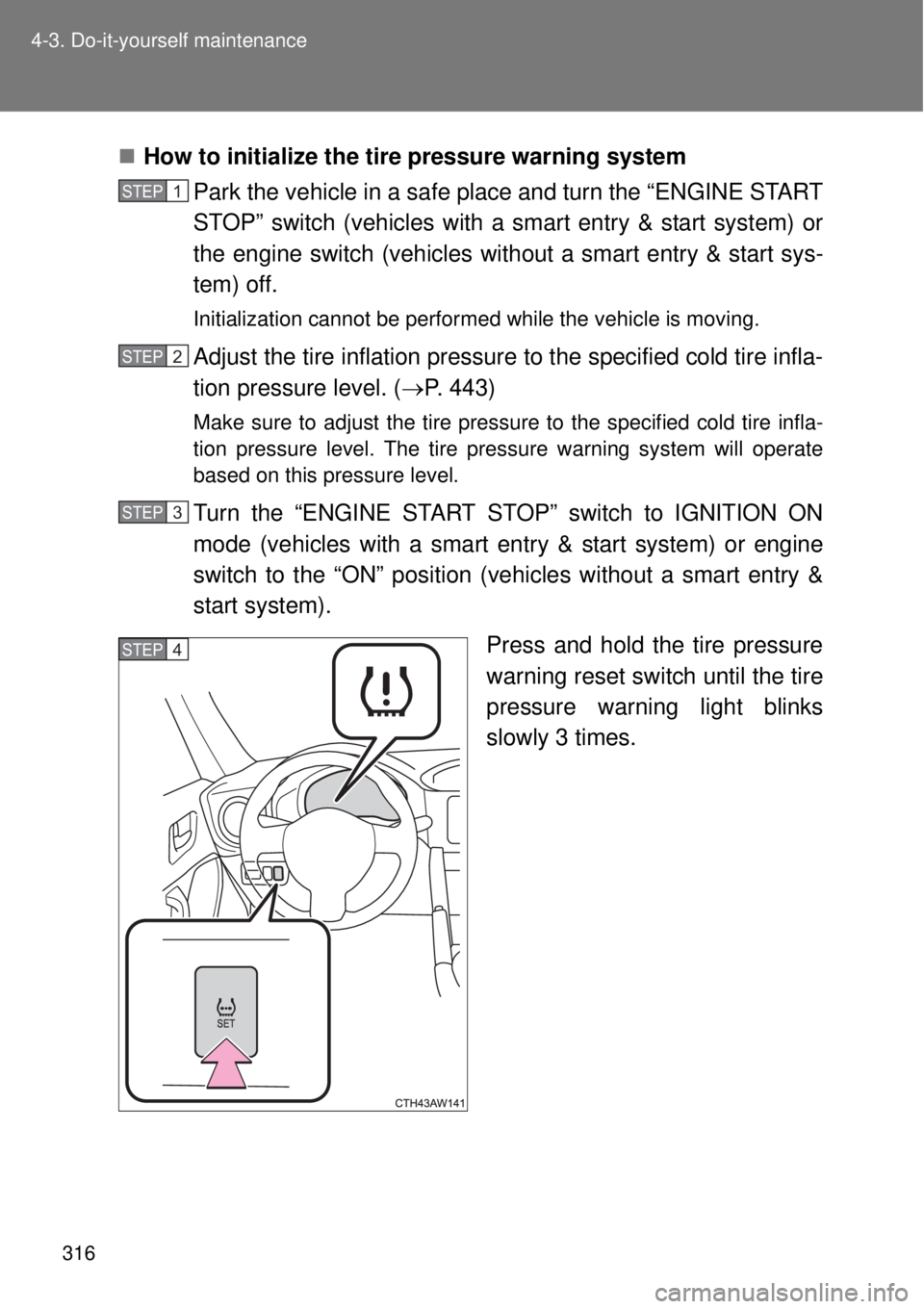
Press and hold the tire pressure
warning reset switch until the tire
pressure warning light blinks
slowly 3 times.
STEP 1
STEP 2
STEP 3
STEP 4
Page 318 of 464

318 4-3. Do-it-yourself maintenance
When to replace your vehicle’s tires
Tires should be replaced if:
You have tire damage such as cuts, splits, cracks deep enough to
expose the fabric or bulges indicating internal damage
A tire goes flat repeatedly or cannot be properly repaired due to the size
or location of a cut or other damage
If you are not sure, consult with any authorized Toyota dealer or repairer, or
another duly qualified and equipped professional.
Replacing tires and wheels
If the ID code of the tire pressure warning valve and transmitter is not regis-
tered, the tire pressure warning system will not work properly. After driving
for about 10 minutes, the tire pressure warning light comes on after blinking
for 1 minute to indicate a system malfunction.
Tire life
Any tires over 6 years old must be checked by a qualified technician even if
they have seldom or never been used or damage is not obvious.
Routine tire inflation pressure checks
The tire pressure warning system does not replace routine tire inflation pres-
sure checks. Make sure to check tire inflation pressure as part of your rou-
tine of daily vehicle checks.
If the tread on snow tires wears down 4 mm (0.16 in.)
The effectiveness of snow tires is lost.
Low profile tires (vehicles with 17-inch tires)
Generally, low profile tires will wear more rapidly and tire grip performance
will be reduced on snowy and/or icy roads when compared to standard tires.
Be sure to use snow tires or tire chains on snowy and/or icy roads and drive
carefully at a speed appropriate for road and weather conditions.
If you press the tire pressure warning reset switch accidentally
If initialization is performed, adjust the tire inflation pressure to the specified
level and initialize the tire pressure warning system again.